


 |
市場調查報告書
商品編碼
2099249
美國車削中心:市場佔有率分析、行業趨勢和統計數據以及成長預測(2026-2031 年)United States Turning Centers - Market Share Analysis, Industry Trends & Statistics, Growth Forecasts (2026 - 2031) |
||||||

※ 本網頁內容可能與最新版本有所差異。詳細情況請與我們聯繫。
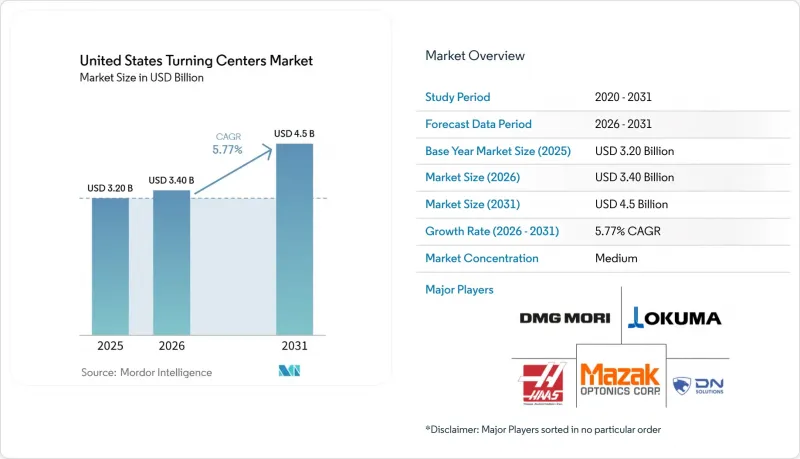
根據 Mordor Intelligence 預測,美國車削中心市場規模將從 2025 年的 32 億美元成長到 2026 年的 34 億美元,到 2031 年將達到 45 億美元,2026 年至 2031 年的複合年成長率為 5.77%。
本報告按產品類型(水平車削中心、立式車削中心等)、軸配置(3軸、4軸、5軸或更多軸)、自動化類型(手動、半自動等)以及最終用戶行業(汽車/商用車、航太/國防等)進行細分。市場預測以價值(美元)和數量(台)兩種形式呈現。
美國車削中心市場的趨勢與洞察
《IRA法案》、《CHIPS法案》和《基礎設施法案》正在推動2兆美元的製造業投資。
美國車削中心市場最強勁的結構性動力來自《工業改革法案》(IRA)、《晶片和科學法案》(CHIPS and Science Act)以及《基礎設施投資和就業法案》(Infrastructure Investment and Employment Act)的協同效應。美國商務部指出,2021年至2024年間,工廠建設數量增加了一倍以上,同期製造業投資也保持強勁勢頭,超出許多預測機構的預期。 CHIPS計畫辦公室已承諾在20個州提供超過190億美元的獎勵,刺激半導體和電子產業超過4,500億美元的私人投資。每新建一座製造工廠,用於生產製程設備、維修工具和進行維修工作的車削中心的需求就會增加。這意味著,與僅由一次性建設支出所預期的相比,美國車削中心市場的需求週期將更長。電池和電動車供應鏈也呈現類似的趨勢,大規模工廠建設正進入設備安裝和生產規模化階段,這需要可重複的數控車削能力。
航太和國防預算的增加正在推動多軸車削中心的需求。
國防費用是美國車削中心市場短期需求最顯著的促進因素之一。美國國防部2026會計年度的預算申請總額為9,616億美元,其中包括約57億美元用於潛艦工業基礎建設,以及6.407億美元用於金屬加工技術開發、認證和生產基礎設施現代化。此外,美國2025會計年度的武器採購申請總額為3,107億美元,將進一步加強飛機、海軍平台和先進武器系統等多個領域的多年生產管道。潛艦艇體環、渦輪盤、起落架零件和推進系統等零件仍依賴經過認證的多軸車削加工,而現有標準不允許對這些要求進行大規模調整。眾議院軍事委員會要求就美國工具機工業基礎及其對海外資源的依賴提交一份報告,這進一步引發了國會的關注。報告強調,採購環境正日益重視國內生產能力和國內組裝。
中檔車削中心市場面臨來自日本和韓國OEM廠商的激烈競爭。
進口競爭仍是美國車削中心市場定價的主要阻礙因素之一。日本和韓國的原始設備製造商(OEM)憑藉著功能豐富的數控車削中心,繼續瞄準20萬至60萬美元的中端價格區間,這使得美國本土製造商難以在價格上與之競爭。根據美國貿易代表辦公室(USTR)的數據,2024年日本與美國的貿易順差為570億美元,而2025年韓國與美國的貿易順差預計為564億美元,機械設備在兩國仍是重要的出口商品。 2026年3月,美國貿易代表辦公室在其關於結構性產能過剩的301條款研究中,特別提到了工具機,指出全球工具機製造業產能運轉率低於76%,低於維持價格平衡的健康水準。在這些研究最終促成具體貿易措施訂定之前,美國買家將繼續面臨價格極具競爭力的進口產品,預計美國國內和歐洲的大規模生產產品供應商將持續面臨壓力。
細分市場分析
2025年,臥式車削中心仍維持主導地位,佔據美國車削中心市場46%的佔有率。這一規模反映了水平車削中心在汽車傳動系統、液壓元件以及石油和天然氣管道等應用領域圓柱形零件批量生產中持續發揮的重要作用。臥式車削系統擁有完善的工具生態系統,也為其市場地位提供了支撐。工廠可以利用棒料送料器、龍門式裝載機和成熟的編程程序,在不顯著影響生產流程的情況下實現自動化規模化。立式車削中心對於大直徑圓盤和環形零件的加工仍然至關重要,尤其是在能源和重工業等對面積效率和零件搬運要求極高的行業。
預計多功能車削中心將成為該產品類別中成長最快的,到2031年,美國車削中心市場規模的複合年成長率將達到6.8%。航太、醫療和半導體設備產業的製造商正在轉向使用這些平台,因為它們可以縮短複雜零件的裝夾時間並減少在進程內庫存。美國國防部對金屬加工現代化的重視也推動了這一轉變,因為供應商面臨著在不大幅增加占地面積的情況下提高單次裝夾生產率的壓力。瑞士型和倒置式立式車削中心預計仍將在更專業的應用領域繼續使用,但它們在微型零件和精密加工應用中仍然發揮著重要作用,因為這些應用對公差的要求過於嚴格,無法進行廣泛的標準化。
到2025年,四軸配置將占美國車削中心市場的48.5%,成為最大的軸數類別。這些系統滿足了眾多汽車、工業機械和能源產業應用的需求,這些應用需要驅動刀具功能,但又不需要複雜的五軸程式設計。三軸系統在大批量通用車削配件、緊固件及類似零件方面仍然佔據重要地位,因為增加軸數並不能帶來足夠的投資回報。因此,四軸平台已成為實用且易於被廣泛接受的中間選擇。
預計到2031年,五軸及以上系統的複合年成長率將達到7.9%,成為美國車削中心市場中成長最快的軸數細分市場。推動這一成長的因素包括航太結構、渦輪機部件、整形外科植入以及其他需要在單一夾具內進行多軸同步插補的幾何形狀。 2026會計年度國防預算累計203億美元的科技預算,用於支援先進製造原型和混合切削能力,從而提高整個供應商的認證標準。美國國家標準與技術研究院(NIST)和「美國製造」(Manufacturing USA)計畫也透過技術轉移和編程支持,持續降低中型工廠採用五軸車削中心系統的門檻,從而擴大五軸車削中心系統的潛在基本客群。
其他好處:
- Excel格式的市場預測(ME)表
- 3個月的分析師支持
目錄
第1章:引言
- 研究假設和市場定義
- 調查範圍
第2章:調查方法
第3章執行摘要
第4章 市場狀況
- 市場概覽
- 市場促進因素
- 《IRA法案》、《CHIPS法案》和《基礎設施法案》正在推動2兆美元的製造業投資。
- 航太和國防預算的增加正在推動多軸車削中心的需求。
- 汽車產業回歸日本以及對電動車超級工廠的投資,正在推動對車削中心電池的需求不斷成長。
- 「購買美國貨」政策和使用國產零件的要求正在影響國防採購。
- 墨西哥的近岸外包正在促進跨境轉運中心的投資。
- 第 232 條款關稅正在推高國內及相關 OEM工具機的價格。
- 市場限制因素
- 中階車削中心市場面臨來自日本和韓國OEM廠商的激烈競爭。
- 利率上升對投資回收期及資本投資決策的影響。
- 熟練的數控操作員和程式設計人員短缺,影響了車削中心的普及。
- 日本和歐洲OEM製造商生產的高規格車削中心交貨週期很長。
- 價值供應鏈分析
- 原料和關鍵部件的生態系統
- 製造和組裝價值鏈
- 分銷和市場進入通路
- 售後服務和生命週期支持
- 監理情勢
- 技術趨勢和當前創新投資狀況
- 人工智慧驅動的自適應控制和顫振抑制
- 高速主軸和HSK-T介面的發展
- 價格分析
- 主要市場參與企業的平均售價 (ASP) 基準
- 按產品類型分類的平均售價 (ASP) 分析
- 以軸配置分析平均售價 (ASP)
- 自動化系統對平均銷售價格 (ASP) 進行分析
- 採購標準與採購分析
- 五力分析-產業吸引力評估
- 新進入者的威脅
- 供應商的議價能力
- 買方的議價能力
- 替代品的威脅
- 產業競爭
- 地緣政治事件對市場的影響
第5章 市場規模與成長預測
- 依產品類型
- 水平車削中心
- 直立式車削中心
- 多功能車削中心
- 其他
- 按軸配置
- 3軸
- 四軸
- 5個或更多軸
- 按自動化類型
- 手動的
- 半自動
- 全自動CNC工具機
- 按最終用戶行業分類
- 汽車和商用車輛
- 航太/國防
- 醫療設備及手術器械
- 石油、天然氣和能源
- 電氣、電子和半導體製造設備
- 通用工業機械
- 其他
第6章 競爭情勢
- 市場集中度
- 策略趨勢
- 市佔率分析
- Competitive Benchmarking Analysis
- 公司簡介
- Haas Automation
- Mazak Corporation
- DMG MORI
- Okuma Corporation
- DN Solutions
- Hyundai WIA
- Hwacheon Machinery
- Nakamura-Tome Precision Industry Co., Ltd
- INDEX-Werke GmbH
- Hardinge Inc.
- EMAG GmbH
- Murata Machinery
- Star CNC Machine Tool Corp.
- Kent CNC
- Takamaz Corporation
- Tornos Holding AG
- Victor Taichung Machinery Works Co., Ltd.
- Hurco Companies, Inc.
- Tsugami Corporation
- Citizen Machinery Co., Ltd.
第7章 市場機會與未來展望
According to Mordor Intelligence, the United States turning centers market size is expected to grow from USD 3.20 billion in 2025 to USD 3.40 billion in 2026 and is forecast to reach USD 4.5 billion by 2031 at 5.77% CAGR over 2026-2031.
This report is Segmented by Product Type (Horizontal Turning Centers, Vertical Turning Centers, and More), by Axis Configuration (3-Axis, 4-Axis, 5-Axis and Above), by Automation Type (Manual, Semi-Automatic, and More), and by End-User Industry (Automotive and Commercial Vehicles, Aerospace & Defense, and More). The Market Forecasts are Provided in Terms of Value (USD) and Volume (Units).
United States Turning Centers Market Trends and Insights
IRA, CHIPS Act, and Infrastructure Act Driving USD 2 Trillion in Manufacturing Investments
The strongest structural support for the United States turning centers market comes from the combined effect of the IRA, the CHIPS and Science Act, and the Infrastructure Investment and Jobs Act. The Department of Commerce stated that factory construction more than doubled between 2021 and 2024, and manufacturing investment remained stronger than many forecasters expected over the same period. The CHIPS Program Office has already committed more than USD 19 billion in proposed incentives across 20 states, helping catalyze more than USD 450 billion in private investment in semiconductor and electronics. Each new fabrication facility increases demand for turning centers used in process equipment manufacturing, service tooling, and maintenance machining, which gives the United States turning centers market a longer demand cycle than one-time construction spending alone would suggest. The same pattern is visible in battery and EV supply chains, where large-scale plant buildouts are moving into equipment installation and production ramp-up phases that need repeatable CNC turning capacity.
Aerospace and Defense Budget Expansion Boosting Multi-Axis Turning Center Demand
Defense spending is one of the clearest near-term demand supports for the United States turning centers market. The FY2026 Department of Defense budget request totals USD 961.6 billion. It includes nearly USD 5.7 billion for the submarine industrial base, as well as USD 640.7 million for metalworking development, certification, and modernization of production infrastructure. The FY2025 weapons procurement request of USD 310.7 billion also reinforces a multi-year production pipeline across aircraft, naval platforms, and advanced weapons systems. Components such as submarine hull rings, turbine discs, landing gear parts, and propulsion hardware still rely on qualified multi-axis turning operations, and current standards do not allow those requirements to shift away at scale. Congressional attention is also increasing, as the House Armed Services Committee called for a report on the United States machine tool industrial base and foreign dependencies, pointing to a procurement environment that increasingly favors domestic capacity and domestic assembly.
Intense Import Competition from Japanese and Korean OEMs in Mid-Market Turning Centers
Import competition remains one of the main limits on pricing strength in the United States turning centers market. Japanese and Korean OEMs continue to target the USD 200,000 to USD 600,000 mid-market range with feature-rich CNC turning centers that are difficult for domestic manufacturers to match on price. USTR data showed that Japan held a USD 57 billion goods trade surplus with the United States in 2024, while Korea's goods trade surplus with the United States stood at USD 56.4 billion in 2025, and machinery remained an important export category in both cases. In March 2026, USTR specifically named machine tools in its Section 301 investigations related to structural excess capacity, noting that global manufacturing capacity utilization remained below 76%, which is still below the level considered healthy for balanced pricing. Until those investigations produce concrete trade actions, United States buyers are likely to continue seeing competitively priced imports that keep pressure on domestic and European suppliers in higher-volume categories.
Other drivers and restraints analyzed in the detailed report include:
- Automotive Reshoring and EV Gigafactory Investments Increasing Need for Turning Center Cells
- Buy American and Domestic Content Mandates Shaping Defense Procurement
- Impact of Elevated Interest Rates on Payback Periods and CapEx Decisions
For complete list of drivers and restraints, kindly check the Table Of Contents.
Segment Analysis
Horizontal turning centers held 46% of the United States' turning centers market share in 2025, maintaining their leading product position. Their scale reflects their continued role in high-volume cylindrical part production across automotive drivetrains, hydraulic components, and oil-and-gas tubular applications. The broad tooling ecosystem for horizontal systems also supports their position, as shops can scale automation with bar feeders, gantry loaders, and established programming routines without major process disruption. Vertical turning centers remained important for large-diameter disc and ring parts, especially in energy and heavy industrial settings where footprint efficiency and part handling matter.
Multi-tasking turning centers are expected to record the fastest growth at a 6.8% CAGR through 2031 in the United States turning centers market size for this product class. Aerospace, medical, and semiconductor equipment producers are moving toward these platforms because they reduce setups and lower in-process inventory for more complex components. The Department of Defense's focus on metalworking modernization is reinforcing this shift because suppliers are under pressure to increase output per setup without expanding floor space at the same pace. Swiss-type and inverted vertical formats will remain more specialized, but they still serve micro-component and precision applications where tolerance demands are too specific for broader standardization.
4-axis configurations accounted for 48.5% of the United States turning centers market in 2025, which made them the largest axis category. These systems meet the needs of many automotive, industrial machinery, and energy applications that require driven-tool capability but do not yet justify full 5-axis programming complexity. The 3-axis segment still has a place in high-volume commodity turning for fittings, fasteners, and similar parts where added-axis capability does not yield an adequate return. This leaves 4-axis platforms as the practical middle ground for a wide installed base.
5-axis and above systems are forecast to expand at a 7.9% CAGR through 2031, which makes them the fastest-growing axis segment in the United States turning centers market. Demand is driven by aerospace structures, turbine parts, orthopedic implants, and other geometries that require simultaneous multi-axis interpolation within a single clamping. The FY2026 defense budget includes a USD 20.3 billion science and technology allocation that supports advanced manufacturing prototypes and hybrid subtractive capability, which raises qualification standards across parts of the supplier base. NIST and Manufacturing USA programs also continue to lower adoption barriers for mid-sized shops through technology transfer and programming support, helping expand the addressable base for 5-axis turning systems.
Complete Report Scope:
- By Product Type
- Horizontal Turning Centers
- Vertical Turning Centers
- Multi-Tasking Turning Centers
- Others
- By Axis Configuration
- 3-Axis
- 4-Axis
- 5-Axis and Above
- By Automation Type
- Manual
- Semi-Automatic
- Fully Automatic CNC
- By End-User Industry
- Automotive and Commercial Vehicles
- Aerospace & Defense
- Medical Devices and Surgical Instruments
- Oil, Gas, and Energy
- Electrical, Electronics and Semiconductor Equipment
- General Industrial Machinery
- Others
List of Companies Covered in this Report:
- Haas Automation
- Mazak Corporation
- DMG MORI
- Okuma Corporation
- DN Solutions
- Hyundai WIA
- Hwacheon Machinery
- Nakamura-Tome Precision Industry Co., Ltd
- INDEX-Werke GmbH
- Hardinge Inc.
- EMAG GmbH
- Murata Machinery
- Star CNC Machine Tool Corp.
- Kent CNC
- Takamaz Corporation
- Tornos Holding AG
- Victor Taichung Machinery Works Co., Ltd.
- Hurco Companies, Inc.
- Tsugami Corporation
- Citizen Machinery Co., Ltd.
Additional Benefits:
- The market estimate (ME) sheet in Excel format
- 3 months of analyst support
TABLE OF CONTENTS
1 Introduction
- 1.1 Study Assumptions & Market Definition
- 1.2 Scope of the Study
2 Research Methodology
3 Executive Summary
4 Market Landscape
- 4.1 Market Overview
- 4.2 Market Drivers
- 4.2.1 IRA, CHIPS Act, and Infrastructure Act Driving USD 2 Trillion in Manufacturing Investments
- 4.2.2 Aerospace and Defense Budget Expansion Boosting Multi-Axis Turning Center Demand
- 4.2.3 Automotive Reshoring and EV Gigafactory Investments Increasing Need for Turning Center Cells
- 4.2.4 Buy American and Domestic Content Mandates Shaping Defense Procurement
- 4.2.5 Nearshoring from Mexico Fueling Cross-Border Turning Center Investments
- 4.2.6 Section 232 Tariffs Elevating Prices for Domestic and Allied OEM Machine Tools
- 4.3 Market Restraints
- 4.3.1 Intense Import Competition from Japanese and Korean OEMs in Mid-Market Turning Centers
- 4.3.2 Impact of Elevated Interest Rates on Payback Periods and CapEx Decisions
- 4.3.3 Skilled CNC Operator and Programmer Shortage Affecting Turning Center Deployment
- 4.3.4 Long Lead Times for High-Specification Turning Centers from Japanese and European OEMs
- 4.4 Value / Supply-Chain Analysis
- 4.4.1 Raw Material & Critical Component Ecosystem
- 4.4.2 Manufacturing & Assembly Value Chain
- 4.4.3 Distribution & Go-to-Market Channels
- 4.4.4 Aftermarket Services & Lifecycle Support
- 4.5 Regulatory Landscape
- 4.6 Technological Outlook & Innovation Investment Landscape
- 4.6.1 AI-Driven Adaptive Control and Chatter Suppression
- 4.6.2 High-Speed Spindle and HSK-T Interface Evolution
- 4.7 Pricing Analysis
- 4.7.1 Average Selling Price (ASP) Benchmarking of Key Market Participants
- 4.7.2 Average Selling Price (ASP) Analysis, by Product Type
- 4.7.3 Average Selling Price (ASP) Analysis, by Axis Configuration
- 4.7.4 Average Selling Price (ASP) Analysis, by Automation
- 4.8 Buying Criteria & Procurement Analysis
- 4.9 Porter's Five Forces Analysis - Industry Attractiveness Scoring
- 4.9.1 Threat of New Entrants
- 4.9.2 Bargaining Power of Suppliers
- 4.9.3 Bargaining Power of Buyers
- 4.9.4 Threat of Substitutes
- 4.9.5 Industry Rivalry
- 4.10 Impact of Geopolitical Events on the Market
5 Market Size & Growth Forecasts
- 5.1 By Product Type
- 5.1.1 Horizontal Turning Centers
- 5.1.2 Vertical Turning Centers
- 5.1.3 Multi-Tasking Turning Centers
- 5.1.4 Others
- 5.2 By Axis Configuration
- 5.2.1 3-Axis
- 5.2.2 4-Axis
- 5.2.3 5-Axis and Above
- 5.3 By Automation Type
- 5.3.1 Manual
- 5.3.2 Semi-Automatic
- 5.3.3 Fully Automatic CNC
- 5.4 By End-User Industry
- 5.4.1 Automotive and Commercial Vehicles
- 5.4.2 Aerospace & Defense
- 5.4.3 Medical Devices and Surgical Instruments
- 5.4.4 Oil, Gas, and Energy
- 5.4.5 Electrical, Electronics and Semiconductor Equipment
- 5.4.6 General Industrial Machinery
- 5.4.7 Others
6 Competitive Landscape
- 6.1 Market Concentration
- 6.2 Strategic Moves
- 6.3 Market Share Analysis
- 6.4 Competitive Benchmarking Analysis
- 6.5 Company Profiles (Includes Global Level Overview, Market Level Overview, Core Segments, Financials as Available, Strategic Information, Products & Services, and Recent Developments)
- 6.5.1 Haas Automation
- 6.5.2 Mazak Corporation
- 6.5.3 DMG MORI
- 6.5.4 Okuma Corporation
- 6.5.5 DN Solutions
- 6.5.6 Hyundai WIA
- 6.5.7 Hwacheon Machinery
- 6.5.8 Nakamura-Tome Precision Industry Co., Ltd
- 6.5.9 INDEX-Werke GmbH
- 6.5.10 Hardinge Inc.
- 6.5.11 EMAG GmbH
- 6.5.12 Murata Machinery
- 6.5.13 Star CNC Machine Tool Corp.
- 6.5.14 Kent CNC
- 6.5.15 Takamaz Corporation
- 6.5.16 Tornos Holding AG
- 6.5.17 Victor Taichung Machinery Works Co., Ltd.
- 6.5.18 Hurco Companies, Inc.
- 6.5.19 Tsugami Corporation
- 6.5.20 Citizen Machinery Co., Ltd.
7 Market Opportunities & Future Outlook
- 7.1 White-Space & Unmet-Need Assessment

 2026年全球岩心塞市場報告
 自行車零件售後市場規模、佔有率和成長分析:按產品類型、自行車類型、材料、銷售管道、最終用戶和地區分類 - 產業預測,2026-2033 年2026年全球燃油管路斷開工具市場報告
 全球鋁板市場:依產品形式、等級、最終用途產業和地區分類-預測至2035年
 印度轉盤中心:市場佔有率分析、產業趨勢與統計及成長預測(2026-2031)德國車削中心:市場佔有率分析、產業趨勢與統計及成長預測(2026-2031 年)
 汽車原料市場:2026-2032年全球市場預測(依產品類型、材料形態、驅動系統、製造流程、車輛類型、應用、銷售管道及通路分類)中國車床中心:市場佔有率分析、產業趨勢與統計及成長預測(2026-2031年)轉向中心:市場佔有率分析、行業趨勢和統計數據、成長預測(2026-2031)
 汽車前風窗流水槽蓋板市場分析及預測(至2035年):類型、產品、技術、組件、應用、材質、最終用戶、功能、安裝類型