

 |
市場調查報告書
商品編碼
2099338
德國車削中心:市場佔有率分析、產業趨勢與統計及成長預測(2026-2031 年)Germany Turning Centers - Market Share Analysis, Industry Trends & Statistics, Growth Forecasts (2026 - 2031) |
||||||

※ 本網頁內容可能與最新版本有所差異。詳細情況請與我們聯繫。
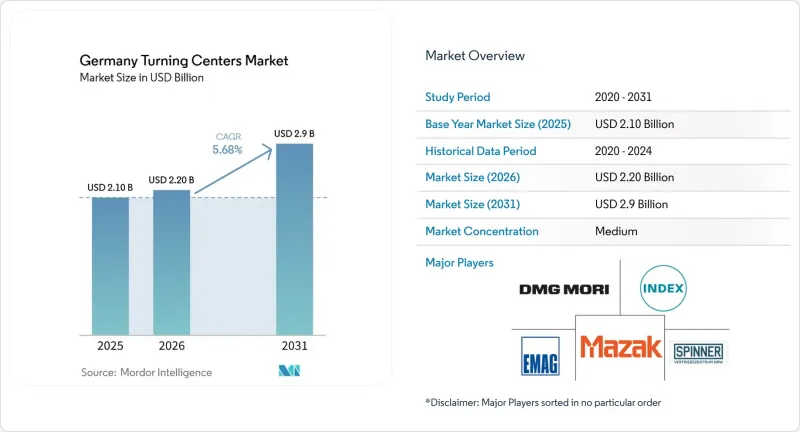
根據 Mordor Intelligence 預測,德國車削中心市場規模將從 2025 年的 21 億美元成長到 2026 年的 22 億美元,然後在 2031 年達到 29 億美元,2026 年至 2031 年的複合年成長率為 5.68%。
本報告按產品類型(水平車削中心、立式車削中心等)、軸配置(3軸、4軸、5軸或更多軸)、自動化類型(手動、半自動、全自動數控)以及最終用戶行業(汽車/商用車、航太/國防等)進行細分。市場預測以貨幣價值(美元)和銷售(台)兩種形式呈現。
德國車削中心市場的趨勢與洞察
向電動車的轉型正在加速動力總成轉向中心設備的現代化。
與許多內燃機零件相比,電動驅動系統零件對孔徑、圓柱度和表面公差的要求更高,這正在改變德國車削中心市場的採購重點。這種轉變使得四軸和五軸車銑平台更受青睞,因為單次裝夾加工對於德國車削中心市場中電動驅動殼體及相關精密零件的加工變得越來越重要。 BMW集團計劃在2027年底前將其慕尼黑工廠改造為生產純電動「新級別」車型,這表明此次設備升級週期已影響工廠層面的投資決策。該公司在其蘭茨胡特工廠額外投資2億歐元(約2.353億美元)用於生產電動驅動單元的中央殼體,也顯示這種需求與實際加工能力直接相關,而非長期計畫。 VDW的客戶組成數據也支持這一轉變,汽車業在德國工具機生產中的佔有率已降至27.2%。相較之下,工程業的佔有率已上升至30.1%,顯示德國車削中心市場正在湧現新的精密加工應用,取代了傳統的動力傳動系統相關需求。因此,德國車削中心市場的需求並非簡單地在汽車應用領域下降,而是重新分配給了對主軸性能和製程控制要求更高的複雜加工操作。
增加國防費用,以符合北約佔GDP 2%的目標。
由於許多軍事系統需要使用由硬化合金、鈦和特殊鋼製成的精密加工零件,國防採購正逐漸成為永續的需求來源。預計德國2025年的軍事開支將達到1,140億美元,比上年成長24%,相當於GDP的2.3%,這將為德國的汽車及周邊市場提供更強勁的需求基礎。 2026年的國防預算(包括常規預算和特別撥款基金)達到1,082億歐元(約1,273億美元)。鑑於2025年6月北約高峰會承諾到2035年將國防和安全總支出提高到GDP的5.0%,採購活動的活性化很可能將持續到下一個預算週期。預計德國2025年的公共設備投資將成長47.7%,這印證了與公共部門需求相關的有形資本形成正在整個體系內擴散的觀點。這為德國車削中心市場創造了第二個成長支柱,這個支柱對乘用車資本投資的依賴程度較低,與長週期工業和安全需求的關係更為密切。
國內對車削中心的需求下降
儘管2026年第一季工具機總訂單開始出現復甦跡象,但繼2025年大幅萎縮後,國內需求仍低於歷史水準。 2025年全年德國工具機新訂單下降16%,2025年第一季較上年同期高峰下降30%。雖然出口需求有所改善,但國內投資依然謹慎,尤其是在汽車製造商領域。 2025年德國工具機產業的平均產能運轉率為76%,較前一年下降6.1個百分點,遠低於長期平均。德國工具機製造商協會(VDW)也指出,12家主要的德國工具機製造商在海外設有生產基地,其中32%的產量來自中國,20%來自美國。這表明,在國內需求疲軟的情況下,投資正在轉移到海外。德國車削中心市場預計將在 2025 年觸底反彈,並在 2026 年復甦,但要完全恢復到 2021 年和 2022 年的訂單環境,中期內可能還需要一些時間。
細分市場分析
到2025年,臥式車削中心將佔該細分市場銷售額的47.8%,成為德國車削中心市場最大的產品類型。這一主導地位反映了臥式車削中心在軸類車削、一般工業生產以及德國工廠成熟的自動化佈局中的廣泛應用。現有的工件夾持系統、操作人員的熟練程度以及生產線層面的連續性支撐了此類設備的更換需求,而臥式系統即使在終端用戶將其操作遷移到更複雜的平台時,也能幫助維持規模。在許多德國工廠中,已安裝設備的重要性仍然很高,因為它們需要在滿足新的功能需求的同時,兼顧已驗證的製程穩定性。
預計2026年至2031年間,多功能車削中心將以6.5%的複合年成長率成長,成為德國車削中心市場成長最快的產品類型。這一成長反映了航太、醫療和汽車精密零件產業對單次裝夾完成全部加工的需求。立式車削中心在能源、重型機械和國防工業的大直徑零件加工中繼續發揮著至關重要的作用。同時,瑞士型車床和多聯滑台車床在植入、電子產品及相關應用的小型精密零件加工中也持續扮演重要角色。 INDEX-Werke的G160五軸車銑複合機床,配備32,000轉/分的主軸和60或90個刀位,專為小型、高度複雜的零件而設計。 DMG Moly 的「CTX 450 4A」具備雙主軸功能,兩個刀架上最多可容納 36 個刀位,可進行完整的六面加工,這標誌著產品開發正朝著緊湊型、製程整合平台的方向發展。這種趨勢支持著一種漸進式的過渡模式:老式臥式設備持續保持其生產效率。同時,新型多功能系統正在承擔新的加工項目,使德國車削中心市場能夠同時支援成熟的產品類別和快速成長的車銑複合平台。
預計到2025年,四軸車削中心將佔德國車削中心總銷售量的49.2%,成為德國車削中心市場中最大的軸配置類別。汽車零件供應商、通用工業機械製造商以及需要徑向銑床但不需要完全同步五軸操作的用戶,對四軸車削中心的需求仍然強勁。許多德國工廠已經運作四軸工作流程,因此,當運作比大規模流程重新設計更為重要時,用同等型號的四軸車削中心進行替換是一個極具吸引力的選擇。成本合理性也是推動四軸車削中心發展的關鍵因素,因為它在提供廣泛功能的同時,價格不會像更高級的系統那樣大幅上漲。因此,憑藉效用、大規模部署的成功經驗以及從三軸系統輕鬆遷移的優勢,四軸平台仍然是高產量需求的核心。
預計2026年至2031年間,五軸及以上配置的加工中心將以7.8%的複合年成長率成長,成為德國車削中心市場中軸數配置成長最快的類型。這一成長主要得益於航太、國防和醫療產業日益成長的需求,這些產業需要更短的設定週期和更高的幾何精度。由於需要先進的應用工程技術,德國原始設備製造商(OEM)在同步車銑軟體和B軸整合方面的優勢仍然難以被競爭對手複製。同時,三軸加工中心仍用於大量生產相對簡單的圓形零件,因為增加軸數並不能帶來足夠的投資回報。 WFL的「M70 MILLTURN」加工中心,其工件加工能力可達長度8000毫米、迴轉直徑850毫米,充分展現了多軸平台如何勝任特殊、高價值的大型零件的加工。政策方向也支持這一趨勢。經合組織發布的《德國2025年調查》預測,製造業競爭力將被列為國家優先事項,能夠增加單次裝夾製作流程數量並提高長期生產率的工具機預計將得到支持。儘管四軸設備仍將是最大的收入來源,但市場構成比預計將向更高性能的系統轉變。
其他好處:
- Excel格式的市場預測(ME)表
- 3個月的分析師支持
目錄
第1章:引言
- 研究假設和市場定義
- 調查範圍
第2章:調查方法
第3章執行摘要
第4章 市場狀況
- 市場概覽
- 市場促進因素
- 向電動車的轉型正在推動動力總成製造地設備的現代化。
- 北約就國防開支目標設定為2%達成協議後,國防費用有所增加。
- 美國出口的成長正在提振對德國車削中心OEM製造商的需求。
- 對工業4.0的投資正在推動高階車削中心的升級。
- 航太業的復甦和空中巴士公司產量的增加支撐了對五軸車削中心和銑床的需求。
- 強大的國內OEM生態系統使我們能夠以較短的交貨週期採購機械設備。
- 市場限制因素
- 國內對車削中心的需求正在下降。
- 高昂的製造成本:能源成本、人事費用和監管合規成本。
- 在中端市場和新興出口管道,與中國企業的競爭日益激烈。
- 技術純熟勞工短缺正在影響設備運轉率。
- 價值供應鏈分析
- 原料和關鍵部件的生態系統
- 製造和組裝價值鏈
- 分銷和市場進入通路
- 售後服務和生命週期支持
- 監理情勢
- 技術趨勢和當前創新投資狀況
- 人工智慧驅動的自適應控制和顫振抑制
- 高速主軸和HSK-T介面的發展
- 價格分析
- 主要市場參與企業平均售價(ASP)基準
- 按產品類型分類的平均售價 (ASP) 分析
- 以軸配置分析平均售價 (ASP)
- 自動化系統對平均銷售價格 (ASP) 進行分析
- 採購標準與採購分析
- 五力分析-產業吸引力評估
- 新進入者的威脅
- 供應商的議價能力
- 買方的議價能力
- 替代品的威脅
- 產業競爭
- 地緣政治事件對市場的影響
第5章 市場規模與成長預測
- 依產品類型
- 水平車削中心
- 直立式車削中心
- 多功能旋轉中心
- 其他
- 按軸配置
- 3軸
- 四軸
- 5個或更多軸
- 按自動化類型
- 手動的
- 半自動
- 全自動CNC工具機
- 按最終用戶行業分類
- 汽車和商用車輛
- 航太/國防
- 醫療設備及手術器械
- 石油、天然氣和能源
- 電氣、電子和半導體製造設備
- 通用工業機械
- 其他
第6章 競爭情勢
- 市場集中度
- 策略趨勢
- 市佔率分析
- Competitive Benchmarking Analysis
- 公司簡介
- DMG Mori
- INDEX-Werke GmbH
- EMAG GmbH & Co. KG
- Spinner AG
- Yamazaki Mazak
- Okuma Corporation
- DN Solutions
- Hyundai WIA
- Nakamura-Tome Precision Industry Co., Ltd
- Hwacheon Machinery
- Haas Automation
- Biglia SpA
- Murata Machinery
- CMZ Machine Tool
- Nidec Machine Tool
- WFL Millturn Technologies
- Tsugami Corporation
- SMEC Co., Ltd.
- Citizen Machinery Co., Ltd.
- Star Micronics Co., Ltd.
第7章 市場機會與未來展望
According to Mordor Intelligence, the Germany turning centers market size is expected to grow from USD 2.10 billion in 2025 to USD 2.20 billion in 2026 and is forecast to reach USD 2.9 billion by 2031 at 5.68% CAGR over 2026-2031.
This report is Segmented by Product Type (Horizontal Turning Centers, Vertical Turning Centers, and More), by Axis Configuration (3-Axis, 4-Axis, 5-Axis & Above), by Automation Type (Manual, Semi-Automatic, Fully Automatic CNC), and by End-User Industry (Automotive and Commercial Vehicles, Aerospace & Defense, and More). The Market Forecasts are Provided in Terms of Value (USD) and Volume (Units).
Germany Turning Centers Market Trends and Insights
EV Transition Driving Drivetrain Turning Center Retooling
Electric drivetrain parts require tighter bore, cylindricity, and surface tolerances than many internal combustion components, which is changing procurement priorities in the Germany turning centers market. This shift favors 4-axis and 5-axis turn-mill platforms because single-setup machining is becoming increasingly important for electric-drive housings and related precision parts in the Germany turning centers market. BMW Group's move to convert its Munich plant to all-electric Neue Klasse production by the end of 2027 shows that this retooling cycle is already shaping plant-level investment decisions. The company's additional EUR 200 million (USD 235.3 million) investment at Plant Landshut for electric-drive-unit central housings also shows that this demand is tied to real machining capacity rather than long-term planning. VDW's customer structure data supports this transition because the automotive industry's share of German machine tool output fell to 27.2%. In comparison, engineering rose to 30.1%, suggesting that newer precision applications in the Germany turning centers market are supplanting older powertrain demand. The result is not a simple loss of automotive demand, but a reallocation toward more complex machining work that needs better axis capability and stronger process control in the Germany turning centers market.
Increased Defense Spending Following NATO's 2% GDP Commitment
Defense procurement is becoming a durable source of demand because many military systems require precision turned parts made from hardened alloys, titanium, and specialty steels. Germany's military spending reached USD 114 billion in 2025, which was 24% higher than the prior year and equal to 2.3% of GDP, giving Germany's turning centers market a stronger non-automotive demand base. The 2026 defense budget reached EUR 108.2 billion (USD 127.3 billion) when the regular budget and the Sondervermogen special fund are combined. NATO's June 2025 summit commitment to raise total defense and security spending to 5.0% of GDP by 2035 shows that elevated procurement activity is likely to persist beyond a single budget cycle. Germany's state equipment investments rose 47.7% in 2025, reinforcing the view that physical capital formation tied to public-sector demand is already moving through the system. This gives the Germany turning centers market a second growth pillar, less tied to passenger vehicle capital expenditure and more tied to long-cycle industrial and security requirements.
Decline in Domestic Turning Center Demand
Although overall machine tool orders began recovering in Q1 2026, domestic demand remains below historical levels following the sharp contraction in 2025. German machine tool domestic new orders fell 16% in full-year 2025, while Q1 2025 recorded a 30% decline from a high prior-year base. Although export demand has improved, domestic investment remains cautious, particularly among automotive manufacturers. Capacity utilization in the German machine tool industry averaged 76% in 2025, which was 6.1 percentage points below the prior year and well below the long-run norm. VDW also noted that 12 of the largest German machine tool OEMs have foreign production sites, with 32% of output in China and 20% in the United States, indicating that investment has shifted outward when local demand is weak. The Germany turning centers market should improve from the 2025 trough in 2026, but a full return to the order environment seen in 2021 and 2022 still appears to be a medium-term event.
Other drivers and restraints analyzed in the detailed report include:
- United States Export Growth Boosting Demand for German Turning Center OEMs
- Industry 4.0 Investments Supporting Premium Turning Center Upgrades
- High Manufacturing Costs, Energy, Labor, and Regulatory Compliance
For complete list of drivers and restraints, kindly check the Table Of Contents.
Segment Analysis
Horizontal turning centers accounted for 47.8% of segment revenue in 2025, making them the largest product category in the Germany turning centers market. Their leadership reflects broad use in shaft turning, general industrial production, and established automation layouts across German plants. Existing workholding systems, operator familiarity, and line-level continuity support same-class replacement purchases, helping horizontal systems retain scale as end users shift more work to higher-complexity platforms. The installed base remains important, as many German shops balance new capability needs with proven process stability.
Multi-tasking turning centers are projected to grow at a CAGR of 6.5% from 2026 to 2031, making them the fastest-growing product type in the Germany turning centers market. This growth reflects demand for single-setup, complete machining in aerospace, medical, and precision automotive applications. Vertical turning centers remain important for large-diameter parts in the energy, heavy machinery, and defense industries. At the same time, Swiss-type and gang-slide machines continue to serve small precision parts for implants, electronics, and related applications. INDEX-Werke's G160 5-axis turn-mill, designed for small, high-complexity parts with a 32,000 rpm spindle and 60 or 90 tool positions, and DMG Mori's CTX 450 4A, with dual-spindle capability and up to 36 tool positions across two carriers for six-sided complete machining, show product development shifting toward compact, process-combining platforms. This supports a gradual migration pattern in which older horizontal assets remain productive. At the same time, new multitasking systems take on incremental jobs, allowing the Germany turning centers market to support both mature product classes and faster-growing turn-mill platforms simultaneously.
4-axis turning centers accounted for 49.2% of revenue in 2025, making them the largest axis class in the Germany turning centers market. Their adoption remains strong among automotive suppliers, general industrial machinery manufacturers, and part families that require radial milling but not full simultaneous 5-axis motion. Many German shops already operate around 4-axis workflows, making like-for-like replacement attractive when uptime matters more than major process redesign. Cost discipline also supports this configuration, as it offers broader capabilities without the full price increase of more advanced systems. This keeps 4-axis platforms at the center of volume demand, supported by their relevance across a wide range of industrial applications, a large installed base, and manageable customer migration from 3-axis systems.
5-axis and above configurations are forecast to grow at a 7.8% CAGR from 2026 to 2031, the fastest rate among axis configurations in the Germany turning centers market. Rising demand from aerospace, defense, and medical applications is driving this growth, as these applications require fewer setups and tighter geometric accuracy. German OEM strengths in synchronized turn-mill software and B-axis integration remain difficult to replicate because they require deep application engineering. At the same time, 3-axis machines continue to serve batch production of simpler round parts where additional axes do not generate sufficient returns. WFL's M70 MILLTURN, presented with workpiece handling capabilities of up to 8,000 mm in length and an 850 mm swing diameter, shows how axis-rich platforms address specialized, high-value large-component machining. Policy direction reinforces this trend, as the OECD's 2025 Germany survey is expected to highlight manufacturing competitiveness as a national priority, supporting machines that deliver more operations per setup and stronger long-term productivity. The market mix is expected to shift toward higher-capability systems, even as 4-axis equipment remains the largest revenue pool.
Complete Report Scope:
- By Product Type
- Horizontal Turning Centers
- Vertical Turning Centers
- Multi-Tasking Turning Centers
- Others
- By Axis Configuration
- 3-Axis
- 4-Axis
- 5-Axis and Above
- By Automation Type
- Manual
- Semi-Automatic
- Fully Automatic CNC
- By End-User Industry
- Automotive and Commercial Vehicles
- Aerospace & Defense
- Medical Devices and Surgical Instruments
- Oil, Gas, and Energy
- Electrical, Electronics and Semiconductor Equipment
- General Industrial Machinery
- Others
List of Companies Covered in this Report:
- DMG Mori
- INDEX-Werke GmbH
- EMAG GmbH & Co. KG
- Spinner AG
- Yamazaki Mazak
- Okuma Corporation
- DN Solutions
- Hyundai WIA
- Nakamura-Tome Precision Industry Co., Ltd
- Hwacheon Machinery
- Haas Automation
- Biglia S.p.A.
- Murata Machinery
- CMZ Machine Tool
- Nidec Machine Tool
- WFL Millturn Technologies
- Tsugami Corporation
- SMEC Co., Ltd.
- Citizen Machinery Co., Ltd.
- Star Micronics Co., Ltd.
Additional Benefits:
- The market estimate (ME) sheet in Excel format
- 3 months of analyst support
TABLE OF CONTENTS
1 Introduction
- 1.1 Study Assumptions & Market Definition
- 1.2 Scope of the Study
2 Research Methodology
3 Executive Summary
4 Market Landscape
- 4.1 Market Overview
- 4.2 Market Drivers
- 4.2.1 EV Transition Driving Drivetrain Turning Center Retooling
- 4.2.2 Increased Defense Spending Following NATO's 2% GDP Commitment
- 4.2.3 United States Export Growth Boosting Demand for German Turning Center OEMs
- 4.2.4 Industry 4.0 Investments Supporting Premium Turning Center Upgrades
- 4.2.5 Aerospace Recovery and Airbus Ramp-Up Sustaining 5-Axis Turn-Mill Demand
- 4.2.6 Strong Domestic OEM Ecosystem Enabling Short Lead-Time Machine Procurement
- 4.3 Market Restraints
- 4.3.1 Decline in Domestic Turning Center Demand
- 4.3.2 High Manufacturing Costs: Energy, Labor, and Regulatory Compliance
- 4.3.3 Intensifying Chinese Competition in Mid-Market and Emerging Export Channels
- 4.3.4 Skilled Worker Shortage Impacting Capacity Utilization
- 4.4 Value / Supply-Chain Analysis
- 4.4.1 Raw Material & Critical Component Ecosystem
- 4.4.2 Manufacturing & Assembly Value Chain
- 4.4.3 Distribution & Go-to-Market Channels
- 4.4.4 Aftermarket Services & Lifecycle Support
- 4.5 Regulatory Landscape
- 4.6 Technological Outlook & Innovation Investment Landscape
- 4.6.1 AI-driven adaptive control and chatter suppression
- 4.6.2 High-speed spindle and HSK-T interface evolution
- 4.7 Pricing Analysis
- 4.7.1 Average Selling Price (ASP) Benchmarking of Key Market Participants
- 4.7.2 Average Selling Price (ASP) Analysis, by Product Type
- 4.7.3 Average Selling Price (ASP) Analysis, by Axis Configuration
- 4.7.4 Average Selling Price (ASP) Analysis, by Automation
- 4.8 Buying Criteria & Procurement Analysis
- 4.9 Porter's Five Forces Analysis - Industry Attractiveness Scoring
- 4.9.1 Threat of New Entrants
- 4.9.2 Bargaining Power of Suppliers
- 4.9.3 Bargaining Power of Buyers
- 4.9.4 Threat of Substitutes
- 4.9.5 Industry Rivalry
- 4.10 Impact of Geopolitical Events on the Market
5 Market Size & Growth Forecasts
- 5.1 By Product Type
- 5.1.1 Horizontal Turning Centers
- 5.1.2 Vertical Turning Centers
- 5.1.3 Multi-Tasking Turning Centers
- 5.1.4 Others
- 5.2 By Axis Configuration
- 5.2.1 3-Axis
- 5.2.2 4-Axis
- 5.2.3 5-Axis and Above
- 5.3 By Automation Type
- 5.3.1 Manual
- 5.3.2 Semi-Automatic
- 5.3.3 Fully Automatic CNC
- 5.4 By End-User Industry
- 5.4.1 Automotive and Commercial Vehicles
- 5.4.2 Aerospace & Defense
- 5.4.3 Medical Devices and Surgical Instruments
- 5.4.4 Oil, Gas, and Energy
- 5.4.5 Electrical, Electronics and Semiconductor Equipment
- 5.4.6 General Industrial Machinery
- 5.4.7 Others
6 Competitive Landscape
- 6.1 Market Concentration
- 6.2 Strategic Moves
- 6.3 Market Share Analysis
- 6.4 Competitive Benchmarking Analysis
- 6.5 Company Profiles (Includes Global Level Overview, Market Level Overview, Core Segments, Financials as Available, Strategic Information, Products & Services, and Recent Developments)
- 6.5.1 DMG Mori
- 6.5.2 INDEX-Werke GmbH
- 6.5.3 EMAG GmbH & Co. KG
- 6.5.4 Spinner AG
- 6.5.5 Yamazaki Mazak
- 6.5.6 Okuma Corporation
- 6.5.7 DN Solutions
- 6.5.8 Hyundai WIA
- 6.5.9 Nakamura-Tome Precision Industry Co., Ltd
- 6.5.10 Hwacheon Machinery
- 6.5.11 Haas Automation
- 6.5.12 Biglia S.p.A.
- 6.5.13 Murata Machinery
- 6.5.14 CMZ Machine Tool
- 6.5.15 Nidec Machine Tool
- 6.5.16 WFL Millturn Technologies
- 6.5.17 Tsugami Corporation
- 6.5.18 SMEC Co., Ltd.
- 6.5.19 Citizen Machinery Co., Ltd.
- 6.5.20 Star Micronics Co., Ltd.
7 Market Opportunities & Future Outlook
- 7.1 White-Space & Unmet-Need Assessment

 2026年全球岩心塞市場報告
 自行車零件售後市場規模、佔有率和成長分析:按產品類型、自行車類型、材料、銷售管道、最終用戶和地區分類 - 產業預測,2026-2033 年2026年全球燃油管路斷開工具市場報告
 全球鋁板市場:依產品形式、等級、最終用途產業和地區分類-預測至2035年
 印度轉盤中心:市場佔有率分析、產業趨勢與統計及成長預測(2026-2031)
 汽車原料市場:2026-2032年全球市場預測(依產品類型、材料形態、驅動系統、製造流程、車輛類型、應用、銷售管道及通路分類)美國車削中心:市場佔有率分析、行業趨勢和統計數據以及成長預測(2026-2031 年)中國車床中心:市場佔有率分析、產業趨勢與統計及成長預測(2026-2031年)轉向中心:市場佔有率分析、行業趨勢和統計數據、成長預測(2026-2031)
 汽車前風窗流水槽蓋板市場分析及預測(至2035年):類型、產品、技術、組件、應用、材質、最終用戶、功能、安裝類型