


 |
市場調查報告書
商品編碼
2099184
跨境光纖骨幹網路連接:市場佔有率分析、行業趨勢和統計數據以及成長預測(2026-2031 年)Cross-Border Fiber Backbone Connectivity - Market Share Analysis, Industry Trends & Statistics, Growth Forecasts (2026 - 2031) |
||||||

※ 本網頁內容可能與最新版本有所差異。詳細情況請與我們聯繫。
據 Mordor Intelligence 稱,跨境光纖骨幹連接市場在 2025 年的價值為 202.1 億美元,預計到 2031 年將達到 368.9 億美元,而 2026 年為 226.5 億美元,預測期(2026-2031 年)的複合年成長率為 10.25%。
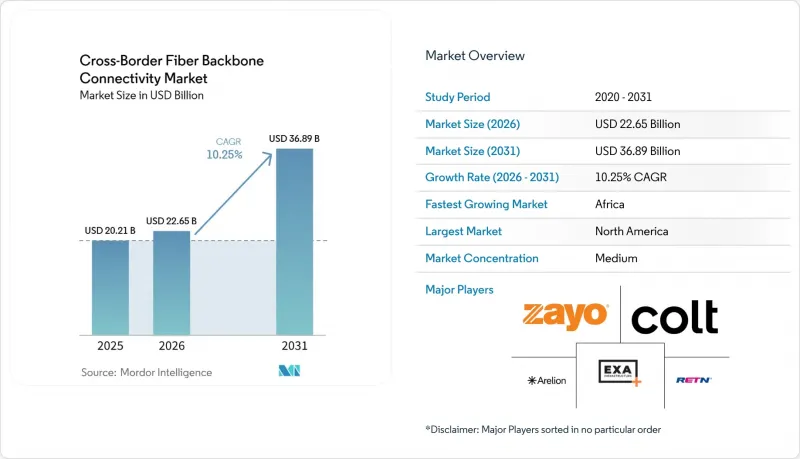
本報告按網路類型(例如,陸基跨境光纖骨幹網路、海底光纖骨幹網路)、所有權類型(例如,獨資)、應用(例如,超大規模資料中心業者和雲端互連、電信營運商傳輸)以及地區進行細分。市場預測以美元計價。
全球跨境光纖骨幹網路連接市場趨勢及洞察
超大規模資料中心業者的路由所有權和直接容量採購
跨境光纖骨幹網路連接市場正經歷變革,買家不再只依賴批發業者的供應,而是希望直接掌控路由設計、光纖容量和登陸策略。這種轉變在通訊業者主導的大規模骨幹網路專案以及從一開始就以流量管理為核心的私人或龍頭企業支持的系統中尤為明顯。 Meta於2025年11月完成了其「2Africa」系統的核心建設,創建了一條覆蓋33個國家的開放式接入路由,這將顯著提升非洲、歐洲和亞洲的國際骨幹網路容量。 Colt也於2026年透過整合其「Juno」和「Marea」海底光纜容量與新的陸地鏈路,進一步擴大了其在該路由上的地位。這表明,對專用路由和長期容量權的獲取正在影響著走廊策略。隨著這一趨勢的蔓延,跨境光纖骨幹網路連接市場正經歷著從短期容量購買向長期基礎設施承諾的穩定轉變。這種轉變強化了航線所有權作為一種商業優勢,在人口最密集的走廊中,與通訊業者建立關係變得更加有選擇性。
人工智慧、雲端運算和資料中心之間的互聯密度
跨境光纖骨幹網路連接市場也受惠於日益成長的高速低延遲連線需求,這些需求將用於連接雲端區域、人工智慧叢集、營運商機房和海底光纜登陸站。 2026年2月,Lumen宣布其「私有連接架構」策略相關的合約金額已達約130億美元,顯示人工智慧相關需求正在推動長途線路新骨幹網路的建設。 Zayo在關鍵人工智慧走廊獲得重要客戶後,也啟動了迄今為止規模最大的線路里程擴展計劃,這表明市場對城際和跨境容量的需求持續成長,以支援大規模數據流量。 2025年10月,NTT Docomo Business和NTT Com Asia在香港新增了「APN InterLink」服務,利用全光子網路技術處理連接東京和香港的ASE海底光纜上的延遲敏感型流量。同樣在2026年4月,Arellion擴展了其在丹麥的網路,以容納新的登陸站和人工智慧工作負載,使骨幹網路規劃與資料中心成長模式更加緊密地結合。這些發展表明,跨境光纖骨幹網路連接市場不再僅由網際網路的整體成長所驅動,因為現在對路由的需求與運算、儲存和雲端交換點的實體集中程度密切相關。
長距離土木工程和卸貨設施的整合需要大量資金投入。
跨境光纖骨幹網路連接市場仍面臨很高的進入門檻。這是因為骨幹網路建設需要大量的前期投資,包括海上作業、登陸站、陸上回程傳輸和跨境整合。雖然小規模業者可以透過轉售容量進入市場,但它們往往難以獲得新國際線路的整個系統所有權。這種成本結構是資金籌措持續集中在流量需求和獲利路徑已經明確的走廊的原因之一。這也解釋了為什麼跨境光纖骨幹網路連接市場更吸引由基礎設施基金、大型通訊業者和雲端公司支持的項目,而不是小規模區域營運商的項目。雖然公共支持可以透過津貼條件減輕部分資金籌措負擔,但也帶來了准入、合規和報告義務等負擔。因此,線路多元化首先在具有戰略意義的走廊上推進,然後擴展到流量較小的跨境線路。
細分市場分析
到2025年,海底光纜骨幹網路將佔據跨境光纖骨幹網路連接市場佔有率的42.89%,這反映了海底光纜在跨洲長距離傳輸海量資料方面發揮的重要作用。由於大型雲端服務供應商、通訊業者和基礎設施營運商仍依賴深海系統連接其最大的需求中心,因此海底光纜在跨境光纖骨幹網路連接市場中繼續佔據核心地位。 Meta公司於2025年11月建成的「2Africa」核心系統,是近期大規模海底光纜擴建計畫中最重要的案例之一。該系統橫跨非洲、歐洲和亞洲,採用涵蓋33個國家的開放式設計和接取方案。此外,海底光纜建造週期正日益技術主導,這有助於延長核心骨幹網路的使用壽命並提高其容量效率。 2026年3月,NTT公司開發了192芯多芯光纖海底光纜系統。該設計旨在將傳輸容量提升至傳統單芯光纖電纜系統的四倍。這對跨境光纖骨幹網路連接市場具有重大影響,因為容量擴展現在必須滿足日益成長的高密度雲端流量需求、資料中心之間更直接的互連以及更多樣化的路由。陸地骨幹網在內陸和邊境走廊中繼續發揮至關重要的支撐作用,這些走廊需要低延遲和便捷的實體接觸來支持短距離國際流量。它們也為通訊業者在內陸資料中心和沿海登陸站之間提供了更大的柔軟性。然而,純陸路路由仍容易受到通行權、邊境程序以及區域許可要求差異等問題的影響。因此,儘管陸地支撐段的價值日益凸顯,但海底系統在長距離路由規劃中仍佔據核心地位。
預計從2026年到2031年,陸基/海底混合骨幹網路將以14.87%的複合年成長率成長。隨著通訊業者在系統設計初期就日益重視冗餘性,面向此類網路的跨境光纖骨幹網路連接市場也不斷擴大。混合架構允許通訊業者和基礎設施所有者將深海傳輸與繞過高風險或擁塞走廊的陸上路徑結合。 EXA Infrastructure和Socar Fiber已採取了這項策略,計劃鋪設一條穿越土耳其、希臘和喬治亞的海底光纜,作為連接歐洲和亞洲的全新陸上替代路徑。 Colt公司2026年的路徑擴展計畫也遵循類似的邏輯,將Juno和Marea等海底資產與登陸站之間新建的陸基光纖電纜結合。在跨國光纖骨幹網路連接市場,這種模式極具吸引力,因為它減少了對單一路徑類型的依賴,並允許更靈活的復原計畫。此外,它還為營運商提供了更大的靈活性,使其能夠根據流量等級、客戶合約和監管限制來客製化路由設計。因此,混合系統正從單純的容錯機制轉變為主流部署方案。預計這一轉變將推動對歐洲-亞洲、非洲以及跨太平洋走廊擴建的新投資。它還為中立的基礎設施所有者提供了一個更廣泛的平台,使其能夠跨多個路由選項而非單一實體路徑出售容量。在跨國光纖骨幹網路連接市場,更廣泛的路由策略既能增強客戶吸引力,又能提升資產的長期價值。
區域分析
2025年,北美佔據了跨境光纖骨幹網路連接市場34.65%的佔有率,並繼續保持領先地位,因為該地區仍然是許多雲端主導骨幹網路投資的主要起點和終點。該地區的建設週期依然活躍,Lumen計劃到2028年新增3400萬英里城際光纖線路,併計劃透過與人工智慧和雲端連接相關的契約,在2031年之前進一步擴展網路。 Zayo在獲得關鍵人工智慧走廊主要客戶的承諾後,也推動了迄今為止最大的線路里程擴展計畫。這些投資表明,北美跨境光纖骨幹網路連接市場的發展不僅受流量成長的影響,線路規劃現在與人工智慧和雲端需求的實體集中區域密切相關。隨著美國聯邦通訊委員會(FCC)於2025年8月進行許可製度改革,加強了對登陸美國的電纜系統的國家安全審查,該地區在政策層面上的重要性也進一步提升。因此,北美已成為跨境光纖骨幹網路連接市場中最活躍、最受關注的地區之一。北美擁有其他地區無法比擬的規模、資金籌措管道、落地基礎設施和監管體系。
歐洲和亞太地區仍然是跨境光纖骨幹網路連接市場的核心,既有成熟的骨幹網路需求,也有積極的線路重新設計。 2025年9月,EXA Infrastructure啟動了「維謝格拉德計畫」(Project Visegrád),將中歐主要城市連接到其廣域超大規模骨幹網,首條線路於2026年中期投入使用。 RETN於2026年2月新增了塔林至採西斯線路,在北歐-波羅的海走廊上提供了一條新的實體獨立線路,容量達40Tbps。在亞太地區,Colt於2026年為NTT的跨太平洋系統「Juno」獲得了容量,新增了東京至洛杉磯線路,並擴展了骨幹網路在主要貿易路線上的覆蓋範圍。政策方面也取得了進展,芬蘭在2025年根據歐盟《Gigabit基礎設施法案》採取的行動表明,芬蘭正持續努力減少部署超高容量網路的障礙。這些發展趨勢結合起來意味著,在走廊多樣化、路由彈性和高密度互連規劃的推動下,歐洲和亞太地區繼續在跨境光纖骨幹連接市場佔據中心地位。
預計2026年至2031年間,非洲的複合年成長率將達到17.43%,成為跨國光纖骨幹連接市場成長最快的區域叢集。這一成長動能主要得益於骨幹網路線路的大規模擴張、非洲大陸路由接入的改善、國際覆蓋範圍的擴大以及登陸點的多樣化。 2025年11月,Meta公司完成了其「2Africa」系統的核心建設,該系統連接了33個國家,並擴展了非洲、歐洲和亞洲的開放式國際通訊容量。 「Medusa」系統也於2025年12月在摩洛哥納祖爾登陸,鞏固了摩洛哥在地中海互聯互通中的作用,並加強了南歐和北非之間的聯繫。隨著營運商尋求替代路由和替代登陸點以減少對脆弱走廊的依賴,中東地區的重要性也日益凸顯。儘管南美洲的市場規模相對較小,但其跨境光纖骨幹網路連接市場正受益於對國際路由日益成長的關注以及對多元化洲際鏈路日益濃厚的興趣。隨著中立和通訊業者主導的骨幹網路系統在該地區擴展,該市場將在樞紐連接中發揮更大的作用,而不僅限於流量鄰近區域。這將使涵蓋中東、非洲和南美的全部區域在長期路由平衡方面佔據更有利的地位。這也意味著跨境光纖骨幹網路連接市場的成長將不再僅僅集中在傳統的北美核心區域。
其他好處:
- Excel格式的市場預測(ME)表
- 3個月的分析師支持
目錄
第1章:引言
- 研究假設和市場定義
- 調查範圍
第2章:調查方法
第3章執行摘要
第4章 市場狀況
- 市場概覽
- 市場促進因素
- 超大規模資料中心業者擁有自己的網路基礎設施,並直接採購容量。
- 跨境資料主權及主權互聯互通方面的義務
- 人工智慧、雲端運算和資料中心之間的互聯密度
- 利用陸路分散運輸以克服地緣政治瓶頸
- 政府主導的數位走廊計劃
- 金融和關鍵基礎設施流量中的多宿主容錯
- 市場限制因素
- 在多個司法管轄區獲得許可出現延誤
- 與長距離土木工程和著陸系統整合相關的大筆資本投資。
- 跨境監管不一致與授權複雜性
- 安全風險、破壞風險、修復路線的瓶頸。
- 產業價值鏈分析
- 監理情勢
- 技術展望
- 波特五力分析
第5章 市場規模與成長預測
- 依網路類型
- 跨越國界的陸地光纖骨幹網
- 海底光纖骨幹網
- 陸生和海底混合型主幹
- 依所有權類型
- 獨資
- 財團所有
- 批發/中立主機所有權
- 透過使用
- 超大規模資料中心業者和雲端互連
- 電信業者和運輸
- 資料中心之間的互連
- 政府和國防部門的互聯互通
- 用於金融服務和低延遲交易的連接
- 其他用途
- 按地區
- 北美洲
- 美國
- 加拿大
- 墨西哥
- 南美洲
- 巴西
- 阿根廷
- 其他南美國家
- 歐洲
- 德國
- 英國
- 法國
- 其他歐洲國家
- 亞太地區
- 中國
- 日本
- 印度
- 韓國
- 其他亞太國家
- 中東
- 沙烏地阿拉伯
- 阿拉伯聯合大公國
- 其他中東國家
- 非洲
- 南非
- 奈及利亞
- 其他非洲國家
- 北美洲
第6章 競爭情勢
- 市場集中度
- 策略趨勢
- 市佔率分析
- 公司簡介
- Arelion AB
- Colt Technology Services Group Limited
- Zayo Group Holdings, Inc.
- EXA Infrastructure Services UK Limited
- RETN Limited
- Tata Communications Limited
- NTT DOCOMO BUSINESS, Inc.
- Orange Wholesale(Orange SA)
- Telecom Italia Sparkle SpA
- PCCW Global Limited
- Lumen Technologies, Inc.
- GTT Communications, Inc.
- GlobalConnect A/S
- Cogent Communications Holdings, Inc.
- Deutsche Telekom AG
- Telefonica Global Solutions, SLU
- Singapore Telecommunications Limited
- SubCom, LLC
- NEC Corporation
- Alcatel Submarine Networks SAS
- Infinera Corporation
- Prysmian SpA
- Seaborn Networks
- HMN Technologies Co., Ltd.
- Ciena Corporation
- Nokia Corporation
第7章 市場機會與未來展望
According to Mordor Intelligence, the cross-Border fiber backbone connectivity market size was valued at USD 20.21 billion in 2025 and is estimated to grow from USD 22.65 billion in 2026 to reach USD 36.89 billion by 2031, at a CAGR of 10.25% during the forecast period (2026-2031).
This report is Segmented by Network Type (Terrestrial Cross-Border Fiber Backbone, Submarine Fiber Backbone, and More), Ownership Type (Single Ownership, and More), Application (Hyperscaler and Cloud Interconnect, Telecom Carrier Transit, and More), and Geography. The Market Forecasts are Provided in Value (USD).
Global Cross-Border Fiber Backbone Connectivity Market Trends and Insights
Hyperscaler Route Ownership And Direct Capacity Procurement
The cross-border fiber backbone connectivity market is being reshaped by buyers who now want direct control over route design, cable capacity, and landing strategy, rather than relying solely on wholesale carrier supply. That shift is visible in large, operator-led backbone projects and in private or anchor-backed systems that are built around traffic assurance from the start. Meta completed the core 2Africa system in November 2025, creating a 33-country open-access route that materially expands international backbone capacity across Africa, Europe, and Asia. Colt also expanded its route position in 2026 by combining subsea capacity on Juno and Marea with new terrestrial links, which shows how private route access and long-term capacity rights now influence corridor strategy. As this pattern spreads, the cross-border fiber backbone connectivity market is seeing a steady shift from short-term capacity purchases toward long-term infrastructure commitments. That change is strengthening route ownership as a commercial advantage and making carrier relationships more selective across the highest-density corridors.
AI, Cloud, And Data Center Interconnection Density
The cross-border fiber backbone connectivity market is also benefiting from the growing need to connect cloud regions, AI clusters, carrier hotels, and cable landing stations with higher speed and lower latency. Lumen said in February 2026 that it had nearly USD 13 billion in contracted deals tied to its Private Connectivity Fabric strategy, which shows how AI-related demand is supporting new backbone builds across long-haul corridors. Zayo also launched its largest route-mile expansion program after securing an anchor customer for critical AI corridors, indicating continued demand for intercity and cross-border capacity to support large data traffic flows. NTT DOCOMO BUSINESS and NTT Com Asia added APN InterLink in Hong Kong in October 2025, using All-Photonic Network technology on the ASE cable between Tokyo and Hong Kong for latency-sensitive traffic. Arelion also expanded its Danish network in April 2026 to support new landings and AI workloads, linking backbone planning more closely to data center growth patterns. These moves show that the cross-border fiber backbone connectivity market is no longer driven only by general internet growth, because route demand now follows the physical concentration of compute, storage, and cloud exchange points.
High Capex For Long-Haul Civil Works And Landing Integration
The cross-border fiber backbone connectivity market still has a high entry barrier because backbone construction requires significant upfront investment in marine works, landing stations, terrestrial backhaul, and cross-border integration. Smaller operators can participate in capacity resale, but they often struggle to fund full system ownership on new international routes. This cost structure is one reason investment continues to cluster around corridors with already visible traffic demand and clearer monetization paths. It also explains why the cross-border fiber backbone connectivity market is attracting more infrastructure funds, larger carriers, and cloud-backed projects than smaller regional builders. Where public support exists, grant conditions can ease some of the financing burden, but they also add access, compliance, and reporting obligations. The result is a market where route diversification often advances first on strategically important corridors and only later reaches thinner cross-border paths.
Other drivers and restraints analyzed in the detailed report include:
- Cross-Border Data Sovereignty And Sovereign Connectivity Mandates
- Terrestrial Diversification Away From Geopolitical Chokepoints
- Permitting Delays Across Multiple Jurisdictions
For complete list of drivers and restraints, kindly check the Table Of Contents.
Segment Analysis
Submarine backbone held 42.89% of the cross-border fiber backbone connectivity market share in 2025, reflecting the role of subsea routes in carrying large volumes of intercontinental traffic over long distances. The segment remains central to the cross-border fiber backbone connectivity market because major cloud, carrier, and infrastructure operators still depend on deepwater systems to connect the largest demand centers. Meta's completion of the core 2Africa system in November 2025 added to the list of the most important recent examples of large-scale subsea expansion, with a 33-country design and open-access positioning across Africa, Europe, and Asia. The subsea build cycle is also becoming increasingly technology-driven, helping extend the useful life and improve capacity efficiency of core backbone routes. NTT developed a 192-core multicore optical fiber submarine cable system in March 2026, with a design aimed at a 4x increase in transmission capacity over conventional single-fiber cable systems. That matters for the cross-border fiber backbone connectivity market because capacity growth now has to align with denser cloud traffic, more direct data center interconnection, and rising demand for route diversity. The terrestrial backbone still plays an important supporting role in landlocked and near-border corridors where short-haul international traffic needs lower latency and easier physical access. It also gives operators more flexibility between inland data centers and coastal landing stations. Even so, terrestrial-only routes remain more exposed to rights-of-way issues, border procedures, and variations in local permitting. That keeps submarine systems at the center of long-haul route planning even as supporting land segments become more valuable.
The hybrid terrestrial-submarine backbone is projected to grow at a 14.87% CAGR from 2026 to 2031, and the cross-border fiber backbone connectivity market for this network type is growing as operators now seek redundancy built into system design from the start. Hybrid architecture helps carriers and infrastructure owners combine deepwater reach with land-based bypass options across exposed or congested corridors. EXA Infrastructure and Socar Fiber moved in that direction with their planned cable across Turkey, Greece, and Georgia, which was positioned as a new terrestrial alternative for Europe-to-Asia traffic. Colt's 2026 route expansion followed a similar logic by combining subsea assets such as Juno and Marea with new terrestrial fiber builds between landing stations. In the cross-border fiber backbone connectivity market, this model is attractive because it reduces reliance on a single route type and supports more flexible restoration planning. It also gives operators more room to match route design with traffic class, customer contracts, and regulatory constraints. Hybrid systems are therefore moving from a resilience add-on to a mainstream deployment choice. That shift is likely to support new investment across Europe-to-Asia, Africa-facing, and transpacific corridor extensions. It also gives neutral infrastructure owners a broader platform to sell capacity across multiple path options rather than a single physical alignment. For the cross-border fiber backbone connectivity market, a wider route logic improves both customer appeal and long-term asset relevance.
Complete Report Scope:
- By Network Type
- Terrestrial Cross-Border Fiber Backbone
- Submarine Fiber Backbone
- Hybrid Terrestrial-Submarine Backbone
- By Ownership Type
- Single Ownership
- Consortium Ownership
- Wholesale Neutral Host Ownership
- By Application
- Hyperscaler and Cloud Interconnect
- Telecom Carrier Transit
- Data Center Interconnect
- Government and Defense Connectivity
- Financial Services and Low-Latency Trading Connectivity
- Other Applications
- By Geography
- North America
- United States
- Canada
- Mexico
- South America
- Brazil
- Argentina
- Rest of South America
- Europe
- Germany
- United Kingdom
- France
- Rest of Europe
- Asia-Pacific
- China
- Japan
- India
- South Korea
- Rest of Asia-Pacific
- Middle East
- Saudi Arabia
- United Arab Emirates
- Rest of the Middle East
- Africa
- South Africa
- Nigeria
- Rest of Africa
- North America
Geography Analysis
North America held 34.65% of the cross-border fiber backbone connectivity market share in 2025, and the region kept that lead because it remains the main origin and destination point for many cloud-led backbone investments. The regional build cycle is still active, with Lumen adding 34 million new intercity fiber miles by 2028 and targeting a larger footprint by 2031 through contracts linked to AI and cloud connectivity. Zayo also moved ahead with the largest route-mile expansion program in its history after winning an anchor customer commitment for critical AI corridors. These investments show that the cross-border fiber backbone connectivity market in North America is being shaped by more than simple traffic growth, as route planning is now closely tied to where AI and cloud demand are physically concentrated. The region also carries added policy weight because the FCC's August 2025 licensing reforms tightened national security review on U.S.-landing cable systems. That makes North America one of the most active and closely watched parts of the cross-border fiber backbone connectivity market. It combines scale, access to funding, landing infrastructure, and regulatory scrutiny in a way few other regions match.
Europe and Asia-Pacific remain central to the cross-border fiber backbone connectivity market because both regions combine mature backbone demand with active route redesign. EXA Infrastructure launched Project Visegrad in September 2025 to connect major Central European cities into its wider hyperscale backbone, and the first routes entered service in mid-2026. RETN added the Tallinn-Cesis route in February 2026, giving the Nordic and Baltic corridor a new physically independent path with 40Tbps of capacity. In the Asia-Pacific region, Colt secured capacity on NTT's Juno trans-Pacific system in 2026, adding a new route between Tokyo and Los Angeles and expanding its backbone reach across major trade lanes. The policy backdrop is also moving, with Finland's 2025 action on the EU Gigabit Infrastructure Act showing continued effort to reduce deployment friction for very high-capacity networks. Together, these developments keep Europe and the Asia-Pacific at the center of corridor diversification, route resilience, and high-density interconnection planning in the cross-border fiber backbone connectivity market.
Africa is projected to grow at a 17.43% CAGR from 2026 to 2031, making it the fastest-growing regional cluster in the cross-border fiber backbone connectivity market. Much of that momentum comes from large backbone additions that improve route access, international reach, and landing diversity across the continent. Meta completed the core 2Africa system in November 2025, connecting 33 countries and extending open-access international capacity across Africa, Europe, and Asia. The Medusa system also landed in Nador in December 2025, supporting Morocco's role in Mediterranean connectivity and strengthening links across Southern Europe and North Africa. The Middle East is also becoming more important as operators pursue bypass routes and alternative landings to reduce dependence on exposed corridors. South America is still smaller in relative terms, but the cross-border fiber backbone connectivity market there is benefiting from stronger international route attention and broader interest in diversified intercontinental links. As more neutral and carrier-led backbone systems expand into the region, the market is likely to play a greater role in hub connectivity rather than remain mostly traffic-adjacent. That gives the broader Middle East, Africa, and South America group a stronger position in long-term route balancing. It also means growth in the cross-border fiber backbone connectivity market is becoming less concentrated in only the historic North Atlantic core.
- Arelion AB
- Colt Technology Services Group Limited
- Zayo Group Holdings, Inc.
- EXA Infrastructure Services UK Limited
- RETN Limited
- Tata Communications Limited
- NTT DOCOMO BUSINESS, Inc.
- Orange Wholesale (Orange S.A.)
- Telecom Italia Sparkle S.p.A.
- PCCW Global Limited
- Lumen Technologies, Inc.
- GTT Communications, Inc.
- GlobalConnect A/S
- Cogent Communications Holdings, Inc.
- Deutsche Telekom AG
- Telefonica Global Solutions, S.L.U.
- Singapore Telecommunications Limited
- SubCom, LLC
- NEC Corporation
- Alcatel Submarine Networks SAS
- Infinera Corporation
- Prysmian S.p.A.
- Seaborn Networks
- HMN Technologies Co., Ltd.
- Ciena Corporation
- Nokia Corporation
Additional Benefits:
- The market estimate (ME) sheet in Excel format
- 3 months of analyst support
TABLE OF CONTENTS
1 INTRODUCTION
- 1.1 Study Assumptions and Market Definition
- 1.2 Scope of the Study
2 RESEARCH METHODOLOGY
3 EXECUTIVE SUMMARY
4 MARKET LANDSCAPE
- 4.1 Market Overview
- 4.2 Market Drivers
- 4.2.1 Hyperscaler Route Ownership and Direct Capacity Procurement
- 4.2.2 Cross-Border Data Sovereignty and Sovereign Connectivity Mandates
- 4.2.3 AI, Cloud, and Data Center Interconnection Density
- 4.2.4 Terrestrial Diversification Away From Geopolitical Chokepoints
- 4.2.5 Government-Backed Digital Corridor Programs
- 4.2.6 Multi-Homed Resilience for Financial and Critical Infrastructure Traffic
- 4.3 Market Restraints
- 4.3.1 Permitting Delays Across Multiple Jurisdictions
- 4.3.2 High Capex for Long-Haul Civil Works and Landing Integration
- 4.3.3 Cross-Border Regulatory Fragmentation and Licensing Complexity
- 4.3.4 Security Risks, Sabotage Exposure, and Route Repair Bottlenecks
- 4.4 Industry Value Chain Analysis
- 4.5 Regulatory Landscape
- 4.6 Technological Outlook
- 4.7 Porter's Five Forces Analysis
- 4.7.1 Bargaining Power of Suppliers
- 4.7.2 Bargaining Power of Buyers
- 4.7.3 Threat of New Entrants
- 4.7.4 Threat of Substitutes
- 4.7.5 Industry Rivalry
5 MARKET SIZE AND GROWTH FORECASTS (VALUE)
- 5.1 By Network Type
- 5.1.1 Terrestrial Cross-Border Fiber Backbone
- 5.1.2 Submarine Fiber Backbone
- 5.1.3 Hybrid Terrestrial-Submarine Backbone
- 5.2 By Ownership Type
- 5.2.1 Single Ownership
- 5.2.2 Consortium Ownership
- 5.2.3 Wholesale Neutral Host Ownership
- 5.3 By Application
- 5.3.1 Hyperscaler and Cloud Interconnect
- 5.3.2 Telecom Carrier Transit
- 5.3.3 Data Center Interconnect
- 5.3.4 Government and Defense Connectivity
- 5.3.5 Financial Services and Low-Latency Trading Connectivity
- 5.3.6 Other Applications
- 5.4 By Geography
- 5.4.1 North America
- 5.4.1.1 United States
- 5.4.1.2 Canada
- 5.4.1.3 Mexico
- 5.4.2 South America
- 5.4.2.1 Brazil
- 5.4.2.2 Argentina
- 5.4.2.3 Rest of South America
- 5.4.3 Europe
- 5.4.3.1 Germany
- 5.4.3.2 United Kingdom
- 5.4.3.3 France
- 5.4.3.4 Rest of Europe
- 5.4.4 Asia-Pacific
- 5.4.4.1 China
- 5.4.4.2 Japan
- 5.4.4.3 India
- 5.4.4.4 South Korea
- 5.4.4.5 Rest of Asia-Pacific
- 5.4.5 Middle East
- 5.4.5.1 Saudi Arabia
- 5.4.5.2 United Arab Emirates
- 5.4.5.3 Rest of the Middle East
- 5.4.6 Africa
- 5.4.6.1 South Africa
- 5.4.6.2 Nigeria
- 5.4.6.3 Rest of Africa
- 5.4.1 North America
6 COMPETITIVE LANDSCAPE
- 6.1 Market Concentration
- 6.2 Strategic Moves
- 6.3 Market Share Analysis
- 6.4 Company Profiles (includes Global Level Overview, Market Level Overview, Core Segments, Financials as available, Strategic Information, Market Rank/Share, Products and Services, Recent Developments)
- 6.4.1 Arelion AB
- 6.4.2 Colt Technology Services Group Limited
- 6.4.3 Zayo Group Holdings, Inc.
- 6.4.4 EXA Infrastructure Services UK Limited
- 6.4.5 RETN Limited
- 6.4.6 Tata Communications Limited
- 6.4.7 NTT DOCOMO BUSINESS, Inc.
- 6.4.8 Orange Wholesale (Orange S.A.)
- 6.4.9 Telecom Italia Sparkle S.p.A.
- 6.4.10 PCCW Global Limited
- 6.4.11 Lumen Technologies, Inc.
- 6.4.12 GTT Communications, Inc.
- 6.4.13 GlobalConnect A/S
- 6.4.14 Cogent Communications Holdings, Inc.
- 6.4.15 Deutsche Telekom AG
- 6.4.16 Telefonica Global Solutions, S.L.U.
- 6.4.17 Singapore Telecommunications Limited
- 6.4.18 SubCom, LLC
- 6.4.19 NEC Corporation
- 6.4.20 Alcatel Submarine Networks SAS
- 6.4.21 Infinera Corporation
- 6.4.22 Prysmian S.p.A.
- 6.4.23 Seaborn Networks
- 6.4.24 HMN Technologies Co., Ltd.
- 6.4.25 Ciena Corporation
- 6.4.26 Nokia Corporation
7 MARKET OPPORTUNITIES AND FUTURE OUTLOOK
- 7.1 White-Space and Unmet-Need Assessment

 跨境光纖線路:市場佔有率分析、行業趨勢和統計數據以及成長預測(2026-2031 年)
 光纖到戶網路市場預測至2034年—全球組件、架構、安裝類型、應用、最終用戶和區域分析
 暗纖網路市場規模、佔有率和成長分析:按類型、光纖類型、最終用戶、應用和地區分類-2026-2033年產業預測
 2026年全球暗纖網路市場報告
 暗纖網路市場分析及預測(至2035年):依類型、產品類型、服務、技術、組件、應用、部署類型、最終用戶、安裝類型及解決方案分類
 全球暗纖網路市場規模、佔有率、趨勢和成長分析報告(2026-2034)
 暗纖網路市場規模、佔有率和趨勢分析報告:按光纖、網路、材料、應用、地區和細分市場預測(2026-2033 年)全球暗纖網路市場規模依光纖類型、網路類型、材料、地區、預測:
 全球暗纖網路市場:市場規模、佔有率、趨勢分析(按網路類型、光纖類型、材料和應用)、區域展望和未來預測(2024-2031 年)