


 |
市場調查報告書
商品編碼
2099092
德國戶外配送:市場佔有率分析、產業趨勢與統計及成長預測(2026-2031)Germany Out Of Home Delivery - Market Share Analysis, Industry Trends & Statistics, Growth Forecasts (2026 - 2031) |
||||||

※ 本網頁內容可能與最新版本有所差異。詳細情況請與我們聯繫。
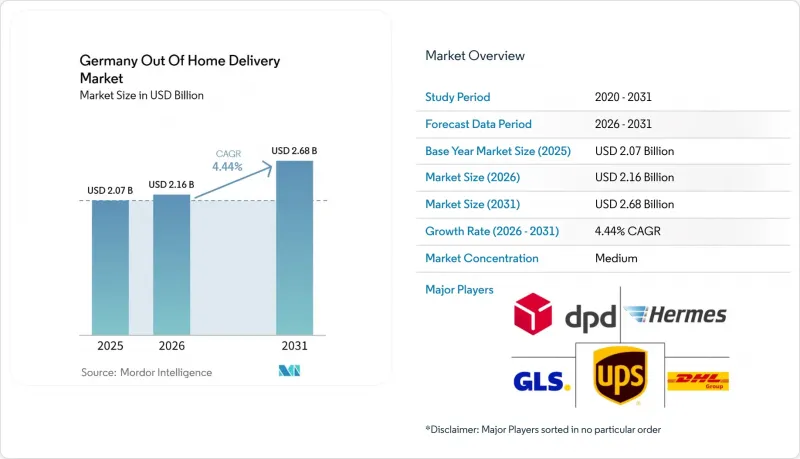
根據 Mordor Intelligence 估計,德國戶外配送市場規模在 2025 年將達到 20.7 億美元,到 2026 年將成長至 21.6 億美元,到 2031 年將達到 26.8 億美元,同期複合年成長率為 4.44%。
本報告按最終用戶行業(電子商務、企業對企業服務 (BFSI)、醫療保健、製造業、一級產業、批發和零售(線下)及其他)和經營模式(企業對企業 (B2B)、企業對消費者 (B2C) 和消費者對消費者 (C2C))進行分類。市場預測以美元計價。
德國外送市場趨勢與洞察。
宅配櫃的早期普及和充滿挑戰的物流環境正在推動消費者對 APM 的空前接受度。
由於德國消費者日常生活中小包裹櫃的普及率較高,德國異地配送市場維持結構性優勢。據DHL稱,到2025年,其Packstation網路將覆蓋超過15,500個站點,屆時90%的德國居民可在10分鐘內使用包裹櫃。這種接近性至關重要,因為在人口密集的都市區,重複使用將使包裹櫃成為預設的配送方式,而不僅僅是偶爾的選擇。 2025年7月,DHL與包括CEWE在內的20家零售合作夥伴合作,推出了一項無需註冊的Packstation試點項目,旨在降低新用戶的使用門檻。該試點計畫擴大了未在DHL系統註冊的消費者的使用範圍,使用戶群無需等待大規模硬體升級即可成長。隨著這些使用習慣的養成,後進企業將越來越難以撼動德國異地配送市場的地位。這是因為,與儲物櫃的數量同樣重要的是,消費者熟悉的使用者體驗以及附近儲物櫃的位置也是至關重要的因素。
人手不足(Fachkraftemangel)迫使快遞公司進行合併。
人手不足進一步加劇了德國整個戶外配送市場整合的必要性。 Stepstone Group 的一項研究顯示,2019 年至 2024 年間,德國對小包裹遞送司機的需求增加了 815%,同期對倉儲物流專業人員的需求也增加了 479%。運輸業面臨的壓力更為普遍,德國貨運協會 (BGL) 報告稱,目前缺口高達 12 萬名卡車駕駛人,公開資訊顯示,十分之四的在職駕駛人即將退休。工資壓力也呈現出類似的趨勢,宅配、速遞和小包裹(CEP) 工人的法定最低工資將從 2021 年的每小時 9.50 歐元(11.17 美元)上漲至 2025 年的每小時 12.82 歐元(15.08 美元),而每小時 15 歐元(每小時 15 歐元的最低工資。在勞動力短缺和工資上漲的背景下,每個儲物櫃和高效的PUDO自提點都能幫助快遞公司維持配送路線的密度,並減輕重複挨家挨戶配送的負擔。因此,德國的戶外配送市場不僅關乎便利性,也是應對長期人手不足、提高勞動生產力的措施。
路邊自動販賣機的嚴格市政許可(Sondernutzungserlaubnis)
獲得許可仍然是德國戶外配送市場進一步密集化發展面臨的最明顯的短期障礙。 2025年,DHL董事會成員尼古拉·哈格萊特納(Nicola Hagleitner)表示,新建「包裹站」的許可流程可能與建築許可一樣複雜,該公司指出,這一負擔正在拖慢其每年安裝多達3000個儲物櫃的目標進度。問題並非源自國內需求不足,而是源自於不同市政當局在程序、所需文件、公共空間相關法規以及核准時間上的差異。 2025年6月,德國公共採購出口協會(BPEX)指出,為了讓戶外基礎設施的部署更可預測,德國城市需要將物流規劃融入新的區域發展計畫中。簡而言之,部署的經濟效益不僅取決於小包裹需求和安裝地點的質量,還取決於地方政府的行政能力以及將儲物櫃視為重要城市物流資產的意願。在這些地方政府程序變得更加統一之前,德國戶外配送市場的投資意圖轉化為裝置容量的速度可能會仍然緩慢。
細分市場分析
至2025年,電子商務將佔德國戶外配送市場39.68%的佔有率,預計到2031年將以4.75%的複合年成長率成長。這使得電子商務成為規模最大且成長最快的終端用戶群。隨著德國電子商務滲透率達到87%,交易量的成長不再僅依賴新增線上消費者的數量;如今,小包裹和退貨的處理效率變得日益重要。 DHL的「包裹站」(Packstation)試點計畫正是反映了這一轉變,該計畫無需註冊,於2025年7月啟動。其目標是吸引消費者,引導他們無需事先註冊即可使用自提櫃。逆向物流的規模也印證了這個邏輯。預計到2025年,退貨小包裹的數量將達到5.5億件,這將形成穩定的退貨需求,不僅支撐新訂單,也支撐自提櫃和PUDO(自提點取貨)的使用。從實際角度來看,這意味著德國的戶外配送產業在零售物流領域經歷了最大的成長,因為消費者需要可重複且無摩擦的配送模式。
在德國的戶外配送市場,醫療保健產業正吸引遠超其現有收入水準的策略性關注。 BPEX KEP 2025 研究報告指出,即使在製造業和工業活動持續放緩的情況下,醫療保健行業仍是少數幾個預計在 2025 年實現持續出貨量成長的終端用戶群體之一。 DHL 於 2025 年 5 月再次強調了這一優先事項,將其位於弗洛爾施塔特的生命科學與醫療保健園區擴建至 10 萬平方公尺,確保能夠容納超過 14 萬托盤的藥品和醫療產品。銀行、金融和保險 (BFSI) 行業透過安全運輸文件和設備,佔據了更大的出貨量;而製造業、一級產業以及線下批發和零售業則增加了更為穩定但周轉較慢的 B2B 收貨業務,這些業務非常適合使用共用的自提點和企業鎖箱。雖然這些小規模的終端用戶群本身無法取代電子商務,但它們透過擴大應用場景和支援更高附加價值的服務層,正在深化德國的戶外配送市場。
其他好處:
- Excel格式的市場預測(ME)表
- 3個月的分析師支持
目錄
第1章:引言
- 研究假設和市場定義
- 調查範圍
第2章:調查方法
第3章執行摘要
第4章 市場狀況
- 市場概覽
- 市場促進因素
- 宅配櫃的早期普及和充滿挑戰的物流環境正在推動消費者對 APM 的空前接受度。
- 人手不足(Fachkraftemangel)迫使運輸公司進行合併。
- 服飾產品異常高的退貨率促進了便利的 PUDO(取貨和送貨)服務的發展。
- 擴展獨立通訊業者的共用開放式儲物櫃網路
- 城市中心嚴格的環境法規(Umweltzonen)促進了戶外空間中心的發展。
- 技術服務領域B2B及隔夜快遞鎖箱業務的成長
- 市場限制因素
- 路邊自動販賣機的嚴格市政許可(Sondernutzungserlaubnis)
- 人們對「免費宅配」有著根深蒂固的歷史期望
- 高密度零售區域空間有限,難以擴展自提點位置。
- 現有主導網路對互通性的抵制
- 價值供應鏈分析
- 監理情勢
- 技術展望
- 波特五力分析
- 地緣政治事件對市場的影響
第5章 市場規模與成長預測
- 按最終用戶行業分類
- 電子商務
- 金融服務(BFSI)
- 衛生保健
- 製造業
- 一級產業
- 批發和零售貿易(線下)
- 其他
- 按經營模式
- 企業對企業 (B2B) 交易
- Business-to-Consumer(B2C)
- 個人對個人(C2C)交易
第6章 競爭情勢
- 市場集中度
- 策略趨勢
- 市佔率分析
- 公司簡介
- DHL Paket GmbH
- Hermes Germany GmbH
- DPD Deutschland GmbH
- GLS Germany GmbH & Co. OHG
- United Parcel Service Deutschland Sa rl & Co. OHG
- FedEx Express Germany GmbH
- Amazon Logistics GmbH
- trans-o-flex Express GmbH & Co. KG
- GO!Express & Logistics Deutschland GmbH
- nox Germany GmbH
- Night Star Express GmbH & Co. KG
- Packeta eCommerce GmbH
- PIN Mail AG
- CITIPOST GmbH
- Nordkurier Logistik GmbH & Co. KG
- MEDIA Logistik GmbH
- BWPOST GmbH & Co. KG
- LVZ Post GmbH
- sudmail GmbH
- arriva GmbH
- RPV Logistik GmbH
- Logistic-Mail-Factory GmbH
第7章 市場機會與未來展望
According to Mordor Intelligence, the Germany out-of-home (OOH) delivery market size was valued at USD 2.07 billion in 2025 and is estimated to grow from USD 2.16 billion in 2026 to USD 2.68 billion by 2031, registering a CAGR of 4.44% over the same period.
This report is Segmented by End-User Industry (E-Commerce, Financial Services (BFSI), Healthcare, Manufacturing, Primary Industry, Wholesale and Retail Trade (Offline), and Others), and by Business Model (Business-To-Business (B2B), Business-To-Consumer (B2C), and Consumer-To-Consumer (C2C)). The Market Forecasts are Provided in Terms of Value (USD).
Germany Out Of Home Delivery Market Trends and Insights
Unrivaled Consumer Adoption of APMs Led by Early Packstation Penetration Severe Logistics
The German out-of-home (OOH) delivery market retains a structural advantage from the early normalization of parcel lockers in daily consumer routines. DHL reported that its Packstation network exceeded 15,500 units in 2025, and that footprint placed 90% of German residents within 10 minutes of a unit. That level of proximity matters because repeated exposure makes lockers a default collection option rather than an occasional fallback in dense urban and suburban areas. DHL also began a registration-free Packstation pilot in July 2025, working with 20 retail partners, including CEWE, to reduce the remaining barrier for first-time users. The pilot broadens access for shoppers who had not enrolled in DHL's system, thereby expanding the user base without waiting for a major hardware change. As that habit base grows, the German out-of-home (OOH) delivery market becomes harder for late entrants to disrupt, because consumer familiarity and nearby locations matter as much as installed locker count.
Labor Shortages (Fachkraftemangel) Forcing Carrier Consolidation
Labor scarcity is reinforcing the case for delivery consolidation across the German out-of-home (OOH) delivery market. Stepstone Group found that demand for parcel deliverers in Germany rose 815% between 2019 and 2024, while demand for warehouse logistics specialists rose 479% over the same period. Pressure is even broader in transport, with the BGL reporting a shortfall of 120,000 truck drivers and public reporting noting that 4 in 10 active drivers are nearing retirement. Wage pressure is also moving in the same direction, with the statutory minimum wage for CEP workers rising from EUR 9.50 (USD 11.17) per hour in 2021 to EUR 12.82 (USD 15.08) per hour in 2025, while political discussion has centered on EUR 15 (USD 17.64) per hour. When labor is constrained and wages are rising, each locker bank and each efficient PUDO stop helps carriers protect route density and reduce repeated door-to-door handling. That is why the German out-of-home (OOH) delivery market is not only a convenience story, because it is also a workforce productivity response to persistent delivery labor scarcity.
Stringent Municipal Permitting (Sondernutzungserlaubnis) for Street-Level APMs
Permitting remains the clearest near-term brake on faster densification in the Germany out-of-home (OOH) delivery market. DHL board member Nikola Hagleitner said in 2025 that the permit process for new Packstations can be as complex as construction approval, and the company linked that burden to slower progress against an installation ambition of up to 3,000 lockers per year. The problem is not a lack of national demand; the delay stems from municipal variation in processes, documentation, public-space rules, and approval timing. BPEX argued in June 2025 that German cities need to integrate logistics planning into new district development if OOH infrastructure is to be rolled out on a more predictable schedule. That means deployment economics are affected not only by parcel demand and site quality, but also by local administrative capacity and willingness to treat lockers as essential urban logistics assets. Until those local processes become more consistent, the Germany out-of-home (OOH) delivery market will keep facing a slower conversion of investment intent into installed capacity.
Other drivers and restraints analyzed in the detailed report include:
- Exceptionally High Apparel Return Rates Favoring Frictionless PUDO Drop-Offs
- Expansion of Carrier-Agnostic and Shared Open Locker Networks
- Deeply Entrenched Historical Expectation of Free Home Delivery
For complete list of drivers and restraints, kindly check the Table Of Contents.
Segment Analysis
E-commerce held 39.68% of the German out-of-home (OOH) delivery market share in 2025 and is projected to expand at a 4.75% CAGR through 2031, making it both the largest and fastest-growing end-user segment. With German e-commerce penetration at 87%, the volume story has moved beyond simply adding new online shoppers and now centers more on how efficiently parcels and returns are handled. DHL's July 2025 registration-free Packstation pilot reflects that shift, because it is designed to capture shoppers who still default to home delivery and bring them into a locker flow without prior registration. The same logic is reinforced by the scale of reverse logistics, with return parcel volumes projected at 550 million in 2025 and creating a steady stream of drop-off interactions that support locker and PUDO usage beyond new orders alone. In practical terms, this means the German out-of-home (OOH) delivery industry is gaining most where retail logistics needs a repeatable, lower-friction consumer handover model.
Healthcare is drawing more strategic attention than its current revenue base alone would suggest in the Germany out-of-home (OOH) delivery market. The BPEX KEP Study 2025 identified healthcare as one of the few end-user groups expected to show sustained shipment volume growth in 2025 even as manufacturing and industrial activity remained weak. DHL reinforced that priority in May 2025 by expanding its Life Sciences and Healthcare campus in Florstadt to 100,000 sqm with capacity for more than 140,000 pallets of pharmaceutical and medical products. BFSI contributes more measured volumes through secure document and equipment movements, while manufacturing, primary industry, and offline wholesale and retail trade add steadier but slower-moving B2B collections that often fit shared PUDO and corporate lockbox use. Together, these smaller end-user groups do not displace e-commerce, but they deepen the Germany out-of-home (OOH) delivery market by broadening the mix of use cases and supporting higher-value service layers.
Complete Report Scope:
- By End-User Industry
- E-Commerce
- Financial Services (BFSI)
- Healthcare
- Manufacturing
- Primary Industry
- Wholesale and Retail Trade (Offline)
- Others
- By Business Model
- Business-to-Business (B2B)
- Business-to-Consumer (B2C)
- Consumer-to-Consumer (C2C)
List of Companies Covered in this Report:
- DHL Paket GmbH
- Hermes Germany GmbH
- DPD Deutschland GmbH
- GLS Germany GmbH & Co. OHG
- United Parcel Service Deutschland S.a r.l. & Co. OHG
- FedEx Express Germany GmbH
- Amazon Logistics GmbH
- trans-o-flex Express GmbH & Co. KG
- GO! Express & Logistics Deutschland GmbH
- nox Germany GmbH
- Night Star Express GmbH & Co. KG
- Packeta eCommerce GmbH
- PIN Mail AG
- CITIPOST GmbH
- Nordkurier Logistik GmbH & Co. KG
- MEDIA Logistik GmbH
- BWPOST GmbH & Co. KG
- LVZ Post GmbH
- sudmail GmbH
- arriva GmbH
- RPV Logistik GmbH
- Logistic-Mail-Factory GmbH
Additional Benefits:
- The market estimate (ME) sheet in Excel format
- 3 months of analyst support
TABLE OF CONTENTS
1 Introduction
- 1.1 Study Assumptions and Market Definition
- 1.2 Scope of the Study
2 Research Methodology
3 Executive Summary
4 Market Landscape
- 4.1 Market Overview
- 4.2 Market Drivers
- 4.2.1 Unrivaled Consumer Adoption of APMs Led by Early Packstation Penetration Severe Logistics
- 4.2.2 Labor Shortages (Fachkraftemangel) Forcing Carrier Consolidation
- 4.2.3 Exceptionally High Apparel Return Rates Favoring Frictionless PUDO Drop-Offs
- 4.2.4 Expansion of Carrier-Agnostic and Shared Open Locker Networks
- 4.2.5 Strict Environmental Zones (Umweltzonen) in Urban Centers Favoring OOH Hubs
- 4.2.6 B2B and Night-Time Express Lockbox Growth for Technical Services
- 4.3 Market Restraints
- 4.3.1 Stringent Municipal Permitting (Sondernutzungserlaubnis) for Street-Level APMs
- 4.3.2 Deeply Entrenched Historical Expectation of Free Home Delivery
- 4.3.3 Space Constraints in High-Density Retail for Expanding PUDO Footprints
- 4.3.4 Interoperability Resistance from Dominant Incumbent Networks
- 4.4 Value / Supply-Chain Analysis
- 4.5 Regulatory Landscape
- 4.6 Technological Outlook
- 4.7 Porter's Five Forces Analysis
- 4.7.1 Bargaining Power of Suppliers
- 4.7.2 Bargaining Power of Buyers
- 4.7.3 Threat of New Entrants
- 4.7.4 Threat of Substitutes
- 4.7.5 Industry Rivalry
- 4.8 Impact of Geopolitical Events on the Market
5 Market Size & Growth Forecasts (Value in USD)
- 5.1 By End-User Industry
- 5.1.1 E-Commerce
- 5.1.2 Financial Services (BFSI)
- 5.1.3 Healthcare
- 5.1.4 Manufacturing
- 5.1.5 Primary Industry
- 5.1.6 Wholesale and Retail Trade (Offline)
- 5.1.7 Others
- 5.2 By Business Model
- 5.2.1 Business-to-Business (B2B)
- 5.2.2 Business-to-Consumer (B2C)
- 5.2.3 Consumer-to-Consumer (C2C)
6 Competitive Landscape
- 6.1 Market Concentration
- 6.2 Strategic Moves
- 6.3 Market Share Analysis
- 6.4 Company Profiles (includes Global Level Overview, Market Level Overview, Core Segments, Financials as available, Strategic Information, Market Rank/Share, Products and Services, Recent Developments)
- 6.4.1 DHL Paket GmbH
- 6.4.2 Hermes Germany GmbH
- 6.4.3 DPD Deutschland GmbH
- 6.4.4 GLS Germany GmbH & Co. OHG
- 6.4.5 United Parcel Service Deutschland S.a r.l. & Co. OHG
- 6.4.6 FedEx Express Germany GmbH
- 6.4.7 Amazon Logistics GmbH
- 6.4.8 trans-o-flex Express GmbH & Co. KG
- 6.4.9 GO! Express & Logistics Deutschland GmbH
- 6.4.10 nox Germany GmbH
- 6.4.11 Night Star Express GmbH & Co. KG
- 6.4.12 Packeta eCommerce GmbH
- 6.4.13 PIN Mail AG
- 6.4.14 CITIPOST GmbH
- 6.4.15 Nordkurier Logistik GmbH & Co. KG
- 6.4.16 MEDIA Logistik GmbH
- 6.4.17 BWPOST GmbH & Co. KG
- 6.4.18 LVZ Post GmbH
- 6.4.19 sudmail GmbH
- 6.4.20 arriva GmbH
- 6.4.21 RPV Logistik GmbH
- 6.4.22 Logistic-Mail-Factory GmbH
7 Market Opportunities & Future Outlook
- 7.1 White-Space and Unmet-Need Assessment

 全球宅配、包裹及小包裹市場-2026-2032年市場預測
 代出貨市場規模、佔有率和成長分析:按產品類型、經營模式、平台類型、供應商類型、公司規模、銷售管道、最終用戶和地區分類-2026-2033年產業預測
 快遞小包裹宅配(CEP) 市場規模、佔有率和成長分析:按服務類型、目的地、運輸方式、遞送速度、包裹重量和地區分類-2026-2033 年產業預測
 英國國內宅配( 小包裹):市場佔有率分析、產業趨勢與統計、成長預測(2026-2031)
 生鮮食品在地化配送市場:預測至 2034 年 -產品類型、配送模式、平台類型、訂單規模、支付方式、最終用戶和地區分類的全球分析全球宅配和小包裹市場預測至2034年-按服務類型、遞送速度、目的地、貨物類型、客戶類型、最終用戶產業和地區分類的分析智慧洗衣取送市場預測至2034年-全球服務類型、服務模式、預訂方式、技術、支付方式、最終用戶和區域分析西班牙快遞、速遞、包裹市場:市場佔有率分析、行業趨勢和統計數據、成長預測(2026-2031 年)英國高階配送服務:市場佔有率分析、產業趨勢與統計及成長預測(2026-2031)
 2026 年至 2035 年宅配、小包裹服務市場的市場機會、成長要素、產業趨勢與預測。