


 |
市場調查報告書
商品編碼
2063617
英國高階配送服務:市場佔有率分析、產業趨勢與統計及成長預測(2026-2031)United Kingdom White Glove Delivery Services - Market Share Analysis, Industry Trends & Statistics, Growth Forecasts (2026 - 2031) |
||||||

※ 本網頁內容可能與最新版本有所差異。詳細情況請與我們聯繫。
英國高階配送市場預計到 2025 年將達到 21.3 億美元,到 2026 年將達到 22.7 億美元,到 2031 年將達到 30.5 億美元,2026 年至 2031 年的複合年成長率為 6.12%。
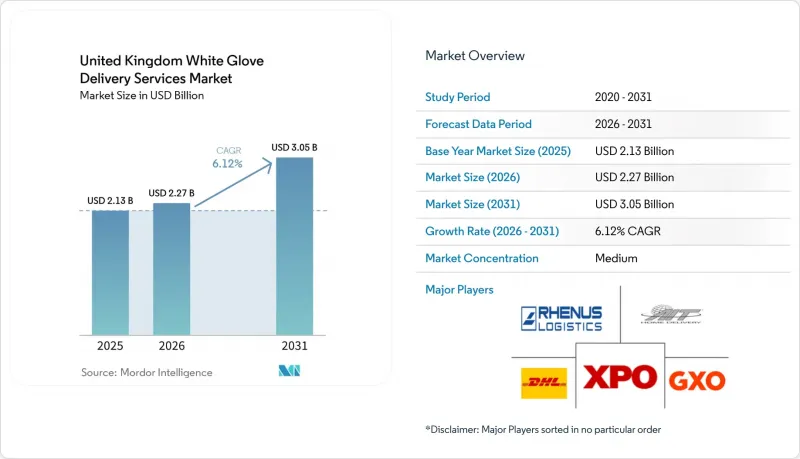
隨著家具、大型家電等大型商品線上銷售的成長,對能夠將商品擺放到指定房間並完成組裝、組裝和包裝材料處理的雙人配送團隊的需求日益成長。本報告依服務類型(例如,標準尊享服務)、終端用戶產業(家具及家居用品、家電及電子產品、醫療保健及醫療設備、奢侈品及藝術品等)及配送速度(標準配送(2-5天)、隔日達/指定日期配送、當日達/特快配送)進行分類,市場預測以美元計價。
英國高階配送市場趨勢與洞察
大型產品類別的電子商務快速成長
2026年1月,沙發、冷藏庫和大螢幕電視等大型商品的線上銷售額年增14.7%,創下自2021年以來的最大月增幅。由於大型商品需要兩人配送團隊才能安全送達指定房間,因此該零售領域的銷售成長將擴大英國高階配送服務的市場。全國數據顯示,到2026年2月,線上銷售額將佔零售總額的28.2%,其中家具和家電是成長最快的類別之一。因此,零售商正在重新思考結帳流程,並專注於組裝選項,將成本中心轉化為收入來源。預計這種結構性轉變將推動高階配送團隊的配送量在預測期後持續成長。
客戶體驗主導的加值交付需求
消費者情緒分析顯示,英國消費者普遍認為,配送溝通不良是他們最大的物流抱怨。此外,消費者對宅配業者將包裹放置在未上鎖或不安全地點的不滿幾乎是普遍存在的。諸如預約送貨、提前通知和送貨上門等服務已成為標準配置,這有利於英國高階配送市場的發展。宜家於2025年2月與TaskRabbit的合作就體現了其商業性優勢。選擇組裝服務的顧客,平均訂單價值增加了4.7倍,複雜商品的退貨率降低了約40%。這證明,相較於單純的配送速度,加值可靠性才是提升顧客忠誠度的關鍵因素。
高昂的人事費用和營運成本溢價
重型貨運司機的平均薪資(以英鎊計價)從2020年的41,000美元上漲至2025年的55,000美元。同時,全國最低生活工資標準在2025年4月上漲了6.7%,達到每小時15.30美元。雇主工資稅的增加使整個物流業的人事費用增加了約19億美元。雙司機制度使每次送貨的人事費用翻倍,而嚴格的送貨時限限制了每日送貨次數,從而擠壓了每條路線的利潤。車輛電氣化降低了燃料成本,但需要對卡車和充電站進行大量資本投資。受傳統固定價格合約約束的營運商,除非重新談判採用開卷式管理,否則將面臨利潤率下降的風險。
細分市場分析
預計到2025年,標準白手套服務將佔據英國白手套配送市場58.63%的佔有率,鞏固其作為大型產品默認「雙人送達指定房間」服務的地位。這個核心細分市場的需求主要來自家具和家電零售商,他們更注重保證送達時間而非單純的配送速度。然而,高階細分市場的利潤率預計將會提升。隨著零售商加快將組裝、智慧家庭設置和垃圾清運等服務整合到結帳流程中,預計到2031年,高階白手套服務將以13.65%的複合年成長率成長。宜家與TaskRabbit合作,提供每次配送收費41.30美元的服務,使附加率提高了50%,複雜商品的退貨率降低了約40%。這表明消費者願意為便捷的「承包」服務付費。
這種提升銷售的潛力解釋了為什麼像GXO Logistics和DHL這樣的全球第三方物流公司正在整合調度入口網站,以便在預訂時提供高級附加服務。大規模的車隊也支援客製化服務,例如溫控藝術品運輸和醫療設備的高階搬運——在這些領域,像勞合社這樣的專業保險公司會以申報價值的0.50%承保高價值貨物。 Wincanton 2024年收入的79%來自公開帳簿契約,這種合約允許營運商將人事費用和燃油成本的上漲轉嫁給托運人,即使服務複雜性增加也能保持盈利。因此,儘管目前高階和客製化服務的需求量較小,但預計到2031年,英國高階配送市場規模將超過2.8億美元。結合即時追蹤、認證技術人員和符合排放氣體標準的卡車的營運商將最有效地抓住這一成長機會。
其他好處:
- Excel格式的市場預測(ME)表
- 3個月的分析師支持
目錄
第1章:引言
- 研究假設和市場定義
- 調查範圍
第2章:調查方法
第3章執行摘要
第4章 市場狀況
- 市場概覽
- 市場促進因素
- 大型產品類別的電子商務快速成長
- 對以客戶體驗主導的價值交付的需求
- 整合退貨處理和逆向物流
- 全球第三方物流產業的重組與資本流入
- 推出智慧家居設備套裝
- 透過超低排放區過渡到符合監管規定的豪華車輛
- 市場限制因素
- 高昂的人事費用和營運成本溢價
- 熟練的雙人團隊短缺
- 損害賠償責任和保險費用
- 分包商網路分散,影響服務的穩定性。
- 價值供應鏈分析
- 監理情勢
- 技術展望
- 波特五力模型
- 地緣政治事件的影響
第5章 市場規模與成長預測
- 按服務類型
- 標準白手套服務
- 尊享白手套服務
- 客製化白手套服務
- 按最終用戶行業分類
- 家具/家居用品
- 家用電子電器和家用電器
- 醫療保健和醫療設備
- 奢侈品和藝術品
- 其他(工業機械、電子商務、零售等)
- 按配送速度
- 標準(2-5天)
- 隔日送達/指定日期送達
- 當日送達/快速送達
第6章 競爭情勢
- 市場集中度
- 策略趨勢
- 市佔率分析
- 公司簡介
- Rhenus Logistics
- AIT Home Delivery(Panther Logistics)
- XPO Logistics(Including BJS Home Delivery)
- DHL Group
- Bishopsgate Logistics
- FedEx
- UPS Healthcare
- GXO Logistics(Wincanton Specialist Services)
- DSV(including DB Schenker)
- DX Freight Premium Logistics
- GS Transport Ltd
- Empire Delivery
- Secure UK Couriers
- Loom Loft Delivery Services
- Onit Logistics
- Loom Loft Delivery Services
- Shackletons White Glove
- Nicholas John Interiors(B Star VIP)
- Abitare UK Delivery
- John Lewis Two-Man Delivery Service
- IKEA TaskRabbit Assembly
第7章 市場機會與未來展望
According to Mordor Intelligence, the united kingdom white glove delivery services market size is projected to be USD 2.13 billion in 2025, USD 2.27 billion in 2026, and reach USD 3.05 billion by 2031, growing at a CAGR of 6.12% from 2026 to 2031.
Rising online sales of bulky items like furniture and large appliances are expanding demand for two-person crews that can place products in the room of choice, assemble them, and clear packaging. This report is Segmented by Service Type (Standard White Glove Service, and More), by End-User Industry (Furniture & Home Goods, Consumer Electronics & Appliances, Healthcare & Medical Devices, Luxury Goods & Art, and More), and by Delivery Speed (Standard (2-5 Day), Next-Day / Nominated-Day, and Same-Day / Express), The Market Forecasts are Provided in Terms of Value (USD).
United Kingdom White Glove Delivery Services Market Trends and Insights
E-Commerce Boom in Bulky-Item Categories
Online sales of large items such as sofas, refrigerators, and big-screen televisions climbed 14.7% year on year in January 2026, the sharpest monthly rise since 2021. Bulky products require two-person crews for safe, room-of-choice delivery, so every uptick in this retail segment expands the addressable market for United Kingdom white glove delivery services. National data show the online share of total retail sales reached 28.2% in February 2026, with furniture and appliances among the fastest movers. Retailers are therefore retooling checkout flows to surface assembly add-ons, converting a cost center into a revenue stream. This structural shift is expected to support steady volume growth for premium crews well beyond the forecast window.
Customer-Experience-Led Value-Added Delivery Demand
Consumer sentiment analysis reveals that United Kingdom shoppers overwhelmingly identify poor delivery communication as their primary logistics frustration. Additionally, there is near-universal consumer dissatisfaction when couriers leave parcels in unsecured or unsafe locations. This favors the United Kingdom white glove delivery services market because appointment scheduling, call-ahead notifications, and in-home handoff are standard features. IKEA's February 2025 integration with TaskRabbit shows the commercial upside: customers who chose assembly lifted average order value by 4.7 times and cut returns on complex items by roughly 40%. Value-added reliability, not raw speed, is proving to be the stronger loyalty driver.
High Labor and Operating Cost Premium
Average heavy-goods-vehicle wages climbed from USD 41,000 in 2020 to USD 55,000 in 2025 after converting from sterling, while the National Living Wage rose 6.7% to USD 15.3 per hour in April 2025. Employer payroll taxes also increased, adding roughly USD 1.9 billion in extra labor costs across the logistics sector. Two-person crews double payroll per stop, and tight appointment windows cap daily drop density, squeezing profit per route. Fleet electrification reduces fuel spend but requires a significant capital outlay for trucks and depot chargers. Operators tied into legacy fixed-price contracts risk margin erosion unless they renegotiate to open-book terms.
Other drivers and restraints analyzed in the detailed report include:
- Returns Handling and Reverse Logistics Integration
- Consolidation and Capital Inflow from Global 3PLs
- Shortage of Skilled Two-Person Crews
For complete list of drivers and restraints, kindly check the Table Of Contents.
Segment Analysis
Standard white glove service accounted for 58.63% of the United Kingdom white glove delivery services market share in 2025, underscoring its role as the default two-person, room-of-choice option for bulky products. Demand in this core segment is anchored to furniture and appliance retailers that prize reliable appointment windows over raw speed. Yet the premium tier is where margin expansion lies. Premium white glove service is projected to grow at a 13.65% CAGR through 2031 as retailers increasingly bundle assembly, smart-home setup, and haul-away into checkout flows. IKEA's TaskRabbit integration, priced at USD 41.3 per job, lifted attach rates by 50% and reduced complex-item returns by roughly 40%, proving consumers will pay for turnkey convenience.
The upsell potential explains why global 3PLs such as GXO Logistics and DHL have integrated scheduling portals that surface premium add-ons at the point of booking. Larger fleets also support bespoke services such as climate-controlled art transport and white-glove handling for medical devices, areas where specialist insurers such as Lloyd's underwrite high-value cargo at 0.50% of declared value. Open-book contracts, which accounted for 79% of Wincanton's 2024 revenue, let operators pass through wage and fuel inflation to shippers, protecting profitability even as service complexity rises. As a result, the premium and customized tiers are expected to add more than USD 280 million to the United Kingdom white glove delivery services market size by 2031, despite representing a smaller volume base today. Operators that combine live tracking, certified technicians, and emissions-compliant trucks are best placed to capture this growth.
List of Companies Covered in this Report:
- Rhenus Logistics
- AIT Home Delivery (Panther Logistics)
- XPO Logistics (Including BJS Home Delivery)
- DHL Group
- Bishopsgate Logistics
- FedEx
- UPS Healthcare
- GXO Logistics (Wincanton Specialist Services)
- DSV (including DB Schenker)
- DX Freight Premium Logistics
- GS Transport Ltd
- Empire Delivery
- Secure UK Couriers
- Loom Loft Delivery Services
- Onit Logistics
- Loom Loft Delivery Services
- Shackletons White Glove
- Nicholas John Interiors (B Star VIP)
- Abitare UK Delivery
- John Lewis Two-Man Delivery Service
- IKEA TaskRabbit Assembly
Additional Benefits:
- The market estimate (ME) sheet in Excel format
- 3 months of analyst support
TABLE OF CONTENTS
1 Introduction
- 1.1 Study Assumptions and Market Definition
- 1.2 Scope of the Study
2 Research Methodology
3 Executive Summary
4 Market Landscape
- 4.1 Market Overview
- 4.2 Market Drivers
- 4.2.1 E-Commerce Boom in Bulky-Item Categories
- 4.2.2 Customer-Experience-Led Value-Added Delivery Demand
- 4.2.3 Returns Handling and Reverse Logistics Integration
- 4.2.4 Consolidation & Capital Inflow from Global 3PLs
- 4.2.5 Smart-Home Device Bundle Installations
- 4.2.6 ULEZ-Driven Shift to Compliant Premium Fleets
- 4.3 Market Restraints
- 4.3.1 High Labor and Operating Cost Premium
- 4.3.2 Shortage of Skilled Two-Person Crews
- 4.3.3 Damage Liability & Insurance Costs
- 4.3.4 Fragmented Subcontractor Networks Impacting Service Consistency
- 4.4 Value / Supply-Chain Analysis
- 4.5 Regulatory Landscape
- 4.6 Technological Outlook
- 4.7 Porter's Five Forces
- 4.7.1 Threat of New Entrants
- 4.7.2 Bargaining Power of Suppliers
- 4.7.3 Bargaining Power of Buyers
- 4.7.4 Threat of Substitutes
- 4.7.5 Competitive Rivalry
- 4.8 Impact of Geo-Political Events
5 Market Size and Growth Forecasts (Value)
- 5.1 By Service Type
- 5.1.1 Standard White Glove Service
- 5.1.2 Premium White Glove Service
- 5.1.3 Customized White Glove Service
- 5.2 By End-User Industry
- 5.2.1 Furniture and Home Goods
- 5.2.2 Consumer Electronics and Appliances
- 5.2.3 Healthcare and Medical Devices
- 5.2.4 Luxury Goods and Art
- 5.2.5 Other (Industrial Machinery, E-commerce and Retail, etc.)
- 5.3 By Delivery Speed
- 5.3.1 Standard (2 to 5 Day)
- 5.3.2 Next-Day / Nominated-Day
- 5.3.3 Same-Day / Express
6 Competitive Landscape
- 6.1 Market Concentration
- 6.2 Strategic Moves
- 6.3 Market Share Analysis
- 6.4 Company Profiles (includes Global level Overview, Market level overview, Core Segments, Financials as available, Strategic Information, Market Rank/Share for Key Companies, Products & Services, and Recent Developments)
- 6.4.1 Rhenus Logistics
- 6.4.2 AIT Home Delivery (Panther Logistics)
- 6.4.3 XPO Logistics (Including BJS Home Delivery)
- 6.4.4 DHL Group
- 6.4.5 Bishopsgate Logistics
- 6.4.6 FedEx
- 6.4.7 UPS Healthcare
- 6.4.8 GXO Logistics (Wincanton Specialist Services)
- 6.4.9 DSV (including DB Schenker)
- 6.4.10 DX Freight Premium Logistics
- 6.4.11 GS Transport Ltd
- 6.4.12 Empire Delivery
- 6.4.13 Secure UK Couriers
- 6.4.14 Loom Loft Delivery Services
- 6.4.15 Onit Logistics
- 6.4.16 Loom Loft Delivery Services
- 6.4.17 Shackletons White Glove
- 6.4.18 Nicholas John Interiors (B Star VIP)
- 6.4.19 Abitare UK Delivery
- 6.4.20 John Lewis Two-Man Delivery Service
- 6.4.21 IKEA TaskRabbit Assembly
7 Market Opportunities and Future Outlook
- 7.1 White-space and Unmet-need Assessment

 全球宅配、包裹及小包裹市場-2026-2032年市場預測
 代出貨市場規模、佔有率和成長分析:按產品類型、經營模式、平台類型、供應商類型、公司規模、銷售管道、最終用戶和地區分類-2026-2033年產業預測
 快遞小包裹宅配(CEP) 市場規模、佔有率和成長分析:按服務類型、目的地、運輸方式、遞送速度、包裹重量和地區分類-2026-2033 年產業預測
 英國國內宅配( 小包裹):市場佔有率分析、產業趨勢與統計、成長預測(2026-2031)
 生鮮食品在地化配送市場:預測至 2034 年 -產品類型、配送模式、平台類型、訂單規模、支付方式、最終用戶和地區分類的全球分析德國戶外配送:市場佔有率分析、產業趨勢與統計及成長預測(2026-2031)全球宅配和小包裹市場預測至2034年-按服務類型、遞送速度、目的地、貨物類型、客戶類型、最終用戶產業和地區分類的分析智慧洗衣取送市場預測至2034年-全球服務類型、服務模式、預訂方式、技術、支付方式、最終用戶和區域分析西班牙快遞、速遞、包裹市場:市場佔有率分析、行業趨勢和統計數據、成長預測(2026-2031 年)
 2026 年至 2035 年宅配、小包裹服務市場的市場機會、成長要素、產業趨勢與預測。