


 |
市場調查報告書
商品編碼
2099052
英國逆向物流:市場佔有率分析、產業趨勢與統計及成長預測(2026-2031)United Kingdom Reverse Logistics - Market Share Analysis, Industry Trends & Statistics, Growth Forecasts (2026 - 2031) |
||||||

※ 本網頁內容可能與最新版本有所差異。詳細情況請與我們聯繫。
據 Mordor Intelligence 稱,2025 年英國逆向物流市場價值為 322.9 億美元,預計到 2031 年將達到 495.1 億美元,而 2026 年為 347.7 億美元,預測期(2026 年至 2031 年)的複合年成長率為 7.32%。
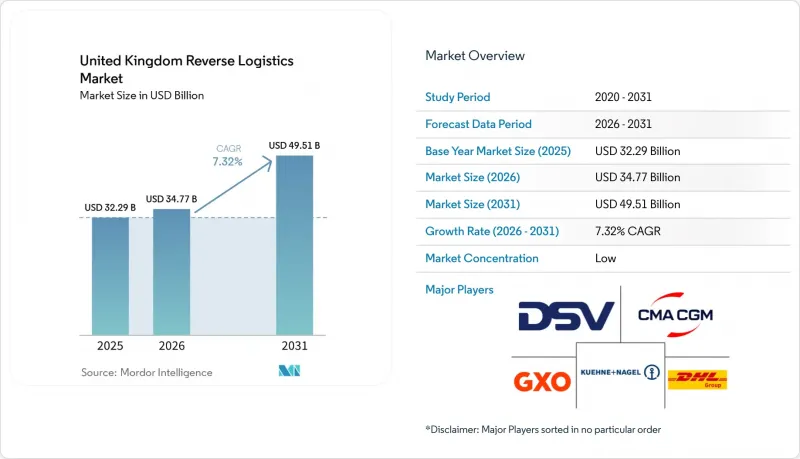
英國逆向物流市場正受惠於更嚴格的回收和再利用法規而蓬勃發展。具體而言,包裝材料的擴大生產者責任延伸(EPR)費用將於2025年10月生效,修訂後的WEEE規則下在線市場的義務將於2025年8月生效,資金籌措義務將於2026年1月開始實施。本報告按逆向物流功能(運輸(陸運、空運及其他運輸方式)、倉儲(儲存、配送等)和附加價值服務)、終端用戶產業(消費品和零售、住宅和室內裝潢、醫療保健和製藥、快速消費品及其他終端用戶)以及地區(英格蘭、蘇格蘭、威爾斯和北愛爾蘭)進行細分。市場預測以美元計價。
英國逆向物流市場的趨勢與洞察
電子商務退貨量不斷增加
英國逆向物流市場持續受惠於服裝、鞋類和電子產品產業線上退貨活動的活性化。儘管英國電商退貨率在2025年全年維持在17.5%左右,但時尚和鞋類品類的退貨率高峰卻高達30%至40%,這反映了貨運總上市數量和倉儲需求結構性地居高不下。光是2026年的「Return Yourly」購物季預計就將產生16億英鎊(21.4億美元)的退貨額,凸顯了英國季節性需求的持續集中。消費者同時訂購多件商品的趨勢日益成長,推動了退貨量,使得更多商品以可再次銷售的狀態退回,並透過更快捷的管道進行收集,而不是被丟棄或低成本處置。這一趨勢促使企業增加對貨運網路、處置工具和退貨平台的投資,因為商品越新或使用越少,其轉售潛力就越高。
零售商加快退款流程的努力
英國逆向物流市場也受到零售商的壓力,他們要求縮短從顧客退貨到退款確認的處理時間。 ASOS於2026年1月推出了分級退貨費用政策,規定退貨率超過70%的顧客需支付4英鎊(5.35美元)的費用,除非他們購買的商品總額達到40英鎊(53美元)。這表明零售商現在對退貨成本的控制非常嚴格。這些費用調整並不能消除處理退貨的必要性,因為退貨仍需要經過收集、檢驗、轉售或處置等流程。物流供應商正在透過加快接收、分類和補貨流程來應對這項挑戰,以防止庫存閒置造成的價值損失。因此,能夠將處理時間從幾天縮短到幾小時的外包合作夥伴的需求日益成長,尤其是在時尚和家電等高退貨率類別中。
每件商品的退貨處理成本很高。
高昂的單件處理成本仍是英國逆向物流市場面臨的最大障礙。每件退貨商品都需要運輸、接收、檢驗、評級、重新包裝,以及後續的轉售或處置,這使得低價商品難以獲利。在退貨率較高的類別中,逆向物流成本可高達總銷售額的7%,足以擠壓中型線上零售商的利潤空間。因此,一些賣家選擇對低轉售價值的商品不予退貨退款,即使這意味著完全放棄回收商品。這種成本負擔雖然有時會促使商家選擇外包,但也限制了經銷商對低價商品高品質退貨處理流程的投資意願。
細分市場分析
2025年,運輸將佔英國逆向物流市場的46.17%,成為目前國內退貨營運結構中佔比最大的環節。這一主導地位反映了道路運輸在收貨點、區域集散點和中央退貨點之間的運輸量極為龐大。 Evri涵蓋全國的小包裹接取網路以及InPost不斷擴展的小包裹櫃和郵局網路基地台,都表明了運輸在這一模式中的重要性,因為退貨環節的增加會提高對收貨密度和乾線運輸的需求。此外,運輸在營運成本中也佔據相當大的比例,因為需要快速連接分散的消費者和處理中心,以滿足客戶對退貨的期望。在英國逆向物流市場,鑑於國內小包裹流通量主導,以及對於大多數退貨商品而言,收貨速度比道路運輸方式的複雜性更為重要,公路運輸在這一環節中也繼續發揮著主導作用。
倉儲是成長最快的產業,預計到2031年,英國逆向物流市場將以13.33%的複合年成長率成長。這一成長主要得益於從簡單的倉儲模式轉變為共用設施內多階段的退貨處理。 DHL供應鏈的「退貨網路」於2025年10月推出,該網路圍繞著11個專用設施構建,透過在同一網路內處理多種產品類型和客戶的退貨,縮短了從接受到檢驗和重新入庫的流程。隨著零售商希望在同一地點開展履約和退貨業務,減少庫存停機時間並提高退貨價值,這項功能的重要性日益凸顯。此外,由於越來越多的退貨商品被重新用於翻新、重新入庫和再銷售管道,而不是被低價值地丟棄,其他附加價值服務在服務組合中的重要性也持續提升。
其他好處:
- Excel格式的市場預測(ME)表
- 3個月的分析師支持
目錄
第1章:引言
- 研究假設和市場定義
- 調查範圍
第2章:調查方法
第3章執行摘要
第4章 市場狀況
- 市場概況及逆向物流在物流中的作用
- 市場促進因素
- 電子商務退貨率上升
- 零售商正努力縮短退款週期。
- 監管主導的回收、維修和再利用需求
- 英國高密度城市返程聚合網路
- 擴大了無需退貨即可退款的選項,並允許“保持原樣”
- 人工智慧驅動的評級、篩選和再銷售分配。
- 市場限制因素
- 每件退貨商品的處理成本相對較高。
- 檢驗和分類的勞力強度
- 整個退貨流程缺乏標準化。
- 在退貨流程開始時,產品狀況資料中發現了不一致之處。
- 法律規範
- 價值鍊和分銷管道的結構分析
- 技術創新的前景
- 波特五力模型
- 逆向物流需求的演變
- 專題報導—英國電子商務產業
- 消費者行為與偏好變化的研究
- 退貨成本對零售商的影響——分析師觀點
- 地緣政治事件對供應鏈轉型的影響
第5章 市場規模及成長預測(價值,2026-2031 年)
- 功能性逆向物流
- 運輸
- 路
- 航空
- 其他交通方式
- 倉儲營運(儲存、配送、收貨)
- 其他附加價值服務(退貨處理、重新入庫、翻新、處置)
- 運輸
- 按最終用戶行業分類
- 消費者和零售商
- 家居與室內設計
- 醫療和藥品
- FMCG
- 其他最終用戶
- 按地區
- 英格蘭
- 蘇格蘭
- 威爾斯
- 北愛爾蘭
第6章 競爭情勢
- 市場集中度
- 關鍵策略趨勢
- 市佔率分析
- 公司簡介
- DHL Group
- GXO Logistics, Inc.
- Wincanton plc
- Kuehne+Nagel International AG
- CEVA Logistics(CMA CGM)
- DSV A/S(incl. DB Schenker)
- Yusen Logistics Co., Ltd.
- UPS Supply Chain Solutions
- FedEx Logistics, Inc.
- Royal Mail Group Ltd.
- Evri
- InPost SA
- ZigZag Global Limited
- ReBOUND Returns Ltd.(Now part of Reconomy Group)
- The Europa Worldwide Group
- Geopost
- ArrowXL Limited
- Ingram Micro United Kingdom
- Unipart Group
- Iron Mountain United Kingdom
- Restore Technology
- Sims Lifecycle Services United Kingdom
第7章 市場機會與未來展望
According to Mordor Intelligence, the United Kingdom reverse logistics market size was valued at USD 32.29 billion in 2025 and estimated to grow from USD 34.77 billion in 2026 to reach USD 49.51 billion by 2031, at a CAGR of 7.32% during the forecast period (2026 to 2031).
The United Kingdom reverse logistics market is being lifted by tighter recovery and recycling rules, as packaging EPR fees became enforceable in October 2025 and online marketplace obligations under the amended WEEE rules moved into force from August 2025, with financing obligations starting in January 2026. This report is Segmented by Reverse Logistics Function (Transportation (Road, Air, Other Modes), Warehousing (Storage, Distribution, and More), Value-Added Services), by End-User Industry (Consumer and Retail, Home and Decor, Healthcare and Pharmaceuticals, FMCG, and Other End Users), and by Geography (England, Scotland, Wales, and Northern Ireland). The Market Forecasts are Provided in USD.
United Kingdom Reverse Logistics Market Trends and Insights
Rising E-Commerce Return Volumes
The United Kingdom reverse logistics market continues to benefit from elevated online return activity across apparel, footwear, and electronics. The United Kingdom e-commerce return rate remained near 17.5% through 2025, while fashion and footwear categories reached 30% to 40% during peak periods, keeping transport pickup and warehouse intake volumes structurally high. Returnuary 2026 alone generated GBP 1.6 billion (USD 2.14 billion) in returned goods, underscoring the continued concentration of seasonal demand in this country. A growing share of these returns comes from multi-item ordering behavior, meaning more products return in resale-ready condition and can be routed to quicker recovery channels rather than scrap or low-value clearance. That pattern supports greater spending on transport links, disposition tools, and returns platforms because each unit has stronger resale potential when the item is still new or lightly handled.
Retailer Push for Faster Refund Cycles
The United Kingdom reverse logistics market is also being shaped by retailer pressure to shorten the time between customer drop-off and refund confirmation. ASOS introduced a tiered return fee policy in January 2026, under which customers with a return rate above 70% face a GBP 4 (USD 5.35) charge unless they keep at least GBP 40 (USD 53) of goods, which shows how tightly retailers are now managing return economics. These fee changes do not remove the need to process returned items, because the product still has to move back through collection, inspection, and resale or disposal channels. Logistics providers are responding by pushing faster intake, sorting, and restocking workflows so that value is not lost while inventory sits idle. The result is a stronger demand for outsourced partners that can compress processing time from days to hours, especially in high-return categories such as fashion and consumer electronics.
High Per-Item Reverse Handling Costs
High per-item handling costs remain the clearest brake on the United Kingdom reverse logistics market. Every returned unit may require transport, intake, inspection, grading, repacking, and either restocking or disposal, making low-ticket goods hard to recover profitably. In high-return categories, reverse logistics spend can reach 7% of gross sales, which is enough to pressure margins for mid-tier online retailers. This is why some sellers use returnless refunds for items with low resale value, even when that means giving up product recovery entirely. The cost burden supports outsourcing in some cases, but it also limits how much retailers are willing to invest in premium returns handling for low-value goods.
Other drivers and restraints analyzed in the detailed report include:
- Regulation-Led Recovery, Repair, and Recycling Demand
- Dense Urban Return Aggregation Networks in England
- Labor Intensity in Inspection and Sorting
For complete list of drivers and restraints, kindly check the Table Of Contents.
Segment Analysis
Transportation accounted for 46.17% of the United Kingdom reverse logistics market share in 2025, making it the largest function in the current structure of national returns activity. That leadership reflects the volume intensity of road-based collection between drop-off points, local aggregation nodes, and central returns sites. Evri's national parcel access network and InPost's ongoing rollout of parcel lockers and Post Office access points show why transport remains so central to the model, because every additional return touchpoint feeds collection density and line-haul demand. Transportation also absorbs a large share of operating costs because it has to connect dispersed consumers with processing hubs quickly enough to support refund expectations. The United Kingdom reverse logistics market stays road-led in this function because domestic parcel flows are dense and collection speed matters more than modal complexity for most returned goods.
Warehousing is the fastest-growing function, and the United Kingdom reverse logistics market for warehousing is projected to expand at a 13.33% CAGR through 2031. This growth is being driven by a shift from simple storage activities to multi-step returns processing within shared facilities. DHL Supply Chain's Return Network, launched in October 2025, is built around 11 purpose-built facilities that process returns for multiple product types and customers within the same network, shortening the path from receipt to inspection and restocking. The function is gaining importance because retailers want co-located fulfillment and returns operations that can cut idle inventory time and lift recovery value. Other value-added services continue to gain ground in the mix as more returned goods are redirected to refurbishment, restocking, and recommerce channels rather than low-value disposal.
Complete Report Scope:
- By Reverse Logistics Function
- Transportation
- Road
- Air
- Other Modes
- Warehousing (Storage, Distribution, Consolidation)
- Other Value-added Services (Return Processing, Restocking, Refurbishment, Disposition)
- Transportation
- By End-user Industry
- Consumer and Retail
- Home and Decor
- Healthcare and Pharmaceuticals
- FMCG
- Other End Users
- By Geography
- England
- Scotland
- Wales
- Northern Ireland
List of Companies Covered in this Report:
- DHL Group
- GXO Logistics, Inc.
- Wincanton plc
- Kuehne+Nagel International AG
- CEVA Logistics (CMA CGM)
- DSV A/S (incl. DB Schenker)
- Yusen Logistics Co., Ltd.
- UPS Supply Chain Solutions
- FedEx Logistics, Inc.
- Royal Mail Group Ltd.
- Evri
- InPost S.A.
- ZigZag Global Limited
- ReBOUND Returns Ltd. (Now part of Reconomy Group)
- The Europa Worldwide Group
- Geopost
- ArrowXL Limited
- Ingram Micro United Kingdom
- Unipart Group
- Iron Mountain United Kingdom
- Restore Technology
- Sims Lifecycle Services United Kingdom
Additional Benefits:
- The market estimate (ME) sheet in Excel format
- 3 months of analyst support
TABLE OF CONTENTS
1 Introduction
- 1.1 Study Assumptions & Market Definition
- 1.2 Scope of the Study
2 Research Methodology
3 Executive Summary
4 Market Landscape
- 4.1 Market Overview and Role of Reverse Logistics in Logistics
- 4.2 Market Drivers
- 4.2.1 Rising E-Commerce Return Volumes
- 4.2.2 Retailer Push for Faster Refund Cycles
- 4.2.3 Regulation-Led Recovery, Repair, and Recycling Demand
- 4.2.4 Dense Urban Return Aggregation Networks in England
- 4.2.5 Growth of Returnless Refund and Keep-It Decisioning
- 4.2.6 AI-Driven Grading, Triage, and Recommerce Routing
- 4.3 Market Restraints
- 4.3.1 High Per-Item Reverse Handling Costs
- 4.3.2 Labor Intensity in Inspection and Sorting
- 4.3.3 Limited Standardization Across Returns Workflows
- 4.3.4 Inconsistent Product Condition Data at Return Initiation
- 4.4 Regulatory Framework
- 4.5 Value Chain and Distribution Channel Architecture Analysis
- 4.6 Technology Innovations Outlook
- 4.7 Porter's Five Forces
- 4.7.1 Threat of New Entrants
- 4.7.2 Bargaining Power of Suppliers
- 4.7.3 Bargaining Power of Buyers
- 4.7.4 Threat of Substitutes
- 4.7.5 Rivalry Among Competitors
- 4.8 Evolution of Reverse Logistics Requirements
- 4.9 Spotlight - United Kingdom E-commerce Industry
- 4.10 Study on Changing Consumer Behavior and Preferences
- 4.11 Impact of Cost of Returns on Retailers - Analyst View
- 4.12 Impact of Geo-Political Events on Supply Chain Shifts
5 Market Size & Growth Forecasts (Value, 2026-2031)
- 5.1 By Reverse Logistics Function
- 5.1.1 Transportation
- 5.1.1.1 Road
- 5.1.1.2 Air
- 5.1.1.3 Other Modes
- 5.1.2 Warehousing (Storage, Distribution, Consolidation)
- 5.1.3 Other Value-added Services (Return Processing, Restocking, Refurbishment, Disposition)
- 5.1.1 Transportation
- 5.2 By End-user Industry
- 5.2.1 Consumer and Retail
- 5.2.2 Home and Decor
- 5.2.3 Healthcare and Pharmaceuticals
- 5.2.4 FMCG
- 5.2.5 Other End Users
- 5.3 By Geography
- 5.3.1 England
- 5.3.2 Scotland
- 5.3.3 Wales
- 5.3.4 Northern Ireland
6 Competitive Landscape
- 6.1 Market Concentration
- 6.2 Key Strategic Moves
- 6.3 Market Share Analysis
- 6.4 Company Profiles (includes Global level Overview, Market level overview, Core Segments, Financials as available, Strategic Information, Market Rank/Share for key companies, Products & Services, and Recent Developments)
- 6.4.1 DHL Group
- 6.4.2 GXO Logistics, Inc.
- 6.4.3 Wincanton plc
- 6.4.4 Kuehne+Nagel International AG
- 6.4.5 CEVA Logistics (CMA CGM)
- 6.4.6 DSV A/S (incl. DB Schenker)
- 6.4.7 Yusen Logistics Co., Ltd.
- 6.4.8 UPS Supply Chain Solutions
- 6.4.9 FedEx Logistics, Inc.
- 6.4.10 Royal Mail Group Ltd.
- 6.4.11 Evri
- 6.4.12 InPost S.A.
- 6.4.13 ZigZag Global Limited
- 6.4.14 ReBOUND Returns Ltd. (Now part of Reconomy Group)
- 6.4.15 The Europa Worldwide Group
- 6.4.16 Geopost
- 6.4.17 ArrowXL Limited
- 6.4.18 Ingram Micro United Kingdom
- 6.4.19 Unipart Group
- 6.4.20 Iron Mountain United Kingdom
- 6.4.21 Restore Technology
- 6.4.22 Sims Lifecycle Services United Kingdom
7 Market Opportunities & Future Outlook
- 7.1 White-space & Unmet-Need Assessment

 2026年全球逆向物流人工智慧(AI)市場報告
 2026-2030年全球逆向物流市場
 逆向物流市場分析及預測(至2035年):依類型、產品、服務、技術、組件、應用、流程、最終使用者、解決方案、模式分類
 中國逆向物流:市場佔有率分析、產業趨勢與統計及成長預測(2026-2031)印度逆向物流:市場佔有率分析、產業趨勢與統計及成長預測(2026-2031)
 逆向物流市場預測至2034年-按退貨類型、服務、物流供應商類型、退貨管道、最終用戶和地區分類的全球分析
 全球逆向物流市場:市場規模、佔有率、趨勢和成長分析(2026-2034)逆向物流市場規模、佔有率、成長及全球產業分析:按類型、應用和地區分類,並提供 2026-2034 年的洞察和預測美國逆向物流:市場佔有率分析、產業趨勢與統計、成長預測(2026-2031)
 逆向物流市場報告:按退貨類型、服務、最終用戶和地區分類(2026-2034 年)