


 |
市場調查報告書
商品編碼
2098601
德國綠色物流:市場佔有率分析、產業趨勢與統計及成長預測(2026-2031)Germany Green Logistics - Market Share Analysis, Industry Trends & Statistics, Growth Forecasts (2026 - 2031) |
||||||

※ 本網頁內容可能與最新版本有所差異。詳細情況請與我們聯繫。
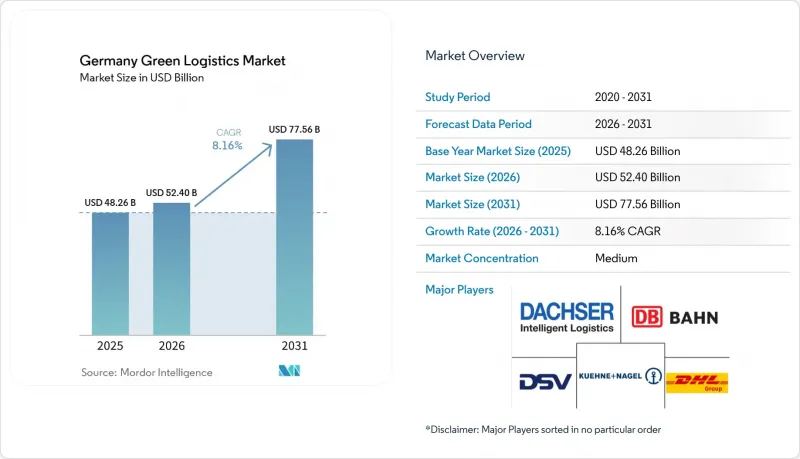
據 Mordor Intelligence 稱,2025 年德國綠色物流市場價值 482.6 億美元,預計 2026 年將達到 524 億美元,到 2031 年將達到 775.6 億美元,2026 年至 2031 年的複合年成長率為 8.16%。
貨運脫碳監管的日益嚴格、電動運輸車輛的普及以及托運人對運輸合約中可衡量的減排要求不斷提高,正在推動市場成長。本報告按物流功能(綠色運輸、綠色倉儲配送、綠色附加價值服務)、燃料和能源類型(電動物流、生質燃料物流等)、終端用戶產業(零售和電子商務、汽車業等)以及地區(北萊茵-威斯特法倫州、巴伐利亞州等)進行細分。市場預測以美元計價。
德國綠色物流市場的趨勢與洞察
關於貨運脫碳和報告方面的監管壓力。
目前,監管壓力正在影響德國綠色物流市場的日常營運決策。歐盟針對重型車輛的二氧化碳排放法規結構正穩步推進卡車脫碳進程,「FuelEU Maritime」計畫將於2025年1月起實施降低海運燃料溫室氣體排放強度的要求。此外,主要貨主要求物流合作夥伴提供更詳細的排放數據,使得碳排放報告不再只是一項輔助服務,而是成為標準商業性審核標準的一部分。這種情況迫使承運商投資於測量系統、可審計流程以及能夠支援客戶履行報告義務的服務產品。因此,德國綠色物流市場的發展不僅取決於其現有的運輸資產,也取決於其遵守法規的準備程度。
都市區和短程運輸路線上的車輛電氣化
在德國的綠色物流市場,都市區配送和短程運輸車輛的電氣化正以驚人的規模迅速擴展。 DHL集團於2025年7月新增了2400輛福特Pro電動貨車,使其在德國的電動車隊總數達到35,000輛。據該公司稱,這將使其在德國三分之一的郵政編碼區域實現零排放配送。 Hermes德國公司計劃在2026年第一季營運約1960輛電動車,從而在德國80多個城市的中心地帶實現零排放小包裹配送。這些發展正在提升低排放氣體區和交通繁忙區域的城市物流服務品質標準。同時,它們也拉大了能夠推動大規模車輛轉型的大型營運商與仍依賴傳統車輛的小型承運商之間的差距。
零排放車輛和充電基礎設施是高度資本密集的。
高昂的初始成本仍然是德國綠色物流市場廣泛採用電動車的最大障礙。 Hermann、DSV 和其他營運商受益於德國聯邦政府的 KsNI 支援框架,Hermann 已將其電動車部署與該計劃於 2025 年結束前的補貼掛鉤。 Daxer 也表示,儘管其電動車部署規模不斷擴大,但車輛購置成本仍然很高,公共卡車充電基礎設施仍然不足。這種成本差異有利於可以透過更廣泛的網路和長期合約實現投資多元化的大型營運商。因此,儘管客戶對低排放服務的需求不斷成長,但小型運輸公司面臨轉型速度較慢的挑戰。
細分市場分析
預計到2025年,綠色運輸將佔市場佔有率的61.58%,這意味著貨運仍將主導德國綠色物流市場。該領域涵蓋公路、鐵路、航空和海運活動,目前營運重點主要集中在公路電氣化和多式聯運鐵路項目。預計到2031年,綠色附加價值服務及其他服務將以12.75%的複合年成長率實現最高成長,這反映出市場對排放數據管理、永續包裝支援和檢驗服務的需求日益成長。這一轉變表明,除了運輸營運本身,客戶也越來越重視認證、測量和流程支援。在德國綠色物流市場,服務模式正在發生變化,諮詢和報告服務正從包含在服務包中的增值服務轉變為付費附加選項。
綠色倉儲物流介於這兩種極端之間,隨著營運商升級其設施能源系統和現場發電設備,其重要性日益凸顯。 2025年,FIEGE將其位於格雷文-萊肯費爾德的太陽能發電系統擴建至約3000千瓦峰值功率(kWp),年發電量高達2.4吉瓦時(GWh)。此類設施投資可減少營運排放,並支援倉庫更靈活的能源利用。因此,德國的綠色物流產業正從單純關注運輸轉向更廣泛的營運模式,將數據、設施和能源管理納入服務包中。
其他好處:
- Excel格式的市場預測(ME)表
- 3個月的分析師支持
目錄
第1章:引言
- 研究假設和市場定義
- 調查範圍
第2章:調查方法
第3章執行摘要
第4章 市場狀況
- 市場概況及綠色物流在物流中的作用
- ESG相關支出趨勢
- 市場促進因素
- 關於貨運脫碳和報告的監管壓力
- 都市區和短程路線車輛的電氣化
- 客戶對低碳物流和採購的需求日益成長
- 運輸方式從公路轉向鐵路和內河航運
- 碳感知路由、貨物整合與網路最佳化軟體
- 綠倉庫維修、屋頂太陽能發電與能源管理系統
- 市場限制因素
- 零排放車輛車隊和充電基礎設施需要高額資本投入。
- 貨運路線上氫氣供應短缺且缺乏高功率充電設施。
- 由於過渡到混合機隊,運作複雜性增加,負載容量降低。
- 為提高低利潤物流合約的永續性而進行的投資,其回報緩慢。
- 法律規範
- 價值鍊和分銷管道的結構分析
- 技術創新前景
- 波特五力模型
- 綠色物流需求的演變
- 地緣政治事件對供應鏈變化的影響
第5章 市場規模及成長預測(價值,2026-2031 年)
- 按職能分類的物流
- 綠色交通
- 路
- 航空
- 海路和內河水道
- 鐵路
- 綠色倉儲和物流
- 綠色附加價值服務及其他
- 綠色交通
- 燃料類型/能源類型
- 電動物流
- 利用生質燃料的物流
- 氫動力物流
- 其他
- 按最終用戶行業分類
- 零售與電子商務
- 製造業和工業
- 車
- 醫療和藥品
- 食品/飲料
- 化學品和危險物質
- 其他
- 按地區
- 北萊茵-威斯特法倫州
- 巴伐利亞
- 巴登-符騰堡州
- 其他州
第6章 競爭情勢
- 市場集中度
- 關鍵策略趨勢
- 市佔率分析
- 公司簡介
- DHL Group
- DSV A/S(including DB Schenker)
- Kuehne+Nagel
- Dachser Group SE & Co. KG
- Deutsche Bahn AG
- Rhenus SE & Co. KG
- Hellmann Worldwide Logistics SE & Co. KG
- AP Moller's Maersk
- CEVA Logistics(CMA CGM)
- GEODIS
- FIEGE Logistik Stiftung & Co. KG
- BLG Logistics Group AG & Co. KG
- UPS
- FedEx
- Hermes Europe GmbH
- GLS Germany GmbH & Co. OHG
- DPD Deutschland
- Hapag-Lloyd
- Lufthansa Cargo
- Nagel-Group
- Gebruder Weiss
- Nippon Express Holdings
第7章 市場機會與未來展望
According to Mordor Intelligence, the Germany green logistics market size was valued at USD 48.26 billion in 2025 and is forecast to reach USD 52.40 billion in 2026 and USD 77.56 billion by 2031 at 8.16% CAGR from 2026 to 2031.
Tighter freight decarbonization rules, wider use of electric delivery fleets, and stronger shipper demand for measurable emissions cuts in transport contracts are shaping growth. This report is Segmented by Logistics Function (Green Transportation, Green Warehousing and Distribution, Green Value-Added Services), by Fuel/Energy Type (Electric Powered Logistics, Biofuel-Based Logistics, and More), by End-User Industry (Retail & E-Commerce, Automotive, and More), and by Region (North Rhine-Westphalia, Bavaria, and More). The Market Forecasts are Provided in Terms of Value (USD).
Germany Green Logistics Market Trends and Insights
Regulatory Pressure on Freight Decarbonization and Reporting
Regulatory pressure now shapes daily operating choices across the Germany green logistics market. The EU heavy-duty vehicle CO2 framework keeps truck decarbonization on a fixed path, and FuelEU Maritime has applied a fuel greenhouse gas intensity reduction requirement for maritime transport since January 2025. Large shippers also need more detailed emissions data from logistics partners, which makes carbon reporting part of normal commercial qualification rather than a side service. This is pushing carriers to invest in measurement systems, auditable processes, and service offers that can support customer reporting obligations. The Germany green logistics market is therefore being shaped by compliance readiness as much as by physical transport assets.
Fleet Electrification in Urban and Short-Haul Lanes
Fleet electrification in city delivery and short-haul transport has moved into a visible scale in the Germany green logistics market. DHL Group expanded its electric fleet in Germany to 35,000 vehicles after adding 2,400 Ford Pro e-vans in July 2025, and the company said this supports zero-emission delivery across one-third of German postcodes. Hermes Germany reached emission-free parcel delivery across more than 80 German city centers by the end of Q1 2026, with around 1,960 electric vehicles in service. These moves are raising the standard for urban logistics service quality in low-emission zones and dense delivery districts. They also widen the gap between large operators that can scale fleet conversion and smaller carriers that still rely on conventional assets.
High Capital Intensity of Zero-Emission Fleets and Charging Infrastructure
High upfront costs remain the clearest brake on wider adoption in the Germany green logistics market. Hellmann, DSV, and other operators benefited from the German federal KsNI support framework, and Hellmann linked its e-mobility rollout to that subsidy support before the program ended in 2025. Dachser also stated in 2025 that vehicle acquisition costs remained high and public charging infrastructure for trucks was still scarce, even as the company expanded its electric fleet. This cost gap favors larger operators that can spread investment across bigger networks and longer contract books. Smaller carriers, therefore, face a slower transition path, even as customer demand for low-emission services rises.
Other drivers and restraints analyzed in the detailed report include:
- Rising Customer Demand for Low-Carbon Logistics Procurement
- Intermodal Shift from Road to Rail and Inland Waterways
- Limited Hydrogen and High-Power Charging Availability on Freight Corridors
For complete list of drivers and restraints, kindly check the Table Of Contents.
Segment Analysis
Green transportation accounted for 61.58% share in 2025, indicating that freight movement still accounts for the majority of spending in the Germany green logistics market size. This segment includes road, rail, air, and sea activity, and road electrification and intermodal rail projects are drawing much of the current operational attention. Green value-added services and others are projected to record the fastest growth at 12.75% CAGR through 2031, reflecting stronger demand for emissions data management, sustainable packaging support, and verification services. That shift shows that customers increasingly value proof, measurement, and process support alongside the transport task itself. In the Germany green logistics market, service design is changing: advisory and reporting work is becoming a paid add-on rather than a bundled extra.
Green warehousing and distribution sits between these two poles and is gaining relevance as operators upgrade site energy systems and local power generation. FIEGE expanded its photovoltaic system in Greven-Reckenfeld in 2025 to around 3,000 kWp, with annual generation of up to 2.4 GWh. That kind of site investment lowers operating emissions and supports more resilient energy use in warehouses. The Germany green logistics industry is therefore moving from a transport-only transition to a broader operating model that includes data, facilities, and energy management within the service package.
Complete Report Scope:
- By Logistics Function
- Green Transportation
- Road
- Air
- Sea and Inland Waterways
- Rail
- Green Warehousing & Distribution
- Green Value-added Services and Others
- Green Transportation
- By Fuel / Energy Type
- Electric-Powered Logistics
- Biofuel-Based Logistics
- Hydrogen-Powered Logistics
- Others
- By End-user Industry
- Retail & E-commerce
- Manufacturing & Industrial
- Automotive
- Healthcare & Pharmaceuticals
- Food & Beverages
- Chemicals & Hazardous Materials
- Others
- By Region
- North Rhine-Westphalia
- Bavaria (Bayern)
- Baden-Wurttemberg
- Rest of States
List of Companies Covered in this Report:
- DHL Group
- DSV A/S (including DB Schenker)
- Kuehne+Nagel
- Dachser Group SE & Co. KG
- Deutsche Bahn AG
- Rhenus SE & Co. KG
- Hellmann Worldwide Logistics SE & Co. KG
- A.P. Moller's Maersk
- CEVA Logistics (CMA CGM)
- GEODIS
- FIEGE Logistik Stiftung & Co. KG
- BLG Logistics Group AG & Co. KG
- UPS
- FedEx
- Hermes Europe GmbH
- GLS Germany GmbH & Co. OHG
- DPD Deutschland
- Hapag-Lloyd
- Lufthansa Cargo
- Nagel-Group
- Gebruder Weiss
- Nippon Express Holdings
Additional Benefits:
- The market estimate (ME) sheet in Excel format
- 3 months of analyst support
TABLE OF CONTENTS
1 Introduction
- 1.1 Study Assumptions & Market Definition
- 1.2 Scope of the Study
2 Research Methodology
3 Executive Summary
4 Market Landscape
- 4.1 Market Overview and Role of Green Logistics in Logistics
- 4.2 ESG Spending Trends
- 4.3 Market Drivers
- 4.3.1 Regulatory Pressure on Freight Decarbonization and Reporting
- 4.3.2 Fleet Electrification in Urban and Short-Haul Lanes
- 4.3.3 Rising Customer Demand for Low-Carbon Logistics Procurement
- 4.3.4 Intermodal Shift from Road to Rail and Inland Waterways
- 4.3.5 Carbon-Aware Routing, Load Consolidation, and Network Optimization Software
- 4.3.6 Green Warehouse Retrofits, Rooftop Solar, and Energy Management Systems
- 4.4 Market Restraints
- 4.4.1 High Capital Intensity of Zero-Emission Fleets and Charging Infrastructure
- 4.4.2 Limited Hydrogen and High-Power Charging Availability on Freight Corridors
- 4.4.3 Higher Operational Complexity from Mixed-Fleet Transition and Payload Penalties
- 4.4.4 Slow Payback for Sustainability Upgrades in Low-Margin Logistics Contracts
- 4.5 Regulatory Framework
- 4.6 Value Chain and Distribution Channel Architecture Analysis
- 4.7 Technology Innovations Outlook
- 4.8 Porter's Five Forces
- 4.8.1 Threat of New Entrants
- 4.8.2 Bargaining Power of Suppliers
- 4.8.3 Bargaining Power of Buyers
- 4.8.4 Threat of Substitutes
- 4.8.5 Rivalry Among Competitors
- 4.9 Evolution of Green Logistics Requirements
- 4.10 Impact of Geo-Political Events on Supply Chain Shifts
5 Market Size & Growth Forecasts (Value, 2026-2031)
- 5.1 By Logistics Function
- 5.1.1 Green Transportation
- 5.1.1.1 Road
- 5.1.1.2 Air
- 5.1.1.3 Sea and Inland Waterways
- 5.1.1.4 Rail
- 5.1.2 Green Warehousing & Distribution
- 5.1.3 Green Value-added Services and Others
- 5.1.1 Green Transportation
- 5.2 By Fuel / Energy Type
- 5.2.1 Electric-Powered Logistics
- 5.2.2 Biofuel-Based Logistics
- 5.2.3 Hydrogen-Powered Logistics
- 5.2.4 Others
- 5.3 By End-user Industry
- 5.3.1 Retail & E-commerce
- 5.3.2 Manufacturing & Industrial
- 5.3.3 Automotive
- 5.3.4 Healthcare & Pharmaceuticals
- 5.3.5 Food & Beverages
- 5.3.6 Chemicals & Hazardous Materials
- 5.3.7 Others
- 5.4 By Region
- 5.4.1 North Rhine-Westphalia
- 5.4.2 Bavaria (Bayern)
- 5.4.3 Baden-Wurttemberg
- 5.4.4 Rest of States
6 Competitive Landscape
- 6.1 Market Concentration
- 6.2 Key Strategic Moves
- 6.3 Market Share Analysis
- 6.4 Company Profiles (includes Global level Overview, Market level overview, Core Segments, Financials as available, Strategic Information, Market Rank/Share for key companies, Products & Services, and Recent Developments)
- 6.4.1 DHL Group
- 6.4.2 DSV A/S (including DB Schenker)
- 6.4.3 Kuehne+Nagel
- 6.4.4 Dachser Group SE & Co. KG
- 6.4.5 Deutsche Bahn AG
- 6.4.6 Rhenus SE & Co. KG
- 6.4.7 Hellmann Worldwide Logistics SE & Co. KG
- 6.4.8 A.P. Moller's Maersk
- 6.4.9 CEVA Logistics (CMA CGM)
- 6.4.10 GEODIS
- 6.4.11 FIEGE Logistik Stiftung & Co. KG
- 6.4.12 BLG Logistics Group AG & Co. KG
- 6.4.13 UPS
- 6.4.14 FedEx
- 6.4.15 Hermes Europe GmbH
- 6.4.16 GLS Germany GmbH & Co. OHG
- 6.4.17 DPD Deutschland
- 6.4.18 Hapag-Lloyd
- 6.4.19 Lufthansa Cargo
- 6.4.20 Nagel-Group
- 6.4.21 Gebruder Weiss
- 6.4.22 Nippon Express Holdings
7 Market Opportunities & Future Outlook
- 7.1 White-space & Unmet-Need Assessment

 印度綠色物流:市場佔有率分析、產業趨勢與統計及成長預測(2026-2031)美國綠色物流:市場佔有率分析、產業趨勢與統計及成長預測(2026-2031)綠色物流:市場佔有率分析、產業趨勢與統計、成長預測(2026-2031)
 綠色物流市場分析及預測(至2035年):依類型、產品、服務、技術、組件、應用、部署、最終用戶及解決方案分類
 2026年全球綠色物流市場報告
 2034年全球電動貨運和綠色物流走廊市場預測-按商業模式、運輸方式、走廊基礎設施、技術、最終用戶和區域分類的全球分析
 綠色物流市場:按車隊遠端資訊處理、電動車充電基礎設施、類型和最終用途分類-全球預測,2026-2032年
 2026-2030年全球綠色物流認證服務市場綠色物流市場預測至2032年:按組件、運輸方式、業務類型、最終用戶和地區分類的全球分析
 全球綠色物流市場