


 |
市場調查報告書
商品編碼
2098561
GPU程式設計平台:市佔率分析、產業趨勢與統計、成長預測(2026-2031年)GPU Programming Platform - Market Share Analysis, Industry Trends & Statistics, Growth Forecasts (2026 - 2031) |
||||||

※ 本網頁內容可能與最新版本有所差異。詳細情況請與我們聯繫。
根據 Mordor Intelligence 預測,GPU 程式設計平台市場規模預計將在 2025 年達到 47.3 億美元,到 2031 年達到 159.7 億美元,2026 年至 2031 年的複合年成長率將達到 22.20%。
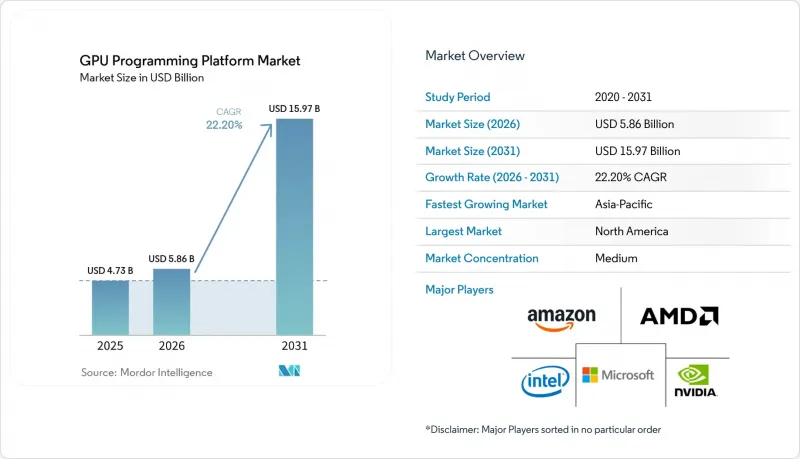
本報告按元件(軟體和服務)、部署模式(本地部署、公共雲端、私有雲端/專用託管雲等)、程式設計模型(ROCm 和 HIP、OneAPI 和 SYCL、OpenCL、基於指令的模型、GPU 核心和 AI 編譯器工具鍊等)、最終用戶(通訊等)以及地區進行細分。市場預測以美元計價。
全球GPU編程平台市場趨勢與洞察
AI訓練和推理工作負載對高度可移植的GPU程式碼的需求日益成長。
人工智慧模型的發展已將GPU程式設計平台市場從利基市場轉變為企業運算領域的主流軟體需求。據NVIDIA稱,Blackwell級系統在高達8192個GPU的規模下,引領了MLPerf Training v6.0的測試,這表明在生產環境中部署大規模訓練叢集時,軟體效能至關重要。這種廣泛的擴展是由推理驅動的,因為生產環境中的推理必須在雲端實例、本地叢集和邊緣系統等混合環境中高效運行,而不是在單一的統一訓練環境中運行。這種需求正推動GPU程式設計平台市場向中間件、SDK和抽象工具發展,使團隊能夠管理不同的記憶體結構、編譯器行為和精確度設置,而無需從頭開始重建應用程式。此外,美國能源局預測,到2026年,人工智慧生成的高效能運算(HPC)程式碼將在關鍵科學領域獲得高度認可,這凸顯了對能夠在共用GPU資源上同時處理人工智慧和科學運算的平台的需求。
企業對跨廠商GPU可移植性的需求日益成長。
企業負責人越來越傾向於選擇能夠減少對單一GPU供應商依賴的軟體,尤其是在供應飽和和硬體價格波動可能影響部署決策的情況下。 GPU程式設計平台市場正在積極回應,將更多價值轉移到可移植性層,該層允許工作負載在NVIDIA和AMD環境下運行,且只需極少的程式碼變更。 2026年初,AMD重點介紹了ROCm的日益普及和平台支援的擴展,顯示替代軟體堆疊對於生產級AI和HPC用例而言正變得越來越實用。 2026年4月,Modular進一步強化了這一趨勢,它允許單一容器在NVIDIA和AMD Instinct GPU上運作。這為企業提供了一條直接實現多供應商部署的途徑,而無需在每次硬體遷移時重寫應用程式。這一點意義重大,因為隨著軟體決策不再受限於單一硬體藍圖,採購團隊可以將工作負載分配到多個供應商,GPU程式設計平台市場將實現更快速的成長。
CUDA生態系內部存在嚴重的鎖定與遷移障礙
CUDA 仍是限制 GPU 程式設計平台市場廣泛多元化的最強結構性因素。這是因為許多生產工作負載最初都是針對 NVIDIA 環境所建置、測試和最佳化的。 NVIDIA 透過 CUDA-X 函式庫、編譯器改進和開發者工具進一步鞏固了其主導地位,這些工具減少了 NVIDIA 生態系統內團隊的最佳化工作量。實際上,擁有大規模AI 和 HPC 程式碼庫的公司面臨著漫長的遷移過程,因為在遷移到不同的技術堆疊時,自訂核心、框架整合和記憶體管理選擇通常需要單獨檢驗。在安全關鍵型和高度監管的工作負載中,這個問題尤其突出,因為現有基於 CUDA 的實作中經過檢驗的良好記錄可能會成為延遲採用替代技術的因素。因此,即使競爭硬體和開源技術堆疊的效能不斷提升,GPU 程式設計平台市場的部分佔有率仍依賴現有環境。
細分市場分析
截至2025年,軟體將佔GPU編程平台市場的62.38%,預計到2031年將以23.41%的複合年成長率成長。這顯示價值重心正從單純的硬體存取轉向開發和執行層。這反映了程式設計模型、編譯器、中介軟體、效能分析工具和SDK在人工智慧訓練、推理和科學運算等領域實現GPU工作負載的重要性。 NVIDIA在2026年推出的CUDA 13.3和CompileIQ進一步強化了這個趨勢,它們引入了AI驅動的編譯器自動調優和基於分塊的C++核心編程,提高了生產工作負載的最佳化效率。隨著GPU編程平台市場的擴張,軟體支出仍將佔最大佔有率。這是因為企業需要的是可移植性、監控功能和更快的調優週期,而不是一次性的基礎設施建置。
到 2025 年,服務將佔據剩餘的 37.62% 市場佔有率,隨著部署環境日益複雜和遷移專案增多,該領域在 GPU 程式設計平台產業中的重要性日益凸顯。諮詢、整合和程式碼移植服務正受益於在不影響生產效能的前提下,將工作負載從 CUDA、ROCm 和 SYCL 環境遷移的需求。 Meta 的 KernelAgent 專案專注於利用 LLM 在 NVIDIA 和 Intel XPU 目標平台上產生 Triton 內核,這也表明隨著工具鏈自動化的進步,對培訓、實施支援和系統化開發人員協助的需求日益成長。對於那些不願自行組建編譯器和效能工程團隊的中型企業而言,託管服務預計仍將至關重要,這將在軟體授權和平台訂閱之外,持續推動 GPU 程式設計平台市場的服務需求。
2025年,公共雲端佔據了GPU程式設計平台市場46.51%的佔有率。這反映了超大規模資料中心業者在託管GPU環境、彈性容量和整合開發服務方面所擁有的規模經濟優勢。公有雲的主導地位得益於AWS、Google Cloud、Microsoft Azure、Oracle以及其他專注於GPU的供應商的廣泛支持,這些供應商將運算能力與編配和框架的存取權限相結合。 VAST Data於2026年2月發布的Polaris平台,透過單一控制平面提供跨公共雲端、新雲和本地環境的編配,從而把握了這一轉變。同時,混合雲和多重雲端預計將以22.73%的複合年成長率成長至2031年,因為許多公司希望將受監管的資料和持久推理工作負載保留在靠近其內部基礎設施的位置,同時在高峰需求期間利用外部容量。
在資料居住、安全性或穩定利用等需要更嚴格基礎設施控制的情況下,私有雲端、專用託管雲和本地環境仍然發揮著至關重要的作用。德國的「工業人工智慧雲」於2026年2月推出,配備了約1萬塊NVIDIA Blackwell GPU,這表明即使是主權和受監管的部署也能連接到大規模人工智慧程序,而無需完全依賴公共雲端架構。本地環境的重要性在科學領域也顯而易見,例如美國能源局(DOE) 的 NERSC Doudna 系統,其下一代超級運算仍然依賴本地程式設計環境,這些環境支援與雲端人工智慧管道相同的軟體庫。這種混合環境支撐著GPU程式設計平台市場,因為客戶並非優先考慮某種部署模式,而是尋求跨所有部署模式的軟體連續性。
區域分析
2025年,北美佔據GPU編程平台市場51.82%的佔有率,持續穩居全球領先地位。該地區擁有最集中的GPU廠商、超大規模資料中心業者、人工智慧軟體公司和企業客戶,為平台開發和部署奠定了堅實的基礎。 CoreWeave在2026年的資金籌措活動以及與Jane Street達成的60億美元交易表明,該地區對GPU基礎設施的商業性需求持續快速成長。 NVIDIA於2025年9月與英特爾的合作也體現了北美在人工智慧基礎設施領域深厚的供應鏈和平台協作實力。此外,美國能源局將繼續支持程式碼可移植性和高階運算抽象化方面的工作,這將有助於維持對異質GPU環境的長期軟體需求。
歐洲仍然是GPU程式設計平台市場結構性的重要區域,數據主權、產業政策和受監管的人工智慧應用正在塑造市場需求。歐盟計畫興建多達五座人工智慧超級工廠,首座預計於2026年投入運作。這將支援新一輪與公共和產業投資相關的自主GPU軟體環境(ZDF)。德國與德國電信、英偉達和Polarise合作開發的「工業人工智慧雲」於2026年2月透過大規模的Blackwell部署,展示了此模式最清晰的範例之一。該環境強調一種能夠跨私有雲端和互聯雲資源整合合規性、效能追蹤和部署柔軟性的軟體堆疊。
預計到2031年,亞太地區將以22.68%的複合年成長率成長,成為GPU程式設計平台市場成長最快的區域板塊。這一成長與自主運算的擴張和國內生態系統的發展密切相關,尤其是在中國和印度,GPU基礎設施策略正逐漸成為更廣泛的人工智慧能力規劃的一部分。此外,隨著企業準備部署多樣化的GPU環境而非單一的統一硬體基礎,開放式、多廠商工具鏈的日益普及也使該地區受益。南美和中東及非洲仍處於發展初期,但隨著超大規模資料中心業者和區域GPU雲端供應商擴大對高階運算的訪問,部署基礎設施正在不斷改進。隨著訪問的改善,預計這些地區的GPU編程平台市場也將擴張,主要面向金融、製造業和電信業的工作負載。
其他好處:
- Excel格式的市場預測(ME)表
- 3個月的分析師支持
目錄
第1章:引言
- 研究假設和市場定義
- 調查範圍
第2章:調查方法
第3章執行摘要
第4章 市場狀況
- 市場概覽
- 市場促進因素
- AI訓練和推理工作負載對可攜式GPU程式碼的需求日益成長。
- 企業對獨立於供應商的GPU可移植性的需求日益成長。
- 雲端原生GPU開發環境的擴展
- 開放原始碼GPU工具鏈降低了新用戶的入門門檻。
- 在高效能運算和全人類人工智慧(GenAI)技術堆疊中擴展異質運算的應用
- 對效能調優和開發人員生產力提升工具的需求日益成長。
- 市場限制因素
- 對 CUDA 生態系的深度依賴以及過渡過程中的摩擦。
- 標準碎片化涵蓋 HIP、SYCL、oneAPI 和 OpenCL
- 遷移過程中需要進行檢驗、重新最佳化和測試,這些都需要高昂的成本。
- GPU編譯器和效能工程領域人才短缺。
- 產業價值鏈分析
- 監理情勢
- 技術展望
- 波特五力分析
第5章 市場規模與成長預測
- 按組件
- 軟體
- 程式設計工具和編譯器
- 中介軟體、SDK 和可移植性工具
- 庫和運行時系統
- 效能監控和分析工具
- 開發、測試和調試工具
- 服務
- 諮詢、整合和程式碼遷移服務
- 託管服務
- 培訓、支援和維護服務
- 軟體
- 按部署模式
- 現場
- 公共雲端
- 私有雲端/專用託管雲
- 混合雲端和多重雲端
- 透過程式設計模型
- CUDA
- ROCm 和 HIP
- oneAPI 和 SYCL
- OpenCL
- 基於指令的模型
- GPU核心與AI編譯器工具鏈
- 其他程式設計模型
- 最終用戶
- 雲端服務供應商和資料中心營運商
- IT、軟體、網際網路和SaaS供應商
- 電訊
- 銀行業、金融服務業及保險業
- 醫療保健和生命科學
- 製造業
- 汽車和運輸業
- 其他最終用戶
- 按地區
- 北美洲
- 美國
- 加拿大
- 墨西哥
- 歐洲
- 德國
- 英國
- 法國
- 義大利
- 其他歐洲國家
- 亞太地區
- 中國
- 日本
- 韓國
- 印度
- 東南亞
- 其他亞太國家
- 南美洲
- 中東和非洲
- 北美洲
第6章 競爭情勢
- 市場集中度
- 策略趨勢
- Vendor Positioning Analysis
- 公司簡介
- NVIDIA Corporation
- Advanced Micro Devices, Inc.
- Intel Corporation
- Amazon Web Services, Inc.
- Microsoft Corporation
- IBM Corporation
- Google LLC
- Hewlett Packard Enterprise Development LP
- Dell Technologies Inc.
- Alibaba Group Holding Limited
- Tencent Holdings Limited
- Red Hat, Inc.
- DigitalOcean Holdings, Inc.
- CoreWeave, Inc.
- Anyscale, Inc.
- Modular, Inc.
- Scale AI, Inc.
- SchedMD LLC
- Atos SE
第7章 市場機會與未來展望
According to Mordor Intelligence, the GPU programming platform market size was USD 4.73 billion in 2025 and is projected to reach USD 15.97 billion by 2031, expanding at a CAGR of 22.20% over 2026-2031.
This report is Segmented by Component (Software, and Services), Deployment Model (On-Premises, Public Cloud, Private Cloud/Dedicated Hosted Cloud, and More), Programming Model (ROCm and HIP, Oneapi and SYCL, Opencl, Directive-Based Models, GPU Kernel and AI Compiler Toolchains, and More), End User (Telecommunications, and More), and Geography. The Market Forecasts are Provided in Terms of Value (USD).
Global GPU Programming Platform Market Trends and Insights
Rising AI Training And Inference Workloads Requiring Portable GPU Code
AI model development has shifted the GPU programming platform market from a specialized niche to a mainstream software requirement for enterprise compute. NVIDIA reported that Blackwell-class systems led MLPerf Training v6.0 at scales up to 8,192 GPUs, which shows how much software performance now matters when large training clusters are deployed in production. The broader expansion is driven by inference, because production inference must run efficiently across a mix of cloud instances, local clusters, and edge systems rather than a single uniform training environment. That need is pushing the GPU programming platform market toward middleware, SDKs, and abstraction tools that can manage different memory structures, compiler behaviors, and precision settings without forcing teams to rebuild applications from scratch. The U.S. Department of Energy also noted in 2026 that AI-generated HPC code was reaching high levels of trust across key scientific domains, which supports demand for platforms that can serve both AI and scientific computing on shared GPU estates.
Growing Enterprise Demand for Cross-Vendor GPU Portability
Enterprise buyers are increasingly seeking software that reduces reliance on a single GPU vendor, especially when supply concentration and hardware pricing can influence deployment decisions. The GPU programming platform market is responding by shifting more value into portability layers that help workloads run across NVIDIA and AMD environments with fewer code changes. AMD highlighted wider ROCm adoption and broader platform support in early 2026, showing that alternative software stacks are becoming more practical for production AI and HPC use cases. Modular reinforced that direction in April 2026, when it enabled a single container to run across NVIDIA and AMD Instinct GPUs, giving enterprises a direct path to multi-vendor deployment without rewriting applications at each hardware transition. This matters because the GPU programming platform market grows faster when software decisions are no longer tied to a single hardware roadmap and when procurement teams can spread workloads across multiple suppliers.
Deep CUDA Ecosystem Lock-In and Migration Friction
CUDA remains the strongest structural restraint on broad diversification in the GPU programming platform market because many production workloads were built, tested, and optimized first for NVIDIA environments. NVIDIA continues to deepen that position through CUDA-X libraries, compiler improvements, and developer tooling that shorten the optimization workload for teams already in the NVIDIA ecosystem. In practical terms, enterprises with large AI and HPC codebases face a long migration path because custom kernels, framework integrations, and memory management choices often require separate validation when moving to another stack. The problem is more pronounced in safety-sensitive, regulated workloads, where the validation history of an existing CUDA-based implementation can slow the adoption of alternatives. This keeps parts of the GPU programming platform market tied to incumbent environments, even when competing hardware or open stacks become more capable.
Other drivers and restraints analyzed in the detailed report include:
- Expansion of Cloud-Native GPU Development Environments
- Open-Source GPU Toolchains Lowering Entry Barriers for New Users
- Fragmented Standards Across HIP, SYCL, oneAPI, and OpenCL
For complete list of drivers and restraints, kindly check the Table Of Contents.
Segment Analysis
Software accounted for 62.38% of the GPU programming platform market in 2025 and is projected to expand at a 23.41% CAGR through 2031, indicating that value is moving toward the development and execution layers rather than remaining concentrated on hardware access alone. That position reflects the importance of programming models, compilers, middleware, profiling tools, and SDKs in making GPU workloads usable across AI training, inference, and scientific computing. NVIDIA reinforced this direction in 2026 with CUDA 13.3 and CompileIQ, which introduced AI-driven compiler autotuning and tile-based C++ kernel programming to improve optimization productivity on production workloads. As the GPU programming platform market expands, software continues to attract the strongest spending because enterprises need portability, monitoring, and faster tuning cycles more than a one-time infrastructure setup.
Services represented the remaining 37.62% share in 2025, and this part of the GPU programming platform industry is gaining weight as deployments become more complex and migration projects multiply. Consulting, integration, and code porting services are benefiting from demand to move workloads between CUDA, ROCm, and SYCL environments without disrupting production performance. Meta's KernelAgent project, which focuses on LLM-assisted Triton kernel generation across NVIDIA and Intel XPU targets, also points to a growing need for training, implementation support, and structured developer enablement as toolchains become more automated. Managed services are likely to remain important for mid-sized enterprises that do not want to build in-house compiler and performance engineering teams, which gives the GPU programming platform market a durable services tail alongside software licensing and platform subscriptions.
Public cloud held 46.51% share of the GPU programming platform market size in 2025, reflecting the scale advantage hyperscalers have in managed GPU environments, elastic capacity, and integrated development services. The leading cloud position was built on broad support from AWS, Google Cloud, Microsoft Azure, Oracle, and GPU-focused providers that package compute with orchestration and access to frameworks. VAST Data's Polaris release in February 2026 captured that shift by offering orchestration across public cloud, neocloud, and on-premises environments through one control plane. At the same time, hybrid and multicloud are projected to expand at a 22.73% CAGR through 2031, as many enterprises seek to keep regulated data and persistent inference workloads closer to their internal infrastructure while using external capacity for peak demand.
Private cloud, dedicated hosted cloud, and on-premises estates remain important where data residency, security, or stable utilization levels justify tighter infrastructure control. Germany's Industrial AI Cloud, launched in February 2026 with around 10,000 NVIDIA Blackwell GPUs, demonstrated that sovereign and regulated deployments can still connect to large-scale AI programs without relying solely on public cloud architectures. On-premises relevance is also visible in scientific environments such as the DOE's NERSC Doudna system, where next-generation supercomputing still depends on a local programming environment that supports the same software libraries used in cloud AI pipelines. This mix supports the GPU programming platform market because customers are not choosing one deployment model over another, they are asking for software continuity across all of them.
Complete Report Scope:
- By Component
- Software
- Programming Tools and Compilers
- Middleware, SDKs, and Portability Tools
- Libraries and Runtime Systems
- Performance Monitoring and Profiling Tools
- Developer, Testing, and Debugging Tools
- Services
- Consulting, Integration, and Code Migration Services
- Managed Services
- Training, Support, and Maintenance Services
- Software
- By Deployment Model
- On-Premises
- Public Cloud
- Private Cloud / Dedicated Hosted Cloud
- Hybrid and Multicloud
- By Programming Model
- CUDA
- ROCm and HIP
- oneAPI and SYCL
- OpenCL
- Directive-Based Models
- GPU Kernel and AI Compiler Toolchains
- Other Programming Models
- By End User
- Cloud Service Providers and Data Center Operators
- IT, Software, Internet, and SaaS Providers
- Telecommunications
- Banking, Financial Services, and Insurance
- Healthcare and Life Sciences
- Manufacturing
- Automotive and Transportation
- Other End Users
- By Geography
- North America
- United States
- Canada
- Mexico
- Europe
- Germany
- United Kingdom
- France
- Italy
- Rest of Europe
- Asia-Pacific
- China
- Japan
- South Korea
- India
- Southeast Asia
- Rest of Asia-Pacific
- South America
- Middle East and Africa
- North America
Geography Analysis
North America held 51.82% of the GPU programming platform market share in 2025, which kept it firmly ahead of every other region. The region combines the largest concentration of GPU vendors, hyperscalers, AI software companies, and enterprise buyers, providing a strong base for both platform development and adoption. CoreWeave's funding activity in 2026 and its USD 6 billion agreement with Jane Street showed that commercial demand for GPU infrastructure was still scaling rapidly in the region. NVIDIA's September 2025 collaboration with Intel also reflected the depth of the North American supply chain and platform coordination around AI infrastructure. In addition, the U.S. Department of Energy continued to support code portability and abstraction work for advanced computing, which helps sustain long-term software demand around heterogeneous GPU environments.
Europe remains a structurally important region for the GPU programming platform market because data sovereignty, industrial policy, and regulated AI deployment are shaping demand. The EU planned a portfolio of up to 5 AI Gigafactories, with the first facilities expected to become operational from 2026, which supports a new wave of sovereign GPU software environments tied to public and industrial investment ZDF. Germany's Industrial AI Cloud, developed with Deutsche Telekom, NVIDIA, and Polarise, added one of the clearest examples of this model in February 2026 through a large Blackwell-based deployment. This environment favors software stacks that can combine compliance, performance tracking, and deployment flexibility across private and connected cloud resources.
Asia-Pacific is projected to expand at a 22.68% CAGR through 2031, which makes it the fastest-growing regional block in the GPU programming platform market. The growth is tied to sovereign compute buildouts and domestic ecosystem development, especially in China and India, where GPU infrastructure strategy is becoming part of broader AI capacity planning. The region also benefits from growing acceptance of open and multi-vendor toolchains as enterprises prepare for mixed GPU fleets instead of one uniform hardware base. South America and the Middle East and Africa remain earlier-stage markets, but the infrastructure conditions for adoption are improving as hyperscalers and regional GPU cloud providers widen access to advanced compute. As that access improves, the GPU programming platform market should broaden across finance, manufacturing, and telecom workloads in these regions as well.
- NVIDIA Corporation
- Advanced Micro Devices, Inc.
- Intel Corporation
- Amazon Web Services, Inc.
- Microsoft Corporation
- IBM Corporation
- Google LLC
- Hewlett Packard Enterprise Development LP
- Dell Technologies Inc.
- Alibaba Group Holding Limited
- Tencent Holdings Limited
- Red Hat, Inc.
- DigitalOcean Holdings, Inc.
- CoreWeave, Inc.
- Anyscale, Inc.
- Modular, Inc.
- Scale AI, Inc.
- SchedMD LLC
- Atos SE
Additional Benefits:
- The market estimate (ME) sheet in Excel format
- 3 months of analyst support
TABLE OF CONTENTS
1 INTRODUCTION
- 1.1 Study Assumptions and Market Definition
- 1.2 Scope of the Study
2 RESEARCH METHODOLOGY
3 EXECUTIVE SUMMARY
4 MARKET LANDSCAPE
- 4.1 Market Overview
- 4.2 Market Drivers
- 4.2.1 Rising AI Training and Inference Workloads Requiring Portable GPU Code
- 4.2.2 Growing Enterprise Demand for Cross-Vendor GPU Portability
- 4.2.3 Expansion of Cloud-Native GPU Development Environments
- 4.2.4 Open-Source GPU Toolchains Lowering Entry Barriers for New Users
- 4.2.5 Increasing Use of Heterogeneous Compute in HPC and GenAI Stacks
- 4.2.6 Rising Need for Performance Tuning and Developer Productivity Tools
- 4.3 Market Restraints
- 4.3.1 Deep CUDA Ecosystem Lock-In and Migration Friction
- 4.3.2 Fragmented Standards Across HIP, SYCL, oneAPI, and OpenCL
- 4.3.3 High Validation, Re-Optimization, and Testing Costs During Porting
- 4.3.4 Scarcity of GPU Compiler and Performance Engineering Talent
- 4.4 Industry Value Chain Analysis
- 4.5 Regulatory Landscape
- 4.6 Technological Outlook
- 4.7 Porter's Five Forces Analysis
- 4.7.1 Bargaining Power of Suppliers
- 4.7.2 Bargaining Power of Buyers
- 4.7.3 Threat of New Entrants
- 4.7.4 Threat of Substitutes
- 4.7.5 Competitive Rivalry
5 MARKET SIZE AND GROWTH FORECASTS (VALUE)
- 5.1 By Component
- 5.1.1 Software
- 5.1.1.1 Programming Tools and Compilers
- 5.1.1.2 Middleware, SDKs, and Portability Tools
- 5.1.1.3 Libraries and Runtime Systems
- 5.1.1.4 Performance Monitoring and Profiling Tools
- 5.1.1.5 Developer, Testing, and Debugging Tools
- 5.1.2 Services
- 5.1.2.1 Consulting, Integration, and Code Migration Services
- 5.1.2.2 Managed Services
- 5.1.2.3 Training, Support, and Maintenance Services
- 5.1.1 Software
- 5.2 By Deployment Model
- 5.2.1 On-Premises
- 5.2.2 Public Cloud
- 5.2.3 Private Cloud / Dedicated Hosted Cloud
- 5.2.4 Hybrid and Multicloud
- 5.3 By Programming Model
- 5.3.1 CUDA
- 5.3.2 ROCm and HIP
- 5.3.3 oneAPI and SYCL
- 5.3.4 OpenCL
- 5.3.5 Directive-Based Models
- 5.3.6 GPU Kernel and AI Compiler Toolchains
- 5.3.7 Other Programming Models
- 5.4 By End User
- 5.4.1 Cloud Service Providers and Data Center Operators
- 5.4.2 IT, Software, Internet, and SaaS Providers
- 5.4.3 Telecommunications
- 5.4.4 Banking, Financial Services, and Insurance
- 5.4.5 Healthcare and Life Sciences
- 5.4.6 Manufacturing
- 5.4.7 Automotive and Transportation
- 5.4.8 Other End Users
- 5.5 By Geography
- 5.5.1 North America
- 5.5.1.1 United States
- 5.5.1.2 Canada
- 5.5.1.3 Mexico
- 5.5.2 Europe
- 5.5.2.1 Germany
- 5.5.2.2 United Kingdom
- 5.5.2.3 France
- 5.5.2.4 Italy
- 5.5.2.5 Rest of Europe
- 5.5.3 Asia-Pacific
- 5.5.3.1 China
- 5.5.3.2 Japan
- 5.5.3.3 South Korea
- 5.5.3.4 India
- 5.5.3.5 Southeast Asia
- 5.5.3.6 Rest of Asia-Pacific
- 5.5.4 South America
- 5.5.5 Middle East and Africa
- 5.5.1 North America
6 COMPETITIVE LANDSCAPE
- 6.1 Market Concentration
- 6.2 Strategic Moves
- 6.3 Vendor Positioning Analysis
- 6.4 Company Profiles (includes Global Level Overview, Market Level Overview, Core Segments, Financials as available, Strategic Information, Market Rank/Share, Products and Services, Recent Developments)
- 6.4.1 NVIDIA Corporation
- 6.4.2 Advanced Micro Devices, Inc.
- 6.4.3 Intel Corporation
- 6.4.4 Amazon Web Services, Inc.
- 6.4.5 Microsoft Corporation
- 6.4.6 IBM Corporation
- 6.4.7 Google LLC
- 6.4.8 Hewlett Packard Enterprise Development LP
- 6.4.9 Dell Technologies Inc.
- 6.4.10 Alibaba Group Holding Limited
- 6.4.11 Tencent Holdings Limited
- 6.4.12 Red Hat, Inc.
- 6.4.13 DigitalOcean Holdings, Inc.
- 6.4.14 CoreWeave, Inc.
- 6.4.15 Anyscale, Inc.
- 6.4.16 Modular, Inc.
- 6.4.17 Scale AI, Inc.
- 6.4.18 SchedMD LLC
- 6.4.19 Atos SE
7 MARKET OPPORTUNITIES AND FUTURE OUTLOOK
- 7.1 White-Space and Unmet-Need Assessment

 快速入口裝卸鎖門市場規模、佔有率及成長分析:依機構/驅動系統、真空壓力耐受等級、結構材料/基材、最終用途產業及地區分類-2026-2033年產業預測
 中介層和矽橋市場報告:趨勢、預測和競爭分析(至2035年)
 用於 HBM 的矽中介層和基板:市場佔有率分析、行業趨勢和統計數據以及成長預測(2026-2031 年)GPU晶圓需求:市佔率分析、產業趨勢與統計、成長預測(2026-2031年)
 中介層及矽橋市場規模、佔有率、成長、全球產業分析、區域趨勢及2026年至2034年預測GPU和HPC用矽中介層:市場佔有率分析、產業趨勢與統計數據以及成長預測(2026-2031年)
 2026年全球量子模擬器市場報告2026年全球多模態記憶體市場報告2026 年 AI 工作負載的 RoCE(基於融合乙太網路的 RDMA)全球市場報告
 伺服器和高效能運算用ABF基板市場:按應用、材料類型、層數和基板厚度分類,全球預測,2026-2032年