

 |
市場調查報告書
商品編碼
2098559
GPU記憶體:市佔率分析、產業趨勢與統計、成長預測(2026-2031)GPU Memory - Market Share Analysis, Industry Trends & Statistics, Growth Forecasts (2026 - 2031) |
||||||

※ 本網頁內容可能與最新版本有所差異。詳細情況請與我們聯繫。
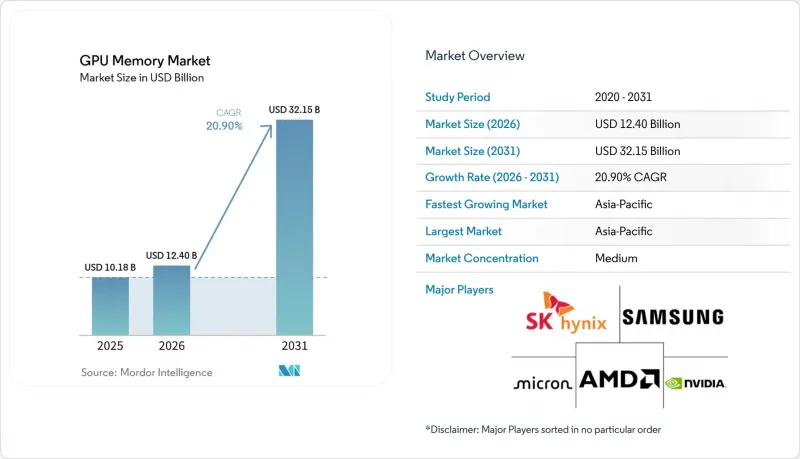
根據 Mordor Intelligence 預測,GPU 記憶體市場預計將從 2025 年的 101.8 億美元成長到 2026 年的 124 億美元,到 2031 年達到 321.5 億美元,2026 年至 2031 年的複合年預計成長率為 20.90%。
本報告按記憶體類型(HBM、GDDR 等)、記憶體容量(8 GB 或以下、8 GB 至 16 GB、16 GB 至 32 GB、32 GB 至 64 GB、64 GB 或 16 GB、16 GB 至 32 GB、32 GB 至 64 GB、64 GB 或 16 GB、16 GB 至 32 GB、32 GB 至 64 GB、64 GB 或以上)、應用領域(專業視覺化與內容創作、邊緣 AI 和嵌入式加速、高效能運算、雲端 GPU 和資料區加速市場預測以美元 (USD) 為單位。
全球GPU記憶體市場趨勢及洞察
AI訓練叢集的擴張增加了HBM的消耗。
隨著人工智慧基礎設施的擴展,HBM 已從一種高階記憶體選項轉變為 GPU 記憶體市場的主要供應來源之一。 NVIDIA 為每顆 Blackwell B200 GPU 指定了 192 GB 的 HBM3E,而對於 GB300 Blackwell Ultra,這項要求已提升至每顆 GPU 288 GB,從而導致每一代加速器的記憶體容量大幅增加。 NVIDIA 還表示,單一 GB200 NVL72 機架將包含超過 13.4 TB 的 HBM3E,這表明其採購策略已從晶片級決策轉向機架級合約。這項變更意味著 GPU 記憶體市場的成長不僅源自於加速器出貨量的增加,還因為每個部署現在消耗的記憶體遠遠超出以往的系統設計。短期內,預計供應將進一步趨緊,因為僅僅增加晶圓產量並不能解決整個 GPU 記憶體市場在堆疊、封裝和認證方面的限制。
NVIDIA Blackwell及其後續平台的部署增加了對認證的需求。
平台過渡如今已成為GPU記憶體市場最關鍵的時機因素之一。這是因為記憶體供應商需要為每一代新產品獲得認證,才能開始收到主要客戶的大量訂單。 2026年6月,彭博社報道稱,三星、SK海力士和美光已獲得NVIDIA「Vera Rubin」平台HBM4的認證。這意味著認證是進入下一個供應週期的敲門磚。隨後,SK海力士與NVIDIA達成了一項涵蓋HBM4、Vera Rubin系統、RTX Spark PC以及Jetson Thor機器人平台的多年技術合作協議,進一步鞏固了其市場地位。這些平台的部署迫使供應商同時支援HBM3E、HBM4及其下一代衍生產品的重疊藍圖,加劇了整個GPU記憶體市場的研發壓力。因此,儘早獲得認證往往與擴大生產規模同等重要,因為獲得認證的供應量才是客戶可以立即部署的數量。
認證供應商的集中度限制了供應的柔軟性。
供應商集中度仍然是GPU記憶體市場最明顯的限制因素之一,因為只有少數幾家製造商能夠大規模供應經認證的HBM記憶體。彭博社證實,到2026年,只有三星、SK海力士和美光三家公司能夠獲得NVIDIA第四代HBM記憶體的認證,凸顯了認證供應商數量的有限性。根據《首爾經濟日報》報道,一些全球大型科技公司甚至提案直接資助SK海力士的生產線和設備建設。這表明,透過常規採購管道增加供應量有多麼困難。這種集中度降低了GPU記憶體市場的整體供應柔軟性,因為如果需求成長速度超過計畫產能,新客戶無法迅速轉向其他供應商。這也意味著,採購時機越來越不僅取決於終端需求和GPU晶圓的供應情況,還取決於能否取得配額協議和認證。
細分市場分析
截至2025年,HBM將佔據GPU記憶體市場42.11%的佔有率,成為最大的記憶體類型。預計到2031年,GPU記憶體市場將以21.52%的複合年成長率成長。 HBM之所以能保持其主導地位,是因為大規模AI訓練和推理系統如今依賴於高頻寬、高密度封裝以及每個平台週期中GPU記憶體規格的提升。 NVIDIA目前面向資料中心的藍圖已經顯示了需求的快速成長,預計Blackwell及其後續產品將顯著提高每個加速器和每個機架的HBM使用量。彭博社也證實,三星、SK海力士和美光已獲得NVIDIA 2026年HBM4週期的認證,這將推動HBM收入的下一階段成長。
供應商積極的2026年藍圖進一步支撐了HBM的成長前景,三星和SK海力士正積極推進12層HBM4E及相關下一代產品的上市。 SK海力士宣布,HBM4E樣品出貨量在2026年6月將達到每堆疊48GB,將推動未來AI加速器記憶體容量的大幅提升。 GDDR仍然是GPU記憶體市場中HBM的重要補充,支援低成本推理、遊戲、視覺化和工作站部署,在這些應用中,系統經濟性比最大頻寬更為重要。 Rhambus和NVIDIA都已表示,GDDR7正在被引入其主流產品線,這為市場帶來了除HBM主導的伺服器叢集之外的第二個廣闊成長平台。其他類型的記憶體仍然重要,但它們的作用更為有限,主要與那些以犧牲頻寬為代價來實現低成本和高容量的架構相關。
區域分析
到2025年,亞太地區將佔據GPU記憶體市場48.34%的佔有率,成為供應和收入方面最大的區域中心。韓國憑藉三星和SK海力士等公司作為HBM製造基地,鞏固了這一地位;而台灣地區仍然是先進封裝技術的中心,這對於人工智慧加速器採用HBM至關重要。根據《韓國中央日報》報道,三星和SK海力士正在擴大HBM相關產品的生產,進一步鞏固了亞太地區作為GPU記憶體市場核心生產基地的地位。日本則透過半導體製造設備、測試系統和記憶體研發支持,為市場注入深度,並強化了支持製造連續性的區域生態系統。此外,隨著雲端服務供應商在新加坡、馬來西亞和印尼等地擴大資料中心佈局,印度和東南亞在GPU記憶體市場的重要性也日益凸顯。
北美仍是GPU記憶體市場的主要需求中心。這是因為規模最大的AI基礎設施項目仍然集中在美國,尤其是在雲端和平台公司。 Mordor Intelligence指出,北美大規模訓練與資料中心GPU部署持續影響硬體採購模式,直接支撐HBM和GDDR兩大記憶體類別的需求。此外,隨著客戶尋求更廣泛的地域採購基礎,他們越來越重視美國相關的記憶體生產能力,北美也因此受益於供應鏈多元化。因此,儘管亞太地區仍是GPU記憶體製造最集中的地區,但北美在GPU記憶體市場仍佔據著舉足輕重的地位。
隨著超大規模資料中心業者和企業在日益嚴格的管治和合規要求下擴展其人工智慧賦能能力,歐洲正成為GPU記憶體市場中日益重要的消費區域。 AWS承諾到2033年投資337億歐元(357億美元)以擴大西班牙的GPU產能;2025年12月,Google宣布將投資55億歐元(58.3億美元)以擴大其在哈瑙和法蘭克福的GPU和TPU產能。歐盟人工智慧立法也推動了對私有雲端和本地人工智慧基礎設施的需求,進而帶動了依賴高階記憶體配置的企業對硬體的需求。儘管南美和中東及非洲目前的市場規模相對較小,但隨著各國人工智慧專案和數位基礎設施計畫在預測期內的推進,這些地區的GPU記憶體市場仍有進一步成長的空間。
其他好處:
- Excel格式的市場預測(ME)表
- 3個月的分析師支持
目錄
第1章:引言
- 研究假設和市場定義
- 調查範圍
第2章:調查方法
第3章執行摘要
第4章 市場狀況
- 市場概覽
- 宏觀經濟因素對市場的影響
- 市場促進因素
- AI訓練叢集的擴張導致了HBM消耗量的增加。
- NVIDIA Blackwell及其後續平台的推出增加了對認證的需求。
- 由於雲端遊戲和人工智慧工作站的升級,GDDR7 的應用正在不斷擴大。
- 擴大先進封裝技術的產能,為GPU記憶體供應開闢了新的途徑。
- 對於資料中心GPU,OEM廠商正致力於提高每瓦頻寬。
- 推理加速器對高容量模組的需求日益成長。
- 市場限制因素
- 認證供應商的集中度限制了供應的柔軟性。
- 3D堆疊和TSV製程的良率敏感性
- HBM 和 GDDR 晶圓生產啟動數量供應短缺。
- 緊湊型GPU平台的散熱與電源限制
- 產業價值鏈分析
- 監理情勢
- 技術展望
- 波特五力分析
第5章 市場規模與成長預測
- 按記憶體類型
- HBM
- GDDR
- 其他GPU記憶體類型
- 按儲存容量
- 8 GB 或更少
- 8 GB~16 GB
- 16 GB~32 GB
- 32 GB~64 GB
- 64 GB 或更多
- 透過使用
- 商用視覺化與內容創作
- 人工智慧訓練和推理
- 高效能運算
- 雲端GPU和資料中心加速
- 遊戲和消費圖形
- 邊緣人工智慧和嵌入式加速
- 按地區
- 北美洲
- 美國
- 加拿大
- 墨西哥
- 歐洲
- 德國
- 英國
- 法國
- 義大利
- 其他歐洲國家
- 亞太地區
- 中國
- 日本
- 韓國
- 印度
- 東南亞
- 其他亞太國家
- 南美洲
- 中東和非洲
- 北美洲
第6章 競爭情勢
- 市場集中度
- 策略趨勢
- 市佔率分析
- 公司簡介
- Samsung Electronics Co., Ltd.
- SK hynix Inc.
- Micron Technology, Inc.
- NVIDIA Corporation
- Advanced Micro Devices, Inc.
- Intel Corporation
- Broadcom Inc.
- Marvell Technology, Inc.
- Taiwan Semiconductor Manufacturing Company Limited
- Amkor Technology, Inc.
- ASE Technology Holding Co., Ltd.
- Powertech Technology Inc.
- United Microelectronics Corporation
- Cadence Design Systems, Inc.
- Synopsys, Inc.
- Rambus Inc.
- Applied Materials, Inc.
- GlobalFoundries Inc.
- Chipbond Technology Corporation
- JCET Group Co., Ltd.
- Siliconware Precision Industries Co., Ltd.
第7章 市場機會與未來展望
According to Mordor Intelligence, the GPU memory market size is expected to increase from USD 10.18 billion in 2025 to USD 12.40 billion in 2026 and reach USD 32.15 billion by 2031, growing at a CAGR of 20.90% over 2026-2031.
This report is Segmented by Memory Type (HBM, GDDR, and More), Memory Capacity (Up To 8 GB, 8 GB To 16 GB, 16 GB To 32 GB, 32 GB To 64 GB, and Above 64 GB), Application (Professional Visualization and Content Creation, Edge AI and Embedded Acceleration, High-Performance Computing, Cloud GPU and Data Center Acceleration, and More), and Geography. The Market Forecasts are Provided in Terms of Value (USD).
Global GPU Memory Market Trends and Insights
AI Training Cluster Expansion Increasing HBM Consumption
AI infrastructure buildouts have turned HBM from a premium memory option into one of the main supply gates for the GPU memory market. NVIDIA specified 192 GB of HBM3E for each Blackwell B200 GPU, and the GB300 Blackwell Ultra raises that requirement to 288 GB per GPU, which sharply lifts memory content per accelerator generation. NVIDIA also stated that a single GB200 NVL72 rack carries more than 13.4 TB of HBM3E, which shows why procurement has shifted from chip-level decisions to rack-level commitments. This change means the GPU memory market grows not only because more accelerators are shipped, but also because each deployment now absorbs far more memory than earlier system designs. The near-term effect is tighter supply utilization, since additional wafer starts alone do not solve limits in stacking, packaging, and qualification across the GPU memory market.
NVIDIA Blackwell and Successor Platform Rollouts Increasing Qualification Demand
Platform transitions are now one of the strongest timing factors in the GPU memory market because memory suppliers need to qualify each new generation before large customer volumes begin. Bloomberg reported in June 2026 that Samsung, SK hynix, and Micron all cleared HBM4 certification for NVIDIA Vera Rubin, making qualification the gateway to the next supply cycle. SK hynix then deepened that position with a multi-year technology partnership with NVIDIA covering HBM4, Vera Rubin systems, RTX Spark-powered PCs, and Jetson Thor robotics platforms. These platform rollouts force suppliers to support overlapping roadmaps for HBM3E, HBM4, and next-generation derivatives at the same time, which raises development pressure across the GPU memory market. The practical result is that early certification often matters as much as manufacturing scale, because qualified volume is what customers can deploy without delay.
Qualified Supplier Concentration Limiting Volume Flexibility
Supplier concentration remains one of the clearest constraints on the GPU memory market because only a very small group of manufacturers can deliver qualified HBM at scale. Bloomberg confirmed in 2026 that Samsung, SK hynix, and Micron were the three memory makers certified for NVIDIA's HBM4 cycle, which underlines how limited the qualified supplier base remains. Seoul Economic Daily reported that global large technology companies even proposed direct funding for SK hynix production lines and equipment, which shows how difficult it is to secure incremental supply through normal purchasing channels. This concentration reduces volume flexibility across the GPU memory market because new customers cannot quickly diversify to alternative sources when demand rises faster than planned capacity. It also means procurement timing is increasingly set by allocation agreements and qualification access, not only by end demand or GPU wafer availability.
Other drivers and restraints analyzed in the detailed report include:
- Cloud Gaming and AI Workstation Upgrades Increasing GDDR7 Adoption
- Advanced Packaging Capacity Buildout Unlocking New GPU Memory Supply
- Yield Sensitivity In 3D Stacking and TSV Processing
For complete list of drivers and restraints, kindly check the Table Of Contents.
Segment Analysis
HBM held 42.11% of the GPU memory market share in 2025, making it the largest memory type, and this part of the GPU memory market size is projected to rise at a 21.52% CAGR through 2031. HBM keeps that lead because large AI training and inference systems now depend on high bandwidth, dense packaging, and rising memory-per-GPU specifications across each platform cycle. NVIDIA's current data center roadmap already shows how fast requirements are increasing, with Blackwell and successor systems moving to much higher HBM loads per accelerator and per rack. Bloomberg also confirmed that Samsung, SK hynix, and Micron all qualified for NVIDIA's HBM4 cycle in 2026, which supports the next phase of HBM revenue expansion.
The growth profile of HBM is also reinforced by active supplier roadmaps in 2026, with Samsung and SK hynix moving 12-layer HBM4E and related next-generation products toward customer deployment. SK hynix stated that its June 2026 HBM4E sample shipments reached 48 GB per stack, which supports the move toward much larger memory footprints in future AI accelerators. GDDR remains the main complement to HBM in the GPU memory market because it supports lower-cost inference, gaming, visualization, and workstation deployments where system economics matter more than maximum bandwidth. Rambus and NVIDIA both showed that GDDR7 is now moving into mainstream product lines, which gives the market a broad second growth base outside HBM-heavy server clusters. Other memory types still matter, but their role remains more selective and is tied to architectures that trade peak bandwidth for lower cost or higher capacity per dollar.
Complete Report Scope:
- By Memory Type
- HBM
- GDDR
- Other GPU Memory Types
- By Memory Capacity
- Up to 8 GB
- 8 GB to 16 GB
- 16 GB to 32 GB
- 32 GB to 64 GB
- Above 64 GB
- By Application
- Professional Visualization and Content Creation
- AI Training and Inference
- High-Performance Computing
- Cloud GPU and Data Center Acceleration
- Gaming and Consumer Graphics
- Edge AI and Embedded Acceleration
- By Geography
- North America
- United States
- Canada
- Mexico
- Europe
- Germany
- United Kingdom
- France
- Italy
- Rest of Europe
- Asia Pacific
- China
- Japan
- South Korea
- India
- Southeast Asia
- Rest of Asia-Pacific
- South America
- Middle East and Africa
- North America
Geography Analysis
Asia-Pacific accounted for 48.34% of the GPU memory market share in 2025, which made it the largest regional base for both supply and revenue. The region holds that position because South Korea anchors HBM manufacturing through Samsung and SK hynix, while Taiwan remains central to advanced packaging that is required for HBM deployment in AI accelerators. Korea JoongAng Daily reported that Samsung and SK hynix are scaling HBM-related production, which reinforces Asia-Pacific's role as the core production center for the GPU memory market. Japan adds depth through semiconductor equipment, testing systems, and memory research support, which strengthens the regional ecosystem around manufacturing continuity. India and Southeast Asia are also becoming more relevant to the GPU memory market as cloud operators expand data center footprints in Singapore, Malaysia, and Indonesia.
North America remains the main demand center in the GPU memory market because the largest AI infrastructure programs are still concentrated among U.S. cloud and platform companies. Mordor Intelligence stated that large-scale training and data center GPU deployments in North America continue to shape hardware procurement patterns, which directly supports memory demand across HBM and GDDR categories. The region also benefits from supply-chain diversification efforts, since U.S.-linked memory capacity is increasingly valued by customers that want a broader geographic sourcing base. This keeps North America important to the GPU memory market even though the heaviest manufacturing concentration remains in Asia-Pacific.
Europe is becoming a more meaningful consumption geography for the GPU memory market as hyperscalers and enterprises add AI-ready capacity under stricter governance and compliance needs. AWS committed EUR 33.7 billion (USD 35.7 billion), to expand GPU capacity in Spain through 2033, and Google announced EUR 5.5 billion (USD 5.83 billion), for GPU and TPU buildout in Hanau and Frankfurt in December 2025. The EU AI Act is also supporting demand for private cloud and on-premise AI infrastructure, which lifts enterprise hardware demand that depends on advanced memory content. South America and Middle East and Africa remain smaller in current scale, but the GPU memory market has room to deepen there as sovereign AI projects and digital infrastructure programs advance through the forecast period.
- Samsung Electronics Co., Ltd.
- SK hynix Inc.
- Micron Technology, Inc.
- NVIDIA Corporation
- Advanced Micro Devices, Inc.
- Intel Corporation
- Broadcom Inc.
- Marvell Technology, Inc.
- Taiwan Semiconductor Manufacturing Company Limited
- Amkor Technology, Inc.
- ASE Technology Holding Co., Ltd.
- Powertech Technology Inc.
- United Microelectronics Corporation
- Cadence Design Systems, Inc.
- Synopsys, Inc.
- Rambus Inc.
- Applied Materials, Inc.
- GlobalFoundries Inc.
- Chipbond Technology Corporation
- JCET Group Co., Ltd.
- Siliconware Precision Industries Co., Ltd.
Additional Benefits:
- The market estimate (ME) sheet in Excel format
- 3 months of analyst support
TABLE OF CONTENTS
1 INTRODUCTION
- 1.1 Study Assumptions and Market Definition
- 1.2 Scope of the Study
2 RESEARCH METHODOLOGY
3 EXECUTIVE SUMMARY
4 MARKET LANDSCAPE
- 4.1 Market Overview
- 4.2 Impact of Macroeconomic Factors on the Market
- 4.3 Market Drivers
- 4.3.1 AI Training Cluster Expansion Increasing HBM Consumption
- 4.3.2 NVIDIA Blackwell and Successor Platform Rollouts Increasing Qualification Demand
- 4.3.3 Cloud Gaming and AI Workstation Upgrades Increasing GDDR7 Adoption
- 4.3.4 Advanced Packaging Capacity Buildout Unlocking New GPU Memory Supply
- 4.3.5 OEM Preference for Higher Bandwidth Per Watt in Data Center GPUs
- 4.3.6 Rising Demand for High-Capacity Modules in Inference Accelerators
- 4.4 Market Restraints
- 4.4.1 Qualified Supplier Concentration Limiting Volume Flexibility
- 4.4.2 Yield Sensitivity in 3D Stacking and TSV Processing
- 4.4.3 Allocation Tension Between HBM and GDDR Wafer Starts
- 4.4.4 Thermal and Power-Delivery Limits in Compact GPU Platforms
- 4.5 Industry Value Chain Analysis
- 4.6 Regulatory Landscape
- 4.7 Technological Outlook
- 4.8 Porter's Five Forces Analysis
- 4.8.1 Threat of New Entrants
- 4.8.2 Bargaining Power of Suppliers
- 4.8.3 Bargaining Power of Buyers
- 4.8.4 Threat of Substitutes
- 4.8.5 Competitive Rivalry
5 MARKET SIZE AND GROWTH FORECASTS
- 5.1 By Memory Type
- 5.1.1 HBM
- 5.1.2 GDDR
- 5.1.3 Other GPU Memory Types
- 5.2 By Memory Capacity
- 5.2.1 Up to 8 GB
- 5.2.2 8 GB to 16 GB
- 5.2.3 16 GB to 32 GB
- 5.2.4 32 GB to 64 GB
- 5.2.5 Above 64 GB
- 5.3 By Application
- 5.3.1 Professional Visualization and Content Creation
- 5.3.2 AI Training and Inference
- 5.3.3 High-Performance Computing
- 5.3.4 Cloud GPU and Data Center Acceleration
- 5.3.5 Gaming and Consumer Graphics
- 5.3.6 Edge AI and Embedded Acceleration
- 5.4 By Geography
- 5.4.1 North America
- 5.4.1.1 United States
- 5.4.1.2 Canada
- 5.4.1.3 Mexico
- 5.4.2 Europe
- 5.4.2.1 Germany
- 5.4.2.2 United Kingdom
- 5.4.2.3 France
- 5.4.2.4 Italy
- 5.4.2.5 Rest of Europe
- 5.4.3 Asia Pacific
- 5.4.3.1 China
- 5.4.3.2 Japan
- 5.4.3.3 South Korea
- 5.4.3.4 India
- 5.4.3.5 Southeast Asia
- 5.4.3.6 Rest of Asia-Pacific
- 5.4.4 South America
- 5.4.5 Middle East and Africa
- 5.4.1 North America
6 COMPETITIVE LANDSCAPE
- 6.1 Market Concentration
- 6.2 Strategic Moves
- 6.3 Market Share Analysis
- 6.4 Company Profiles (includes Global Level Overview, Market Level Overview, Core Segments, Financials as available, Strategic Information, Market Rank/Share, Products and Services, Recent Developments)
- 6.4.1 Samsung Electronics Co., Ltd.
- 6.4.2 SK hynix Inc.
- 6.4.3 Micron Technology, Inc.
- 6.4.4 NVIDIA Corporation
- 6.4.5 Advanced Micro Devices, Inc.
- 6.4.6 Intel Corporation
- 6.4.7 Broadcom Inc.
- 6.4.8 Marvell Technology, Inc.
- 6.4.9 Taiwan Semiconductor Manufacturing Company Limited
- 6.4.10 Amkor Technology, Inc.
- 6.4.11 ASE Technology Holding Co., Ltd.
- 6.4.12 Powertech Technology Inc.
- 6.4.13 United Microelectronics Corporation
- 6.4.14 Cadence Design Systems, Inc.
- 6.4.15 Synopsys, Inc.
- 6.4.16 Rambus Inc.
- 6.4.17 Applied Materials, Inc.
- 6.4.18 GlobalFoundries Inc.
- 6.4.19 Chipbond Technology Corporation
- 6.4.20 JCET Group Co., Ltd.
- 6.4.21 Siliconware Precision Industries Co., Ltd.
7 MARKET OPPORTUNITIES AND FUTURE OUTLOOK
- 7.1 White-Space and Unmet-Need Assessment

 HBM 8層堆疊與12層堆疊:市場佔有率分析、產業趨勢與統計、成長預測(2026-2031年)
 高頻寬記憶體 (HBM) 市場預測至 2034 年—按產品類型、儲存容量、封裝技術、頻寬、應用、最終用戶和地區分類的全球分析
 高頻寬記憶體市場:按記憶體類型、應用和地區分類。
 混合儲存立方體市場規模、佔有率和成長分析:按類型、應用、介面、最終用戶和地區分類——2026-2033年產業預測
 混合儲存立方體和高頻寬儲存市場:按儲存類型、容量、外形規格、技術、產品類型、應用、國家和地區分類-全球產業分析、市場規模、市場佔有率及2026年至2033年預測高頻寬記憶體(HBM)市場:全球產業分析、市場規模、市場佔有率及按處理器類型、單堆疊記憶體容量、技術、應用、國家和地區分類的預測-2026年至2033年顯存:市場佔有率分析、產業趨勢與統計、成長預測(2026-2031)高速記憶體:市場佔有率分析、產業趨勢與統計資料、成長預測(2026-2031)2034年HBM平台市場預測-按平台類型、記憶標準、應用和地區分類的全球分析高頻寬記憶體 (HBM) 和先進記憶體介面市場:預測(至 2034 年)—按記憶體類型、介面技術、應用和地區分類的全球分析