


 |
市場調查報告書
商品編碼
2097336
有機太陽能電池:市場佔有率分析、產業趨勢與統計及成長預測(2026-2031)Organic Solar Cell - Market Share Analysis, Industry Trends & Statistics, Growth Forecasts (2026 - 2031) |
||||||

※ 本網頁內容可能與最新版本有所差異。詳細情況請與我們聯繫。
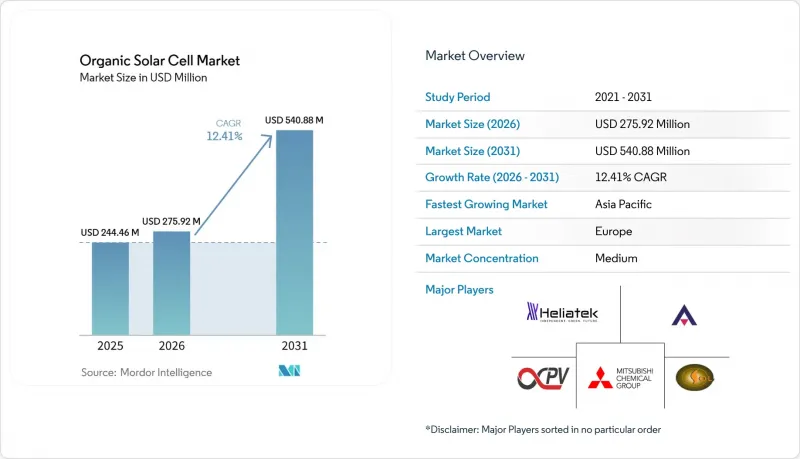
根據 Mordor Intelligence 預測,有機太陽能電池市場預計將從 2025 年的 2.4446 億美元成長到 2026 年的 2.7592 億美元,到 2031 年達到 5.4088 億美元,2026 年至 2031 年的複合年成長率為 12.41%。
本報告按類型(小分子、聚合物、雜化材料、新興結構)、應用(建築光伏一體化、家用電子電器、汽車等)、最終用戶(住宅、商業及工業、公共產業、政府及軍事)和地區(北美、歐洲、亞太、南美、中東和非洲)進行細分。市場預測以美元計價。
全球有機太陽能電池市場趨勢與洞察
利用非富勒烯受體快速提高效率
到2025年,經認證的單結太陽能電池效率將達到20.82%,顯著縮小與碲化鎘薄膜技術的差距,並使有機太陽能電池成為主流商業應用的可行方案。 Y6系列受體增強了近紅外線頻譜的吸收,將電壓損耗降低至0.5V以下,並提高了熱循環穩定性。 2024年至2026年初,已記錄了200多項專利申請,中國、德國和日本已成為重要的創新中心。然而,由於非富勒烯受體(NFA)合成的複雜性增加,原料成本不斷上漲,這意味著長期競爭力取決於能否將捲對卷生產規模從試點階段擴大到規模。諸如Heliatek的「Flex16」生產線等關鍵措施旨在使建築光伏一體化(BIPV)應用中的組件效率超過16%。
對超輕量光電建築維修的需求
在市政近零能耗法規和企業LEED認證目標的推動下,對建築一體化光伏(BIPV)維修的需求日益成長。這是因為有機組件的重量約為2公斤/平方米,僅為框架式矽面板重量的五分之一。 2025年7月,NEXT Energy Technologies公司安裝了一面40x60吋的幕牆,由六塊面板組成,實現了3.5%的效率和32%的可見光透過率。該裝置能夠在不顯著降低室內照明的情況下,抵銷建築物20-25%的插電負載。將於2026年生效的歐盟太陽能標準強制要求大規模非住宅建築安裝太陽能相容屋頂。此外,法國於2025年10月將低碳組件的增值稅(VAT)降至5.5%,這使得有機光伏組件的價格優勢高達14.5個百分點。此外,輕質有機薄片解決了歷史建築外觀的結構荷載限制問題,從而實現了矽基解決方案難以實現的維修機會。
模組壽命不足10年
2025 年的戶外測試顯示,7 個月後效率維持率為 91%,但投資人仍要求 25 年的表現預測。在潮濕高溫環境下,使用 IEC 61215 協議進行的測試表明,1032 小時後效率保持率為 94%,這相當於實際使用條件下的約 3-5 年。然而,潮氣侵入和劣化等問題仍然是限制保固期的因素。根據 VDE 2025 年的“銀行合格評估”,貸款機構要求至少兩年的現場數據,但很少有供應商能夠達到這一標準,Heliatek 就是一個突出的例子。由於對老化率缺乏共識,保險公司採用了保守的劣化劣化,導致其平準化電力成本 (LCOE) 高於矽基系統。封裝技術的進步,例如採用原子層沉積的隔離層,旨在實現 15 年的使用壽命,以符合商業租賃條款。
細分市場分析
到2025年,小分子裝置將佔據有機太陽能電池市場47.1%的佔有率。這主要得益於真空沉澱所實現的高層均勻性以及OLED製程的應用。結合聚合物給體和小分子受體的混合結構,透過平衡吸收頻寬和耐熱性,滿足了特定客戶的需求。在狹縫式和凹版印刷技術的推動下,聚合物基元件預計將以14.4%的複合年成長率成長,這些技術可降低40%的資本支出,並加速規模化生產。
在汽車和國防應用領域,由於製程可重複性,低分子量聚合物仍然是首選。然而,聚合物鏈技術的進步提高了批次間的一致性,從而緩解了傳統的可靠性問題。隨著封裝技術的改進和熱循環不穩定性問題的消除,聚合物基有機太陽能電池組件的市場規模預計將顯著擴大。繼Heliatek獲得IEC 61215認證之後,相關認證工作正在進行中,預計到2027年,多條聚合物產品線將獲得類似認證。此外,專注於大宗聚合物供應的製造商也後向整合整合到單體合成中,以提高成本效益。
區域分析
預計到2025年,歐洲將佔全球銷售額的38.6%,這得益於能源轉型政策、法國的碳排放掛鉤增值稅退稅計畫以及歐盟太陽能標準所建立的有利法規結構。德國復興信貸銀行(KfW)提供的綠色貸款激勵措施降低了太陽能發電和儲能相結合的混合系統的資金籌措成本,而這些系統也受益於有機組件帶來的整體成本降低。法國對低碳組件的稅收優惠政策促使維修預算轉向有機板材,而北歐國家正在新建的零碳學校建築中試點使用透明幕牆。
亞太地區預計將以13.8%的複合年成長率實現最快成長,這主要得益於中國在特種化學品領域的領先地位(特種化學品是無富勒烯受體的主要供應來源),以及印度計劃到2026年將其預算增加32%,達到3053.9億印度盧比(約36.5億美元)。印度的計畫強制要求政府專案使用本地生產的電池。日本的ALCA-Next聯盟致力於實現超過20%的效率,而韓國的國防費用正在推動早期龍頭客戶的發展。儘管智慧財產權糾紛和出口管制的不確定性只是次要挑戰,但本地捲對卷設備製造商正在加速工廠擴張。
北美佔了15%左右的市場佔有率,這主要得益於加州第24號太陽能法規和美國國防部對輕型電源的競標。加拿大的淨零能耗建築標準和墨西哥的電子設備近岸外包措施也進一步推動了需求成長。在中東,人們對用於標誌性建築和遮蔭步道的透明光伏技術越來越感興趣。同時,巴西正在進行Agrivoltaik試點項目,該項目結合了有機面板和耐陰作物。
其他好處:
- Excel格式的市場預測(ME)表
- 3個月的分析師支持
目錄
第1章:引言
- 研究假設和市場定義
- 調查範圍
第2章:調查方法
第3章執行摘要
第4章 市場狀況
- 市場概覽
- 市場促進因素
- 利用非富勒烯受體快速提高效率
- 對超輕量光電建築維修的需求
- 歐盟碳足跡掛鉤補貼
- 企業對淨零排放太陽能的需求
- 預計到 2028 年,卷對卷印刷的成本將趨於一致。
- 國防領域對折疊式電源的需求
- 市場限制因素
- 如果模組壽命不足10年
- 非富勒烯受體原料供應瓶頸
- 缺乏銀行貸款合格標準
- 鈣鈦礦矽串聯系統之間的競爭
- 供應鏈分析
- 監理情勢
- 技術展望
- 波特五力分析
第5章 市場規模與成長預測
- 按類型
- 小分子有機太陽能電池
- 聚合物有機太陽能電池
- 混合有機太陽能電池
- 新興結構
- 透過使用
- 建築一體化光伏發電(BIPV)
- 家用電子產品
- 車
- 室內能源採集
- 國防/航太
- 其他
- 最終用戶
- 住宅
- 商業和工業用途
- 公用事業
- 政府/軍隊
- 按地區
- 北美洲
- 美國
- 加拿大
- 墨西哥
- 歐洲
- 德國
- 英國
- 法國
- 義大利
- 北歐國家
- 俄羅斯
- 其他歐洲國家
- 亞太地區
- 中國
- 印度
- 日本
- 韓國
- 東南亞國協
- 其他亞太國家
- 南美洲
- 巴西
- 阿根廷
- 其他南美國家
- 中東和非洲
- 沙烏地阿拉伯
- 阿拉伯聯合大公國
- 南非
- 埃及
- 其他中東和非洲國家
- 北美洲
第6章 競爭情勢
- 市場集中度
- 策略趨勢(併購、聯盟、購電協議)
- 市場佔有率分析(主要公司的市場排名和市場佔有率)
- 公司簡介
- Armor SA
- BASF SE
- BELECTRIC OPV GmbH
- DisaSolar SAS
- Draper Energy LLC
- Eight19 Ltd.
- Epishine AB
- FlexEnable Ltd.
- Heliatek GmbH
- Henkel AG
- InfinityPV ApS
- Mitsubishi Chemical Group Corporation
- NanoFlex Power Corporation
- Next Energy Technologies, Inc.
- ONYX Solar Group LLC
- Solarmer Energy, Inc.
- Solterra Solar Cells, Inc.
- Sumitomo Chemical Co., Ltd.
- Sunew SA
- Ynvisible Interactive Inc.
第7章 市場機會與未來展望
According to Mordor Intelligence, the organic solar cell market size is expected to increase from USD 244.46 million in 2025 to USD 275.92 million in 2026 and reach USD 540.88 million by 2031, growing at a CAGR of 12.41% over 2026-2031.
This report is Segmented by Type (Small-Molecule, Polymer, Hybrid, Emerging Structures), Application (BIPV, Consumer Electronics, Automotive, and More), End-User (Residential, Commercial & Industrial, Utilities, Government & Military), and Geography (North America, Europe, Asia-Pacific, South America, Middle East & Africa). Market Forecasts are Provided in Terms of Value (USD).
Global Organic Solar Cell Market Trends and Insights
Rapid Efficiency Gains via Non-Fullerene Acceptors
Certified single-junction efficiencies reached 20.82% in 2025, significantly reducing the gap with cadmium-telluride thin film technologies and establishing organic cells as viable for mainstream commercial applications. The Y6-family acceptors enhanced absorption into the near-infrared spectrum, reduced voltage losses to below 0.5 V, and improved thermal-cycle stability. Over 200 patent filings were recorded between 2024 and early 2026, highlighting China, Germany, and Japan as key centers of innovation. However, the higher synthesis complexity of non-fullerene acceptors (NFAs) continues to drive up raw material costs, making long-term competitiveness dependent on scaling roll-to-roll production beyond pilot-scale operations. Flagship initiatives, such as Heliatek's Flex16 line, aim to achieve module efficiencies exceeding 16% for building-integrated applications.
Demand for Ultra-Light BIPV Retrofits
Municipal near-zero-energy regulations and corporate LEED targets have driven an increase in BIPV retrofits, as organic modules weigh approximately 2 kg/m2, which is only one-fifth the weight of framed silicon panels. In July 2025, NEXT Energy Technologies installed a six-panel 40 X 60-inch facade, achieving 3.5% efficiency and 32% visible-light transmittance. This installation offset 20-25% of building plug loads without significantly reducing interior light levels. The EU Solar Standard, effective from 2026, mandates solar-ready roofs for large non-residential buildings. Additionally, France's VAT reduction to 5.5% for low-carbon modules in October 2025 created a 14.5-percentage-point price advantage for organic PV. Lightweight organic sheets also address structural-load limitations on heritage facades, enabling retrofit opportunities that silicon-based solutions often cannot meet.
Sub-10-Year Module Lifetime
Outdoor tests in 2025 showed 91% efficiency retention after seven months, but investors still require 25-year performance projections. The damp-heat IEC 61215 protocols demonstrated a 94% retention rate after 1,032 hours, equivalent to approximately three to five years in field conditions. However, issues such as moisture ingress and photodegradation continue to limit warranty durations. According to VDE's 2025 bankability review, lenders require at least two years of field data, a benchmark achieved by only a few suppliers, with Heliatek being a notable example. The lack of consensus on aging multipliers leads insurers to adopt conservative degradation rates, increasing the levelized cost of energy compared to silicon-based systems. Advances in encapsulation technologies, such as atomic-layer-deposited barriers, are targeting 15-year lifespans to align with commercial lease durations.
Other drivers and restraints analyzed in the detailed report include:
- EU Carbon-Footprint-Linked Subsidies
- Corporate Net-Zero Demand for Transparent PV
- Perovskite-Silicon Tandem Competition
For complete list of drivers and restraints, kindly check the Table Of Contents.
Segment Analysis
Small-molecule devices accounted for 47.1% of the organic solar cell market share in 2025, driven by the high-layer uniformity achieved through vacuum evaporation and the utilization of OLED toolsets. Hybrid structures, which combine polymer donors with small-molecule acceptors, address niche customer requirements by balancing absorption bandwidth and thermal resilience. Polymer variants are projected to grow at a compound annual growth rate (CAGR) of 14.4%, supported by slot-die and gravure printing technologies that offer 40% lower capital expenditure and faster scale-up potential.
Process reproducibility continues to favor small-molecule formats in automotive and defense applications. However, advancements in polymer chains have improved batch consistency, reducing previous reliability concerns. The market size for polymer-based organic solar cell modules is expected to grow significantly as encapsulation improvements address thermal-cycle instability. Certification pathways, such as Heliatek's IEC 61215 precedent, are being followed, with several polymer product lines anticipated to receive similar endorsements by 2027. Manufacturers focusing on polymer bulk supply are also pursuing backward integration into monomer synthesis to achieve cost efficiencies.
Complete Report Scope:
- By Type
- Small-Molecule Organic Solar Cells
- Polymer Organic Solar Cells
- Hybrid Organic Solar Cells
- Emerging Structures
- By Application
- Building-Integrated Photovoltaics (BIPV)
- Consumer Electronics
- Automotive
- Indoor Energy Harvesting
- Defense & Aerospace
- Others
- By End-user
- Residential
- Commercial and Industrial
- Utilities
- Government and Military
- By Geography
- North America
- United States
- Canada
- Mexico
- Europe
- Germany
- United Kingdom
- France
- Italy
- NORDIC Countries
- Russia
- Rest of Europe
- Asia-Pacific
- China
- India
- Japan
- South Korea
- ASEAN Countries
- Rest of Asia-Pacific
- South America
- Brazil
- Argentina
- Rest of South America
- Middle East and Africa
- Saudi Arabia
- United Arab Emirates
- South Africa
- Egypt
- Rest of Middle East and Africa
- North America
Geography Analysis
Europe accounted for 38.6% of the projected 2025 revenue, driven by the implementation of Energiewende policies, France's carbon-linked VAT rebates, and the EU Solar Standard, which together created a supportive regulatory framework. Germany's KfW green-loan incentives reduced financing costs for solar-plus-storage hybrids, which also benefited from the lower balance-of-system costs associated with organic modules. France's tax advantage for low-carbon modules redirected retrofit budgets toward organic sheets, and Nordic countries are piloting transparent facades in new zero-carbon schools.
The Asia-Pacific region is projected to exhibit the fastest growth, with a CAGR of 13.8%, driven by China's dominance in the specialty-chemical base for non-fullerene acceptor supply and India's planned 32% budget increase to INR 305.39 billion (USD 3.65 billion) by 2026, which mandates the use of locally manufactured cells for government projects. Japan's ALCA-Next consortium is focused on achieving efficiencies exceeding 20%, while South Korea's defense spending supports the development of early anchor customers. Although intellectual property disputes and export-control uncertainties present minor challenges, local roll-to-roll equipment manufacturers are accelerating factory ramp-ups.
North America accounts for a mid-teens market share, supported by California's Title 24 solar regulations and lightweight power tenders from the U.S. Department of Defense. Additional demand is generated by Canada's net-zero building code and Mexico's electronics near-shoring initiatives. In the Middle East, there is growing interest in transparent photovoltaic (PV) technology for iconic towers and shaded walkways. Meanwhile, Brazil is conducting agrivoltaic trials that integrate organic panels with shade-tolerant crops.
- Armor SA
- BASF SE
- BELECTRIC OPV GmbH
- DisaSolar SAS
- Draper Energy LLC
- Eight19 Ltd.
- Epishine AB
- FlexEnable Ltd.
- Heliatek GmbH
- Henkel AG
- InfinityPV ApS
- Mitsubishi Chemical Group Corporation
- NanoFlex Power Corporation
- Next Energy Technologies, Inc.
- ONYX Solar Group LLC
- Solarmer Energy, Inc.
- Solterra Solar Cells, Inc.
- Sumitomo Chemical Co., Ltd.
- Sunew S.A.
- Ynvisible Interactive Inc.
Additional Benefits:
- The market estimate (ME) sheet in Excel format
- 3 months of analyst support
TABLE OF CONTENTS
1 Introduction
- 1.1 Study Assumptions & Market Definition
- 1.2 Scope of the Study
2 Research Methodology
3 Executive Summary
4 Market Landscape
- 4.1 Market Overview
- 4.2 Market Drivers
- 4.2.1 Rapid efficiency gains via non-fullerene acceptors
- 4.2.2 Demand for ultra-light BIPV retrofits
- 4.2.3 EU carbon-footprint-linked subsidies
- 4.2.4 Corporate net-zero demand for transparent PV
- 4.2.5 Roll-to-roll printing cost parity by 2028
- 4.2.6 Defense need for foldable power
- 4.3 Market Restraints
- 4.3.1 Sub-10-year module lifetime
- 4.3.2 Non-fullerene acceptor feedstock bottlenecks
- 4.3.3 Lack of bankability standards
- 4.3.4 Perovskite-silicon tandem competition
- 4.4 Supply-Chain Analysis
- 4.5 Regulatory Landscape
- 4.6 Technological Outlook
- 4.7 Porters Five Forces Analysis
- 4.7.1 Threat of New Entrants
- 4.7.2 Bargaining Power of Buyers
- 4.7.3 Bargaining Power of Suppliers
- 4.7.4 Threat of Substitutes
- 4.7.5 Competitive Rivalry
5 Market Size & Growth Forecasts
- 5.1 By Type
- 5.1.1 Small-Molecule Organic Solar Cells
- 5.1.2 Polymer Organic Solar Cells
- 5.1.3 Hybrid Organic Solar Cells
- 5.1.4 Emerging Structures
- 5.2 By Application
- 5.2.1 Building-Integrated Photovoltaics (BIPV)
- 5.2.2 Consumer Electronics
- 5.2.3 Automotive
- 5.2.4 Indoor Energy Harvesting
- 5.2.5 Defense & Aerospace
- 5.2.6 Others
- 5.3 By End-user
- 5.3.1 Residential
- 5.3.2 Commercial and Industrial
- 5.3.3 Utilities
- 5.3.4 Government and Military
- 5.4 By Geography
- 5.4.1 North America
- 5.4.1.1 United States
- 5.4.1.2 Canada
- 5.4.1.3 Mexico
- 5.4.2 Europe
- 5.4.2.1 Germany
- 5.4.2.2 United Kingdom
- 5.4.2.3 France
- 5.4.2.4 Italy
- 5.4.2.5 NORDIC Countries
- 5.4.2.6 Russia
- 5.4.2.7 Rest of Europe
- 5.4.3 Asia-Pacific
- 5.4.3.1 China
- 5.4.3.2 India
- 5.4.3.3 Japan
- 5.4.3.4 South Korea
- 5.4.3.5 ASEAN Countries
- 5.4.3.6 Rest of Asia-Pacific
- 5.4.4 South America
- 5.4.4.1 Brazil
- 5.4.4.2 Argentina
- 5.4.4.3 Rest of South America
- 5.4.5 Middle East and Africa
- 5.4.5.1 Saudi Arabia
- 5.4.5.2 United Arab Emirates
- 5.4.5.3 South Africa
- 5.4.5.4 Egypt
- 5.4.5.5 Rest of Middle East and Africa
- 5.4.1 North America
6 Competitive Landscape
- 6.1 Market Concentration
- 6.2 Strategic Moves (M&A, Partnerships, PPAs)
- 6.3 Market Share Analysis (Market Rank/Share for key companies)
- 6.4 Company Profiles (includes Global level Overview, Market level overview, Core Segments, Financials as available, Strategic Information, Products & Services, and Recent Developments)
- 6.4.1 Armor SA
- 6.4.2 BASF SE
- 6.4.3 BELECTRIC OPV GmbH
- 6.4.4 DisaSolar SAS
- 6.4.5 Draper Energy LLC
- 6.4.6 Eight19 Ltd.
- 6.4.7 Epishine AB
- 6.4.8 FlexEnable Ltd.
- 6.4.9 Heliatek GmbH
- 6.4.10 Henkel AG
- 6.4.11 InfinityPV ApS
- 6.4.12 Mitsubishi Chemical Group Corporation
- 6.4.13 NanoFlex Power Corporation
- 6.4.14 Next Energy Technologies, Inc.
- 6.4.15 ONYX Solar Group LLC
- 6.4.16 Solarmer Energy, Inc.
- 6.4.17 Solterra Solar Cells, Inc.
- 6.4.18 Sumitomo Chemical Co., Ltd.
- 6.4.19 Sunew S.A.
- 6.4.20 Ynvisible Interactive Inc.
7 Market Opportunities & Future Outlook
- 7.1 White-space & Unmet-Need Assessment

 拓普康太陽能電池全球市場規模、佔有率、趨勢和成長分析報告(2026-2034)
 軟性太陽能電池:市場佔有率分析、產業趨勢與統計及成長預測(2026-2031)
 2026 年至 2035 年 N 型太陽能電池組件的市場機會、成長要素、產業趨勢和預測。
 串聯太陽能電池市場預測至2034年—按電池結構、效率範圍、技術、應用、最終用戶和地區分類的全球分析有機太陽能電池(OPV)市場預測—全球材料、裝置結構、應用、終端用戶和地區分析—2034年太陽能電池:市場佔有率分析、行業趨勢和統計數據、成長預測(2026-2031)
 有機太陽能電池市場規模、佔有率和趨勢分析報告:按類型、應用、最終用戶、材料、地區和細分市場分類(2026-2033 年)串聯太陽能電池市場規模、佔有率、成長、全球產業分析、區域趨勢及2026-2034年預測。第三代能源市場規模、佔有率、成長、全球產業分析、區域趨勢及2026-2034年預測。
 下一代太陽能電池市場規模、佔有率和成長分析:按技術、材料、應用、安裝類型、最終用戶、組件和地區分類-2026-2033年產業預測