


 |
市場調查報告書
商品編碼
2097317
軟性太陽能電池:市場佔有率分析、產業趨勢與統計及成長預測(2026-2031)Flexible Solar Cell - Market Share Analysis, Industry Trends & Statistics, Growth Forecasts (2026 - 2031) |
||||||

※ 本網頁內容可能與最新版本有所差異。詳細情況請與我們聯繫。
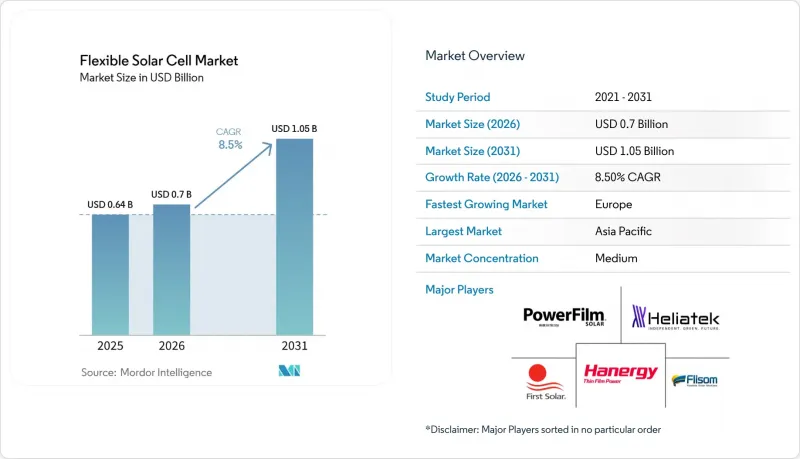
根據 Mordor Intelligence 預測,軟性太陽能電池市場規模將從 2025 年的 6.4 億美元成長到 2026 年的 7 億美元,到 2031 年將達到 10.5 億美元,2026 年至 2031 年的複合年成長率為 8.5%。
本報告按技術(有機太陽能電池、CIGS、非晶質、鈣鈦礦、染料敏化太陽能電池、新興混合太陽能電池)、基板材料(塑膠、金屬箔、超薄玻璃)、應用(建築整合太陽能、家用電子電器、汽車、航太、穿戴式設備、離網系統)和地區(北美、歐洲、亞太地區、南美、中東和非洲)進行細分。市場預測以美元計價。
全球軟性太陽能電池市場趨勢與洞察
透過卷對卷方式降低 CIGS 和 a-Si 生產成本。
2025年,新型CIGS生產線的每吉瓦資本支出降至1.2億美元,比大量生產的剛性太陽能電池工廠低33%。這使得在高太陽輻射條件下,平準化電力成本(LCOE)降至每千瓦時0.05美元。在波蘭一座100兆瓦的工廠中,引入線上雷射劃線技術使傳統人工成本降低了12%,投資回收期僅18個月。歐盟資助的測試表明,在10公尺/分鐘的捲材速度下,效率穩定在17.2%,證實了提高產量並不一定會降低性能。使用非鹵素溶劑的狹縫式製程使危險廢棄物處理成本降低了40%,考慮到REACH法規的不斷收緊,這是一項意義重大的成就。運作溫度低於200 度C的非晶質生產線現在可以直接對技術紡織品進行塗布,這為剛性晶圓不適用的穿戴式設備市場開闢了新的機會。
淨零能耗建築標準正在推動對獨立於建築的公共空間(BIPV)的需求。
歐盟《建築能源性能指令》規定,所有新建建築到2030年必須實現近零能耗,並將太陽能系統的採購納入建築供應鏈。德國《建築能源法》規定,建築暖氣必須使用65%的現場可再生能源;法國的RE2020法規限制了產品固有的碳排放量,這促使建築師採用輕盈、低碳的軟性層壓板。在西班牙和北歐國家,相關法規已擴展至倉庫和玻璃帷幕牆,顯著增加了屋頂和牆面的可用面積。軟性層壓板的重量為2-3公斤/平方米,而框架玻璃的重量為12-15公斤/平方米,因此軟性層壓板非常適合高層建築的維修,否則這些翻新將需要昂貴的結構維修。因此,銷售環節正從能源經理轉向帷幕牆工程師,這提高了需求的可見性,但也延長了從採購到最終確定規格的時間。
與c-Si面板相比,效率較低
現場數據顯示,軟性CIGS(連續互動式太陽能電池)的效率為15-20%,而單晶矽太陽能電池的效率為22-24%。在慕尼黑的屋頂上,這22%的能量缺口,在0.30歐元/kWh的收費系統下,將投資回收期從8年延長至10.2年。鈣鈦礦疊層太陽能電池的成本可能與之相當,但由於低溫加工的限制,軟性CIGS的效率仍低於20%。有機太陽能電池的商用效率約為12%,這對於室內應用來說是可以接受的,但除非透明度帶來的好處能夠抵消發電量的降低,否則其在戶外的應用受到限制。雙面光透明塗層可以透過提高屋頂反照率來提高8-12%的效率,但需要額外支付0.18美元/瓦的特殊背板成本。因此,儘管效率差距正在逐步縮小,但速度緩慢,這阻礙了軟性太陽能電池屋頂裝置的快速市場普及。
細分市場分析
憑藉成熟的捲對卷生產線和IEC-61646認證,CIGS在2025年佔據了軟性太陽能電池市場54.7%的佔有率。鈣鈦礦太陽能電池預計到2031年將以28.1%的複合年成長率成長,主要得益於其串聯效率超過33%,遠高於單結矽太陽能電池。有機太陽能電池因其透明性仍是建築外觀的首選,其組件效率在10-13%之間,更注重美觀而非輸出功率。非晶質太陽能電池儘管第一年劣化率已超過20%,但仍繼續用於需要在200 度C高溫下在纖維上沉積薄膜的嚴苛環境下的充電器中。
在30µm厚的玻璃上形成的鈣鈦礦-CIGS串聯電池重量為200 g/m²,此規格使其在航太應用中的價格可低至5美元/瓦。然而,儘管銦的成本存在風險,但由於CIGS擁有20年的應用歷史,投資人仍然更青睞它,而確保資金籌措的穩定性仍然是一個挑戰。有機太陽能電池製造商正透過採用銀奈米線電極來解決面積擴展的限制,該電極可將串聯電阻降低15%,並朝著實現15%的商業效率邁進。同時,由於染料敏化太陽能電池缺乏在軟性太陽能電池市場保持競爭力所需的耐久性和效率,因此正逐步從各公司的商業藍圖中移除。
區域分析
預計到2025年,亞太地區將佔全球銷售額的49.9%,主要得益於中國在卷對卷CIGS生產線和銦提煉的優勢。日本的Solar Frontier公司將於2024年交付900兆瓦的CIGS組件,而韓國投資8,000億韓元的鈣鈦礦先導工廠預計將於2027年投產。印度的500兆瓦彈性生產線正在協助農村電氣化,而東協的契約製造製造商正在增加400兆瓦的產能,使該地區的組件成本降至每瓦0.70美元以下。
歐洲是成長最快的地區,年複合成長率達12.3%,這得益於2030年實現近零能耗建築的指令。在德國,2024年將安裝180兆瓦的軟性層壓光伏組件,德國復興信貸銀行(KfW)的補助將涵蓋建築整合太陽能(BIPV)資本投資的30%。法國的生命週期碳排放法規有利於輕質薄膜的應用,而在西班牙,無需結構加固的弧形屋頂倉庫的光伏組件安裝工作正在推進。在北歐的一個先導計畫中,透明有機光伏組件被整合到三層玻璃中,以滿足被動式房屋的標準。
在北美,美國《通貨膨脹控制法案》提供的稅額扣抵支持每年250兆瓦的太陽能發電裝置容量,主要集中在加州和德克薩斯州。加拿大則將目標客戶鎖定在離網的原住民社區,而墨西哥的市場規模仍然較小,因為公用事業規模的剛性面板太陽能發電系統仍佔據主導地位。在中東和非洲,值得關注的項目包括阿拉伯聯合大公國Masdar城12兆瓦的幕牆項目和沙烏地阿拉伯NEOM 50兆瓦的規範化項目,但計畫實施進度仍然緩慢。在南美洲,巴西亞馬遜河流域正在部署的離網太陽能發電系統是推動市場的主要動力。
其他好處:
- Excel格式的市場預測(ME)表
- 3個月的分析師支持
目錄
第1章:引言
- 研究假設和市場定義
- 調查範圍
第2章:調查方法
第3章執行摘要
第4章 市場狀況
- 市場概覽
- 市場促進因素
- 透過卷對卷方式降低 CIGS 和 a-Si 生產成本。
- 淨零能耗建築規範正在推動對獨立於能源的公共空間建築(BIPV)的需求。
- 穿戴式裝置和物聯網需要超輕量電源。
- 用於高空平台和無人機的串聯鈣鈦礦聚合物技術的突破性進展
- 軍方採購折疊式太陽能和電池混合動力產品
- 關於可回收基材(不含PET的結構)的法規
- 市場限制因素
- 與c-Si面板相比,效率較低
- 紫外線和濕度會加速劣化。
- CIGS製程規模化生產面臨的銦供應瓶頸
- 超薄模組缺乏全球統一的認證標準
- 供應鏈分析
- 監理情勢
- 技術展望
- 波特五力模型
第5章 市場規模與成長預測
- 透過技術
- 有機太陽能電池(OPV)
- 銅銦鎵硒(CIGS)
- 非晶質(a-Si)
- 鈣鈦礦
- 染料敏化太陽能電池(DSSC)
- 新型混合架構
- 按基板
- 塑膠(PET、PEN、PI)
- 金屬箔(不銹鋼、鈦)
- 超薄玻璃
- 透過使用
- 建築一體化光伏發電(BIPV)
- 家用電子電器和物聯網設備
- 汽車和運輸業
- 航太/國防
- 穿戴式裝置和可攜式電源
- 偏遠地區及離網電力
- 按地區
- 北美洲
- 美國
- 加拿大
- 墨西哥
- 歐洲
- 英國
- 德國
- 法國
- 西班牙
- 北歐國家
- 俄羅斯
- 其他歐洲國家
- 亞太地區
- 中國
- 印度
- 日本
- 韓國
- 東南亞國協
- 其他亞太國家
- 南美洲
- 巴西
- 阿根廷
- 哥倫比亞
- 其他南美國家
- 中東和非洲
- 阿拉伯聯合大公國
- 沙烏地阿拉伯
- 南非
- 埃及
- 其他中東和非洲國家
- 北美洲
第6章 競爭情勢
- 市場集中度
- 策略趨勢(併購、聯盟、購電協議)
- 市場佔有率分析(主要公司的市場排名和佔有率)
- 公司簡介
- Alta Devices, Inc.
- ASCA(ARMOR solar power films)
- Bruker Corporation(Bruker AFM-Flexible PV Equipment)
- eArc(Sunman Energy Co., Ltd.)
- First Solar, Inc.
- Flisom AG
- GCell(3G Solar Photovoltaics Ltd.)
- Global Solar Energy, Inc.
- Hanergy Thin Film Power Group Ltd.
- Heliatek GmbH
- MiaSole Hi-Tech Corp.
- NICE Solar Energy
- Oxford PV Ltd.
- P3 Solar
- PowerFilm Solar, Inc.
- Saule Technologies SA
- SoloPower Systems, Inc.
- Sun Harmonics
- Sunflare, Inc.
- Verditek plc
第7章 市場機會與未來展望
According to Mordor Intelligence, the flexible solar cell market size is expected to grow from USD 0.64 billion in 2025 to USD 0.70 billion in 2026 and is forecast to reach USD 1.05 billion by 2031 at 8.5% CAGR over 2026-2031.
This report is Segmented by Technology (Organic Photovoltaics, CIGS, Amorphous Silicon, Perovskite, DSSC, Emerging Hybrids), Substrate Material (Plastic, Metal Foils, Ultra-Thin Glass), Application (BIPV, Consumer Electronics, Automotive, Aerospace, Wearables, Off-Grid), and Geography (North America, Europe, Asia-Pacific, South America, Middle East and Africa). Market Forecasts are Provided in Value (USD).
Global Flexible Solar Cell Market Trends and Insights
Roll-to-roll Cost Reductions in CIGS & a-Si Production
Capital outlays per gigawatt for new CIGS lines fell to USD 120 million in 2025, 33% below batch-processed rigid plants, trimming the levelized cost of electricity under high-irradiance conditions to USD 0.05 per kWh. A Poland-based 100 MW facility validated an 18-month tooling payback period after integrating in-line laser scribing, which removed 12% of legacy labor costs. EU-funded trials maintained 17.2% stabilized efficiency at 10 m/min web speed, confirming that throughput gains do not necessarily compromise performance. Slot-die coating with non-halogenated solvents reduced hazardous waste fees by 40%, which is significant as REACH restrictions continue to tighten. Amorphous silicon lines, operating below 200 °C, can now coat directly onto technical textiles, opening opportunities in wearable markets where rigid wafers are unsuitable.
Net-zero Building Codes Boosting BIPV Demand
The EU Energy Performance of Buildings Directive requires near-zero energy status for all new structures by 2030, pulling photovoltaic purchasing decisions into the construction supply chain. Germany's Gebaudeenergiegesetz requires a 65% on-site renewable share for heating, and France's RE2020 regulation caps embodied carbon, prompting architects to adopt lightweight, low-carbon flexible laminates. Spain and Nordic countries have extended mandates to warehouses and glazed facades, respectively, expanding the available roof and wall surface area significantly. Flexible laminates weigh 2-3 kg/m2 compared to 12-15 kg/m2 for framed glass, making them suitable for high-rise retrofits where costly structural modifications would otherwise be required. As a result, sales cycles are shifting from energy managers to facade engineers, increasing demand visibility while extending specification timelines.
Lower Efficiency Versus c-Si Panels
Field data show flexible CIGS efficiency at 15-20% compared to 22-24% for mono-silicon. On a Munich rooftop, this 22% energy shortfall extends payback from 8 years to 10.2 years under EUR 0.30/kWh tariffs. Perovskite tandems offer potential parity, but flexible variants remain below 20% due to low-temperature processing constraints. Organic cells are commercialized at approximately 12% efficiency, which is acceptable for indoor applications but limits outdoor use unless transparency premiums offset the reduction in kilowatt-hours generated. Bifacial coatings recover 8-12% through roof-albedo gains, but add USD 0.18/W in specialized backsheet costs. The efficiency gap is therefore narrowing slowly, which is tempering near-term rooftop penetration in the flexible solar cell market.
Other drivers and restraints analyzed in the detailed report include:
- Wearables & IoT Need Ultra-light Power Sources
- Tandem Perovskite-polymer Breakthroughs for HAPS & Drones
- Indium Supply Bottlenecks for CIGS Scaling
For complete list of drivers and restraints, kindly check the Table Of Contents.
Segment Analysis
CIGS held a 54.7% share of the flexible solar cell market in 2025, supported by established roll-to-roll production lines and IEC-61646 certification. Perovskites are projected to grow at a 28.1% CAGR through 2031, driven by tandem efficiencies exceeding 33% that surpass single-junction silicon. Organic photovoltaics remain the preferred option for building facades due to their transparency, with module-level efficiency of 10-13% that prioritizes aesthetics over power output. Amorphous silicon continues to be used in rugged chargers where deposition onto textiles at 200°C is required, despite first-year degradation now exceeding 20%.
Perovskite-CIGS tandem cells on 30 µm glass weigh 200 g/m2, a specification that supports pricing of USD 5/W in aerospace applications. However, bankability remains a challenge, as investors continue to favor CIGS due to its 20-year field record, despite risks associated with indium costs. Organic photovoltaic manufacturers are addressing area-scaling limitations through silver-nanowire electrodes that reduce series resistance by 15%, moving toward 15% commercial efficiency. Dye-sensitized cells are being removed from commercial roadmaps, as they lack the durability and efficiency required to remain competitive in the flexible solar cell market.
Complete Report Scope:
- By Technology
- Organic Photovoltaics (OPV)
- Copper Indium Gallium Selenide (CIGS)
- Amorphous Silicon (a-Si)
- Perovskite
- Dye-Sensitized Solar Cells (DSSC)
- Emerging Hybrid Architectures
- By Substrate Material
- Plastic (PET, PEN, PI)
- Metal Foils (Stainless Steel, Titanium)
- Ultra-Thin Glass
- By Application
- Building-Integrated Photovoltaics (BIPV)
- Consumer Electronics and IoT Devices
- Automotive and Transportation
- Aerospace and Defense
- Wearables and Portable Power
- Remote and Off-Grid Power
- By Geography
- North America
- United States
- Canada
- Mexico
- Europe
- United Kingdom
- Germany
- France
- Spain
- Nordic Countries
- Russia
- Rest of Europe
- Asia-Pacific
- China
- India
- Japan
- South Korea
- ASEAN Countries
- Rest of Asia-Pacific
- South America
- Brazil
- Argentina
- Colombia
- Rest of South America
- Middle East and Africa
- United Arab Emirates
- Saudi Arabia
- South Africa
- Egypt
- Rest of Middle East and Africa
- North America
Geography Analysis
Asia-Pacific accounted for 49.9% of 2025 revenue, driven by Chinese roll-to-roll CIGS lines and dominance in indium refining. Japan's Solar Frontier shipped 900 MW of CIGS in 2024, and South Korea's KRW 800 billion perovskite pilot is expected to begin production in 2027. India's 500 MW flexible line supports rural electrification, while ASEAN contract manufacturers are adding 400 MW of capacity, keeping regional module costs below USD 0.70/W.
Europe is the fastest-growing region at a 12.3% CAGR, supported by directives mandating near-zero-energy buildings by 2030. Germany installed 180 MW of flexible laminates in 2024, with KfW subsidies covering 30% of BIPV capital expenditure. France's lifecycle carbon regulations favor lightweight films, and Spain is adopting curved-roof warehouse installations that require no structural reinforcement. Nordic pilots are integrating transparent OPV into triple-glazed units to meet passive-house compliance standards.
In North America, U.S. Inflation Reduction Act tax credits support 250 MW of annual installations, concentrated in California and Texas. Canada is targeting off-grid indigenous communities, while Mexico remains a small market as utility-scale rigid installations continue to dominate. In the Middle East and Africa, notable projects include the UAE's 12 MW Masdar City facade and Saudi Arabia's 50 MW NEOM specification, though project execution remains delayed. In South America, the market is largely driven by off-grid kits deployed in Brazil's Amazon basin.
- Alta Devices, Inc.
- ASCA (ARMOR solar power films)
- Bruker Corporation (Bruker AFM - Flexible PV Equipment)
- eArc (Sunman Energy Co., Ltd.)
- First Solar, Inc.
- Flisom AG
- GCell (3G Solar Photovoltaics Ltd.)
- Global Solar Energy, Inc.
- Hanergy Thin Film Power Group Ltd.
- Heliatek GmbH
- MiaSole Hi-Tech Corp.
- NICE Solar Energy
- Oxford PV Ltd.
- P3 Solar
- PowerFilm Solar, Inc.
- Saule Technologies S.A.
- SoloPower Systems, Inc.
- Sun Harmonics
- Sunflare, Inc.
- Verditek plc
Additional Benefits:
- The market estimate (ME) sheet in Excel format
- 3 months of analyst support
TABLE OF CONTENTS
1 Introduction
- 1.1 Study Assumptions & Market Definition
- 1.2 Scope of the Study
2 Research Methodology
3 Executive Summary
4 Market Landscape
- 4.1 Market Overview
- 4.2 Market Drivers
- 4.2.1 Roll-to-roll cost reductions in CIGS & a-Si production
- 4.2.2 Net-zero building codes boosting BIPV demand
- 4.2.3 Wearables & IoT need ultra-light power sources
- 4.2.4 Tandem perovskite-polymer breakthroughs for HAPS & drones
- 4.2.5 Military procurement of foldable solar-battery hybrids
- 4.2.6 Recyclable substrate mandates (PET-free architectures)
- 4.3 Market Restraints
- 4.3.1 Lower efficiency versus c-Si panels
- 4.3.2 Accelerated UV / moisture degradation
- 4.3.3 Indium supply bottlenecks for CIGS scaling
- 4.3.4 Lack of global certification protocols for ultra-thin modules
- 4.4 Supply-Chain Analysis
- 4.5 Regulatory Landscape
- 4.6 Technological Outlook
- 4.7 Porter's Five Forces
- 4.7.1 Threat of New Entrants
- 4.7.2 Bargaining Power of Suppliers
- 4.7.3 Bargaining Power of Buyers
- 4.7.4 Threat of Substitutes
- 4.7.5 Industry Rivalry
5 Market Size & Growth Forecasts
- 5.1 By Technology
- 5.1.1 Organic Photovoltaics (OPV)
- 5.1.2 Copper Indium Gallium Selenide (CIGS)
- 5.1.3 Amorphous Silicon (a-Si)
- 5.1.4 Perovskite
- 5.1.5 Dye-Sensitized Solar Cells (DSSC)
- 5.1.6 Emerging Hybrid Architectures
- 5.2 By Substrate Material
- 5.2.1 Plastic (PET, PEN, PI)
- 5.2.2 Metal Foils (Stainless Steel, Titanium)
- 5.2.3 Ultra-Thin Glass
- 5.3 By Application
- 5.3.1 Building-Integrated Photovoltaics (BIPV)
- 5.3.2 Consumer Electronics and IoT Devices
- 5.3.3 Automotive and Transportation
- 5.3.4 Aerospace and Defense
- 5.3.5 Wearables and Portable Power
- 5.3.6 Remote and Off-Grid Power
- 5.4 By Geography
- 5.4.1 North America
- 5.4.1.1 United States
- 5.4.1.2 Canada
- 5.4.1.3 Mexico
- 5.4.2 Europe
- 5.4.2.1 United Kingdom
- 5.4.2.2 Germany
- 5.4.2.3 France
- 5.4.2.4 Spain
- 5.4.2.5 Nordic Countries
- 5.4.2.6 Russia
- 5.4.2.7 Rest of Europe
- 5.4.3 Asia-Pacific
- 5.4.3.1 China
- 5.4.3.2 India
- 5.4.3.3 Japan
- 5.4.3.4 South Korea
- 5.4.3.5 ASEAN Countries
- 5.4.3.6 Rest of Asia-Pacific
- 5.4.4 South America
- 5.4.4.1 Brazil
- 5.4.4.2 Argentina
- 5.4.4.3 Colombia
- 5.4.4.4 Rest of South America
- 5.4.5 Middle East and Africa
- 5.4.5.1 United Arab Emirates
- 5.4.5.2 Saudi Arabia
- 5.4.5.3 South Africa
- 5.4.5.4 Egypt
- 5.4.5.5 Rest of Middle East and Africa
- 5.4.1 North America
6 Competitive Landscape
- 6.1 Market Concentration
- 6.2 Strategic Moves (M&A, Partnerships, PPAs)
- 6.3 Market Share Analysis (Market Rank/Share for key companies)
- 6.4 Company Profiles (includes Global level Overview, Market level overview, Core Segments, Financials as available, Strategic Information, Products & Services, and Recent Developments)
- 6.4.1 Alta Devices, Inc.
- 6.4.2 ASCA (ARMOR solar power films)
- 6.4.3 Bruker Corporation (Bruker AFM - Flexible PV Equipment)
- 6.4.4 eArc (Sunman Energy Co., Ltd.)
- 6.4.5 First Solar, Inc.
- 6.4.6 Flisom AG
- 6.4.7 GCell (3G Solar Photovoltaics Ltd.)
- 6.4.8 Global Solar Energy, Inc.
- 6.4.9 Hanergy Thin Film Power Group Ltd.
- 6.4.10 Heliatek GmbH
- 6.4.11 MiaSole Hi-Tech Corp.
- 6.4.12 NICE Solar Energy
- 6.4.13 Oxford PV Ltd.
- 6.4.14 P3 Solar
- 6.4.15 PowerFilm Solar, Inc.
- 6.4.16 Saule Technologies S.A.
- 6.4.17 SoloPower Systems, Inc.
- 6.4.18 Sun Harmonics
- 6.4.19 Sunflare, Inc.
- 6.4.20 Verditek plc
7 Market Opportunities & Future Outlook
- 7.1 White-space & Unmet-Need Assessment

 拓普康太陽能電池全球市場規模、佔有率、趨勢和成長分析報告(2026-2034)
 有機太陽能電池:市場佔有率分析、產業趨勢與統計及成長預測(2026-2031)
 2026 年至 2035 年 N 型太陽能電池組件的市場機會、成長要素、產業趨勢和預測。
 串聯太陽能電池市場預測至2034年—按電池結構、效率範圍、技術、應用、最終用戶和地區分類的全球分析有機太陽能電池(OPV)市場預測—全球材料、裝置結構、應用、終端用戶和地區分析—2034年太陽能電池:市場佔有率分析、行業趨勢和統計數據、成長預測(2026-2031)
 有機太陽能電池市場規模、佔有率和趨勢分析報告:按類型、應用、最終用戶、材料、地區和細分市場分類(2026-2033 年)串聯太陽能電池市場規模、佔有率、成長、全球產業分析、區域趨勢及2026-2034年預測。第三代能源市場規模、佔有率、成長、全球產業分析、區域趨勢及2026-2034年預測。
 下一代太陽能電池市場規模、佔有率和成長分析:按技術、材料、應用、安裝類型、最終用戶、組件和地區分類-2026-2033年產業預測