


 |
市場調查報告書
商品編碼
2097324
電動車電池再利用:市場佔有率分析、產業趨勢與統計及成長預測(2026-2031)EV Battery Reuse - Market Share Analysis, Industry Trends & Statistics, Growth Forecasts (2026 - 2031) |
||||||

※ 本網頁內容可能與最新版本有所差異。詳細情況請與我們聯繫。
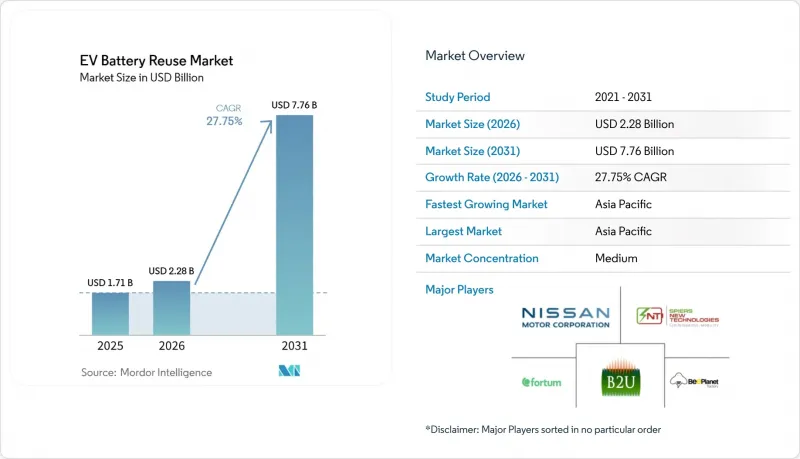
據 Mordor Intelligence 稱,電動車電池回收市場預計將從 2025 年的 17.1 億美元成長到 2026 年的 22.8 億美元,到 2031 年達到 77.6 億美元,預計 2026 年至 2031 年的複合年成長率為 27.75%。
本報告按電池化學成分(例如磷酸鋰鐵(LFP))、應用(例如電網級能源儲存系統、電動車充電基礎設施緩衝)、最終用戶(例如公共產業和獨立發電商 (IPP)、商業和工業設施)以及地區(北美、歐洲、亞太、南美、中東和非洲)進行細分。市場預測以美元 (USD) 為單位。
全球電動汽車電池回收市場趨勢及洞察
電動車用鋰離子電池成本快速下降
2025年,全新汽車電池組的平均價格為每千瓦時108美元,但預計到2026年底將降至每千瓦時80美元。殘值下降有望使回收管道更容易獲得庫存。固定系統開發商以每千瓦時30至50美元的價格購買模組,即可實現與鉛酸電池系統的成本持平,同時也能受益於更長的循環壽命。成本差距的縮小正在推動模組級回收,人工智慧診斷技術能夠識別劣化電池組中的可用電芯,從而進一步增加電動車電池回收市場的供應。更短的測試週期將使篩檢成本降低至每組50至80美元,即使新電池價格下降,也能維持利潤率。
電網級儲能系統對頻率調節的需求激增
到2025年,電力公司將部署超過50吉瓦時(GWh)的電網級儲能容量,其中二手儲能資產將佔認證市場新增容量的12%。 Element Energy在德克薩斯州的53兆瓦時(MWh)項目表明,翻新電池組可以實現亞秒級響應時間和99%的運轉率,使其符合ERCOT收費系統下的頻率調節補償資格。德克薩斯州和加州的進一步部署凸顯了電動車電池再利用市場與可再生能源日益普及之間的緊密聯繫,而再生能源的普及正在推動電力市場的日常波動。隨著輔助服務在批發市場中更容易獲得,認證的二手儲能系統正在獲得穩定的收入來源,從而提高了再利用的經濟可行性。
缺乏統一的重用標準和測試協議
儘管有IEC 63330-1標準,但諸如EN 18061和SAE J2997等區域性標準仍要求營運商遵循多項認證流程,導致合規成本增加高達25%。 UL 1974是目前最廣泛認可的標準,但其缺乏關於剩餘壽命揭露的規定,造成資訊缺口,阻礙了保險公司提供具有成本效益的保險。全球統一標準的缺失(預計到2027年不太可能實現)持續阻礙電動車電池再利用市場的快速國際擴張。
細分市場分析
由於其循環壽命長、熱穩定性好,預計到2025年,磷酸鐵鋰電池(LFP)將佔據電動車電池回收市場42.3%的佔有率,從而降低固定用循環應用中的保固風險。儘管碳奈米管電池(NCA)的市場規模較小,但預計其複合年成長率將達到31.2%,這主要得益於其200-260 Wh/kg的高能量密度。這種高能量密度使得緊湊型容器化系統能夠在空間受限的應用場景(例如船舶和資料中心)中部署。
鎳錳鈷電池由於部分充電狀態下電阻顯著增加,導致其應用受限,且只能在溫控環境下使用,因此普及速度緩慢。而二手鋰離子電池由於成本優勢,正在加速鉛酸電池的替代,其成本優勢遠高於翻新的閥控式鉛酸電池。例如,GPT Telco 的「TowerBox」技術在不增加成本的情況下,成功地將電池循環壽命延長了三倍。固態電池由於評估標準尚未建立,目前仍未進入商業性再利用的行列,預計在 2030 年前,其對電動車電池再利用市場的影響微乎其微。
區域分析
預計到2024年,亞太地區將佔全球電池銷售額的35.7%,到2030年將維持35.9%的複合年成長率。這得歸功於中國每年58萬噸廢舊電池的供應量以及覆蓋其中85%的全國性回收網路。寧德時代(CATL)在全球電池市場佔有37.5%的佔有率,並透過在2030年前部署3萬個換電站來鞏固其穩定的原料供應和技術領先地位。日本和韓國正與歐盟合作夥伴共同努力,協調數位護照的資料框架,以促進跨境貿易。
在北美,相關工作正在加速推進,這得益於美國能源局(DOE) 的資金支持以及各州強制推行的「生產者延伸責任制」(EPR)。 Element Energy 公司位於德克薩斯州的 53 兆瓦時 (MWh) 設施已成功利用廢棄電池組實現了數小時的電網供電,提振了投資者的信心。新澤西州的立法為美國的生產者責任制樹立了先例,而加州的擔保法規則加強了對消費者的保護。加拿大正與北美各地的回收中心合作,但統一的聯邦框架仍未建立。
在歐洲,隨著歐盟電池法規將於2026年到期以及回收配額的提高,相關工作正在取得進展。德國正主導BASF和Stena公司進行回收合作,而北歐國家則透過渡輪電氣化試驗,在航運業開闢了二手電池的利基市場。英國正準備在2026年前推出雙向充電立法,目標是利用日產聆風電池將家庭能源成本降低50%。在拉丁美洲和非洲等新興地區,捐助者資助的微電網可望加速電池的普及。然而,逆向物流能力建構和安全監管仍然至關重要。
其他好處:
- Excel格式的市場預測(ME)表
- 3個月的分析師支持
目錄
第1章:引言
- 研究假設和市場定義
- 調查範圍
第2章:調查方法
第3章執行摘要
第4章 市場狀況
- 市場概覽
- 市場促進因素
- 電動車用鋰離子電池成本的快速下降
- 用於頻率調節的電網級儲能系統 (ESS) 的需求正在激增。
- 關於循環經濟的原始設備製造商的義務和生產者責任延伸制度
- 二次電池認證體系在全球日益受到重視。
- 透過人工智慧驅動的健康狀態分析,實現包裝層級的重複利用。
- 在服務不足地區引進微電網
- 市場限制因素
- 缺乏統一的重用標準和測試協議
- 殘值保證與責任不確定性
- 高額的逆向物流和診斷成本
- 提高可重複使用包裝的防火安全意識
- 供應鏈分析
- 監理情勢
- 技術展望
- 波特五力分析
第5章 市場規模與成長預測
- 電池化學成分
- 磷酸鋰鐵(LFP)
- 鎳錳鈷(NMC)
- 鎳鈷鋁合金(NCA)
- 鎳氫電池(NiMH)
- 鉛酸
- 固態電池
- 透過使用
- 電網級能源儲存系統
- 電動車充電基礎設施的緩衝
- 工業和資料中心備用電源
- 通訊塔/遠端基地台
- 獨立式太陽能發電與微電網
- 船舶和輕軌的輔助電源
- 最終用戶
- 公共產業及獨立電力生產商(IPP)
- 商業和工業設施
- 住宅和社區能源
- 汽車製造商和旅遊服務提供商
- EPC/專案開發公司
- 按地區
- 北美洲
- 美國
- 加拿大
- 墨西哥
- 歐洲
- 德國
- 英國
- 法國
- 義大利
- 北歐國家
- 俄羅斯
- 其他歐洲國家
- 亞太地區
- 中國
- 印度
- 日本
- 韓國
- 東南亞國協
- 其他亞太國家
- 南美洲
- 巴西
- 阿根廷
- 其他南美國家
- 中東和非洲
- 沙烏地阿拉伯
- 阿拉伯聯合大公國
- 南非
- 埃及
- 其他中東和非洲國家
- 北美洲
第6章 競爭情勢
- 市場集中度
- 策略趨勢(併購、聯盟、購電協議)
- 市場佔有率分析(主要公司的市場排名和市場佔有率)
- 公司簡介
- B2U Storage Solutions, Inc.
- BeePlanet Factory SL
- BYD-Second-Life ESS
- CATL-Echelon Use
- Connected Energy Limited
- ECO STOR AS
- Element Energy Inc.
- Fortum Battery Solutions
- Hyundai Motor Group-Battery Reuse
- LG Energy Solution-Second-Life
- Mercedes-Benz Energy
- Nissan 4R Energy Corporation
- Octillion Power Systems, Inc.
- RePurpose Energy Inc.
- Redwood Materials-Reuse Division
- Renault Mobilize Power Solutions
- Smartville, Inc.
- Spiers New Technologies, Inc.
- TES Sustainable Battery Solutions Pte. Ltd.
- Volvo Energy
第7章 市場機會與未來展望
According to Mordor Intelligence, the EV battery reuse market size is expected to increase from USD 1.71 billion in 2025 to USD 2.28 billion in 2026 and reach USD 7.76 billion by 2031, growing at a CAGR of 27.75% over 2026-2031.
This report is Segmented by Battery Chemistry (Lithium-Iron-Phosphate (LFP), and More), Application (Grid-Scale Energy Storage Systems, EV Charging Infrastructure Buffering, and More), End-User (Utilities and IPPs, Commercial and Industrial Facilities, and More), and Geography (North America, Europe, Asia-Pacific, South America, Middle East and Africa). Market Forecasts are Provided in Value (USD).
Global EV Battery Reuse Market Trends and Insights
Rapid Decline in EV-Grade Li-ion Battery Costs
In 2025, new automotive-grade battery packs averaged USD 108 per kWh, with projections indicating a decrease to USD 80 per kWh by late 2026. Lower residual values are expected to increase inventory availability for reuse channels. Stationary developers purchasing modules at USD 30-50 per kWh achieve cost parity with lead-acid systems while benefiting from improved cycle life. This narrower cost spread supports module-level harvesting, facilitated by AI diagnostics that identify functional cells within degraded packs, thereby driving additional volumes into the EV battery reuse market. Shorter testing cycles reduce screening expenses to USD 50-80 per pack, supporting profit margins even as new battery prices fall.
Surging Grid-Scale ESS Demand for Frequency Balancing
Utilities installed over 50 GWh of grid-scale storage in 2025, with second-life assets accounting for up to 12% of new capacity in certified markets. Element Energy's 53 MWh project in Texas demonstrated that repurposed battery packs can achieve sub-one-second response times and 99% availability, qualifying for frequency-regulation payments under ERCOT tariffs. Additional deployments in Texas and California highlight the alignment of the EV battery reuse market with increasing renewable energy penetration, which drives intraday volatility. As wholesale markets enhance ancillary-service products, certified second-life systems gain access to stable revenue streams, strengthening the economic viability of reuse.
Lack of Unified Reuse Standards and Testing Protocols
Despite the existence of IEC 63330-1, varying regional standards such as EN 18061 and SAE J2997 require operators to follow multiple certification processes, increasing compliance costs by up to 25%. While UL 1974 is the most widely recognized standard, it does not include provisions for remaining-life disclosure, leading to gaps that deter insurers from providing cost-effective coverage. The absence of a harmonized global standard, which is unlikely to be established before 2027, continues to hinder the rapid international expansion of the EV battery reuse market.
Other drivers and restraints analyzed in the detailed report include:
- OEM Circular-Economy Mandates and EPR Regulations
- Emerging global second-life battery certification schemes
- Residual-Value Warranty and Liability Uncertainty
For complete list of drivers and restraints, kindly check the Table Of Contents.
Segment Analysis
LFP is projected to capture 42.3% of the EV battery reuse market share in 2025, driven by its long cycle life and thermal stability, which reduce warranty risks for stationary duty cycles. NCA, despite a smaller market base, is expected to grow at a CAGR of 31.2%, supported by its energy density of 200-260 Wh/kg, which facilitates compact, containerized systems for applications such as marine and data centers where space is limited.
Nickel-manganese-cobalt is experiencing slower adoption due to higher impedance rise under partial-state-of-charge conditions, restricting its use to climate-controlled environments. The replacement of lead-acid batteries is accelerating as second-life lithium-ion batteries offer cost advantages over refreshed valve-regulated lead-acid alternatives. For instance, GPT Telco's TowerBox demonstrates a threefold improvement in cycle life without additional cost. Solid-state batteries remain outside commercial reuse streams, with no standards for their assessment currently in place, suggesting minimal impact on the EV battery reuse market before 2030.
Complete Report Scope:
- By Battery Chemistry
- Lithium-iron-phosphate (LFP)
- Nickel-manganese-cobalt (NMC)
- Nickel-cobalt-aluminum (NCA)
- Nickel-metal-hydride (NiMH)
- Lead-acid
- Solid-state
- By Application
- Grid-scale Energy Storage Systems
- EV Charging Infrastructure Buffering
- Industrial and Data-center Backup Power
- Telecom Towers / Remote BTS
- Off-grid Solar and Microgrids
- Marine and Light-Rail Auxiliary Power
- By End-user
- Utilities and IPPs
- Commercial and Industrial Facilities
- Residential and Community Energy
- Automotive OEMs and Mobility Providers
- EPCs / Project Developers
- By Geography
- North America
- United States
- Canada
- Mexico
- Europe
- Germany
- United Kingdom
- France
- Italy
- NORDIC Countries
- Russia
- Rest of Europe
- Asia-Pacific
- China
- India
- Japan
- South Korea
- ASEAN Countries
- Rest of Asia-Pacific
- South America
- Brazil
- Argentina
- Rest of South America
- Middle East and Africa
- Saudi Arabia
- United Arab Emirates
- South Africa
- Egypt
- Rest of Middle East and Africa
- North America
Geography Analysis
Asia-Pacific accounted for 35.7% of global revenue in 2024 and will post a 35.9% CAGR by 2030, underpinned by China's 580,000-ton retired-battery stream and a nationwide collection network covering 85% of volume. CATL's 37.5% global cell share ensures robust feedstock and technological leadership as it scales 30,000 swapping stations by 2030. Japan and South Korea collaborate with EU partners to harmonize digital passport data frameworks, fostering cross-border trade.
North America accelerates on the back of DOE funding and state-level EPR mandates. Element Energy's 53 MWh Texas facility validates multi-hour grid services using retired packs, amplifying investor confidence. New Jersey's legislation sets a U.S. precedent for producer responsibility, and California's warranty rules refine consumer safeguards. Canada ties into continental recovery hubs, yet a unified federal framework remains pending.
Europe advances through the EU Battery Regulation's 2026 passport deadline and escalating collection quotas. Germany spearheads recycling alliances like BASF-Stena, while Nordic ferry electrification experiments create maritime second-life niches. The UK readies for bi-directional charging law changes by 2026, tapping Nissan LEAF batteries to cut household energy costs by 50%. Emerging regions in LATAM and Africa look to donor-funded microgrids to jump-start adoption; however, capacity-building for reverse logistics and safety oversight remains essential.
- B2U Storage Solutions, Inc.
- BeePlanet Factory S.L.
- BYD - Second-Life ESS
- CATL - Echelon Use
- Connected Energy Limited
- ECO STOR AS
- Element Energy Inc.
- Fortum Battery Solutions
- Hyundai Motor Group - Battery Reuse
- LG Energy Solution - Second-Life
- Mercedes-Benz Energy
- Nissan 4R Energy Corporation
- Octillion Power Systems, Inc.
- RePurpose Energy Inc.
- Redwood Materials - Reuse Division
- Renault Mobilize Power Solutions
- Smartville, Inc.
- Spiers New Technologies, Inc.
- TES Sustainable Battery Solutions Pte. Ltd.
- Volvo Energy
Additional Benefits:
- The market estimate (ME) sheet in Excel format
- 3 months of analyst support
TABLE OF CONTENTS
1 Introduction
- 1.1 Study Assumptions & Market Definition
- 1.2 Scope of the Study
2 Research Methodology
3 Executive Summary
4 Market Landscape
- 4.1 Market Overview
- 4.2 Market Drivers
- 4.2.1 Rapid decline in EV-grade Li-ion battery costs
- 4.2.2 Surging grid-scale ESS demand for frequency balancing
- 4.2.3 OEM circular-economy mandates & EPR regulations
- 4.2.4 Emerging global second-life battery certification schemes
- 4.2.5 AI-enabled SoH analytics unlocking pack-level reuse
- 4.2.6 Microgrid adoption in underserved regions
- 4.3 Market Restraints
- 4.3.1 Lack of unified reuse standards & testing protocols
- 4.3.2 Residual-value warranty and liability uncertainty
- 4.3.3 High reverse-logistics & diagnostic costs
- 4.3.4 Fire-safety perception of repurposed packs
- 4.4 Supply-Chain Analysis
- 4.5 Regulatory Landscape
- 4.6 Technological Outlook
- 4.7 Porters Five Forces Analysis
- 4.7.1 Threat of New Entrants
- 4.7.2 Bargaining Power of Buyers
- 4.7.3 Bargaining Power of Suppliers
- 4.7.4 Threat of Substitutes
- 4.7.5 Competitive Rivalry
5 Market Size & Growth Forecasts
- 5.1 By Battery Chemistry
- 5.1.1 Lithium-iron-phosphate (LFP)
- 5.1.2 Nickel-manganese-cobalt (NMC)
- 5.1.3 Nickel-cobalt-aluminum (NCA)
- 5.1.4 Nickel-metal-hydride (NiMH)
- 5.1.5 Lead-acid
- 5.1.6 Solid-state
- 5.2 By Application
- 5.2.1 Grid-scale Energy Storage Systems
- 5.2.2 EV Charging Infrastructure Buffering
- 5.2.3 Industrial and Data-center Backup Power
- 5.2.4 Telecom Towers / Remote BTS
- 5.2.5 Off-grid Solar and Microgrids
- 5.2.6 Marine and Light-Rail Auxiliary Power
- 5.3 By End-user
- 5.3.1 Utilities and IPPs
- 5.3.2 Commercial and Industrial Facilities
- 5.3.3 Residential and Community Energy
- 5.3.4 Automotive OEMs and Mobility Providers
- 5.3.5 EPCs / Project Developers
- 5.4 By Geography
- 5.4.1 North America
- 5.4.1.1 United States
- 5.4.1.2 Canada
- 5.4.1.3 Mexico
- 5.4.2 Europe
- 5.4.2.1 Germany
- 5.4.2.2 United Kingdom
- 5.4.2.3 France
- 5.4.2.4 Italy
- 5.4.2.5 NORDIC Countries
- 5.4.2.6 Russia
- 5.4.2.7 Rest of Europe
- 5.4.3 Asia-Pacific
- 5.4.3.1 China
- 5.4.3.2 India
- 5.4.3.3 Japan
- 5.4.3.4 South Korea
- 5.4.3.5 ASEAN Countries
- 5.4.3.6 Rest of Asia-Pacific
- 5.4.4 South America
- 5.4.4.1 Brazil
- 5.4.4.2 Argentina
- 5.4.4.3 Rest of South America
- 5.4.5 Middle East and Africa
- 5.4.5.1 Saudi Arabia
- 5.4.5.2 United Arab Emirates
- 5.4.5.3 South Africa
- 5.4.5.4 Egypt
- 5.4.5.5 Rest of Middle East and Africa
- 5.4.1 North America
6 Competitive Landscape
- 6.1 Market Concentration
- 6.2 Strategic Moves (M&A, Partnerships, PPAs)
- 6.3 Market Share Analysis (Market Rank/Share for key companies)
- 6.4 Company Profiles (includes Global level Overview, Market level overview, Core Segments, Financials as available, Strategic Information, Products & Services, and Recent Developments)
- 6.4.1 B2U Storage Solutions, Inc.
- 6.4.2 BeePlanet Factory S.L.
- 6.4.3 BYD - Second-Life ESS
- 6.4.4 CATL - Echelon Use
- 6.4.5 Connected Energy Limited
- 6.4.6 ECO STOR AS
- 6.4.7 Element Energy Inc.
- 6.4.8 Fortum Battery Solutions
- 6.4.9 Hyundai Motor Group - Battery Reuse
- 6.4.10 LG Energy Solution - Second-Life
- 6.4.11 Mercedes-Benz Energy
- 6.4.12 Nissan 4R Energy Corporation
- 6.4.13 Octillion Power Systems, Inc.
- 6.4.14 RePurpose Energy Inc.
- 6.4.15 Redwood Materials - Reuse Division
- 6.4.16 Renault Mobilize Power Solutions
- 6.4.17 Smartville, Inc.
- 6.4.18 Spiers New Technologies, Inc.
- 6.4.19 TES Sustainable Battery Solutions Pte. Ltd.
- 6.4.20 Volvo Energy
7 Market Opportunities & Future Outlook
- 7.1 White-space & Unmet-need Assessment

 電動車電池再利用市場:按車輛類型、電池類型、再利用應用、再利用策略、動力系統、國家及地區分類-全球產業分析、市場規模、市場佔有率及2026年至2033年預測
 電動汽車電池回收:市場佔有率分析、產業趨勢與統計及成長預測(2026-2031)
 二手電動車電池市場-全球產業規模、佔有率、趨勢、機會、預測:按車輛類型、按類型、按應用、按地區和競爭對手分類,2021-2031年
 電動車電池回收市場規模、佔有率和趨勢:按類型、車輛類型、應用和地區分類,預測至2026-2034年
 電動車電池回收市場:按應用和地區分類
 電動汽車電池回收市場機會、成長要素、產業趨勢分析及2026-2035年預測電動車電池回收市場:依化學成分、製程、應用、最終用戶、國家及地區分類-全球產業分析、市場規模、市場佔有率及2025年至2032年預測
 2026-2030年全球電動車電池回收市場
 電動汽車電池回收市場規模、佔有率和成長分析(按供應來源、電池化學成分、車輛類型、應用、回收策略、產能範圍和地區分類)—產業預測(2026-2033 年)
 全球電動汽車電池回收市場:預測至2032年-依化學成分、電池來源、回收流程、回收階段、最終用戶及地區進行分析