


 |
市場調查報告書
商品編碼
1998807
電動汽車電池回收市場機會、成長要素、產業趨勢分析及2026-2035年預測EV Battery Reuse Market Opportunity, Growth Drivers, Industry Trend Analysis, and Forecast 2026 - 2035 |
||||||

全球電動車電池回收市場預計到 2025 年價值 7.599 億美元,預計到 2035 年將達到 329 億美元,年複合成長率為 45.8%。
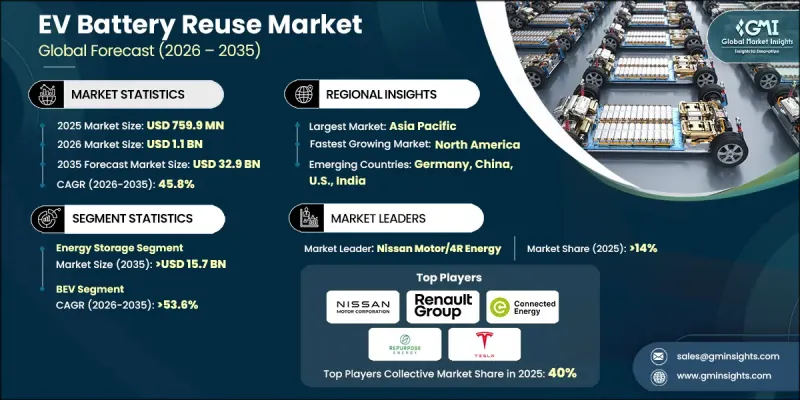
電動車的快速普及以及對電池生命週期進行永續且經濟可行的管理的需求日益成長,是推動市場成長的主要因素。隨著全球電動車普及率的持續加速,大量電池即將完成其在車輛中的初始使用壽命,這為電池的二次利用創造了機會。促進循環經濟實踐的政策、電池再生技術成本的下降以及對儲能解決方案日益成長的需求,也正在塑造市場格局。回收利用的電動車電池正擴大應用於支援可再生能源併網和電力管理應用的能源儲存系統中。汽車製造商和儲能公司正大力投資電池二次利用項目,因為這些措施既能延長電池的價值,又能減少對環境的影響。此外,人工智慧驅動的診斷和預測分析技術的進步正在改進電池健康評估,並實現更有效率的分類、再生和再利用流程。世界各地的公司也在建立專門的業務部門,致力於將廢棄電動車電池用於二次用途,這進一步加速了該行業的擴張。
| 市場範圍 | |
|---|---|
| 開始年份 | 2025 |
| 預測期 | 2026-2035 |
| 上市時的市場規模 | 7.599億美元 |
| 預測金額 | 329億美元 |
| 複合年成長率 | 45.8% |
預計到2035年,電動車充電應用領域將以60.5%的複合年成長率成長。充電基礎設施中翻新電池的日益普及,推動了對快速充電網路的支援需求,從而緩解了電網的尖峰負載壓力。這些儲能系統使充電營運商能夠更有效地管理能源需求,提高能源分配效率,並降低高功率充電基礎設施的營運成本。隨著電動車充電生態系統的快速擴張,二手電池儲能系統在維持電網穩定和提升充電網路整體性能方面發揮日益重要的作用。
預計到2025年,混合動力汽車(HEV)和插電式混合動力汽車(PHEV)將佔據52.6%的市場佔有率。然而,由於這些車輛的電池充放電循環次數通常較低,因此與純電動車相比,它們對電動車電池回收市場的貢獻相對較小。混合動力汽車電池設計的改進和車輛使用壽命的延長正在減少進入回收市場的電池數量。因此,儘管HEV和PHEV仍然保持著相當大的市場佔有率,但該細分市場中可回收電池的數量仍然相對有限。
預計到2025年,美國電動車電池再利用市場規模將達7,510萬美元。電動車的日益普及、雄心勃勃的永續性目標以及對經濟高效的儲能解決方案日益成長的需求,正在推動美國市場的發展。政府鼓勵循環經濟實踐的政策,包括廢棄物管理和永續性框架的法規,正在促使汽車製造商和能源公司投資電池再利用舉措。這些政策有助於在向清潔能源轉型的大背景下,為電池二次利用應用建立一個有利的生態系統。
目錄
第1章:調查方法和範圍
第2章執行摘要
第3章業界考察
- 生態系分析
- 監理情勢
- 影響產業的因素
- 促進因素
- 產業潛在風險與挑戰
- 成長潛力分析
- 波特五力分析
- PESTEL 分析
- 價格趨勢分析,2022-2035年
- 新機會和趨勢
- 投資分析及未來展望
第4章 競爭情勢
- 介紹
- 企業市佔率分析
- 主要進展
- 併購
- 夥伴關係與合作
- 新產品發布
- 業務拓展計劃及資金籌措
- 競爭性標竿分析
- 創新與永續發展趨勢
第5章 市場規模及預測:依應用領域分類,2022-2035年
- 儲能
- 電動車充電
- 基地台
- 低速車輛
第6章 市場規模與預測:依來源分類,2022-2035年
- BEV
- 油電混合車和插電式油電混合車
第7章 市場規模及預測:依地區分類,2022-2035年
- 北美洲
- 美國
- 加拿大
- 歐洲
- 英國
- 德國
- 義大利
- 西班牙
- 俄羅斯
- 法國
- 亞太地區
- 中國
- 日本
- 韓國
- 印度
- 澳洲
- 世界其他地區
第8章:公司簡介
- 4R Energy Corporation
- B2U Storage
- BatteryLoop
- BeePlanet Factory
- Cactos
- Connected Energy
- EcarACCU
- Element Energy
- Enel X
- Evyon
- Higher Wire
- Moment Energy
- Nissan Motor
- OCTAVE
- RePurpose Energy
- Renault Group
- RWE+Audi
- Second Life EV Batteries
- Spiers New Technologies
- Stena Metall
- Tesla
The Global EV Battery Reuse Market was valued at USD 759.9 million in 2025 and is estimated to grow at a CAGR of 45.8% to reach USD 32.9 billion by 2035.
The market growth is supported by the rapid adoption of electric vehicles and the increasing need to manage battery lifecycles in a sustainable and economically viable manner. As EV deployment continues to accelerate worldwide, a significant number of batteries are reaching the end of their initial automotive usage phase, creating opportunities for second-life applications. Policies promoting circular economy practices, falling costs associated with battery refurbishment technologies, and the expanding demand for energy storage solutions are also shaping the market landscape. Reused EV batteries are increasingly deployed in energy storage systems that support renewable energy integration and power management applications. Automotive manufacturers and energy storage companies are heavily investing in second-life battery programs because these initiatives extend battery value while reducing environmental impact. Additionally, advancements in artificial intelligence-driven diagnostics and predictive analytics are improving the evaluation of battery health, enabling more efficient sorting, refurbishment, and repurposing processes. Companies across various regions are also establishing specialized business units focused on repurposing used EV batteries for secondary applications, which is further accelerating industry expansion.
| Market Scope | |
|---|---|
| Start Year | 2025 |
| Forecast Year | 2026-2035 |
| Start Value | $759.9 Million |
| Forecast Value | $32.9 Billion |
| CAGR | 45.8% |
The EV charging application segment is expected to grow at a CAGR of 60.5% through 2035. Reused batteries are increasingly integrated into charging infrastructure to support fast-charging networks by reducing peak load pressure on electricity grids. These storage systems allow charging operators to balance energy demand more effectively, enhance energy distribution efficiency, and lower operational costs associated with high-power charging infrastructure. As the EV charging ecosystem expands rapidly, the role of second-life battery storage systems is becoming increasingly important for maintaining grid stability while improving overall charging network performance.
The hybrid electric vehicles (HEVs) and plug-in hybrid electric vehicles (PHEVs) accounted for 52.6% share in 2025. However, these vehicles contribute relatively less to the EV battery reuse market compared to fully electric vehicles because their batteries generally experience less intensive charge and discharge cycles. Improvements in hybrid battery design and extended vehicle lifespan have reduced the number of batteries entering the reuse stream from these vehicle types. As a result, while HEVs and PHEVs maintain a notable share of the market landscape, the volume of reusable batteries from this segment remains comparatively limited.
U.S. EV Battery Reuse Market was valued at USD 75.1 million in 2025. Increasing adoption of electric vehicles, ambitious sustainability targets, and the rising need for cost-effective energy storage solutions are driving strong market momentum across the country. Government measures encouraging circular economy practices, including regulations related to waste management and sustainability frameworks, are motivating automotive manufacturers and energy companies to invest in battery repurposing initiatives. These policies are helping create a supportive ecosystem for second-life battery applications within the broader clean energy transition.
Major players operating in the Global EV Battery Reuse Market include Nissan Motor, Renault Group, Tesla, 4R Energy Corporation, Spiers New Technologies, B2U Storage, Connected Energy, Enel X, Moment Energy, BeePlanet Factory, BatteryLoop, RWE + Audi, Evyon, Element Energy, RePurpose Energy, Cactos, EcarACCU, OCTAVE, Higher Wire, Second Life EV Batteries, and Stena Metall. Companies operating in the EV Battery Reuse Market are focusing on multiple strategies to strengthen their market presence and expand their competitive position. Industry participants are investing in advanced battery diagnostics technologies, artificial intelligence-driven health assessment tools, and automated refurbishment systems to improve efficiency and scalability. Strategic partnerships between automakers, energy storage providers, and technology companies are becoming increasingly common to accelerate the development of second-life battery ecosystems. Firms are also expanding into energy storage markets by integrating reused batteries into renewable energy systems and charging infrastructure projects. Additionally, companies are establishing dedicated subsidiaries and pilot projects to refine repurposing processes and improve battery lifecycle management.
Table of Contents
Chapter 1 Methodology & Scope
- 1.1 Research design
- 1.1.1 Research approach
- 1.1.2 Data collection methods
- 1.2 Base estimates and calculations
- 1.2.1 Base year calculation
- 1.2.2 Market estimates & forecast parameters
- 1.3 Forecast
- 1.3.1 Key trends for market estimates
- 1.3.2 Quantified market impact analysis
- 1.3.2.1 Mathematical impact of growth parameters on forecast
- 1.3.3 Scenario analysis framework
- 1.4 Primary research and validation
- 1.4.1 Some of the primary sources (but not limited to)
- 1.5 Data mining sources
- 1.5.1 Paid Sources
- 1.5.2 Sources, by region
- 1.6 Research trail & scoring components
- 1.6.1 Research trail components
- 1.6.2 Scoring components
- 1.7 Research transparency addendum
- 1.7.1 Source attribution framework
- 1.7.2 Quality assurance metrics
- 1.7.3 Our commitment to trust
- 1.8 Market definitions
Chapter 2 Executive Summary
- 2.1 Industry synopsis, 2022 - 2035
- 2.2 Business trends
- 2.3 Application trends
- 2.4 Source trends
- 2.5 Regional trends
Chapter 3 Industry Insights
- 3.1 Industry ecosystem analysis
- 3.2 Regulatory landscape
- 3.3 Industry impact forces
- 3.3.1 Growth drivers
- 3.3.2 Industry pitfalls & challenges
- 3.4 Growth potential analysis
- 3.5 Porter's analysis
- 3.5.1 Bargaining power of suppliers
- 3.5.2 Bargaining power of buyers
- 3.5.3 Threat of new entrants
- 3.5.4 Threat of substitutes
- 3.6 PESTEL analysis
- 3.6.1 Political factors
- 3.6.2 Economic factors
- 3.6.3 Social factors
- 3.6.4 Technological factors
- 3.6.5 Legal factors
- 3.6.6 Environmental factors
- 3.7 Price trend analysis, 2022-2035
- 3.8 Emerging opportunities & trends
- 3.9 Investment analysis & future prospects
Chapter 4 Competitive landscape, 2025
- 4.1 Introduction
- 4.2 Company market share analysis, 2025
- 4.3 Key developments
- 4.3.1 Mergers & acquisitions
- 4.3.2 Partnerships & collaborations
- 4.3.3 New product launches
- 4.3.4 Expansion plans and funding
- 4.4 Competitive benchmarking
- 4.5 Innovation & sustainability landscape
Chapter 5 Market Size and Forecast, By Application, 2022 - 2035 (MWh & USD Million)
- 5.1 Key trends
- 5.2 Energy storage
- 5.3 EV charging
- 5.4 Base stations
- 5.5 Low speed vehicles
Chapter 6 Market Size and Forecast, By Source, 2022 - 2035 (MWh & USD Million)
- 6.1 Key trends
- 6.2 BEV
- 6.3 HEV & PHEV
Chapter 7 Market Size and Forecast, By Region, 2022 - 2035 (MWh & USD Million)
- 7.1 Key trends
- 7.2 North America
- 7.2.1 U.S.
- 7.2.2 Canada
- 7.3 Europe
- 7.3.1 UK
- 7.3.2 Germany
- 7.3.3 Italy
- 7.3.4 Spain
- 7.3.5 Russia
- 7.3.6 France
- 7.4 Asia Pacific
- 7.4.1 China
- 7.4.2 Japan
- 7.4.3 South Korea
- 7.4.4 India
- 7.4.5 Australia
- 7.5 Rest of the world
Chapter 8 Company Profiles
- 8.1 4R Energy Corporation
- 8.2 B2U Storage
- 8.3 BatteryLoop
- 8.4 BeePlanet Factory
- 8.5 Cactos
- 8.6 Connected Energy
- 8.7 EcarACCU
- 8.8 Element Energy
- 8.9 Enel X
- 8.10 Evyon
- 8.11 Higher Wire
- 8.12 Moment Energy
- 8.13 Nissan Motor
- 8.14 OCTAVE
- 8.15 RePurpose Energy
- 8.16 Renault Group
- 8.17 RWE + Audi
- 8.18 Second Life EV Batteries
- 8.19 Spiers New Technologies
- 8.20 Stena Metall
- 8.21 Tesla

 電動車電池再利用市場:按車輛類型、電池類型、再利用應用、再利用策略、動力系統、國家及地區分類-全球產業分析、市場規模、市場佔有率及2026年至2033年預測
 電動汽車電池回收:市場佔有率分析、產業趨勢與統計及成長預測(2026-2031)
 電動車電池回收的市場規模、佔有率、成長、全球產業分析、區域趨勢和2026年至2034年的預測電動車電池再利用:市場佔有率分析、產業趨勢與統計及成長預測(2026-2031)
 二手電動車電池市場-全球產業規模、佔有率、趨勢、機會、預測:按車輛類型、按類型、按應用、按地區和競爭對手分類,2021-2031年
 電動車電池回收市場規模、佔有率和趨勢:按類型、車輛類型、應用和地區分類,預測至2026-2034年
 電動車電池回收市場:按應用和地區分類電動車電池回收市場:依化學成分、製程、應用、最終用戶、國家及地區分類-全球產業分析、市場規模、市場佔有率及2025年至2032年預測
 2026-2030年全球電動車電池回收市場
 電動汽車電池回收市場規模、佔有率和成長分析(按供應來源、電池化學成分、車輛類型、應用、回收策略、產能範圍和地區分類)—產業預測(2026-2033 年)