


 |
市場調查報告書
商品編碼
2117355
電動汽車電池回收:市場佔有率分析、產業趨勢與統計及成長預測(2026-2031)Electric Vehicle Battery Recycling - Market Share Analysis, Industry Trends & Statistics, Growth Forecasts (2026 - 2031) |
||||||

※ 本網頁內容可能與最新版本有所差異。詳細情況請與我們聯繫。
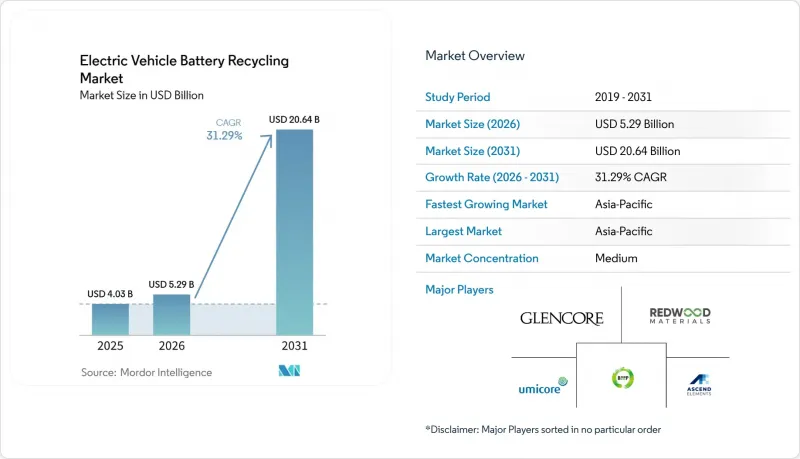
據 Mordor Intelligence 稱,電動車電池回收市場預計將在 2025 年達到 40.3 億美元,在 2026 年達到 52.9 億美元,在 2031 年達到 206.4 億美元,從 2026 年到 2031 年的複合年成長率為 31.29%。
本報告按電池化學成分(鋰離子電池、鎳氫電池及其他)、供應來源(電動車生產廢料及其他)、回收工藝(濕法冶金及其他)、車輛類型(摩托車、三輪車、乘用車及其他)、回收材料(鋰、鈷、鎳及其他)和地區進行細分。市場預測以美元計價。
全球電動汽車電池回收市場趨勢及洞察
電動車銷量激增,造成了廢棄電池的「海嘯」。
電動車銷量的激增預示著未來十年將出現前所未有的電池廢棄物浪潮。最初熱潮期間售出的車輛如今已接近使用壽命終點。因此,預計每年可回收的廢棄電池數量將顯著增加。然而,儘管處理能力不斷提升,一些地區仍面臨嚴重的供不應求。在一個主要市場,回收商已處理了大量電池組,但仍難以支付大規模的賠償金,凸顯了供應緊張的局面。特斯拉與Redwood Materials的合作正是這一趨勢的例證。兩家公司的閉迴路夥伴關係確保生產廢料和廢棄電池組都能重新投入負極箔和正極前驅體生產線,從而減少對新原料的依賴。挪威和加州部分地區等閉合迴路普及的先驅者預計將面臨未來的挑戰。隨著早期採用者大規模報廢車輛,這些地區很可能面臨區域性回收能力短缺的問題。
嚴格的生產者延伸責任制(EPR)法規
歐盟電池法規於2025年8月生效,規定到2027年鈷和鎳的回收率必須達到90%,鋰的回收率必須達到50%,並計畫在2031年實施更嚴格的標準。在中國,修訂後的可追溯性法規要求將所有運往認證回收商的電池單元進行溯源;在印度,則要求分階段提高電池廢棄物的回收率。同時,澳洲電池管理委員會(Australian Battery Stewardship Council)目前幾乎涵蓋了整個零售業,其目標是在未來進一步提高回收率。合規的經濟效益至關重要。與未受監管的地區相比,處理量大的濕式回收工廠可以利用歐洲的回收成分積分來獲得更高的內部收益率(IRR)。原始設備製造商(OEM)正在推進設計創新,以加快拆卸速度。例如,BMW的卡扣式模組與傳統的黏合劑設計相比,顯著縮短了工作時間。
水煤氣廠面臨高額資本支出和長投資回收期等問題。
建造一條具備標準加工能力的濕式冶金生產線需要大量的資本支出(CAPEX)和高昂的營運成本(OPEX)。這種財務結構會顯著延長投資回收期,尤其是在沒有補貼的情況下。李科(Li-Cycle)位於羅徹斯特的工廠就曾遭遇嚴重的預算超支,並最終申請破產保護,凸顯了該行業固有的營運風險。在主要礦區以外,化學工程專家嚴重短缺。這種短缺導致北美和歐洲的人事費用遠高於中國。根據歐盟的《工業排放指令》,獲得環境影響許可可能會顯著延誤專案進度。因此,像優美科(Umicore)和寧德時代(CATL Brunp)這樣資金雄厚的行業參與企業正在積極鞏固其市場佔有率。相較之下,新興的新創公司要么尋求原始設備製造商(OEM)的銷售保證,要么轉向資本投入較少的直接回收方法。
細分市場分析
預計到2025年,鋰離子電池的化學成分將佔總銷量的76.07%,並以32.07%的複合年成長率成長,從而構成電動車電池回收市場的基礎。雖然富鎳NMC電池在豪華車領域佔據主導地位,但磷酸鋰鐵(LFP)電池目前在商用車和低價定價模式中佔據主導地位。寧德時代(CATL Brunp)透過處理大量鋰離子電池廢料並實現顯著的鋰回收率,證明了濕式冶煉的高效性。由於回收的NMC廢料比LFP具有更高的金屬價值,加工商往往更傾向於直接回收LFP。隨著技術的多元化發展,預計NMC電池的電動車(EV)電池回收市場將持續成長,而LFP電池的加工量預計將會增加,但其價值密度將會下降。原始設備製造商 (OEM) 正透過模組化電池組、快速拆解和化學成分QR碼等「面向回收的設計」舉措,擴大其在電動車電池回收市場的巨大佔有率,這些舉措簡化了自動化設施的處理流程。在二次儲能市場,高鎳電池組的相容性正在下降,因為磷酸鐵鋰電池 (LFP) 在固定式儲能市場越來越受歡迎。這是因為磷酸鐵鋰電池在一次翻新循環後就會被送回回收商。即將推出的歐洲政策強制要求更高的再生鋰含量標準,預計將進一步擴大鎳基複合材料 (NMC) 水溶液冶金與磷酸鐵鋰電池直接回收之間的盈利差距。
鋰錳氧化物和鎳氫化物等原料會產生長尾流,但由於其數量有限且通常與較早的混合動力汽車項目相關,因此對現貨價格的影響甚微。BASF、優美科和諾斯沃特等公司的持續擴張凸顯了其對濕式提煉能力的持續投入,尤其是在高鎳廢料方面。隨著業界轉向富鎳低鈷解決方案,加工商正準備應對每噸平均收益下降的局面,並加強研發不會破壞正極材料晶體結構的低能耗直接法。
到2025年,生產廢棄物將佔原料的58.37%,構成閉合迴路合約的基礎,從而確保化學成分的均勻性。 Redwood Materials公司在美國的所有廢料均來自特斯拉、Panasonic和福特,並已生產出足夠的再生銅箔,足以供應大量電動車。雖然超級工廠的生產擴張階段可能會導致廢料產生量達到峰值,進而造成短期供應過剩,並擴大電動車電池回收市場的規模,但隨著生產線良率的提高,這種供應過剩的情況預計最終會得到解決。
廢舊電池的數量正以每年32.15%的速度成長,預計將超過生產廢棄物的成長速度。在印度,預計未來將有大量電池組被丟棄。然而,只有一小部分電池組得到官方回收。這一缺口正由非官方的拆解公司填補,這些公司往往會丟棄有價值的陰極材料。同時,歐盟正在努力提高回收目標。這加速了帶有QR碼的「電池護照」的推廣,確保電池組被送往經過認證的回收商。因此,合規營運商在電動車電池回收領域的市場佔有率正在擴大。在亞洲摩托車領域,一個擁有集中式交換站的物流系統正在簡化小型電池組的大規模,並大幅降低單位運輸成本。
區域分析
2025年,亞太地區佔據了全球電動車電池回收市場佔有率的72.87%。受中國龐大的生產規模和印度摩托車電動化的推動,預計該地區電動車電池回收市場在2026年至2031年間將以33.12%的複合年成長率成長。中國處理大量的廢棄電池,寧德時代(CATL)旗下的Brunp公司從海量原料中實現了鎳、鈷、錳和鋰的高回收率。 Brunp公司透過主導「白名單」認證體系,將技術專長和原料集中到少數幾家獲得許可的工廠,從而對中國的回收標準產生了重大影響。同時,印度的《電池廢棄物管理條例》為未來幾年設定了雄心勃勃的回收目標。然而,目前印度的電池處理能力嚴重不足,吸引了Atelo Recycling、塔塔化工和Exide Industries等大型企業的投資。
預計到2025年,歐洲將成為電動車電池回收市場第二大佔有率地區,這主要得益於德國汽車製造商的工廠以及歐盟電池法規的推動。歐盟法規規定,到2031年,電池中鈷、鋰和鎳的回收率必須分別達到16%、6%和6%。富騰集團(Fortum)將於2025年獲得4000萬歐元的創新基金津貼,這將使其位於哈爾雅瓦爾塔(Harjavarta)的工廠的處理能力加倍,達到每年2萬噸。大眾汽車也正從其位於杜森費爾德(Düsenfeld)的混合動力生產線採購回收的前驅材料,用於其位於薩爾茨吉特(Salzgitter)的超級工廠。西班牙和義大利被定位為回收中心,Stena Recycling公司位於巴塞隆納的新中心整合了來自北非的廢料,並將其供應給北歐的水基提煉。挪威的汽車市場目前在新車銷售中佔據相當大的佔有率,預計將帶動該地區廢棄物需求的激增。除非跨境物流得到擴展,否則這可能會給該地區的處理能力帶來壓力。
北美電動車電池回收市場正迅速擴張,這得益於美國《通貨膨脹控制法案》的獎勵,該法案對使用回收材料製成的電池提供稅額扣抵。 Redwood Materials公司在南卡羅來納州建立了一家負極箔工廠,旨在利用生產廢料和經銷商回收的電池組實現可觀的年產量。 Ascend Elements公司也在肯塔基州運作了一家水冷陰極工廠。然而,Li-Cycle公司位於羅徹斯特的工廠面臨成本超支問題,促使嘉能可公司介入。在加拿大,聯邦政府正利用與礦業叢集的合作關係,並撥款加強重點省份的回收基礎設施。除主要地區外,巴西、沙烏地阿拉伯和阿拉伯聯合大公國等國也在進行先導計畫和可行性研究,這表明地理多元化具有潛力,儘管它們目前的貢獻仍然有限。
其他好處
- Excel格式的市場預測(ME)表
- 3個月的分析師支持
目錄
第1章:引言
- 研究假設和市場定義
- 調查範圍
第2章:調查方法
第3章執行摘要
第4章 市場狀況
- 市場概覽
- 市場促進因素
- 電動車銷量激增,引發了廢棄電池的「海嘯」。
- 強制實施嚴格的生產者延伸責任制(EPR)
- 基本礦物價格飆升,提高了再生材料的投資報酬率 (ROI)。
- 原始設備製造商(OEM)推動脫碳和本地化供應鏈發展。
- 磷酸鐵鋰鋰回收具有獨特的經濟優勢
- 人工智慧驅動的自動化包裹拆解
- 市場限制因素
- 濕式冶金廠投資額高,投資回收期長。
- 黑麥粉現貨價格波動極大
- 高壓電池回收中的安全和物流風險
- 與回收利用直接相關的智慧財產權專利密集領域。
- 價值供應鏈分析
- 監理情勢
- 技術展望
- 波特五力模型
- 電池回收能力概述
- 現有工廠的位置與加工能力
- 已公佈的工廠和擴建計劃
- 電池回收技術概述
- 熱冶金法
- 濕式冶金
- 直接法/機械加工
- 回收技術的成本效益評估
- 未來的技術變革以及預計將從中受益的公司
第5章 市場規模與成長預測
- 電池化學成分
- 鋰離子電池(NMC、NCA、LFP、LMO、LCO)
- 鎳氫電池
- 鉛酸
- 按供應來源
- 電動車生產廢料
- 二手電動車電池
- 透過回收過程
- 濕式冶金
- 熱冶金法
- 直接/機械及其他新型技術
- 按車輛類型
- 摩托車
- 三輪車
- 搭乘用車
- 輕型商用車
- 中型和大型商用車輛
- 巴士和長途汽車
- 由回收材料
- 鋰
- 鈷
- 鎳
- 錳
- 石墨及其他
- 按地區
- 北美洲
- 美國
- 加拿大
- 其他北美國家
- 南美洲
- 巴西
- 阿根廷
- 其他南美國家
- 歐洲
- 德國
- 法國
- 英國
- 義大利
- 西班牙
- 挪威
- 荷蘭
- 俄羅斯
- 其他歐洲國家
- 亞太地區
- 中國
- 日本
- 印度
- 韓國
- 澳洲
- 印尼
- 泰國
- 其他亞太國家
- 中東和非洲
- 沙烏地阿拉伯
- 阿拉伯聯合大公國
- 其他中東和非洲國家
- 北美洲
第6章 競爭情勢
- 市場集中度
- 策略趨勢
- 市佔率分析
- 公司簡介
- ACCUREC Recycling GmbH
- American Manganese Inc.(RecycLiCo Battery Materials Inc.)
- Aqua Metals, Inc.
- Ascend Elements, Inc.
- Call2Recycle, Inc.
- Eco-Bat Technologies Ltd.
- Fortum Battery Recycling(Fortum Oyj)
- Glencore
- Redwood Materials, Inc.
- Umicore
- Guangdong Brunp Recycling Technology Co., Ltd.
- GEM Co., Ltd.
- Duesenfeld GmbH
- Retriev Technologies Inc.
- Veolia Environnement SA
- Ganfeng Lithium Group Co., Ltd.
- RecyBat(Societe Nouvelle d'Affinage des Metaux-SNAM)
- TES-AMM Pte Ltd.(TES Sustainable Technology Solutions)
第7章 市場機會與未來展望
According to Mordor Intelligence, the electric vehicle battery recycling market size is expected to be USD 4.03 billion in 2025, USD 5.29 billion in 2026, and reach USD 20.64 billion by 2031, growing at a CAGR of 31.29% from 2026 to 2031.
This report is Segmented by Battery Chemistry (Lithium-Ion, Nickel-Metal Hydride, and More), Source (EV-Production Scrap and More), Recycling Process (Hydrometallurgical and More), Vehicle Type (Two-Wheelers, Three-Wheelers, Passenger Cars, and More), Recovered Material (Lithium, Cobalt, Nickel, and More), and Geography. The Market Forecasts are Provided in Terms of Value (USD).
Global Electric Vehicle Battery Recycling Market Trends and Insights
Surging EV Sales Creating End-of-Life Battery Tsunami
Sales of electric vehicles (EVs) have increased significantly, signaling an unprecedented wave of battery retirements over the next decade. Vehicles sold during the initial surge are now nearing the end of their duty cycles. Consequently, annual scrap availability is expected to grow substantially. However, despite capacity additions, some regions face a significant shortfall. In one major market, recyclers processed a large volume of battery packs but struggled to cover black-mass payables, highlighting a tight supply scenario. Tesla's collaboration with Redwood Materials exemplifies the trend: their closed-loop partnership channels both production scrap and post-consumer packs back into anode-foil and cathode-precursor lines, reducing reliance on virgin materials. Regions like Norway and certain areas of California, pioneers in EV adoption, are set to face challenges. As early adopters retire their vehicles en masse, these regions will grapple with a localized undersupply of recycling capacity.
Stringent Extended-Producer-Responsibility (EPR) Mandates
The EU Battery Regulation, which entered into force in August 2025, requires 90% recovery of cobalt and nickel and 50% recovery of lithium by 2027, with sharper thresholds by 2031. China's updated traceability code forces every shipped cell to be linked to an approved recycler, while India mandates increased collection rates for battery waste over time. Meanwhile, Australia's Battery Stewardship Council, which now encompasses almost the entire retail sector, aims for higher collection rates in the future. The economics of compliance play a pivotal role: a hydromet plant processing significant volumes can achieve a higher internal rate of return (IRR) with European recycled-content credits than in areas without regulation. Original Equipment Manufacturers (OEMs) are innovating designs for quicker disassembly; for instance, BMW's snap-fit modules have significantly reduced labor time when compared to traditional adhesive-bonded designs.
High CAPEX and Long Payback for Hydromet Plants
Building a hydromet line with typical capacity requires significant capital expenditures (capex) and incurs high operational expenses (opex). This financial setup significantly extends the payback period, especially in the absence of subsidies. Li-Cycle's Rochester hub faced substantial budget overruns and subsequently sought bankruptcy protection, underscoring the inherent execution risks. Outside prominent mining regions, there's a notable shortage of chemical engineering professionals. This shortage has led to labor costs in North America and Europe being significantly higher than in China. Under the EU Industrial Emissions Directive, obtaining environmental impact permits can significantly extend project timelines. As a result, well-funded industry players like Umicore and CATL Brunp are aggressively consolidating their market presence. In contrast, emerging startups are either securing offtake guarantees backed by OEMs or shifting towards direct recycling methods that require lower capital expenditures.
Other drivers and restraints analyzed in the detailed report include:
- Escalating Critical-Mineral Prices Boosting Recycled-Material ROI
- OEM Drive for Low-Carbon, Localized Supply Chains
- Volatile Black-Mass Spot Prices
For complete list of drivers and restraints, kindly check the Table Of Contents.
Segment Analysis
Lithium-ion chemistries accounted for 76.07% of 2025 revenue and are forecast to grow at a 32.07% CAGR, anchoring the electric vehicle battery recycling market. Nickel-rich NMC variants dominate high-end passenger cars, while lithium-iron-phosphate (LFP) now leads in commercial fleets and budget models. CATL Brunp processed significant volumes of lithium-ion scrap, achieving notable lithium recovery, underscoring the efficiency of hydrometallurgy. Recovered NMC scrap commands a higher metal value compared to LFP, prompting processors to favor direct regeneration for LFP. With technology diversification, the Electric Vehicle (EV) battery recycling market for NMC is set to grow, while LFP's share will see increased tonnage output but at a diminished value density. OEMs are enhancing the effective EV battery recycling market share through design-for-recycling initiatives-like modular packs, rapid disassembly, and chemistry QR codes-making them more amenable to automated facilities. The second-life energy-storage market is now less aligned with high-nickel packs, as stationary markets are increasingly favoring LFP, which returns to recyclers after a single refurbishment. Upcoming European policies mandating higher recycled-lithium thresholds are poised to amplify the profitability divide between NMC hydrometallurgy and LFP's direct routes.
Inputs like lithium-manganese-oxide and nickel-metal-hydride create a long-tail flow but seldom influence spot prices due to their limited volumes, typically associated with legacy hybrid programs. The ongoing expansions by BASF, Umicore, and Northvolt highlight a sustained commitment to hydrometallurgical capacities, especially for high-nickel scrap. As the industry gravitates towards nickel-rich and cobalt-lean solutions, processors brace for a dip in average revenue per tonne, intensifying their pursuit of low-energy direct pathways that preserve cathode crystal integrity.
Production scrap accounted for 58.37% of feedstock in 2025 and anchors closed-loop contracts that guarantee chemistry homogeneity. Redwood Materials, receiving all of its United States scrap from Tesla, Panasonic, and Ford, produced recycled copper foil sufficient for a significant number of electric vehicles (EVs). While scrap rates can peak during gigafactory ramp-ups, leading to short-term surpluses that inflate the size of the electric vehicle battery recycling market, it's anticipated that rising line yields will eventually reduce this surplus stream.
End-of-life volumes are growing 32.15% per year and are forecast to overtake production scrap. India expects to retire a significant volume of battery packs in the future. However, only a portion of these packs is formally collected. This shortfall is being addressed by informal dismantlers, who often discard valuable cathode materials. Meanwhile, the EU is working towards higher collection targets. This push is hastening the adoption of QR-code battery passports, ensuring packs are directed to certified recyclers. As a result, compliant operators in the electric vehicle battery recycling sector are seeing their market share expand. In Asia's two-wheeler sector, centralized swap-station logistics are streamlining the large-scale collection of smaller battery packs, slashing transport costs per unit.
Complete Report Scope:
- By Battery Chemistry
- Lithium-ion (NMC, NCA, LFP, LMO, LCO)
- Nickel-metal Hydride
- Lead-acid
- By Source
- EV-production scrap
- End-of-life EV batteries
- By Recycling Process
- Hydrometallurgical
- Pyrometallurgical
- Direct / Mechanical and Other Emerging
- By Vehicle Type
- Two-Wheelers
- Three-Wheelers
- Passenger Cars
- Light Commercial Vehicles
- Medium and Heavy Commercial Vehicles
- Buses and Coaches
- By Recovered Material
- Lithium
- Cobalt
- Nickel
- Manganese
- Graphite and Others
- By Geography
- North America
- United States
- Canada
- Rest of North America
- South America
- Brazil
- Argentina
- Rest of South America
- Europe
- Germany
- France
- United Kingdom
- Italy
- Spain
- Norway
- Netherlands
- Russia
- Rest of Europe
- Asia Pacific
- China
- Japan
- India
- South Korea
- Australia
- Indonesia
- Thailand
- Rest of Asia Pacific
- Middle East and Africa
- Saudi Arabia
- United Arab Emirates
- Rest of Middle East and Africa
- North America
Geography Analysis
Asia-Pacific held 72.87% of the Electric vehicle battery recycling market share in 2025. The Electric vehicle battery recycling market size in the region is projected to expand at a 33.12% CAGR between 2026 and 2031, supported by China's manufacturing scale and India's two-wheeler electrification. China processes significant volumes of spent batteries, with CATL's Brunp subsidiary achieving high recovery rates for nickel, cobalt, manganese, and lithium from substantial feedstock quantities. By leading the white-list certification scheme, Brunp influences a majority of the national recycling standards, consolidating technical expertise and feedstock flows within a limited number of licensed plants. Meanwhile, India's Battery Waste Management Rules set ambitious collection targets for the coming years. However, a notable capacity shortfall is already attracting investments from key players such as Attero Recycling, Tata Chemicals, and Exide Industries.
Europe ranked second in the electric vehicle battery recycling market share in 2025, anchored by Germany's OEM base and the EU Battery Regulation, which mandates 16% cobalt, 6% lithium, and 6% nickel recycled content by 2031. Fortum secured a EUR 40 million Innovation Fund grant in 2025 to double its Harjavalta plant to 20,000 t/y, and Volkswagen sources recycled precursors for its Salzgitter gigafactory from Duesenfeld's hybrid line . Spain and Italy are positioning as collection gateways, with Stena Recycling's new Barcelona hub aggregating scrap from North Africa for hydromet refiners in northern Europe. Norway's fleet, now accounting for a significant share of new sales, is set to create a localized scrap pulse. This could strain regional capacity unless cross-border logistics expand.
North America's electric vehicle battery recycling market is expanding rapidly, supported by incentives under the U.S. Inflation Reduction Act, which provides credits for cells utilizing recycled content. Redwood Materials has established an anode-foil plant in South Carolina, targeting significant annual output sourced from production scrap and dealer-collected packs. Ascend Elements has also launched a Hydro-to-Cathode facility in Kentucky. However, Li-Cycle has faced cost overruns at its Rochester hub, prompting Glencore to intervene. In Canada, the federal government has allocated funding to enhance recycling infrastructure in key provinces, leveraging its connections to mining clusters. Beyond the primary regions, countries such as Brazil, Saudi Arabia, and the UAE are conducting pilot projects and feasibility studies, indicating potential geographic diversification, though their current contributions remain limited.
- ACCUREC Recycling GmbH
- American Manganese Inc. (RecycLiCo Battery Materials Inc.)
- Aqua Metals, Inc.
- Ascend Elements, Inc.
- Call2Recycle, Inc.
- Eco-Bat Technologies Ltd.
- Fortum Battery Recycling (Fortum Oyj)
- Glencore
- Redwood Materials, Inc.
- Umicore
- Guangdong Brunp Recycling Technology Co., Ltd.
- GEM Co., Ltd.
- Duesenfeld GmbH
- Retriev Technologies Inc.
- Veolia Environnement S.A.
- Ganfeng Lithium Group Co., Ltd.
- RecyBat (Societe Nouvelle d'Affinage des Metaux - SNAM)
- TES-AMM Pte Ltd. (TES Sustainable Technology Solutions)
Additional Benefits:
- The market estimate (ME) sheet in Excel format
- 3 months of analyst support
TABLE OF CONTENTS
1 Introduction
- 1.1 Study Assumptions and Market Definition
- 1.2 Scope of the Study
2 Research Methodology
3 Executive Summary
4 Market Landscape
- 4.1 Market Overview
- 4.2 Market Drivers
- 4.2.1 Surging EV Sales Creating End-of-Life Battery Tsunami
- 4.2.2 Stringent Extended-Producer-Responsibility (EPR) Mandates
- 4.2.3 Escalating Critical-Mineral Prices Boosting Recycled-Material ROI
- 4.2.4 OEM Drive for Low-Carbon, Localized Supply Chains
- 4.2.5 LFP-Specific Lithium-Recovery Economics
- 4.2.6 AI-Enabled Automated Pack Disassembly
- 4.3 Market Restraints
- 4.3.1 High CAPEX and Long Payback for Hydromet Plants
- 4.3.2 Volatile Black-Mass Spot Prices
- 4.3.3 Safety and Logistics Risks in HV-Battery Collection
- 4.3.4 Patent Thicket Around Direct-Recycling IP
- 4.4 Value/Supply-Chain Analysis
- 4.5 Regulatory Landscape
- 4.6 Technological Outlook
- 4.7 Porter's Five Forces
- 4.7.1 Bargaining Power of Suppliers
- 4.7.2 Bargaining Power of Consumers
- 4.7.3 Threat of New Entrants
- 4.7.4 Threat of Substitutes
- 4.7.5 Intensity of Competitive Rivalry
- 4.8 Overview of Battery-Recycling Capacity
- 4.8.1 Existing Plant Locations and Capacities
- 4.8.2 Announced Plants and Expansions
- 4.9 Overview of Battery-Recycling Technologies
- 4.9.1 Pyrometallurgical
- 4.9.2 Hydrometallurgical
- 4.9.3 Direct / Mechanical
- 4.10 Cost-Benefit Evaluation of Recycling Technologies
- 4.11 Futuristic Technology Shifts and Likely Beneficiaries
5 Market Size and Growth Forecasts (Value (USD))
- 5.1 By Battery Chemistry
- 5.1.1 Lithium-ion (NMC, NCA, LFP, LMO, LCO)
- 5.1.2 Nickel-metal Hydride
- 5.1.3 Lead-acid
- 5.2 By Source
- 5.2.1 EV-production scrap
- 5.2.2 End-of-life EV batteries
- 5.3 By Recycling Process
- 5.3.1 Hydrometallurgical
- 5.3.2 Pyrometallurgical
- 5.3.3 Direct / Mechanical and Other Emerging
- 5.4 By Vehicle Type
- 5.4.1 Two-Wheelers
- 5.4.2 Three-Wheelers
- 5.4.3 Passenger Cars
- 5.4.4 Light Commercial Vehicles
- 5.4.5 Medium and Heavy Commercial Vehicles
- 5.4.6 Buses and Coaches
- 5.5 By Recovered Material
- 5.5.1 Lithium
- 5.5.2 Cobalt
- 5.5.3 Nickel
- 5.5.4 Manganese
- 5.5.5 Graphite and Others
- 5.6 By Geography
- 5.6.1 North America
- 5.6.1.1 United States
- 5.6.1.2 Canada
- 5.6.1.3 Rest of North America
- 5.6.2 South America
- 5.6.2.1 Brazil
- 5.6.2.2 Argentina
- 5.6.2.3 Rest of South America
- 5.6.3 Europe
- 5.6.3.1 Germany
- 5.6.3.2 France
- 5.6.3.3 United Kingdom
- 5.6.3.4 Italy
- 5.6.3.5 Spain
- 5.6.3.6 Norway
- 5.6.3.7 Netherlands
- 5.6.3.8 Russia
- 5.6.3.9 Rest of Europe
- 5.6.4 Asia Pacific
- 5.6.4.1 China
- 5.6.4.2 Japan
- 5.6.4.3 India
- 5.6.4.4 South Korea
- 5.6.4.5 Australia
- 5.6.4.6 Indonesia
- 5.6.4.7 Thailand
- 5.6.4.8 Rest of Asia Pacific
- 5.6.5 Middle East and Africa
- 5.6.5.1 Saudi Arabia
- 5.6.5.2 United Arab Emirates
- 5.6.5.3 Rest of Middle East and Africa
- 5.6.1 North America
6 Competitive Landscape
- 6.1 Market Concentration
- 6.2 Strategic Moves
- 6.3 Market Share Analysis
- 6.4 Company Profiles (Includes Global Level Overview, Market Level Overview, Core Segments, Financials as Available, Strategic Information, Market Rank/Share for Key Companies, Products and Services, SWOT Analysis, and Recent Developments)
- 6.4.1 ACCUREC Recycling GmbH
- 6.4.2 American Manganese Inc. (RecycLiCo Battery Materials Inc.)
- 6.4.3 Aqua Metals, Inc.
- 6.4.4 Ascend Elements, Inc.
- 6.4.5 Call2Recycle, Inc.
- 6.4.6 Eco-Bat Technologies Ltd.
- 6.4.7 Fortum Battery Recycling (Fortum Oyj)
- 6.4.8 Glencore
- 6.4.9 Redwood Materials, Inc.
- 6.4.10 Umicore
- 6.4.11 Guangdong Brunp Recycling Technology Co., Ltd.
- 6.4.12 GEM Co., Ltd.
- 6.4.13 Duesenfeld GmbH
- 6.4.14 Retriev Technologies Inc.
- 6.4.15 Veolia Environnement S.A.
- 6.4.16 Ganfeng Lithium Group Co., Ltd.
- 6.4.17 RecyBat (Societe Nouvelle d'Affinage des Metaux - SNAM)
- 6.4.18 TES-AMM Pte Ltd. (TES Sustainable Technology Solutions)
7 Market Opportunities and Future Outlook
- 7.1 White-Space and Unmet-Need Assessment

 電動車電池再利用市場:按車輛類型、電池類型、再利用應用、再利用策略、動力系統、國家及地區分類-全球產業分析、市場規模、市場佔有率及2026年至2033年預測
 電動車電池回收的市場規模、佔有率、成長、全球產業分析、區域趨勢和2026年至2034年的預測
 電動車電池再利用:市場佔有率分析、產業趨勢與統計及成長預測(2026-2031)
 二手電動車電池市場-全球產業規模、佔有率、趨勢、機會、預測:按車輛類型、按類型、按應用、按地區和競爭對手分類,2021-2031年
 電動車電池回收市場規模、佔有率和趨勢:按類型、車輛類型、應用和地區分類,預測至2026-2034年
 電動車電池回收市場:按應用和地區分類
 電動汽車電池回收市場機會、成長要素、產業趨勢分析及2026-2035年預測電動車電池回收市場:依化學成分、製程、應用、最終用戶、國家及地區分類-全球產業分析、市場規模、市場佔有率及2025年至2032年預測
 2026-2030年全球電動車電池回收市場
 電動汽車電池回收市場規模、佔有率和成長分析(按供應來源、電池化學成分、車輛類型、應用、回收策略、產能範圍和地區分類)—產業預測(2026-2033 年)