


 |
市場調查報告書
商品編碼
2097208
亞太地區汽車機油:市場佔有率分析、產業趨勢與統計及成長預測(2026-2031)Asia-Pacific Automotive Engine Oils - Market Share Analysis, Industry Trends & Statistics, Growth Forecasts (2026 - 2031) |
||||||

※ 本網頁內容可能與最新版本有所差異。詳細情況請與我們聯繫。
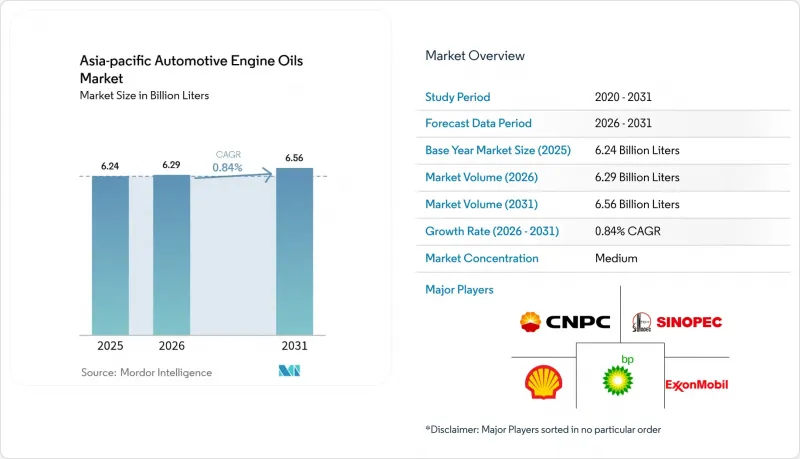
根據 Mordor Intelligence 預測,亞太地區汽車機油市場預計將從 2025 年的 62.4 億公升成長到 2026 年的 62.9 億升,然後在 2031 年達到 65.6 億公升,2026 年至 2031 年的複合年成長率為 0.84%。
本報告按產品類型(乘用車引擎油、重型車輛機油、摩托車機油)、基料(礦物油、合成油、半合成油、生物基油)和地區(中國、印度、巴基斯坦、孟加拉、日本、韓國、台灣、澳洲、馬來西亞、印尼及其他亞太地區)進行細分。市場預測以銷售量(公升)為單位。
亞太地區汽車機油市場趨勢及洞察。
在新興的東協國家,內燃機汽車的數量持續成長。
越南、印尼、泰國和馬來西亞汽車保有量的快速成長持續推動傳統潤滑油的需求,即便在電氣化浪潮興起的背景下,這一需求依然強勁。越南的汽車發展藍圖目標是到2030年實現年銷量100萬輛,這意味著兩位數的成長,並帶動當地組裝廠的潤滑油填充量增加。同樣,印尼擁有1.2531億輛摩托車,摩托車仍然是通勤的主要交通工具,因此摩托車機油的消耗量也居高不下。在地採購法規要求到2030年國產化率達到55-60%,刺激了區域調配廠的發展,降低了物流成本,並促成了針對熱帶使用條件定製配方的潤滑油生產。在這些市場,亞太地區的汽車機油市場受益於小型引擎在擁擠的都市區常見的保養週期所帶來的售後市場需求。供應商正透過開發經銷商培訓計劃和品牌服務連鎖店來抓住這一機遇,以確保客戶的重複購買。
OEM工廠灌裝夥伴關係正在推動高階市場的成長。
汽車製造商正擴大將潤滑油品牌納入保固範圍,鼓勵客戶從授權供應商購買。殼牌與多家日本汽車製造商近期達成的協議表明,雙方共同開發的專為混合動力引擎量身定做的0W-20和5W-30潤滑油,能夠支援長達10,000公里的換油週期。同樣,道達爾能源與起亞的合作,透過將潤滑油推薦與原廠遠端資訊處理系統結合,鼓勵客戶定期保養,從而提高客戶留存率。這些舉措正將競爭戰場從零售貨架轉移到設計中心,使那些致力於開發添加劑化學技術的潤滑油調配商受益匪淺,這些技術旨在最佳化燃油效率、冷啟動性能和觸媒轉換器耐久性之間的平衡。隨著混合動力汽車銷售的成長,原廠加註潤滑油正成為經銷商進入售後市場的盈利切入點,這不僅提升了品牌價值,也加速了亞太地區汽車機油市場的優質化趨勢。
電動車的普及正在抑制傳統汽車需求的成長。
中國加速向電池式電動車(BEV)轉型,徹底消除了對引擎潤滑的需求,這影響了東南亞國協的政策藍圖。預計到2024年,電動車將佔該地區市場佔有率的13%,到2035年將達到850萬輛。雖然混合動力汽車透過採用較小的引擎來緩解這一趨勢,但每輛車的潤滑油總用量仍在減少,迫使供應商將多元化經營,轉向電動車溫度控管液和齒輪油領域。此外,充電生態系統正在重塑加油站的經濟結構,亞太地區整個汽車機油市場的傳統換油收入來源正在萎縮,迫使分銷模式做出調整。
細分市場分析
預計到2025年,乘用車引擎油將佔據亞太地區汽車機油市場最大佔有率,達到48.92%。這主要得益於乘用車在該地區持續佔據主導地位。同時,摩托車機油預計將保持最高的成長率,到2031年複合年成長率將達到0.93%,這主要受東協特大城市摩托車高滲透率和有效距離式踏板車興起的推動。重型車輛機油市場則保持穩定成長,反映出該地區基礎設施投資的持續成長和貨運量的擴張。
MCO(摩托車專用機油)的成長與OEM廠商致力於開發用於發電機的小排氣量混合動力引擎(需在穩定的轉速下運作)的努力不謀而合,這類引擎需要耐熱潤滑油。專注於此細分市場的供應商正在開發具有卓越剪切穩定性的10W-30等級機油,以適應亞洲摩托車設計中常用的濕式離合器系統。隨著都市區擁塞日益嚴重,共享摩托車的使用量不斷成長,而提供快速換油服務的連鎖店在路邊服務亭也提高了消費者的忠誠度。整體而言,擁有多元化產品系列的供應商可以從亞太地區汽車機油市場快速成長的MCO細分市場中獲益,同時緩解PCMO(汽油機油)銷售放緩的影響。
其他好處:
- Excel格式的市場預測(ME)表
- 3個月的分析師支持
目錄
第1章:引言
- 研究假設和市場定義
- 調查範圍
第2章:調查方法
第3章執行摘要
第4章 市場狀況
- 市場概覽
- 市場促進因素
- 在新興的東南亞國協,內燃機汽車的數量持續成長。
- OEM製造商與一家大型潤滑油公司建立工廠灌裝合作關係。
- 亞太地區更嚴格的燃油效率標準
- 叫車營運時間激增
- 有效距離式的電動兩輪混合動力汽車
- 市場限制因素
- 中國乘用車電動車滲透率
- 關於延長換油週期的原廠規範。
- 政府推廣生物潤滑劑
- 價值鍊和通路分析
- 波特五力模型
- 法律規範
- 汽車產業的發展趨勢
第5章 市場規模與成長預測
- 依產品類型
- 乘用車引擎機油(PCMO)
- 0W-XX
- 5W-XX
- 10W-XX
- 15W-XX
- 單級
- 其他年級
- 重型機油(HDMO)
- 0W-XX
- 5W-XX
- 10W-XX
- 15W-XX
- 單級
- 其他年級
- 摩托車機油(MCO)
- 0W-XX
- 5W-XX
- 10W-XX
- 15W-XX
- 單級
- 其他年級
- 乘用車引擎機油(PCMO)
- 透過股票溶液
- 礦物
- 合成
- 半合成
- 生物基
- 按地區
- 中國
- 印度
- 巴基斯坦
- 孟加拉
- 日本
- 韓國
- 台灣
- 澳洲
- 馬來西亞
- 印尼
- 泰國
- 越南
- 其他亞太國家
第6章 競爭情勢
- 市場集中度
- 策略趨勢
- 市佔率(%)/排名分析
- 公司簡介
- Shell plc
- Exxon Mobil Corporation
- BP Plc
- TotalEnergies
- Chevron Corporation
- China Petrochemical Corporation
- CNPC
- Indian Oil Corporation Limited
- ENEOS Corporation
- FUCHS
- Motul
- PT Pertamina
- PTT LUBRICANTS
- Idemitsu Kosan Co.
- Gulf Oil International
- Repsol
- Lukoil Lubricants
- SK Enmove co.Ltd.
- Bharat Petroleum Corporation
第7章 市場機會與未來展望
第8章:執行長面臨的關鍵策略挑戰
According to Mordor Intelligence, the Asia-Pacific automotive engine oils market size is expected to grow from 6.24 Billion Liters in 2025 to 6.29 Billion Liters in 2026 and is forecast to reach 6.56 Billion Liters by 2031 at 0.84% CAGR over 2026-2031.
This report is Segmented by Product Type (Passenger Car Motor Oil, Heavy Duty Motor Oil, and Motorcycle Engine Oil), Base Stock (Mineral, Synthetic, Semi-Synthetic, and Bio-Based), and Geography (China, India, Pakistan, Bangladesh, Japan, South Korea, Taiwan, Australia, Malaysia, Indonesia, and Rest of Asia-Pacific). The Market Forecasts are Provided in Terms of Volume (Litres).
Asia-Pacific Automotive Engine Oils Market Trends and Insights
ICE parc still expanding in emerging ASEAN
Rapid vehicle fleet growth in Vietnam, Indonesia, Thailand, and Malaysia continues to drive positive conventional lubricant demand, even as electrification advances. Vietnam's automotive roadmap aims for 1 million annual vehicle sales by 2030, implying double-digit growth and stronger factory-fill volumes for local assemblers. Indonesia's 125.31 million motorcycle fleet similarly sustains high consumption of Motorcycle Engine Oil as commuting remains two-wheeler-centric. Localization rules that mandate 55-60% domestic content by 2030 stimulate regional blending plants, which lower logistics costs and enable customized formulations for tropical duty cycles. Across these markets, the Asia-Pacific Automotive Engine Oils Market benefits from aftermarket demand tied to small-engine maintenance intervals common in congested urban traffic. Suppliers capitalizing on this upside deploy dealer-education programs and branded service chains to secure repeat purchases.
OEM factory-fill partnerships drive premium segment growth
Automakers increasingly embed lubricant brands into their warranty propositions, channeling purchases toward approved suppliers. Recent agreements between Shell and several Japanese manufacturers demonstrate how the co-development of 0W-20 and 5W-30 blends, tailored for hybrid engines, supports extended drain intervals of up to 10,000 km. TotalEnergies' collaboration with Kia also ties lubrication recommendations to OEM telematics that prompt service visits, thereby increasing customer stickiness. These programs shift the competitive arena from retail shelves to design centers, rewarding formulators with additive chemistry that balances fuel economy, low-temperature start-up, and catalytic-converter durability. As hybrid sales rise, factory-fill volumes act as gateways to profitable dealership aftermarkets, reinforcing brand equity and accelerating the premiumization trajectory of the Asia-Pacific Automotive Engine Oils Market.
Electronic vehicle penetration constrains traditional demand growth
China's accelerating shift toward battery electric cars removes engine lubrication requirements entirely and influences ASEAN policy road maps. EV share in the region reached 13% in 2024 and is on track for 8.5 million units by 2035. While hybrids moderate the decline by retaining small engines, overall per-vehicle lubricant volumes contract, forcing suppliers to hedge through EV thermal-management fluids and gear oils. Distribution models must also adapt as charging ecosystems reshape service-station economics, compressing conventional oil-change revenue streams across the Asia-Pacific Automotive Engine Oils Market.
Other drivers and restraints analyzed in the detailed report include:
- Tightening fuel-economy standards accelerate low-viscosity adoption
- Ride-hailing expansion intensifies commercial lubricant demand
- Extended drain intervals reduce service frequency requirements
For complete list of drivers and restraints, kindly check the Table Of Contents.
Segment Analysis
Passenger Car Motor Oil generated the largest slice of the Asia-Pacific Automotive Engine Oils Market in 2025 at 48.92%, benefiting from the region's still-dominant passenger-vehicle parc. Motorcycle Engine Oil, however, is the fastest riser, with a 0.93% CAGR to 2031, driven by the predominance of two-wheelers in ASEAN megacities and the emergence of range-extender hybrid scooters. Heavy-duty motor oil remains stable, reflecting steady infrastructure investment and regional freight expansion.
MCO growth also aligns with OEM experimentation in small-capacity hybrid engines that run at steady RPM for generator duties, demanding thermally robust lubricants. Suppliers attuned to this niche develop shear-stable 10W-30 grades that are compatible with the wet-clutch systems commonly found in Asia's motorcycle designs. As urban congestion increases, ride-share scooter usage rises, and service chains that market fast oil swaps at roadside kiosks deepen consumer loyalty. Overall, diversified product portfolios enable vendors to cushion slowing PCMO volumes while capitalizing on the faster-growing MCO segment of the Asia-Pacific Automotive Engine Oils Market.
Complete Report Scope:
- by Product Type
- Passenger Car Motor Oil (PCMO)
- 0W-XX
- 5W-XX
- 10W-XX
- 15W-XX
- Monogrades
- Other Grades
- Heavy Duty Motor Oil (HDMO)
- 0W-XX
- 5W-XX
- 10W-XX
- 15W-XX
- Monogrades
- Other Grades
- Motorcycle Engine Oil (MCO)
- 0W-XX
- 5W-XX
- 10W-XX
- 15W-XX
- Monogrades
- Other Grades
- Passenger Car Motor Oil (PCMO)
- By Base Stock
- Mineral
- Synthetic
- Semi-Synthetic
- Bio-Based
- By Geography
- China
- India
- Pakistan
- Bangladesh
- Japan
- South Korea
- Taiwan
- Australia
- Malaysia
- Indonesia
- Thailand
- Vietnam
- Rest of Asia-Pacific
List of Companies Covered in this Report:
- Shell plc
- Exxon Mobil Corporation
- BP Plc
- TotalEnergies
- Chevron Corporation
- China Petrochemical Corporation
- CNPC
- Indian Oil Corporation Limited
- ENEOS Corporation
- FUCHS
- Motul
- PT Pertamina
- PTT LUBRICANTS
- Idemitsu Kosan Co.
- Gulf Oil International
- Repsol
- Lukoil Lubricants
- SK Enmove co.Ltd.
- Bharat Petroleum Corporation
Additional Benefits:
- The market estimate (ME) sheet in Excel format
- 3 months of analyst support
TABLE OF CONTENTS
1 Introduction
- 1.1 Study Assumptions and Market Definition
- 1.2 Scope of the Study
2 Research Methodology
3 Executive Summary
4 Market Landscape
- 4.1 Market Overview
- 4.2 Market Drivers
- 4.2.1 ICE (Internal Combustion Engine) parc still expanding in emerging ASEAN
- 4.2.2 OEM factory-fill tie-ups with lube majors
- 4.2.3 Tightening APAC fuel-economy standards
- 4.2.4 Surge in ride-hailing motor-hours
- 4.2.5 Electrified two-wheeler range-extender hybrids
- 4.3 Market Restraints
- 4.3.1 Electronic Vehicle penetration in China passenger cars
- 4.3.2 Longer OEM drain-interval specifications
- 4.3.3 Government push for bio-lubricants
- 4.4 Value Chain and Distribution Channel Analysis
- 4.5 Porter's Five Forces
- 4.5.1 Threat of New Entrants
- 4.5.2 Bargaining Power of Suppliers
- 4.5.3 Bargaining Power of Buyers
- 4.5.4 Threat of Substitutes
- 4.5.5 Industry Rivalry
- 4.6 Regulatory Framework
- 4.7 Automotive Industry Trends
5 Market Size and Growth Forecasts (Volume)
- 5.1 by Product Type
- 5.1.1 Passenger Car Motor Oil (PCMO)
- 5.1.1.1 0W-XX
- 5.1.1.2 5W-XX
- 5.1.1.3 10W-XX
- 5.1.1.4 15W-XX
- 5.1.1.5 Monogrades
- 5.1.1.6 Other Grades
- 5.1.2 Heavy Duty Motor Oil (HDMO)
- 5.1.2.1 0W-XX
- 5.1.2.2 5W-XX
- 5.1.2.3 10W-XX
- 5.1.2.4 15W-XX
- 5.1.2.5 Monogrades
- 5.1.2.6 Other Grades
- 5.1.3 Motorcycle Engine Oil (MCO)
- 5.1.3.1 0W-XX
- 5.1.3.2 5W-XX
- 5.1.3.3 10W-XX
- 5.1.3.4 15W-XX
- 5.1.3.5 Monogrades
- 5.1.3.6 Other Grades
- 5.1.1 Passenger Car Motor Oil (PCMO)
- 5.2 By Base Stock
- 5.2.1 Mineral
- 5.2.2 Synthetic
- 5.2.3 Semi-Synthetic
- 5.2.4 Bio-Based
- 5.3 By Geography
- 5.3.1 China
- 5.3.2 India
- 5.3.3 Pakistan
- 5.3.4 Bangladesh
- 5.3.5 Japan
- 5.3.6 South Korea
- 5.3.7 Taiwan
- 5.3.8 Australia
- 5.3.9 Malaysia
- 5.3.10 Indonesia
- 5.3.11 Thailand
- 5.3.12 Vietnam
- 5.3.13 Rest of Asia-Pacific
6 Competitive Landscape
- 6.1 Market Concentration
- 6.2 Strategic Moves
- 6.3 Market Share (%)**/Ranking Analysis
- 6.4 Company Profiles (includes Global level Overview, Market level overview, Core Segments, Financials as available, Production Capacity, Strategic Information, Market Rank/Share for key companies, Products and Services, and Recent Developments)
- 6.4.1 Shell plc
- 6.4.2 Exxon Mobil Corporation
- 6.4.3 BP Plc
- 6.4.4 TotalEnergies
- 6.4.5 Chevron Corporation
- 6.4.6 China Petrochemical Corporation
- 6.4.7 CNPC
- 6.4.8 Indian Oil Corporation Limited
- 6.4.9 ENEOS Corporation
- 6.4.10 FUCHS
- 6.4.11 Motul
- 6.4.12 PT Pertamina
- 6.4.13 PTT LUBRICANTS
- 6.4.14 Idemitsu Kosan Co.
- 6.4.15 Gulf Oil International
- 6.4.16 Repsol
- 6.4.17 Lukoil Lubricants
- 6.4.18 SK Enmove co.Ltd.
- 6.4.19 Bharat Petroleum Corporation
7 Market Opportunities and Future Outlook
- 7.1 White-space and Unmet-need Assessment
8 Key Strategic Questions for CEOs

 汽車機油市場:2026-2032年全球市場預測(按產品類型、車輛類型、應用、最終用戶和分銷管道分類)
 東非汽車機油:市場佔有率分析、產業趨勢與統計及成長預測(2026-2031 年)
 2026年全球汽車機油市場報告美國汽車引擎機油:市場佔有率分析、產業趨勢與統計及成長預測(2026-2031)
 汽車機油市場:依產品類型、黏度等級、應用、銷售管道和地區分類
 2026-2030年全球汽車機油市場日本汽車機油:市場佔有率分析、產業趨勢與統計及成長預測(2026-2031)
 全球汽車機油市場:2025年至2030年預測全球汽車機油市場規模(按等級、燃料類型、車輛類型、區域範圍和預測)
 全球汽車機油市場:產業分析、規模、佔有率、成長、趨勢和預測(2025-2032 年)