


 |
市場調查報告書
商品編碼
2073616
南美洲化肥市場:市佔率分析、產業趨勢與統計及成長預測(2026-2031 年)South America Fertilizers - Market Share Analysis, Industry Trends & Statistics, Growth Forecasts (2026 - 2031) |
||||||

※ 本網頁內容可能與最新版本有所差異。詳細情況請與我們聯繫。
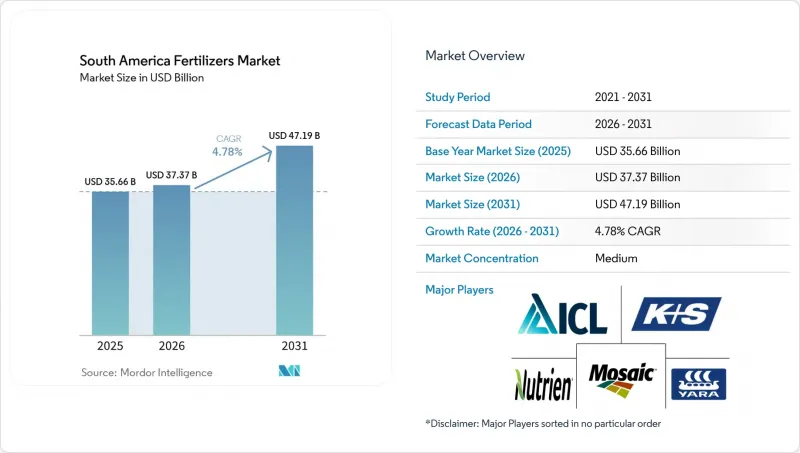
據 Mordor Intelligence 稱,2025 年南美化肥市場價值為 356.6 億美元,預計到 2031 年將達到 471.9 億美元,而 2026 年為 373.7 億美元,預測期(2026-2031 年)複合年成長率為 4.78%。
本報告按肥料類型(複合肥和單質肥)、形態(常規型和特種型)、施用方法(灌溉施肥、葉面噴布、土壤施用)、作物類型(田間作物、園藝作物、草坪和觀賞作物)以及國家(阿根廷、巴西和其他南美國家)進行分類。市場預測以價值(美元)和數量(公噸)表示。
南美洲化肥市場趨勢與洞察
擴大大豆和玉米種植面積
在巴西,2025-2026作物年度大豆種植面積將達4,910萬公頃,較去年同期成長2.8%。種植主要集中在馬托格羅索州和馬托皮巴邊境地區,這些地區酸性的塞拉多土壤需要高磷底肥。玉米雙季種植(巴西稱為「Safrinha」)提高了巴西的玉米產量,同時將氮肥追施期縮短至20天以內,刺激了對可快速噴施的液態尿素-硝酸銨混合肥的需求。雙季種植策略給物流安排帶來了壓力,並增加了對易於獲取的肥料的需求,以支持作物的快速輪作。雙季玉米(巴西稱為“Safrinha”)佔巴西玉米總產量的很大一部分。 2月至3月的種植期將氮肥追施期限制在18天以內。因此,人們對液態尿素-硝酸銨混合物的需求日益成長,這種混合物使用噴霧器施用比撒播顆粒肥料更快。
精密農業和專用材料的引進
基於Sentinel-2和Planet衛星影像的可變施肥技術,到2025年將使巴西大豆和玉米的尿素用量減少14%,同時維持產量穩定。這種養分利用效率的提高,正促使消費者轉向水溶性、添加抑制劑和包膜的肥料配方,這些配方可以透過噴霧器和滴灌系統進行精確計量。在甘蔗試驗中,聚合物包膜尿素將氮肥的有效期延長至90天,無需兩次施肥,每公頃可節省28美元的燃料和人事費用。在整個南美洲肥料市場,隨著生產商尋求降低投入成本並實現永續性指標,精密農業工具正推動特種肥料從利基市場走向主流市場。
加強對營養物質徑流和溫室氣體(GHG)的監管
巴西國家水利委員會(CONAMA)第430/2011號決議對巴西流域廢水排放制定了更嚴格的標準,其中包括氮和其他污染物。該決議修訂並補充了第357/2005號決議,強制要求包括甘蔗和水稻生產商在內的工農業企業遵守更嚴格的營養物排放限值,以減少地表水和地下水資源的污染。該決議旨在解決人們日益關注的水質及其對生態系統和公眾健康的影響。監管成本的增加可能會阻礙小規模農戶採用特殊材料,因為缺乏信貸獎勵來抵銷初始價格溢價。這些措施有望促進永續實踐和技術的採用,以滿足合規要求,同時最大限度地減少對環境的影響。
細分市場分析
到2025年,單一成分肥料將佔南美肥料市場佔有率的89.4%,成為最大的細分市場。這主要歸功於生產者對「一次性」解決方案的需求,以節省勞動力。農民,尤其是在馬托格羅索州的大規模大豆種植區,報告稱使用複合肥(NPK)產品後,勞動成本降低了30-40%,施肥錯誤也減少了。此外,隨著精密農業實踐揭示了該地區土壤普遍存在的鋅、硼和錳缺乏問題,微量元素添加劑的需求也在穩步成長。塞拉杜薩利特雷工廠的國內磷酸鹽生產正在加強當地磷酸一銨(MAP)和磷酸二銨(DAP)的供應。另一方面,鉀肥的進口依賴性仍然很高。硫和鈣的日益缺乏也提高了次要大量元素在採購清單上的重要性,從而擴大了南美肥料市場的營養基礎。
複合肥是成長最快的細分市場,預計到2031年將以7.8%的複合年成長率成長。這主要歸因於塞拉多地區以外的馬托比巴地區新拓展領域養分缺乏土壤的日益增多,以及肥料調配商利用鐵路樞紐,根據當地土壤分析結果客製化氮磷鉀(NPK)配方。這種方法降低了區域運輸和倉儲成本。農民不再只關注價格比較,而是開始評估整個方案的經濟效益,他們認知到均衡複合肥在提高產量穩定性和氣候脅迫下養分利用效率的優勢。同時,單一成分肥料也在不斷發展,尿素生產商推出了包膜產品,磷酸鹽供應商則添加了微量元素。這些趨勢確保了這兩個細分市場將繼續在南美肥料市場中佔據重要地位。
到2025年,傳統肥料將佔南美肥料市場92.8%的佔有率,成為最大的細分市場。如此巨大的市場佔有率歸功於其在農業生產中的廣泛應用、具成本效益以及滿足多種作物營養需求的能力。傳統肥料的高滲透率凸顯了其在支持全部區域農業生產力方面發揮的關鍵作用。
特種肥料領域是成長最快的細分市場,預計到2031年將以6.0%的複合年成長率成長。緩效性肥料(CRF)作為一種單次施用系統,能夠為作物在整個生長季節提供養分,從而減少勞動密集的多次施肥需求,因此備受關注。在灌溉果園和溫室栽培中,液態和水溶性肥料的使用量不斷成長,這得益於變數施肥系統的引入。聚合物包膜尿素在該地區氮肥市場佔據重要佔有率,尤其是在甘蔗種植中,其90天的養分釋放週期與作物的養分吸收相匹配,從而無需在生長季中期進行額外施肥。
其他好處:
- Excel格式的市場預測(ME)表
- 3個月的分析師支持
目錄
第1章:引言
- 研究假設和市場定義
- 調查範圍
- 調查方法
第2章:本報告的內容
第3章:執行摘要和主要發現
第4章:主要產業趨勢
- 主要農作物種植面積
- 田間作物
- 園藝作物
- 平均施肥量
- 微量營養素
- 田間作物
- 園藝作物
- 主要營養素
- 田間作物
- 園藝作物
- 次要營養元素
- 田間作物
- 園藝作物
- 微量營養素
- 配備灌溉設施的農田
- 法律規範
- 價值鍊和通路分析
- 市場促進因素
- 擴大大豆和玉米種植面積
- 政府貸款項目旨在減輕住宅負擔
- 精密農業和特殊材料的引進
- 巴西國家化肥計畫(2050 年)的實施
- 綠色氨生產能力的提升
- 人工智慧驅動的浮動利率諮詢服務
- 市場限制因素
- 天然氣和鉀肥價格波動
- 加強對營養物質徑流和溫室氣體(GHG)的監管
- 巴拿馬運河和紅海的貨物運輸出現瓶頸。
- 農業專業人才短缺阻礙了新技術的採用。
第5章 市場規模與成長預測
- 按類型
- 複雜類型
- 直的
- 微量營養素
- 硼
- 銅
- 鐵
- 錳
- 鉬
- 鋅
- 其他
- 氮基
- 尿素
- 其他
- 磷酸鹽基
- 磷酸二銨(DAP)
- 磷酸一銨(MAP)
- 瞬態過磷酸鈣(SSP)
- 三重過磷酸鈣(TSP)
- 鉀基
- 氯化鉀(MoP)
- 硫酸鉀(SoP)
- 其他
- 次要營養元素
- 鈣
- 鎂
- 硫
- 微量營養素
- 按形式
- 傳統的
- 特種
- 控釋肥料(CRF)
- 液體肥料
- 緩效性肥料(SRF)
- 水溶性
- 透過應用方法
- 施肥和灌溉
- 葉面噴布
- 土壤
- 按作物類型
- 大田作物
- 園藝作物
- 草坪和觀賞植物
- 按地區
- 阿根廷
- 巴西
- 其他南美國家
第6章 競爭情勢
- 市場集中度
- 策略趨勢
- 市佔率分析
- 企業狀況
- 公司簡介
- Coromandel International Limited
- EuroChem Group AG
- COMPO EXPERT GmbH
- Haifa Group
- Kingenta Ecological Engineering Group Co., Ltd.
- Koch Fertilizer LLC
- Nutrien Ltd.
- Sociedad Quimica y Minera de Chile SA
- The Mosaic Company
- Yara International ASA
- ICL Group Ltd.
- K+S Aktiengesellschaft
- Indian Farmers Fertiliser Cooperative Ltd.
- Omex Agriculture Ltd.
- Agro-Culture Liquid Fertilizers LLC
第7章 化肥產業執行長面臨的關鍵策略挑戰
According to Mordor Intelligence, the south america fertilizers market size was valued at USD 35.66 billion in 2025 and estimated to grow from USD 37.37 billion in 2026 to reach USD 47.19 billion by 2031, at a CAGR of 4.78% during the forecast period (2026-2031).
This report is Segmented by Type (Complex and Straight), by Form (Conventional and Specialty), by Application Mode (Fertigation, Foliar, and Soil), by Crop Type (Field Crops, Horticultural Crops, and Turf and Ornamental), and by Country (Argentina, Brazil, and the Rest of South America). The Market Forecasts are Provided in Terms of Value (USD ) and Volume (Metric Tons)
South America Fertilizers Market Trends and Insights
Rising Soybean and Corn Acreage Expansion
Brazil planted 49.1 million ha of soybeans in the 2025-2026 crop year, a 2.8% rise, concentrated in Mato Grosso and the MATOPIBA frontier, where acidic cerrado soils require high phosphate starters. Safrinha corn production increases the country's corn output and compresses the nitrogen top-dress window to fewer than 20 days, stimulating demand for liquid urea-ammonium-nitrate blends that sprayers can deliver quickly. Double-cropping strategies tighten logistics calendars and increase the premium on readily available fertilizers that support rapid crop transitions. Second-crop corn, known as safrinha, accounts for a significant share of Brazil's total corn production. Its planting window, from February to March, limits the top-dress nitrogen application period to 18 days. This has increased demand for liquid urea-ammonium-nitrate solutions, which can be applied more quickly with spray rigs than with granular broadcast methods.
Adoption of Precision Farming and Specialty Inputs
Variable-rate technology guided by Sentinel-2 and Planet imagery cut urea use by 14% of Brazilian soybean and corn in 2025 while keeping yields flat. The gain in nutrient-use efficiency shifts product preference toward water-soluble, inhibitor-enhanced, and coated formulations that sprayers and drip systems meter precisely. Polymer-coated urea extended nitrogen availability to 90 days in sugarcane trials, eliminating the need for two application passes and saving USD 28 per ha in fuel and labor. Across the South America fertilizer market, precision tools are moving specialty inputs from niche to mainstream as growers chase input savings and sustainability metrics.
Stricter Nutrient-Runoff and Greenhouse Gas (GHG) Regulations
Resolution 430/2011 of CONAMA, which regulates the discharge of effluents into receiving water bodies in Brazil, established stricter standards for nitrogen and other pollutants. This regulation, which modifies and supplements Resolution 357/2005, mandates that industries and agricultural operations, including sugarcane and rice producers, adhere to tighter nutrient discharge limits to reduce pollution in surface and groundwater resources. The regulation aims to address the growing concerns over water quality and its impact on ecosystems and public health. Increased regulatory costs could hinder the adoption of specialty inputs by smallholders unless credit incentives help offset the initial price premium. These measures are projected to encourage the adoption of sustainable practices and technologies to meet compliance requirements while minimizing environmental impact.
Other drivers and restraints analyzed in the detailed report include:
- Brazil National Fertilizer Plan 2050 Implementation
- Emergence of Green-Ammonia Production Capacity
- Agronomy Talent Shortage Slowing Tech Adoption
For complete list of drivers and restraints, kindly check the Table Of Contents.
Segment Analysis
Straight was the largest segment, accounting for 89.4% of South America fertilizers market share in 2025, as growers seek single-pass solutions that save labor. Farmers have reported labor savings of 30-40% and reduced application errors when using complex NPK products, particularly in large-scale soybean fields in Mato Grosso. Additionally, micronutrient additives are experiencing steady growth driven by precision farming practices that have identified widespread deficiencies in zinc, boron, and manganese in regional soils. The commencement of domestic phosphate production at the Serra do Salitre facility is bolstering the local supply of monoammonium phosphate (MAP) and diammonium phosphate (DAP). Potash continues to rely heavily on imports. Increasing deficiencies in sulfur and calcium are also elevating the importance of secondary macronutrients on procurement lists, thereby expanding the nutrient base of the South America fertilizers market.
Complex is the fastest-growing segment, advancing at an 7.8% CAGR through 2031, as multi-deficiency soils expand beyond the Cerrado into new MATOPIBA frontiers, fertilizer blenders are utilizing rail-linked hubs to customize NPK formulations based on localized soil analyses. This approach helps reduce regional freight and storage costs. Farmers are transitioning from focusing solely on price comparisons to evaluating total-program economics, acknowledging the benefits of balanced blends in improving yield stability and nutrient-use efficiency under climate stress. Meanwhile, straight grades are evolving, with urea producers introducing coated variants and phosphate suppliers adding micronutrient enrichments. These developments ensure that both segments remain significant in South America fertilizer market.
Conventional fertilizers were the largest segment, accounting for 92.8% share of the South America fertilizers market size in 2025. This dominance can be attributed to their widespread use in agricultural practices, cost-effectiveness, and the ability to meet the nutrient requirements of various crops. The high adoption rate of conventional fertilizers highlights their critical role in supporting agricultural productivity across the region.
The specialty segment is the fastest-growing, advancing at a 6.0% CAGR through 2031. Controlled-release fertilizers (CRF) are gaining prominence as a single-application system that provides nutrients to crops throughout the growing season, thereby reducing the need for multiple labor-intensive applications. Liquid and water-soluble fertilizers are experiencing growth in irrigated fruit-growing regions and greenhouse operations, supported by the adoption of variable-rate fertigation systems. Polymer-coated urea holds a notable share of the regional nitrogen market, particularly in sugarcane cultivation, where its 90-day nutrient release cycle aligns with the crop's nutrient uptake, eliminating the need for additional mid-season applications.
Complete Report Scope:
- By Type
- Complex
- Straight
- Micronutrients
- Boron
- Copper
- Iron
- Manganese
- Molybdenum
- Zinc
- Others
- Nitrogenous
- Urea
- Others
- Phosphatic
- Di-ammonium Phosphate (DAP)
- Monoammonium phosphate (MAP)
- Single Super Phosphate (SSP)
- Triple Superphosphate (TSP)
- Potassic
- Muriate of Potassium (MoP)
- Sulphate of Potash (SoP)
- Others
- Secondary Macronutrients
- Calcium
- Magnesium
- Sulfur
- Micronutrients
- By Form
- Conventional
- Speciality
- Controlled Release Fertilizers (CRF)
- Liquid Fertilizer
- Slow-release fertilizers (SRF)
- Water Soluble
- By Application Mode
- Fertigation
- Foliar
- Soil
- By Crop Type
- Field Crops
- Horticultural Crops
- Turf and Ornamental
- By Geography
- Argentina
- Brazil
- Rest of South America
List of Companies Covered in this Report:
- Coromandel International Limited
- EuroChem Group AG
- COMPO EXPERT GmbH
- Haifa Group
- Kingenta Ecological Engineering Group Co., Ltd.
- Koch Fertilizer LLC
- Nutrien Ltd.
- Sociedad Quimica y Minera de Chile S.A.
- The Mosaic Company
- Yara International ASA
- ICL Group Ltd.
- K+S Aktiengesellschaft
- Indian Farmers Fertiliser Cooperative Ltd.
- Omex Agriculture Ltd.
- Agro-Culture Liquid Fertilizers LLC
Additional Benefits:
- The market estimate (ME) sheet in Excel format
- 3 months of analyst support
TABLE OF CONTENTS
1 INTRODUCTION
- 1.1 Study Assumptions and Market Definition
- 1.2 Scope of the Study
- 1.3 Research Methodology
2 REPORT OFFERS
3 EXECUTIVE SUMMARY AND KEY FINDINGS
4 KEY INDUSTRY TRENDS
- 4.1 Acreage of Major Crop Types
- 4.1.1 Field Crops
- 4.1.2 Horticultural Crops
- 4.2 Average Nutrient Application Rates
- 4.2.1 Micronutrients
- 4.2.1.1 Field Crops
- 4.2.1.2 Horticultural Crops
- 4.2.2 Primary Nutrients
- 4.2.2.1 Field Crops
- 4.2.2.2 Horticultural Crops
- 4.2.3 Secondary Macronutrients
- 4.2.3.1 Field Crops
- 4.2.3.2 Horticultural Crops
- 4.2.1 Micronutrients
- 4.3 Agricultural Land Equipped for Irrigation
- 4.4 Regulatory Framework
- 4.5 Value Chain and Distribution Channel Analysis
- 4.6 Market Drivers
- 4.6.1 Rising soybean and corn acreage expansion
- 4.6.2 Government credit programs boosting affordability
- 4.6.3 Adoption of precision farming and specialty inputs
- 4.6.4 Brazil National Fertilizer Plan 2050 implementation
- 4.6.5 Emergence of green ammonia production capacity
- 4.6.6 AI-enabled variable-rate advisory services
- 4.7 Market Restraints
- 4.7.1 Volatility in natural-gas and potash prices
- 4.7.2 Stricter nutrient-runoff and Greenhouse Gas (GHG) regulations
- 4.7.3 Freight bottlenecks via the Panama Canal and the Red Sea
- 4.7.4 Agronomy talent shortage is slowing tech adoption
5 MARKET SIZE AND GROWTH FORECASTS (VALUE AND VOLUME)
- 5.1 By Type
- 5.1.1 Complex
- 5.1.2 Straight
- 5.1.2.1 Micronutrients
- 5.1.2.1.1 Boron
- 5.1.2.1.2 Copper
- 5.1.2.1.3 Iron
- 5.1.2.1.4 Manganese
- 5.1.2.1.5 Molybdenum
- 5.1.2.1.6 Zinc
- 5.1.2.1.7 Others
- 5.1.2.2 Nitrogenous
- 5.1.2.2.1 Urea
- 5.1.2.2.2 Others
- 5.1.2.3 Phosphatic
- 5.1.2.3.1 Di-ammonium Phosphate (DAP)
- 5.1.2.3.2 Monoammonium phosphate (MAP)
- 5.1.2.3.3 Single Super Phosphate (SSP)
- 5.1.2.3.4 Triple Superphosphate (TSP)
- 5.1.2.4 Potassic
- 5.1.2.4.1 Muriate of Potassium (MoP)
- 5.1.2.4.2 Sulphate of Potash (SoP)
- 5.1.2.4.3 Others
- 5.1.2.5 Secondary Macronutrients
- 5.1.2.5.1 Calcium
- 5.1.2.5.2 Magnesium
- 5.1.2.5.3 Sulfur
- 5.1.2.1 Micronutrients
- 5.2 By Form
- 5.2.1 Conventional
- 5.2.2 Speciality
- 5.2.2.1 Controlled Release Fertilizers (CRF)
- 5.2.2.2 Liquid Fertilizer
- 5.2.2.3 Slow-release fertilizers (SRF)
- 5.2.2.4 Water Soluble
- 5.3 By Application Mode
- 5.3.1 Fertigation
- 5.3.2 Foliar
- 5.3.3 Soil
- 5.4 By Crop Type
- 5.4.1 Field Crops
- 5.4.2 Horticultural Crops
- 5.4.3 Turf and Ornamental
- 5.5 By Geography
- 5.5.1 Argentina
- 5.5.2 Brazil
- 5.5.3 Rest of South America
6 COMPETITIVE LANDSCAPE
- 6.1 Market Concentration
- 6.2 Strategic Moves
- 6.3 Market Share Analysis
- 6.4 Company Landscape
- 6.5 Company Profiles (Includes Global Level Overview, Market Level Overview, Core Segments, Financials as Available, Strategic Information, Market Rank/Share for Key Companies, Products and Services, and Recent Developments)
- 6.5.1 Coromandel International Limited
- 6.5.2 EuroChem Group AG
- 6.5.3 COMPO EXPERT GmbH
- 6.5.4 Haifa Group
- 6.5.5 Kingenta Ecological Engineering Group Co., Ltd.
- 6.5.6 Koch Fertilizer LLC
- 6.5.7 Nutrien Ltd.
- 6.5.8 Sociedad Quimica y Minera de Chile S.A.
- 6.5.9 The Mosaic Company
- 6.5.10 Yara International ASA
- 6.5.11 ICL Group Ltd.
- 6.5.12 K+S Aktiengesellschaft
- 6.5.13 Indian Farmers Fertiliser Cooperative Ltd.
- 6.5.14 Omex Agriculture Ltd.
- 6.5.15 Agro-Culture Liquid Fertilizers LLC
7 KEY STRATEGIC QUESTIONS FOR FERTILIZER CEOS

 有機肥料pH計市場:全球市場預測,2026-2032年
 全球複合肥料市場規模、佔有率、趨勢及成長分析報告(2026-2034)
 2026年全球氨肥市場報告
 2026-2030年全球磷肥市場
 東南亞化肥市場:市佔率分析、產業趨勢與統計及成長預測(2026-2031年)化肥市場規模、佔有率、成長、全球產業分析、區域趨勢及2026-2034年預測。昆蟲衍生肥料市場規模、佔有率、成長、全球產業分析、區域趨勢及2026年至2034年預測。印尼化肥市場:市場佔有率分析、產業趨勢與統計、成長預測(2026-2031)全球昆蟲衍生肥料市場規模、佔有率、趨勢和成長分析報告(2026-2034)綠色氨肥:市場佔有率分析、產業趨勢與統計、成長預測(2026-2031)