


 |
市場調查報告書
商品編碼
2073289
歐洲員工福利管理:市場佔有率分析、產業趨勢與統計及成長預測(2026-2031 年)Europe Benefits Administration - Market Share Analysis, Industry Trends & Statistics, Growth Forecasts (2026 - 2031) |
||||||

※ 本網頁內容可能與最新版本有所差異。詳細情況請與我們聯繫。
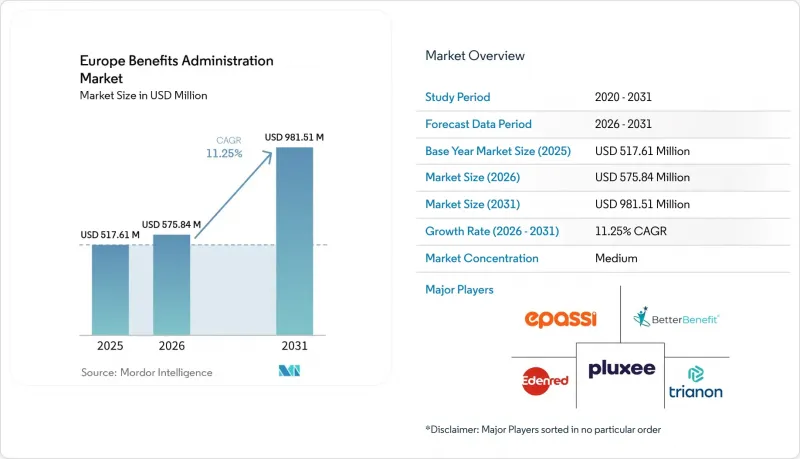
根據 Mordor Intelligence 預測,歐洲員工福利管理市場規模預計將在 2025 年達到 5.1761 億美元,2026 年達到 5.7584 億美元,到 2031 年達到 9.8151 億美元,2026 年至 2031 年的複合年成長率為 11.25%。
本報告按元件(軟體和服務)、解決方案類型(例如,退休和退休金管理)、部署模式(雲端、本地部署、混合部署)、組織規模(大型企業和中小企業)、最終用戶產業(例如,醫療保健和生命科學)以及地區進行細分。市場預測以美元計價。
歐洲員工福利管理市場的趨勢與洞察
歐盟薪酬透明度指令加強了對全面薪酬的資料要求。
歐盟的《工資透明度指令》是推動歐洲福利管理市場短期發展的最顯著因素,因為它將福利數據從人力資源記錄的補充資訊提升為正式的合規要求。成員國必須在2026年6月7日前實施指令,迫使雇主在第一個完整的報告週期開始前建立報告系統。歐盟境內有250名或以上員工的雇主必須從2026年開始提交性別薪資差距報告,其中包括浮動薪資和福利部分,報告工作將於2027年開始。這迫使企業規範其在薪酬、福利和整個人力資源系統中評估和分類薪酬數據的方式,從而提升了整合管理平台的吸引力。該指令還建立了一個持續的合規週期,因為薪資差距超過5%且不合理的雇主必須與員工代表合作進行薪資評估。這凸顯了持續分析能力的重要性,而非一次性審計。隨著各國政府不斷增加各自的要求和時間表,歐洲員工福利管理市場對能夠適應國家差異而無需單獨本地化的系統的需求日益成長。
對多邊合規自動化日益成長的需求
歐洲福利管理市場的發展也受到以下因素的驅動:在多個歐洲司法管轄區運作福利項目的複雜性日益增加,這些司法管轄區的稅收制度、薪資核算、退休金和報告法規各不相同。在全部區域營運的雇主開始意識到,人力資源部門需要耗費大量時間在本地薪資核算團隊、仲介和管理人員之間進行手動協調,這會導致許多本可避免的錯誤。人力資源實施專家報告稱,到2026年,在自動化程度有限的跨國環境中,行政任務可能佔人力資源工作時間的57%,這使得平台投資的回報更容易得到證明。這種需求正在推動那些能夠將福利工作流程與薪資核算系統和本地合規邏輯相結合的供應商的發展,而不僅僅是提供註冊流程的前端介面。 SD Worx的業務遍及27個歐洲國家,預計2025年的營收將達到13.07億歐元(14.1億美元),這充分證明了將跨國合規問題作為標準功能所帶來的商業性價值。隨著報告要求的擴大,採購標準正朝著品質、可審計性和遵守當地法規的方向發展,從而提高了歐洲福利管理市場的技術標準。
資料隱私和跨境資料傳輸的負擔
由於員工福利平台需要處理跨多個司法管轄區的高度敏感的個人資訊、薪資數據和健康相關數據,數據隱私仍然是歐洲員工福利管理市場面臨的最大限制因素之一。 《一般資料保護規則》(GDPR) 對持續文件記錄、管治和風險評估提出了要求,這對沒有大規模內部合規團隊的中型企業來說無疑是一項沉重的負擔。自 Schrems II 裁決以來,將人力資源資料傳輸到美國雲端環境的雇主必須完成傳輸影響評估,並實施技術保障措施,例如使用歐盟控制的金鑰進行加密。雖然歐盟-美國資料隱私框架在一定程度上緩解了認證資料傳輸中的摩擦,但未來潛在的法律糾紛仍然是許多雇主擔憂的問題,導致他們在歐盟以外選擇長期架構時持謹慎態度。德國勞動法又帶來了一項挑戰:集中處理人力資源數據必須經過嚴格的“必要性審查”,這限制了跨國公司僅僅出於提高運營效率的目的而集中處理福利數據。因此,在歐洲員工福利管理市場,託管在歐盟境內的基礎設施顯然更受青睞。然而,這種趨勢可能會導致供應商成本上升、採購流程延誤以及實施週期延長。
細分市場分析
2025年,軟體在歐洲福利管理市場佔據68.12%的佔有率,繼續保持其在該領域的重要收入來源地位。雇主們繼續優先考慮用於資格認定、註冊流程、員工自助服務和報告的核心引擎,因為這些功能是擺脫人工管理的第一步。對於那些希望在不立即將所有流程外包的情況下,建構跨國通用營運層的組織而言,軟體也符合其預算優先事項。然而,隨著服務業預計到2031年將以14.02%的複合年成長率成長,超過歐洲福利管理市場的整體成長率,收入組成正在改變。
該服務業的快速成長反映出,僅靠軟體無法解決在員工代表委員會、GDPR(一般資料保護規則)法規、薪資核算映射以及與保險公司協調等複雜情況下實施的難題。在多個歐盟國家拓展業務的雇主仍需要外部支持,以進行實施、規則制定、合規性解讀和變更管理。 2026年1月,Benifex報告稱,全球32%的雇主已在使用單一整合的福利管理平台,而14%的雇主在不同地區使用多個平台。這表明,儘管平台採用率正在提高,但諮詢支援仍然十分必要。該調查還發現,51%的全球雇主優先考慮人力資源系統和福利平台的整合,這自然推動了對服務主導交付的需求。在歐洲福利管理行業,雖然軟體仍然是一項主要支出,但預計在預測期內,服務將成為更強勁的成長動力。
到2025年,核心管理平台將佔據歐洲福利管理市場41.16%的佔有率,這反映了它們在員工登記、資格審核和理賠核對方面作為主要記錄系統的地位。對於希望擺脫電子表格和分散的本地工作流程的雇主而言,這些工具仍然是常見的起點。它們的主導地位也表明,許多組織仍然專注於取代舊式管理系統,而不是先建立完善的使用者體驗層。同時,預計2031年,職場福利管理將以13.14%的複合年成長率成長,成為歐洲福利管理市場中成長最快的解決方案細分領域。
這一成長反映出支出類別明顯轉向雇主出資和員工自主支配,包括旅行、健康、代金券和彈性生活方式預算。隨著雇主要求福利計畫能夠輕鬆個人化並透過單一數位體驗進行溝通,職場工具的重要性日益凸顯。單卡和應用機制透過將多種自主支配福利整合到單一介面,也減輕了管理負擔。退休和退休金管理仍然是一個關鍵領域,尤其是在英國,儀錶板功能和資料清洗技術的進步正在提升現代管理層的價值。因此,歐洲福利管理產業正從基本的福利處理擴展到更廣泛的平台模式,以支援法定管理和以員工為中心的選項。
其他好處:
- Excel格式的市場預測(ME)表
- 3個月的分析師支持
目錄
第1章:引言
- 研究假設和市場定義
- 調查範圍
第2章:調查方法
第3章執行摘要
第4章 市場狀況
- 市場概覽
- 市場促進因素
- 歐洲人力資源系統雲端遷移
- 對多邊合規自動化日益成長的需求
- 中小企業對可配置SaaS平台的採用率不斷提高。
- 對個人化、行動優先的員工福利體驗的需求
- 歐盟工資透明度指令加強了對總薪酬的資料要求。
- 跨境遠距辦公的擴展增加了A1和社會保障管理的複雜性。
- 市場限制因素
- 資料隱私以及跨境資料傳輸帶來的負擔
- 與現有薪資核算系統、保險公司系統和退休金系統整合的複雜性。
- 由於員工代表委員會和共同決策機制,德語區(DACH)的部署出現延誤。
- 歐洲通訊業者與福利機構之間連結碎片化
- 產業價值鏈分析
- 監理情勢
- 技術展望
- 宏觀經濟因素對市場的影響
- 波特五力分析
第5章 市場規模與成長預測
- 按組件
- 軟體
- 服務
- 按解決方案類型
- 核心管理平台
- 可選員工福利管理
- 退休和退休金管理
- 職場福利管理
- 支援員工決策和自助服務
- 其他解決方案類型
- 部署模式
- 基於雲端的
- 現場
- 混合
- 按組織規模
- 大公司
- 小型企業
- 按最終用戶行業分類
- 資訊科技/通訊
- 銀行業、金融服務業及保險業
- 醫療保健和生命科學
- 製造業
- 零售與電子商務
- 其他終端用戶產業
- 按地區
- 德國
- 英國
- 法國
- 義大利
- 西班牙
- 荷蘭
- 北歐的
- 波蘭
- 其他歐洲國家
第6章 競爭情勢
- 市場集中度
- 策略趨勢
- 市佔率分析
- 公司簡介
- Benefex Limited
- EDENRED SE
- Pluxee NV
- Epassi Group Oy
- Reward Gateway(UK)Ltd
- SME HCI Limited
- Universal Cover, SA
- SPENDIT AG
- Thanks Ben Ltd
- Yonder Technology Limited
- Zest Technology Ltd.
- BetterBenefit GmbH
- Swile, societe par actions simplifiee
- Trianon SA
- Aptia UK Limited
- PlanSource Benefits Administration, Inc.
- Benefitfocus.com, Inc.
- Businessolver.com Inc.
- bswift LLC
- Empower Benefits, Inc. dba Corestream
第7章 市場機會與未來展望
According to Mordor Intelligence, the europe benefits administration market size is projected to be USD 517.61 million in 2025, USD 575.84 million in 2026, and reach USD 981.51 million by 2031, growing at a CAGR of 11.25% from 2026 to 2031.
This report is Segmented by Component (Software, and Services), Solution Type (Retirement and Pension Administration, and More), Deployment Mode (Cloud-Based, On-Premises, and Hybrid), Organization Size (Large Enterprises, and Small and Medium-Sized Enterprises), End-User Industry (Healthcare and Life Sciences, and More), and Geography. The Market Forecasts are Provided in Terms of Value (USD).
Europe Benefits Administration Market Trends and Insights
EU Pay Transparency Directive Elevates Total Reward Data Requirements
The EU Pay Transparency Directive is the clearest near-term driver for the Europe benefits administration market because it moves benefits data from a supporting HR record into a formal compliance requirement. Member states must apply the directive by June 7, 2026, which is forcing employers to prepare their reporting structures before the first full reporting cycle begins. Employers with 250 or more employees in the EU must file gender pay gap reports that include variable pay and benefits components from the 2026 calendar year onward, with reporting beginning in 2027. This pushes organizations to standardize how they value and classify rewards data across payroll, benefits, and HR systems, which increases the appeal of unified administration platforms. The directive also creates an ongoing compliance loop, as employers with an unjustified pay gap above 5% must complete a joint pay assessment with employee representatives, underscoring the need for always-available analytics rather than one-time audits. As national governments add their own requirements and timelines, the Europe benefits administration market is benefiting from demand for systems that can handle country variation without separate local builds.
Rising Need for Multi-Country Compliance Automation
The Europe benefits administration market is also being boosted by the growing complexity of running benefit programs across multiple European jurisdictions with different tax, payroll, pension, and reporting rules. Employers operating across the region are finding that manual coordination among local payroll teams, brokers, and administrators consumes too much HR time and leads to avoidable errors. HR implementation specialists reported in 2026 that administration can take up to 57% of HR working time in multi-country environments when automation is limited, which makes the return on platform investment easier to justify. This demand is strengthening providers that can combine benefits workflows with payroll connectivity and local compliance logic, rather than offering a simple enrollment front end. SD Worx's scale across 27 European countries and its 2025 revenue base of EUR 1.307 billion (USD 1.41 billion) show the commercial value of solving compliance across borders as a built-in capability. As reporting obligations expand, procurement criteria are shifting toward integration quality, auditability, and support for local rules, raising the technical standard for the Europe benefits administration market.
Data Privacy and Cross-Border Data Transfer Burdens
Data privacy remains one of the strongest brakes on the Europe benefits administration market because benefit platforms process sensitive personal, salary, and health-related data across multiple legal jurisdictions. GDPR creates ongoing documentation, governance, and risk assessment requirements, and those obligations fall more heavily on mid-sized employers that lack large internal compliance teams. Post-Schrems II, employers transferring HR data to U.S.-based cloud environments have had to complete transfer impact assessments and implement technical safeguards, such as encryption using EU-controlled keys. The EU-U.S. Data Privacy Framework reduced some friction for certified transfers, but the possibility of future legal challenges remains a concern for many employers, making them cautious about long-term architecture choices outside the EU. German employment law adds another layer because centralized HR data processing must meet a strict necessity test, which limits how easily multinational groups can centralize benefits data for operational efficiency alone. This leaves the Europe benefits administration market with a clear preference for EU-hosted infrastructure, but that preference can raise vendor costs, slow procurement, and stretch implementation timelines.
Other drivers and restraints analyzed in the detailed report include:
- Cloud Migration Across European HR Stacks
- Cross-Border Remote Work Expands A1 and Social Security Administration Complexity
- Integration Complexity with Legacy Payroll, Carrier, and Pension Systems
For complete list of drivers and restraints, kindly check the Table Of Contents.
Segment Analysis
Software held 68.12% of the Europe benefits administration market in 2025, which kept it as the clear revenue base for the category. Employers continued to prioritize core engines for eligibility, enrollment, employee self-service, and reporting because those functions are the first step away from manual administration. Software also fits the budget priorities of organizations that want a common operating layer across countries without immediately outsourcing every process. Even so, the revenue mix is changing because services are projected to grow at a 14.02% CAGR through 2031, which is faster than the overall Europe benefits administration market.
That faster services growth reflects the fact that software alone does not solve deployment complexity in a region shaped by works councils, GDPR controls, payroll mapping, and carrier coordination. Employers expanding across several EU countries still need outside support for implementation, rule configuration, compliance interpretation, and change management. Benifex reported in January 2026 that 32% of employers globally already use a single, unified benefits management platform, while 14% use multiple platforms across regions, indicating that platform adoption is advancing but still often requires advisory support. The same research found that 51% of global employers prioritize integrating HR systems with benefits platforms, which naturally increases the demand for services-led delivery. In the Europe benefits administration industry, software remains the core spend category, while services are the stronger growth lever over the forecast period.
Core administration platforms accounted for 41.16% of the Europe benefits administration market in 2025, reflecting their role as the main system of record for enrollment, eligibility, and billing reconciliation. These tools remain the usual starting point for employers moving away from spreadsheets or fragmented local workflows. Their lead position also shows that many organizations are still focused on replacing legacy administration rather than building advanced experience layers first. At the same time, worksite benefits administration is expected to grow at a 13.14% CAGR through 2031, making it the fastest-moving solution area in the Europe benefits administration market.
This growth reflects a clear shift toward employer-funded but employee-directed spending categories such as mobility, wellbeing, vouchers, and flexible lifestyle budgets. Worksite tools are becoming more relevant as employers seek benefit programs that are easier to personalize and communicate through a single digital experience. Single-card and app-based structures also reduce administrative effort by consolidating several discretionary benefits into a single interface. Retirement and pension administration remains an important adjacent category, especially in the United Kingdom, where dashboard readiness and data cleanup are raising the value of modern administration layers. The Europe benefits administration industry is therefore broadening from basic benefit processing into a wider platform model that supports both statutory administration and employee-facing choice.
Complete Report Scope:
- By Component
- Software
- Services
- By Solution Type
- Core Administration Platforms
- Voluntary Benefits Administration
- Retirement and Pension Administration
- Worksite Benefits Administration
- Employee Decision Support and Self-Service
- Other Solution Types
- By Deployment Mode
- Cloud-Based
- On-Premises
- Hybrid
- By Organization Size
- Large Enterprises
- Small and Medium-Sized Enterprises
- By End-user Industry
- Information Technology and Telecommunications
- Banking, Financial Services, and Insurance
- Healthcare and Life Sciences
- Manufacturing
- Retail and E-Commerce
- Other End-user Industries
- By Geography
- Germany
- United Kingdom
- France
- Italy
- Spain
- Netherlands
- Nordics
- Poland
- Rest of Europe
List of Companies Covered in this Report:
- Benefex Limited
- EDENRED SE
- Pluxee N.V.
- Epassi Group Oy
- Reward Gateway (UK) Ltd
- SME HCI Limited
- Universal Cover, SA
- SPENDIT AG
- Thanks Ben Ltd
- Yonder Technology Limited
- Zest Technology Ltd.
- BetterBenefit GmbH
- Swile, societe par actions simplifiee
- Trianon SA
- Aptia UK Limited
- PlanSource Benefits Administration, Inc.
- Benefitfocus.com, Inc.
- Businessolver.com Inc.
- bswift LLC
- Empower Benefits, Inc. dba Corestream
Additional Benefits:
- The market estimate (ME) sheet in Excel format
- 3 months of analyst support
TABLE OF CONTENTS
1 INTRODUCTION
- 1.1 Study Assumptions and Market Definition
- 1.2 Scope of the Study
2 RESEARCH METHODOLOGY
3 EXECUTIVE SUMMARY
4 MARKET LANDSCAPE
- 4.1 Market Overview
- 4.2 Market Drivers
- 4.2.1 Cloud Migration across European HR Stacks
- 4.2.2 Rising Need for Multi-Country Compliance Automation
- 4.2.3 Growing SME Adoption of Configurable SaaS Platforms
- 4.2.4 Demand for Personalized and Mobile-First Benefits Experiences
- 4.2.5 EU Pay Transparency Directive Elevates Total Reward Data Requirements
- 4.2.6 Cross-Border Remote Work Expands A1 and Social Security Administration Complexity
- 4.3 Market Restraints
- 4.3.1 Data Privacy and Cross-Border Data Transfer Burdens
- 4.3.2 Integration Complexity with Legacy Payroll, Carrier, and Pension Systems
- 4.3.3 Works Council and Co-Determination Delays in DACH Rollouts
- 4.3.4 Carrier and Benefits Provider Connectivity Fragmentation across Europe
- 4.4 Industry Value Chain Analysis
- 4.5 Regulatory Landscape
- 4.6 Technological Outlook
- 4.7 Impact of Macroeconomic Factors on the Market
- 4.8 Porter's Five Forces Analysis
- 4.8.1 Bargaining Power of Buyers
- 4.8.2 Bargaining Power of Suppliers
- 4.8.3 Threat of New Entrants
- 4.8.4 Threat of Substitutes
- 4.8.5 Intensity of Competitive Rivalry
5 MARKET SIZE AND GROWTH FORECASTS (VALUE)
- 5.1 By Component
- 5.1.1 Software
- 5.1.2 Services
- 5.2 By Solution Type
- 5.2.1 Core Administration Platforms
- 5.2.2 Voluntary Benefits Administration
- 5.2.3 Retirement and Pension Administration
- 5.2.4 Worksite Benefits Administration
- 5.2.5 Employee Decision Support and Self-Service
- 5.2.6 Other Solution Types
- 5.3 By Deployment Mode
- 5.3.1 Cloud-Based
- 5.3.2 On-Premises
- 5.3.3 Hybrid
- 5.4 By Organization Size
- 5.4.1 Large Enterprises
- 5.4.2 Small and Medium-Sized Enterprises
- 5.5 By End-user Industry
- 5.5.1 Information Technology and Telecommunications
- 5.5.2 Banking, Financial Services, and Insurance
- 5.5.3 Healthcare and Life Sciences
- 5.5.4 Manufacturing
- 5.5.5 Retail and E-Commerce
- 5.5.6 Other End-user Industries
- 5.6 By Geography
- 5.6.1 Germany
- 5.6.2 United Kingdom
- 5.6.3 France
- 5.6.4 Italy
- 5.6.5 Spain
- 5.6.6 Netherlands
- 5.6.7 Nordics
- 5.6.8 Poland
- 5.6.9 Rest of Europe
6 COMPETITIVE LANDSCAPE
- 6.1 Market Concentration
- 6.2 Strategic Moves
- 6.3 Market Share Analysis
- 6.4 Company Profiles (includes Global Level Overview, Market Level Overview, Core Segments, Financials as available, Strategic Information, Market Rank/Share, Products and Services, Recent Developments)
- 6.4.1 Benefex Limited
- 6.4.2 EDENRED SE
- 6.4.3 Pluxee N.V.
- 6.4.4 Epassi Group Oy
- 6.4.5 Reward Gateway (UK) Ltd
- 6.4.6 SME HCI Limited
- 6.4.7 Universal Cover, SA
- 6.4.8 SPENDIT AG
- 6.4.9 Thanks Ben Ltd
- 6.4.10 Yonder Technology Limited
- 6.4.11 Zest Technology Ltd.
- 6.4.12 BetterBenefit GmbH
- 6.4.13 Swile, societe par actions simplifiee
- 6.4.14 Trianon SA
- 6.4.15 Aptia UK Limited
- 6.4.16 PlanSource Benefits Administration, Inc.
- 6.4.17 Benefitfocus.com, Inc.
- 6.4.18 Businessolver.com Inc.
- 6.4.19 bswift LLC
- 6.4.20 Empower Benefits, Inc. dba Corestream
7 MARKET OPPORTUNITIES AND FUTURE OUTLOOK
- 7.1 White-space and Unmet-Need Assessment

 2026年全球員工福利管理軟體市場報告
 員工福利技術:市場佔有率分析、產業趨勢與統計、成長預測(2026-2031)
 2026-2030年全球員工福利管理服務市場2026年全球福利與獎勵管理市場報告亞太地區員工福利技術:市場佔有率分析、產業趨勢與統計及成長預測(2026-2031 年)員工福祉平台:市場佔有率分析、產業趨勢與統計、成長預測(2026-2031)2026年全球福利管理軟體市場報告
 福利管理軟體市場規模、佔有率和成長分析(按部署類型、最終用戶、功能提供、定價模式和地區分類)-2026-2033年產業預測
 員工福利技術平台市場:按解決方案類型、部署模式、組織規模和行業垂直領域分類 - 2026-2032 年全球預測2025年全球社會福利管理服務市場報告