


 |
市場調查報告書
商品編碼
2073026
供應鏈碳管理軟體:市場佔有率分析、產業趨勢與統計及成長預測(2026-2031)Supply Chain Carbon Management Software - Market Share Analysis, Industry Trends & Statistics, Growth Forecasts (2026 - 2031) |
||||||

※ 本網頁內容可能與最新版本有所差異。詳細情況請與我們聯繫。
據 Mordor Intelligence 稱,2025 年供應鏈碳管理軟體市值為 31.1 億美元,預計到 2031 年將達到 79.6 億美元,而 2026 年為 36 億美元,預測期(2026-2031 年)的複合年成長率為 17.20%。
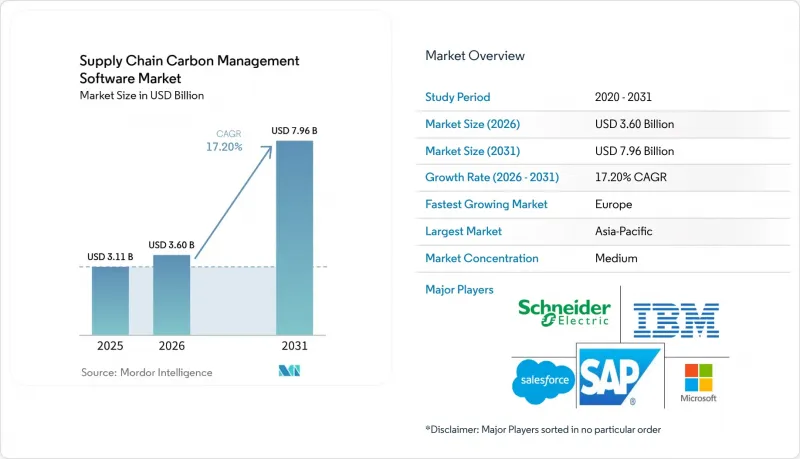
本報告按產品/服務(軟體和服務)、部署模式(雲端、本地部署、混合部署)、企業規模(大型企業和中小企業)、應用領域(碳會計和排放追蹤等)、最終用戶產業(IT和電信、銀行、金融服務和保險、製造業等)以及地區進行細分。市場預測以美元計價。
全球供應鏈碳管理軟體市場趨勢及洞察
全球供應鏈對範圍 3 資訊揭露的壓力日益增大
全球供應商網路中的企業對供應鏈碳管理軟體市場的需求強勁,這些企業需要更嚴格的範圍3揭露。首批提交CSRD(供應鏈碳報告)的企業於2025年報告了2024會計年度的範圍3數據,樹立了標桿,為後續提交者必須達到的證據水平和可重複性樹立了榜樣。隨著ESRS E1將範圍3置於氣候報告的核心地位,企業必須持續評估所有相關類別,並逐年採用一致的方法。由於供應商資料來自多個系統、地區和報告格式,手動文件管理難以滿足此要求。加州的氣候揭露框架也為總部位於美國的跨國公司帶來了類似的壓力,供應鏈碳管理軟體市場不再僅由歐洲主導。因此,能夠支援供應商資料收集、排放因子應用、稽核追蹤管理以及大規模合規報告的平台正在加速發展。
引入人工智慧驅動的供應商數據協調
供應鏈碳管理軟體市場擴張的另一個原因是,企業面臨的挑戰更多在於數據不一致而非數據缺失。供應商的排放記錄通常分散在發票、產品記錄、生命週期資料庫和ERP匯出資料中,每個資料來源使用的單位、邊界和假設各不相同。因此,數據協調已成為軟體的核心功能,而不僅僅是輔助功能。 2026年3月,EcoVadis與Watershed合作,將供應商的原始數據與自動化可靠性評估相結合,顯示市場正在從單純的資料擷取轉向可靠性評分和證據檢驗。 2026年5月,EcoVadis透過Workiva擴展了其網路,進一步將供應商碳數據與需要符合審計要求的輸出報告工作流程整合。因此,供應鏈碳管理軟體市場越來越重視那些能夠對資料品質進行排名、檢測異常值並將大量供應商輸入資料納入正式保證流程的供應商。
供應商數據有重大缺口,排放因子品質較差。
供應鏈碳管理軟體市場面臨的最大實際限制因素仍然是供應商數據的品質。許多公司仍然依賴二手估計值,因為供應商要么不提供完整的原始排放數據,要么提供的數據格式難以檢驗。這不僅降低了報告的質量,也限制了下游規劃工具的價值。當通用排放因子無法反映特定地點或國家層級的情況時,這項挑戰會進一步加劇,並可能導致全球供應鏈碳排放基準出現重大偏差。 SAP 在其 2026 年更新中透過添加針對農產品和工業品的特定國家排放因子,部分解決了這個問題,這表明買家對地理細分的需求日益成長。在供應商參與度提高、排放因子庫更加精確之前,供應鏈碳管理軟體在採購網路分散的公司中仍將面臨緩慢普及的局面。
細分市場分析
預計到2025年,解決方案將佔供應鏈碳管理軟體市場收入的68.74%,軟體授權仍將是支出中的最大組成部分。這種主導地位反映了早期企業採購模式:企業首先取得用於排放測量、供應商資料收集和報告管理的核心平台。買家偏好解決方案的另一個原因是,解決方案能夠建立通用資料模型,從而支援後續的保障、規劃和產品級分析。在供應鏈碳管理軟體產業發展的早期階段,這種「平台優先」的策略是合理的,因為大型企業在引入外部諮詢支援之前需要一個穩定的系統。解決方案領域也受惠於SaaS交付模式,該模式使企業能夠加速部署,並更輕鬆地更新其分散式供應商網路中的系統。
預計到2031年,服務業將以17.65%的複合年成長率成長,成為成長最快的產業。這一成長表明,許多公司已經超越了軟體採購的初始階段,現在需要支援才能在其複雜的供應商生態系統中有效利用軟體。 CSRD(供應鏈系統需求和資料)保障工作流程、供應商參與、資料清理和排放因子匹配等工作都非常耗費人力,通常超出了內部團隊的能力範圍。 ERM與Carbmee的合作正反映了這一轉變,它將軟體功能與服務主導的執行相結合,以推動整個製造價值鏈中的範圍3減排活動。因此,供應鏈碳管理軟體市場正在朝著一種新的模式轉變,即服務範圍從初始設定擴展到持續的資料管理、供應商協作和持續的脫碳實施。這一趨勢鞏固了能夠支援長期引進週期並在初始部署完成後提供可衡量成果的供應商和合作夥伴的地位。
在供應鏈碳管理軟體市場,到2025年,雲端採用率將佔銷售額的65.12%,成為主導交付模式。雲端平台透過自動化從採購、財務和物流系統中資料擷取,無需大規模的本地基礎設施,從而早期就佔據了市場佔有率。它們也滿足了永續發展團隊的需求,即快速部署、降低前期成本以及輕鬆擴展至整個供應商網路。對於許多中型企業而言,雲端系統減輕了維護本地伺服器的負擔,同時滿足了即時報告的需求。雲端在供應鏈碳管理軟體市場的主導地位反映了法規和報告要求的快速變化,因為買家優先考慮的是頻繁更新和易於部署的功能。
預計到2031年,混合部署將以17.85%的複合年成長率成長,成為成長最快的部署模式。推動這一成長的因素是,企業既需要雲端規模的連接,又需要將敏感的供應商和營運資料保留在受控的本地環境中。這項需求在歐洲尤其重要,因為資料管治和資料居住需求對系統設計選擇有顯著的影響。 SAP的碳足跡管理架構體現了這一發展方向,它允許企業在雲端環境中計算碳數據,並根據需要將結果暴露給本地系統。雖然本地部署在國防、政府和監管嚴格的供應鏈中仍然發揮作用,但它們不太適合快速供應商存取和持續更新的需求。因此,將合規管理與可操作的可擴展性相結合的混合模式在供應鏈碳管理軟體市場中越來越受歡迎。
區域分析
2025年,歐洲將佔全球銷售額的34.56%,引領供應鏈碳管理軟體市場。該地區被認為是政策制定向實際實施過渡最為先進的地區,因為大型企業已根據《碳排放交易指令》(CSRD)的相關要求,全面完成了範圍3的報告週期。歐洲供應鏈碳管理軟體市場也受惠於CSRD、歐盟排放交易體系(ETS)、碳排放交易管理框架(CBAM)以及產品護照編制等因素的綜合推動,這些因素在企業和產品層面都產生了資料需求。德國尤其突出,因為其汽車和工業供應鏈高度依賴產品碳足跡的要求以及對供應商詳細資料收集的要求。法國和荷蘭也仍然是重要的需求中心,這得益於報告系統的實施、進出口活動以及大型企業的高度集中。
北美是第二大區域市場,這得益於美國跨國公司、加州的資訊揭露要求以及大型企業積極主動的自願目標設定。美國買家持續投資,因為他們需要能夠支援其複雜的國內外供應商網路進行全公司範圍排放計算的系統。在加拿大,由於碳定價機制和跨境客戶報告要求,也出現了類似的需求,這要求軟體具備跨多個司法管轄區的報告邏輯。南美洲仍處於應用前沿,隨著企業永續發展期望的提高和綠色金融活動推動系統性排放報告,巴西的發展勢頭強勁。
預計到2031年,亞太地區將以18.12%的複合年成長率(CAGR)實現最高成長,成為供應鏈碳管理軟體市場成長最快的地區。該地區的發展受到國內氣候政策以及與歐洲和北美客戶出口相關的排放規要求的影響。中國正透過其「排放碳中和」目標和不斷完善的碳排放交易框架,更加重視範圍3和企業碳數據。印度憑藉其「節能框架」、「碳權交易機制」以及對上市公司的BRSR核心要求,正獲得發展動力。在日本,GX基金、永續發展指導以及對上市公司的資訊揭露壓力支撐了高階需求。同時,由於沙烏地阿拉伯的「2030願景」、阿拉伯聯合大公國的「2050淨零排放」以及南非和奈及利亞碳政策的發展,中東和非洲地區已開始在市場中搶佔先機。
其他好處:
- Excel格式的市場預測(ME)表
- 3個月的分析師支持
目錄
第1章:引言
- 研究假設和市場定義
- 調查範圍
第2章:調查方法
第3章執行摘要
第4章 市場狀況
- 市場概覽
- 市場促進因素
- 全球供應鏈面臨越來越大的壓力,需要揭露範圍 3 的信息
- 引入人工智慧驅動的供應商數據標準化
- 出口導引型製造業數位產品護照的準備情況
- 大型企業中主導為導向的脫碳計劃
- 排碳權與內部碳定價的工作流程整合
- 將碳分析功能整合到 ERP 和採購套件中。
- 市場限制因素
- 供應商提供的資料缺失嚴重,導致排放因子品質低落。
- 與傳統 ERP、TMS 和 MES 系統整合所帶來的負擔。
- 符合審計標準的網路安全和資料隱私問題
- 中小型企業採購負責人的預算敏感性
- 產業宏觀經濟因素及其影響
- 產業價值鏈分析
- 技術展望
- 波特五力分析
第5章 市場規模與成長預測
- 按組件
- 解決方案
- 服務
- 部署模式
- 雲
- 現場
- 混合
- 按公司規模
- 大公司
- 小型企業
- 透過使用
- 測量並追蹤碳足跡
- 排放報告和合規性
- 與供應商合作及數據收集
- 產品碳足跡評估
- 氣候風險分析
- 脫碳策略和計劃
- 產業最終用途
- 製造業
- 零售與電子商務
- 運輸/物流
- 能源公用事業
- 食品/飲料
- 資訊科技/通訊
- BFSI
- 建築和基礎設施
- 政府/公共部門
- 其他終端用戶產業
- 按地區
- 北美洲
- 美國
- 加拿大
- 墨西哥
- 南美洲
- 巴西
- 阿根廷
- 其他南美國家
- 歐洲
- 德國
- 英國
- 法國
- 義大利
- 西班牙
- 俄羅斯
- 其他歐洲國家
- 亞太地區
- 中國
- 印度
- 日本
- 韓國
- 澳洲
- 其他亞太國家
- 中東和非洲
- 中東
- 沙烏地阿拉伯
- 阿拉伯聯合大公國
- 其他中東國家
- 非洲
- 南非
- 奈及利亞
- 其他非洲國家
- 中東
- 北美洲
第6章 競爭情勢
- 市場集中度
- 策略趨勢
- 市佔率分析
- 公司簡介
- IBM Corporation
- SAP SE
- Microsoft Corporation
- Schneider Electric SE
- Salesforce, Inc.
- Sphera Solutions, Inc.
- Workiva Inc.
- ENGIE SA
- Watershed, Inc.
- Persefoni AI, Inc.
- Plan A ESG GmbH
- Greenly SAS
- Emitwise Ltd.
- Sweep SAS
- Carbon Direct, Inc.
- Carbmee GmbH
- Cority Software Inc.
- Diligent Corporation
- Wolters Kluwer NV
- Sinai Technologies, Inc.
第7章 市場機會與未來展望
According to Mordor Intelligence, the supply chain carbon management software market size was valued at USD 3.11 billion in 2025 and estimated to grow from USD 3.60 billion in 2026 to reach USD 7.96 billion by 2031, at a CAGR of 17.20% during the forecast period (2026-2031).
This report is Segmented by Offering (Software, and Services), Deployment Model (Cloud, On-Premise, and Hybrid), Enterprise Size (Large Enterprises, and Small and Medium Enterprises), Application (Carbon Accounting and Emissions Tracking, and More), End-Use Industry (IT and Telecom, BFSI, Manufacturing, and More), and Geography. The Market Forecasts are Provided in Terms of Value (USD).
Global Supply Chain Carbon Management Software Market Trends and Insights
Rising Scope 3 Disclosure Pressure Across Global Supply Chains
The supply chain carbon management software market is seeing strong demand from companies that now need more rigorous Scope 3 disclosures across global supplier networks. The first CSRD filers reported 2024 fiscal-year Scope 3 data in 2025, creating a live benchmark for the level of evidence and repeatability that later filers now need to meet. ESRS E1 kept Scope 3 at the center of climate reporting, meaning companies still need to assess all relevant categories and apply consistent methods year over year. That requirement is difficult to manage in manual files because supplier data comes from many systems, geographies, and reporting formats. California's climate disclosure framework is intensifying the same pressure on U.S.-based multinationals, so the supply chain carbon management software market is no longer being shaped solely by Europe. The result is a faster move toward platforms that can collect supplier data, apply emissions factors, maintain audit trails, and support assurance-ready reporting at scale.
Adoption of AI-Based Supplier Data Harmonization
The supply chain carbon management software market is also expanding because enterprises are struggling less with missing data than with inconsistent data. Supplier emissions records often sit across invoices, product records, life cycle databases, and ERP exports, and each source uses different units, boundaries, and assumptions. That makes harmonization a core software task rather than a supporting feature. In March 2026, EcoVadis and Watershed partnered to combine supplier primary data with automated reliability grading, demonstrating how the market is moving toward confidence scoring and evidence checks rather than simple data intake. In May 2026, EcoVadis expanded the same network through Workiva, further connecting supplier carbon data with reporting workflows that require audit-ready outputs. As a result, the supply chain carbon management software market is rewarding vendors that can rank data quality, detect outliers, and move high-volume supplier inputs into formal assurance processes.
High Supplier Data Gaps and Poor Emissions Factor Quality
The biggest practical constraint in the supply chain carbon management software market remains supplier data quality. Many enterprises still rely on secondary estimates because suppliers do not provide complete primary emissions data, or they do so in formats that cannot be easily verified. That weakens reporting quality and also limits the value of downstream planning tools. The challenge becomes harder when generic emissions factors do not reflect site-level or country-level conditions, which can materially distort carbon baselines for global supply chains. SAP addressed part of this issue in its 2026 updates by adding more country-specific factors for agricultural and industrial commodities, indicating that buyer demand for geographic granularity is growing. Until supplier participation improves and emissions factor libraries become more precise, the supply chain carbon management software market will continue to face slower adoption among companies with fragmented sourcing networks.
Other drivers and restraints analyzed in the detailed report include:
- Digital Product Passport Readiness in Export-Oriented Manufacturing
- Procurement-Led Decarbonization Programs in Large Enterprises
- Integration Burden With Legacy ERP, TMS, And MES Systems
For complete list of drivers and restraints, kindly check the Table Of Contents.
Segment Analysis
Solutions accounted for 68.74% of 2025 revenue in the supply chain carbon management software market, with software licenses remaining the largest component of spending. That lead reflected early enterprise buying patterns, in which companies first secured the core platform needed for emissions measurement, supplier data capture, and reporting controls. Buyers also preferred solutions because they established a common data model that could later support assurance, planning, and product-level analysis. In the early build-out stage of the supply chain carbon management software industry, this platform-first approach made sense because large enterprises needed a stable system before adding external advisory support. The solutions segment also benefited from SaaS delivery, which enabled companies to onboard faster and update their systems more easily across distributed supplier networks.
The services segment is projected to expand at a 17.65% CAGR through 2031, which makes it the fastest-growing component. That rise shows that many enterprises have moved past the first step of buying software and now need help using it across complex supplier ecosystems. CSRD assurance workflows, supplier outreach, data cleaning, and emissions factor matching are all work-intensive tasks that internal teams often cannot absorb. The ERM and Carbmee partnership reflects this shift by combining software capabilities with service-led execution to drive Scope 3 reduction work in manufacturing value chains. The supply chain carbon management software market is therefore moving toward a model in which services extend beyond setup to include continuous data management, supplier engagement, and decarbonization follow-through. That pattern strengthens vendors and partners that can support long implementation cycles and deliver measurable outcomes after the initial deployment is complete.
Cloud deployment accounted for 65.12% of 2025 revenue in the supply chain carbon management software market, making it the dominant delivery model. Cloud platforms gained early market share by enabling automated data ingestion from procurement, finance, and logistics systems without the need for extensive internal infrastructure. They also meet the needs of sustainability teams that want faster setup, lower upfront costs, and easier expansion across supplier networks. For many mid-sized adopters, cloud systems reduced the burden of maintaining internal servers while supporting live reporting needs. Cloud leadership in the supply chain carbon management software market also reflects how quickly regulatory and reporting requirements evolve, because buyers value frequent updates and easier feature rollouts.
Hybrid deployment is projected to grow at a 17.85% CAGR through 2031, which makes it the fastest-growing mode. This growth comes from enterprises that need cloud-scale connectivity but still must keep sensitive supplier or operational data within controlled regional environments. That requirement is particularly relevant in Europe, where data governance and residency expectations shape system design choices. SAP's footprint management architecture demonstrates this direction, as companies can calculate carbon data in cloud environments and publish results back to on-premises systems when needed. On-premises deployments still hold a role in defense, government, and tightly regulated supply chains, but they are less aligned with the need for fast supplier onboarding and continuous updates. As a result, the supply chain carbon management software market is increasingly favoring hybrid models that combine compliance control with practical scalability.
Complete Report Scope:
- By Component
- Solutions
- Services
- By Deployment Mode
- Cloud
- On-Premises
- Hybrid
- By Enterprise Size
- Large Enterprises
- Small And Medium Enterprises
- By Application
- Carbon Footprint Measurement and Tracking
- Emissions Reporting and Compliance
- Supplier Engagement and Data Collection
- Product Carbon Footprint Assessment
- Climate Risk Analysis
- Decarbonization Strategy and Planning
- By End-Use Industry
- Manufacturing
- Retail and E-Commerce
- Transportation and Logistics
- Energy and Utilities
- Food and Beverage
- IT and Telecom
- BFSI
- Construction and Infrastructure
- Government and Public Sector
- Other End-user Industries
- By Geography
- North America
- United States
- Canada
- Mexico
- South America
- Brazil
- Argentina
- Rest of South America
- Europe
- Germany
- United Kingdom
- France
- Italy
- Spain
- Russia
- Rest of Europe
- Asia-Pacific
- China
- India
- Japan
- South Korea
- Australia
- Rest of Asia-Pacific
- Middle East and Africa
- Middle East
- Saudi Arabia
- United Arab Emirates
- Rest of Middle East
- Africa
- South Africa
- Nigeria
- Rest of Africa
- Middle East
- North America
Geography Analysis
Europe held a 34.56% revenue share in 2025, making it the leading position in the supply chain carbon management software market. The region moved furthest from policy planning to live implementation because large companies have already completed full Scope 3 reporting cycles under CSRD-linked requirements. The supply chain carbon management software market also benefits in Europe from the combined effect of CSRD, the EU Emissions Trading System, CBAM, and product passport preparation, which together create both corporate and product-level data needs. Germany stands out because its automotive and industrial supply chains face high exposure to both product carbon footprint demands and deep supplier data collection requirements. France and the Netherlands also remain important demand centers due to reporting adoption, import-export activity, and a high concentration of large enterprises.
North America represented the second-largest regional market, supported by U.S. multinationals, California disclosure mandates, and strong voluntary target-setting among large companies. Buyers in the United States continue to invest because they need systems that can support enterprise-wide emissions accounting across complex domestic and overseas supplier networks. Canada adds a similar need through carbon pricing and cross-border customer reporting requirements, which favor software with multi-jurisdiction reporting logic. South America remains at the forefront of adoption, but Brazil is building momentum as corporate sustainability expectations rise and green finance activity drives structured emissions reporting.
Asia-Pacific is projected to post the fastest CAGR of 18.12% through 2031, making it the strongest growth region in the supply chain carbon management software market. The region is being shaped by domestic climate policies and by export-linked compliance needs from customers in Europe and North America. China is pushing Scope 3 and enterprise carbon data higher on the agenda through its dual-carbon goals and the broader evolution of its emissions trading framework. India is adding momentum through the Energy Conservation framework, the Carbon Credit Trading Scheme, and BRSR Core expectations for listed companies. Japan supports premium demand through GX funding, sustainability guidance, and listed-company disclosure pressure, while the Middle East and Africa are beginning to see earlier traction through enterprise decarbonization efforts tied to Saudi Vision 2030, UAE Net Zero 2050, and carbon policy development in South Africa and Nigeria.
- IBM Corporation
- SAP SE
- Microsoft Corporation
- Schneider Electric SE
- Salesforce, Inc.
- Sphera Solutions, Inc.
- Workiva Inc.
- ENGIE SA
- Watershed, Inc.
- Persefoni AI, Inc.
- Plan A ESG GmbH
- Greenly SAS
- Emitwise Ltd.
- Sweep SAS
- Carbon Direct, Inc.
- Carbmee GmbH
- Cority Software Inc.
- Diligent Corporation
- Wolters Kluwer N.V.
- Sinai Technologies, Inc.
Additional Benefits:
- The market estimate (ME) sheet in Excel format
- 3 months of analyst support
TABLE OF CONTENTS
1 INTRODUCTION
- 1.1 Study Assumptions and Market Definition
- 1.2 Scope of the Study
2 RESEARCH METHODOLOGY
3 EXECUTIVE SUMMARY
4 MARKET LANDSCAPE
- 4.1 Market Overview
- 4.2 Market Drivers
- 4.2.1 Rising Scope 3 Disclosure Pressure Across Global Supply Chains
- 4.2.2 Adoption of AI-Based Supplier Data Harmonization
- 4.2.3 Digital Product Passport Readiness in Export-Oriented Manufacturing
- 4.2.4 Procurement-Led Decarbonization Programs in Large Enterprises
- 4.2.5 Carbon Credit and Internal Carbon Price Workflow Integration
- 4.2.6 Embedded Carbon Analytics in ERP and Procurement Suites
- 4.3 Market Restraints
- 4.3.1 High Supplier Data Gaps and Poor Emissions Factor Quality
- 4.3.2 Integration Burden with Legacy ERP, TMS, and MES Systems
- 4.3.3 Audit-Grade Cybersecurity and Data Privacy Concerns
- 4.3.4 Budget Sensitivity Among Mid-Market and SME Buyers
- 4.4 Industry Macroeconomic Factors and Their Impact
- 4.5 Industry Value Chain Analysis
- 4.6 Technological Outlook
- 4.7 Porter's Five Forces Analysis
- 4.7.1 Threat of New Entrants
- 4.7.2 Bargaining Power of Buyers
- 4.7.3 Bargaining Power of Suppliers
- 4.7.4 Threat of Substitutes
- 4.7.5 Intensity of Competitive Rivalry
5 MARKET SIZE AND GROWTH FORECASTS (VALUE)
- 5.1 By Component
- 5.1.1 Solutions
- 5.1.2 Services
- 5.2 By Deployment Mode
- 5.2.1 Cloud
- 5.2.2 On-Premises
- 5.2.3 Hybrid
- 5.3 By Enterprise Size
- 5.3.1 Large Enterprises
- 5.3.2 Small And Medium Enterprises
- 5.4 By Application
- 5.4.1 Carbon Footprint Measurement and Tracking
- 5.4.2 Emissions Reporting and Compliance
- 5.4.3 Supplier Engagement and Data Collection
- 5.4.4 Product Carbon Footprint Assessment
- 5.4.5 Climate Risk Analysis
- 5.4.6 Decarbonization Strategy and Planning
- 5.5 By End-Use Industry
- 5.5.1 Manufacturing
- 5.5.2 Retail and E-Commerce
- 5.5.3 Transportation and Logistics
- 5.5.4 Energy and Utilities
- 5.5.5 Food and Beverage
- 5.5.6 IT and Telecom
- 5.5.7 BFSI
- 5.5.8 Construction and Infrastructure
- 5.5.9 Government and Public Sector
- 5.5.10 Other End-user Industries
- 5.6 By Geography
- 5.6.1 North America
- 5.6.1.1 United States
- 5.6.1.2 Canada
- 5.6.1.3 Mexico
- 5.6.2 South America
- 5.6.2.1 Brazil
- 5.6.2.2 Argentina
- 5.6.2.3 Rest of South America
- 5.6.3 Europe
- 5.6.3.1 Germany
- 5.6.3.2 United Kingdom
- 5.6.3.3 France
- 5.6.3.4 Italy
- 5.6.3.5 Spain
- 5.6.3.6 Russia
- 5.6.3.7 Rest of Europe
- 5.6.4 Asia-Pacific
- 5.6.4.1 China
- 5.6.4.2 India
- 5.6.4.3 Japan
- 5.6.4.4 South Korea
- 5.6.4.5 Australia
- 5.6.4.6 Rest of Asia-Pacific
- 5.6.5 Middle East and Africa
- 5.6.5.1 Middle East
- 5.6.5.1.1 Saudi Arabia
- 5.6.5.1.2 United Arab Emirates
- 5.6.5.1.3 Rest of Middle East
- 5.6.5.2 Africa
- 5.6.5.2.1 South Africa
- 5.6.5.2.2 Nigeria
- 5.6.5.2.3 Rest of Africa
- 5.6.5.1 Middle East
- 5.6.1 North America
6 COMPETITIVE LANDSCAPE
- 6.1 Market Concentration
- 6.2 Strategic Moves
- 6.3 Market Share Analysis
- 6.4 Company Profiles (includes Global Level Overview, Market Level Overview, Core Segments, Financials as available, Strategic Information, Market Rank/Share, Products and Services, Recent Developments)
- 6.4.1 IBM Corporation
- 6.4.2 SAP SE
- 6.4.3 Microsoft Corporation
- 6.4.4 Schneider Electric SE
- 6.4.5 Salesforce, Inc.
- 6.4.6 Sphera Solutions, Inc.
- 6.4.7 Workiva Inc.
- 6.4.8 ENGIE SA
- 6.4.9 Watershed, Inc.
- 6.4.10 Persefoni AI, Inc.
- 6.4.11 Plan A ESG GmbH
- 6.4.12 Greenly SAS
- 6.4.13 Emitwise Ltd.
- 6.4.14 Sweep SAS
- 6.4.15 Carbon Direct, Inc.
- 6.4.16 Carbmee GmbH
- 6.4.17 Cority Software Inc.
- 6.4.18 Diligent Corporation
- 6.4.19 Wolters Kluwer N.V.
- 6.4.20 Sinai Technologies, Inc.
7 MARKET OPPORTUNITIES AND FUTURE OUTLOOK
- 7.1 White-Space and Unmet-Need Assessment

 環境足跡管理市場預測至2034年-按足跡類型、評估範圍、功能模組、合規架構、最終使用者和地區分類的全球分析
 碳足跡管理市場-2026-2032年全球市場預測
 產品碳足跡(PCF)軟體:市場佔有率分析、產業趨勢與統計、成長預測(2026-2031)人工智慧碳足跡管理軟體:市場佔有率分析、產業趨勢與統計、成長預測(2026-2031)範圍 3排放管理軟體:市場佔有率分析、行業趨勢和統計數據以及成長預測(2026-2031 年)
 碳足跡減少市場:全球產業規模、佔有率、趨勢、機會和預測(按解決方案類型、最終用戶和地區分類),競爭格局(2021-2031 年)
 碳足跡管理市場規模、佔有率和趨勢分析報告:按部署類型、類別、最終用途、地區和細分市場預測(2026-2033 年)
 2026-2030年全球人工智慧碳足跡管理市場
 碳足跡管理市場報告:按產品、部署、最終用戶產業和地區分類(2026-2034 年)全球碳管理人工智慧市場預測(至2034年):按組件、部署模式、組織規模、技術、應用、最終用戶和地區分類