


 |
市場調查報告書
商品編碼
2072973
人工智慧碳足跡管理軟體:市場佔有率分析、產業趨勢與統計、成長預測(2026-2031)AI Carbon Footprint Management Software - Market Share Analysis, Industry Trends & Statistics, Growth Forecasts (2026 - 2031) |
||||||

※ 本網頁內容可能與最新版本有所差異。詳細情況請與我們聯繫。
據 Mordor Intelligence 稱,2025 年人工智慧碳足跡管理軟體市場價值 18.2 億美元,預計從 2026 年到 2031 年將以 20.70% 的複合年成長率成長,到 2031 年達到 55.6 億美元。
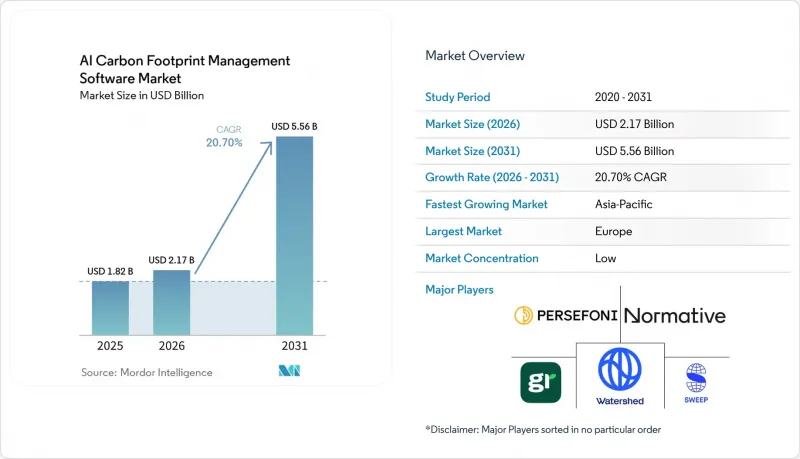
本報告按組件(軟體和服務)、部署模式(雲端、本地部署、混合部署)、企業規模(大型企業和中小企業)、最終用戶行業(IT和電信、銀行、金融服務和保險、工業製造、能源和公共產業、零售和電子商務等)以及地區進行細分。市場預測以美元計價。
全球人工智慧碳足跡管理軟體市場趨勢與洞察
對範圍 1、範圍 2 和範圍 3 資訊揭露的監理壓力日益增大
與排放報告的初始階段相比,如今有關資訊揭露義務的法規涵蓋了更大比例的企業報告目標,這直接推動了人工智慧碳足跡管理軟體市場的成長。歐盟的《企業永續發展報告指令》要求第一階段的企業(目標群體約為500家擁有500名以上員工的大型公用事業公司)在2025年發布符合ESRS標準的2024年永續發展報告。加州的《氣候變遷企業資料課責法案》要求年收入超過10億美元的加州營業單位自2026年8月10日起提交範圍1和範圍2的報告,範圍3的報告則從2027年開始。這個週期的一個實際轉變是,資訊揭露越來越依賴可追溯性和外部審計,而非寬泛的估算,這提升了確保原始記錄保存、工作流程管理和報告一致性的系統的價值。這種轉變意味著軟體的採用不再完全由使用者自行決定。這是因為公司不再需要交付能夠經受住內部永續性審查以及監管機構審查和保證流程的成果。
企業淨零排放承諾與「科學碳目標」的採納
2025年,企業對脫碳的承諾進一步深化,強化了對人工智慧碳足跡管理軟體的結構性需求。根據科學碳目標舉措(SBTi)的數據,截至2025年底,擁有檢驗的短期目標的企業數量達到9,764家,較2024年成長40%。同時,擁有檢驗的淨零排放目標的企業數量成長61%,達到2,325家。追蹤數據顯示,擁有檢驗的目標或有效承諾的企業總數達到12353家,這意味著未來的報告和監測基數大規模僅從當前採用情況推斷出的基數。亞洲地區經檢驗的企業數量成長最快,其中中國經檢驗的目標數量增加了92%。這擴大了目標需求範圍,即使在先前被認為碳軟體採購成熟度較低的市場也是如此。此外,SBTi提案的對企業淨零排放標準的修訂表明,其方向是更嚴格地應用範圍 3,鼓勵企業加快對原始數據收集和高精度庫存系統的投資,而不是依賴可能不再可接受的粗略平均值。
在範圍 3 供應鏈中觀察到顯著的數據品質差異。
範圍 3 仍然是企業庫存中最具挑戰性的部分。這是因為底層資料通常超出直接營運控制範圍,並且流經大規模。為了回應其所謂的“最後一公里難題”,Normative 於 2026 年 2 月推出了碳排放清單管理服務。僅在 2026 年的前六週,其獲得溫室氣體會計系統認證的顧問就提供了超過 1000 小時的客戶支援。 EcoVadis 於 2026 年 4 月透過整合 Carbmee 擴展了其碳數據網路。 Carbmee 的環境智慧系統提供了買家目前所需的詳細信息,透過識別 SKU 層級的排放熱點並將脫碳工作與財務回報指標聯繫起來,從而改進供應商層面的報告。儘管平台工具有所改進,但供應商資料收集仍然十分繁瑣,調查方法的多樣性也延緩了從購買軟體到完全合規的進程。這種限制在多層供應鏈中構成了一個特別嚴重的問題,因為雖然軟體可以集中數據,但它無法立即解決所有供應商節點的原始數據不足的問題。
細分市場分析
在2025年的AI碳足跡管理軟體市場中,軟體佔比高達70.34%。這表明買家仍然傾向於可擴展的平台,這些平台能夠在一個統一的運作環境中集中管理範圍1、2和3的數據。這一趨勢在大規模部署中尤其明顯,因為企業需要跨多個營業單位的工作流程、標準化的調查方法以及跨業務部門和司法管轄區的統一報告。 2026年5月,Workiva在其平台上新增了對CDP 2026問卷的支持,並簡化了AI驅動的ESRS智慧功能。這反映了供應商將合規相關功能直接整合到產品層,而不是將其作為單獨的諮詢服務趨勢。 SAP的Green Ledger也呈現類似的趨勢,它將交易級碳核算功能引入了S/4HANA Cloud。這正在推動向碳金融整合的更廣泛轉型,而這些系統正是財務團隊所信賴的。隨著碳數據與財務報告、內部控制和企業工作流程的聯繫日益緊密,軟體在提供大規模可復現性和集中式管治將繼續發揮主導作用。
服務業是成長最快的產業,人工智慧碳足跡管理軟體市場預計在2026年至2031年間,該領域的複合年成長率將達到21.45%。這一成長反映出平台能夠自動化的流程與企業仍需人工干預的流程之間存在明顯的營運差距。在供應商資料的收集、清理和檢驗方面,這一趨勢尤其顯著。 Normative公司推出託管服務,這表明即使客戶已經擁有軟體功能,他們仍然願意為人工庫存管理支援付費。服務層的重要性日益凸顯,因為許多企業仍缺乏內部基礎設施,無法在方法論一致性、證據處理和流程嚴謹性方面做出可靠的報告。未來,訂閱收入和交付支援之間的界限可能會更加模糊,因為能夠將軟體和執行支援相結合的供應商將在將需求轉化為成功的報告成果方面佔據優勢。
到2025年,基於雲端的部署將佔總收入的67.12%,而混合部署預計將實現最快成長,到2031年複合年成長率將達到22.08%。雲端仍然是最大的部署模式,因為它支援即時API,便於供應商更新數據,並能與依賴持續數據更新的報告工作流程快速整合。這種模式也符合企業在營運方面的需求,即無需在每個站點建立新的基礎設施,即可集中查看跨地點、跨職能部門和跨外部合作夥伴的數據。同時,混合模式正日益普及,因為一些買家希望在不將所有原始營運數據遷移到外部的情況下,獲得進階分析和柔軟性的報告功能。這種趨勢在監管嚴格的環境中尤其明顯,在這些環境中,報告團隊需要雲端規模的建模工具,而敏感的工廠、員工或流程資料必須受到更嚴格的內部控制。
隨著微軟 Dynamics 365 Business Central “2025 Wave 2” 版本於 2026 年 1 月正式發布,ERP 採購工作流程中新增了範圍 3 價值鏈流程自動化功能。這表明部署選項越來越依賴企業已在使用的系統。在石油天然氣、國防以及部分公共部門等領域,由於排放數據涉及商業性敏感資訊或與機密營運資訊重疊,本地部署仍然至關重要。在這些環境中,混合架構更像是一種長期營運模式,它將本地控制與雲端智慧結合,而非權宜之計。因此,人工智慧碳足跡管理軟體市場正朝著多層部署設計方向發展,其中資料來源保留在本地,而分析、基準測試和報告功能則持續遷移到靈活的雲端環境。
區域分析
2025年,歐洲繼續保持領先地位,在人工智慧碳足跡管理軟體市場佔據34.56%的佔有率。這一地位得益於氣候相關資訊揭露條例(CSRD)的分階段實施以及歐洲主要企業應對氣候變遷措施的整體度。根據「科學碳目標舉措」(SBTi),預計到2025年底,CAC 40指數和DAX 40指數成分股公司將分別實現其目標的70%和68%,這表明軟體的持續使用、合約續約和升級擁有穩固的基礎。法規和目標的雙重檢驗意味著,歐洲的需求不僅限於為合規而進行的初始採用。許多採購公司還需要更強大的管理功能、更廣泛的範圍3覆蓋以及更強力的審計支援。因此,歐洲仍然是人工智慧碳足跡管理軟體市場中監管執行和企業承諾如何相互促進的最佳例證。
在北美,隨著監管期限的臨近,SBTi的普及已接近全面。加州SB 253法案規定,在該州運營的大型營業單位必須在2026年8月10日前完成範圍1和範圍2的碳排放披露,範圍3的報告將於2027年開始。儘管標普500指數成分股公司在2025年底前已完成39%的SBTi目標,但這仍落後於歐洲主要基準,顯示該地區除了升級需求外,在SBTi的普及方面仍有巨大的空間。預計到2031年,亞太地區的複合年成長率將達到22.67%,使其成為人工智慧碳足跡管理軟體市場成長最快的地區。 2025年,中國SBTi認證企業數量將成長92%,顯示SBTi的普及將對整個供應鏈產生強大的連鎖反應。同時,日本市場也受益於「ASUENE IMPACT」等產品的發布以及國內主要科技公司推出的更詳細的碳核算標準。
儘管南美仍處於起步階段,但其發展趨勢積極,這主要得益於不斷擴大的報告要求以及出口相關供應鏈的需求。預計到2025年,南美洲採用SBTi目標的企業數量將增加42%,墨西哥的檢驗企業數量將成長58%。這表明跨境價值鏈已經開始影響該地區的軟體需求。中東和非洲也處於採用SBTi的早期階段,阿拉伯聯合大公國和沙烏地阿拉伯正在成為重要的需求中心,這得益於更廣泛的淨零排放和投資主導轉型議程。在這兩個地區,短期觸發因素通常是來自歐洲和北美買家的供應鏈壓力,而非完善的國內資訊揭露體系,這表明軟體需求可能仍將與全球貿易關係和客戶報告預期密切相關。
其他好處:
- Excel格式的市場預測(ME)表
- 3個月的分析師支持
目錄
第1章:引言
- 研究假設和市場定義
- 調查範圍
第2章:調查方法
第3章執行摘要
第4章 市場狀況
- 市場概覽
- 市場促進因素
- 對範圍 1、範圍 2 和範圍 3 資訊揭露的監理壓力日益增大
- 企業淨零排放承諾和科學碳目標的引入
- 透過人工智慧驅動的自動化減少人工碳數據處理工作流程。
- 企業對符合審計要求的永續發展報告的需求
- 複雜價值鏈中供應商層面的碳排放可見度要求
- 將碳數據與企業資源計劃 (ERP)、環境健康安全 (EHS) 和財務報告系統整合。
- 市場限制因素
- 在範圍 3 供應鏈中觀察到顯著的數據品質差異。
- 中型企業面臨高昂的實施和整合成本
- 新興企業缺乏碳計量的內部專業知識
- 基於雲端的碳平台中的網路安全和資料隱私問題
- 產業價值鏈分析
- 監理情勢
- 宏觀經濟因素對市場的影響
- 技術展望
- 波特五力分析
第5章 市場規模與成長預測
- 按組件
- 軟體
- 服務
- 部署模式
- 基於雲端的
- 現場
- 混合
- 按公司規模
- 大公司
- 小型企業
- 產業最終用途
- 資訊科技/通訊
- BFSI
- 工業製造
- 能源公用事業
- 石油和天然氣
- 零售與電子商務
- 食品飲料製造業
- 建築和基礎設施
- 政府/公共部門
- 其他終端用戶產業
- 按地區
- 北美洲
- 美國
- 加拿大
- 墨西哥
- 南美洲
- 巴西
- 阿根廷
- 其他南美國家
- 歐洲
- 德國
- 英國
- 法國
- 義大利
- 西班牙
- 俄羅斯
- 其他歐洲國家
- 亞太地區
- 中國
- 印度
- 日本
- 韓國
- 澳洲
- 其他亞太國家
- 中東和非洲
- 中東
- 沙烏地阿拉伯
- 阿拉伯聯合大公國
- 土耳其
- 其他中東國家
- 非洲
- 南非
- 埃及
- 其他非洲國家
- 中東
- 北美洲
第6章 競爭情勢
- 市場集中度
- 策略趨勢
- 市佔率分析
- 公司簡介
- Persefoni AI, Inc.
- Watershed, Inc.
- Normative Group AB
- Greenly SAS
- Sweep SAS
- Plan A Technologies GmbH
- SINAI Technologies, Inc.
- Green Project Technologies(ACT Group)
- CarbonChain Limited
- CarbonCloud AB
- 51 To Carbon Zero Limited
- Cority Software Inc.
- Benchmark Gensuite LLC
- FigBytes Inc.
- Diligent Corporation
- Workiva Inc.
- Enablon BV
- Intelex Technologies ULC
- EcoVadis SAS
- IBM Corporation
- SAP SE
- Salesforce, Inc.
- Microsoft Corporation
- Schneider Electric SE
第7章 市場機會與未來展望
According to Mordor Intelligence, the AI carbon footprint management software market size was valued at USD 1.82 billion in 2025 and is forecast to reach USD 5.56 billion by 2031 at a CAGR of 20.70% from 2026 to 2031.
This report is Segmented by Component (Software, and Services), Deployment Mode (Cloud-Based, On-Premise, and Hybrid), Enterprise Size (Large Enterprises, and Small and Medium Enterprises), End-Use Industry (IT and Telecom, BFSI, Industrial Manufacturing, Energy and Utilities, Retail and E-Commerce, and More), and Geography. The Market Forecasts are Provided in Terms of Value (USD).
Global AI Carbon Footprint Management Software Market Trends and Insights
Rising Regulatory Pressure For Scope 1, Scope 2, and Scope 3 Disclosure
Mandatory disclosure rules now cover a larger share of the corporate reporting base than in earlier phases of emissions reporting, providing direct growth support for the AI carbon footprint management software market. The EU Corporate Sustainability Reporting Directive required the first wave of companies, around 500 large public-interest entities with more than 500 employees, to publish ESRS-compliant sustainability statements in 2025 for fiscal 2024 data. California's Climate Corporate Data Accountability Act requires Scope 1 and Scope 2 reporting from August 10, 2026, for entities with more than USD 1 billion in annual revenue that do business in the state, and Scope 3 reporting begins in 2027. The practical change in this cycle is that disclosure is increasingly tied to traceability and external review rather than broad estimation, which raises the value of systems that preserve source records, workflow controls, and reporting consistency. That shift makes software adoption less discretionary because companies now need outputs that can withstand regulatory scrutiny and assurance processes, not just internal sustainability reviews.
Corporate Net-Zero Commitments and Science Based Targets Adoption
Corporate decarbonization commitments deepened further in 2025, reinforcing structural demand in the AI carbon footprint management software market. The Science Based Targets initiative reported 9,764 companies with validated near-term targets by the end of 2025, up 40% from 2024, while validated net-zero targets rose 61% to 2,325 companies. The same tracker showed that the total number of companies with validated targets or active commitments reached 12,353, suggesting a much larger future reporting and monitoring base than current deployments alone indicate. Asia posted the fastest growth in validated companies, and China recorded 92% growth in validated targets, widening the addressable demand pool in markets previously viewed as less mature for carbon software procurement. SBTi's proposed revision of the Corporate Net-Zero Standard also points toward stricter Scope 3 coverage, encouraging companies to invest earlier in primary data capture and higher-fidelity inventory systems rather than relying on broad averages that may no longer be acceptable.
High Data Quality Gaps Across Scope 3 Supply Chains
Scope 3 remains the most difficult part of a corporate inventory because the underlying data often sits outside direct operational control and flows through large supplier networks with varying reporting maturity. Normative launched Carbon Inventory Managed Services in February 2026 to address what it described as the last-mile problem, and its GHG Protocol-certified advisors logged more than 1,000 client-support hours in the first 6 weeks of 2026 alone. EcoVadis expanded its Carbon Data Network in April 2026 by adding Carbmee, whose Environmental Intelligence System identifies emissions hotspots at the SKU level and links decarbonization actions to financial return metrics, demonstrating the level of granularity buyers now need to improve supplier-level reporting. Even with better platform tools, supplier data collection remains labor-intensive and methodologically uneven, which slows the path from software purchase to full compliance. This restraint matters most in multi-tier supply chains because software can centralize data but cannot immediately address weak primary inputs from every supplier node.
Other drivers and restraints analyzed in the detailed report include:
- AI-Powered Automation Reducing Manual Carbon Data Workflows
- Enterprise Demand for Audit-Ready Sustainability Reporting
- High Implementation and Integration Costs For Mid-Market Buyers
For complete list of drivers and restraints, kindly check the Table Of Contents.
Segment Analysis
Software accounted for 70.34% of the AI carbon footprint management software market in 2025, indicating that buyers still prefer scalable platforms that centralize Scope 1, 2, and 3 data in a single operating environment. That preference is strongest in larger deployments where companies need multi-entity workflows, standardized methodologies, and consistent reporting structures across business units and jurisdictions. Workiva expanded its platform in May 2026 with CDP 2026 questionnaire support and AI-powered, simplified ESRS intelligence, reflecting how vendors are adding compliance-specific functionality directly into product layers rather than treating it as separate advisory work. SAP's Green Ledger moved in the same direction by bringing transaction-level carbon accounting into S/4HANA Cloud, which supports the broader shift toward carbon-financial integration within systems that finance teams already trust. As carbon data becomes more closely tied to financial reporting, internal controls, and enterprise workflows, software retains its dominant role because it offers repeatability and central governance at scale.
Services are the fastest-growing component, with the AI carbon footprint management software market projected to expand at a 21.45% CAGR for this segment from 2026 to 2031. That growth reflects a clear execution gap between what the platform can automate and what organizations still need people to do, especially when supplier data must be collected, cleaned, and validated. Normative's managed service launch in 2026 showed that buyers continue to pay for hands-on inventory support even when they already have access to software functionality. The service layer is also gaining importance because assurance-ready reporting demands method consistency, evidence handling, and process discipline that many organizations still lack internally. Over time, the line between subscription revenue and delivery support is likely to remain blurred because vendors that can combine software with execution support are better positioned to convert demand into successful reporting outcomes.
Cloud-based deployment held 67.12% of revenue in 2025, while hybrid deployment is set to record the fastest growth at a 22.08% CAGR through 2031. Cloud remained the largest model because it supports real-time APIs, makes supplier updates easier, and enables faster integration with reporting workflows that depend on continuous data refresh. It also aligns with the operating preferences of enterprises that want centralized visibility across sites, functions, and external partners without building new infrastructure at every location. At the same time, the hybrid model is gaining traction because some buyers want advanced analytics and reporting flexibility without moving all raw operational data off-premise. That pattern is especially relevant in regulated settings where sensitive plant, workforce, or process data must stay under tighter internal control even as reporting teams need cloud-scale modeling tools.
Microsoft's 2025 Wave 2 release for Dynamics 365 Business Central, which became generally available in January 2026, added Scope 3 value chain process automation into ERP purchasing workflows, demonstrating how deployment choices are increasingly shaped by the systems companies already use. On-premise deployment still matters in sectors such as oil and gas, defense, and parts of the public sector where emissions data overlaps with commercially sensitive or classified operating information. In that environment, hybrid architecture is less a temporary compromise and more a long-term operating model that combines on-premise control with cloud-based intelligence. The AI carbon footprint management software market is therefore moving toward a layered deployment design, where the data source may remain internal, but analytics, benchmarking, and reporting functions continue to shift to flexible cloud environments.
Complete Report Scope:
- By Component
- Software
- Services
- By Deployment Mode
- Cloud-Based
- On-Premise
- Hybrid
- By Enterprise Size
- Large Enterprises
- Small and Medium Enterprises
- By End-Use Industry
- IT and Telecom
- BFSI
- Industrial Manufacturing
- Energy and Utilities
- Oil and Gas
- Retail and E-Commerce
- Food and Beverage Manufacturing
- Construction and Infrastructure
- Government and Public Sector
- Other End-User Industries
- By Geography
- North America
- United States
- Canada
- Mexico
- South America
- Brazil
- Argentina
- Rest of South America
- Europe
- Germany
- United Kingdom
- France
- Italy
- Spain
- Russia
- Rest of Europe
- Asia-Pacific
- China
- India
- Japan
- South Korea
- Australia
- Rest of Asia-Pacific
- Middle East and Africa
- Middle East
- Saudi Arabia
- United Arab Emirates
- Turkey
- Rest of Middle East
- Africa
- South Africa
- Egypt
- Rest of Africa
- Middle East
- North America
Geography Analysis
Europe held 34.56% of the AI carbon footprint management software market share in 2025, maintaining its lead. That position rests on the phased rollout of the CSRD and the broader maturity of corporate climate commitments across large European companies. The Science Based Targets initiative showed that CAC 40 and DAX 40 companies reached target penetration rates of 70% and 68% by the end of 2025, pointing to a deep installed base for ongoing software use, renewals, and upgrades. That mix of regulation and target validation means demand in Europe is not limited to first-time compliance deployments, because many buyers also need better controls, broader Scope 3 coverage, and stronger audit support. The region, therefore, remains the clearest example of how regulatory depth and corporate commitment can reinforce each other inside the AI carbon footprint management software market.
North America moved closer to a stronger adoption phase as regulatory deadlines approached. California's SB 253 created an August 10, 2026, deadline for Scope 1 and Scope 2 disclosure from large entities doing business in the state, with Scope 3 reporting beginning in 2027. The S&P 500 reached 39% SBTi target penetration by the end of 2025, which was below leading European benchmarks and suggests that the region still has meaningful room for new deployments rather than only upgrade demand. Asia-Pacific is projected to expand at a 22.67% CAGR through 2031, making it the fastest-growing geography in the AI carbon footprint management software market. China's 92% increase in SBTi-validated companies in 2025 points to a strong supply-chain spillover effect, while Japan's market is being supported by product launches such as ASUENE IMPACT and by more detailed carbon accounting standards from domestic technology leaders.
South America remained an earlier-stage market, but the direction of travel was positive because reporting expectations and export-linked supply chain requests continued to spread. SBTi target adoption in South America grew 42% in 2025, and Mexico posted a 58% increase in validated companies, showing that cross-border value chains are already influencing software demand in the region. The Middle East and Africa also remained at an earlier stage of adoption, with the UAE and Saudi Arabia as the main demand centers under broader net-zero and investment-led transition agendas. In both regions, the near-term trigger is often supply-chain pressure from European and North American buyers rather than a fully mature domestic disclosure regime, which means software demand is likely to remain closely linked to global trade relationships and customer reporting expectations.
- Persefoni AI, Inc.
- Watershed, Inc.
- Normative Group AB
- Greenly SAS
- Sweep SAS
- Plan A Technologies GmbH
- SINAI Technologies, Inc.
- Green Project Technologies (ACT Group)
- CarbonChain Limited
- CarbonCloud AB
- 51 To Carbon Zero Limited
- Cority Software Inc.
- Benchmark Gensuite LLC
- FigBytes Inc.
- Diligent Corporation
- Workiva Inc.
- Enablon B.V.
- Intelex Technologies ULC
- EcoVadis SAS
- IBM Corporation
- SAP SE
- Salesforce, Inc.
- Microsoft Corporation
- Schneider Electric SE
Additional Benefits:
- The market estimate (ME) sheet in Excel format
- 3 months of analyst support
TABLE OF CONTENTS
1 INTRODUCTION
- 1.1 Study Assumptions and Market Definition
- 1.2 Scope of the Study
2 RESEARCH METHODOLOGY
3 EXECUTIVE SUMMARY
4 MARKET LANDSCAPE
- 4.1 Market Overview
- 4.2 Market Drivers
- 4.2.1 Rising Regulatory Pressure for Scope 1, Scope 2, and Scope 3 Disclosure
- 4.2.2 Corporate Net-Zero Commitments and Science Based Targets Adoption
- 4.2.3 AI-Powered Automation Reducing Manual Carbon Data Workflows
- 4.2.4 Enterprise Demand for Audit-Ready Sustainability Reporting
- 4.2.5 Supplier-Level Carbon Visibility Requirements in Complex Value Chains
- 4.2.6 Integration of Carbon Data With ERP, EHS, and Financial Reporting Systems
- 4.3 Market Restraints
- 4.3.1 High Data Quality Gaps Across Scope 3 Supply Chains
- 4.3.2 High Implementation and Integration Costs for Mid-Market Buyers
- 4.3.3 Limited Internal Carbon Accounting Expertise in Emerging Enterprises
- 4.3.4 Cybersecurity and Data Privacy Concerns in Cloud-Based Carbon Platforms
- 4.4 Industry Value-Chain Analysis
- 4.5 Regulatory Landscape
- 4.6 Impact of Macroeconomic Factors on the Market
- 4.7 Technological Outlook
- 4.8 Porter's Five Forces Analysis
- 4.8.1 Bargaining Power of Suppliers
- 4.8.2 Bargaining Power of Buyers
- 4.8.3 Threat of New Entrants
- 4.8.4 Threat of Substitutes
- 4.8.5 Intensity of Competitive Rivalry
5 MARKET SIZE AND GROWTH FORECASTS (VALUE)
- 5.1 By Component
- 5.1.1 Software
- 5.1.2 Services
- 5.2 By Deployment Mode
- 5.2.1 Cloud-Based
- 5.2.2 On-Premise
- 5.2.3 Hybrid
- 5.3 By Enterprise Size
- 5.3.1 Large Enterprises
- 5.3.2 Small and Medium Enterprises
- 5.4 By End-Use Industry
- 5.4.1 IT and Telecom
- 5.4.2 BFSI
- 5.4.3 Industrial Manufacturing
- 5.4.4 Energy and Utilities
- 5.4.5 Oil and Gas
- 5.4.6 Retail and E-Commerce
- 5.4.7 Food and Beverage Manufacturing
- 5.4.8 Construction and Infrastructure
- 5.4.9 Government and Public Sector
- 5.4.10 Other End-User Industries
- 5.5 By Geography
- 5.5.1 North America
- 5.5.1.1 United States
- 5.5.1.2 Canada
- 5.5.1.3 Mexico
- 5.5.2 South America
- 5.5.2.1 Brazil
- 5.5.2.2 Argentina
- 5.5.2.3 Rest of South America
- 5.5.3 Europe
- 5.5.3.1 Germany
- 5.5.3.2 United Kingdom
- 5.5.3.3 France
- 5.5.3.4 Italy
- 5.5.3.5 Spain
- 5.5.3.6 Russia
- 5.5.3.7 Rest of Europe
- 5.5.4 Asia-Pacific
- 5.5.4.1 China
- 5.5.4.2 India
- 5.5.4.3 Japan
- 5.5.4.4 South Korea
- 5.5.4.5 Australia
- 5.5.4.6 Rest of Asia-Pacific
- 5.5.5 Middle East and Africa
- 5.5.5.1 Middle East
- 5.5.5.1.1 Saudi Arabia
- 5.5.5.1.2 United Arab Emirates
- 5.5.5.1.3 Turkey
- 5.5.5.1.4 Rest of Middle East
- 5.5.5.2 Africa
- 5.5.5.2.1 South Africa
- 5.5.5.2.2 Egypt
- 5.5.5.2.3 Rest of Africa
- 5.5.5.1 Middle East
- 5.5.1 North America
6 COMPETITIVE LANDSCAPE
- 6.1 Market Concentration
- 6.2 Strategic Moves
- 6.3 Market Share Analysis
- 6.4 Company Profiles (includes Global Level Overview, Market Level Overview, Core Segments, Financials as available, Strategic Information, Market Rank/Share, Products and Services, Recent Developments)
- 6.4.1 Persefoni AI, Inc.
- 6.4.2 Watershed, Inc.
- 6.4.3 Normative Group AB
- 6.4.4 Greenly SAS
- 6.4.5 Sweep SAS
- 6.4.6 Plan A Technologies GmbH
- 6.4.7 SINAI Technologies, Inc.
- 6.4.8 Green Project Technologies (ACT Group)
- 6.4.9 CarbonChain Limited
- 6.4.10 CarbonCloud AB
- 6.4.11 51 To Carbon Zero Limited
- 6.4.12 Cority Software Inc.
- 6.4.13 Benchmark Gensuite LLC
- 6.4.14 FigBytes Inc.
- 6.4.15 Diligent Corporation
- 6.4.16 Workiva Inc.
- 6.4.17 Enablon B.V.
- 6.4.18 Intelex Technologies ULC
- 6.4.19 EcoVadis SAS
- 6.4.20 IBM Corporation
- 6.4.21 SAP SE
- 6.4.22 Salesforce, Inc.
- 6.4.23 Microsoft Corporation
- 6.4.24 Schneider Electric SE
7 MARKET OPPORTUNITIES AND FUTURE OUTLOOK
- 7.1 White-Space and Unmet-Need Assessment

 環境足跡管理市場預測至2034年-按足跡類型、評估範圍、功能模組、合規架構、最終使用者和地區分類的全球分析
 碳足跡管理市場-2026-2032年全球市場預測
 產品碳足跡(PCF)軟體:市場佔有率分析、產業趨勢與統計、成長預測(2026-2031)供應鏈碳管理軟體:市場佔有率分析、產業趨勢與統計及成長預測(2026-2031)範圍 3排放管理軟體:市場佔有率分析、行業趨勢和統計數據以及成長預測(2026-2031 年)
 碳足跡減少市場:全球產業規模、佔有率、趨勢、機會和預測(按解決方案類型、最終用戶和地區分類),競爭格局(2021-2031 年)
 碳足跡管理市場規模、佔有率和趨勢分析報告:按部署類型、類別、最終用途、地區和細分市場預測(2026-2033 年)
 2026-2030年全球人工智慧碳足跡管理市場
 碳足跡管理市場報告:按產品、部署、最終用戶產業和地區分類(2026-2034 年)全球碳管理人工智慧市場預測(至2034年):按組件、部署模式、組織規模、技術、應用、最終用戶和地區分類