


 |
市場調查報告書
商品編碼
2072761
整合行銷服務:市場佔有率分析、產業趨勢與統計、成長預測(2026-2031)Integrated Marketing Services Market - Market Share Analysis, Industry Trends & Statistics, Growth Forecasts (2026 - 2031) |
||||||

※ 本網頁內容可能與最新版本有所差異。詳細情況請與我們聯繫。
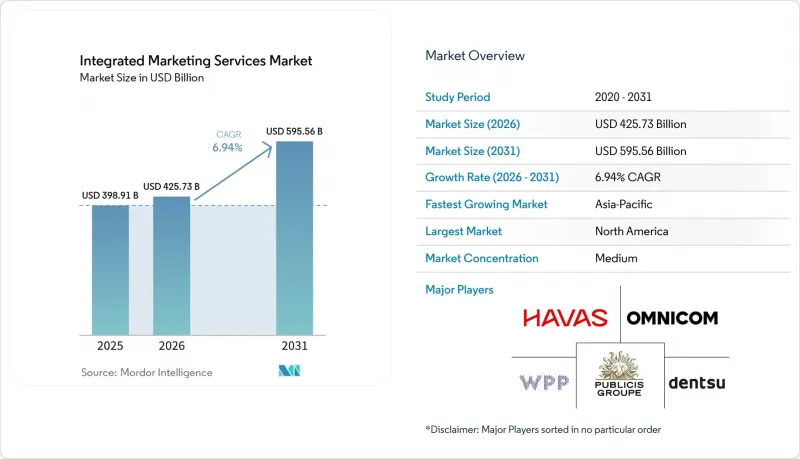
根據 Mordor Intelligence 預測,整合行銷服務市場預計將從 2025 年的 3,989.1 億美元成長到 2026 年的 4,257.3 億美元,到 2031 年達到 5955.6 億美元,2026 年至 2031 年的複合年成長率為 6.94%。
本報告按服務類型(品牌策略和創新服務、數位行銷服務等)、交付模式(企劃為基礎合約、包月合約等)、組織規模(中小企業等)、最終用戶行業(零售和電子商務等)以及地區進行細分。市場預測以美元計價。
全球整合行銷服務市場趨勢與洞察
人工智慧驅動的個人化正在重塑廣告公司的價值提案。
人工智慧 (AI) 正在加速從受眾分析到宣傳活動執行的進程,而這項轉變正在重塑整合行銷服務市場的經營模式。 2026 年,首席行銷長 (CMO) 將 15.3% 的行銷預算分配給了 AI舉措,但只有 30% 的行銷機構表示已成熟並做好準備,這造成了明顯的執行差距,需要代理商合作夥伴來填補。這一差距意義重大,因為客戶尋求的不僅僅是自動化,而是能夠將個人化、媒體和效果衡量整合到單一服務架構中的代理商。 2025 年,陽獅集團展示了 AI 驅動的產品和服務對業務的影響,為 5.6%的內部成長貢獻了 300 個基點。這表明,AI 原生執行已經開始支持大規模供應商擴大市場佔有率。類似的支出轉變也在推動相關領域的業務成長,例如連網電視 (CTV) 歸因和即時忠誠度編配,而且長期合作合約的規模也在擴大而非縮小。因此,在整合行銷服務市場中,人工智慧正在提升能夠將工具、人才、管治和跨管道執行整合到單一營運模式中的廣告公司的價值。
零售媒體和創作者電商正在推動對全通路整合的需求。
零售媒體不再只是被視為下游通路中的一種策略,而這種轉變促使品牌要求其代理商合作夥伴在整個整合行銷服務市場中提供更高程度的協調。電通預測,到2026年,全球零售媒體將成長12.3%,使其成為成長最快的數位管道之一,並進一步鞏固其在購物者行銷、受眾策略和品牌建立中的作用。這意味著代理商需要將零售商的數據、內容、媒體策劃和品牌定位在上游管道中連接起來,而不是孤立地看待每個領域。 2025年,陽獅集團透過投資10億歐元(10.8億美元)進行補充收購,包括收購captiv8和HEPMIL,進一步強化了這個方向,以擴大其在創作者洞察、網紅電商和區域數位活化領域的地位。這一點至關重要,因為當廣告代理商能夠將受眾洞察與零售商激活相結合,並完成從內容到購買的完整路徑時,創作者電商的價值將進一步提升。事實上,這正推動整合行銷服務市場朝著更廣泛的客戶範圍、更高價值的長期合作合約以及在健康和美容等垂直市場中更強大的品類專業化方向發展。
隱私法規和訊號損失會壓縮可覆蓋範圍。
隱私法規的執行不再局限於法律審查,它也正在影響整合行銷服務市場的宣傳活動設計和歸因分析。截至2026年1月,美國超過12個州的法規強制要求企業偵測並遵守基於瀏覽器的通用退出訊號。這縮小了在效果行銷中應用預設追蹤假設的實際範圍。加州透過州立法機構第566號法案進一步推進了瀏覽器級別的退出要求,表明正在轉向更自動化和永續的同意環境。谷歌於2026年6月將廣告資料從GA4傳遞到Google廣告,並將控制資料的主要方式限制在「ad_storage」中,這進一步加重了歐洲經濟區(EEA)廣告主的營運負擔。因此,一些宣傳活動的目標受眾有所減少,而由於需要更強大的同意管理和第一方資料工作流程,代理商面臨更高的基礎設施成本。然而,透過將這些合規任務整合到更廣泛的服務包中,就有可能將市場限制轉化為在整合行銷服務市場中留住客戶的優勢。
細分市場分析
2025年,廣告及媒體規劃與採購服務將佔33.68%的市場佔有率,成為整合行銷服務市場最大的收入來源。這一地位反映了程序化媒體、封閉式採購和跨通路策劃在大規模廣告公司營運模式中持續佔據核心地位。宏盟集團的媒體與廣告部門在2025年累計了100億美元的收入,占公司總收入的58%。這顯示付費媒體及相關執行服務仍具有龐大的市場規模。公共關係和傳播服務也仍然重要,宏盟集團體驗式行銷業務在2025年以固定外匯計算成長19%,預示著贏得媒體、內容、活動和品牌體驗之間的協同效應將進一步增強。
品牌策略和創新服務正面臨越來越大的壓力,Omnicom集團的品牌和零售商務業務部門預計在2025年全年將以固定外匯計算下降15.8%。這表明許多客戶正在將創新預算分配給更廣泛的媒體主導外包服務。數位行銷服務預計將在2026年至2031年間以7.21%的複合年成長率成長,成為整合行銷服務產業中成長最快的服務部門。這一成長反映了市場對搜尋、社交商務、聯網電視以及由生成式人工智慧驅動的搜尋引擎最佳化等服務的需求不斷成長,所有這些都需要更快的測試速度、更多的數據回饋以及更緊密的內容和媒體整合。內容和宣傳活動管理服務,以及客戶互動、客戶關係管理(CRM)和忠誠度服務也呈現成長趨勢,因為品牌正在尋求能夠將自有資料、宣傳活動執行和客戶維繫計畫整合到單一服務架構中的代理商的支援。 ISO 27001、GDPR 和 CCPA 等合規標準也正在成為採購過程中的選擇標準,這意味著在整合行銷服務市場中,服務差異化不僅取決於創新和媒體能力,還取決於營運保障。
2025年,按月付費的合約將佔總收入的41.48%,成為整合行銷服務市場的主導模式。這種模式之所以佔據主導地位,是因為企業負責人仍然重視跨多個市場和職能部門的連續性、組織洞察力和協作。大型客戶在需要以統一的營運節奏管理媒體、數據、客戶關係管理和創新活動時,通常會依賴長期合作關係。喜力啤酒2025年的合作夥伴選擇清晰地體現了這一模式。該公司再次選擇電通負責其全球媒體運營,並將其創新運營拓展至陽獅集團、Stagwell和WPP集團。這表明,即使客戶拓展了合作夥伴,他們仍然會為核心整合營運維持穩定、長期的合作關係。
企劃為基礎合約和混合內部團隊合約的擴張,源自於許多中端市場客戶尋求柔軟性,而非一開始就簽訂長期、寬泛的合約。當品牌正在建立內部人工智慧能力,但仍需要代理商在執行、整合和人才管理方面提供支援時,混合型結構尤其有效。陽獅集團透過Marcel及其相關的內部人才基礎設施專注於此模式,該基礎設施支援客戶內部團隊與代理商專家之間的協作。預計到2031年,績效合約的複合年成長率將達到8.02%,這表明隨著歸因分析的改進,買家越來越傾向於基於績效的定價模式。對於整合行銷服務產業而言,這既是機會也是挑戰。一方面,代理商可以在初步成果後加深與客戶的合作關係;另一方面,隨著績效衡量成為報酬的依據,代理商也承擔更大的風險。
區域分析
預計到2025年,北美將佔據整合行銷服務市場34.46%的佔有率,並在2026年繼續保持最大的區域市場地位。該地區受惠於許多優勢,例如企業廣告預算高度集中、程序化基礎設施最成熟,以及全球最大控股公司總部位置。宏盟集團(Omnicom)預計其美國業務在2025年的收入將達到91億美元,佔其公司總收入的52.7%,這充分體現了該市場龐大的需求規模。陽獅集團(Publicis)也報告稱,其在北美的業務在2025年實現了5.4%的內部成長,其中美國市場佔集團淨銷售額的57%,這進一步鞏固了該地區在全球廣告公司業績中的重要地位。同時,美國市場日益嚴格的隱私法規正促使廣告支出轉向與第一方資料相關的管道,從而提升了能夠以整合方式管理合規性和激活的整合服務模式的價值。
在以數位媒體為先導的投資和成熟的跨境品牌推廣活動的支撐下,歐洲繼續保持其在整合行銷服務市場第二大區域市場的地位。陽獅集團預測,2025年歐洲市場的內部成長將達到4.2%,其中德國為8.9%,英國為7.2%。這表明,儘管法規環境日益嚴格,市場需求仍然強勁。由於《一般資料保護規範》(GDPR)、《數位服務法案》和《人工智慧法案》的實施,合規成本不斷上升,這使得能夠將管治成本分攤到更廣泛客戶群的大型網路公司更具優勢。南美洲市場雖然絕對規模仍然較小,但在2025年實現了強勁成長。宏盟集團在南美洲的銷售額以固定外匯計算成長了29.3%,陽獅集團的內部成長也達到了18.7%。巴西和阿根廷是推動這一成長的主要動力。
預計到2031年,亞太地區將以8.20%的複合年成長率成長,成為整合行銷服務市場成長最快的地區。該地區受益於不斷增強的數位廣告基礎設施、零售媒體的快速擴張以及支援互聯用戶旅程中商業、支付和內容的平台生態系統。提交的草案也指出,到2026年,印度的數位廣告支出將成長9.6%,澳洲、中國、日本和印度的零售媒體擴張也在加速,這些因素共同推動了該地區的成長動能。此外,由於超級應用和市場環境縮短了曝光、交易和效果衡量之間的流程,東南亞的電商媒體模式正變得日益重要。除亞太地區外,中東地區在陽獅集團的投資組合中實現了最高的集中內部成長,預計到2025年將達到10.8%,這反映了陽獅集團在沙烏地阿拉伯和阿拉伯聯合大公國的持續品牌投資。非洲仍然是銷售額最小的地區,但隨著南非、奈及利亞和埃及「行動優先」的普及,隨著本土品牌的發展和跨國公司業務範圍的擴大,對更全面的代理商功能的需求正在早期成長。
其他好處:
- Excel格式的市場預測(ME)表
- 3個月的分析師支持
目錄
第1章:引言
- 研究假設和市場定義
- 調查範圍
第2章:調查方法
第3章執行摘要
第4章 市場狀況
- 市場概覽
- 市場促進因素
- 全通路環境下的品牌一致性要求
- 基於績效的預算分配
- 人工智慧驅動的個人化與內容創作
- 零售媒體與創作者電商的擴張
- 整合第一方數據並引入無塵室
- 中小企業行銷技術堆疊分散化以及外包給代理商的情況日益增加。
- 市場限制因素
- 隱私法規和訊號遺失
- 跨通道測量中的碎片化
- 與生成式人工智慧相關的權利和責任風險
- 答案引擎搜尋與平台差異性
- 宏觀經濟因素對市場的影響
- 產業價值鏈分析
- 監理情勢
- 技術展望
- 波特五力分析
第5章 市場規模與成長預測
- 按服務類型
- 品牌策略與創新服務
- 廣告、媒體企劃與採購服務
- 數位行銷服務
- 公共關係和傳播服務
- 內容和宣傳活動管理服務
- 客戶參與、顧客關係管理與忠誠度服務
- 其他服務類型
- 按型號提供
- 企劃為基礎合約
- 預付費合約
- 績效合約
- 混合式和嵌入式團隊參與
- 按組織規模
- 大公司
- 小型企業
- 按最終用戶行業分類
- 零售與電子商務
- 消費品/美容
- 媒體與娛樂
- 資訊科技/通訊
- BFSI
- 醫療保健和生命科學
- 其他終端使用者產業(教育、旅遊旅館、工業、汽車)
- 按地區
- 北美洲
- 美國
- 加拿大
- 墨西哥
- 南美洲
- 巴西
- 阿根廷
- 智利
- 其他南美國家
- 歐洲
- 德國
- 英國
- 法國
- 義大利
- 西班牙
- 其他歐洲國家
- 亞太地區
- 中國
- 日本
- 印度
- 韓國
- 澳洲
- 其他亞太國家
- 中東
- 阿拉伯聯合大公國
- 沙烏地阿拉伯
- 卡達
- 其他中東國家
- 非洲
- 南非
- 埃及
- 奈及利亞
- 其他非洲國家
- 北美洲
第6章 競爭情勢
- 市場集中度
- 策略趨勢
- 市佔率分析
- 公司簡介
- Omnicom Group Inc.
- Publicis Groupe SA
- WPP plc
- Dentsu Group Inc.
- Accenture plc
- Havas NV
- Stagwell Inc.
- Deloitte Touche Tohmatsu Limited
- Capgemini SE
- Cognizant Technology Solutions Corporation
- Tata Consultancy Services Limited
- Infosys Limited
- Hakuhodo DY Holdings Inc.
- BlueFocus Intelligent Communications Group Co., Ltd.
- Daniel J. Edelman Holdings, Inc.
- Ruder Finn, Inc.
- FINN Partners, Inc.
- LLYC SA
第7章 市場機會與未來展望
According to Mordor Intelligence, the integrated marketing services market size is expected to increase from USD 398.91 billion in 2025 to USD 425.73 billion in 2026 and reach USD 595.56 billion by 2031, growing at a CAGR of 6.94% over 2026-2031.
This report is Segmented by Service Type (Brand Strategy and Creative Services, Digital Marketing Services, and More), Delivery Model (Project-Based Engagement, Retainer-Based Engagement, and More), Organization Size (Small and Medium-Sized Enterprises, and More), End-User Industry (Retail and E-Commerce, and More), and Geography. The Market Forecasts are Provided in Terms of Value (USD)
Global Integrated Marketing Services Market Trends and Insights
Artificial Intelligence-Enabled Personalization Reshapes Agency Value Proposition
Artificial intelligence is reducing the time between audience analysis and live campaign delivery, and that shift is changing the commercial model of the integrated marketing services market. In 2026, CMOs allocated 15.3% of total marketing budgets to AI initiatives, yet only 30% of marketing organizations reported mature readiness, which left a clear execution gap for agency partners to fill. That gap matters because clients are not only looking for automation, they are also looking for agencies that can connect personalization, media, and measurement into one service structure. Publicis showed the commercial effect in 2025, when AI-powered products and services contributed 300 basis points to its 5.6% organic growth, which indicates that AI-native execution is already supporting share gains for scaled providers. The same spending shift is expanding work in adjacent areas such as CTV attribution and real-time loyalty orchestration, so retainers are becoming broader rather than smaller. For the integrated marketing services market, AI is therefore raising the value of agencies that can combine tools, talent, governance, and cross-channel execution in one operating model.
Retail Media and Creator Commerce Drive Demand for Full-Funnel Integration
Retail media is no longer treated as a narrow lower-funnel tactic, and that shift is increasing the amount of coordination brands expect from agency partners across the integrated marketing services market. Dentsu projected global retail media growth of 12.3% in 2026, which placed it among the fastest-growing digital channels and reinforced its role in shopper marketing, audience strategy, and brand building.The implication is that agencies now need to connect retailer data, content, media planning, and upper-funnel brand positioning instead of handling each area separately. Publicis reinforced that direction in 2025 by investing EUR 1 billion (USD 1.08 billion) in bolt-on acquisitions that included captiv8 and HEPMIL, which expanded its position in creator intelligence, influencer commerce, and regional digital activation. This matters because creator commerce is becoming more valuable when agencies can link audience insight to retailer activation and close the path from content to purchase. In practice, that is pushing the integrated marketing services market toward broader account scopes, larger retainers, and stronger category specialization in verticals such as health and beauty.
Privacy Regulation and Signal Loss Compress Addressable Reach
Privacy enforcement is now affecting campaign design and attribution inside the integrated marketing services market, not just legal review. As of January 2026, rules across 12 or more U.S. states required businesses to detect and honor browser-based universal opt-out signals, which reduced the practical room for default tracking assumptions in performance marketing. California also moved browser-level opt-out requirements further forward through Assembly Bill 566, which signaled a more automated and persistent consent environment. Google's June 2026 Consent Mode change added another layer of operational pressure by making ad_storage the main control over what ad data passes from GA4 into Google Ads for EEA advertisers. The result is a smaller addressable pool for some campaigns and higher infrastructure costs for agencies that now need stronger consent management and first-party data workflows. Even so, agencies that absorb those compliance tasks into broader service bundles can turn a market restraint into a client retention advantage within the integrated marketing services market.
Other drivers and restraints analyzed in the detailed report include:
- First-Party Data and Clean-Room Adoption Create Long-Cycle Agency Dependency
- Performance-Based Contracts Redefine Integrated Agency Pricing Architecture
- Generative Artificial Intelligence Rights and Indemnity Exposure Elevate Agency Liability
For complete list of drivers and restraints, kindly check the Table Of Contents.
Segment Analysis
Advertising and Media Planning and Buying Services held 33.68% share in 2025, which made it the largest revenue block in the integrated marketing services market. That position reflects the continuing central role of programmatic media, walled-garden buying, and cross-channel planning in large agency operating models. Omnicom's Media and Advertising discipline generated USD 10 billion in 2025, or 58% of total company revenue, which showed how much scale still sits inside paid media and related execution services. Public Relations and Communications Services remained relevant because experiential work expanded 19% in constant currency for Omnicom in 2025, which pointed to a stronger overlap between earned media, content, events, and brand experience.
Brand Strategy and Creative Services faced more pressure, and Omnicom's Branding and Retail Commerce discipline declined 15.8% in constant currency in full-year 2025, which suggested that many clients were folding creative budgets into wider media-led mandates. Digital Marketing Services is projected to advance at a 7.21% CAGR from 2026 to 2031, which makes it the fastest-growing service area in the integrated marketing services industry. Its growth reflects stronger demand for search, social commerce, connected TV, and generative engine optimization, all of which require faster testing, more data feedback, and tighter links between content and media. Content and Campaign Management Services, along with Customer Engagement, CRM and Loyalty Services, are also moving upward because brands want agency support that connects owned data, campaign activation, and retention programs inside one service structure. Compliance markers such as ISO 27001 and GDPR or CCPA readiness are becoming procurement filters as well, which means service differentiation now depends on operational assurance as much as creative or media capability in the integrated marketing services market.
Retainer-Based Engagement accounted for 41.48% of total revenue in 2025, which made it the leading delivery model in the integrated marketing services market. This structure remains dominant because enterprise marketers still value continuity, institutional knowledge, and coordination across multiple markets and functions. Large accounts often rely on long-duration relationships when media, data, CRM, and creative activity need to move through one shared operating rhythm. Heineken's 2025 roster decision illustrated that pattern, because the company reappointed Dentsu for global media and distributed creative work across Publicis, Stagwell, and WPP, which showed that even when clients diversify partners, they still preserve stable long-term relationships for core integrated work.
Project-Based Engagement and Hybrid Embedded Team Engagement are expanding because more mid-market clients want flexibility without signing broad multi-year agreements at the start. Hybrid structures are especially relevant when brands are building internal AI capabilities and still need agency help for execution, integration, and talent support. Publicis has leaned into that model through Marcel and related embedded talent infrastructure, which supports co-working arrangements between internal client teams and agency specialists. Performance-Based Engagement is projected to grow at a 8.02% CAGR through 2031, which shows how strongly buyers now favor outcome-linked pricing once attribution improves. For the integrated marketing services industry, that creates both upside and risk, because agencies can deepen client relationships after early performance wins, but they also take on more exposure when measurement becomes the basis for compensation.
Complete Report Scope:
- By Service Type
- Brand Strategy and Creative Services
- Advertising and Media Planning and Buying Services
- Digital Marketing Services
- Public Relations and Communications Services
- Content and Campaign Management Services
- Customer Engagement, Customer Relationship Management and Loyalty Services
- Other Service Types
- By Delivery Model
- Project-Based Engagement
- Retainer-Based Engagement
- Performance-Based Engagement
- Hybrid and Embedded Team Engagement
- By Organization Size
- Large Enterprises
- Small and Medium-Sized Enterprises
- By End-User Industry
- Retail and E-commerce
- Consumer Goods and Beauty
- Media and Entertainment
- IT and Telecom
- BFSI
- Healthcare and Life Sciences
- Other End-User Industries (Education, Travel and Hospitality, Industrial, Automotive)
- By Geography
- North America
- United States
- Canada
- Mexico
- South America
- Brazil
- Argentina
- Chile
- Rest of South America
- Europe
- Germany
- United Kingdom
- France
- Italy
- Spain
- Rest of Europe
- Asia-Pacific
- China
- Japan
- India
- South Korea
- Australia
- Rest of Asia-Pacific
- Middle East
- United Arab Emirates
- Saudi Arabia
- Qatar
- Rest of Middle East
- Africa
- South Africa
- Egypt
- Nigeria
- Rest of Africa
- North America
Geography Analysis
North America held 34.46% of the integrated marketing services market share in 2025, and it remained the largest regional base in 2026. The region benefits from the deepest concentration of enterprise advertising budgets, the most mature programmatic infrastructure, and the headquarters presence of the largest global holding companies. Omnicom generated USD 9.1 billion from U.S. operations in 2025, or 52.7% of total company revenue, which illustrated the scale of demand concentrated in this market. Publicis also reported 5.4% organic growth in North America in 2025, with the United States contributing 57% of the group's net revenue, which confirmed the region's structural weight in global agency performance. At the same time, the U.S. market is dealing with tighter privacy enforcement, which is pushing spend toward first-party-data-connected channels and raising the value of integrated service models that can manage compliance and activation together.
Europe remained the second-largest regional block in the integrated marketing services market, supported by digital-first media investment and mature cross-border brand activity. Publicis reported 4.2% organic growth in Europe in 2025, with Germany at 8.9% and the United Kingdom at 7.2%, which showed that demand remained healthy despite a stricter regulatory setting. GDPR, the Digital Services Act, and the AI Act are increasing compliance costs, and that is giving larger networks an advantage because they can spread governance costs across wider client portfolios. South America remained smaller in absolute size, but growth was strong in 2025 as Omnicom's regional revenue rose 29.3% in constant currency and Publicis reported 18.7% organic growth, with Brazil and Argentina leading the improvement.
Asia-Pacific is projected to grow at an 8.20% CAGR through 2031, which makes it the fastest-growing geography in the integrated marketing services market size. The region is benefiting from stronger digital ad infrastructure, rapid retail media expansion, and platform ecosystems that support commerce, payments, and content inside connected user journeys. The supplied draft also pointed to 9.6% digital ad spending growth in India in 2026 and stronger retail media expansion across Australia, China, Japan, and India, which supports the region's faster momentum. Southeast Asia's commerce-media model is also becoming more important because super-app and marketplace environments are shortening the path between exposure, transaction, and measurement. Outside Asia-Pacific, the Middle East posted the strongest concentrated organic growth inside Publicis's portfolio at 10.8% in 2025, which reflected continued brand investment in Saudi Arabia and the UAE. Africa remained the smallest geography by revenue, but mobile-first adoption in South Africa, Nigeria, and Egypt is supporting early demand for fuller agency capabilities as local brands scale and multinationals expand coverage.
- Omnicom Group Inc.
- Publicis Groupe S.A.
- WPP plc
- Dentsu Group Inc.
- Accenture plc
- Havas N.V.
- Stagwell Inc.
- Deloitte Touche Tohmatsu Limited
- Capgemini SE
- Cognizant Technology Solutions Corporation
- Tata Consultancy Services Limited
- Infosys Limited
- Hakuhodo DY Holdings Inc.
- BlueFocus Intelligent Communications Group Co., Ltd.
- Daniel J. Edelman Holdings, Inc.
- Ruder Finn, Inc.
- FINN Partners, Inc.
- LLYC S.A.
Additional Benefits:
- The market estimate (ME) sheet in Excel format
- 3 months of analyst support
TABLE OF CONTENTS
1 INTRODUCTION
- 1.1 Study Assumptions and Market Definition
- 1.2 Scope of the Study
2 RESEARCH METHODOLOGY
3 EXECUTIVE SUMMARY
4 MARKET LANDSCAPE
- 4.1 Market Overview
- 4.2 Market Drivers
- 4.2.1 Omnichannel Brand Consistency Mandates
- 4.2.2 Performance-Based Budget Allocation
- 4.2.3 Artificial Intelligence-Enabled Personalization and Content Production
- 4.2.4 Retail Media and Creator Commerce Expansion
- 4.2.5 First-Party Data Collaboration and Clean-Room Adoption
- 4.2.6 Fragmented Small and Medium-Sized Business Martech Stacks Increasing Agency Outsourcing
- 4.3 Market Restraints
- 4.3.1 Privacy Regulation and Signal Loss
- 4.3.2 Cross-Channel Measurement Fragmentation
- 4.3.3 Generative Artificial Intelligence Rights and Indemnity Exposure
- 4.3.4 Answer-Engine Search and Platform Volatility
- 4.4 Impact of Macroeconomic Factors on the Market
- 4.5 Industry Value Chain Analysis
- 4.6 Regulatory Landscape
- 4.7 Technological Outlook
- 4.8 Porter's Five Forces Analysis
- 4.8.1 Threat of New Entrants
- 4.8.2 Bargaining Power of Buyers
- 4.8.3 Bargaining Power of Suppliers
- 4.8.4 Threat of Substitutes
- 4.8.5 Intensity of Competitive Rivalry
5 MARKET SIZE AND GROWTH FORECASTS (VALUE)
- 5.1 By Service Type
- 5.1.1 Brand Strategy and Creative Services
- 5.1.2 Advertising and Media Planning and Buying Services
- 5.1.3 Digital Marketing Services
- 5.1.4 Public Relations and Communications Services
- 5.1.5 Content and Campaign Management Services
- 5.1.6 Customer Engagement, Customer Relationship Management and Loyalty Services
- 5.1.7 Other Service Types
- 5.2 By Delivery Model
- 5.2.1 Project-Based Engagement
- 5.2.2 Retainer-Based Engagement
- 5.2.3 Performance-Based Engagement
- 5.2.4 Hybrid and Embedded Team Engagement
- 5.3 By Organization Size
- 5.3.1 Large Enterprises
- 5.3.2 Small and Medium-Sized Enterprises
- 5.4 By End-User Industry
- 5.4.1 Retail and E-commerce
- 5.4.2 Consumer Goods and Beauty
- 5.4.3 Media and Entertainment
- 5.4.4 IT and Telecom
- 5.4.5 BFSI
- 5.4.6 Healthcare and Life Sciences
- 5.4.7 Other End-User Industries (Education, Travel and Hospitality, Industrial, Automotive)
- 5.5 By Geography
- 5.5.1 North America
- 5.5.1.1 United States
- 5.5.1.2 Canada
- 5.5.1.3 Mexico
- 5.5.2 South America
- 5.5.2.1 Brazil
- 5.5.2.2 Argentina
- 5.5.2.3 Chile
- 5.5.2.4 Rest of South America
- 5.5.3 Europe
- 5.5.3.1 Germany
- 5.5.3.2 United Kingdom
- 5.5.3.3 France
- 5.5.3.4 Italy
- 5.5.3.5 Spain
- 5.5.3.6 Rest of Europe
- 5.5.4 Asia-Pacific
- 5.5.4.1 China
- 5.5.4.2 Japan
- 5.5.4.3 India
- 5.5.4.4 South Korea
- 5.5.4.5 Australia
- 5.5.4.6 Rest of Asia-Pacific
- 5.5.5 Middle East
- 5.5.5.1 United Arab Emirates
- 5.5.5.2 Saudi Arabia
- 5.5.5.3 Qatar
- 5.5.5.4 Rest of Middle East
- 5.5.6 Africa
- 5.5.6.1 South Africa
- 5.5.6.2 Egypt
- 5.5.6.3 Nigeria
- 5.5.6.4 Rest of Africa
- 5.5.1 North America
6 COMPETITIVE LANDSCAPE
- 6.1 Market Concentration
- 6.2 Strategic Moves
- 6.3 Market Share Analysis
- 6.4 Company Profiles (includes Global Level Overview, Market Level Overview, Core Segments, Financials as available, Strategic Information, Market Rank/Share, Products and Services, Recent Developments)
- 6.4.1 Omnicom Group Inc.
- 6.4.2 Publicis Groupe S.A.
- 6.4.3 WPP plc
- 6.4.4 Dentsu Group Inc.
- 6.4.5 Accenture plc
- 6.4.6 Havas N.V.
- 6.4.7 Stagwell Inc.
- 6.4.8 Deloitte Touche Tohmatsu Limited
- 6.4.9 Capgemini SE
- 6.4.10 Cognizant Technology Solutions Corporation
- 6.4.11 Tata Consultancy Services Limited
- 6.4.12 Infosys Limited
- 6.4.13 Hakuhodo DY Holdings Inc.
- 6.4.14 BlueFocus Intelligent Communications Group Co., Ltd.
- 6.4.15 Daniel J. Edelman Holdings, Inc.
- 6.4.16 Ruder Finn, Inc.
- 6.4.17 FINN Partners, Inc.
- 6.4.18 LLYC S.A.
7 MARKET OPPORTUNITIES AND FUTURE OUTLOOK
- 7.1 White-Space and Unmet-Need Assessment

 遊戲網紅行銷服務:市場佔有率分析、產業趨勢與統計、成長預測(2026-2031)思想領袖行銷服務:市場佔有率分析、產業趨勢與統計、成長預測(2026-2031 年)創收型行銷服務市場:市場佔有率分析、產業趨勢與統計、成長預測(2026-2031)
 內容行銷市場:依內容類型、格式、通路、買家類型和產業分類-2026-2032年全球市場預測內容行銷軟體市場:按解決方案類型、應用、產業、部署模式和組織規模分類 - 全球預測(2026-2032 年)
 2026年全球內容行銷軟體市場報告2026年全球人工智慧內容行銷市場報告
 內容市場規模、佔有率和成長分析(按內容類型、內容格式、主要讀者、分發管道、最終用戶和地區分類)-2026-2033年產業預測
 內容行銷市場分析及預測(至2035年):按類型、產品類型、服務、技術、應用、部署類型、最終用戶、解決方案和模式分類內容行銷推廣服務市場:按服務類型、內容類型、組織規模和最終用戶分類 - 2026-2032 年全球預測