


 |
市場調查報告書
商品編碼
2072686
未漂白牛皮紙漿:市場佔有率分析、行業趨勢和統計數據、成長預測(2026-2031)Unbleached Kraft Pulp - Market Share Analysis, Industry Trends & Statistics, Growth Forecasts (2026 - 2031) |
||||||

※ 本網頁內容可能與最新版本有所差異。詳細情況請與我們聯繫。
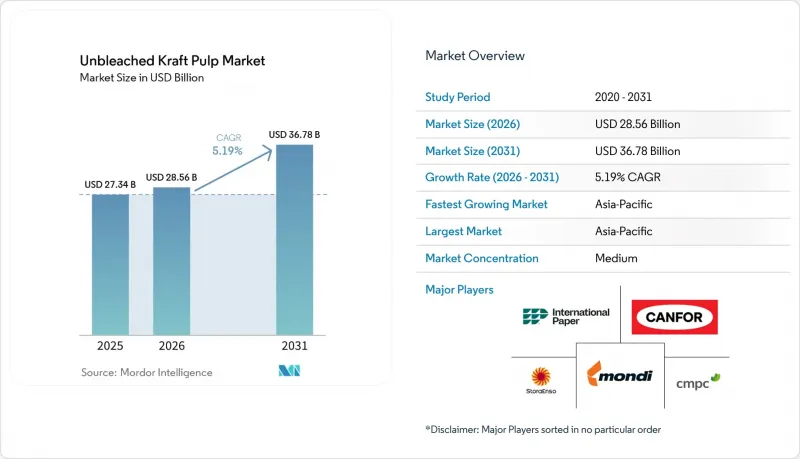
根據 Mordor Intelligence 預測,未漂白牛皮紙漿市場規模將從 2025 年的 273.4 億美元成長到 2026 年的 285.6 億美元,然後在 2031 年達到 367.8 億美元,2026 年至 2031 年的複合成長率為 5.19%。
本報告按等級(針葉木、闊葉木、混合纖維)、應用(瓦楞紙板原紙、牛皮紙、特種紙等)和地區(北美、南美、歐洲、亞太、中東和非洲)進行細分。市場預測以美元計價。
全球未漂白牛皮紙漿市場趨勢及洞察
電子商務推動了對瓦楞紙板包裝日益成長的需求。
電子商務物流仍然是未漂白牛皮紙漿市場短期需求的最明確指標。這是因為每件出貨的商品都需要比門市補貨更多的瓦楞紙板保護。美國箱板紙產業的穩健營運持續惠及未漂白牛皮紙漿(UKP)市場,即使整個產業的產能有所下降,各家造紙廠仍維持著較高的運轉率利用率。根據美國造紙協會(AF&PA)的報告,到2025年,箱板紙的運轉率將維持在91.9%。儘管設備產能下降了5.1%,但仍實現了這一目標,這表明終端用戶需求吸收了結構性產能下降的影響。研究也指出,到2025年,箱板紙將占美國紙張和紙板總產能的50%以上,再次鞏固了其在包裝系統中的核心地位。這為原生強度纖維市場提供了穩定的支撐,尤其是在造紙廠需要可靠的原料來生產牛皮箱紙板和瓦楞紙板原紙的情況下。因此,UKP 市場繼續與瓦楞紙包裝的需求緊密相連,電子商務出貨量的增加為消費提供了強力的支持。
過渡到永續的未漂白包裝材料
未漂白牛皮紙漿市場也受益於包裝形式的轉變,這種轉變使得包裝形式更易於回收利用,並符合日益嚴格的永續性法規,從而簡化了規格要求。歐盟第2025/40號法規於2025年2月生效,規定到2030年,所有進入歐盟市場的包裝都必須可回收利用,並將於2026年8月開始實施。這一趨勢正在推動單一材料和纖維基包裝結構的發展,並增加了運輸和重型應用領域對未塗佈和未漂白紙張的需求。在德國,需求跡象十分明顯,預計2025年,包裝紙產量將達到1,250萬噸,佔紙張總產量的67%,比2024年增加1.8%。此外,採購團隊在評估包裝規格的纖維選擇時,更加重視製程化學和排放特性,這也使未漂白牛皮紙漿(UKP)市場受益。這使得未漂白等級的產品在需要更強環保性能且不犧牲機械性能的嚴苛應用中的項目中表現更佳。
來自再生纖維(OCC基生產)的激烈競爭
在瓦楞紙板應用領域,未漂白牛皮紙漿市場面臨來自再生纖維最直接的競爭壓力,因為在瓦楞紙板領域,成本控制比強度更為重要。大型包裝集團不斷建構原生紙漿和再生紙漿混合生產系統,從而縮小了獨立市場紙漿經銷商的市場佔有率。斯莫菲特韋斯特羅克公司(Smurfit Westrock)報告稱,其營運每年消耗1300萬噸再生纖維,凸顯了大型生產商混合纖維策略的規模。國際紙業公司(International Paper)也於2026年4月同意收購NORPAC,透過增加瓦楞紙板和再生輕質瓦楞紙板的產能,提高了系統的柔軟性。這對英國市場(UKP)有重大影響,因為每增加一個綜合再生紙漿產能,都可能降低成本敏感等級原生棕色纖維的市場需求。這種抑製作用在北美和歐洲最為顯著,因為這些地區擁有成熟的回收系統和一體化包裝集團,使其能夠根據經濟狀況更靈活地調整原料組成。
細分市場分析
2025年,軟木漿佔全球各等級需求的57.23%,在箱板紙和高強度紙等未漂白牛皮紙漿市場中保持核心地位。這個細分市場的主導地位反映了雲杉、松木和冷杉等原料中長纖維的優勢,這些纖維對於高要求包裝應用中的抗張強度和耐破強度至關重要。此外,歐洲和北美買家繼續優先考慮認證採購,FSC和PEFC框架正在塑造軟木漿的採購標準。這有助於未漂白牛皮紙漿(UKP)市場的等級穩定性,因為認證和強度性能能夠協同滿足客戶規格要求。智利未漂白輻射松漿的產量從2022年的50.3萬噸下降到2024年的32.62萬噸。這表明,供應商對產品系列的嚴格控制也可能導致軟木漿出口供應緊張。這些供應調整進一步鞏固了針葉原料在造紙廠對強度標準不能妥協的應用領域的高階地位。
預計到2031年,硬木漿將以5.73%的複合年成長率成長,成為未漂白牛皮紙漿(UKP)市場中成長最快的細分品級。這一成長主要得益於亞洲造紙廠擴大使用桉樹基原料,在這些造紙廠中,成本績效往往優先於纖維強度。巴西仍是重要的結構性驅動力,預計到2025年,其國內紙漿產量將達到2,940萬噸,出口量將從2024年起成長11.6%,達到2,070萬噸。此外,隨著東南亞和印度的造紙廠將硬木漿和軟木漿混合,以最佳化投入成本和紙板性能,混合纖維品級在未漂白牛皮紙漿行業的商業性價值也在不斷提升。雖然這加劇了不同品級之間的競爭,但不可否認的是,在強度至關重要的規格中,軟木漿仍然是未漂白牛皮紙漿市場的標準。
區域分析
亞太地區預計到2025年將佔據未漂白牛皮紙漿市場39.45%的佔有率,並預計到2031年將以5.92%的複合年成長率成長。這將使該地區繼續保持其作為最大且成長最快的區域市場的地位。作為全球最大的紙板生產國,中國仍然是該地區的主要需求中心,並持續需要原生紙漿來生產對品質要求較高的瓦楞紙包裝。印度是該地區需求成長最顯著的國家,這得益於有組織零售業的擴張、藥品包裝出口的成長以及電子商務履約活動的增加。日本和韓國透過技術先進的特殊紙張應用,尤其是在工業和電子產品包裝領域,繼續支撐著未漂白牛皮紙漿市場。 UPM在2026年第一季執行長報告中指出,儘管歐洲和北美市場環境有所疲軟,但亞洲特種紙市場仍保持穩定。
2025年和2026年,受法規主導,歐洲未漂白牛皮紙漿市場呈現更顯著的趨勢。歐盟第2025/40號法規及其2026年8月生效日期迫使包裝材料買家加快向可回收纖維基產品的轉型。 2025年,德國包裝紙產量達1,250萬噸,佔全國紙張總產量的67%。這顯示包裝紙在德國紙張需求中佔據了多麼重要的地位。作為其專注於高階包裝材料策略的一部分,Bilerud持續提升其整個系統的產能,包括其位於斯卡爾布拉茨卡(Skalbracka)的工廠在第一季的運作。 Mondi也在透過其位於盧松貝羅克(Luzomberok)的生質能發電工程推動長期基礎設施建設,該項目預計將使其綜合工廠的能源自給率從75%提高到90%。
北美仍然是未漂白牛皮紙漿的主要消費地和生產地,這得益於其大規模的綜合性箱板紙生產基地以及對包裝資產的持續投資。儘管美國包裝紙產量在2025年成長了1.7%,但箱板紙的運轉率仍維持在91.9%,這表明市場需求能夠很好地適應產能下降的情況。南美洲繼續發揮重要的供應作用,主要供應未漂白牛皮紙漿市場。 Arauco公司的Skriu專案截至2025年第四季已完成42.6%的建設,並按計畫推進,預計將於2027年下半年投產。 CMPC公司的Natureza項目也被定位為未來重要的產能擴張項目,生產計畫高達250萬噸,並製定了專門的出口碼頭戰略,預計將對2030年前的全球貿易格局產生影響。
其他好處:
- Excel格式的市場預測(ME)表
- 3個月的分析師支持
目錄
第1章:引言
- 研究假設和市場定義
- 調查範圍
第2章:調查方法
第3章執行摘要
第4章 市場狀況
- 市場概覽
- 產業結構與一體化動態
- 一體化紙漿結構與市場型紙漿結構的比較
- 瓦楞紙板原紙生產商的角色(後向整合)
- 區域生產群集
- 市場區隔程度
- 原料和纖維的經濟性
- 纖維組成:主要為針葉樹,夾雜一些闊葉樹。
- 低化學處理紙漿與漂白紙漿的比較
- 木材成本結構和供應情況
- 產量效率
- 將回收融入纖維複合材料
- 永續性的優勢
- 生產及產能分析
- 世界裝置容量
- 與瓦楞紙板原紙廠合作
- 設備運轉率趨勢
- 提高造紙廠產能與改造
- 棕地投資與待開發區投資
- 貿易流和供應鏈
- 國內消費及出口佔有率
- 主要出口地區
- 主要進口市場
- 對物流和貨物的影響
- 區域自給自足趨勢
- 供應鏈中斷
- 價格分析
- 成本結構與競爭力
- 成本構成:木材、能源、化學品
- 與漂白紙漿相比,成本優勢顯著
- 回收整合的影響
- 區域成本競爭力
- 利潤率分析
- 市場動態
- 市場促進因素
- 電子商務正在推動瓦楞紙板包裝需求的成長。
- 過渡到永續的、未經漂白的包裝材料
- 零售和運輸包裝中的塑膠替代品
- 重型包裝市場的成長
- 透過減少化學加工來提高環境可接受性
- 包裝製造商的整合策略
- 市場限制因素
- 由於再生纖維(以OCC為原料生產)的出現,競爭變得異常激烈。
- 僅在高品質應用中使用有限
- 原料成本波動(對木材供應的影響)
- 環境壓力對林業和土地利用的影響
- 市場促進因素
- 技術與製程趨勢
- 牛皮紙漿生產流程(重點關注未漂白紙漿)
- 化學回收系統
- 提高能源效率
- 纖維強度的最佳化
- 自動化和數位化
- ESG與永續性分析
- 化學品用量減少與漂白紙漿的比較
- 碳足跡比較
- 林業的永續性
- 回收整合
- 監理情勢
第5章 市場規模與成長預測
- 按年級
- 未漂白牛皮紙漿
- 未漂白硬木牛皮紙漿
- 由混合纖維製成的未漂白牛皮紙漿
- 透過使用
- 貨櫃紙板
- 牛皮紙
- 特種紙
- 其他用途
- 按地區
- 北美洲
- 美國
- 加拿大
- 墨西哥
- 南美洲
- 巴西
- 阿根廷
- 其他南美國家
- 歐洲
- 德國
- 英國
- 法國
- 俄羅斯
- 北歐的
- 其他歐洲國家
- 亞太地區
- 中國
- 印度
- 日本
- 印尼
- 其他亞太國家
- 中東和非洲
- 中東
- 非洲
- 北美洲
第6章 競爭情勢
- 市場集中度
- 策略趨勢
- 市佔率分析
- 公司簡介
- International Paper Company
- Stora Enso Oyj
- Mondi plc
- Suzano SA
- CMPC Celulosa SA
- Canfor Pulp Products Inc.
- Billerud Aktiebolag(publ)
- UPM-Kymmene Corporation
- Oji Holdings Corporation
- Nippon Paper Industries Co., Ltd.
- Georgia-Pacific LLC
- Packaging Corporation of America
- Domtar Corporation
- Mercer International Inc.
- Celulosa Arauco y Constitucion SA
- Sappi Limited
- Svenska Cellulosa Aktiebolaget SCA(publ)
- Metsa Board Corporation
- Klabin SA
- Smurfit Westrock plc
第7章:戰略展望與未來趨勢
- 包裝主導的需求前景
- 競爭材料和再生纖維
- 風險評估
- 纖維成分中的未來作用
According to Mordor Intelligence, the unbleached kraft pulp market size is expected to grow from USD 27.34 billion in 2025 to USD 28.56 billion in 2026 and is forecast to reach USD 36.78 billion by 2031 at 5.19% CAGR over 2026-2031.
This report is Segmented by Grade (Softwood, Hardwood, and Mixed Fiber), Application (Containerboard, Kraft Paper, Specialty Paper, and More), and Geography (North America, South America, Europe, Asia-Pacific, and Middle East and Africa). The Market Forecasts are Provided in Terms of Value (USD).
Global Unbleached Kraft Pulp Market Trends and Insights
Growth In Corrugated Packaging Demand Driven By E-Commerce
E-commerce logistics remained the clearest near-term demand signal for the unbleached kraft pulp market because each shipped unit typically requires more corrugated protection than store-based replenishment formats. The unbleached kraft pulp (UKP) market continued to benefit from strong operating conditions in U.S. containerboard, where mills kept utilization high even after capacity reductions across the sector. AF&PA reported that containerboard operating rates held at 91.9% in 2025, even as installed capacity declined by 5.1%, which showed that end demand absorbed the structural footprint cuts. The same survey showed that containerboard represented more than 50% of total U.S. paper and paperboard capacity in 2025, reinforcing its central role in the packaging system. This supports a stable outlet for virgin strength fiber, especially where mills need dependable furnish for kraft linerboard and corrugating medium. As a result, the UKP market continues to track corrugated packaging demand closely, with e-commerce shipment growth providing a durable floor for consumption.
Shift Toward Sustainable, Unbleached Packaging Materials
The unbleached kraft pulp market is also benefiting from the shift toward packaging formats that are easier to recycle and simpler to specify under tightening sustainability rules. Regulation (EU) 2025/40 entered into force in February 2025 and sets a path under which all packaging placed on the EU market must be recyclable by 2030, with the regulation applying from August 2026. This direction favors mono-material and fiber-based packaging structures, which has increased the appeal of uncoated and unbleached paper formats in transport and heavy-duty uses. Germany provided a clear demand signal in 2025, when packaging paper output reached 12.5 million tonnes and represented 67% of total paper production, up 1.8% from 2024. The unbleached kraft pulp (UKP) market also benefits from procurement teams placing more weight on process chemistry and discharge profiles when evaluating fiber options for packaging specifications. That gives unbleached grades an advantage in programs that seek stronger environmental positioning without giving up mechanical performance in demanding applications.
Strong Competition From Recycled Fiber (OCC-Based Production)
The unbleached kraft pulp market faces its most direct competitive pressure from recycled fiber in containerboard applications where cost discipline matters more than peak strength. Large packaging groups continue to build systems that combine virgin and recycled furnish, which reduces the addressable share available to independent market pulp sellers. Smurfit Westrock reported annual recycled fiber consumption of 13 million tonnes across its operating footprint, showing the scale at which major producers are managing mixed fiber strategies. International Paper also agreed in April 2026 to acquire NORPAC, adding containerboard and recycled lightweight containerboard capability that improves system flexibility. This matters for the UKP market because each increase in integrated recycled capacity can reduce merchant demand for virgin brown fiber in cost-sensitive grades. The restraint is strongest in North America and Europe, where mature collection systems and integrated packaging groups have greater ability to shift furnish according to economics.
Other drivers and restraints analyzed in the detailed report include:
- Plastic Substitution In Retail And Transport Packaging
- Growth In Heavy-Duty Packaging
- Limited Use In High-Quality Applications
For complete list of drivers and restraints, kindly check the Table Of Contents.
Segment Analysis
Softwood held 57.23% of global demand by grade in 2025, which kept it at the center of the unbleached kraft pulp market across linerboard and heavy-duty paper uses. The segment's lead reflects the long-fiber advantage of spruce, pine, and fir furnish, which remains essential for tensile and burst strength in demanding packaging applications. Buyers in Europe and North America also continue to place weight on certified sourcing, with FSC and PEFC frameworks shaping procurement eligibility for softwood supply. This supports grade stability in the unbleached kraft pulp (UKP) market because certification and strength performance work together in customer specifications. Chile's production of unbleached radiata pine pulp reached 326,200 tonnes in 2024, down from 503,000 tonnes in 2022, which showed that portfolio discipline among suppliers can also tighten softwood availability in export channels. That supply adjustment reinforced the premium role of softwood furnish in applications where mills cannot compromise on strength benchmarks.
Hardwood is projected to expand at a 5.73% CAGR, which makes it the fastest-growing grade in the unbleached kraft pulp (UKP) market size by segment through 2031. Growth is being supported by wider use of eucalyptus-based furnish in Asian mills, where cost-performance balance often matters more than peak fiber strength. Brazil remained the key structural enabler because national pulp production reached 29.4 million tonnes in 2025 and exports climbed to 20.7 million tonnes, up 11.6% from 2024. Mixed fiber grades are also gaining commercial value in the unbleached kraft pulp industry because mills in Southeast Asia and India are blending hardwood and softwood to optimize input cost and board performance. This keeps grade competition active, but it does not change the fact that softwood remains the reference point for strength-critical specifications in the unbleached kraft pulp market.
Complete Report Scope:
- By Grade
- Softwood Unbleached Kraft Pulp
- Hardwood Unbleached Kraft Pulp
- Mixed Fiber Unbleached Kraft Pulp
- By Application
- Containerboard
- Kraft Paper
- Specialty Paper
- Other Applications
- By Geography
- North America
- United States
- Canada
- Mexico
- South America
- Brazil
- Argentina
- Rest of South America
- Europe
- Germany
- United Kingdom
- France
- Russia
- Nordics
- Rest of Europe
- Asia-Pacific
- China
- India
- Japan
- Indonesia
- Rest of Asia-Pacific
- Middle East and Africa
- Middle East
- Africa
- North America
Geography Analysis
Asia-Pacific held 39.45% of the unbleached kraft pulp market share in 2025 and is projected to expand at a 5.92% CAGR through 2031, which keeps it as both the largest and fastest-growing regional segment. China remains the main regional demand center because it is the world's largest paperboard producer and continues to require virgin fiber grades for quality-sensitive corrugated packaging output. India is the strongest demand-growth vector within the region, supported by organized retail expansion, pharmaceutical packaging exports, and rising e-commerce fulfillment activity. Japan and South Korea continue to support the unbleached kraft pulp market through technically demanding specialty paper uses, especially in industrial and electronics-linked packaging chains. UPM stated in its Q1 2026 CEO presentation that specialty paper markets in Asia remained stable, even as conditions were softer in Europe and North America.
Europe showed a more regulation-led demand profile in the unbleached kraft pulp market during 2025 and 2026. Regulation (EU) 2025/40 and its August 2026 application timeline pushed packaging buyers to move earlier on recyclable fiber-based formats. Germany's packaging paper production reached 12.5 million tonnes in 2025 and accounted for 67% of national paper output, which showed how deeply packaging has come to dominate paper demand in the country. Billerud continued to upgrade capabilities across its system, including work at Skarblacka in Q1 2026, as part of its focus on premium packaging materials. Mondi also advanced long-term infrastructure through its biomass power project in Ruzomberok, which is expected to raise energy self-sufficiency at the integrated mill from 75% to 90%.
North America remained a major consumption and production hub for the unbleached kraft pulp market, supported by its large integrated containerboard base and continued investment in packaging assets. Packaging paper production in the United States grew 1.7% in 2025, while containerboard operating rates remained at 91.9%, which showed that demand adjusted well to lower capacity. South America continued to function mainly as a supply region for the unbleached kraft pulp market, with Arauco's Sucuriu project reaching 42.6% physical progress by Q4 2025 and remaining on schedule for start-up in the second half of 2027. CMPC's Natureza project also remained a major future capacity addition, with planned output of up to 2.5 million tonnes per year and a dedicated export terminal strategy that will influence global trade flows through 2030.
- International Paper Company
- Stora Enso Oyj
- Mondi plc
- Suzano S.A.
- CMPC Celulosa S.A.
- Canfor Pulp Products Inc.
- Billerud Aktiebolag (publ)
- UPM-Kymmene Corporation
- Oji Holdings Corporation
- Nippon Paper Industries Co., Ltd.
- Georgia-Pacific LLC
- Packaging Corporation of America
- Domtar Corporation
- Mercer International Inc.
- Celulosa Arauco y Constitucion S.A.
- Sappi Limited
- Svenska Cellulosa Aktiebolaget SCA (publ)
- Metsa Board Corporation
- Klabin S.A.
- Smurfit Westrock plc
Additional Benefits:
- The market estimate (ME) sheet in Excel format
- 3 months of analyst support
TABLE OF CONTENTS
1 INTRODUCTION
- 1.1 Study Assumptions and Market Definition
- 1.2 Scope of the Study
2 RESEARCH METHODOLOGY
3 EXECUTIVE SUMMARY
4 MARKET LANDSCAPE
- 4.1 Market Overview
- 4.2 Industry Structure and Integration Dynamics
- 4.2.1 Integrated vs Market Pulp Structure
- 4.2.2 Role of Containerboard Producers (Backward Integration)
- 4.2.3 Regional Production Clusters
- 4.2.4 Degree of Market Fragmentation
- 4.3 Raw Material and Fiber Economics
- 4.3.1 Fiber Mix: Softwood dominant and Mixed hardwood integration
- 4.3.2 Lower Chemical Processing vs Bleached Pulp
- 4.3.3 Wood Cost Structure and Availability
- 4.3.4 Yield Efficiency
- 4.3.5 Recycling Integration in Fiber Mix
- 4.3.6 Sustainability Advantage
- 4.4 Production and Capacity Analysis
- 4.4.1 Global Installed Capacity
- 4.4.2 Integration with Containerboard Mills
- 4.4.3 Capacity Utilization Trends
- 4.4.4 Capacity Additions and Mill Conversions
- 4.4.5 Brownfield vs Greenfield Investments
- 4.5 Trade Flow and Supply Chain
- 4.5.1 Domestic Consumption vs Export Share
- 4.5.2 Key Exporting Regions
- 4.5.3 Key Import Markets
- 4.5.4 Logistics and Freight Impact
- 4.5.5 Regional Self-Sufficiency Trends
- 4.5.6 Supply Chain Disruptions
- 4.6 Pricing Analysis
- 4.7 Cost Structure and Competitiveness
- 4.7.1 Cost Breakdown: Wood, energy, chemicals
- 4.7.2 Cost Advantage vs Bleached Pulp
- 4.7.3 Impact of Recycling Integration
- 4.7.4 Regional Cost Competitiveness
- 4.7.5 Margin Analysis
- 4.8 Market Dynamics
- 4.8.1 Market Drivers
- 4.8.1.1 Growth in Corrugated Packaging Demand Driven by E-commerce
- 4.8.1.2 Shift Toward Sustainable, Unbleached Packaging Materials
- 4.8.1.3 Plastic Substitution in Retail and Transport Packaging
- 4.8.1.4 Growth in Heavy-Duty Packaging
- 4.8.1.5 Lower Chemical Processing Enhancing Environmental Acceptance
- 4.8.1.6 Integration Strategies by Packaging Companies
- 4.8.2 Market Restraints
- 4.8.2.1 Strong Competition from Recycled Fiber (OCC-based production)
- 4.8.2.2 Limited Use in High-Quality Applications
- 4.8.2.3 Raw Material Cost Volatility (wood supply impact)
- 4.8.2.4 Environmental Pressure on Forestry and Land Use
- 4.8.1 Market Drivers
- 4.9 Technology and Process Landscape
- 4.9.1 Kraft Pulping Process (Unbleached Focus)
- 4.9.2 Chemical Recovery Systems
- 4.9.3 Energy Efficiency Improvements
- 4.9.4 Fiber Strength Optimization
- 4.9.5 Automation and Digitalization
- 4.10 ESG and Sustainability Analysis
- 4.10.1 Reduced Chemical Usage vs Bleached Pulp
- 4.10.2 Carbon Footprint Comparison
- 4.10.3 Forestry Sustainability
- 4.10.4 Recycling Integration
- 4.10.5 Regulatory Landscape
5 MARKET SIZE AND GROWTH FORECASTS (VALUE)
- 5.1 By Grade
- 5.1.1 Softwood Unbleached Kraft Pulp
- 5.1.2 Hardwood Unbleached Kraft Pulp
- 5.1.3 Mixed Fiber Unbleached Kraft Pulp
- 5.2 By Application
- 5.2.1 Containerboard
- 5.2.2 Kraft Paper
- 5.2.3 Specialty Paper
- 5.2.4 Other Applications
- 5.3 By Geography
- 5.3.1 North America
- 5.3.1.1 United States
- 5.3.1.2 Canada
- 5.3.1.3 Mexico
- 5.3.2 South America
- 5.3.2.1 Brazil
- 5.3.2.2 Argentina
- 5.3.2.3 Rest of South America
- 5.3.3 Europe
- 5.3.3.1 Germany
- 5.3.3.2 United Kingdom
- 5.3.3.3 France
- 5.3.3.4 Russia
- 5.3.3.5 Nordics
- 5.3.3.6 Rest of Europe
- 5.3.4 Asia-Pacific
- 5.3.4.1 China
- 5.3.4.2 India
- 5.3.4.3 Japan
- 5.3.4.4 Indonesia
- 5.3.4.5 Rest of Asia-Pacific
- 5.3.5 Middle East and Africa
- 5.3.5.1 Middle East
- 5.3.5.2 Africa
- 5.3.1 North America
6 COMPETITIVE LANDSCAPE
- 6.1 Market Concentration
- 6.2 Strategic Moves
- 6.3 Market Share Analysis
- 6.4 Company Profiles (includes Global Level Overview, Market Level Overview, Core Segments, Financials as available, Strategic Information, Products and Services, Recent Developments)
- 6.4.1 International Paper Company
- 6.4.2 Stora Enso Oyj
- 6.4.3 Mondi plc
- 6.4.4 Suzano S.A.
- 6.4.5 CMPC Celulosa S.A.
- 6.4.6 Canfor Pulp Products Inc.
- 6.4.7 Billerud Aktiebolag (publ)
- 6.4.8 UPM-Kymmene Corporation
- 6.4.9 Oji Holdings Corporation
- 6.4.10 Nippon Paper Industries Co., Ltd.
- 6.4.11 Georgia-Pacific LLC
- 6.4.12 Packaging Corporation of America
- 6.4.13 Domtar Corporation
- 6.4.14 Mercer International Inc.
- 6.4.15 Celulosa Arauco y Constitucion S.A.
- 6.4.16 Sappi Limited
- 6.4.17 Svenska Cellulosa Aktiebolaget SCA (publ)
- 6.4.18 Metsa Board Corporation
- 6.4.19 Klabin S.A.
- 6.4.20 Smurfit Westrock plc
7 STRATEGIC OUTLOOK AND FUTURE DYNAMICS
- 7.1 Packaging-Led Demand Outlook
- 7.2 Competition vs Recycled Fiber
- 7.3 Risk Assessment
- 7.4 Future Role in Fiber Mix

 漂白桉樹牛皮紙漿:市場佔有率分析、行業趨勢和統計數據、成長預測(2026-2031)漂白針葉樹牛皮紙漿:市場佔有率分析、行業趨勢和統計數據、成長預測(2026-2031)木漿:市場佔有率分析、產業趨勢與統計、成長預測(2026-2031)
 漂白桉樹牛皮紙漿市場:依等級、產品形式、應用、通路,全球預測(2026-2032年)全球漂白硬木牛皮紙漿市場(按漂白技術、等級、紙漿形態、應用和分銷管道分類)預測(2026-2032年)北方漂白軟木牛皮紙市場按產品等級、認證、應用、最終用途和分銷管道分類 - 全球預測(2026-2032 年)漂白軟木牛皮紙市場按等級、應用、終端用戶產業和銷售管道,全球預測(2026-2032年)
 日本木漿市場規模、佔有率、趨勢及預測(按類型、等級、最終用途行業和地區分類),2026-2034年
 木漿市場規模、佔有率和成長分析(按類型、製造流程、最終用途產業和地區分類)-2026-2033年產業預測
 漂白尤加利牛皮紙漿市場:全球2025-2029年