


 |
市場調查報告書
商品編碼
2097412
漂白桉樹牛皮紙漿:市場佔有率分析、行業趨勢和統計數據、成長預測(2026-2031)Bleached Eucalyptus Kraft Pulp - Market Share Analysis, Industry Trends & Statistics, Growth Forecasts (2026 - 2031) |
||||||

※ 本網頁內容可能與最新版本有所差異。詳細情況請與我們聯繫。
根據 Mordor Intelligence 的數據,2025 年漂白桉樹牛皮紙漿市場(以出貨量為準)價值 5,765 萬噸,預計到 2031 年將從 2026 年的 6,023 萬噸增至 7,632 萬噸,預測期(2026-2031 年)複合年成長率為 4.85%。
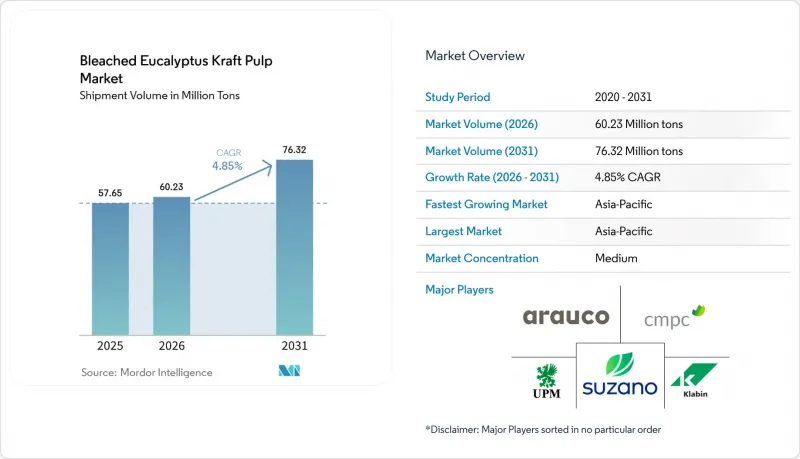
本報告按漂白工藝(無元素氯漂白、完全無氯漂白)、應用領域(衛生紙、印刷書寫紙、特種紙、包裝紙)和地區(北美、南美、歐洲、亞太、中東和非洲)進行細分。市場預測以出貨量(噸)為基礎。
全球漂白桉樹牛皮紙漿市場趨勢及洞察
紙巾和衛生用品消費量的結構性成長
新興經濟體的人均紙巾消費量遠低於已開發國家,這為漂白桉樹牛皮紙漿市場帶來了長期成長潛力。儘管印度的紙巾需求預計將從2024年的28萬噸增加到2026年的35.7萬噸,但由於再生纖維無法達到所需的白度和柔軟度標準,國內造紙廠仍需進口優質硬木漿。此外,印尼、越南和菲律賓的區域性快餐和零售連鎖店正在為餐飲服務業制定紙巾規格標準,而餐飲服務業需要使用原生紙漿。預計2025年全球紙巾銷售額將達到452億美元,到2034年將達到785億美元,將推動原生桉樹漿的潛在需求。儘管低檔毛巾和餐巾紙產品中再生纖維的含量不斷增加,但這一長期趨勢仍能保護市場免受高利潤產品領域替代壓力的影響。
高階應用領域對原生纖維的偏好日益成長。
生產面紙、尿布和女性用衛生用品的加工商指定使用原生桉樹紙漿,因為其柔軟度、白度和濕強度是再生紙漿無法穩定達到的。 Ense公司於2025年第四季運作了歐洲首個用於衛生用品的桉樹絨毛紙漿生產線。該生產線年產能為12.5萬噸,目標是比通用等級的紙漿溢價15-20%。品牌所有者也正在利用尤加利種植園快速的碳固存能力來提升其永續發展訊息。 Suzano公司的「Eucanatural」未漂白紙漿表明,供應商如何透過滿足特定的功能需求來保護利潤率並實現產品組合多元化,而不是僅僅依賴價格競爭。
價格劇烈波動
中國現貨紙漿價格從2025年7月的每噸495美元反彈至2025年12月的每噸540美元,波動幅度達9%,給簽訂季度合約的加工商帶來了沉重負擔。在價格觸底期間,約四分之一的商品紙漿市場出現負現金流,迫使像布拉塞爾這樣的公司將60萬噸的產能轉為生產溶解漿,而溶解漿的價格比商品紙漿高出每噸200至300美元。這種價格波動使資本規劃變得複雜,迫使生產商在減產或加速產能擴張之間做出選擇,而這兩種選擇都會加劇價格週期性波動。
細分市場分析
預計到2025年,無元素氯漂白(ECF)製程將佔據漂白桉樹牛皮紙漿市場42.34%的佔有率。這反映了其經濟高效且符合規範的特性已被廣泛接受。 ECF製程每噸烘乾紙漿使用20-40公斤二氧化氯,即可達到88-92%的ISO白度,同時符合嚴格的吸附劑有機鹵素法規要求。隨著這項技術在南美洲的新生產線中被廣泛採用,尤其是在那些可以利用回收鍋爐自給自足電力以抵消化學品成本的地區,ECF級漂白桉樹牛皮紙漿的市場規模預計將持續擴大。
儘管由於歐洲品牌法規的推動,完全無氯(TCF)工藝預計將以4.97%的複合年成長率成長,但由於使用過氧化氫、氧氣和臭氧會使化學品成本增加20-30%,且ISO白度通常穩定在90%左右,因此其市場佔有率仍然很小。諸如FSC認證和2024年修訂的PEFC標準等認證框架減輕了審核負擔,但它們並未明確推薦TCF工藝,因此其應用主要集中在願意支付環保溢價的衛生紙和裝飾紙等小眾紙品類中。
區域分析
預計到2025年,亞太地區將佔全球紙巾總銷量的38.21%,並將在2031年之前以4.67%的複合年成長率持續成長。這主要得益於印度和東南亞地區紙巾滲透率的提高,以及儘管中國國內綜合造紙廠不斷擴張,但中國進口需求依然強勁。在印度,隨著都市區中產階級家庭轉向使用更柔軟的面紙,消費品質正在提升;而在印尼、越南和菲律賓,連鎖餐廳等場所的「外出」使用捲筒紙巾的需求正在加速成長。在日本和澳大利亞,對特種紙巾和蓬鬆紙巾的需求仍然存在,但整體成長速度正在放緩。
到2025年,南美洲將佔全球硬木紙漿供應量的47%。這主要得益於桉樹人工林在最佳氣候條件下平均每年每公頃27噸的產量,這是其他地區生產者無法比擬的優勢。 Arauco公司年產350萬噸的Skriu紙漿廠計畫於2027年下半年運作,CMPC公司年產250萬噸的Natureza紙漿廠計畫於2029年下半年投產,這兩個計畫將進一步增強該地區的出口能力。對鐵路和港口基礎設施的綜合投資顯著降低了運往中國的運輸成本,將運輸時間縮短至30-35天,並縮小了與印尼供應商之間的運費差距。
在北美和歐洲,成熟的需求趨勢正在形成,主要集中在高檔紙巾、特殊產品以及受法規主導的包裝變革。歐洲禁止使用一次性塑膠的指令正逐步提升對模塑紙漿和塗佈紙板的需求,而恩斯公司在西班牙新建的絨毛紙生產線則以溢價滿足了衛生級紙巾的需求。
其他好處:
- Excel格式的市場預測(ME)表
- 3個月的分析師支持
目錄
第1章:引言
- 研究假設和市場定義
- 調查範圍
第2章:調查方法
第3章執行摘要
- 市場概覽
- 主要結構主題
- 定價方向和利潤率預測
- 主要風險和戰略影響
- 投資的吸引力
第4章 市場狀況
- 市場概覽
- 產業結構與市場結構
- 全球市場結構:專業紙漿生產商與綜合生產商
- 市場集中度
- 拉丁美洲作為出口樞紐的作用
- 中國作為價格決定的需求中心
- 紙漿產業的週期性
- 供應商的議價能力:大型生產商和買家(紙張和衛生紙製造商)
- 全球供應分析(產能和產量)
- 設備產能(百萬噸)
- 主要地區的產能及整體產能運轉率
- 生產趨勢(過去5年)
- 巨型工廠經濟效益(規模經濟)
- 未來產能擴張(已確認和預期)
- 生產能力削減和停產的趨勢
- 一體化程度(從森林到紙漿)
- 人工林和纖維經濟
- 尤加利種植模式:作物輪作週期(5年)、每公頃產量及替代方案的比較。
- 區域競爭力:拉丁美洲 vs. 歐洲 vs. 亞洲
- 土地、氣候和生產力優勢
- 木材成本佔總成本的百分比
- 內部採購和第三方木材採購
- 風險:氣候變遷以及火災和蟲害的風險。
- 認證和可追溯性(FSC/PEFC關係)
- 人均消費趨勢
- 貿易流動和全球趨勢
- BEKP的出口導向
- 主要出口國:
- 主要進口市場:
- 貿易路線和物流
- 港口基礎設施和瓶頸
- 運費對交付價格的影響
- 貿易中斷:航運限制與地緣政治緊張局勢
- 價格分析
- 作為價格基準的市場:中國、歐洲、印度
- 過去的價格週期
- 影響價格波動的因素:供應增加和需求成長、港口和工廠的庫存水準和運轉率,以及能源和化學品成本。
- 價格價差分析:跨區域套利交易機會
- 生產者價格紀律與市場供過於求
- 短期和長期價格展望
- 相關性:紙張需求週期與全球工業生產
- 市場動態
- 市場促進因素
- 紙巾和衛生用品消費量的結構性成長
- 高階應用領域對原生纖維的偏好日益成長。
- 電子商務正在推動包裝需求。
- 從塑膠到纖維基材料過渡
- 新興市場的快速成長
- 擴大高產桉樹種植園
- 市場限制因素
- 價格波動強度(產品價格的週期性波動)
- 與再生纖維的競爭
- 林業實踐的環境檢驗
- 對中國需求的依賴
- 市場促進因素
- 當前技術和工藝狀況
- 牛皮紙漿生產流程概述
- 漂白技術:無元素氯漂白 (ECF) 和完全無氯漂白 (TCF)
- 化學回收和能源整合
- 水資源利用效率和封閉回路型系統
- 造紙廠的自動化和數位化最佳化
- 紡織工程與品管
- 環境、社會及公司治理(ESG)與永續性評估
- 碳足跡比較(與替代方案的比較)
- 植樹造林的永續性
- 水資源利用與廢水管理
- 生物多樣性考量
- 目前認證狀態(FSC、PEFC)
- 監管壓力(歐洲、中國、拉丁美洲)
- 波特五力分析
第5章 市場規模與成長預測
- 透過漂白過程
- 無元素氯
- 完全不含氯
- 透過使用
- 棉紙
- 列印/書寫紙
- 特種紙
- 包裝
- 按地區
- 北美洲
- 美國
- 加拿大
- 墨西哥
- 南美洲
- 巴西
- 阿根廷
- 其他南美國家
- 歐洲
- 德國
- 英國
- 義大利
- 瑞典
- 俄羅斯
- 芬蘭
- 其他歐洲國家
- 亞太地區
- 中國
- 印度
- 日本
- 印尼
- 澳洲和紐西蘭
- 其他亞太國家
- 中東和非洲
- 中東
- 非洲
- 北美洲
第6章 競爭情勢
- 市場集中度
- 策略趨勢
- 市佔率分析
- 公司簡介
- Suzano SA
- Empresas CMPC
- UPM-Kymmene Corporation
- Stora Enso Oyj
- Ence Energia y Celulosa
- Klabin SA
- Bracell(part of the RGE Group)
- Celulosa Arauco y Constitucion SA(Arauco)
- Eldorado Brasil Inc.
- Metsa Group
- APP Group
第7章 戰略分析與展望
- 有興趣的投資領域
- 風險矩陣(需求、供給、政策)
- BEKP和再生纖維的未來作用
According to Mordor Intelligence, the bleached eucalyptus kraft pulp market size in terms of shipment volume was valued at 57.65 Million tons in 2025 and is estimated to grow from 60.23 Million tons in 2026 to reach 76.32 Million tons by 2031, at a CAGR of 4.85% during the forecast period (2026-2031).
This report is Segmented by Bleaching Process (Elemental Chlorine Free, Totally Chlorine Free), Application (Tissue Paper, Printing and Writing Paper, Specialty Paper, Packaging), and Geography (North America, South America, Europe, Asia-Pacific, Middle East and Africa). The Market Forecasts are Provided in Terms of Volume (Tons).
Global Bleached Eucalyptus Kraft Pulp Market Trends and Insights
Structural Growth In Tissue And Hygiene Consumption
Per-capita tissue use in emerging economies remains far below developed-market norms, giving the bleached eucalyptus kraft pulp market a long runway for conversion growth. India's tissue demand is projected to reach 357,000 tons in 2026, up from 280,000 tons in 2024, yet domestic mills still import premium hardwood pulp because recycled fiber cannot meet brightness and softness thresholds. Regional quick-service restaurants and retail chains in Indonesia, Vietnam, and the Philippines are also standardizing away-from-home tissue grades that require virgin fiber. Global tissue sales climbed to USD 45.2 billion in 2025 and are forecast to hit USD 78.5 billion by 2034, reinforcing the underlying demand pull for virgin eucalyptus pulp. This secular trend cushions the market from substitution pressure in higher-margin formats even as recycled content rises in lower-grade towel and napkin products.
Increasing Preference For Virgin Fiber In Premium Applications
Converters producing facial tissue, diapers, and feminine hygiene products specify virgin eucalyptus pulp for softness, brightness, and wet strength that recycled alternatives cannot consistently deliver. Ence started Europe's first eucalyptus-based fluff pulp line in Q4 2025 with 125,000 tons annual capacity aimed at hygiene applications, targeting premiums of 15-20% over commodity grades. Brand owners also leverage faster carbon sequestration rates of eucalyptus plantations to support sustainability messaging. Suzano's Eucanatural unbleached pulp illustrates how suppliers are segmenting their portfolios to defend margins by meeting specialized functional demands rather than competing solely on price.
High Price Volatility
Chinese spot prices rebounded from USD 495 per ton in July 2025 to USD 540 per ton by December 2025, a 9% swing that strained converters on quarterly contracts. Roughly one-quarter of the merchant pulp market operated cash-negative during the trough, pushing Bracell to reconfigure 600,000 tons of capacity into dissolving pulp, which trades USD 200-300 per ton higher. Such volatility complicates capital planning and encourages producers either to curtail output or accelerate capacity ramps, each option reinforcing price cycles.
Other drivers and restraints analyzed in the detailed report include:
- E-commerce Driving Packaging Demand
- Shift From Plastic To Fiber-Based Materials
- Competition From Recycled Fiber
For complete list of drivers and restraints, kindly check the Table Of Contents.
Segment Analysis
Elemental chlorine free processes accounted for 42.34% of bleached eucalyptus kraft pulp market share in 2025, reflecting widespread acceptance of its cost-effective compliance profile. ECF sequences use 20-40 kg of chlorine dioxide per oven-dry ton, achieving 88-92% ISO brightness while meeting tight adsorbable organic halogen rules. The bleached eucalyptus kraft pulp market size for ECF grades will continue to rise as new South American lines default to this technology, particularly where power self-sufficiency from recovery boilers offsets chemical cost.
Totally chlorine free sequences are forecast to expand at a 4.97% CAGR, fueled by European brand mandates, yet they still make up a small slice because peroxide, oxygen, and ozone raise chemical spend 20-30% and often cap brightness near 90% ISO. Certification frameworks such as FSC Aligned and PEFC's updated 2024 standard lower audit friction but stop short of favoring TCF, so adoption concentrates in niche hygiene and decor paper grades willing to pay a green premium.
Complete Report Scope:
- By Bleaching Process
- Elemental Chlorine Free
- Totally Chlorine Free
- By Application
- Tissue Paper
- Printing and Writing Paper
- Specialty Paper
- Packaging
- By Geography
- North America
- United States
- Canada
- Mexico
- South America
- Brazil
- Argentina
- Rest of South America
- Europe
- Germany
- United Kingdom
- Italy
- Sweden
- Russia
- Finland
- Rest of Europe
- Asia-Pacific
- China
- India
- Japan
- Indonesia
- Australia and New Zealand
- Rest of Asia-Pacific
- Middle East and Africa
- Middle East
- Africa
- North America
Geography Analysis
Asia-Pacific represented 38.21% of global volume in 2025 and is on track for a 4.67% CAGR through 2031, underpinned by rising tissue penetration in India and Southeast Asia plus enduring Chinese import demand even as domestic integrated mills expand. India's consumption upgrades as urban middle-class households trade up to softer facial tissue formats, while Indonesia, Vietnam, and the Philippines accelerate away-from-home towel rollouts in foodservice chains. Japan and Australia sustain niche requirements for specialty and fluff grades but show muted overall growth.
South America supplied 47% of global hardwood pulp in 2025, leveraging eucalyptus plantation yields averaging 27 Mg ha-1 yr-1 under optimal weather, an edge that producers elsewhere cannot match. Arauco's 3.5 million-ton Sucuriu mill, slated for H2 2027, and CMPC's 2.5 million-ton Natureza project in H2 2029 will reinforce the region's export heft. Integrated rail-and-port investments slash delivered costs to China, where transit can now reach 30-35 days, tightening the freight differential with Indonesian suppliers.
North America and Europe show mature demand profiles focused on premium tissue, specialty, and regulatory-driven packaging shifts. European directives banning single-use plastics channel incremental tonnage into molded pulp and coated board, while Ence's new fluff line in Spain captures hygiene-grade demand at a price premium.
- Suzano S.A.
- Empresas CMPC
- UPM-Kymmene Corporation
- Stora Enso Oyj
- Ence Energia y Celulosa
- Klabin S.A.
- Bracell (part of the RGE Group)
- Celulosa Arauco y Constitucion S.A. (Arauco)
- Eldorado Brasil Inc.
- Metsa Group
- APP Group
Additional Benefits:
- The market estimate (ME) sheet in Excel format
- 3 months of analyst support
TABLE OF CONTENTS
1 INTRODUCTION
- 1.1 Study Assumptions and Market Definition
- 1.2 Scope of the Study
2 RESEARCH METHODOLOGY
3 EXECUTIVE SUMMARY
- 3.1 Market Snapshot
- 3.2 Key Structural Themes
- 3.3 Pricing Direction and Margin Outlook
- 3.4 Key Risks and Strategic Takeaways
- 3.5 Investment Attractiveness
4 MARKET LANDSCAPE
- 4.1 Market Overview
- 4.2 Industry Structure and Market Architecture
- 4.2.1 Global Market Structure: Merchant Pulp vs Integrated Producers
- 4.2.2 Degree of Market Concentration
- 4.2.3 Role of Latin America as Export Hub
- 4.2.4 China as Price-Setting Demand Center
- 4.2.5 Cyclical Nature of the Pulp Industry
- 4.2.6 Bargaining Power: Suppliers (Large-scale producers) and Buyers (Paper and Tissue Manufacturers)
- 4.3 Global Supply Analysis (Capacity and Production)
- 4.3.1 Installed Capacity (Million Tons)
- 4.3.2 Capacity by Major Region and Overall Capacity Utilization Rates
- 4.3.3 Production Trends (Last 5 Years)
- 4.3.4 Mega Mill Economics (Scale advantage)
- 4.3.5 Upcoming Capacity Additions (Committed and Speculative)
- 4.3.6 Capacity Curtailments and Downtime Trends
- 4.3.7 Integration Levels (Forest to Pulp)
- 4.4 Plantation and Fiber Economics
- 4.4.1 Eucalyptus Plantation Model: Rotation cycles (5 years) and Yield per hectare vs alternatives
- 4.4.2 Regional Competitiveness: Latin America vs Europe vs Asia
- 4.4.3 Land, Climate and Productivity Advantages
- 4.4.4 Wood Cost as % of Total Cost
- 4.4.5 Captive vs Third-Party Wood Sourcing
- 4.4.6 Risks: Climate variability and Fire and pest exposure
- 4.4.7 Certification and Traceability (FSC/PEFC relevance)
- 4.5 Per Capita Consumption Trends
- 4.6 Trade Flow and Global Movement
- 4.6.1 Export-Oriented Nature of BEKP
- 4.6.2 Key Exporting Countries:
- 4.6.3 Key Import Markets:
- 4.6.4 Trade Routes and Logistics
- 4.6.5 Port Infrastructure and Bottlenecks
- 4.6.6 Freight Cost Impact on Delivered Price
- 4.6.7 Trade Disruptions: Shipping constraints and Geopolitical tensions
- 4.7 Pricing Analysis
- 4.7.1 Benchmark Pricing Markets: China, Europe, and India
- 4.7.2 Historical Price Cycles
- 4.7.3 Price Drivers: Supply Additions vs Demand Growth, Inventory Levels at Ports and Mills, Operating Rates, and Energy and Chemical Costs
- 4.7.4 Price Spread Analysis: Regional Arbitrage Opportunities
- 4.7.5 Producer Price Discipline vs Market Oversupply
- 4.7.6 Short-term vs Long-term Price Outlook
- 4.7.7 Correlation with: Paper Demand Cycles and Global Industrial Production
- 4.8 Market Dynamics
- 4.8.1 Market Drivers
- 4.8.1.1 Structural Growth in Tissue and Hygiene Consumption
- 4.8.1.2 Increasing Preference for Virgin Fiber in Premium Applications
- 4.8.1.3 E-commerce Driving Packaging Demand
- 4.8.1.4 Shift from Plastic to Fiber-Based Materials
- 4.8.1.5 Rapid Growth in Emerging Markets
- 4.8.1.6 Expansion of High-Yield Eucalyptus Plantations
- 4.8.2 Market Restraints
- 4.8.2.1 High Price Volatility (Cyclical Commodity Behavior)
- 4.8.2.2 Competition from Recycled Fiber
- 4.8.2.3 Environmental Scrutiny on Forestry Practices
- 4.8.2.4 Dependence on China Demand
- 4.8.1 Market Drivers
- 4.9 Technology and Process Landscape
- 4.9.1 Kraft Pulping Process Overview
- 4.9.2 Bleaching Technologies: Elemental Chlorine Free (ECF) and Totally Chlorine Free (TCF)
- 4.9.3 Chemical Recovery and Energy Integration
- 4.9.4 Water Efficiency and Closed-Loop Systems
- 4.9.5 Automation and Digital Mill Optimization
- 4.9.6 Fiber Engineering and Quality Control
- 4.10 ESG and Sustainability Assessment
- 4.10.1 Carbon Footprint Comparison (vs alternatives)
- 4.10.2 Plantation Forestry Sustainability
- 4.10.3 Water Use and Effluent Management
- 4.10.4 Biodiversity Considerations
- 4.10.5 Certification Landscape (FSC, PEFC)
- 4.10.6 Regulatory Pressures (Europe, China, Latin America)
- 4.11 Porter's Five Forces Analysis
- 4.11.1 Bargaining Power of Suppliers
- 4.11.2 Bargaining Power of Buyers
- 4.11.3 Threat of New Entrants
- 4.11.4 Threat of Substitutes
- 4.11.5 Intensity of Competitive Rivalry
5 MARKET SIZE AND GROWTH FORECAST (VOLUME)
- 5.1 By Bleaching Process
- 5.1.1 Elemental Chlorine Free
- 5.1.2 Totally Chlorine Free
- 5.2 By Application
- 5.2.1 Tissue Paper
- 5.2.2 Printing and Writing Paper
- 5.2.3 Specialty Paper
- 5.2.4 Packaging
- 5.3 By Geography
- 5.3.1 North America
- 5.3.1.1 United States
- 5.3.1.2 Canada
- 5.3.1.3 Mexico
- 5.3.2 South America
- 5.3.2.1 Brazil
- 5.3.2.2 Argentina
- 5.3.2.3 Rest of South America
- 5.3.3 Europe
- 5.3.3.1 Germany
- 5.3.3.2 United Kingdom
- 5.3.3.3 Italy
- 5.3.3.4 Sweden
- 5.3.3.5 Russia
- 5.3.3.6 Finland
- 5.3.3.7 Rest of Europe
- 5.3.4 Asia-Pacific
- 5.3.4.1 China
- 5.3.4.2 India
- 5.3.4.3 Japan
- 5.3.4.4 Indonesia
- 5.3.4.5 Australia and New Zealand
- 5.3.4.6 Rest of Asia-Pacific
- 5.3.5 Middle East and Africa
- 5.3.5.1 Middle East
- 5.3.5.2 Africa
- 5.3.1 North America
6 COMPETITIVE LANDSCAPE
- 6.1 Market Concentration
- 6.2 Strategic Moves
- 6.3 Market Share Analysis
- 6.4 Company Profiles (includes Global level Overview, Market level overview, Core Segments, Financials as available, Strategic Information, Production Capacity, Products and Services, and Recent Developments)
- 6.4.1 Suzano S.A.
- 6.4.2 Empresas CMPC
- 6.4.3 UPM-Kymmene Corporation
- 6.4.4 Stora Enso Oyj
- 6.4.5 Ence Energia y Celulosa
- 6.4.6 Klabin S.A.
- 6.4.7 Bracell (part of the RGE Group)
- 6.4.8 Celulosa Arauco y Constitucion S.A. (Arauco)
- 6.4.9 Eldorado Brasil Inc.
- 6.4.10 Metsa Group
- 6.4.11 APP Group
7 STRATEGIC ANALYSIS AND OUTLOOK
- 7.1 Investment Hotspots
- 7.2 Risk Matrix (Demand, Supply, Policy)
- 7.3 Future Role of BEKP vs Recycled Fiber

 未漂白硬木和針葉木牛皮紙漿市場:全球市場預測,2026-2032年漂白硬木牛皮紙漿市場:全球市場預測,2026-2032年
 漂白針葉樹牛皮紙漿:市場佔有率分析、行業趨勢和統計數據、成長預測(2026-2031)木漿:市場佔有率分析、產業趨勢與統計、成長預測(2026-2031)漂白桉樹牛皮紙漿市場:依等級、產品形式、應用、通路,全球預測(2026-2032年)全球漂白硬木牛皮紙漿市場(按漂白技術、等級、紙漿形態、應用和分銷管道分類)預測(2026-2032年)北方漂白軟木牛皮紙市場按產品等級、認證、應用、最終用途和分銷管道分類 - 全球預測(2026-2032 年)
 日本木漿市場規模、佔有率、趨勢及預測(按類型、等級、最終用途行業和地區分類),2026-2034年
 木漿市場規模、佔有率和成長分析(按類型、製造流程、最終用途產業和地區分類)-2026-2033年產業預測
 漂白尤加利牛皮紙漿市場:全球2025-2029年