


 |
市場調查報告書
商品編碼
2072671
漂白針葉樹牛皮紙漿:市場佔有率分析、行業趨勢和統計數據、成長預測(2026-2031)Bleached Softwood Kraft Pulp - Market Share Analysis, Industry Trends & Statistics, Growth Forecasts (2026 - 2031) |
||||||

※ 本網頁內容可能與最新版本有所差異。詳細情況請與我們聯繫。
根據 Mordor Intelligence 預測,漂白軟木牛皮紙漿市場預計將從 2025 年的 245.6 億美元成長到 2026 年的 252.3 億美元,到 2031 年達到 313.4 億美元,2026 年至 2031 年的複合年成長率預計為 4.43%。
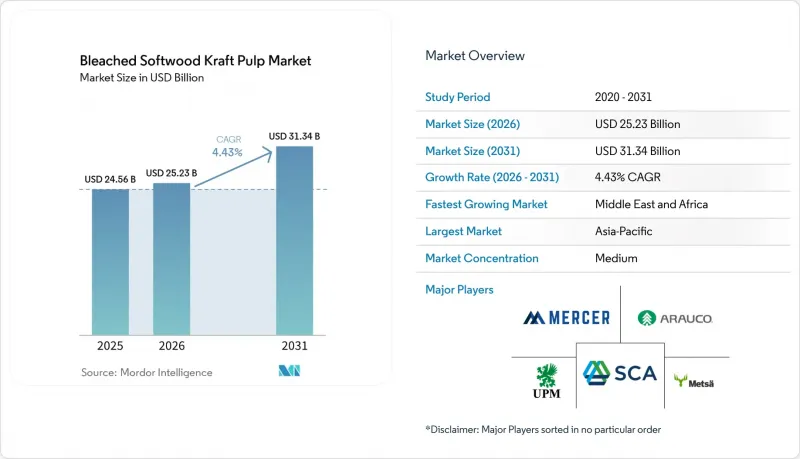
本報告按應用領域(衛生紙、絨布紙、印刷書寫紙、特種紙、包裝紙)、等級(北方漂白軟木紙 (NBSK)、南方漂白軟木紙 (SBSK) 等)和地區(北美、南美、歐洲、亞太、中東和非洲)進行細分。市場預測以美元 (USD) 為單位。
全球漂白軟木牛皮紙漿市場趨勢及洞察
長纖維在需要強度的應用中發揮著不可或缺的作用。
在強度性能要求極高的應用中,漂白針葉木牛皮紙漿市場仍依賴長纖維。 2.5至4.5毫米的針葉木牛皮紙漿纖維能夠提供造紙商所需的黏合網和紙張連續性,特別適用於那些對抗張強度、耐破強度和撕裂強度要求極高的紙漿等級。 Billerud的Carlsborg NBSK規格表明,該等級的紙漿不僅符合FDA和歐盟的食品接觸要求,還能滿足高要求紙漿混合配方中所需的強度特性。 SCA位於奧斯特蘭德的工廠為生活用紙、包裝紙和特種紙供應NBSK,該公司目前的年產能已超過100萬噸,並計劃進一步提高產能。這些產品需求以及對供應的堅定承諾確保了漂白針葉木牛皮紙漿(BSKP)市場的強勁需求,即便買家正尋求透過提高混合紙漿中硬木紙漿的比例來最佳化成本。
貨櫃板材的成長需要加固層
漂白軟木牛皮紙漿市場也受益於箱板襯紙和中型中增強纖維的使用。根據美國纖維及紙漿協會(AF&PA)的報告,2026年第一季箱板總產量較2025第一季第一季下降8%,但2026年第一季末的庫存仍較2025年第四季末下降3%,顯示在產能削減後,營運平衡趨於緊張。斯莫菲特韋斯特羅克公司在2026年4月的財報電話會議上表示,其2026年第一季幾乎所有纖維等級的庫存都已售罄,並已進一步提價以應對成本上漲。雖然漂白軟木紙漿並非用於箱板生產的所有環節,但軟木纖維仍依賴具有嚴格邊緣抗壓強度和耐破強度標準的優質增強層。從 3 月到 2026 年第二季度,紙箱需求逐漸恢復,而箱板紙供應仍然受限,漂白軟木牛皮紙漿(BSKP) 市場正獲得造紙商的支持,他們優先考慮可靠的增強質量,而不是成本最低的原料。
與硬木替代品相比,結構成本增加
與漂白闊葉木牛皮紙漿相比,漂白針葉木牛皮紙漿紙漿市場面臨顯著的成本挑戰。由於需要更昂貴的纖維原料、更長的纖維預處理時間以及保持長纖維完整性的製程條件,其成本結構仍高於桉樹基闊葉木紙漿。 Metsä集團在2025年全年收益報告中指出,歐洲和中國市場對針葉木紙漿的需求依然疲軟,闊葉木紙漿的部分替代正在減少最終產品中漂白針葉木牛皮紙漿的使用量。美世國際的「一個目標一百」計畫在2026年第一季實現了4,100萬美元的成本削減,目標是1億美元。這顯示生產商正致力於降低內部成本,而不是寄望於價格回升來解決問題。儘管採取了這些措施,但預計在預測期內,漂白軟木牛皮紙漿(BSKP) 市場將難以縮小與人工林硬木的核心木材成本差距,因此,低性能等級的替代壓力將繼續存在。
細分市場分析
截至2025年,生活用紙將佔漂白針葉木牛皮紙漿市場規模的37.13%,預計到2031年將以5.87%的複合年成長率成長。這些因素共同促成了生活用紙成為漂白針葉木牛皮紙漿產業中規模最大、成長最快的應用領域。該領域受益於兩大並行的需求趨勢:成熟經濟體持續的優質化以及東南亞和南亞地區人均滲透率的加速成長。根據TAPPI Paper360報告顯示,已開發市場的自有品牌生活用紙可能占到銷售量的近40%,其需求量相當於兩台生活用紙生產線的年產能。性能要求也是一個關鍵因素,因為多層生活用紙的外層仍然依賴長纖維密度來達到柔軟度、厚度和濕強度等目標,而這些目標對於含有大量硬木的紙漿來說難以實現。
從策略角度來看,絨毛漿仍然是第二大重要應用領域,與成人失禁用品、嬰兒尿布和女性用衛生用品的需求密切相關。斯道拉恩索的《2025年資本市場報告》將絨毛漿定位為“可防禦的業務板塊”,並將斯庫茨卡工廠的重組與絨毛漿產量的增加直接聯繫起來。這表明生產商正在積極轉向更永續的需求領域。雖然包裝應用在產量中仍佔據重要地位,但BSKP的應用場景正變得更加多樣化,因為它主要用於增強多層襯紙板,並未決定整體原料配方。 Canfor的產品資料強調了其在衛生紙、包裝紙和過濾紙等級中的增強強度和易於精煉的特性,解釋了為什麼在造紙商優先考慮可靠的運行性能和強度而非降低原料成本的情況下,這種等級的紙漿仍然具有價值。雖然印刷和書寫紙的需求持續下降,但特種紙在對白度和成型性要求較高的應用中仍然發揮著至關重要的作用。因此,漂白軟木牛皮紙漿(BSKP)市場的應用構成正逐漸從傳統紙張等級轉向衛生用品、特殊紙和高性能包裝材料。
區域分析
到2025年,亞太地區將佔漂白軟木牛皮紙漿市場38.76%的佔有率,成為該地區最大的需求中心。中國作為最大的漂白軟木牛皮紙漿海運進口國和邊際價格的決定者,仍然是該地區的重要因素。該地區的紙巾產業繼續使用進口漂白軟木牛皮紙漿生產高檔多層紙巾,而紙板和衛生用品的需求則更為廣泛。隨著營收成長和全部區域零售業態的普及,印度和印尼的人均紙張消費量不斷上升,兩國的重要性日益凸顯。日本對高白度紙巾和特殊紙的需求仍然成熟且強勁,這推動了該地區對高品質進口紙巾的持續需求。此外,由於缺乏北方軟木資源的大規模國內基礎,亞太地區仍然長期依賴進口,該地區的漂白軟木牛皮紙漿(BSKP)市場仍然對運輸成本、貿易流量和出口國生產商的運轉率高度敏感。
北美和歐洲是漂白針葉木牛皮紙漿市場的主要生產中心,其中加拿大供應全球大部分漂白針葉木牛皮紙漿,瑞典和芬蘭是第二大生產國。預計2025年歐洲漂白針葉木牛皮紙漿的消耗量將比2024年下降10%。這反映出生活用紙需求相對強勁,同時,印刷和書寫用紙也面臨用硬木取代漂白針葉木的壓力。歐盟木材法規(EUDR)增加了出口到歐洲的出口商的合規和可追溯性成本,UPM表示正在努力在過渡期內遵守所有規定。北美地區的分佈也在發生變化,不列顛哥倫比亞省的產能正在下降,而戰略投資正湧入加拿大東部。據加拿大基礎設施銀行稱,JD Irving在聖約翰的「下一代項目」(Project NextGen)是一個耗資15億美元的現代化項目,其中6.6億美元來自貸款,旨在將產量提高70%以上,同時將每噸紙漿的溫室氣體排放減半。
在漂白軟木牛皮紙漿市場,中東和非洲地區預計將成為成長最快的地區,2026年至2031年的複合年成長率將達到6.31%。需求成長的促進因素包括都市化、食品和消費品包裝需求的增加,以及在本地纖維供應有限的國家擴大紙巾產能。沙烏地阿拉伯的「2030願景」計畫正在刺激下游包裝產業的投資,而在埃及和奈及利亞,不斷壯大的都市區中產階級推動了紙巾需求的成長。撒哈拉以南非洲的消費基數很低,因此即使當地紙漿產業規模不大,該地區仍有長期成長空間。南美洲作為漂白軟木牛皮紙漿的生產和物流中心的重要性高於其作為需求中心的重要性,但由於巴西和阿根廷包裝需求的成長,該地區仍在消化不斷增加的供應。 Arauco 在巴西為紙漿出口進行的大規模基礎設施建設主要集中在硬木紙漿,但它仍將改善全部區域的物流,並間接支持整個南美出口鏈中漂白針葉木牛皮紙漿(BSKP) 市場的貿易效率。
其他好處:
- Excel格式的市場預測(ME)表
- 3個月的分析師支持
目錄
第1章:引言
- 研究假設和市場定義
- 調查範圍
第2章:調查方法
第3章執行摘要
- 市場概覽
- 需求錨點和最終用途配置
- 價格預測和利潤率趨勢
- 戰略意義
第4章 市場狀況
- 市場概覽
- 供給面趨勢
- 區域集中度(加拿大、北歐國家、美國)
- 長期林業作物輪作週期
- 人工林擴張的空間有限。
- 供給彈性約束
- 面臨供給衝擊:野火、蟲害、地緣政治不穩定
- 伐木政策和環境法規的影響
- 生產及產能分析
- 各區域的設備產能
- 設備運轉率趨勢
- 老舊資產基礎設施及現代化
- 新增產能將受到限制。
- 營運暫停,生產受限
- 與木材業的合作(依賴木片)
- 原料和纖維的經濟性
- 針葉樹種(松樹、雲杉、冷杉)
- 木材的成本結構(硬木與軟木的比較)
- 對鋸木廠殘渣(木片供應)的依賴
- 區域紡織品成本競爭力
- 林業永續性和認證
- 貿易流動和市場聯繫
- 出口導向供應鏈結構
- 主要貿易路線(加拿大/北歐國家 - 中國/歐洲)
- 中國作為邊際買家和價格影響力量
- 貿易中斷與地緣政治風險
- 價格分析
- 基準等級:NBSK定價
- 過去的價格週期
- 結構溢價與硬木漿
- 價格主要決定因素:供應緊張程度、需求強化程度、能源和物流成本。
- 期貨價格展望
- 成本結構與成本曲線
- 成本明細(木材、能源、化學品、人工)
- 在全球成本曲線上的位置
- 能源成本敏感性
- 市場動態
- 市場促進因素
- 長纖維在強度應用上的不可替代作用
- 對需要加固層的貨櫃板材的需求正在增加。
- 電子商務包裝的載重需求(高強度)
- 高性能等級產品的替代性有限
- 工業用紙(麻袋、重型包裝袋)的放大
- 提高包裝和衛生產品的品質標準
- 市場限制因素
- 與其他硬木相比,結構成本更高。
- 由於其生長週期長,纖維供應有限。
- 木片供應對鋸木廠產量的依賴性
- 林業易受干擾(火災、病蟲害和氣候變遷的影響)。
- 市場促進因素
- 技術與工藝概述
- 牛皮紙漿製造(針葉樹加工)
- 纖維強度最佳化
- 漂白技術(ECF)
- 能源回收系統
- 自動化和數位化工廠
- ESG與永續性分析
- 森林管理措施
- 碳足跡
- 生物多樣性考量
- 水和排放
- 目前身份驗證狀態
第5章 市場規模與成長預測
- 透過使用
- 組織
- 起毛
- 列印/書寫
- 特種紙
- 包裝
- 按年級
- 北方漂白軟木工藝品(NBSK)
- 南方漂白軟木工藝品(SBSK)
- 其他年級
- 按地區
- 北美洲
- 美國
- 加拿大
- 墨西哥
- 南美洲
- 巴西
- 阿根廷
- 其他南美國家
- 歐洲
- 德國
- 英國
- 法國
- 俄羅斯
- 北歐的
- 其他歐洲國家
- 亞太地區
- 中國
- 印度
- 日本
- 印尼
- 其他亞太國家
- 中東和非洲
- 中東
- 非洲
- 北美洲
第6章 競爭情勢
- 市場集中度
- 策略趨勢
- 市佔率分析
- 公司簡介
- Metsa Group
- UPM-Kymmene Corporation
- Celulosa Arauco y Constitucion SA
- Svenska Cellulosa Aktiebolaget SCA(publ)
- Mercer International Inc.
- Global Cellulose Fibers
- West Fraser Timber Co.
- Canfor Corporation
- Stora Enso Oyj
- JD Irving, Limited
- Billerud AB
- Smurfit Westrock Company
- Domtar Corporation
第7章:未來展望與情境分析
- 策略展望與未來趨勢
- 供應限制和需求成長
- 價格溢價的永續性
- 投資展望
- 風險評估
- 未來在全球紡織業格局中的角色
According to Mordor Intelligence, the bleached softwood kraft pulp market size is expected to increase from USD 24.56 billion in 2025 to USD 25.23 billion in 2026 and reach USD 31.34 billion by 2031, growing at a CAGR of 4.43% over 2026-2031.
This report is Segmented by Application (Tissue, Fluff, Printing and Writing, Specialty Paper, and Packaging), Grade (Northern Bleached Softwood Kraft (NBSK), Southern Bleached Softwood Kraft (SBSK), and More), and Geography (North America, South America, Europe, Asia-Pacific, Middle East and Africa). The Market Forecasts are Provided in Terms of Value (USD).
Global Bleached Softwood Kraft Pulp Market Trends and Insights
Irreplaceable Role Of Long Fiber In Strength Applications
The bleached softwood kraft pulp market continues to depend on long fiber where strength performance cannot be compromised. Softwood kraft pulp fibers at 2.5-4.5 millimeters give paper makers the bonding network and sheet continuity needed in grades that rely on tensile, burst, and tear properties. Billerud's Karlsborg NBSK specification shows that the grade meets FDA and EU food contact requirements while also delivering the strength profile expected in demanding furnish designs. SCA's Ostrand mill is supplying NBSK into tissue, packaging paper, and specialty paper, and the company is still planning capacity growth from a base already above 1 million tonnes per year. That combination of product requirements and supply commitment means the bleached softwood kraft pulp (BSKP) market keeps a resilient demand floor even when buyers try to optimize costs with more hardwood content.
Growth In Containerboard Requiring Reinforcement Layers
The bleached softwood kraft pulp market is also supported by the use of reinforcement fibers in containerboard liner and medium. AF&PA reported that total containerboard production in Q1 2026 fell 8% from Q1 2025, yet inventories at the end of Q1 2026 were still 3% lower than at the end of Q4 2025, which points to tighter operating balance after capacity reductions. Smurfit Westrock stated in its April 2026 earnings call that it had reached near sold-out status for nearly every fiber grade in Q1 2026 and had launched another round of price increases to address higher costs. Containerboard does not use bleached softwood pulp everywhere, but premium reinforcement layers still depend on softwood fiber where edge crush and burst targets are strict. As box demand improves from March through Q2 2026 and available linerboard supply remains disciplined, the bleached softwood kraft pulp (BSKP) market gains support from mills that need dependable reinforcement quality rather than the lowest-cost furnish.
Structurally Higher Cost Vs Hardwood Alternatives
The bleached softwood kraft pulp market faces a clear cost challenge against bleached hardwood kraft pulp. Softwood pulp production requires more expensive fiber input, longer fiber preparation, and process conditions that preserve long-fiber integrity, so the cost base remains structurally above eucalyptus-based hardwood supply. Metsa Group stated in its full-year 2025 results that softwood market pulp demand remained muted in Europe and China and that partial replacement with hardwood pulp was reducing NBSK volumes in end products. Mercer International's One Goal One Hundred program had reached USD 41 million in savings through Q1 2026 against a USD 100 million target, which shows how strongly producers are focused on internal cost reduction rather than assuming price recovery will solve the issue. Even with that response, the bleached softwood kraft pulp (BSKP) market is unlikely to close the core wood cost gap with plantation hardwood during the forecast period, so substitution pressure will continue in lower-performance grades.
Other drivers and restraints analyzed in the detailed report include:
- E-Commerce-Induced Packaging Stress Requirements
- Limited Substitution Possibility In High-Performance Grades
- Limited Fiber Availability Due To Long Growth Cycles
For complete list of drivers and restraints, kindly check the Table Of Contents.
Segment Analysis
Tissue accounted for 37.13% share of the bleached softwood kraft pulp market size in 2025, and it is also projected to expand at a 5.87% CAGR through 2031. That combination makes tissue the largest and fastest-growing application in the bleached softwood kraft pulp industry. The segment benefits from two parallel demand streams, stable premiumization in mature economies and faster per-capita adoption in Southeast Asia and South Asia. TAPPI Paper360 said private-label tissue could approach 40% of volume in developed markets, which is equal to the demand created by two tissue machine capacities each year. The performance requirement also matters, because multi-ply tissue outer plies still depend on long-fiber density to meet softness, caliper, and wet strength targets that hardwood-heavy furnishes struggle to achieve.
Fluff pulp remains the second most important application from a strategic standpoint because it is tied to adult incontinence, baby diaper, and feminine hygiene demand. Stora Enso's 2025 capital markets material described fluff pulp as a defensible segment and linked its Skutskar restructuring directly to higher fluff output, which shows that producers are actively shifting toward more durable demand pockets. Packaging stays volume significant, but the use case is more selective because BSKP mainly reinforces multi-ply linerboard rather than setting the full furnish mix. Canfor's product material highlights reinforcement strength and ease of refining for tissue, packaging, and filter grades, which explains why the grade retains value where paper makers need dependable runnability and strength rather than the lowest possible furnish cost. Printing and writing paper continues to decline, while specialty paper keeps a premium role for brightness and formation-sensitive uses, so the application mix in the bleached softwood kraft pulp (BSKP) market is gradually shifting toward hygiene, specialty, and performance packaging rather than legacy paper grades.
Complete Report Scope:
- By Application
- Tissue
- Fluff
- Printing and Writing
- Specialty Paper
- Packaging
- By Grade
- Northern Bleached Softwood Kraft (NBSK)
- Southern Bleached Softwood Kraft (SBSK)
- Other Grades
- By Geography
- North America
- United States
- Canada
- Mexico
- South America
- Brazil
- Argentina
- Rest of South America
- Europe
- Germany
- United Kingdom
- France
- Russia
- Nordics
- Rest of Europe
- Asia-Pacific
- China
- India
- Japan
- Indonesia
- Rest of Asia-Pacific
- Middle East and Africa
- Middle East
- Africa
- North America
Geography Analysis
Asia-Pacific held 38.76% of the bleached softwood kraft pulp market share in 2025, making it the largest regional demand center. China remains the key factor because it is the largest importer and the marginal price-setting buyer in the seaborne NBSK trade. The region's tissue sector continues to draw imported BSKP into premium multi-ply tissue production, while paperboard and hygiene products create a broader demand base across the region. India and Indonesia are moving up in importance as rising incomes and modern retail formats increase per-capita paper consumption. Japan remains a mature but demanding outlet for high-brightness tissue and specialty grades, which helps preserve premium import demand in the region. Asia-Pacific also stays permanently import dependent because it lacks a large domestic boreal softwood resource base, so the bleached softwood kraft pulp (BSKP) market in the region remains highly sensitive to shipping costs, trade flows, and producer operating rates in exporting countries.
North America and Europe form the main production center of the bleached softwood kraft pulp market, with Canada supplying a major share of global NBSK output and Sweden and Finland forming the second major producer bloc. Europe's consumption of bleached softwood kraft pulp fell by 10% in 2025 from 2024, reflecting hardwood substitution pressure in printing and writing papers even as tissue demand remained more resilient. The EUDR is adding compliance and traceability costs for exporters selling into Europe, and UPM said it was carrying out compliance work during the transition period to meet the full requirements. Production geography inside North America is also shifting because British Columbia has been losing capacity while eastern Canada is receiving strategic investment. Canada Infrastructure Bank said J.D. Irving's Project NextGen in Saint John is a USD 1.5 billion modernization supported by a USD 660 million loan and is intended to lift production by more than 70% while cutting greenhouse gas emissions per tonne by half.
The Middle East and Africa is projected to record the fastest regional growth at a 6.31% CAGR from 2026 to 2031 in the bleached softwood kraft pulp market. Demand is being supported by urbanization, broader food and consumer goods packaging needs, and tissue capacity growth in countries with little local fiber supply. Saudi Arabia's Vision 2030 program is encouraging downstream packaging investment, while Egypt and Nigeria are building tissue demand from a growing urban middle class. Sub-Saharan Africa starts from a very low consumption base, which gives the region a long runway for growth even without a large local pulp industry. South America remains more important as a production and logistics region than as a demand center for BSKP, but growing packaging demand in Brazil and Argentina is still absorbing incremental volumes. Arauco's broader infrastructure buildout for pulp exports in Brazil is centered on hardwood pulp, yet it still improves regional logistics that can indirectly support trade efficiency for the bleached softwood kraft pulp (BSKP) market across the South American export chain.
- Metsa Group
- UPM-Kymmene Corporation
- Celulosa Arauco y Constitucion S.A.
- Svenska Cellulosa Aktiebolaget SCA (publ)
- Mercer International Inc.
- Global Cellulose Fibers
- West Fraser Timber Co.
- Canfor Corporation
- Stora Enso Oyj
- J.D. Irving, Limited
- Billerud AB
- Smurfit Westrock Company
- Domtar Corporation
Additional Benefits:
- The market estimate (ME) sheet in Excel format
- 3 months of analyst support
TABLE OF CONTENTS
1 INTRODUCTION
- 1.1 Study Assumptions and Market Definition
- 1.2 Scope of the Study
2 RESEARCH METHODOLOGY
3 EXECUTIVE SUMMARY
- 3.1 Market Snapshot
- 3.2 Demand Anchors and End-Use Mix
- 3.3 Pricing Outlook and Margin Trends
- 3.4 Strategic Implications
4 MARKET LANDSCAPE
- 4.1 Market Overview
- 4.1.1 Supply-Side Dynamics
- 4.1.2 Geographic Concentration (Canada, Nordics, USA)
- 4.1.3 Long Forestry Rotation Cycles
- 4.1.4 Limited Plantation Expansion Potential
- 4.1.5 Supply Elasticity Constraints
- 4.1.6 Exposure to Supply Shocks: Wildfires, Pests, and Geopolitical Disruptions
- 4.1.7 Impact of Logging Policies and Environmental Restrictions
- 4.2 Production and Capacity Analysis
- 4.2.1 Installed Capacity by Region
- 4.2.2 Capacity Utilization Trends
- 4.2.3 Aging Asset Base vs Modernization
- 4.2.4 Limited Greenfield Capacity Additions
- 4.2.5 Downtime and Curtailments
- 4.2.6 Integration with Sawmill Industry (Chip Dependency)
- 4.3 Raw Material and Fiber Economics
- 4.3.1 Softwood Species (Pine, Spruce, Fir)
- 4.3.2 Wood Cost Structure (Higher vs Hardwood)
- 4.3.3 Dependency on Sawmill Residues (Chips Supply)
- 4.3.4 Regional Fiber Cost Competitiveness
- 4.3.5 Forestry Sustainability and Certification
- 4.4 Trade Flow and Market Linkages
- 4.4.1 Export-Oriented Supply Structure
- 4.4.2 Key Trade Routes (Canada/Nordics ? China/Europe)
- 4.4.3 China as Marginal Buyer and Price Influencer
- 4.4.4 Trade Disruptions and Geopolitical Exposure
- 4.5 Pricing Analysis
- 4.5.1 Benchmark Grade: NBSK Pricing
- 4.5.2 Historical Price Cycles
- 4.5.3 Structural Premium vs Hardwood Pulp
- 4.5.4 Key Price Drivers: Supply Tightness, Reinforcement Demand, and Energy and Logistics Costs
- 4.5.5 Forward Price Outlook
- 4.6 Cost Structure and Cost Curve
- 4.6.1 Cost Breakdown (Wood, Energy, Chemicals, Labor)
- 4.6.2 Global Cost Curve Positioning
- 4.6.3 Energy Cost Sensitivity
- 4.7 Market Dynamics
- 4.7.1 Market Drivers
- 4.7.1.1 Irreplaceable Role of Long Fiber in Strength Applications
- 4.7.1.2 Growth in Containerboard Requiring Reinforcement Layers
- 4.7.1.3 E-commerce-Induced Packaging Stress Requirements (Higher Strength)
- 4.7.1.4 Limited Substitution Possibility in High-Performance Grades
- 4.7.1.5 Expansion of Industrial Paper (Sack Kraft, Heavy-Duty Bags)
- 4.7.1.6 Improved Quality Standards in Packaging & Hygiene Products
- 4.7.2 Market Restraints
- 4.7.2.1 Structurally Higher Cost vs Hardwood Alternatives
- 4.7.2.2 Limited Fiber Availability Due to Long Growth Cycles
- 4.7.2.3 Dependence on Sawmill Output for Wood Chip Supply
- 4.7.2.4 Exposure to Forestry Disruptions (Fires, Pests, Climate Impact)
- 4.7.1 Market Drivers
- 4.8 Technology and Process Landscape
- 4.8.1 Kraft Pulping (Softwood Processing)
- 4.8.2 Fiber Strength Optimization
- 4.8.3 Bleaching Technologies (ECF)
- 4.8.4 Energy Recovery Systems
- 4.8.5 Automation and Digital Mills
- 4.9 ESG and Sustainability Analysis
- 4.9.1 Forestry Management Practices
- 4.9.2 Carbon Footprint
- 4.9.3 Biodiversity Considerations
- 4.9.4 Water and Emissions
- 4.9.5 Certification Landscape
5 MARKET SIZE AND GROWTH FORECAST
- 5.1 By Application
- 5.1.1 Tissue
- 5.1.2 Fluff
- 5.1.3 Printing and Writing
- 5.1.4 Specialty Paper
- 5.1.5 Packaging
- 5.2 By Grade
- 5.2.1 Northern Bleached Softwood Kraft (NBSK)
- 5.2.2 Southern Bleached Softwood Kraft (SBSK)
- 5.2.3 Other Grades
- 5.3 By Geography
- 5.3.1 North America
- 5.3.1.1 United States
- 5.3.1.2 Canada
- 5.3.1.3 Mexico
- 5.3.2 South America
- 5.3.2.1 Brazil
- 5.3.2.2 Argentina
- 5.3.2.3 Rest of South America
- 5.3.3 Europe
- 5.3.3.1 Germany
- 5.3.3.2 United Kingdom
- 5.3.3.3 France
- 5.3.3.4 Russia
- 5.3.3.5 Nordics
- 5.3.3.6 Rest of Europe
- 5.3.4 Asia-Pacific
- 5.3.4.1 China
- 5.3.4.2 India
- 5.3.4.3 Japan
- 5.3.4.4 Indonesia
- 5.3.4.5 Rest of Asia-Pacific
- 5.3.5 Middle East and Africa
- 5.3.5.1 Middle East
- 5.3.5.2 Africa
- 5.3.1 North America
6 COMPETITIVE LANDSCAPE
- 6.1 Market Concentration
- 6.2 Strategic Moves
- 6.3 Market Share Analysis
- 6.4 Company Profiles (includes Global Level Overview, Market Level Overview, Core Segments, Financials as available, Strategic Information, Products and Services, Recent Developments)
- 6.4.1 Metsa Group
- 6.4.2 UPM-Kymmene Corporation
- 6.4.3 Celulosa Arauco y Constitucion S.A.
- 6.4.4 Svenska Cellulosa Aktiebolaget SCA (publ)
- 6.4.5 Mercer International Inc.
- 6.4.6 Global Cellulose Fibers
- 6.4.7 West Fraser Timber Co.
- 6.4.8 Canfor Corporation
- 6.4.9 Stora Enso Oyj
- 6.4.10 J.D. Irving, Limited
- 6.4.11 Billerud AB
- 6.4.12 Smurfit Westrock Company
- 6.4.13 Domtar Corporation
7 FUTURE OUTLOOK AND SCENARIO ANALYSIS
- 7.1 Strategic Outlook and Future Dynamics
- 7.2 Supply Constraints vs Demand Growth
- 7.3 Sustainability of Price Premium
- 7.4 Investment Outlook
- 7.5 Risk Assessment
- 7.6 Future Role in Global Fiber Mix

 未漂白硬木和針葉木牛皮紙漿市場:全球市場預測,2026-2032年漂白硬木牛皮紙漿市場:全球市場預測,2026-2032年
 漂白桉樹牛皮紙漿:市場佔有率分析、行業趨勢和統計數據、成長預測(2026-2031)木漿:市場佔有率分析、產業趨勢與統計、成長預測(2026-2031)漂白桉樹牛皮紙漿市場:依等級、產品形式、應用、通路,全球預測(2026-2032年)全球漂白硬木牛皮紙漿市場(按漂白技術、等級、紙漿形態、應用和分銷管道分類)預測(2026-2032年)北方漂白軟木牛皮紙市場按產品等級、認證、應用、最終用途和分銷管道分類 - 全球預測(2026-2032 年)
 日本木漿市場規模、佔有率、趨勢及預測(按類型、等級、最終用途行業和地區分類),2026-2034年
 木漿市場規模、佔有率和成長分析(按類型、製造流程、最終用途產業和地區分類)-2026-2033年產業預測
 漂白尤加利牛皮紙漿市場:全球2025-2029年