


 |
市場調查報告書
商品編碼
2072681
人力資源知識庫和自助服務平台:市場佔有率分析、行業趨勢和統計數據以及成長預測(2026-2031 年)HR Knowledge Base And Self-Service Platform - Market Share Analysis, Industry Trends & Statistics, Growth Forecasts (2026 - 2031) |
||||||

※ 本網頁內容可能與最新版本有所差異。詳細情況請與我們聯繫。
據 Mordor Intelligence 稱,2025 年人力資源知識庫和自助服務平台市場價值為 42.3 億美元,預計到 2031 年將達到 79.8 億美元,2026 年至 2031 年的複合年成長率為 11.31%。
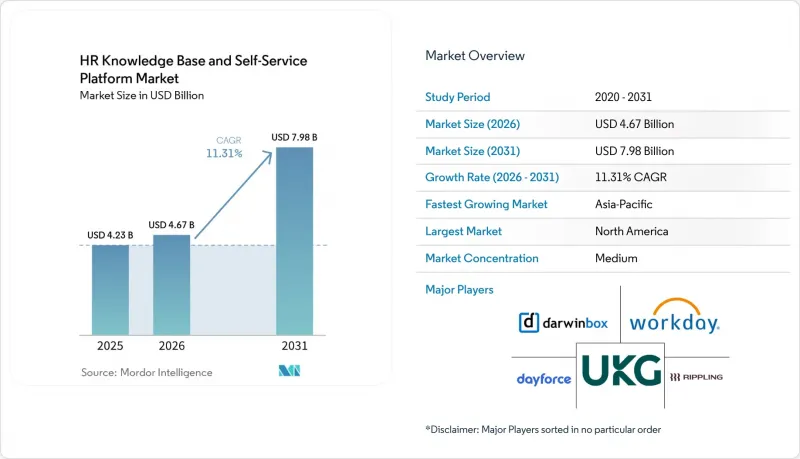
本報告按部署模式(雲端、本地部署、混合部署)、企業規模(大型企業、中小企業)、功能(知識管理等)、最終用戶產業(銀行、金融服務和保險、醫療保健和生命科學、資訊科技和電信等)以及地區進行細分。市場預測以價值(美元)表示。
全球人力資源知識庫與自助服務平台市場趨勢與洞察
利用人工智慧實現人力資源服務的現代化
人工智慧已從一項可選功能發展成為人力資源知識庫和自助服務平台的核心需求。如今,企業期望這些系統能夠在遵守已通過核准內容的前提下,解決複雜的人力資源諮詢。 Workday 於 2026 年 3 月發布的 Sana 系統,部署了擁有 300 多項人力資源和財務技能的自助服務代理。一位客戶報告稱,該系統在 40 天內實現了 90% 的用戶採用率,同時也註銷了 400 個未經授權的人工智慧授權。這清楚地表明,為什麼管理管治的平台正在人力資源服務環境中取代未經授權的工具。負責人不再僅僅關注減少工單數量,他們還會檢驗系統能否在數千次員工互動中維持政策的「單一資料來源」。缺乏組織特定上下文的通用模型難以在高度規範的工作流程中獲得信任,這使得那些基於公司特定人力資源內容搜尋資訊的供應商更具優勢。
混合辦公模式下,需要全天候員工自助服務。
混合辦公模式的興起永久改變了員工透過人力資源知識庫和自助服務平台尋求人力資源支援的時間和方式。如今,員工的問題來自不同的時區、使用不同的設備,並涉及不同的員工類型,這些模式與傳統的人力資源服務台設計不符。微軟的員工自助服務代理程式已展現出企業級的可用性,透過單一的互動式介面為遍佈100多個國家的數十萬員工和供應商提供服務。在成熟的部署中,大多數日常人力資源問題無需人工支援即可解決,但知識內容的不完整或過時往往會阻礙部署。這使得人們的關注點從簡單的存取入口網站轉移到內容的品質、及時性和引導操作的完整性。結合主動通知、情境搜尋和逐步工作流程指導的平台,其效能優於基於靜態搜尋的被動式入口網站。
員工機密資料的隱私性和可解釋性要求
隱私和可解釋性法規正在減緩人力資源知識庫和自助服務平台市場的部分發展,尤其對於處理高度敏感員工記錄的雇主而言更是如此。這些平台處理薪酬數據、休假信息、績效記錄、紀律處分記錄、居住狀態等信息,因此合規性面臨挑戰。在與僱用相關的應用情境中,自動化決策的問責制仍然是一個重要問題,歐盟人工智慧法對高風險系統的提供者和採用者提出了文件要求。如果文檔鏈不完整,可能會導致採購延誤。對於通常缺乏專門隱私和法律團隊的中型買家而言,這種負擔更加沉重。在監管嚴格的採購流程中,那些將可解釋性儀表板、審計日誌和合規的同意工作流程作為標準功能的供應商更具優勢。
細分市場分析
預計到2025年,雲端平台將佔據人力資源知識庫和自助服務平台市場規模的68.41%,這清楚地顯示了雲端技術的主導地位。該細分市場受益於基於員工規模的SaaS定價模式,這對於管理季節性、全球性或企劃為基礎員工的雇主至關重要。與本地部署系統相比,雲端原生環境也更容易適應變化,從而滿足持續模型調整和內容更新的需求。這使得雲端成為人力資源知識庫和自助服務平台市場中尋求更快發布速度和降低日常基礎設施管理負擔的買家的首選。 IT與電信、零售和金融服務業的領導者在2024年和2025年加速了雲端遷移。這是因為在傳統系統環境中,如果沒有大規模的客製化,人工智慧搜尋、自然語言查詢解析和上下文策略搜尋等功能很難得到支援。
到2031年,成長最快的部署方案是混合模式。這是因為一些雇主仍然要求對敏感員工資料的儲存位置進行更嚴格的控制。在監管嚴格的環境中,資料居住規則和內部安全策略使得全面遷移到SaaS平台的批准變得困難,這一點尤其明顯。供應商正在透過聯合模式來解決這個問題,該模式允許將敏感記錄保存在私有或本地環境中,同時透過託管雲層進行資料檢索和使用者互動。這種方法可以在不強制在專案早期進行全面基礎設施改造的情況下,保持現代化的使用者體驗。雖然在公共和國防等對安全性要求較高的領域,本地環境仍然存在,但隨著更新速度、應對力和降低維護負擔變得越來越重要,本地環境在人力資源知識庫和自助服務平台市場中的作用正在縮小。
到2025年,大型企業將佔據最大的銷售佔有率。這是因為它們擁有足夠的規模,能夠以自助服務平台取代或補充現有的人力資源共用服務。在許多大型企業中,人力資源團隊每月要處理數千條員工諮詢,因此即使是少量的自動化也能顯著提高員工的工作效率和回應品質。因此,在人力資源知識庫和自助服務平台市場,大規模買家往往傾向於選擇綜合平台契約,這些合約整合了知識管理、虛擬代理、服務工作流程和分析功能。這類合約通常需要選擇能夠在現有人力資本管理(HCM)系統之上提供整合功能的供應商。此外,大型企業通常擁有強大的管治、變革管理和合規資源,這有助於從試驗計畫過渡到企業級推廣。
預計2026年至2031年間,中小企業(SME)的複合年成長率將達到15.82%,成為成長最快的客戶群。這項轉變反映了雲端原生工具帶來的部署負擔減輕,降低了以往員工人數少於5000人的公司難以負擔的高階實施方案的成本和工作量。分層式軟體包結構也對此有所受益,它允許買家從知識管理或員工自助服務入手,而無需更換整個人力資本管理(HCM)系統。在人力資源知識庫和自助服務平台產業,這種模組化模式正受到越來越多擁有200至2000名員工的公司以及需要管理人力資源內容但又不想面對企業級系統複雜性的規模小規模的受監管公司的青睞。
區域分析
到2025年,北美將佔據人力資源知識庫和自助服務平台市場41.23%的佔有率,成為全球最大的市場。該地區受益於企業級SaaS的高滲透率、龐大的人力資源共享服務預算,以及相比其他地區更早採用人工智慧驅動的員工體驗工具。美國作為核心市場的地位依然穩固,其大型企業已迅速將自助服務與更廣泛的人力資本管理(HCM)和工作流程現代化專案整合。企業勞動力軟體需求的規模和成熟度與北美供應商生態系統密切相關,正促使競爭焦點從基本的門戶功能轉向人工智慧品質、管治深度和整合廣度。
歐洲仍然是人力資源知識庫和自助服務平台市場的重要區域,但同時也受到法規和諮詢規則的顯著影響。 GDPR、歐盟人工智慧法規以及各國勞動法都會影響雇主從試點計畫過渡到全面運作的速度。德國和法國尤其關鍵,因為與員工代表委員會協商和員工監督的法規可能會使人力資源人工智慧系統的實施進度延遲數月。因此,能夠從一開始就提供全面文件、可解釋性和基於本地政策的控制功能的供應商極具吸引力。
預計到2031年,亞太地區將以15.63%的複合年成長率成長,成為人力資源知識庫和自助服務平台市場成長最快的地區。在無固定辦公場所的製造、物流和零售業,員工對行動優先、多語言系統有著強勁的需求。在印度,多語言、行動優先的人力資源系統的採用率比僅使用英語的系統提高了70%以上,凸顯了語言支援在高成長地區的重要性。南美洲和中東及非洲地區尚處於應用初期,但供應商在墨西哥城等主要城市的佈局表明,他們已做好準備,滿足墨西哥、中美洲和南美洲更廣泛的企業需求。
其他好處:
- Excel格式的市場預測(ME)表
- 3個月的分析師支持
目錄
第1章:引言
- 研究假設和市場定義
- 調查範圍
第2章:調查方法
第3章執行摘要
第4章 市場狀況
- 市場概覽
- 宏觀經濟因素對市場的影響
- 市場促進因素
- 利用人工智慧實現人力資源服務交付現代化
- 在混合辦公環境下,需要全天候員工自助服務。
- 雲端人力資源套件整合及降低整體擁有成本 (TCO)
- 跨國公司人力資源政策合規性的日益複雜化
- 影子人工智慧管治正在推動對受管理的人力資源知識層的需求。
- 支援非固定辦公室職位和多語言員工正在推動目標用例的擴展。
- 市場限制因素
- 關於敏感員工資料的隱私性和可解釋性的要求
- 將傳統人力資源資訊系統、薪資核算系統和身分管理系統整合起來的複雜性。
- 員工代表委員會和人工智慧相關勞動法律的審查正在減緩產品推出的速度。
- 內容管治成熟度低,儲存庫中權限設定過多
- 產業價值鏈分析
- 監理情勢
- 技術展望
- 波特五力分析
第5章 市場規模與成長預測
- 按部署模式
- 基於雲端的
- 現場
- 混合
- 按最終用戶公司規模分類
- 大公司
- 小型企業
- 功能性別
- 知識管理
- 知識發現與搜尋
- 員工自助服務
- 互動式人工智慧和虛擬代理
- 服務自動化
- 分析與管治
- 按最終用戶行業分類
- BFSI
- 醫療保健和生命科學
- 資訊科技/通訊
- 零售與電子商務
- 工業製造
- 政府/公共部門
- 其他終端用戶產業
- 按地區
- 北美洲
- 美國
- 加拿大
- 墨西哥
- 南美洲
- 巴西
- 阿根廷
- 其他南美國家
- 歐洲
- 德國
- 英國
- 法國
- 義大利
- 西班牙
- 俄羅斯
- 荷蘭
- 其他歐洲國家
- 亞太地區
- 中國
- 日本
- 印度
- 韓國
- 澳洲和紐西蘭
- 其他亞太國家
- 中東
- 沙烏地阿拉伯
- 阿拉伯聯合大公國
- 其他中東國家
- 非洲
- 南非
- 奈及利亞
- 其他非洲國家
- 北美洲
第6章 競爭情勢
- 市場集中度
- 策略趨勢
- 市佔率分析
- 公司簡介。
- Workday, Inc.
- UKG Inc.
- Dayforce Corporation
- Rippling, Inc.
- Bamboo HR LLC
- Personio SE and Co. KG
- Hi Bob Ltd.
- Darwinbox Digital Solutions Pte. Ltd.
- Everyday Software, SL
- Connecteam Ltd.
- Leena AI, Inc.
- Simpplr, Inc.
- Staffbase GmbH
- iTacit Inc.
- Trainual, Inc.
- Tettra, Inc.
- Axero Solutions, LLC
- Korra AI LTD.
- Public Sector Analytics Limited
- Humaans Software UK LTD
第7章 市場機會與未來展望
According to Mordor Intelligence, the HR knowledge base and self-service platform market size was valued at USD 4.23 billion in 2025 and is forecast to reach USD 7.98 billion by 2031, growing at a CAGR of 11.31% over 2026-2031.
This report is Segmented by Deployment Model (Cloud-Based, On-Premises, and Hybrid), Enterprise Size (Large Enterprises, and Small and Medium Enterprises), Functionality (Knowledge Management, and More), End-User Industry (BFSI, Healthcare and Life Sciences, Information Technology and Telecom, and More), and Geography. The Market Forecasts are Provided in Terms of Value (USD)
Global HR Knowledge Base And Self-Service Platform Market Trends and Insights
AI-Enabled HR Service Delivery Modernization
AI has shifted from being an optional feature to a core requirement in HR knowledge bases and self-service platforms. Enterprises now expect these systems to resolve complex HR queries while staying anchored to approved policy content. Workday's March 2026 rollout of Sana introduced a self-service agent with over 300 HR and finance skills, and one customer reported 90% user adoption within 40 days while retiring 400 unsanctioned AI licenses. This illustrates why governed platforms are replacing unapproved tools in HR service environments. Buyers are no longer focused only on ticket deflection; they are also testing whether a system can preserve a single source of policy truth across thousands of employee interactions. Vendors that ground retrieval in company-specific HR content are gaining an edge, since generic models without organizational context are harder to trust in regulated workflows.
Need For 24-7 Employee Self-Service Across Hybrid Workforces
Hybrid work has permanently changed when and how employees seek HR support in the HR knowledge base and self-service platform market. Questions now come from different time zones, devices, and worker types, and that pattern does not fit the design of older HR help desks. Microsoft's Employee Self-Service Agent has already demonstrated enterprise-scale viability, serving hundreds of thousands of employees and vendors across more than 100 countries through a single conversational interface. Mature deployments handle a large share of routine HR questions without human support, but adoption often stalls when knowledge content is incomplete or outdated. This shifts attention from portal access alone to content quality, freshness, and guided action completion. Platforms that combine proactive notifications, contextual retrieval, and step-by-step workflow support are performing better than passive portals built around static search.
Sensitive Employee Data Privacy And Explainability Requirements
Privacy and explainability rules are slowing parts of the HR knowledge base and self-service platform market, especially for employers handling sensitive employee records. These platforms process compensation data, leave information, performance history, disciplinary records, and immigration status, which raises the compliance bar. Explanation duties for automated decision-making remain a live issue in employment use cases, and the EU AI Act imposes documentation requirements on providers and deployers of high-risk systems, which can delay procurement when the documentation chain is incomplete. This burden is harder for mid-market buyers to absorb because they often lack dedicated privacy and legal teams. Vendors that ship explainability dashboards, audit logs, and compliant consent workflows as standard features are better positioned in regulated buying cycles.
Other drivers and restraints analyzed in the detailed report include:
- Cloud HR Suite Consolidation and Lower Total Cost of Ownership
- Rising Compliance Complexity Across Multi-Country HR Policies
- Legacy HRIS, Payroll, And Identity Integration Complexity
For complete list of drivers and restraints, kindly check the Table Of Contents.
Segment Analysis
Cloud-based platforms accounted for 68.41% of the HR knowledge base and self-service platform market size in 2025, making cloud the clear mainstream deployment choice. The segment benefited from SaaS pricing that can rise or fall with headcount, which is important for employers managing seasonal, global, or project-based workforces. It also benefited from the need for continuous model tuning and content updates, since cloud-native environments can push those changes more easily than on-premises systems. In the HR knowledge base and self-service platform market, this has made cloud the default option for buyers who want faster releases and lower day-to-day infrastructure effort. Large organizations in information technology and telecom, retail, and financial services accelerated cloud moves in 2024 and 2025 because AI-enabled search, natural language query resolution, and contextual policy retrieval are difficult to support in older deployments without major custom work.
Hybrid is the fastest-growing deployment option through 2031 because some employers still need tighter control over where sensitive employee data sits. This is especially relevant in regulated settings where data residency rules or internal security policies make full SaaS migration harder to approve. Vendors are responding with federated models that keep sensitive records in private or on-premises environments while letting retrieval and user interaction run through managed cloud layers. That approach helps preserve modern user experience without forcing a full infrastructure replacement at the start of the project. On-premises remains present in high-security public sector and defense settings, but its role is narrowing as the HR knowledge base and self-service platform market places more value on update speed, audit readiness, and lower maintenance effort.
Large enterprises held the largest share of revenue in 2025 because they had the scale to justify replacing or augmenting HR shared services with self-service platforms. In many of these organizations, HR teams manage thousands of monthly employee questions, so even modest automation can create meaningful savings in staff time and response quality. The HR knowledge base and self-service platform market has therefore seen large buyers favor broader platform contracts that combine knowledge management, virtual agents, service workflows, and analytics. Those deals often favor vendors that can deliver integrated capabilities on top of existing HCM systems. Large employers also tend to have stronger governance, change management, and compliance resources, which makes it easier to move from pilot programs to enterprise production use.
Small and medium-sized enterprises are projected to grow at a 15.82% CAGR from 2026 to 2031, which makes them the fastest-growing customer tier. This shift reflects lower implementation burdens, as cloud-native tools reduce the cost and effort that once kept advanced deployments out of reach for firms with fewer than 5,000 employees. Tiered packaging is also helping because buyers can start with knowledge management or employee self-service without replacing an entire HCM stack. In the HR knowledge base and self-service platform industry, that modular model is widening adoption among firms with 200 to 2,000 employees and among smaller regulated employers that need controlled HR content without enterprise-scale complexity.
Complete Report Scope:
- By Deployment Model
- Cloud-Based
- On-Premises
- Hybrid
- By End User Enterprise Size
- Large Enterprises
- Small and Medium-Sized Enterprises
- By Functionality
- Knowledge Management
- Knowledge Discovery and Search
- Employee Self-Service
- Conversational AI and Virtual Agents
- Service Automation
- Analytics and Governance
- By End-user Industry
- BFSI
- Healthcare and Life Sciences
- Information Technology and Telecom
- Retail and E-commerce
- Industrial Manufacturing
- Government and Public Sector
- Other End-user Industries
- By Geography
- North America
- United States
- Canada
- Mexico
- South America
- Brazil
- Argentina
- Rest of South America
- Europe
- Germany
- United Kingdom
- France
- Italy
- Spain
- Russia
- Netherlands
- Rest of Europe
- Asia-Pacific
- China
- Japan
- India
- South Korea
- Australia and New Zealand
- Rest of Asia-Pacific
- Middle East
- Saudi Arabia
- United Arab Emirates
- Rest of Middle East
- Africa
- South Africa
- Nigeria
- Rest of Africa
- North America
Geography Analysis
North America held 41.23% of the HR knowledge base and self-service platform market share in 2025, giving the region the largest global position. The region benefited from high enterprise SaaS penetration, larger HR shared services budgets, and faster early adoption of AI-assisted employee experience tools. The United States remained the anchor market because large employers there have been quicker to connect self-service with broader HCM and workflow modernization programs. The scale and maturity of enterprise workforce software demand, closely tied to North American vendor ecosystems, mean competition centers less on basic portal functions and more on AI quality, governance depth, and integration breadth.
Europe remains a major region in the HR knowledge base and self-service platform market, but regulatory and consultation rules more heavily shape it. GDPR, the EU AI Act, and national labor frameworks all influence how quickly employers can move from testing to scaled production use. Germany and France are especially important because works council consultation and employee oversight rules can add months to deployment timelines for HR AI systems. That has increased the appeal of vendors that can show stronger documentation, explainability, and local policy controls from the start.
Asia-Pacific is projected to grow at a 15.63% CAGR through 2031, the fastest regional pace in the HR knowledge base and self-service platform market. Demand is strong for mobile-first, multilingual support where deskless manufacturing, logistics, and retail workforces need it. Multilingual mobile-first HR systems in India have shown adoption improvements of more than 70% compared with English-only systems, highlighting the importance of language coverage in high-growth settings. South America, the Middle East, and Africa are at earlier adoption stages, but vendor expansion into hubs such as Mexico City shows that providers are preparing for broader enterprise demand across Mexico, Central America, and South America.
- Workday, Inc.
- UKG Inc.
- Dayforce Corporation
- Rippling, Inc.
- Bamboo HR LLC
- Personio SE and Co. KG
- Hi Bob Ltd.
- Darwinbox Digital Solutions Pte. Ltd.
- Everyday Software, S.L.
- Connecteam Ltd.
- Leena AI, Inc.
- Simpplr, Inc.
- Staffbase GmbH
- ITacit Inc.
- Trainual, Inc.
- Tettra, Inc.
- Axero Solutions, LLC
- Korra AI LTD.
- Public Sector Analytics Limited
- Humaans Software UK LTD
Additional Benefits:
- The market estimate (ME) sheet in Excel format
- 3 months of analyst support
TABLE OF CONTENTS
1 INTRODUCTION
- 1.1 Study Assumptions and Market Definition
- 1.2 Scope of the Study
2 RESEARCH METHODOLOGY
3 EXECUTIVE SUMMARY
4 MARKET LANDSCAPE
- 4.1 Market Overview
- 4.2 Impact of Macroeconomic Factors on the Market
- 4.3 Market Drivers
- 4.3.1 AI-Enabled HR Service Delivery Modernization
- 4.3.2 Need for 24-7 Employee Self-Service Across Hybrid Workforces
- 4.3.3 Cloud HR Suite Consolidation and Lower Total Cost of Ownership
- 4.3.4 Rising Compliance Complexity Across Multi-Country HR Policies
- 4.3.5 Shadow AI Governance Driving Demand for Controlled HR Knowledge Layers
- 4.3.6 Deskless and Multilingual Workforce Support Expanding Addressable Use Cases
- 4.4 Market Restraints
- 4.4.1 Sensitive Employee Data Privacy and Explainability Requirements
- 4.4.2 Legacy HRIS, Payroll, and Identity Integration Complexity
- 4.4.3 Works Council and AI Employment Law Review Slowing Production Rollouts
- 4.4.4 Low Content Governance Maturity and Over-Permissioned Repositories
- 4.5 Industry Value-Chain Analysis
- 4.6 Regulatory Landscape
- 4.7 Technological Outlook
- 4.8 Porter's Five Forces Analysis
- 4.8.1 Bargaining Power of Buyers
- 4.8.2 Bargaining Power of Suppliers
- 4.8.3 Threat of New Entrants
- 4.8.4 Threat of Substitutes
- 4.8.5 Intensity of Competitive Rivalry
5 MARKET SIZE AND GROWTH FORECASTS (VALUE)
- 5.1 By Deployment Model
- 5.1.1 Cloud-Based
- 5.1.2 On-Premises
- 5.1.3 Hybrid
- 5.2 By End User Enterprise Size
- 5.2.1 Large Enterprises
- 5.2.2 Small and Medium-Sized Enterprises
- 5.3 By Functionality
- 5.3.1 Knowledge Management
- 5.3.2 Knowledge Discovery and Search
- 5.3.3 Employee Self-Service
- 5.3.4 Conversational AI and Virtual Agents
- 5.3.5 Service Automation
- 5.3.6 Analytics and Governance
- 5.4 By End-user Industry
- 5.4.1 BFSI
- 5.4.2 Healthcare and Life Sciences
- 5.4.3 Information Technology and Telecom
- 5.4.4 Retail and E-commerce
- 5.4.5 Industrial Manufacturing
- 5.4.6 Government and Public Sector
- 5.4.7 Other End-user Industries
- 5.5 By Geography
- 5.5.1 North America
- 5.5.1.1 United States
- 5.5.1.2 Canada
- 5.5.1.3 Mexico
- 5.5.2 South America
- 5.5.2.1 Brazil
- 5.5.2.2 Argentina
- 5.5.2.3 Rest of South America
- 5.5.3 Europe
- 5.5.3.1 Germany
- 5.5.3.2 United Kingdom
- 5.5.3.3 France
- 5.5.3.4 Italy
- 5.5.3.5 Spain
- 5.5.3.6 Russia
- 5.5.3.7 Netherlands
- 5.5.3.8 Rest of Europe
- 5.5.4 Asia-Pacific
- 5.5.4.1 China
- 5.5.4.2 Japan
- 5.5.4.3 India
- 5.5.4.4 South Korea
- 5.5.4.5 Australia and New Zealand
- 5.5.4.6 Rest of Asia-Pacific
- 5.5.5 Middle East
- 5.5.5.1 Saudi Arabia
- 5.5.5.2 United Arab Emirates
- 5.5.5.3 Rest of Middle East
- 5.5.6 Africa
- 5.5.6.1 South Africa
- 5.5.6.2 Nigeria
- 5.5.6.3 Rest of Africa
- 5.5.1 North America
6 COMPETITIVE LANDSCAPE
- 6.1 Market Concentration
- 6.2 Strategic Moves
- 6.3 Market Share Analysis
- 6.4 Company Profiles (includes Global Level Overview, Market Level Overview, Core Segments, Financials as available, Strategic Information, Market Rank/Share, Products and Services, Recent Developments).
- 6.4.1 Workday, Inc.
- 6.4.2 UKG Inc.
- 6.4.3 Dayforce Corporation
- 6.4.4 Rippling, Inc.
- 6.4.5 Bamboo HR LLC
- 6.4.6 Personio SE and Co. KG
- 6.4.7 Hi Bob Ltd.
- 6.4.8 Darwinbox Digital Solutions Pte. Ltd.
- 6.4.9 Everyday Software, S.L.
- 6.4.10 Connecteam Ltd.
- 6.4.11 Leena AI, Inc.
- 6.4.12 Simpplr, Inc.
- 6.4.13 Staffbase GmbH
- 6.4.14 iTacit Inc.
- 6.4.15 Trainual, Inc.
- 6.4.16 Tettra, Inc.
- 6.4.17 Axero Solutions, LLC
- 6.4.18 Korra AI LTD.
- 6.4.19 Public Sector Analytics Limited
- 6.4.20 Humaans Software UK LTD
7 MARKET OPPORTUNITIES AND FUTURE OUTLOOK
- 7.1 White-Space and Unmet-Need Assessment

 工業機器人智慧軟體:市場佔有率分析、產業趨勢與統計、成長預測(2026-2031)
 2026年全球神經多樣性員工生產力工具市場報告人工智慧睡眠技術:市場佔有率分析、產業趨勢與統計及成長預測(2026-2031)
 人工智慧生產力工具市場規模、佔有率和成長分析:按組件、部署模式/架構、組織規模、威脅狩獵調查方法和目標產業分類-2026-2033年產業預測法律產業的AI軟體:市佔率分析、產業趨勢與統計及成長預測(2026-2031年)
 AI生產力工具市場規模、佔有率和趨勢分析報告:按交付方式、部署方式、最終用途、地區和細分市場預測(2026-2033年)2026年全球命名實體連結人工智慧市場報告
 衡量人工智慧的實際使用情況
 2026-2030年全球人工智慧運行時最佳化市場
 人工智慧驅動設計工具市場分析與預測(至2035年):類型、服務、技術、組件、應用、部署模式、最終用戶及功能