


 |
市場調查報告書
商品編碼
2118039
人工智慧睡眠技術:市場佔有率分析、產業趨勢與統計及成長預測(2026-2031)AI-Powered Sleep Technologies - Market Share Analysis, Industry Trends & Statistics, Growth Forecasts (2026 - 2031) |
||||||

※ 本網頁內容可能與最新版本有所差異。詳細情況請與我們聯繫。
根據 Mordor Intelligence 預測,人工智慧睡眠技術市場預計將從 2025 年的 59.2 億美元成長到 2026 年的 69.1 億美元,然後從 2026 年到 2031 年以 20.35% 的複合年成長率成長,到 2031 年達到 174.6 億美元。
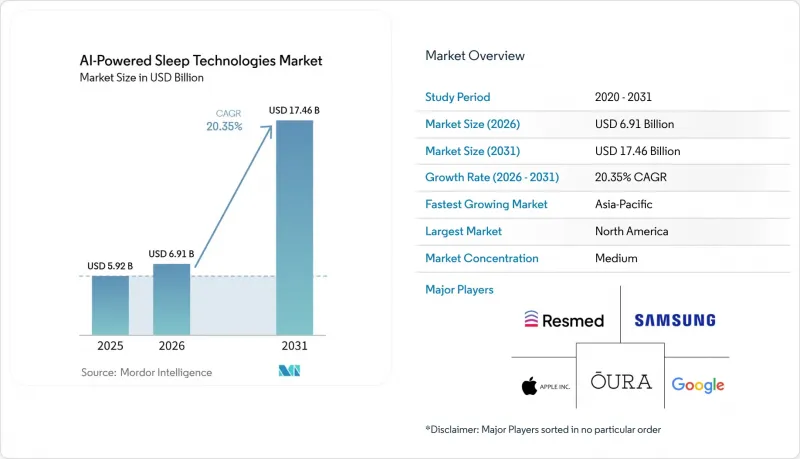
本報告按產品類型(例如,人工智慧睡眠追蹤器)、技術(例如,機器學習和感測器融合)、應用(例如,睡眠監測和評分)、最終用戶(例如,居家照護機構、醫院)以及地區(北美、歐洲、亞太地區、中東和非洲、南美)進行細分。市場預測以美元計價。
全球人工智慧睡眠技術市場趨勢及洞察
對個人化睡眠最佳化的需求日益成長
隨著用戶期望從靜態評分報告轉向個人化指導,人工智慧睡眠技術市場正在蓬勃發展。使用者越來越希望獲得能夠反映其數週生理功能、日常行為和睡眠模式的建議,而非泛泛的睡眠衛生指導。結合睡眠階段、心率變異性、皮膚溫度和恢復訊號的設備和平台,使得個人化功能更方便日常使用。 Eight Sleep 表示,其「自動駕駛」平台每晚可為每位用戶進行數百萬次生物特徵調整,該公司正在透過其「AI睡眠代理」進一步擴展此模式,該代理旨在模擬和最佳化恢復效果。在人工智慧睡眠技術市場,競爭價值的轉變在於,能夠透過自適應指導和可衡量的結果來維持用戶長期參與度的平台更受青睞。
從被動監測過渡到封閉回路型睡眠干預
人工智慧驅動的睡眠技術市場不再僅僅專注於收集夜間數據並在隔天早晨呈現結果。封閉回路型系統開始檢測睡眠期間的生理變化,並直接調整環境和治療方案。這一點意義重大,因為與單純的被動監測相比,介入措施能創造更持久的提案,尤其是在系統能夠在睡眠期間而非睡眠結束後做出反應的情況下。 Eight Sleep 透過將即時生物分析與自動溫度控制相結合,拓展了藍圖。因此,人工智慧主導的睡眠技術市場正穩步從感測器所有權轉向干預措施的品質和演算法的反應速度。
消費者對演算法睡眠評分的信任度有差距
人工智慧驅動的睡眠技術市場持續面臨可靠性問題。這是因為許多評分系統都是專有的,臨床醫師難以解讀。 2025年發表在《科學報告》(Scientific Reports)上的一項研究表明,如果臨床醫生無法充分評估演算法偏差和決策模糊性,那麼人工智慧驅動的睡眠技術在臨床上的應用將受到限制。當評分品質可能因膚色、身體質量指數(BMI)和合併症亞組而異時,這些問題會更加突出。 2026年發表在《睡眠與呼吸》(Sleep and Breathing)上的一篇綜述概述了一個用於診斷睡眠呼吸障礙的可解釋人工智慧框架,但也指出,在臨床層面,可解釋性和準確性之間的權衡仍未解決。在臨床醫生更清楚地了解演算法如何得出輸出結果之前,人工智慧驅動的睡眠技術市場在危機醫療環境中的普及速度可能仍然緩慢。
細分市場分析
預計到2025年,人工智慧睡眠追蹤器將佔據人工智慧睡眠技術市場42.83%的佔有率,而睡眠應用程式和數位睡眠平台預計到2031年將以20.63%的年成長率成長。追蹤器的主導地位反映了腕戴式穿戴式裝置、戒指式裝置和床墊下方感應器等產品的成熟度,這些裝置已無縫融入日常生活。憑藉其廣泛的普及、持續的數據收集以及清晰的面向消費者的健康應用場景,這些設備仍然是進入人工智慧睡眠技術市場的主要入口。
軟體主導產品正蓬勃發展,因為數位化分發的經濟效益比單純擴展硬體更具吸引力。 2025年發表在《npj Digital Medicine》期刊上的Meta分析證實了全自動數位認知行為療法對失眠的有效性,進一步增強了醫療機構對基於應用程式的護理的信心。這項證據有助於解釋為什麼人工智慧驅動的睡眠技術市場正逐漸轉向能夠透過訂閱、臨床項目和數據驅動的指導來實現長期用戶參與度盈利的產品。
預計到2025年,機器學習和感測器融合技術將佔銷售額的38.57%,而人工智慧驅動的行為療法預計到2031年將以21.84%的年均成長率成長。感測器融合技術仍然是人工智慧驅動睡眠技術市場的核心。這是因為主流睡眠測量設備仍然依賴光學脈搏波儀、加速計以及相關的多重訊號處理技術,將生物生理原始數據轉化為有用的夜間睡眠模式。這項技術基礎目前已廣泛應用於穿戴式裝置和家庭監測工具,這也使其在當前的銷售市場中佔據主導地位。
雷達、聲學和熱感應技術非常適合此用途,因為它們無需佩戴在身上即可進行監測。雲端和邊緣人工智慧的整合支援所有這些模式,透過平衡低延遲處理和跨大規模資料集的持續模型更新來實現。在人工智慧驅動的睡眠技術市場,這正在催生更廣泛的技術競爭,其價值更多地取決於如何有效地組合、解讀訊號並將其轉化為行動,而不是依賴單一感測器。
區域分析
到2025年,北美將佔據人工智慧睡眠技術市場41.28%的佔有率。該地區的主導地位源於多方面因素的綜合作用:龐大的已確診和未確診睡眠障礙患者群體、完善的臨床基礎設施以及對人工智慧睡眠工具更為積極的法規環境。根據《呼吸醫學》雜誌估計,到2024年,美國將有8,370萬成年人患有阻塞型睡眠呼吸中止症中止症,這將為該地區帶來龐大的篩檢和管理人群。
歐洲在人工智慧睡眠技術市場中仍然扮演著重要角色,因為該技術的應用與臨床檢驗和資料管治的關聯日益緊密。儘管該地區擁有完善的醫療保健基礎設施,但旨在應用於臨床的產品在證據品質、互通性和注重隱私的數據處理方面仍面臨更高的挑戰。根據《數位健康前沿》(Frontiers in Digital Health)報告,技術路徑正在不斷改進,例如,Garmin正在將穿戴式裝置的睡眠資料整合到一個符合GDPR標準的HL7 FHIR格式的標準化資料庫中。這使得消費者產生的資訊能夠更有效地應用於臨床實踐。簡而言之,能夠將面向消費者的監測數據轉化為符合規範的臨床工作流程的公司,很可能在歐洲人工智慧睡眠技術市場中佔據競爭優勢。
亞太地區預計將成為人工智慧睡眠技術市場成長最快的地區,到2031年複合年成長率預計為23.86%。中國正透過政策指導支持該產業發展,國家規劃和健康生活計劃將睡眠健康置於更廣泛的預防和神經科學優先事項中,並賦予其明確的定位。這些進展對於增強全部區域的消費者需求和機構認可度具有重要意義。中東和非洲,特別是海灣合作理事會國家和南美部分地區,仍處於起步階段,高級產品最初透過全球穿戴式裝置生態系統進入市場。在這些市場,人工智慧睡眠技術市場的成長速度預計將較為緩慢,直到價格、保險報銷和醫療保健基礎設施更加完善。
其他好處:
- Excel格式的市場預測(ME)表
- 3個月的分析師支持
目錄
第1章:引言
- 研究假設和市場定義
- 調查範圍
第2章:調查方法
第3章執行摘要
第4章 市場狀況
- 市場概覽
- 市場促進因素
- 對個人化睡眠最佳化的需求日益成長
- 從被動監測過渡到封閉回路型睡眠干預
- 家庭睡眠診斷和遠端監測的發展
- 睡眠數據與數位健康生態系統的互通性
- 人工智慧睡眠篩檢的保險覆蓋途徑
- 睡眠障礙及相關慢性疾病盛行率增加
- 市場限制因素
- 消費者對演算法睡眠評分的信任度有差距
- 臨床檢驗標準因醫療設備。
- 夜間生物識別監測中的資料隱私限制
- 先進的人工智慧睡眠監測設備和平台高成本
- 供應鏈/價值鏈分析
- 監理情勢
- 技術展望
- 波特五力分析
第5章 市場規模與成長預測
- 依產品類型
- 人工智慧睡眠追蹤器
- 整合人工智慧的睡眠環境設備
- 人工智慧驅動的睡眠療法和介入措施
- 睡眠應用程式和數位睡眠平台
- 透過技術
- 機器學習和感測器融合
- 雷達、聲學和熱感
- 人工智慧驅動的行為療法
- 雲端和邊緣人工智慧的融合
- 透過使用
- 睡眠監測和評分
- 睡眠呼吸中止症和打鼾的檢測
- 睡眠最佳化和指導
- 數位睡眠療法
- 最終用戶
- 居家醫療
- 醫院
- 睡眠診所和中心
- 企業健康與調查計畫
- 按地區
- 北美洲
- 美國
- 加拿大
- 墨西哥
- 歐洲
- 德國
- 英國
- 法國
- 義大利
- 西班牙
- 其他歐洲國家
- 亞太地區
- 中國
- 日本
- 印度
- 澳洲
- 韓國
- 其他亞太國家
- 中東和非洲
- GCC
- 南非
- 其他中東和非洲國家
- 南美洲
- 巴西
- 阿根廷
- 其他南美國家
- 北美洲
第6章 競爭情勢
- 市場集中度
- 市佔率分析
- 公司簡介
- Apollo Neuroscience, Inc.
- Apple Inc.
- Awake Labs Inc.
- Compumedics Limited
- Eight Sleep, Inc.
- Emfit Ltd.
- Fitbit, LLC
- Garmin Ltd.
- Google LLC
- Huawei Technologies Co., Ltd.
- Masimo Corporation
- Oura Health Oy
- Philips NV
- ResMed Inc.
- Samsung Electronics Co., Ltd.
- Sleep Number Corporation
- SleepScore Labs, Inc.
- Somnox BV
- Withings
- Xiaomi Corporation
第7章 市場機會與未來展望
According to Mordor Intelligence, the AI-powered sleep technologies market is expected to grow from USD 5.92 billion in 2025 to USD 6.91 billion in 2026 and is forecasted to reach USD 17.46 billion by 2031 at 20.35% CAGR over 2026-2031.
This report is Segmented by Product Type (AI-Enabled Sleep Trackers, and More), Technology (Machine Learning and Sensor Fusion, and More), Application (Sleep Monitoring and Scoring, and More), End-User (Home Care Settings, Hospitals, and More), and Geography (North America, Europe, Asia-Pacific, Middle East and Africa, South America). The Market Forecasts are Provided in Terms of Value (USD).
Global AI-Powered Sleep Technologies Market Trends and Insights
Rising Demand for Personalized Sleep Optimization
The AI-powered sleep technologies market is gaining from a clear shift in user expectations toward individualized guidance rather than static score reporting. Users increasingly want recommendations that reflect their physiology, daily behavior, and multi-week sleep patterns instead of generic sleep hygiene prompts. Devices and platforms that combine sleep staging, heart rate variability, skin temperature, and recovery signals are making that personalization more practical in daily use. Eight Sleep stated that its Autopilot platform makes millions of nightly biometric adjustments per user, and the company is extending that model with an AI Sleep Agent designed to simulate and optimize recovery outcomes. In the AI-powered sleep technologies market, this moves competitive value toward platforms that can maintain longer user engagement through adaptive coaching and measurable outcomes.
Shift From Passive Monitoring to Closed-Loop Sleep Intervention
The AI-powered sleep technologies market is no longer centered only on collecting overnight data and presenting it the next morning. Closed-loop systems are starting to detect physiological changes during sleep and respond with direct environmental or therapeutic adjustments. This matters because intervention creates a more durable value proposition than passive monitoring alone, especially when the system can respond during the sleep window instead of after it. Eight Sleep linked its real-time biometric analysis to automated temperature changes and expanded its roadmap toward AI-led sleep apnea and menopausal sleep applications. As a result, the AI-powered sleep technologies market is steadily shifting from sensor ownership toward intervention quality and algorithm responsiveness.
Consumer Trust Gaps Around Algorithmic Sleep Scoring
The AI-powered sleep technologies market still faces a trust problem because many scoring systems remain proprietary and difficult for clinicians to interpret. A 2025 study in Scientific Reports found that clinical adoption remains limited when clinicians cannot adequately assess algorithmic bias and decision opacity. Those concerns become more serious when scoring quality may vary across skin tone, BMI, and comorbidity subgroups. A 2026 review in Sleep and Breathing outlined an explainable AI framework for sleep-disordered breathing diagnostics, but also noted that the trade-off between interpretability and accuracy remains unresolved at the clinical scale. Until clinicians gain clearer visibility into how algorithms reach outputs, the AI-powered sleep technologies market will keep facing slower uptake in higher-acuity care settings.
Other drivers and restraints analyzed in the detailed report include:
- Growth of At-Home Sleep Diagnostics and Remote Monitoring
- Sleep Data Interoperability with Digital Health Ecosystems
- Fragmented Clinical Validation Standards Across Device Classes
For complete list of drivers and restraints, kindly check the Table Of Contents.
Segment Analysis
AI-enabled sleep trackers held 42.83% of the AI-powered sleep technologies market share in 2025, while sleep apps and digital sleep platforms are projected to grow at 20.63% through 2031. The leading position of trackers reflects the maturity of wrist-worn wearables, rings, and under-mattress sensing formats that already fit into daily routines with limited friction. These devices remain the main front door into the AI-powered sleep technologies market because they combine broad reach, recurring data capture, and a clear consumer wellness use case.
Software-led products are gaining ground because the economics of digital delivery are more attractive than hardware-only expansion. A 2025 meta-analysis in npj Digital Medicine confirmed the efficacy of fully automated digital cognitive behavioral therapy for insomnia, which supports wider institutional confidence in app-based care. That evidence helps explain why the AI-powered sleep technologies market is gradually shifting toward products that can monetize long-term engagement through subscriptions, clinical programs, and data-enabled coaching.
Machine learning and sensor fusion held 38.57% of revenue in 2025, while AI-guided behavioral therapy is expected to grow at 21.84% through 2031. Sensor fusion remains central to the AI-powered sleep technologies market because mainstream sleep devices still rely on photoplethysmography, accelerometry, and related multi-signal processing to convert raw physiological inputs into usable overnight profiles. That technical base is now well established across wearables and home monitoring tools, which helps explain its current revenue leadership.
Radar, audio, and thermal approaches fit well with that goal because they can monitor without adding a device to the body. Cloud and edge AI integration supports all of these modalities by balancing lower-latency processing with continuous model updates across larger data sets. In the AI-powered sleep technologies market, that creates a broader technology race where value depends less on any single sensor and more on how effectively signals are combined, interpreted, and translated into action.
Complete Report Scope:
- By Product Type
- AI-Enabled Sleep Trackers
- AI-Integrated Sleep Environment Devices
- AI-Driven Sleep Therapeutics and Interventions
- Sleep Apps and Digital Sleep Platforms
- By Technology
- Machine Learning and Sensor Fusion
- Radar, Audio, and Thermal Sensing
- AI-Guided Behavioral Therapy
- Cloud and Edge AI Integration
- By Application
- Sleep Monitoring and Scoring
- Sleep Apnea and Snoring Detection
- Sleep Optimization and Coaching
- Digital Sleep Therapy
- By End-User
- Home Care Settings
- Hospitals
- Sleep Clinics and Centers
- Corporate Wellness and Research Programs
- By Geography
- North America
- United States
- Canada
- Mexico
- Europe
- Germany
- United Kingdom
- France
- Italy
- Spain
- Rest of Europe
- Asia-Pacific
- China
- Japan
- India
- Australia
- South Korea
- Rest of Asia-Pacific
- Middle East and Africa
- GCC
- South Africa
- Rest of Middle East and Africa
- South America
- Brazil
- Argentina
- Rest of South America
- North America
Geography Analysis
North America held 41.28% of the AI-powered sleep technologies market share in 2025. The region leads because it combines a high burden of diagnosed and undiagnosed sleep disorders with strong clinical infrastructure and a more active regulatory path for AI-enabled sleep tools. Respiratory Medicine estimated 83.7 million U.S. adults had obstructive sleep apnea in 2024, which gives the region a very large screening and management base.
Europe remains important to the AI-powered sleep technologies market because adoption is increasingly tied to clinical validation and data governance. The region has strong provider infrastructure, but products that want a clinical role face a higher burden around evidence quality, interoperability, and privacy-ready data handling. The technical path is improving, as Frontiers in Digital Health documented GDPR-compliant HL7 FHIR integration of Garmin wearable sleep data into a standardized repository, which supports more practical clinical use of consumer-generated information. This means the European AI-powered sleep technologies market is likely to favor companies that can translate consumer-grade monitoring into compliant clinical workflows.
Asia-Pacific is projected to be the fastest-growing region in the AI-powered sleep technologies market, with a projected CAGR of 23.86% through 2031. China is supporting the category through policy direction, as national planning and healthy living initiatives now give sleep health a clearer place inside broader prevention and brain science priorities. These signals matter because they strengthen both consumer demand and institutional acceptance across the region. Middle East and Africa, especially the GCC, and parts of South America, remain earlier-stage opportunities where premium products are entering through global wearable ecosystems first. In those markets, the AI-powered sleep technologies market is likely to expand more gradually until pricing, reimbursement, and care infrastructure become more supportive.
- Apollo Neuroscience, Inc.
- Apple
- Awake Labs Inc.
- Compumedics
- Eight Sleep, Inc.
- Emfit Ltd.
- Fitbit, LLC
- Garmin
- Google LLC
- Huawei Technologies
- Masimo
- Oura Health Oy
- Philips N.V.
- Resmed
- Samsung Group
- Sleep Number Corporation
- SleepScore Labs, Inc.
- Somnox B.V.
- Withings
- Xiaomi Corporation
Additional Benefits:
- The market estimate (ME) sheet in Excel format
- 3 months of analyst support
TABLE OF CONTENTS
1 Introduction
- 1.1 Study Assumptions and Market Definition
- 1.2 Scope of the Study
2 Research Methodology
3 Executive Summary
4 Market Landscape
- 4.1 Market Overview
- 4.2 Market Drivers
- 4.2.1 Rising Demand for Personalized Sleep Optimization
- 4.2.2 Shift From Passive Monitoring to Closed-Loop Sleep Intervention
- 4.2.3 Growth of At-Home Sleep Diagnostics and Remote Monitoring
- 4.2.4 Sleep Data Interoperability with Digital Health Ecosystems
- 4.2.5 Reimbursement Pathways for AI-Assisted Sleep Screening
- 4.2.6 Increasing Prevalence of Sleep Disorders and Associated Chronic Diseases
- 4.3 Market Restraints
- 4.3.1 Consumer Trust Gaps Around Algorithmic Sleep Scoring
- 4.3.2 Fragmented Clinical Validation Standards Across Device Classes
- 4.3.3 Data Privacy Constraints for Overnight Biometric Monitoring
- 4.3.4 High Cost of Advanced AI-Enabled Sleep Monitoring Devices and Platforms
- 4.4 Supply/Value Chain Analysis
- 4.5 Regulatory Landscape
- 4.6 Technological Outlook
- 4.7 Porter's Five Forces Analysis
- 4.7.1 Threat of New Entrants
- 4.7.2 Bargaining Power of Suppliers
- 4.7.3 Bargaining Power of Buyers
- 4.7.4 Threat of Substitutes
- 4.7.5 Competitive Rivalry
5 Market Size & Growth Forecasts (Value, USD)
- 5.1 By Product Type
- 5.1.1 AI-Enabled Sleep Trackers
- 5.1.2 AI-Integrated Sleep Environment Devices
- 5.1.3 AI-Driven Sleep Therapeutics and Interventions
- 5.1.4 Sleep Apps and Digital Sleep Platforms
- 5.2 By Technology
- 5.2.1 Machine Learning and Sensor Fusion
- 5.2.2 Radar, Audio, and Thermal Sensing
- 5.2.3 AI-Guided Behavioral Therapy
- 5.2.4 Cloud and Edge AI Integration
- 5.3 By Application
- 5.3.1 Sleep Monitoring and Scoring
- 5.3.2 Sleep Apnea and Snoring Detection
- 5.3.3 Sleep Optimization and Coaching
- 5.3.4 Digital Sleep Therapy
- 5.4 By End-User
- 5.4.1 Home Care Settings
- 5.4.2 Hospitals
- 5.4.3 Sleep Clinics and Centers
- 5.4.4 Corporate Wellness and Research Programs
- 5.5 By Geography
- 5.5.1 North America
- 5.5.1.1 United States
- 5.5.1.2 Canada
- 5.5.1.3 Mexico
- 5.5.2 Europe
- 5.5.2.1 Germany
- 5.5.2.2 United Kingdom
- 5.5.2.3 France
- 5.5.2.4 Italy
- 5.5.2.5 Spain
- 5.5.2.6 Rest of Europe
- 5.5.3 Asia-Pacific
- 5.5.3.1 China
- 5.5.3.2 Japan
- 5.5.3.3 India
- 5.5.3.4 Australia
- 5.5.3.5 South Korea
- 5.5.3.6 Rest of Asia-Pacific
- 5.5.4 Middle East and Africa
- 5.5.4.1 GCC
- 5.5.4.2 South Africa
- 5.5.4.3 Rest of Middle East and Africa
- 5.5.5 South America
- 5.5.5.1 Brazil
- 5.5.5.2 Argentina
- 5.5.5.3 Rest of South America
- 5.5.1 North America
6 Competitive Landscape
- 6.1 Market Concentration
- 6.2 Market Share Analysis
- 6.3 Company Profiles (includes Global level Overview, Market level overview, Core Segments, Financials as available, Strategic Information, Market Rank/Share for key companies, Products & Services, Recent Developments)
- 6.3.1 Apollo Neuroscience, Inc.
- 6.3.2 Apple Inc.
- 6.3.3 Awake Labs Inc.
- 6.3.4 Compumedics Limited
- 6.3.5 Eight Sleep, Inc.
- 6.3.6 Emfit Ltd.
- 6.3.7 Fitbit, LLC
- 6.3.8 Garmin Ltd.
- 6.3.9 Google LLC
- 6.3.10 Huawei Technologies Co., Ltd.
- 6.3.11 Masimo Corporation
- 6.3.12 Oura Health Oy
- 6.3.13 Philips N.V.
- 6.3.14 ResMed Inc.
- 6.3.15 Samsung Electronics Co., Ltd.
- 6.3.16 Sleep Number Corporation
- 6.3.17 SleepScore Labs, Inc.
- 6.3.18 Somnox B.V.
- 6.3.19 Withings
- 6.3.20 Xiaomi Corporation
7 Market Opportunities & Future Outlook
- 7.1 White-space & Unmet-need Assessment

 工業機器人智慧軟體:市場佔有率分析、產業趨勢與統計、成長預測(2026-2031)
 2026年全球神經多樣性員工生產力工具市場報告
 人工智慧生產力工具市場規模、佔有率和成長分析:按組件、部署模式/架構、組織規模、威脅狩獵調查方法和目標產業分類-2026-2033年產業預測法律產業的AI軟體:市佔率分析、產業趨勢與統計及成長預測(2026-2031年)人力資源知識庫和自助服務平台:市場佔有率分析、行業趨勢和統計數據以及成長預測(2026-2031 年)
 AI生產力工具市場規模、佔有率和趨勢分析報告:按交付方式、部署方式、最終用途、地區和細分市場預測(2026-2033年)2026年全球命名實體連結人工智慧市場報告
 衡量人工智慧的實際使用情況
 2026-2030年全球人工智慧運行時最佳化市場
 人工智慧驅動設計工具市場分析與預測(至2035年):類型、服務、技術、組件、應用、部署模式、最終用戶及功能