


 |
市場調查報告書
商品編碼
2119276
工業機器人智慧軟體:市場佔有率分析、產業趨勢與統計、成長預測(2026-2031)Industrial Robot Intelligence Software - Market Share Analysis, Industry Trends & Statistics, Growth Forecasts (2026 - 2031) |
||||||

※ 本網頁內容可能與最新版本有所差異。詳細情況請與我們聯繫。
根據 Mordor Intelligence 預測,工業機器人智慧軟體市場規模將從 2025 年的 18.3 億美元和 2026 年的 20.4 億美元成長到 2031 年的 32.6 億美元,2026 年至 2031 年的複合年成長率為 9.83%。
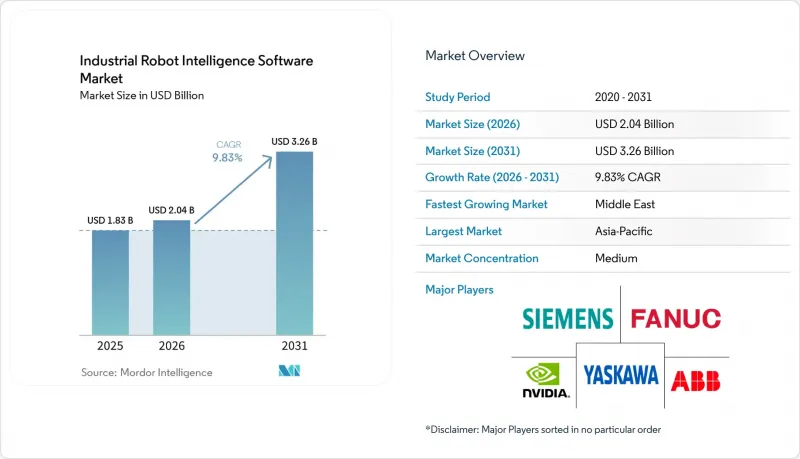
本報告按軟體功能(例如,機器人編程、離線編程)、部署模式(例如,本地部署)、應用領域(例如,物料輸送、包裝)、最終用戶行業(例如,汽車行業)、公司規模(例如,大型企業、中小企業)和地區進行細分。市場預測以美元(USD)計價。
全球工業機器人智慧軟體市場趨勢與洞察
人工智慧驅動的自適應機器人執行
實體人工智慧的基礎模型正在改變工業機器人的經濟格局。製造商無需再為每個動作單獨編程,而是可以訓練通用策略並將其應用於各個生產單元。這種方法降低了軟體開發工作量,即使是以前需要大量客製化的應用也是如此。 2026年5月,FANUC)進一步深化了ROBOGUIDE與NVIDIA Isaac Sim的整合,使模擬機器人和真實機器人能夠使用相同的控制演算法,並解決了兩種環境之間的軌跡差異。 ABB計劃在2026年下半年發布“RobotStudio HyperReality”,聲稱透過利用NVIDIA Omniverse,實現了虛擬機器人與真實機器人行為之間99%的相關性。 2026年發表在《自然通訊》(Nature Communications)上的一項研究表明,結合高精度感知和基於語言的推理可以提高複雜且容錯性高的製造任務的性能。這些進步,加上硬體成本的下降和軟體功能的擴展,正在推動工業機器人智慧軟體市場的持續投資。
工廠人手不足和工廠回流的經濟影響
勞動力短缺正推動企業做出自動化決策,以減少對短期資本週期的依賴。製造業雇主需要能夠在減少對稀缺熟練勞動力依賴的同時完成任務的系統。根據國際機器人聯合會(IFR)預測,到2025年,美國部署的機器人數量將增加11%,達到38,000台,這將是歷史第三高的數字。舊金山聯邦儲備銀行的一項調查發現,面臨貿易政策不確定性的企業正在擴大工業機器人的使用,這表明政策風險與自動化活動之間存在關聯。這不僅催生了對現有機器人軟體升級的需求,也催生了對新機器人部署專案的需求。隨著製造商必須在控制勞動力和轉移成本的同時維持生產水平,人工智慧控制變得越來越重要。因此,當回流生產計劃需要靈活且可重複的生產方法時,工業機器人智慧軟體市場將從中受益。
高昂的整合和檢驗成本
在現有工廠中實施智慧軟體需要與可程式邏輯控制器 (PLC)、安全控制設備、視覺系統和製造執行系統 (MES) 整合。在涉及多個供應商的複雜生產單元中,這項工作的成本可能超過軟體授權費用。 ABB 估計 RobotStudio HyperReality 可以將試運行時間縮短高達 80%,這說明了現有試運行工作的規模,但實施新的軟體堆疊仍需要初步投資。南丹麥大學的研究人員發現,在歐洲的小批量生產環境中,機器人應用的最大障礙在於重新配置和程式設計。在涉及多個品牌、安全連鎖裝置和舊有系統的專案中,檢驗工作可能會延長專案週期。雖然使用預認證模組和通用整合層可以減輕負擔,但這並不能消除現場特定測試的必要性。這就是為什麼在預算有限或整合商支援不足的企業中,工業機器人智慧軟體市場成長緩慢的原因。
細分市場分析
截至2025年,「機器人編程」和「離線編程」佔工業機器人智慧軟體市場佔有率的24.78%,成為最大的軟體功能類別。這一地位反映了多年來對OEM程式環境的投入,以及使用示教器進行工作流程實施的豐富經驗。 ABB RobotStudio、FANUC ROBOGUIDE和KUKA iiQWorks繼續為生產單元中的關鍵規劃、編程和檢驗任務提供支援。感知和視覺引導預計將以12.16%的複合年成長率成長至2031年,成為軟體功能中成長率最高的領域。原生AI視覺工具無需專用夾具即可依據CAD參考系定位零件。此功能可減少小批量生產應用中的設定工作量,並支援更廣泛的生產條件。根據2025年的一項研究,使用真實工業檢測影像的合成資料訓練的檢測模型的平均準確率達到98.40%。此結果表明,CAD 模型和基於物理的影像生成可以減輕工業感知中資料收集的負擔。
FANUC和數位孿生軟體將程式設計和感知功能連接起來,使工程師能夠在虛擬環境中檢驗視覺引導任務。 FANUC 和 NVIDIA 於 2026 年 5 月加強了合作,以解決模擬機器人運動與實際機器人運動之間的差異。在多個機器人必須在共用工作空間內協調運動並避免碰撞的應用中,運動規劃和控制的價值也日益凸顯。 Realtime Robotics 的運動規劃軟體運行在控制器韌體之上,滿足了這項需求。隨著製造商將機器人遙測數據作為生產輸入,預測性維護和診斷以及數據管理和分析也在不斷發展。 KUKA 的 iiQWorks.Copilot 將人工智慧輔助與模擬工作流程結合,使程式設計、模擬和人工智慧輔助能夠在單一工作流程中更緊密地協同工作。因此,工業機器人智慧軟體市場正從獨立的功能工具轉向更整合的工程平台。
到2025年,本地部署將佔市場佔有率的60.59%。這一主導地位反映了運動敏感型生產作業對本地控制的需求。封閉回路型伺服控制的週期時間小於4毫秒,因此無法依賴雲端的往返延遲。汽車、航太和國防等產業的供應鏈對生產軟體的資料管理也有嚴格的要求。這些因素使得執行層功能持續靠近機器人控制器。本地環境持續支援安全關鍵型操作所需的高可靠性。它們還允許製造商管理本地檢驗和工廠特定設定。這種結構性作用限制了雲端服務取代本地部署控制軟體的速度。
預計到2031年,基於雲端的採用率將以13.02%的複合年成長率成長。此模式支援大規模人工智慧訓練、合成資料生成和跨站點協作。 NVIDIA OSMO支援在分散式運算環境中編配Isaac Sim工作流程。 ABB的RobotStudio HyperReality允許將參數化的機器人工作站匯出到NVIDIA Omniverse,以便在硬體試運行之前進行基於雲端的模型訓練。機器人即服務(RaaS)合約整合了硬體、軟體、連接和維護,並作為經常性支出累計。 Workr透過將ABB機器人與雲端訓練的實體人工智慧結合,為中小型製造商提供服務。其混合架構將本地執行與基於雲端的更新和叢集分析相結合。這種方法使多站點製造商能夠在不影響單元級即時效能的情況下集中管理智慧。
區域分析
2025年,亞太地區將佔據全球48.62%的市佔率。 2024年,中國部署了29.5萬台工業機器人,佔全球年度部署量的54%,運作中中的機器人數量將達到202.72萬台,這將持續推動對程式設計、人工智慧升級和互聯營運的需求。 2026年7月,三星宣布將在龜尾投資19兆韓元(約137.7億美元)用於人形機器人的大規模生產和以人工智慧為中心的製造。同時,現代WiA宣布將在機器人領域投資4,000億韓元(約2.899億美元),其中包括對人工智慧和軟體新創企業的投資。 2026年5月,Config公司獲得2,700萬美元種子輪資金籌措,用於建立一個基於雲端的機器人即服務(RaaS)平台,用於機器人基礎模型的資料收集。日本和韓國擁有大規模的機器人部署基礎設施,需要定期進行軟體升級,而印度和澳洲預計將有更快成長的新軟體堆疊業務機會。
北美和歐洲合計佔據工業機器人智慧軟體市場第二大佔有率。預計2025年,美國將部署38,000台機器人,年增11%。食品產業的自動化、製造業回流計畫以及人工智慧基礎設施的建設是推動市場需求的主要因素。 NVIDIA的Isaac生態系統透過模擬、合成資料產生和邊緣部署為開發人員和製造商提供支援。到2024年,西歐的機器人密度將達到每10,000名製造業工人擁有267台機器人,其中德國、瑞士、荷蘭和義大利在該地區的應用方面處於領先地位。歐洲客戶尤其重視虛擬性能驗證、安全標準和網路安全要求,而南美市場仍處於新興階段,主要集中在汽車組裝和程式設計工具領域。
預計到2031年,中東地區工業機器人智慧軟體市場將以13.06%的複合年成長率成長,成為該地區成長最快的市場。 「沙烏地阿拉伯2030願景」和阿拉伯聯合大公國的「3000億行動」將機器人部署與更廣泛的多元化發展計畫連結起來。阿布達比國家石油公司(ADNOC)計劃於2026年在塔維拉部署一台大型自主操作機器人,目標是在年底前全面運作。 2025年10月,聯合索維爾國際集團簽署了一項價值1.325億美元的資金籌措框架協議,用於在阿拉伯聯合大公國建造一個人工智慧驅動的機器人製造和研發基地。同時,2026年5月,Micropolis AI Robotics與EMSTEEL簽署了一份價值120萬美元的契約,用於部署四台自主物流機器人。這些進展表明,商業部署正與政府主導的試點計畫同步推進。另一方面,非洲仍然是最小的區域市場,南非和奈及利亞的初期需求集中在採礦、物流和食品加工領域。
其他好處:
- Excel格式的市場預測(ME)表
- 3個月的分析師支持
目錄
第1章:引言
- 研究假設和市場定義
- 調查範圍
第2章:調查方法
第3章執行摘要
第4章 市場狀況
- 市場概覽
- 市場促進因素
- 人工智慧驅動的自適應機器人執行
- 工廠勞動力短缺和製造業回流的經濟影響
- 數位孿生和虛擬性能驗證的要求
- 適用於多品種、小批量生產的低代碼編程
- 利用 CAD 訓練的感知能力實現燈具照明自動化。
- 從合成資料和模擬到真實環境的訓練流程
- 市場限制因素
- 高昂的整合成本和檢驗成本
- 與網路安全和功能安全相關的風險
- 將模擬傳輸的風險
- 具備安全認證的機器人軟體工程師短缺
- 產業價值鏈分析
- 監理情勢
- 技術展望
- 波特五力分析
第5章 市場規模與成長預測
- 按功能分類的軟體
- 機器人編程和離線編程
- 感知和視覺引導
- 仿真和數位孿生
- 運動規劃與控制
- 其他軟體功能(預測性維護和診斷、資料管理和分析)
- 按部署模式
- 現場
- 基於雲端的
- 混合
- 透過使用
- 物料運輸包裝
- 組裝和連接
- 焊接和表面處理
- 品質檢驗和測量
- 機器物料輸送和加工
- 其他用途(揀貨、組裝和訂單處理、物流和移動操作、在危險環境中工作)
- 按最終用戶行業分類
- 汽車與出行
- 電子和半導體
- 一般製造業
- 食品/飲料
- 藥品和醫療設備
- 其他終端用戶產業(金屬和機械、物流和倉儲、航太和國防)
- 按公司規模
- 大公司
- 小型企業
- 按地區
- 北美洲
- 美國
- 加拿大
- 墨西哥
- 南美洲
- 巴西
- 阿根廷
- 其他南美國家
- 歐洲
- 德國
- 義大利
- 法國
- 英國
- 俄羅斯
- 其他歐洲國家
- 亞太地區
- 中國
- 日本
- 韓國
- 印度
- 澳洲
- 其他亞太國家
- 中東
- 沙烏地阿拉伯
- 阿拉伯聯合大公國
- 土耳其
- 其他中東國家
- 非洲
- 南非
- 奈及利亞
- 其他非洲國家
- 北美洲
第6章 競爭情勢
- 市場集中度
- 策略趨勢
- 市佔率分析
- 公司簡介
- ABB Ltd.
- FANUC Corporation
- Siemens AG
- NVIDIA Corporation
- Yaskawa Electric Corporation
- KUKA Aktiengesellschaft
- Rockwell Automation, Inc.
- Mitsubishi Electric Corporation
- Omron Corporation
- Universal Robots A/S
- Robert Bosch GmbH
- Dassault Systemes SE
- PTC Inc.
- Microsoft Corporation
- Amazon Web Services, Inc.
- Inbolt SAS
- Augmentus Pte. Ltd.
- Palladyne AI Corp.
- Fizyr BV
- Brain Corporation
- Realtime Robotics, Inc.
- Visual Components Oy
第7章 市場機會與未來展望
According to Mordor Intelligence, the industrial robot intelligence software market size is projected to expand from USD 1.83 billion in 2025 and USD 2.04 billion in 2026 to USD 3.26 billion by 2031, registering a CAGR of 9.83% between 2026 to 2031.
This report is Segmented by Software Function (Robot Programming and Offline Programming, and More), Deployment Model (On-Premise, and More), Application (Material Handling and Packaging, and More), End-User Industry (Automotive, and More), Enterprise Size (Large Enterprises, and Small and Medium-Sized Enterprises) and Geography. The Market Forecasts are Provided in Terms of Value (USD).
Global Industrial Robot Intelligence Software Market Trends and Insights
AI-Enabled Adaptive Robot Execution
Foundation models for physical AI are changing the economics of industrial robotics. Manufacturers can train broad policies and adapt them to individual cells, rather than programming every action separately. This approach can lower the software effort for applications that previously required extensive custom work. FANUC deepened its ROBOGUIDE integration with NVIDIA Isaac Sim in May 2026 so simulation and physical robots use the same control algorithms, addressing trajectory differences between the two settings. ABB planned RobotStudio HyperReality for release in the second half of 2026, using NVIDIA Omniverse to support a claimed 99% correlation between virtual and physical robot behavior. A 2026 Nature Communications study found that combining precision perception with language-model reasoning improved results on complex, fault-tolerant manufacturing tasks. These developments support continued spending on the industrial robot intelligence software market as hardware costs decline and software capabilities expand.
Factory Labor Scarcity and Reshoring Economics
Labor shortages are making automation decisions less dependent on short-term capital cycles. Manufacturing employers need systems that can perform tasks with less reliance on scarce specialist labor. The International Federation of Robotics reported that U.S. robot installations rose 11% to 38,000 units in 2025, the third strongest result on record. The Federal Reserve Bank of San Francisco found that firms facing trade-policy uncertainty increased their use of industrial robots, linking policy risk with automation activity. This creates demand for software upgrades in existing fleets as well as new robot projects. AI-guided execution becomes more relevant where manufacturers must sustain output while controlling labor and relocation costs. The industrial robot intelligence software market, therefore, benefits when reshoring programs require flexible, repeatable production methods.
High Integration and Validation Cost
Deploying intelligence software in established factories requires coordination with programmable logic controllers, safety controls, vision systems, and manufacturing execution systems. This work can cost more than the software license in complex, multi-supplier cells. ABB's estimate of up to 80% lower commissioning time for RobotStudio HyperReality indicates the scale of existing commissioning effort, though a new software stack still requires upfront investment. Researchers at the University of Southern Denmark found that reconfiguration and programming were the leading barriers to robot adoption in small-batch European manufacturing settings. Validation can lengthen projects where multiple brands, safety interlocks, and legacy systems are involved. Pre-certified modules and common integration layers can reduce the burden, but they do not eliminate the need for site-specific testing. This slows adoption in the industrial robot intelligence software market among organizations with smaller budgets or limited integrator support.
Other drivers and restraints analyzed in the detailed report include:
- Digital Twins and Virtual Commissioning Requirements
- Low-Code Programming for High-Mix Production
- Cybersecurity and Functional-Safety Exposure
For complete list of drivers and restraints, kindly check the Table Of Contents.
Segment Analysis
Robot Programming and Offline Programming accounted for 24.78% of the industrial robot intelligence software market in 2025, making it the largest software-function category. Its position reflects long-running investment in OEM programming environments and the large installed base of teach-pendant workflows. ABB RobotStudio, FANUC ROBOGUIDE, and KUKA iiQWorks support planning, programming, and validation tasks that remain essential in production cells. Perception and Vision Guidance is projected to expand at a 12.16% CAGR through 2031, the fastest rate among software functions. AI-native vision tools can locate parts from CAD reference frames without dedicated fixtures. That capability reduces setup work for lower-volume applications and supports a wider set of production conditions. A 2025 study reported a mean average precision of 98.40% for a detection model trained on synthetic data on real industrial inspection images. The result shows how CAD models and physics-based image generation can reduce the data-collection effort for industrial perception.
Simulation and Digital Twin software link programming and perception, allowing engineers to validate vision-guided tasks in a virtual environment. FANUC and NVIDIA strengthened their integration in May 2026 to address differences between simulated and physical robot behavior. Motion Planning and control are also gaining value in applications where multiple robots must coordinate their movements and avoid collisions in shared workspaces. Realtime Robotics addresses this requirement with motion-planning software that operates above controller firmware. Predictive Maintenance and Diagnostics, along with Data Management and Analytics, expand as manufacturers use robot telemetry as a production input. KUKA's iiQWorks.Copilot combines AI assistance with simulation workflows. This brings programming, simulation, and AI support closer together in a single workflow. The industrial robot intelligence software market is consequently shifting from separate functional tools toward more integrated engineering platforms.
On-Premises deployment accounted for 60.59% of the market in 2025. This lead reflects the need for local control in motion-sensitive production operations. Closed-loop servo control operates at cycle times below 4 milliseconds and cannot depend on cloud round-trip latency. Automotive, aerospace, and defense supply chains also apply strict data-control requirements to production software. These factors keep execution-layer functions close to the robot controller. On-premises environments continue to support the high reliability needed for safety-critical operations. They also allow manufacturers to manage local validation and plant-specific configurations. This structural role limits the speed at which cloud services can replace locally deployed control software.
Cloud-Based deployment is projected to expand at a 13.02% CAGR through 2031. The model supports large-scale AI training, synthetic-data generation, and collaboration across locations. NVIDIA OSMO supports orchestration of Isaac Sim workflows across distributed compute environments. ABB's RobotStudio HyperReality can export parameterized robot stations to NVIDIA Omniverse for cloud-based model training before hardware commissioning. Robotics-as-a-Service contracts combine hardware, software, connectivity, and maintenance into recurring operating expenses. Workr has used cloud-trained physical AI with ABB robots to serve smaller manufacturers. Hybrid architectures combine local execution with cloud-based updates and fleet analytics. This approach gives multi-site manufacturers centralized intelligence management without compromising real-time performance at the cell level.
Complete Report Scope:
- By Software Function
- Robot Programming and Offline Programming
- Perception and Vision Guidance
- Simulation and Digital Twin
- Motion Planning and Control
- Other Software Functions (Predictive Maintenance and Diagnostics, Data Management and Analytics)
- By Deployment Model
- On-Premises
- Cloud-Based
- Hybrid
- By Application
- Material Handling and Packaging
- Assembly and Joining
- Welding and Surface Treatment
- Quality Inspection and Metrology
- Machine Tending and Processing
- Other Applications (Picking, Kitting, and Order Fulfillment, Intralogistics and Mobile Manipulation, Hazardous-Environment Operations)
- By End-User Industry
- Automotive and Mobility
- Electronics and Semiconductors
- General Manufacturing
- Food and Beverage
- Pharmaceuticals and Medical Devices
- Other End-User Industries (Metals and Machinery, Logistics and Warehousing, Aerospace and Defense)
- By Enterprise Size
- Large Enterprises
- Small and Medium-Sized Enterprises
- By Geography
- North America
- United States
- Canada
- Mexico
- South America
- Brazil
- Argentina
- Rest of South America
- Europe
- Germany
- Italy
- France
- United Kingdom
- Russia
- Rest of Europe
- Asia-Pacific
- China
- Japan
- South Korea
- India
- Australia
- Rest of Asia-Pacific
- Middle East
- Saudi Arabia
- United Arab Emirates
- Turkey
- Rest of Middle East
- Africa
- South Africa
- Nigeria
- Rest of Africa
- North America
Geography Analysis
Asia-Pacific held 48.62% of the market in 2025. China installed 295,000 industrial robots in 2024, accounting for 54% of global annual installations, and had an operational stock of 2,027,200 units, creating ongoing demand for programming, AI upgrades, and connected operations. Samsung announced KRW 19 trillion (USD 13.77 billion) for humanoid robot mass production and AI-centered manufacturing in Gumi in July 2026, while Hyundai Wia announced KRW 400 billion (USD 289.9 million) for robotics investments, including stakes in AI and software startups. Config raised a USD 27 million seed round in May 2026 for robot-foundation-model data collection and a cloud-based robot-as-a-service platform. Japan and South Korea have large installed bases of robots that require periodic software upgrades, while India and Australia offer faster-growing opportunities for newer software stacks.
North America and Europe together provide the next largest combined contribution to the industrial robot intelligence software market. The United States installed 38,000 robots in 2025, an 11% increase from the prior year, with food-sector automation, reshoring programs, and AI infrastructure contributing to demand. NVIDIA's Isaac ecosystem supports simulation, synthetic-data generation, and edge deployment for developers and manufacturers. Western Europe recorded a robot density of 267 units per 10,000 manufacturing employees in 2024, with Germany, Switzerland, the Netherlands, and Italy leading regional adoption. European customers place particular weight on virtual commissioning, safety standards, and cybersecurity requirements, while South America remains an emerging area centered on automotive assembly and programming tools.
The Middle East is projected to expand at 13.06% CAGR through 2031, the fastest geographic rate in the industrial robot intelligence software market. Saudi Vision 2030 and the United Arab Emirates Operation 300bn connect robotics deployment with wider diversification plans. ADNOC deployed a heavy-duty autonomous operator robot at Taweelah in 2026, with full operation targeted by year-end. Lianhe Sowell International Group signed a USD 132.5 million financing framework in October 2025 for an AI-powered robot manufacturing and research base in the United Arab Emirates, while Micropolis AI Robotics signed a USD 1.2 million deployment agreement with EMSTEEL in May 2026 for 4 autonomous logistics robots. These activities show commercial deployments emerging alongside state-backed pilots, while Africa remains the smallest geographic segment, with early demand in South Africa and Nigeria focused on extractives, logistics, and food processing.
- ABB Ltd.
- FANUC Corporation
- Siemens AG
- NVIDIA Corporation
- Yaskawa Electric Corporation
- KUKA Aktiengesellschaft
- Rockwell Automation, Inc.
- Mitsubishi Electric Corporation
- Omron Corporation
- Universal Robots A/S
- Robert Bosch GmbH
- Dassault Systemes SE
- PTC Inc.
- Microsoft Corporation
- Amazon Web Services, Inc.
- Inbolt SAS
- Augmentus Pte. Ltd.
- Palladyne AI Corp.
- Fizyr B.V.
- Brain Corporation
- Realtime Robotics, Inc.
- Visual Components Oy
Additional Benefits:
- The market estimate (ME) sheet in Excel format
- 3 months of analyst support
TABLE OF CONTENTS
1 INTRODUCTION
- 1.1 Study Assumptions and Market Definition
- 1.2 Scope of the Study
2 RESEARCH METHODOLOGY
3 EXECUTIVE SUMMARY
4 MARKET LANDSCAPE
- 4.1 Market Overview
- 4.2 Market Drivers
- 4.2.1 AI-Enabled Adaptive Robot Execution
- 4.2.2 Factory Labor Scarcity and Reshoring Economics
- 4.2.3 Digital Twins and Virtual Commissioning Requirements
- 4.2.4 Low-Code Programming for High-Mix Production
- 4.2.5 CAD-Trained Perception for Fixture-Light Automation
- 4.2.6 Synthetic Data and Sim-to-Real Training Pipelines
- 4.3 Market Restraints
- 4.3.1 High Integration and Validation Cost
- 4.3.2 Cybersecurity and Functional-Safety Exposure
- 4.3.3 Sim-to-Real Transfer Risk in Variable Cells
- 4.3.4 Scarcity of Safety-Certified Robotics Software Talent
- 4.4 Industry Value-Chain Analysis
- 4.5 Regulatory Landscape
- 4.6 Technological Outlook
- 4.7 Porter's Five Forces Analysis
- 4.7.1 Threat of New Entrants
- 4.7.2 Bargaining Power of Suppliers
- 4.7.3 Bargaining Power of Buyers
- 4.7.4 Threat of Substitutes
- 4.7.5 Competitive Rivalry
5 MARKET SIZE AND GROWTH FORECASTS (VALUE)
- 5.1 By Software Function
- 5.1.1 Robot Programming and Offline Programming
- 5.1.2 Perception and Vision Guidance
- 5.1.3 Simulation and Digital Twin
- 5.1.4 Motion Planning and Control
- 5.1.5 Other Software Functions (Predictive Maintenance and Diagnostics, Data Management and Analytics)
- 5.2 By Deployment Model
- 5.2.1 On-Premises
- 5.2.2 Cloud-Based
- 5.2.3 Hybrid
- 5.3 By Application
- 5.3.1 Material Handling and Packaging
- 5.3.2 Assembly and Joining
- 5.3.3 Welding and Surface Treatment
- 5.3.4 Quality Inspection and Metrology
- 5.3.5 Machine Tending and Processing
- 5.3.6 Other Applications (Picking, Kitting, and Order Fulfillment, Intralogistics and Mobile Manipulation, Hazardous-Environment Operations)
- 5.4 By End-User Industry
- 5.4.1 Automotive and Mobility
- 5.4.2 Electronics and Semiconductors
- 5.4.3 General Manufacturing
- 5.4.4 Food and Beverage
- 5.4.5 Pharmaceuticals and Medical Devices
- 5.4.6 Other End-User Industries (Metals and Machinery, Logistics and Warehousing, Aerospace and Defense)
- 5.5 By Enterprise Size
- 5.5.1 Large Enterprises
- 5.5.2 Small and Medium-Sized Enterprises
- 5.6 By Geography
- 5.6.1 North America
- 5.6.1.1 United States
- 5.6.1.2 Canada
- 5.6.1.3 Mexico
- 5.6.2 South America
- 5.6.2.1 Brazil
- 5.6.2.2 Argentina
- 5.6.2.3 Rest of South America
- 5.6.3 Europe
- 5.6.3.1 Germany
- 5.6.3.2 Italy
- 5.6.3.3 France
- 5.6.3.4 United Kingdom
- 5.6.3.5 Russia
- 5.6.3.6 Rest of Europe
- 5.6.4 Asia-Pacific
- 5.6.4.1 China
- 5.6.4.2 Japan
- 5.6.4.3 South Korea
- 5.6.4.4 India
- 5.6.4.5 Australia
- 5.6.4.6 Rest of Asia-Pacific
- 5.6.5 Middle East
- 5.6.5.1 Saudi Arabia
- 5.6.5.2 United Arab Emirates
- 5.6.5.3 Turkey
- 5.6.5.4 Rest of Middle East
- 5.6.6 Africa
- 5.6.6.1 South Africa
- 5.6.6.2 Nigeria
- 5.6.6.3 Rest of Africa
- 5.6.1 North America
6 COMPETITIVE LANDSCAPE
- 6.1 Market Concentration
- 6.2 Strategic Moves
- 6.3 Market Share Analysis
- 6.4 Company Profiles (includes Global Level Overview, Market Level Overview, Core Segments, Financials as available, Strategic Information, Market Rank/Share, Products and Services, Recent Developments)
- 6.4.1 ABB Ltd.
- 6.4.2 FANUC Corporation
- 6.4.3 Siemens AG
- 6.4.4 NVIDIA Corporation
- 6.4.5 Yaskawa Electric Corporation
- 6.4.6 KUKA Aktiengesellschaft
- 6.4.7 Rockwell Automation, Inc.
- 6.4.8 Mitsubishi Electric Corporation
- 6.4.9 Omron Corporation
- 6.4.10 Universal Robots A/S
- 6.4.11 Robert Bosch GmbH
- 6.4.12 Dassault Systemes SE
- 6.4.13 PTC Inc.
- 6.4.14 Microsoft Corporation
- 6.4.15 Amazon Web Services, Inc.
- 6.4.16 Inbolt SAS
- 6.4.17 Augmentus Pte. Ltd.
- 6.4.18 Palladyne AI Corp.
- 6.4.19 Fizyr B.V.
- 6.4.20 Brain Corporation
- 6.4.21 Realtime Robotics, Inc.
- 6.4.22 Visual Components Oy
7 MARKET OPPORTUNITIES AND FUTURE OUTLOOK
- 7.1 White-Space and Unmet-Need Assessment

 2026年全球神經多樣性員工生產力工具市場報告
 人工智慧睡眠技術:市場佔有率分析、產業趨勢與統計及成長預測(2026-2031)
 人工智慧生產力工具市場規模、佔有率和成長分析:按組件、部署模式/架構、組織規模、威脅狩獵調查方法和目標產業分類-2026-2033年產業預測法律產業的AI軟體:市佔率分析、產業趨勢與統計及成長預測(2026-2031年)人力資源知識庫和自助服務平台:市場佔有率分析、行業趨勢和統計數據以及成長預測(2026-2031 年)
 AI生產力工具市場規模、佔有率和趨勢分析報告:按交付方式、部署方式、最終用途、地區和細分市場預測(2026-2033年)2026年全球命名實體連結人工智慧市場報告
 衡量人工智慧的實際使用情況
 2026-2030年全球人工智慧運行時最佳化市場
 人工智慧驅動設計工具市場分析與預測(至2035年):類型、服務、技術、組件、應用、部署模式、最終用戶及功能