


 |
市場調查報告書
商品編碼
2072622
工業和製造業資訊通訊技術:市場佔有率分析、行業趨勢和統計數據、成長預測(2026-2031 年)Industrial and Manufacturing TIC - Market Share Analysis, Industry Trends & Statistics, Growth Forecasts (2026 - 2031) |
||||||

※ 本網頁內容可能與最新版本有所差異。詳細情況請與我們聯繫。
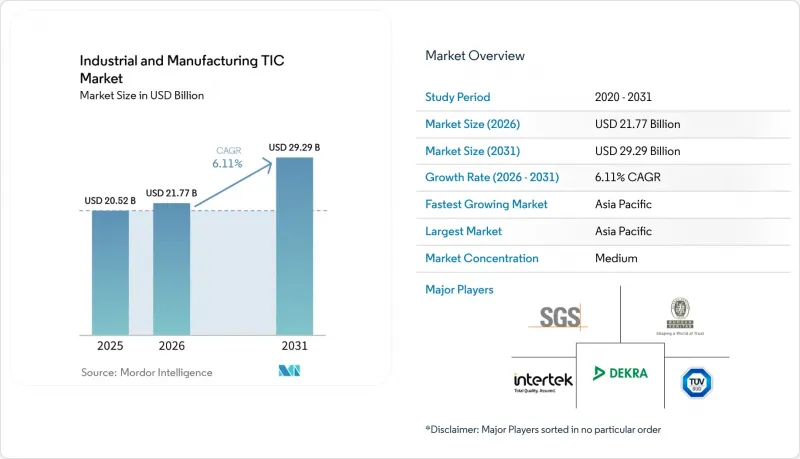
據 Mordor Intelligence 稱,工業和製造業 TIC 市場預計將從 2025 年的 205.2 億美元成長到 2026 年的 217.7 億美元,到 2031 年達到 292.9 億美元,預計 2026 年至 2031 年的複合年成長率為 6.11%。
本報告按服務類型(測試、檢驗、認證)、採購方式(內部、外包)、服務交付方式(現場、異地/實驗室、遠端/數位化)以及地區(北美、歐洲、亞太、中東和非洲、南美)進行細分。市場預測以美元計價。
全球工業與製造業TIC市場趨勢與洞察
加強全球產品安全和製程法令遵循
強制性合格評定已成為整個工業供應鏈的標準,這一轉變仍然是工業和製造業技術資訊認證(TIC)市場最大的結構性需求促進因素。歐盟的《永續產品生態設計條例》提高了對生命週期檢驗的期望。同時,世貿組織的《技術性貿易壁壘協定》(TBT)框架持續支持互認協議,從而提升了多司法管轄區認證對出口商的價值。這種轉變在汽車和工業控制領域尤其明顯,ISO 26262 和 IEC 61508 等標準擴大應用於依賴先進電控系統的軟體密集系統和安全功能,從而增加了對獨立評估的需求。德國和日本的一級供應商過去主要依賴內部檢驗,現在當審核員要求對安全完整性等級(SIL)組件及其相關文件和包裝進行獨立驗證時,他們會選擇使用經認證的第三方機構。隨著這些義務從原始設備製造商 (OEM) 向下游轉移至零件供應商,工業和製造業技術合格評定 (TIC) 市場正在獲得更廣泛的基本客群和大規模的業務量。正因如此,經認證的測試和檢驗服務正在比其最初的合規性購買者更深入地滲透到供應鏈的各個環節。
工業4.0和互聯機器的檢驗需求
工業物聯網 (IIoT) 感測器、自主機器人和邊緣運算控制器的激增,使得傳統的實驗室協定無法應對檢驗任務。如今,連網機器需要進行電磁相容性測試、機械安全檢查、網路安全評估、協定互通性審查以及在實際運作條件下的可靠性檢驗,這既增加了測試時間,也提高了實驗室的要求。 2026 年 3 月,OPC 基金會宣布將於 2026 年底停止對 OPC UA 1.03 版本的支援。因此,製造商需要基於 1.05 版本進行檢驗,以維持認證的互通性。此類協議的轉換將催生對重新認證的需求,並支持工業和製造業資訊通訊技術 (TIC) 市場更持續的服務模式。 2026 年 5 月,MISTRAS 集團重申了 2026 年全年營收預測,預計為 7.3 億至 7.5 億美元。同時,該公司航太與國防部門2026年第一季營收年增35.5%,顯示市場對數位整合設備的複雜檢驗工作需求日益成長。隨著數位資產管理人員越來越需要持續的狀態可見性,而非一次性的檢測活動,能夠將分析和實體檢測相結合的服務供應商更有優勢贏得這些預算。
中小製造商遵守多項標準的高昂成本。
由於國內和國際合規體系存在重疊,中小型製造商面臨的負擔比大型企業更重,這限制了它們全面進入工業和製造業的TIC市場。即使是單一產品銷往北美、歐洲和亞太地區,也可能需要單獨的認證途徑、文件和續約流程,從而導致成本增加和延誤。 ISO/IEC 17050下的自我聲明途徑只能提供部分緩解,因為許多受監管類別仍需要指定的第三方機構。簡言之,成本最高的類別往往對小規模出口商而言柔軟性最低。雖然能夠將多個市場項目打包到單一合約中的TIC服務提供者可以緩解這些摩擦,但潛在的需求限制仍然阻礙了它們在工業和製造業整體TIC市場的廣泛應用。
細分市場分析
到2025年,檢驗業務仍將佔據工業和製造業TIC市場60.81%的佔有率,並繼續成為所有服務類型中重要的收入支柱。檢驗業務範圍廣泛,涵蓋結構材料的破壞性機械測試、焊接的無損檢測、控制系統的電磁相容性(EMC)檢查以及聯網設備的韌體檢驗。如此廣泛的範圍使得工業和製造業TIC市場與檢驗業務緊密相連,因為在產品開發和生產的幾乎每個階段,都需要提供性能、安全性和可靠性標準符合性的證據。檢驗業務仍然是第二大服務類型,因為工業運營商仍然需要對營運資產進行健全性評估、工廠審核以及在運作中工廠檢查。雖然認證業務的收入相對小規模,但隨著服務組合從一次性檢驗轉向持續保證計劃,預計到2031年,其複合年成長率將達到6.25%。 SGS 成為全球首家獲得 ISO/IEC 42001 人工智慧管理系統認證的機構,這表明人工智慧保障正在從一次性諮詢服務發展成為持續的、可認證的服務線。
隨著永續發展報告、數位化產品護照框架、能源管理系統和人工智慧管治要求的出現,認證途徑正在不斷拓展,這些要求為製造業營運帶來了新的審核範圍。必維集團(Bureau Veritas)報告稱,其工業產品認證服務在2025會計年度全年和2026會計年度第一季均實現了接近兩位數的有機收入成長,其中鐵路系統評估和壓力容器認證是主要貢獻者。這一趨勢印證了工業和製造業技術資訊認證(TIC)市場不再僅僅由傳統的安全認證驅動的觀點,因為新的保證類別正在創造持續的新需求。因此,儘管檢驗仍佔據工業和製造業TIC市場的最大佔有率,但隨著自我聲明管道的收窄和正式第三方證據價值的提升,認證的佔有率正在穩步成長。正是這種平衡解釋了為什麼領先的認證機構會持續投資於實驗室基礎設施和高價值的認證組合。
區域分析
預計到2025年,亞太地區將佔據工業和製造業TIC市場佔有率的45.63%,並在2031年之前以6.94%的複合年成長率持續成長,成為規模最大且成長最快的區域市場。國內產量的成長、更嚴格的國家標準以及出口相關的合規要求是推動亞太地區工業和製造業TIC市場發展的因素。在中國,隨著CCC體系和GB標準的不斷修訂,強制認證的產品範圍持續擴大,對定期檢驗和認證的需求也隨之增加。在印度,電子、製藥和先進化工領域的BIS認證和生產連結獎勵計畫計畫正在催生新的需求。這些計劃將製造業成長與正式的合規要求連結起來。 2026年4月,Intertek收購了位於艾哈默德巴德的一家光伏(PV)檢測站的資產,並根據印度製造業和可再生能源發展目標,建立了符合ISO 17025、BIS和IECEE CB認證體系的檢測設施。
日本憑藉其在精密製造和電子產業的雄厚基礎,提供了穩定的需求,其品質要求和完善的標準框架持續支撐著正規的TIC(技術資訊認證)支出。隨著機械和能源相關設備的強制性合格評定要求不斷擴大,韓國也正在崛起,進一步鞏固其在工業和製造業TIC市場中的區域地位。歐洲仍然是監管最嚴格的地區,CE標誌、REACH法規、RoHS指令以及新引入的機械和網路安全義務,構成了一個結構性的迭代認證週期。德國憑藉其先進的工程技術基礎以及DEKRA、TUV SUD、TUV Rheinland和TUV NORD等主要TIC總部的存在,繼續保持領先地位,這些機構都為國內和跨境認證活動提供支援。由於電子、醫療設備和先進工業系統等行業的回流,北美仍然是工業和製造業TIC市場的核心收入來源地,這推動了跨州和多標準合規工作的日益成長。 2026 年 1 月,SGS 收購了 ATS,從而大大加強了其在北美的地位,提高了與在工業檢驗領域競爭的區域專家的規模標準。
中東、非洲和南美洲的工業和製造業技術資訊認證(TIC)市場雖然規模仍然較小,但成長迅速。沙烏地阿拉伯和阿拉伯聯合大公國正在擴大其強制性合格評定體系,作為其工業多元化計畫的一部分;南非和埃及則在建立國內認證能力,這將逐步減少其對外國認證機構的依賴。在南美洲,巴西繼續透過國家計量和品質管理局(INMETRO)擴大強制性認證的範圍;在阿根廷,在地採購。
其他好處
- Excel格式的市場預測(ME)表
- 3個月的分析師支持
目錄
第1章:引言
- 研究假設和市場定義
- 調查範圍
第2章:調查方法
第3章執行摘要
第4章 市場狀況
- 市場概覽
- 市場促進因素
- 加強全球產品安全和製造過程法令遵循
- 中型製造企業擴大將專業技術資訊中心(TIC)外包。
- 工業4.0和互聯機械的檢驗要求
- 與永續性和循環經濟相關的認證需求
- 歐盟機械法規中網路安全和人工智慧合規的負擔
- 工業供應鏈中對碳排放和產品護照檢驗的需求
- 市場限制因素
- 中小製造商遵守多項標準的高昂成本
- 合格檢驗員和高級實驗室人員短缺
- 不同認證系統對遠端和混合審核形式的接受程度有差異。
- 測試互聯資產的責任和資料完整性風險
- 產業價值鏈分析
- 監理情勢
- 技術展望
- 宏觀經濟因素對市場的影響
- 波特五力分析
第5章 市場規模與成長預測
- 按服務類型
- 測試
- 檢查
- 認證
- 透過採購方式
- 內部實施
- 外包
- 按服務交付方式
- 現場
- 異地/檢查室
- 遠端/數位
- 按地區
- 北美洲
- 美國
- 加拿大
- 墨西哥
- 歐洲
- 英國
- 德國
- 法國
- 義大利
- 其他歐洲國家
- 亞太地區
- 中國
- 日本
- 印度
- 韓國
- 其他亞太國家
- 中東
- 沙烏地阿拉伯
- 阿拉伯聯合大公國
- 土耳其
- 其他中東國家
- 非洲
- 南非
- 埃及
- 其他非洲國家
- 南美洲
- 巴西
- 阿根廷
- 南美洲其他地區
- 北美洲
第6章 競爭情勢
- 市場集中度
- 策略趨勢
- 市佔率分析
- 公司簡介
- SGS SA
- Bureau Veritas SA
- Intertek Group plc
- DEKRA SE
- TUV SUD AG
- Applus Services, SA
- Kiwa NV
- TUV Rheinland AG
- LRQA Group Limited
- Element Materials Technology Group Limited
- MISTRAS Group, Inc.
- RINA SpA
- TUV NORD AG
- TUV AUSTRIA HOLDING AG
- DNV Group AS
- Cotecna Inspection SA
- CSA Group Testing & Certification Inc.
- Centre Testing International Group Co., Ltd.
- UL Solutions Inc.
- Socotec Group
- GRG Metrology & Test Group Co., Ltd.
- BSI Group Holdings UK Ltd.
第7章 市場機會與未來展望
According to Mordor Intelligence, the industrial and manufacturing TIC Market size is expected to increase from USD 20.52 billion in 2025 to USD 21.77 billion in 2026 and reach USD 29.29 billion by 2031, growing at a CAGR of 6.11% over 2026-2031.
This report is Segmented by Service Type (Testing, Inspection, and Certification), Sourcing Type (In-House, and Outsourced), Mode of Service Delivery (On-Site, Off-site/Laboratory, and Remote/Digital), and Geography (North America, Europe, Asia-Pacific, Middle East, Africa, and South America). The Market Forecasts are Provided in Terms of Value (USD).
Global Industrial and Manufacturing TIC Market Trends and Insights
Tightening Global Product Safety and Process Compliance Rules
Mandatory conformity assessment has become the baseline across industrial supply chains, and that shift remains the largest structural demand driver for the industrial and manufacturing TIC market. The EU Ecodesign for Sustainable Products Regulation widened lifecycle verification expectations, while the WTO Technical Barriers to Trade framework continues to support mutual recognition arrangements that increase the value of multi-jurisdiction credentials for exporters. The change is visible in automotive and industrial controls, where standards such as ISO 26262 and IEC 61508 are now applied to software-heavy systems and safety functions that depend on advanced electronic control units, thereby expanding the need for independent assessment. Tier-one suppliers in Germany and Japan that once relied more heavily on internal verification now engage accredited third parties when auditors require independent confirmation for safety-integrity-level components and related documentation packages. As these obligations move from OEMs down to component suppliers, the industrial and manufacturing TIC market gains a wider customer base and a larger recurring workload. This is why certified inspection and validation services are reaching deeper into the supply chain than the original compliance buyer.
Industry 4.0 and Connected Machinery Validation Needs
The spread of IIoT sensors, autonomous robotics, and edge-computing controllers has created a validation workload that older laboratory protocols were not built to handle. Connected machinery now needs electromagnetic compatibility tests, mechanical safety checks, cybersecurity assessments, protocol interoperability reviews, and reliability validation under live operating conditions, which extends both testing time and laboratory requirements. The OPC Foundation stated in March 2026 that support for OPC UA version 1.03 will end by year-end 2026, requiring manufacturers to validate against version 1.05 to maintain certified interoperability. That kind of protocol transition creates repeat recertification demand and supports a more continuous service model inside the industrial and manufacturing TIC market. MISTRAS Group reaffirmed full-year 2026 revenue guidance of USD 730 million to USD 750 million in May 2026, while its aerospace and defense segment revenue rose 35.5% year over year in Q1 2026, which points to stronger demand for complex validation work in digitally integrated equipment. Providers that combine analytics with physical inspection are better positioned to win these budgets, as digital asset operators increasingly seek ongoing condition visibility rather than isolated test events.
High Multi-Standard Compliance Cost for Small and Mid-Sized Manufacturers
Overlapping national and international compliance systems create a heavier burden for small and mid-sized manufacturers than for larger firms, limiting their full participation in the industrial and manufacturing TIC market. A single product sold into North America, Europe, and Asia-Pacific may still require separate certification routes, documentation, and renewal cycles, which adds both cost and delay. The self-declaration route under ISO/IEC 17050 provides only partial relief, as many regulated categories still require a designated third party. That means the highest-cost categories often remain the least flexible ones for smaller exporters. TIC providers that can bundle multi-market programs under a single contract can reduce this friction, but the underlying demand constraint still slows broader adoption across the industrial and manufacturing TIC market.
Other drivers and restraints analyzed in the detailed report include:
- EU Machinery Regulation Cybersecurity and AI Conformity Burden
- Rising Outsourcing of Specialist TIC by Mid-Sized Manufacturers
- Shortage of Qualified Inspectors and Advanced Lab Talent
For complete list of drivers and restraints, kindly check the Table Of Contents.
Segment Analysis
Testing retained a 60.81% share of the industrial and manufacturing testing, inspection, and certification (TIC) market in 2025, which kept it as the clear revenue anchor across service types. Testing covers a broad range of work, from destructive mechanical tests on structural materials to non-destructive testing of welds, electromagnetic compatibility checks on control systems, and firmware validation on connected equipment. That breadth keeps the industrial and manufacturing TIC market closely tied to testing, as nearly every product development and production stage still requires evidence that performance, safety, and reliability standards are met. Inspection remained the second-largest service type because industrial operators continue to require in-service asset integrity reviews, plant audits, and factory checks across capital-intensive sectors. Certification was smaller by revenue, but it is projected to grow at a 6.25% CAGR through 2031 as the service mix shifts toward recurring assurance programs rather than single-event validation. SGS became the first organization globally to receive ISO/IEC 42001 AI management system certification, demonstrating that AI assurance is moving toward a recurring, certifiable service line rather than remaining a one-time advisory exercise.
The certification path is widening because sustainability reporting, digital product passport frameworks, energy management systems, and AI governance requirements now create new audit scopes across manufacturing operations. Bureau Veritas stated that its industrial products certification services delivered high single-digit organic revenue growth in both full-year 2025 and Q1 2026, with railway systems assessment and pressure vessel certification among the strongest contributors. That pattern supports the view that the industrial and manufacturing TIC market is no longer driven solely by legacy safety certification, as newer assurance categories are generating fresh, recurring demand. Testing, therefore, remains the largest part of the industrial and manufacturing TIC market, while certification is steadily gaining ground as self-declaration routes narrow and formal third-party evidence becomes more valuable. This balance explains why leading providers continue to invest in both laboratory infrastructure and higher-value certification portfolios.
Complete Report Scope:
- By Service Type
- Testing
- Inspection
- Certification
- By Sourcing Type
- In-house
- Outsourced
- By Mode of Service Delivery
- On-site
- Off-site / Laboratory
- Remote / Digital
- By Geography
- North America
- United States
- Canada
- Mexico
- Europe
- United Kingdom
- Germany
- France
- Italy
- Rest of Europe
- Asia-Pacific
- China
- Japan
- India
- South Korea
- Rest of Asia-Pacific
- Middle East
- Saudi Arabia
- United Arab Emirates
- Turkey
- Rest of Middle East
- Africa
- South Africa
- Egypt
- Rest of Africa
- South America
- Brazil
- Argentina
- Rest of South America
- North America
Geography Analysis
Asia-Pacific held 45.63% of the industrial and manufacturing TIC market share in 2025 and is expected to expand at a 6.94% CAGR through 2031, making it both the largest and fastest-growing regional block. Rising domestic production, stricter national standards, and export-linked compliance needs support the industrial and manufacturing TIC market in Asia-Pacific. China continues to expand the scope of products subject to mandatory certification through the CCC system and ongoing updates to GB standards, sustaining recurring testing and certification demand. India is adding new demand through BIS certification and through production-linked incentive programs in electronics, pharmaceuticals, and advanced chemistry cells that tie manufacturing growth to formal compliance requirements. Intertek acquired the assets of a solar PV laboratory in Ahmedabad in April 2026, creating an ISO 17025-accredited facility with BIS and IECEE CB Scheme accreditations that align with India's manufacturing and renewable build-out goals.
Japan provides a stable demand through its precision manufacturing and electronics base, where quality requirements and established standards frameworks continue to support formal TIC spending. South Korea is also gaining momentum as mandatory conformity assessment requirements expand for machinery and energy-related equipment, further strengthening the regional role of the industrial and manufacturing TIC market. Europe remains the most regulation-dense region, with CE marking, REACH, RoHS, and incoming machinery and cybersecurity obligations creating a structurally recurring certification cycle. Germany continues to stand out because it combines a deep engineering base with leading TIC headquarters such as DEKRA, TUV SUD, TUV Rheinland, and TUV NORD, all of which support both domestic and cross-border certification activity. North America remains a core revenue region for the industrial and manufacturing TIC market because reshoring in electronics, medical devices, and advanced industrial systems is adding multi-state and multi-standard compliance work. SGS strengthened its North American position materially through the ATS acquisition in January 2026, which raised the scale threshold for regional specialists competing in industrial testing and inspection breadth.
The Middle East, Africa, and South America still represent smaller but developing parts of the industrial and manufacturing TIC market. Saudi Arabia and the United Arab Emirates are expanding mandatory conformity systems as part of industrial diversification programs, while South Africa and Egypt are building national accreditation capacity that should gradually reduce reliance on foreign-accredited bodies. In South America, Brazil continues to expand the scope of compulsory certification through INMETRO, while Argentina's demand for industrial safety inspections is growing alongside formal manufacturing activity. These regions offer a longer-cycle opportunity because regulatory infrastructure and accreditation networks need time to mature, but supply chain diversification and local-content policies are steadily improving the demand base for the industrial and manufacturing TIC market.
- SGS SA
- Bureau Veritas SA
- Intertek Group plc
- DEKRA SE
- TUV SUD AG
- Applus Services, S.A.
- Kiwa N.V.
- TUV Rheinland AG
- LRQA Group Limited
- Element Materials Technology Group Limited
- MISTRAS Group, Inc.
- RINA S.p.A.
- TUV NORD AG
- TUV AUSTRIA HOLDING AG
- DNV Group AS
- Cotecna Inspection SA
- CSA Group Testing & Certification Inc.
- Centre Testing International Group Co., Ltd.
- UL Solutions Inc.
- Socotec Group
- GRG Metrology & Test Group Co., Ltd.
- BSI Group Holdings UK Ltd.
Additional Benefits:
- The market estimate (ME) sheet in Excel format
- 3 months of analyst support
TABLE OF CONTENTS
1 INTRODUCTION
- 1.1 Study Assumptions and Market Definition
- 1.2 Scope of the Study
2 RESEARCH METHODOLOGY
3 EXECUTIVE SUMMARY
4 MARKET LANDSCAPE
- 4.1 Market Overview
- 4.2 Market Drivers
- 4.2.1 Tightening Global Product Safety and Process Compliance Rules
- 4.2.2 Rising Outsourcing of Specialist TIC by Mid-Sized Manufacturers
- 4.2.3 Industry 4.0 and Connected Machinery Validation Needs
- 4.2.4 Sustainability and Circular Economy Certification Demand
- 4.2.5 EU Machinery Regulation Cybersecurity and AI Conformity Burden
- 4.2.6 Carbon and Product Passport Verification Demand in Industrial Supply Chains
- 4.3 Market Restraints
- 4.3.1 High Multi-Standard Compliance Cost for Small and Mid-Sized Manufacturers
- 4.3.2 Shortage of Qualified Inspectors and Advanced Lab Talent
- 4.3.3 Fragmented Acceptance of Remote and Hybrid Inspections Across Accreditation Regimes
- 4.3.4 Liability and Data Integrity Risk in Connected-Asset Testing
- 4.4 Industry Value-Chain Analysis
- 4.5 Regulatory Landscape
- 4.6 Technological Outlook
- 4.7 Impact of Macroeconomic Factors on the Market
- 4.8 Porter's Five Forces Analysis
- 4.8.1 Threat of New Entrants
- 4.8.2 Bargaining Power of Suppliers
- 4.8.3 Bargaining Power of Buyers
- 4.8.4 Threat of Substitutes
- 4.8.5 Competitive Rivalry
5 MARKET SIZE AND GROWTH FORECASTS (VALUE)
- 5.1 By Service Type
- 5.1.1 Testing
- 5.1.2 Inspection
- 5.1.3 Certification
- 5.2 By Sourcing Type
- 5.2.1 In-house
- 5.2.2 Outsourced
- 5.3 By Mode of Service Delivery
- 5.3.1 On-site
- 5.3.2 Off-site / Laboratory
- 5.3.3 Remote / Digital
- 5.4 By Geography
- 5.4.1 North America
- 5.4.1.1 United States
- 5.4.1.2 Canada
- 5.4.1.3 Mexico
- 5.4.2 Europe
- 5.4.2.1 United Kingdom
- 5.4.2.2 Germany
- 5.4.2.3 France
- 5.4.2.4 Italy
- 5.4.2.5 Rest of Europe
- 5.4.3 Asia-Pacific
- 5.4.3.1 China
- 5.4.3.2 Japan
- 5.4.3.3 India
- 5.4.3.4 South Korea
- 5.4.3.5 Rest of Asia-Pacific
- 5.4.4 Middle East
- 5.4.4.1 Saudi Arabia
- 5.4.4.2 United Arab Emirates
- 5.4.4.3 Turkey
- 5.4.4.4 Rest of Middle East
- 5.4.5 Africa
- 5.4.5.1 South Africa
- 5.4.5.2 Egypt
- 5.4.5.3 Rest of Africa
- 5.4.6 South America
- 5.4.6.1 Brazil
- 5.4.6.2 Argentina
- 5.4.6.3 Rest of South America
- 5.4.1 North America
6 COMPETITIVE LANDSCAPE
- 6.1 Market Concentration
- 6.2 Strategic Moves
- 6.3 Market Share Analysis
- 6.4 Company Profiles (includes Global Level Overview, Market Level Overview, Core Segments, Financials as available, Strategic Information, Market Rank/Share, Products and Services, Recent Developments)
- 6.4.1 SGS SA
- 6.4.2 Bureau Veritas SA
- 6.4.3 Intertek Group plc
- 6.4.4 DEKRA SE
- 6.4.5 TUV SUD AG
- 6.4.6 Applus Services, S.A.
- 6.4.7 Kiwa N.V.
- 6.4.8 TUV Rheinland AG
- 6.4.9 LRQA Group Limited
- 6.4.10 Element Materials Technology Group Limited
- 6.4.11 MISTRAS Group, Inc.
- 6.4.12 RINA S.p.A.
- 6.4.13 TUV NORD AG
- 6.4.14 TUV AUSTRIA HOLDING AG
- 6.4.15 DNV Group AS
- 6.4.16 Cotecna Inspection SA
- 6.4.17 CSA Group Testing & Certification Inc.
- 6.4.18 Centre Testing International Group Co., Ltd.
- 6.4.19 UL Solutions Inc.
- 6.4.20 Socotec Group
- 6.4.21 GRG Metrology & Test Group Co., Ltd.
- 6.4.22 BSI Group Holdings UK Ltd.
7 MARKET OPPORTUNITIES AND FUTURE OUTLOOK
- 7.1 White-Space and Unmet-Need Assessment

 歐洲金屬精密車削產品製造:市場佔有率分析、產業趨勢與統計、成長預測(2026-2031)印度製造業:市場佔有率分析、產業趨勢與統計及成長預測(2026-2031)
 工業和製造市場研究服務工業和製造技術研究服務
 製造業中的ESG:市場規模、佔有率、成長、全球產業分析、區域趨勢及2026-2034年預測全球製造業ESG市場規模、佔有率、趨勢和成長分析報告(2026-2034年)製造業客戶體驗成長機會:2025-2026 年
 光伏電池雷射加工設備市場規模、佔有率和成長分析:按雷射技術、機器配置、晶圓類型、應用、自動化程度、最終用戶產業和地區分類-2026-2033年產業預測
 製造業調查回顧:2025 年
 全球製造業市場:按產業、技術和地區分類