


 |
市場調查報告書
商品編碼
2119850
歐洲金屬精密車削產品製造:市場佔有率分析、產業趨勢與統計、成長預測(2026-2031)Europe Metal Precision Turned Product Manufacturing - Market Share Analysis, Industry Trends & Statistics, Growth Forecasts (2026 - 2031) |
||||||

※ 本網頁內容可能與最新版本有所差異。詳細情況請與我們聯繫。
據 Mordor Intelligence 稱,2025 年歐洲金屬精密車削產品製造市場價值為 189.7 億美元,預計到 2031 年將達到 255.2 億美元,而 2026 年為 199.4 億美元,2026 年至 2031 年的複合成長率為 5.11%。
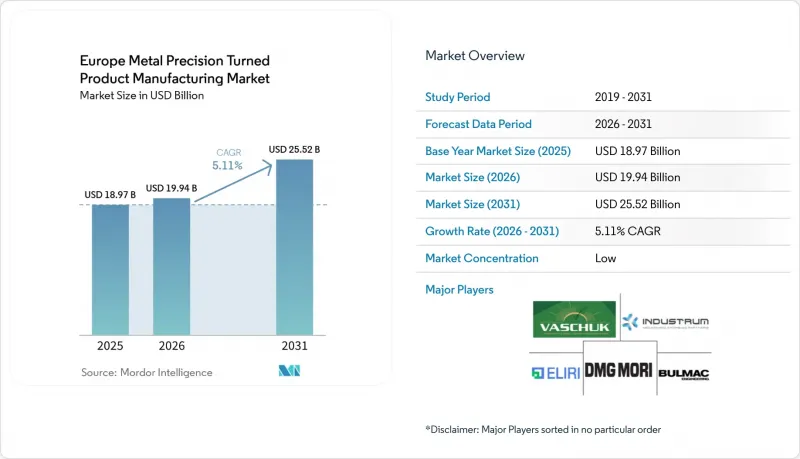
本報告依加工方法(手工加工、數控加工)、工具機類型(自動螺紋加工機、旋轉式傳送機、CNC車床及其他)、產品類型、材料、最終用戶、技術、生產規模和地區(德國、法國及其他)進行分類。市場預測以美元計價。
歐洲精密金屬車削產品市場趨勢與洞察。
汽車電氣化和對輕量化零件的需求
電池式電動車(BEV) 的生產正在改變歐洲金屬精密車削市場的零件需求。雖然傳統鐵基動力傳動系統零件在某些應用領域的產量正在下降,但馬達軸、電池模組端蓋、電力驅動橋殼體和電力電子基板等零件卻面臨新的需求。根據德國汽車工業協會 (VDA) 的報告顯示,到 2025 年,德國生產的汽車中將有 40% 是電動車。銅合金匯流排對錶面質量要求極高,而鋁製馬達殼體即使在經過熱循環後也必須保持精確的過盈配合公差。先前專注於手排變速箱零件的供應商現在需要更強大的加工和測量能力才能贏得這場競爭。這種訂單不會導致供應商之間出現統一的替代模式。那些能夠在產量增加之前將新的車輛設計轉化為穩定且可重複的加工流程的公司將獲得競爭優勢。
擴大醫用牙科植體體生產
植入製造中對一致性和可追溯性的需求推動了歐洲醫療和牙科領域精密金屬車削產品的市場發展。生產集中在瑞士汝拉山脈和德國南部等成熟的精密車削區域。根據歐盟統計局預測,到2025年,65歲及以上人口預計將佔歐洲總人口的22%以上。這一人口趨勢正在推動對整形外科修復、牙科修復體和相關植入手術的需求。 ISO 13485品質要求對小規模供應商構成准入門檻,有利於擁有成熟且經過檢驗流程的專業廠商。對於契約製造製造商而言,在植入專案的整個生命週期中保持檢驗的流程具有商業性價值。因此,可靠的檢驗、批次記錄和材料控制與切削能力同等重要。
熟練的CNC編程人員和測量人員短缺
歐洲金屬精密車削產品製造市場普遍面臨經驗豐富的數控程式設計人員和測量專家短缺的問題,限制了其產能。每家工廠都需要能夠對多軸機床進行編程、解讀尺寸測量結果並管理製程變更而不影響零件品質的員工。這項要求比操作傳統車床或處理單一生產任務所需的技能更高。精密工程叢集中老員工的存在也帶來了對接班人的需求,而學徒制專案可能無法迅速滿足這項需求。雖然自動化減少了人工勞動,但也增加了對機電一體化和製程控制技能的需求。由於高技能工作依賴於程式判斷和對測量結果的仔細解讀,這些限制因素會影響產品品質和產量。因此,服務受監管行業和航太客戶的企業面臨最嚴峻的人才短缺壓力。
細分市場分析
截至2025年,CNC加工將佔據歐洲精密金屬車削產品市場82.37%的佔有率,預計到2031年將以6.28%的複合年成長率成長。這一佔有率反映了CNC加工在汽車、醫療、航太和工業等領域訂單中的核心地位,這些領域對可重複的公差要求極高。手工加工在維修、傳統工藝和小批量客製化產品中仍然發揮著重要作用。隨著新的生產能力圍繞可程式設計設備構建,手工加工的作用預計將會逐漸減少。數位化程式設計縮短了重複訂單的設定時間,並提高了初始產品檢驗的一致性。這使得CNC生產更加實用,即使對於那些處理常規客戶專案的小規模供應商也是如此。客戶還可以受益於能夠保存、查看和重複使用程序,以便在重新下訂單時使用。僅靠手動調整很難確保這種連續性,尤其是在公差要求非常嚴格的情況下。
此外,數控系統支援生產記錄的可追溯性,這在受監管和高附加價值應用中變得日益重要。歐洲金屬精密車削產業受惠於各工廠能夠將刀具數據、檢驗結果和生產歷史記錄與特定訂單關聯起來。由於學徒通常主要接受最新數控系統的培訓,因此在設備種類繁多的工廠中,人員配備可能面臨挑戰。隨著產能的擴大,波蘭、捷克和羅馬尼亞的新工廠正在引進先進設備。
2025年,CNC車床和車削中心在歐洲金屬精密車削產品製造市場中佔48.26%的比重。水平和立式車削中心繼續承擔大部分汽車軸、殼體和通用工業零件的加工任務。瑞士型車床用於加工小型複雜零件,這類零件在切削刀具附近需要精細的支撐。預計到2031年,CNC多軸車床的年複合成長率將達到8.47%。航太領域的承包商正在利用這些設備製造需要嚴格按照控制順序完成多道加工工序的零件。自動螺紋加工機和旋轉傳送機仍然適用於大量生產的標準零件。因此,工具機的選擇越來越取決於零件的特性,而不是工廠是否擁有現有設備。這使得能夠在報價初期就將加工能力與產品複雜性相匹配的供應商更具優勢。
隨著客戶對複雜零件和減少工序交接次數的需求不斷成長,工具機配置也隨之改變。多軸加工中心可以將車削、銑削、鑽孔和精加工整合到單一控制循環中,從而減少返工並提高相關形狀的一致性。即使在生產淡季,也可以繼續投資多軸設備,為未來高要求的訂單做好準備。舍弗勒航空航太公司使用WFL MILLTURN加工中心加工由Inconel 718、M50NiL和Chronidur 30等材料製成的零件,包括那些需要極高精度車削和銑削的加工任務。雖然標準車床在許多應用中仍然必不可少,但它們無法滿足航太和醫療領域的所有技術規格要求。
到2025年,襯套和套筒將佔據歐洲金屬精密車削產品製造市場24.18%的佔有率。這一佔有率反映了油壓設備、汽車和工業機械行業的持續需求。螺絲和螺栓仍然是重要的大量生產產品,但常用鋼材的價格競爭日益激烈。軸、銷和軸向部件用於需要在長期製造過程中保持尺寸一致性的場合。螺紋嵌件用於支撐需要精確成型金屬介面的航太複合材料結構。液壓和氣壓元件、車削和銑削零件以及其他產品供應給能源、鐵路和機械行業的客戶。這些產品類別之間的差異在採購過程中反映得淋漓盡致。標準產品強調可靠的生產和成本控制,而醫療產品則強調檢驗的性能和長期的品質保證。
預計到2031年,醫療和牙科組件市場將以8.84%的複合年成長率成長。鈦組件對同心度有嚴格的要求,廣泛應用於根管植入、牙齦成形器、牙支台齒和整形外科螺絲等領域。這些規範更注重經過檢驗的製造程序,而非單價本身。歐盟醫療設備法規要求植入式醫療設備製造商履行書面檢驗和確認義務。這些要求可能導致認證週期延長,並使生產集中在擁有完善品質系統的公司。這種產品組合為專業供應商提供了獲得高價值、持續訂單的機會。這一趨勢進一步強調了在整個生產過程中進行細緻的流程規劃、書面品質檢查以及與供應商溝通的重要性。
其他好處
- Excel格式的市場預測(ME)表
- 3個月的分析師支持
目錄
第1章:引言
- 研究假設和市場定義
- 調查範圍
第2章:調查方法
第3章執行摘要
第4章 市場狀況
- 市場概覽
- 市場促進因素
- 汽車電氣化和對輕量化零件的需求
- 擴大醫用牙科植體體生產
- 擴大多軸和瑞士型CNC車床的應用
- 航太工業的生產以及對高精度零件的要求。
- 數位產品護照和原料可追溯性
- 歐洲供應鏈中關鍵零件的近岸外包
- 市場限制因素
- 熟練的CNC編程人員和測量技術人員短缺
- 高昂的能源成本、合規成本和設備更換成本。
- 鋁、鋼、黃銅和鈦等原料成本的波動
- 受監管醫療組件的檢驗週期較長
- 價值和供應鏈分析
- 監理情勢
- 技術展望
- 波特五力分析
第5章 市場規模與成長預測
- 透過加工方法
- 手動處理
- CNC加工
- 按機器類型
- 自動螺絲切割機
- 旋轉式傳送機
- CNC車床和車削中心
- 水平車削中心
- 直立式車削中心
- CNC瑞士型或滑動式主軸車床
- CNC多軸車床
- CNC多軸車床
- 其他機器類型
- 依產品類型
- 螺絲和螺栓
- 襯套和套筒
- 軸、銷、軸向部件
- 螺紋嵌件和緊固組件
- 液壓和氣壓部件
- 車銑複合零件
- 醫療和牙科部件
- 其他精密金屬車削產品
- 材料
- 鋼和不銹鋼
- 鋁及鋁合金
- 黃銅和銅合金
- 鈦及鈦合金
- 鎳基合金和高溫合金
- 工程塑膠及其他材料
- 最終用戶
- 車
- 工業機械及自動化
- 電子與電機工程
- 醫療和牙科護理
- 航太/國防
- 液壓和氣壓
- 能源和發電設備
- 鐵路、航運及運輸設備
- 家用電器/消費品
- 其他
- 透過技術
- CNC車削
- 瑞士型加工
- 多軸車削和銑削
- 多主軸加工
- 手動轉向
- 混合積層製造和切割工藝
- 按生產規模
- 原型製作和單件生產
- 小批量生產
- 中等規模生產
- 大規模生產
- 國家
- 德國
- 法國
- 英國
- 義大利
- 西班牙
- 瑞士
- 荷蘭
- 比利時
- 奧地利
- 波蘭
- 捷克共和國
- 羅馬尼亞
- 匈牙利
- 俄羅斯
- 其他歐洲國家
第6章 競爭情勢
- 市場集中度分析
- 策略趨勢
- 市佔率分析
- 公司簡介
- DMG MORI CO., LTD.
- Xometry Europe GmbH
- Protolabs, Inc.
- Grieshaber GmbH & Co. KG
- PREFAG Carl Rivoir GmbH & Co. KG
- Zannini SpA
- Schuler Prazisionstechnik AG
- Decovi SA
- Neida Bartschi AG
- Benoit Jolivet SAS
- SABNER Sp. z oo
- Hardy's Precision Engineering Ltd
- Bulmac Engineering Ltd
- INDUSTRUM GROUPE
- VASCHUK LTD.
- ELIRI SA
- DANI 151 LTD
- UAB Kiruna
- Sargasas UAB
- GMO Precision Turned Parts GmbH
- JE Gerhardt GmbH
第7章 市場機會與未來展望
According to Mordor Intelligence, the Europe metal precision turned product manufacturing market size was valued at USD 18.97 billion in 2025, and is projected to grow from USD 19.94 billion in 2026 to reach USD 25.52 billion by 2031, at a 5.11% CAGR over 2026-2031.
This report is Segmented by Operation (Manual, CNC), Machine Type (Automatic Screw, Rotary Transfer, CNC Lathes, Other), Product Type, Material, End User, Technology, Production Scale, and Geography (Germany, France, and More). The Market Forecasts are Provided in Terms of Value (USD).
Europe Metal Precision Turned Product Manufacturing Market Trends and Insights
Automotive Electrification and Lightweight Component Demand
Battery-electric vehicle production is changing the requirements for parts in the European metal precision-turned parts market. Traditional ferrous powertrain volumes are declining in some applications, but motor shafts, battery-module end caps, e-axle housings, and power-electronics substrates create new requirements. The VDA reported that 40% of cars manufactured in Germany in 2025 were electric . Copper-alloy bus bars require controlled surface quality, while aluminum motor housings must maintain accurate interference fits through thermal cycling. Suppliers that formerly focused on manual-transmission parts need stronger machining and measurement capability to compete for this work. The change does not produce a uniform replacement pattern across suppliers. It rewards companies that can translate new vehicle designs into stable, repeatable machining routes before production volumes rise.
Expansion of Medical, Dental, and Implant Manufacturing
Medical and dental demand supports the European metal precision-turned parts market, as implants require consistent geometry and traceable manufacturing. Production is concentrated in established precision turning areas, including Switzerland's Jura Arc and southern Germany. Eurostat reported that people aged 65 or older accounted for more than 22% of Europe's population in 2025 . This demographic profile supports demand for orthopedic revisions, dental replacements, and related implant procedures. ISO 13485 quality requirements raise the barrier for smaller suppliers and favor established specialists with validated processes. For contract manufacturers, the commercial value lies in maintaining a validated process over the full life of an implant program. This makes reliable inspection, batch records, and material control as important as cutting capacity.
Scarcity of Skilled CNC Programming and Metrology Talent
The shortage of experienced CNC programmers and metrology specialists limits capacity across the European metal precision turned product manufacturing market. Shops need employees who can program multi-axis machines, interpret dimensional results, and manage process changes without compromising the quality of parts. This requirement is more demanding than operating a conventional lathe or handling a single production task. Older workers in precision engineering clusters also create replacement needs that apprenticeship programs may not meet quickly enough. Automation can reduce manual handling, but it increases the demand for mechatronics and process control skills. The constraint affects both quality and output because advanced work depends on programming judgment and careful interpretation of measurement results. Staffing pressures are therefore most severe in operations serving regulated or aerospace customers.
Other drivers and restraints analyzed in the detailed report include:
- Rising Adoption of Multi-Axis and Swiss-Type CNC Turning
- Nearshoring of Critical Components Within European Supply Chains
- High Energy, Compliance, and Equipment-Conversion Costs
For complete list of drivers and restraints, kindly check the Table Of Contents.
Segment Analysis
CNC operations accounted for 82.37% of the European metal precision-turned product manufacturing market share in 2025 and are forecast to grow at a 6.28% CAGR through 2031. The share reflects its central role in automotive, medical, aerospace, and industrial orders that require repeatable tolerances. Manual operation remains relevant for repair, legacy work, and bespoke jobs with limited volumes. Its role is likely to remain narrow as new capacity is built around programmable equipment. Digital programs reduce setup time for repeat orders and enable more consistent first-article inspection. This makes CNC production more practical, even for smaller suppliers serving recurring customer programs. Customers also benefit from programs that can be stored, reviewed, and reused when an order is returned. That continuity is difficult to achieve through manual adjustments alone, especially where tolerances are critical.
CNC systems also support traceable production records, which are increasingly important for regulated and high-value applications. The European metal precision-turned parts industry benefits when shops can link tool data, inspection results, and production history to a specific order. Mixed fleets can be harder to staff because apprentices often train primarily on modern CNC systems. New facilities in Poland, Czechia, and Romania are adopting advanced equipment as they expand capacity.
CNC lathes and turning centers accounted for 48.26% of the European metal precision turned product manufacturing market share in 2025. Horizontal and vertical centers continue to handle a large share of automotive shafts, housings, and general industrial work. Swiss-type machines serve small, complex components for which close support near the cutting tool is important. CNC multi-axis turning machines are forecast to grow at an 8.47% CAGR through 2031. Aerospace subcontractors use them for parts that require several features to be completed within a tightly controlled sequence. Automatic screw machines and rotary transfer machines remain useful for high-volume standard components. Machine selection is therefore increasingly tied to the part's features rather than to the legacy equipment available in a shop. This favors suppliers that can match process capability to product complexity early in the quotation stage.
The machine mix is changing because customers increasingly request complex parts with fewer handoffs between operations. A multi-axis machine can combine turning, milling, drilling, and finishing operations in a single controlled cycle. This reduces refactoring and improves the consistency of features that relate to one another. Investment in multi-axis equipment can continue during periods of weaker production because it prepares suppliers for more demanding future orders. Schaeffler Aerospace uses WFL MILLTURN machining centers to machine components from Inconel 718, M50NiL, and Cronidur 30, including work requiring fine-turning and milling tolerances. Standard lathes remain essential for many applications, but they cannot meet every specification in aerospace and medical work.
Bushings and sleeves accounted for 24.18% of the European metal precision-turned product manufacturing market share in 2025. Their position reflects recurring demand from hydraulic equipment, vehicles, and industrial machinery. Screws and bolts remain important high-volume products, although price competition is strong in common steel grades. Shafts, pins, and axial components are used where dimensional consistency must be maintained over extended production runs. Threaded inserts support composite aerospace structures that need accurately formed metallic interfaces. Hydraulic and pneumatic components, turned-milled parts, and other products serve energy, rail, and machinery customers. The contrast between these groups is clear in the purchasing process. Standard products emphasize reliable output and cost control, while medical products emphasize validated capability and long-term quality assurance.
Medical and dental components are forecast to grow at an 8.84% CAGR through 2031. Root implants, gingiva formers, dental abutments, and orthopedic screws use titanium components with strict concentricity requirements. Their specifications place greater emphasis on validated processes than on unit price alone. The EU Medical Devices Regulation requires manufacturers of implantable devices to meet documented verification and validation obligations. These requirements make qualification periods lengthy and can concentrate production among companies with established quality systems. This product mix gives specialist suppliers a route to higher-value, recurring work. This pattern reinforces the importance of careful process planning, documented quality checks, and supplier communication throughout a production program.
Complete Report Scope:
- By Operation
- Manual Operation
- CNC Operation
- By Machine Type
- Automatic Screw Machines
- Rotary Transfer Machines
- CNC Lathes and Turning Centers
- Horizontal Turning Centers
- Vertical Turning Centers
- CNC Swiss-Type or Sliding-Headstock Lathes
- CNC Multi-Axis Turning Machines
- CNC Multi-Spindle Turning Machines
- Other Machine Types
- By Product Type
- Screws and Bolts
- Bushings and Sleeves
- Shafts, Pins, and Axial Components
- Threaded Inserts and Fastening Components
- Hydraulic and Pneumatic Components
- Turned-Milled Complex Components
- Medical and Dental Components
- Other Metal Precision Turned Products
- By Material
- Steel and Stainless Steel
- Aluminum and Aluminum Alloys
- Brass and Copper Alloys
- Titanium and Titanium Alloys
- Nickel-Based and High-Temperature Alloys
- Engineering Plastics and Other Materials
- By End User
- Automotive
- Industrial Machinery and Automation
- Electronics and Electrical Engineering
- Medical and Dental
- Aerospace and Defense
- Hydraulics and Pneumatics
- Energy and Power Equipment
- Rail, Maritime, and Transportation Equipment
- Appliances and Consumer Products
- Other End Users
- By Technology
- CNC Turning
- Swiss Machining
- Multi-Axis Turn-Mill Machining
- Multi-Spindle Machining
- Manual Turning
- Hybrid Additive-Subtractive Machining
- By Production Scale
- Prototype and One-Off Production
- Small-Batch Production
- Medium-Series Production
- High-Volume Production
- By Country
- Germany
- France
- United Kingdom
- Italy
- Spain
- Switzerland
- Netherlands
- Belgium
- Austria
- Poland
- Czechia
- Romania
- Hungary
- Russia
- Rest of Europe
List of Companies Covered in this Report:
- DMG MORI CO., LTD.
- Xometry Europe GmbH
- Protolabs, Inc.
- Grieshaber GmbH & Co. KG
- PREFAG Carl Rivoir GmbH & Co. KG
- Zannini S.p.A.
- Schuler Prazisionstechnik AG
- Decovi SA
- Neida Bartschi AG
- Benoit Jolivet SAS
- SABNER Sp. z o.o.
- Hardy's Precision Engineering Ltd
- Bulmac Engineering Ltd
- INDUSTRUM GROUPE
- VASCHUK LTD.
- ELIRI SA
- DANI 151 LTD
- UAB Kiruna
- Sargasas UAB
- GMO Precision Turned Parts GmbH
- J. E. Gerhardt GmbH
Additional Benefits:
- The market estimate (ME) sheet in Excel format
- 3 months of analyst support
TABLE OF CONTENTS
1 Introduction
- 1.1 Study Assumptions and Market Definition
- 1.2 Scope of the Study
2 Research Methodology
3 Executive Summary
4 Market Landscape
- 4.1 Market Overview
- 4.2 Market Drivers
- 4.2.1 Automotive Electrification and Lightweight Component Demand
- 4.2.2 Expansion of Medical, Dental, and Implant Manufacturing
- 4.2.3 Rising Adoption of Multi-Axis and Swiss-Type CNC Turning
- 4.2.4 Aerospace Production and Tight-Tolerance Component Requirements
- 4.2.5 Digital Product Passports and Traceable Material Provenance
- 4.2.6 Nearshoring of Critical Components Within European Supply Chains
- 4.3 Market Restraints
- 4.3.1 Scarcity of Skilled CNC Programming and Metrology Talent
- 4.3.2 High Energy, Compliance, and Equipment-Conversion Costs
- 4.3.3 Volatility in Aluminum, Steel, Brass, and Titanium Input Costs
- 4.3.4 Long Validation Cycles for Regulated Medical Components
- 4.4 Value and Supply-Chain Analysis
- 4.5 Regulatory Landscape
- 4.6 Technological Outlook
- 4.7 Porter's Five Forces Analysis
- 4.7.1 Bargaining Power of Suppliers
- 4.7.2 Bargaining Power of Buyers
- 4.7.3 Threat of New Entrants
- 4.7.4 Threat of Substitutes
- 4.7.5 Intensity of Competitive Rivalry
5 Market Size and Growth Forecasts (Value (USD))
- 5.1 By Operation
- 5.1.1 Manual Operation
- 5.1.2 CNC Operation
- 5.2 By Machine Type
- 5.2.1 Automatic Screw Machines
- 5.2.2 Rotary Transfer Machines
- 5.2.3 CNC Lathes and Turning Centers
- 5.2.3.1 Horizontal Turning Centers
- 5.2.3.2 Vertical Turning Centers
- 5.2.3.3 CNC Swiss-Type or Sliding-Headstock Lathes
- 5.2.3.4 CNC Multi-Axis Turning Machines
- 5.2.3.5 CNC Multi-Spindle Turning Machines
- 5.2.4 Other Machine Types
- 5.3 By Product Type
- 5.3.1 Screws and Bolts
- 5.3.2 Bushings and Sleeves
- 5.3.3 Shafts, Pins, and Axial Components
- 5.3.4 Threaded Inserts and Fastening Components
- 5.3.5 Hydraulic and Pneumatic Components
- 5.3.6 Turned-Milled Complex Components
- 5.3.7 Medical and Dental Components
- 5.3.8 Other Metal Precision Turned Products
- 5.4 By Material
- 5.4.1 Steel and Stainless Steel
- 5.4.2 Aluminum and Aluminum Alloys
- 5.4.3 Brass and Copper Alloys
- 5.4.4 Titanium and Titanium Alloys
- 5.4.5 Nickel-Based and High-Temperature Alloys
- 5.4.6 Engineering Plastics and Other Materials
- 5.5 By End User
- 5.5.1 Automotive
- 5.5.2 Industrial Machinery and Automation
- 5.5.3 Electronics and Electrical Engineering
- 5.5.4 Medical and Dental
- 5.5.5 Aerospace and Defense
- 5.5.6 Hydraulics and Pneumatics
- 5.5.7 Energy and Power Equipment
- 5.5.8 Rail, Maritime, and Transportation Equipment
- 5.5.9 Appliances and Consumer Products
- 5.5.10 Other End Users
- 5.6 By Technology
- 5.6.1 CNC Turning
- 5.6.2 Swiss Machining
- 5.6.3 Multi-Axis Turn-Mill Machining
- 5.6.4 Multi-Spindle Machining
- 5.6.5 Manual Turning
- 5.6.6 Hybrid Additive-Subtractive Machining
- 5.7 By Production Scale
- 5.7.1 Prototype and One-Off Production
- 5.7.2 Small-Batch Production
- 5.7.3 Medium-Series Production
- 5.7.4 High-Volume Production
- 5.8 By Country
- 5.8.1 Germany
- 5.8.2 France
- 5.8.3 United Kingdom
- 5.8.4 Italy
- 5.8.5 Spain
- 5.8.6 Switzerland
- 5.8.7 Netherlands
- 5.8.8 Belgium
- 5.8.9 Austria
- 5.8.10 Poland
- 5.8.11 Czechia
- 5.8.12 Romania
- 5.8.13 Hungary
- 5.8.14 Russia
- 5.8.15 Rest of Europe
6 Competitive Landscape
- 6.1 Market Concentration Analysis
- 6.2 Strategic Moves
- 6.3 Market Share Analysis
- 6.4 Company Profiles (Includes Global Level Overview, Market Level Overview, Core Segments, Financials as available, Strategic Information, Market Rank/Share, Products and Services, Recent Developments)
- 6.4.1 DMG MORI CO., LTD.
- 6.4.2 Xometry Europe GmbH
- 6.4.3 Protolabs, Inc.
- 6.4.4 Grieshaber GmbH & Co. KG
- 6.4.5 PREFAG Carl Rivoir GmbH & Co. KG
- 6.4.6 Zannini S.p.A.
- 6.4.7 Schuler Prazisionstechnik AG
- 6.4.8 Decovi SA
- 6.4.9 Neida Bartschi AG
- 6.4.10 Benoit Jolivet SAS
- 6.4.11 SABNER Sp. z o.o.
- 6.4.12 Hardy's Precision Engineering Ltd
- 6.4.13 Bulmac Engineering Ltd
- 6.4.14 INDUSTRUM GROUPE
- 6.4.15 VASCHUK LTD.
- 6.4.16 ELIRI SA
- 6.4.17 DANI 151 LTD
- 6.4.18 UAB Kiruna
- 6.4.19 Sargasas UAB
- 6.4.20 GMO Precision Turned Parts GmbH
- 6.4.21 J. E. Gerhardt GmbH
7 Market Opportunities and Future Outlook
- 7.1 White-Space and Unmet-Need Assessment

 印度製造業:市場佔有率分析、產業趨勢與統計及成長預測(2026-2031)
 工業和製造市場研究服務工業和製造技術研究服務
 製造業中的ESG:市場規模、佔有率、成長、全球產業分析、區域趨勢及2026-2034年預測全球製造業ESG市場規模、佔有率、趨勢和成長分析報告(2026-2034年)工業和製造業資訊通訊技術:市場佔有率分析、行業趨勢和統計數據、成長預測(2026-2031 年)製造業客戶體驗成長機會:2025-2026 年
 光伏電池雷射加工設備市場規模、佔有率和成長分析:按雷射技術、機器配置、晶圓類型、應用、自動化程度、最終用戶產業和地區分類-2026-2033年產業預測
 製造業調查回顧:2025 年
 全球製造業市場:按產業、技術和地區分類