


 |
市場調查報告書
商品編碼
2066698
歐洲氰基丙烯酸黏合劑:市場佔有率分析、產業趨勢和統計數據以及成長預測(2026-2031 年)Europe Cyanoacrylate Adhesives - Market Share Analysis, Industry Trends & Statistics, Growth Forecasts (2026 - 2031) |
||||||

※ 本網頁內容可能與最新版本有所差異。詳細情況請與我們聯繫。
根據 Mordor Intelligence 預測,歐洲氰基丙烯酸酯黏合劑市場將從 2025 年的 7.8 億美元成長到 2026 年的 8.2 億美元,到 2031 年將達到 10.6 億美元,2026 年至 2031 年的複合年成長率為 5.28%。
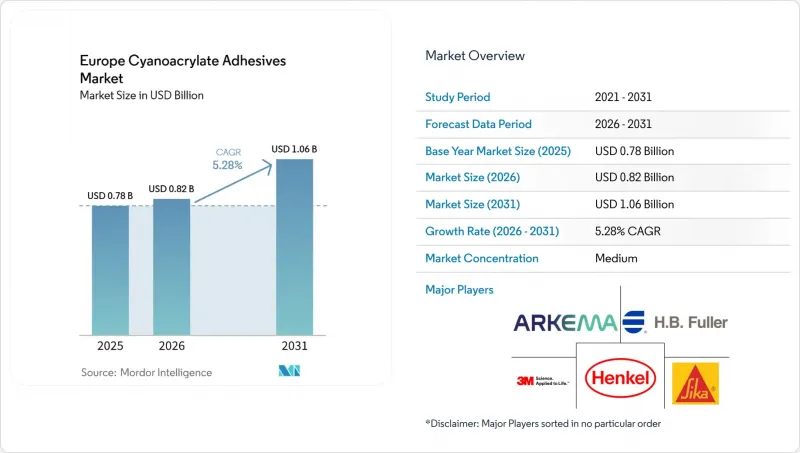
本報告按終端用戶產業(航太、汽車、建築施工、鞋類和皮革、醫療、木工和細木工以及其他終端用戶產業)、技術(反應型和紫外光固化型黏合劑)以及地區(法國、德國、義大利、俄羅斯、西班牙、英國和其他歐洲國家)進行細分。市場預測以美元計價。
歐洲氰基丙烯酸黏合劑市場趨勢與洞察
歐洲汽車生產中減輕重量的努力正在加速進行。
歐洲汽車製造商正將鋁、碳纖維和高抗張強度鋼結合起來,在不影響碰撞安全性的前提下減輕車身重量。黏合劑黏接無需鉚釘,提高了疲勞壽命,並實現了不同材料的連接。氰基丙烯酸酯黏合劑在內飾件、感測器外殼和線束的應力消除方面表現出色,其固化時間不到30秒,支援即時生產。漢高公司針對樂泰(LOCTITE)和特洛森(TEROSON)產品線的宣傳活動(將於2026年初推出)強調了減輕車身重量、實現汽車碳排放目標以及快速生產切換的重要性。歐盟的循環設計提案要求採用可逆黏接技術。投資於熱剝離氰基丙烯酸酯的供應商將獲得先發優勢。電動車電池模組受到介電常數和熱失控的限制,迫使化合物開發商轉向具有非結構性但又具備散熱性能的混合型和填料型黏合劑。
組織級氰基丙烯酸黏合劑在微創手術中的快速應用
目前,N-丁基-2-氰基丙烯酸酯和辛基-2-氰基丙烯酸黏合劑廣泛應用於腹腔鏡手術的各個領域,用於切口縫合、網片固定和靜脈曲張封閉。隨機對照試驗表明,網片固定成功率達100%,且與可吸收釘相比,患者疼痛評分更低。此外,美國國家衛生與臨床最佳化研究所 (NICE) 的指南也認可其與機械固定有相當的臨床療效,並指出其可縮短住院時間。根據歐盟醫療設備法規,這些黏合劑被歸類為III類醫療器械,需要提交完整的生物相容性資料。由於使用無菌一次性施用器並經過ISO 10993檢驗,其高昂的價格是合理的。此外,由於手術周轉率提高和再入院率降低,醫院也能夠接受較高的單位成本。
嚴格的勞動安全標籤(H315/H335)限制了工業生產量。
H315/H335 分類要求使用局部排氣通風裝置、護目鏡和聚合物複合手套。由於工人需要配戴呼吸防護設備,手工組裝的生產速度將會減慢,單件人事費用將會增加。 3M 和 ITW 將於 2025 年年中更新安全資料表 (SDS),其中將明確暴露限值,並指導客戶採用具備排氣功能且最大限度減少手部接觸的自動化點膠單元。資金有限的中小型企業可能被迫退出市場,加速市場整合。
細分市場分析
預計到2025年,醫療產業的需求佔有率將達到31.48%,這反映出手術室對組織黏合劑的需求,因為組織黏合劑能夠縮短手術時間並減輕術後疼痛。該領域預計將保持最高成長率,2026年至2031年的複合年成長率將達到6.04%。這主要得益於歐盟醫療設備法規(EU-MDR)和ISO 10993測試標準已成為採購的先決條件。汽車行業仍然是一個重要的細分市場,但由於耐熱性的限制,其應用僅限於內裝和線路管理。建築、鞋類和木工行業對價格敏感型複合材料產品的需求穩定。
2026年發表在《臨床醫學雜誌》(Journal of Clinical Medicine)上的一項綜述,對來自六個國家的十項研究進行了分析,發現辛基-2-氰基丙烯酸酯在乳房手術中的感染率低於皮下縫合線,但在高張力下傷口裂開的風險更高。醫療設備製造商,例如貝朗(B. Braun)、先進醫療解決方案(Advanced Medical Solutions)和吉姆(GEM),正在將一次性施用器商業化,其利潤率高於工業級敷貼器。在醫療領域之外,航太工程師正在使用低揮發性Dymax 9773來固定衛星和航空電子設備中的印刷電路基板(PCB)。本產品具有快速紫外線(UV)固化的特性,可在數秒內滿足ASTM E595和軍用標準(MIL-STD)-883的要求。
其他好處:
- Excel格式的市場預測(ME)表
- 3個月的分析師支持
目錄
第1章:引言
- 研究假設和市場定義
- 調查範圍
第2章:調查方法
第3章執行摘要
第4章 市場狀況
- 市場概覽
- 市場促進因素
- 加快歐洲汽車生產減重步伐
- 氰基丙烯酸酯樹脂在微創手術組織修復的快速應用
- 複合板和伺服家具製造的成長
- DIY和住宅維修零售市場的繁榮是由電子商務的普及所推動的。
- 採用低氣味、低揮發性配方,以符合更嚴格的 REACH 和 VOC 法規。
- 市場限制因素
- 嚴格的勞動安全標籤(H315/H335)限制了工業生產量。
- 在溫度超過 120 度C。
- 由於乙腈供應波動,導致甲基-2-氰基丙烯酸酯單體原料價格波動。
- 價值鏈分析
- 監理情勢
- 分銷鏈分析
- 波特五力模型
第5章 市場規模與成長預測
- 按最終用戶行業分類
- 航太
- 車
- 建築/施工
- 鞋類和皮革
- 衛生保健
- 木工和細木工
- 其他終端用戶產業
- 透過技術
- 反應型
- 紫外光固化黏合劑
- 按地區
- 法國
- 德國
- 義大利
- 俄羅斯
- 西班牙
- 英國
- 其他歐洲國家
第6章 競爭情勢
- 市場集中度
- 策略趨勢
- 市佔率和排名分析
- 公司簡介
- 3M
- Arkema
- Bolton Group
- CHEMENCE
- DELO Industrie Klebstoffe GmbH & Co. KGaA
- Dymax Corporation
- HB Fuller Company
- Henkel AG & Co. KGaA
- Hoenle AG
- Illinois Tool Works Inc.
- Jowat SE
- Kisling Deutschland GmbH
- Master Bond
- Parson Adhesives Inc.
- Permabond LLC
- Sika AG
- Soudal Holding NV
- ThreeBond Holdings Co., Ltd.
- WEICON GmbH & Co. KG
第7章 市場機會與未來展望
According to Mordor Intelligence, the europe cyanoacrylate adhesives market size is projected to expand from USD 0.78 billion in 2025 to USD 0.82 billion in 2026 and USD 1.06 billion by 2031, registering a CAGR of 5.28% between 2026 and 2031.
This report is Segmented by End-User Industry (Aerospace, Automotive, Building and Construction, Footwear and Leather, Healthcare, Woodworking and Joinery, and Other End-User Industries), Technology (Reactive, and UV Cured Adhesives), and Geography (France, Germany, Italy, Russia, Spain, United Kingdom, and Rest of Europe). The Market Forecasts are Provided in Terms of Value (USD).
Europe Cyanoacrylate Adhesives Market Trends and Insights
Accelerating Lightweighting Initiatives in European Automotive Production
European automakers blend aluminum, carbon fiber, and high-strength steel to trim mass without sacrificing crash performance. Adhesive bonding eliminates rivets, raises fatigue life, and permits mixed-material joints. Cyanoacrylates excel in interior trim, sensor housings, and wiring harness strain relief, where sub-30-second fixture times support just-in-time sequencing. Henkel's early 2026 campaign on its LOCTITE and TEROSON ranges underscores the link between lightweighting, fleet carbon dioxide targets, and rapid production changeovers. The European Union's circular-design proposals call for reversible bonding; suppliers investing in thermally debondable cyanoacrylates gain first-mover advantage. Electric vehicle battery modules add dielectric and thermal-runaway constraints, nudging formulators toward hybrid or filled grades that dissipate heat while remaining non-structural.
Rapid Adoption of Tissue Grade Cyanoacrylates in Minimally Invasive Surgeries
N-butyl-2- and octyl-2-cyanoacrylate glues now close incisions, fix meshes, and seal varices across laparoscopic specialties. Randomized studies reported 100% mesh fixation success and lower pain scores versus absorbable tacks, while the United Kingdom's National Institute for Health and Care Excellence (NICE) guidance states clinical equivalence to mechanical fixation with shorter hospital stays. The EU Medical Device Regulation classifies these glues as Class III, demanding exhaustive biocompatibility data. Premium pricing reflects sterile single-use applicators and ISO 10993 validation, yet hospitals tolerate higher unit costs thanks to quicker procedure turnover and lower readmission rates.
Stringent Occupational Safety Labeling (H315/H335) Limiting Industrial Throughput
H315/H335 classifications obligate local exhaust, goggles, and polymer-laminate gloves. Manual assembly lines are slow as operators don respirators, raising labor cost per part. Mid-2025 Safety Data Sheet (SDS) updates from 3M and ITW enumerate exposure limits and push customers toward automated dispensing cells that vent fumes and minimize hand contact. Small firms lacking capital may exit, accelerating market consolidation.
Other drivers and restraints analyzed in the detailed report include:
- Growth of Engineered Wood and Modular Furniture Manufacturing
- Shift to Low-Odor, Low-Bloom Formulations to Meet Stricter VOC Rules
- Performance Discrepancies Above 120 °C
For complete list of drivers and restraints, kindly check the Table Of Contents.
Segment Analysis
Healthcare's 31.48% share of 2025 demand reflected operating-room preferences for tissue-grade glues that shorten OR time and reduce postoperative pain. A 6.04% CAGR through 2026-2031 keeps the segment atop the growth league, as European Union Medical Device Regulation (EU-MDR) compliance and ISO 10993 testing become standard procurement prerequisites. Automotive remains a significant segment; however, heat resistance limits applications to interior trim and wire management. Construction, footwear, and woodworking contribute a steady volume in price-sensitive formulations.
A 2026 Journal of Clinical Medicine reviewed across 10 studies spanning six countries found lower infection rates for octyl-2-cyanoacrylate in breast surgery than subcuticular sutures, though wound dehiscence risk rose under high tension. Medical-device firms such as B. Braun, Advanced Medical Solutions, and GEM commercialize single-use applicators that fetch margins above industrial grades. Outside healthcare, aerospace engineers adopt low-outgassing Dymax 9773 for printed circuit board (PCB) staking on satellites and avionics, meeting American Society for Testing and Materials (ASTM) E595 and Military Standard (MIL-STD)-883 benchmarks in seconds, with fast ultraviolet (UV) cure.
List of Companies Covered in this Report:
- 3M
- Arkema
- Bolton Group
- CHEMENCE
- DELO Industrie Klebstoffe GmbH & Co. KGaA
- Dymax Corporation
- H.B. Fuller Company
- Henkel AG & Co. KGaA
- Hoenle AG
- Illinois Tool Works Inc.
- Jowat SE
- Kisling Deutschland GmbH
- Master Bond
- Parson Adhesives Inc.
- Permabond LLC
- Sika AG
- Soudal Holding N.V.
- ThreeBond Holdings Co., Ltd.
- WEICON GmbH & Co. KG
Additional Benefits:
- The market estimate (ME) sheet in Excel format
- 3 months of analyst support
TABLE OF CONTENTS
1 Introduction
- 1.1 Study Assumptions and Market Definition
- 1.2 Scope of the Study
2 Research Methodology
3 Executive Summary
4 Market Landscape
- 4.1 Market Overview
- 4.2 Market Drivers
- 4.2.1 Accelerating lightweighting initiatives in European automotive production
- 4.2.2 Rapid adoption of tissue-grade cyanoacrylates in minimally-invasive surgeries
- 4.2.3 Growth of engineered wood and modular furniture manufacturing
- 4.2.4 DIY and home-improvement retail boom fuelled by e-commerce penetration
- 4.2.5 Shift to low-odor, low-bloom formulations to meet stricter REACH and VOC rules
- 4.3 Market Restraints
- 4.3.1 Stringent occupational safety labelling (H315/H335) limiting industrial throughput
- 4.3.2 Performance gap versus structural acrylics and epoxies at >120 °C applications
- 4.3.3 Feedstock volatility for methyl-2-cyanoacrylate monomer, driven by acetonitrile supply swings
- 4.4 Value Chain Analysis
- 4.5 Regulatory Landscape
- 4.6 Distribution Chain Analysis
- 4.7 Porter's Five Forces
- 4.7.1 Threat of New Entrants
- 4.7.2 Bargaining Power of Suppliers
- 4.7.3 Bargaining Power of Buyers
- 4.7.4 Threat of Substitutes
- 4.7.5 Competitive Rivalry
5 Market Size and Growth Forecasts (Value)
- 5.1 By End-User Industry
- 5.1.1 Aerospace
- 5.1.2 Automotive
- 5.1.3 Building and Construction
- 5.1.4 Footwear and Leather
- 5.1.5 Healthcare
- 5.1.6 Woodworking and Joinery
- 5.1.7 Other End-user Industries
- 5.2 By Technology
- 5.2.1 Reactive
- 5.2.2 UV-Cured Adhesives
- 5.3 By Geography
- 5.3.1 France
- 5.3.2 Germany
- 5.3.3 Italy
- 5.3.4 Russia
- 5.3.5 Spain
- 5.3.6 United Kingdom
- 5.3.7 Rest of Europe
6 Competitive Landscape
- 6.1 Market Concentration
- 6.2 Strategic Moves
- 6.3 Market Share(%)/Ranking Analysis
- 6.4 Company Profiles (includes Global level Overview, Market level overview, Core Segments, Financials as available, Strategic Information, Products and Services, and Recent Developments)
- 6.4.1 3M
- 6.4.2 Arkema
- 6.4.3 Bolton Group
- 6.4.4 CHEMENCE
- 6.4.5 DELO Industrie Klebstoffe GmbH & Co. KGaA
- 6.4.6 Dymax Corporation
- 6.4.7 H.B. Fuller Company
- 6.4.8 Henkel AG & Co. KGaA
- 6.4.9 Hoenle AG
- 6.4.10 Illinois Tool Works Inc.
- 6.4.11 Jowat SE
- 6.4.12 Kisling Deutschland GmbH
- 6.4.13 Master Bond
- 6.4.14 Parson Adhesives Inc.
- 6.4.15 Permabond LLC
- 6.4.16 Sika AG
- 6.4.17 Soudal Holding N.V.
- 6.4.18 ThreeBond Holdings Co., Ltd.
- 6.4.19 WEICON GmbH & Co. KG
7 Market Opportunities and Future Outlook
- 7.1 White-space and Unmet-Need Assessment

 氰基丙烯酸黏合劑市場:全球市場預測,2026-2032年
 亞太地區氰基丙烯酸黏合劑:市場佔有率分析、產業趨勢與統計及成長預測(2026-2031)
 2026年全球氰基丙烯酸黏合劑市場報告
 全球氰基丙烯酸黏合劑市場規模、佔有率、趨勢和成長分析報告(2026-2034年)北美氰基丙烯酸酯黏合劑:市場佔有率分析、產業趨勢、統計數據和成長預測(2025-2030 年)氰基丙烯酸酯黏合劑:市場佔有率分析、產業趨勢與統計、成長預測(2025-2030)
 到 2030 年氰基丙烯酸黏劑市場預測:按產品類型、最終用戶和地區分類的全球分析
 氰基丙烯酸黏劑市場:按化學、按固化工藝、按應用、按最終用途行業、按地區 - 預測至 2029 年