


 |
市場調查報告書
商品編碼
2066697
亞太地區氰基丙烯酸黏合劑:市場佔有率分析、產業趨勢與統計及成長預測(2026-2031)Asia-Pacific Cyanoacrylate Adhesives - Market Share Analysis, Industry Trends & Statistics, Growth Forecasts (2026 - 2031) |
||||||

※ 本網頁內容可能與最新版本有所差異。詳細情況請與我們聯繫。
據 Mordor Intelligence 稱,2025 年亞太地區氰基丙烯酸酯黏合劑市場價值為 12.6 億美元,預計到 2031 年將從 2026 年的 13.3 億美元成長至 17.6 億美元,預測期(2026-2031 年)複合年成長率為 5.72%。
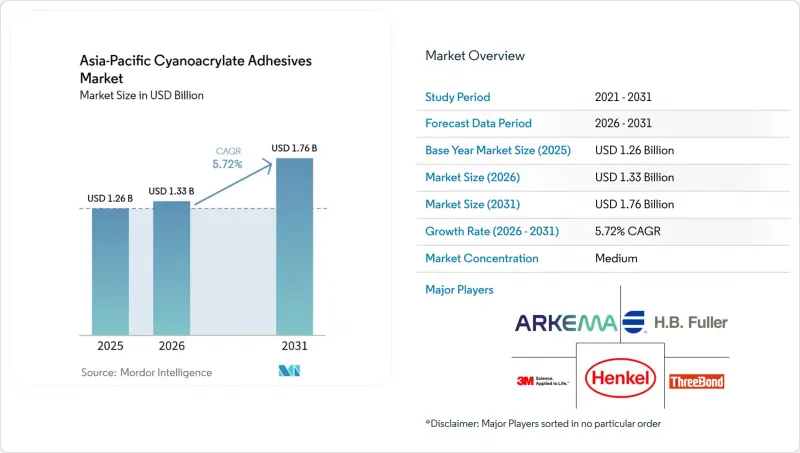
本報告按終端用戶產業(航太、汽車、建築施工、鞋類和皮革、醫療保健、木工和細木工等)、技術(反應式和紫外線固化)以及地區(澳洲、中國、印度、印尼、日本、馬來西亞、新加坡、韓國、泰國和其他亞太地區)進行細分。市場預測以美元計價。
亞太地區氰基丙烯酸黏合劑市場的趨勢與洞察。
電子設備組裝需求快速成長
到2026年1月,印度「電子元件製造計畫」下獲批准的多個項目將吸引數十億美元的投資和數千個新的就業崗位,從而提振對用於多層印刷電路基板(PCB)、相機模組和光學元件的氰基丙烯酸酯黏合劑的需求。在中國,工業機器人產量的顯著成長以及設備製造附加價值的提升表明自動化程度正在不斷提高,這推動了高速生產線對黏合劑的需求。漢高新加坡技術中心目前正在複製點膠、晶片貼裝和層壓工藝,以縮短用於半導體封裝的氰基丙烯酸黏合劑的認證時間。 UPM位於柔佛州新山的塗佈生產線計劃於2026年中期運作,將增加用於耐用標籤和折疊式顯示膜的薄膜結構,以滿足東南亞電子產品製造商的需求。
汽車產業輕量化努力的擴展
在中國,汽車和新能源汽車產量的不斷成長推動了對用於電池組外殼、裝飾件和電子元件的氰基丙烯酸黏合劑的需求。因此,東亞合生(Toagosei)的電池相關黏合劑銷量較以往顯著成長,促使其在越南和印度的子公司在2024年擴大業務規模。現代摩比斯(Hyundai Mobis)要求供應商申報所含物質,並降低重金屬和銅的含量,同時優先選擇無需加熱即可粘合不同材料的快速固化、低VOC瞬黏合劑。隨著OEM廠商致力於使用生物基或再生塑膠,氰基丙烯酸酯膠黏劑無需烘箱即可快速提供初始強度,從而與結構丙烯酸樹脂形成互補,有助於提高超級工廠的生產效率。
氰基丙烯酸酯單體價格波動
Pidilight透露,醋酸乙烯單體成本的降低提高了其毛利率,但也強調了其對原物料價格波動的脆弱性。儘管中國2025年生產者物價指數下降,且乙烯投資增加,但黏合劑製造商的成本轉嫁空間有限。根據日本化學資料庫,國內烷基氰基丙烯酸酯的產量不高,規模經濟效益有限。缺乏避險工具的中小型加工商要么被迫承受現貨價格的急劇上漲,要么失去市場佔有率,導致亞太地區氰基丙烯酸酯黏合劑市場的許多企業不得不與大型跨國公司簽訂代工生產協議。
細分市場分析
預計到2025年,醫療保健產業將佔據亞太地區氰基丙烯酸酯黏合劑市場31.48%的佔有率,並在2026年至2031年間以6.04%的複合年成長率成長。此細分市場的成長主要得益於中國三類醫療器材法規的明確化以及印度公司獲得美國認證後,無菌生產線資金的流入。醫院傾向於使用外用皮膚黏合劑來加速傷口癒合並降低針刺傷的風險。來自亞洲OEM滅菌公司的跨境需求也推動了銷售量成長。東南亞國協可支配收入的成長帶動了擇期手術數量的增加,進一步促進了亞太地區氰基丙烯酸黏合劑市場這一細分領域對醫用氰基丙烯酸酯產品的需求。
消費品DIY和木工產業仍是穩定的需求來源。即使在都市區經濟放緩的情況下,Pidilight透過拓展區域銷售管道,也增強了該品類的韌性。在製鞋和皮革作坊中,強力黏合劑用於粘合鞋底和裝飾邊條。在中國,建築業的應用雖然緩慢,但由於綠建築轉型帶來的維修工程,需求仍然強勁。在汽車和電子行業,隨著輕量化和小型化的發展,強力膠的市場佔有率保持在兩位數,但對於需要耐熱的連接件,環氧樹脂的需求正在成長。航太領域的需求雖然小眾但穩定,主要集中在對較不重要的客艙和航空電子設備零件的加固上。
其他好處:
- Excel格式的市場預測(ME)表
- 3個月的分析師支持
目錄
第1章:引言
- 研究假設和市場定義
- 調查範圍
第2章:調查方法
第3章執行摘要
第4章 市場狀況
- 市場概覽
- 市場促進因素
- 電子設備組裝需求激增
- 加大力度減輕汽車重量
- 住宅DIY市場蓬勃發展。
- 擴大外用皮膚黏合劑在醫療設備領域的應用
- 引入低氣味、低粉化配方,以確保工人安全。
- 市場限制因素
- 氰基丙烯酸酯單體價格波動
- 嚴格的揮發性有機化合物 (VOC) 法規和職場暴露限值
- 與環氧樹脂相比,耐熱極限
- 價值鏈分析
- 監理情勢
- 分銷通路分析
- 波特五力模型
第5章 市場規模與成長預測
- 按最終用戶行業分類
- 航太
- 車
- 建築/施工
- 鞋類和皮革
- 衛生保健
- 木工和細木工
- 其他終端用戶產業
- 透過技術
- 反應型
- 紫外線固化
- 地區
- 中國
- 印度
- 印尼
- 日本
- 馬來西亞
- 新加坡
- 韓國
- 泰國
- 澳洲
- 其他亞太國家
第6章 競爭情勢
- 市場集中度
- 策略趨勢
- 市佔率和排名分析
- 公司簡介
- 3M
- Aica Kogyo Co., Ltd.
- Arkema
- DELO Industrial Adhesives
- Dymax Corporation
- EpoxySet Inc.
- HB Fuller Company
- Henkel AG & Co. KGaA
- Hubei Huitian New Materials Co. Ltd
- ITW Performance Polymers
- Kangda New Materials(Group)Co., Ltd.
- NANPAO RESINS CHEMICAL GROUP
- Pidilite Industries Ltd.
- Sika AG
- ThreeBond Holdings Co., Ltd.
- Toagosei Co., Ltd.
第7章 市場機會與未來展望
According to Mordor Intelligence, the asia-Pacific cyanoacrylate adhesives market size was valued at USD 1.26 billion in 2025 and is estimated to grow from USD 1.33 billion in 2026 to reach USD 1.76 billion by 2031, at a CAGR of 5.72% during the forecast period (2026-2031).
This report is Segmented by End User Industry (Aerospace, Automotive, Building and Construction, Footwear and Leather, Healthcare, Woodworking and Joinery, and More), Technology (Reactive and UV-Cured), and Geography (Australia, China, India, Indonesia, Japan, Malaysia, Singapore, South Korea, Thailand, and Rest of Asia-Pacific). The Market Forecasts are Provided in Terms of Value (USD).
Asia-Pacific Cyanoacrylate Adhesives Market Trends and Insights
Surging Electronics Assembly Demand
Multiple projects approved under India's Electronics Component Manufacturing Scheme by January 2026 are attracting billions in capital and thousands of new jobs, lifting instant-adhesive offtake for multilayer printed circuit boards (PCBs), camera modules, and optical devices. In China, strong gains in industrial-robot output and equipment manufacturing value add demonstrate expanding automation that boosts adhesive consumption on high-speed lines. Henkel's Singapore Technical Center now recreates dispensing, die-attach, and lamination processes, cutting qualification times for cyanoacrylates aimed at semiconductor packaging. UPM's Johor Bahru coating line, coming online mid-2026, adds filmic constructions for durable labels and foldable-display films, catering to Southeast Asian electronics makers.
Rising Automotive Lightweighting Initiatives
China has increased its production of motor vehicles and new-energy vehicles, boosting the demand for cyanoacrylate in battery pack housings, trims, and electronics. Consequently, Toagosei has experienced a notable rise in sales of its battery-related adhesives compared to previous levels, prompting subsidiaries in Vietnam and India to expand during 2024. Hyundai Mobis requires suppliers to declare substances and reduce heavy-metal and copper content, favoring fast-curing, low- volatile organic compound (VOCs) instant bonds that eliminate heat in mixed-material joints. As OEMs target bio-based or recycled plastics, cyanoacrylates complement structural acrylics by delivering quick green strength without ovens, supporting throughput in gigafactories.
Price Volatility of Cyanoacrylate Monomers
Pidilite disclosed falling vinyl acetate monomer costs that widened gross margins but underscored susceptibility to feedstock swings. China's producer price index fell in 2025, limiting pass-through room for adhesive makers even as ethylene investment rose. Japan's chemicals database shows modest local alkyl-cyanoacrylate production volumes, constraining scale economies. Smaller converters, lacking hedging tools, absorb spot spikes or lose share, pushing many toward tolling deals with integrated multinationals in the Asia Pacific cyanoacrylate adhesives market.
Other drivers and restraints analyzed in the detailed report include:
- Booming Residential DIY Market
- Growing Medical Device Usage of Topical Skin Adhesives
- Stringent Volatile Organic Compound (VOC) and Workplace Exposure Limits
For complete list of drivers and restraints, kindly check the Table Of Contents.
Segment Analysis
Healthcare held 31.48% of the Asia Pacific cyanoacrylate adhesives market share in 2025 and is projected to grow at 6.04% CAGR through 2026 to 2031. The segment advances as China's Class III rules remove ambiguity and Indian firms win U.S. clearances, encouraging capital inflows into sterile production lines. Hospitals prefer topical skin adhesives to speed wound closure and cut needlestick risk. Cross-border demand from Asia-based OEM contract sterilizers also supports volume growth. Rising disposable incomes across ASEAN expand elective surgery counts, further lifting medical-grade cyanoacrylate uptake within the Asia Pacific cyanoacrylate adhesives market size for this segment.
Consumer DIY and woodworking remain steady contributors. Pidilite's rural channel expansion strengthens category resilience during urban slowdowns. Footwear and leather workshops leverage instant bonds for sole attachment and trim finishing. Construction uptake moderates in China, yet stays positive due to green-transition retrofits. Automotive and electronics retain double-digit share as lightweighting and miniaturization continue, though heat-critical joints migrate to epoxies. Aerospace demand is niche but stable, focused on non-critical cabin and avionics fastening.
List of Companies Covered in this Report:
- 3M
- Aica Kogyo Co., Ltd.
- Arkema
- DELO Industrial Adhesives
- Dymax Corporation
- EpoxySet Inc.
- H.B. Fuller Company
- Henkel AG & Co. KGaA
- Hubei Huitian New Materials Co. Ltd
- ITW Performance Polymers
- Kangda New Materials (Group) Co., Ltd.
- NANPAO RESINS CHEMICAL GROUP
- Pidilite Industries Ltd.
- Sika AG
- ThreeBond Holdings Co., Ltd.
- Toagosei Co., Ltd.
Additional Benefits:
- The market estimate (ME) sheet in Excel format
- 3 months of analyst support
TABLE OF CONTENTS
1 Introduction
- 1.1 Study Assumptions and Market Definition
- 1.2 Scope of the Study
2 Research Methodology
3 Executive Summary
4 Market Landscape
- 4.1 Market Overview
- 4.2 Market Drivers
- 4.2.1 Surging electronics assembly demand
- 4.2.2 Rising automotive lightweighting initiatives
- 4.2.3 Booming residential DIY market
- 4.2.4 Growing medical device usage of topical skin adhesives
- 4.2.5 Shift to low-odor/low-bloom formulations for worker safety
- 4.3 Market Restraints
- 4.3.1 Price volatility of cyanoacrylate monomers
- 4.3.2 Stringent VOC and workplace exposure limits
- 4.3.3 Limited heat-resistance versus epoxies
- 4.4 Value Chain Analysis
- 4.5 Regulatory Landscape
- 4.6 Distribution Channel Analysis
- 4.7 Porter's Five Forces
- 4.7.1 Threat of New Entrants
- 4.7.2 Bargaining Power of Suppliers
- 4.7.3 Bargaining Power of Buyers
- 4.7.4 Threat of Substitutes
- 4.7.5 Competitive Rivalry
5 Market Size and Growth Forecasts (Value)
- 5.1 End User Industry
- 5.1.1 Aerospace
- 5.1.2 Automotive
- 5.1.3 Building and Construction
- 5.1.4 Footwear and Leather
- 5.1.5 Healthcare
- 5.1.6 Woodworking and Joinery
- 5.1.7 Other End-user Industries
- 5.2 Technology
- 5.2.1 Reactive
- 5.2.2 UV-Cured
- 5.3 Geography
- 5.3.1 China
- 5.3.2 India
- 5.3.3 Indonesia
- 5.3.4 Japan
- 5.3.5 Malaysia
- 5.3.6 Singapore
- 5.3.7 South Korea
- 5.3.8 Thailand
- 5.3.9 Australia
- 5.3.10 Rest of Asia-Pacific
6 Competitive Landscape
- 6.1 Market Concentration
- 6.2 Strategic Moves
- 6.3 Market Share(%)/Ranking Analysis
- 6.4 Company Profiles (includes Global level Overview, Market level overview, Core Segments, Financials as available, Strategic Information, Products and Services, and Recent Developments)
- 6.4.1 3M
- 6.4.2 Aica Kogyo Co., Ltd.
- 6.4.3 Arkema
- 6.4.4 DELO Industrial Adhesives
- 6.4.5 Dymax Corporation
- 6.4.6 EpoxySet Inc.
- 6.4.7 H.B. Fuller Company
- 6.4.8 Henkel AG & Co. KGaA
- 6.4.9 Hubei Huitian New Materials Co. Ltd
- 6.4.10 ITW Performance Polymers
- 6.4.11 Kangda New Materials (Group) Co., Ltd.
- 6.4.12 NANPAO RESINS CHEMICAL GROUP
- 6.4.13 Pidilite Industries Ltd.
- 6.4.14 Sika AG
- 6.4.15 ThreeBond Holdings Co., Ltd.
- 6.4.16 Toagosei Co., Ltd.
7 Market Opportunities and Future Outlook
- 7.1 White-space and Unmet-need Assessment

 氰基丙烯酸黏合劑市場:全球市場預測,2026-2032年
 歐洲氰基丙烯酸黏合劑:市場佔有率分析、產業趨勢和統計數據以及成長預測(2026-2031 年)
 2026年全球氰基丙烯酸黏合劑市場報告
 全球氰基丙烯酸黏合劑市場規模、佔有率、趨勢和成長分析報告(2026-2034年)北美氰基丙烯酸酯黏合劑:市場佔有率分析、產業趨勢、統計數據和成長預測(2025-2030 年)氰基丙烯酸酯黏合劑:市場佔有率分析、產業趨勢與統計、成長預測(2025-2030)
 到 2030 年氰基丙烯酸黏劑市場預測:按產品類型、最終用戶和地區分類的全球分析
 氰基丙烯酸黏劑市場:按化學、按固化工藝、按應用、按最終用途行業、按地區 - 預測至 2029 年