


 |
市場調查報告書
商品編碼
2066693
亞太地區聚氨酯黏合劑:市場佔有率分析、產業趨勢與統計及成長預測(2026-2031)Asia-Pacific Polyurethane Adhesives - Market Share Analysis, Industry Trends & Statistics, Growth Forecasts (2026 - 2031) |
||||||

※ 本網頁內容可能與最新版本有所差異。詳細情況請與我們聯繫。
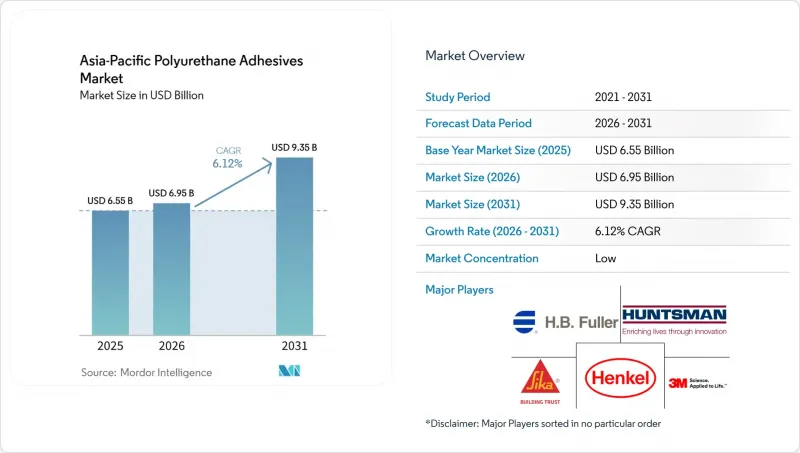
根據 Mordor Intelligence 預測,亞太地區聚氨酯黏合劑市場規模預計將從 2025 年的 65.5 億美元成長到 2026 年的 69.5 億美元,然後從 2026 年到 2031 年以 6.12% 的複合年成長率成長,到 2031 億美元達到 93.5 億美元。
本報告按終端用戶產業(航太、汽車、醫療、包裝等)、技術(熱熔膠、反應型膠、溶劑型膠、紫外光固化膠、水性膠)和地區(澳洲、中國、印度、印尼、日本、馬來西亞、新加坡、韓國、泰國及其他亞太地區)進行細分。市場預測以美元計價。
亞太地區聚氨酯黏合劑市場趨勢及洞察。
新冠疫情後時代,建築外圍維修工程激增。
隨著業主尋求降低成本的措施並努力實現淨零排放目標,各大城市的維修預算正在增加。中國已採取開創性舉措,在低碳建築領域投入高達5,500億美元,這大大推動了聚氨酯的需求,尤其是在保溫板黏合和劣化。根據新加坡2040年陸路交通總體規劃,新建火車站正在使用防火硬質發泡黏合劑。這些黏合劑即使在室溫下固化,也能與老化的鋼材和混凝土牢固黏合。由於其抗表面污染的特性,濕固化產品在市場上迅速普及,從而減少了停工時間。印度的智慧城市建設和日本的老舊高層建築也呈現類似的趨勢。然而,大量湧入的廉價中國MDI產品構成了挑戰,可能會擠壓加工商的利潤空間。儘管面臨價格壓力,但那些結合專有底漆和現場培訓的供應商仍在成功搶佔市場佔有率。
促進車輛減重,以延長電動車的續航里程。
汽車製造商正逐漸摒棄傳統的鉚釘和環氧樹脂,轉而採用雙組分聚氨酯。這些聚氨酯在電池模組黏合、鋁製外殼密封以及形成導熱間隙填充材方面表現出色。 HB Fuller 的「UR4515GF」在 70 度C下固化 120 分鐘後,在電著底漆鋼板上可達到 20.05 MPa 的搭接剪切強度,使其成為自動化電動車組裝的理想之選。漢高將於 2025 年推出的「Technomelt PUR 6260 ECO」由超過 60% 的可再生材料製成,僅需 50 度C即可軟化,從而降低烘箱能耗並保護熱敏基材。隨著汽車製造商將單次充電續航里程提升至 600 公里以上,轉向新型黏合劑的需求也日益顯著。此外,印度汽車產業以 7.12% 的複合年成長率成長,為符合在地採購配額標準的本土化合物製造商帶來了龐大的商機。
對易燃芯材製定更嚴格的防火安全法規
建築應用中聚氨酯黏合劑日益嚴格的防火安全標準增加了測試負擔並限制了配方,從而限制了市場發展,並延緩了其在某些建築領域的應用。澳洲的AS 5637.1分組編號系統可能要求對符合標準的面板組件進行成本高昂的全面防火測試,前提是黏合劑層發生收縮或熔化。韓國研究人員透過在水性聚氨酯中添加磷酸化聚乙烯醇和鎂鋁層狀雙羥基氫氧化物,在保持黏合強度高於0.70 MPa的同時,將峰值發熱量降低了30%。然而,此類添加劑黏度增加和成本上升,使得其應用受到限制,直到專案保險公司強制要求使用為止。
細分市場分析
至2025年,包裝產業將佔亞太地區聚氨酯黏合劑市場總規模的28.24%。這主要得益於用於零嘴零食、藥品和電商快遞包裝的軟性複合製程。推動這一成長的關鍵在於濕固化反應型熱熔膠,這種膠合劑可在數秒內形成氣密密封,並且與溶劑型產品相比,能耗更低。該地區採用氮氣環境下凹版印刷機的複合工廠,由於能夠避免冷凝造成的缺陷,因此能夠支持方便麵和調味品等產品的大批量生產。汽車應用雖然目前規模較小,但由於電動車電池模組、輕量化車身面板和隔音泡棉對雙組分聚氨酯和熱塑性聚氨酯薄膜的需求不斷成長,其小規模也達到了6.94%。目前,亞太地區的聚氨酯黏合劑市場正專注於能夠證明導熱係數達到 2 W/m*K 或更高,並提供符合 GB/T 33014 側面碰撞試驗規程的碰撞模擬數據的供應商。
建築黏合劑受益於保溫維修項目,但也面臨一些挑戰,例如中國三線城市項目核准延遲。越南和印尼的鞋廠正在轉向使用水性聚氨酯分散體,這種分散體可減少90-95%的揮發性有機化合物(VOC)。塗覆透氣性聚氨酯的醫用膠帶與親水膠體層相容,並正在擴大馬來西亞創傷護理產品的出口。在木工業,反應型黏合劑正被用於工程木地板,可將夾緊時間縮短50%,並在無需新建烘乾爐的情況下提高生產線產能。即使在包裝和汽車行業週期放緩的情況下,這些細分領域仍保持著整體的基本成長,並為亞太地區聚氨酯黏合劑市場提供了廣泛的需求基礎。
其他好處:
- Excel格式的市場預測(ME)表
- 3個月的分析師支持
目錄
第1章:引言
- 研究假設和市場定義
- 調查範圍
第2章:調查方法
第3章執行摘要
第4章 市場狀況
- 市場概覽
- 市場促進因素
- 新冠疫情後時代,建築外圍結構維修激增。
- 促進車輛減重,以延長電動車的續航里程。
- 向高性能層壓材料過渡,以用於電子商務包裝材料
- 低VOC PUR熱熔膠在3C電子領域的應用
- 綠建築法規正在推廣剛性板材黏合。
- 市場限制因素
- MDI/TDI原物料價格波動
- 對易燃芯材消防安全法規的審查
- OEM認證週期正在減緩新技術的採用速度。
- 價值鏈分析
- 監管分析
- 分銷通路分析
- 波特五力模型
第5章 市場規模與成長預測
- 按最終用戶行業分類
- 航太
- 車
- 建築/施工
- 鞋類和皮革
- 衛生保健
- 包裝
- 木工和細木工
- 其他終端用戶產業
- 透過技術
- 熱熔膠
- 反應型
- 溶劑型
- 紫外光固化黏合劑
- 水系
- 國家
- 澳洲
- 中國
- 印度
- 印尼
- 日本
- 馬來西亞
- 新加坡
- 韓國
- 泰國
- 其他亞太國家
第6章 競爭情勢
- 市場集中度
- 策略趨勢
- 市佔率和排名分析
- 公司簡介
- 3M
- Arkema
- Avery Dennison Corporation
- BASF
- Dow Inc.
- HB Fuller Company
- Henkel AG & Co. KGaA
- Hubei Huitian New Materials Co., Ltd.
- Huntsman Corporation
- ITW Performance Polymers
- Jowat SE
- Kangda New Materials(Group)Co., Ltd.
- NANPAO RESINS CHEMICAL GROUP
- Permabond LLC
- Pidilite Industries Ltd.
- Sika AG
第7章 市場機會與未來展望
According to Mordor Intelligence, the asia-Pacific polyurethane adhesives market size is expected to grow from USD 6.55 billion in 2025 to USD 6.95 billion in 2026 and is forecast to reach USD 9.35 billion by 2031 at a 6.12% CAGR over 2026-2031.
This report is Segmented by End-User Industry (Aerospace, Automotive, Healthcare, Packaging, and More), Technology (Hot Melt, Reactive, Solvent-Borne, UV Cured Adhesives, and Water-Borne), and Geography (Australia, China, India, Indonesia, Japan, Malaysia, Singapore, South Korea, Thailand, Rest of Asia-Pacific). The Market Forecasts are Provided in Terms of Value (USD).
Asia-Pacific Polyurethane Adhesives Market Trends and Insights
Surge in Building-Envelope Retrofits Post-COVID Era
As owners pursue lower operating costs and commit to net-zero goals, refurbishment budgets in major cities are on the rise. In a significant move, China invested a whopping USD 550 billion into low-carbon construction, subsequently boosting the demand for polyurethanes, especially in insulation-panel bonding and waterproofing membranes. Under Singapore's Land Transport Master Plan 2040, newly added rail stations are opting for fire-resistant rigid-foam adhesives. These adhesives are designed to bond with aged steel or concrete, even at ambient cure. Moisture-curing grades are flourishing in the market due to their ability to tolerate surface contaminants, thereby reducing downtime. This trend is mirrored in India's smart-city corridors and Japan's aging high-rise buildings. However, the influx of inexpensive Chinese MDI poses a challenge, potentially squeezing margins for converters. Yet, segment suppliers who combine unique primers with on-site training are managing to capture market share, even amidst pricing pressures.
Automotive Lightweighting Push for EV Range Extension
Automakers are increasingly turning to two-component polyurethanes, moving away from traditional rivets and epoxies. These polyurethanes are adept at bonding cell modules, sealing aluminum housings, and creating thermally conductive gap fillers. H.B. Fuller's UR4515GF achieves a lap-shear strength of 20.05 MPa on E-coat steel after a 70 °C, 120-minute cure, making it a perfect fit for automated EV assembly lines. Launched in 2025, Henkel's Technomelt PUR 6260 ECO boasts over 60% renewable feedstock and softens at a mere 50 °C, leading to energy savings in ovens and safeguarding heat-sensitive substrates. With OEMs extending their ranges to exceed 600 km per charge, the shift towards adhesive substitution becomes evident. Furthermore, India's automotive sector, growing at a CAGR of 7.12%, presents lucrative opportunities for local formulators who align with localization quotas.
Fire-Safety Regulatory Scrutiny on Combustible Cores
Heightened fire-safety standards for polyurethane adhesives in construction applications impose testing burdens and formulation constraints that act as a market restraint, slowing adoption in certain building segments. Australia's AS 5637.1 group-number scheme can push an otherwise compliant panel assembly into costly full-scale fire tests if the adhesive layer shrinks or melts. Korean researchers cut peak heat-release rate 30% by adding phosphorylated polyvinyl alcohol plus magnesium-aluminum layered double hydroxides to water-borne polyurethane, yet bonding strength held above 0.70 MPa. Such additives raise viscosity and cost, so adoption lags until mandated by project insurers.
Other drivers and restraints analyzed in the detailed report include:
- E-Commerce Packaging Shift to High-Performance Laminates
- 3C Electronics Adoption of Low-VOC PUR Hot-Melts
- OEM Qualification Cycles Delaying Tech Substitution
For complete list of drivers and restraints, kindly check the Table Of Contents.
Segment Analysis
Packaging represented 28.24% of the Asia-Pacific polyurethane adhesives market size in 2025 thanks to flexible-laminate formats used for snacks, pharmaceuticals, and e-commerce mailers. Growth hinges on moisture-curing reactive hot-melts that deliver hermetic seals within seconds and cut energy versus solvent-borne lines. Regional laminate plants that install nitrogen-inerted gravure presses avoid condensation defects, supporting bigger lot sizes for instant noodles and condiments. Automotive uses, although smaller in tonnage, grow at 6.94% CAGR as EV battery modules, lightweight body panels, and acoustic foams demand two-component polyurethanes and thermoplastic polyurethane films. The Asia-Pacific polyurethane adhesives market now prizes suppliers able to certify thermal conductivity >=2 W/m*K and provide crash simulation data that meet GB /T 33014 side-impact protocols.
Construction adhesives benefit from insulation retrofits but face slow project approvals in China's tier-3 cities. Footwear factories in Vietnam and Indonesia convert to water-based polyurethane dispersions that slash VOCs by 90-95%. Medical tapes coated with breathable polyurethane interact well with hydrocolloid layers, expanding wound-care exports from Malaysia. Woodworking taps reactive hot-melts for engineered-wood flooring because clamp times drop 50%, boosting line capacity without new kilns. These niche areas collectively sustain baseline growth even if packaging or automotive cycles soften, keeping demand broad-based within the Asia-Pacific polyurethane adhesives market.
List of Companies Covered in this Report:
- 3M
- Arkema
- Avery Dennison Corporation
- BASF
- Dow Inc.
- H.B. Fuller Company
- Henkel AG & Co. KGaA
- Hubei Huitian New Materials Co., Ltd.
- Huntsman Corporation
- ITW Performance Polymers
- Jowat SE
- Kangda New Materials (Group) Co., Ltd.
- NANPAO RESINS CHEMICAL GROUP
- Permabond LLC
- Pidilite Industries Ltd.
- Sika AG
Additional Benefits:
- The market estimate (ME) sheet in Excel format
- 3 months of analyst support
TABLE OF CONTENTS
1 Introduction
- 1.1 Study Assumptions and Market Definition
- 1.2 Scope of the Study
2 Research Methodology
3 Executive Summary
4 Market Landscape
- 4.1 Market Overview
- 4.2 Market Drivers
- 4.2.1 Surge in building-envelope retrofits post-COVID era
- 4.2.2 Automotive lightweighting push for EV range extension
- 4.2.3 E-commerce packaging shift to high-performance laminates
- 4.2.4 3C electronics adoption of low-VOC PUR hot-melts
- 4.2.5 Green-building regulations spurring rigid panel bonding
- 4.3 Market Restraints
- 4.3.1 Volatility in MDI/TDI feedstock prices
- 4.3.2 Fire-safety regulatory scrutiny on combustible cores
- 4.3.3 OEM qualification cycles delaying tech substitution
- 4.4 Value Chain Analysis
- 4.5 Regulatory Analysis
- 4.6 Distribution Channel Analysis
- 4.7 Porter's Five Forces
- 4.7.1 Threat of New Entrants
- 4.7.2 Bargaining Power of Suppliers
- 4.7.3 Bargaining Power of Buyers
- 4.7.4 Threat of Substitutes
- 4.7.5 Competitive Rivalry
5 Market Size and Growth Forecasts (Value)
- 5.1 By End-user Industry
- 5.1.1 Aerospace
- 5.1.2 Automotive
- 5.1.3 Building and Construction
- 5.1.4 Footwear and Leather
- 5.1.5 Healthcare
- 5.1.6 Packaging
- 5.1.7 Woodworking and Joinery
- 5.1.8 Other End-user Industries
- 5.2 Technology
- 5.2.1 Hot Melt
- 5.2.2 Reactive
- 5.2.3 Solvent-borne
- 5.2.4 UV Cured Adhesives
- 5.2.5 Water-borne
- 5.3 By Country
- 5.3.1 Australia
- 5.3.2 China
- 5.3.3 India
- 5.3.4 Indonesia
- 5.3.5 Japan
- 5.3.6 Malaysia
- 5.3.7 Singapore
- 5.3.8 South Korea
- 5.3.9 Thailand
- 5.3.10 Rest of Asia-Pacific
6 Competitive Landscape
- 6.1 Market Concentration
- 6.2 Strategic Moves
- 6.3 Market Share(%)/Ranking Analysis
- 6.4 Company Profiles (includes Global level Overview, Market level overview, Core Segments, Financials as available, Strategic Information, Products & Services, and Recent Developments)
- 6.4.1 3M
- 6.4.2 Arkema
- 6.4.3 Avery Dennison Corporation
- 6.4.4 BASF
- 6.4.5 Dow Inc.
- 6.4.6 H.B. Fuller Company
- 6.4.7 Henkel AG & Co. KGaA
- 6.4.8 Hubei Huitian New Materials Co., Ltd.
- 6.4.9 Huntsman Corporation
- 6.4.10 ITW Performance Polymers
- 6.4.11 Jowat SE
- 6.4.12 Kangda New Materials (Group) Co., Ltd.
- 6.4.13 NANPAO RESINS CHEMICAL GROUP
- 6.4.14 Permabond LLC
- 6.4.15 Pidilite Industries Ltd.
- 6.4.16 Sika AG
7 Market Opportunities and Future Outlook
- 7.1 White-space and Unmet-need Assessment

 全球聚氨酯黏合劑市場:按技術、類型、終端應用產業和地區分類-預測至2031年
 聚氨酯黏合劑市場:按類型、技術、形態、終端應用產業和分銷管道分類-2026-2032年全球市場預測
 聚氨酯黏合劑市場規模、佔有率和成長分析:按類型、樹脂類型、基材、應用和地區分類-2026-2033年產業預測
 歐洲聚氨酯黏合劑:市場佔有率分析、產業趨勢和統計數據以及成長預測(2026-2031 年)聚氨酯接著劑:市場佔有率分析、產業趨勢與統計數據、成長預測(2026-2031)
 全球聚氨酯接著劑市場規模、佔有率、趨勢和成長分析報告(2026-2034年)
 2026年全球聚氨酯接著劑市場報告電子產業用聚氨酯(PU)黏合劑:市場佔有率分析、產業趨勢與統計、成長預測(2026-2031)
 聚氨酯接著劑的全球市場:類別,各技術,各終端用戶業界,各地區,機會,預測,2018年~2032年中東和非洲聚氨酯(PU)黏合劑市場佔有率分析、產業趨勢和成長預測(2025-2030)