


 |
市場調查報告書
商品編碼
2066662
聚氨酯接著劑:市場佔有率分析、產業趨勢與統計數據、成長預測(2026-2031)Polyurethane Adhesives - Market Share Analysis, Industry Trends & Statistics, Growth Forecasts (2026 - 2031) |
||||||

※ 本網頁內容可能與最新版本有所差異。詳細情況請與我們聯繫。
根據 Mordor Intelligence 預測,聚氨酯黏合劑市場預計將從 2025 年的 154.5 億美元成長到 2026 年的 162.6 億美元,到 2031 年達到 212.9 億美元,2026 年至 2031 年的複合年成長率預計為 5.54%預計。
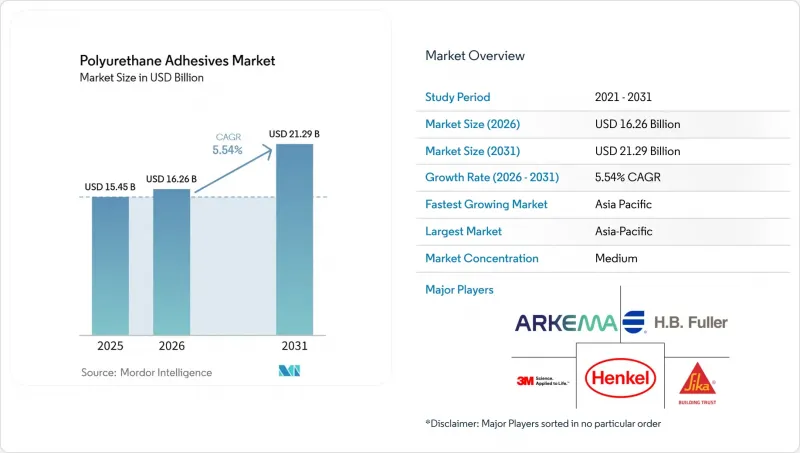
本報告按技術(熱熔型、反應型、溶劑型等)、終端用戶產業(航太、汽車、建築施工、鞋類和皮革、醫療保健、包裝、木工和細木工等)以及地區(亞太地區、北美、歐洲、南美、中東和非洲)進行細分。市場預測以美元計價。
全球聚氨酯黏合劑市場趨勢及洞察
亞太地區新興經濟體的建築業蓬勃發展
在印度,「國家基礎設施管道」計畫下的資本投資增加,刺激了對幕牆、地板材料和預製內部裝潢建材的需求,這些材料均採用結構聚氨酯接著劑黏合。在中國,建築應用已佔黏合劑產量的很大一部分,而成長軸心正轉向電池模組、太陽能電池陣列和航太組件,這些領域更青睞低VOC、快乾型膠合劑。能夠證明其產品具有低殘留單體含量和全生命週期耐久性的供應商,在大規模公共競標中更受青睞。區域基礎設施項目的規模擴大,增強了批量採購的議價能力,永續性化學產品也因此更受青睞。隨著專案日益關注淨零排放目標,適用於自動化噴塗和麵板層壓的聚氨酯配方正在取代溶劑型環氧樹脂。
汽車和航太OEM製造商的輕量化趨勢
汽車製造商正以黏合劑多材料接頭取代焊接加強件,以提高燃油效率並增強碰撞時的能量吸收。聚氨酯系統透過提供減振和填充間隙的柔軟性,與電動車電池組中的剛性環氧樹脂結構形成互補。在航太領域,海克塞爾的Modipur射出成型成型聚氨酯能夠以低溫和短週期固化複雜的複合材料零件,從而拓展了其大規模生產應用範圍。 BMWi3/i8和空中巴士A350等OEM案例凸顯了對能夠維持碳纖維複合材料中纖維完整性的黏合劑的需求。由此產生的需求轉變,使得人們開始關注針對拉伸強度、耐熱循環性和耐化學性進行最佳化的聚氨酯。在長期合約中,能夠提供與各種基材相容性和疲勞壽命等檢驗資料的供應商更受青睞。
二苯基甲烷二異氰酸酯和甲苯二異氰酸酯原料價格的波動
2025年,由於下游需求疲軟,異氰酸酯的運轉率仍然很低。預計2026年的價格復甦將更取決於停產和產業重組,而非銷售量成長。歐洲生產商正面臨能源成本飆升和亞洲廉價進口產品帶來的利潤壓力,儘管中美暫停加徵關稅使物流趨於穩定,但這並未提振需求。黏合劑生產商難以將成本波動轉嫁到價格上,隨著利潤空間受到擠壓,他們正在加快尋找超低單體或無異氰酸酯的替代品。這些趨勢迫使加工商轉向脂肪族無溶劑聚氨酯和混合化學技術,這些技術對原料價格波動的敏感度較低。
細分市場分析
至2025年,反應型聚氨酯接著劑將佔據32.21%的市場。這主要得益於其無溶劑特性、濕氣固化性能以及在層壓板、複合材料和多層薄膜中久經考驗的優異性能。在該類別中,超低單體含量的產品能夠加快生產線速度並縮短固化時間,從而擴大高通量軟性包裝生產線聚氨酯接著劑的複合年成長率將達到7.12%,其透明黏合和低熱應力特性正吸引醫療設備和電子組裝製造商的注意。
短波紫外線引發劑如今可在不到 5 秒內實現完全固化,從而實現線上品質檢測並減少在製品庫存。水性聚氨酯分散體在鞋類製造領域也正不斷擴大市場佔有率,因為低 VOC 含量和更安全的工作環境對鞋類製造至關重要。隨著加工商維修生產線以實現精確稱重和機器人控制的輪胎邊緣,專為自動化點膠設計的混合化學成分聚氨酯黏合劑市場需求日益成長。能夠提供流變性能變異性、噴嘴堵塞阻力和固化後初始強度等數據的供應商,正在鞏固其作為首選供應商的地位,並擴大中型加工商升級設備後聚氨酯黏合劑的市場佔有率。
區域分析
預計到2025年,亞太地區將佔據45.20%的市場佔有率,並預計在2026年至2031年間以7.34%的年均複合成長率成長。該地區的基建投資正持續推動對面板、地板和組裝的需求。為此,當地領先企業正在拓展設計能力,以滿足該地區對軟性包裝、太陽能組件和新能源汽車日益成長的需求。此外,印尼和泰國都市區維修計畫的激增也推動了對低VOC內外牆黏合劑系統的需求,進一步拓展了聚氨酯黏合劑市場的機會。
在北美和歐洲,模組化住宅、自動化汽車生產線和航太複合材料領域對智慧結構性黏著劑的需求強勁。西卡在德克薩斯德克薩斯州錫利市的擴張以及漢高基於人工智慧的電池黏合劑平台,都清楚地表明了該地區對高黏度和特種等級膠粘劑的重視,這些膠粘劑能夠縮短開發週期。隨著REACH法規和加州空氣品質管理區(AQMD)法規的日益嚴格,水性膠粘劑和反應型混合膠粘劑的訂單量不斷成長,從而擴大了對化學成分受監管的聚氨酯黏合劑的市場需求。
在南美洲、中東和非洲,西卡在巴西和摩洛哥新建的砂漿和外加劑工廠正在推動市場成長。巴西和摩洛哥的公共住宅計畫和可再生能源園區需要高耐久性和耐候性的黏合劑生產線,這推動了聚氨酯黏合劑的市場滲透,即使在紫外線照射強烈和熱循環頻繁的氣候條件下也是如此。儘管人均消費量尚未達到已開發地區的水平,但穩步推進的基礎設施建設預計將為那些實現本地化技術支援和庫存的供應商帶來兩位數的銷售成長。
其他好處:
- Excel格式的市場預測(ME)表
- 3個月的分析師支持
目錄
第1章:引言
- 研究假設和市場定義
- 調查範圍
第2章:調查方法
第3章執行摘要
第4章 市場狀況
- 市場概覽
- 市場促進因素
- 亞太地區新興國家的建築業蓬勃發展
- 汽車和航太製造商的輕量化趨勢
- 從溶劑型化學技術轉型為反應型和環境友善化學技術
- 模組化異地建造工藝的興起
- 人工智慧控制的配料機器人在組裝中迅速普及
- 市場限制因素
- MDI/TDI原物料價格波動
- 歐盟和美國對揮發性有機化合物和異氰酸酯的暴露有嚴格的規定。
- 來自矽烷改質聚醚(SMP)體系的競爭日益加劇
- 價值鏈分析
- 監理情勢
- 波特五力模型
- 終端用戶趨勢
- 航太
- 車
- 建築/施工
- 鞋類和皮革
- 包裝
- 木工和細木工
第5章 市場規模與成長預測
- 透過技術
- 熱熔膠
- 反應型
- 溶劑型
- 紫外線固化
- 水性塗料
- 按最終用戶行業分類
- 航太
- 車
- 建築/施工
- 鞋類和皮革
- 衛生保健
- 包裝
- 木工和細木工
- 其他終端用戶產業
- 按地區
- 亞太地區
- 中國
- 日本
- 印度
- 韓國
- 印尼
- 泰國
- 馬來西亞
- 新加坡
- 澳洲
- 其他亞太國家
- 北美洲
- 美國
- 加拿大
- 墨西哥
- 歐洲
- 德國
- 法國
- 英國
- 義大利
- 西班牙
- 俄羅斯
- 其他歐洲國家
- 南美洲
- 巴西
- 阿根廷
- 其他南美國家
- 中東和非洲
- 沙烏地阿拉伯
- 南非
- 其他中東和非洲國家
- 亞太地區
第6章 競爭情勢
- 市場集中度
- 策略趨勢
- 市佔率和排名分析
- 公司簡介
- 3M
- Arkema
- Ashland Global Holdings Inc.
- Avery Dennison Corp.
- Beijing Comens New Materials
- Dow Inc.
- HB Fuller Company
- Henkel AG & Co. KGaA
- Hubei Huitian New Materials
- Huntsman International LLC
- Jowat SE
- Kangda New Materials Group
- MAPEI SpA
- NANPAO Resins Chemical Group
- Parker Hannifin(Lord Corp.)
- Permabond LLC
- Pidilite Industries Ltd.
- Sika AG
- Soudal Holding NV
- Wacker Chemie AG
第7章 市場機會與未來展望
According to Mordor Intelligence, the polyurethane adhesives market size is expected to increase from USD 15.45 billion in 2025 to USD 16.26 billion in 2026 and reach USD 21.29 billion by 2031, growing at a CAGR of 5.54% over 2026-2031.
This report is Segmented by Technology (Hot Melt, Reactive, Solvent-Borne, and More), End User Industry (Aerospace, Automotive, Building and Construction, Footwear and Leather, Healthcare, Packaging, Woodworking and Joinery, and Others), and Geography (Asia-Pacific, North America, Europe, South America, and the Middle-East and Africa). The Market Forecasts are Provided in Terms of Value (USD).
Global Polyurethane Adhesives Market Trends and Insights
Construction Boom in Emerging Asia-Pacific Economies
India's stepped-up capital expenditure under the National Infrastructure Pipeline is stimulating demand for curtain walls, flooring, and prefab interiors bonded with structural polyurethane adhesives. In China, construction applications already represent a major share of adhesive output value, and growth is pivoting toward battery modules, photovoltaic arrays, and aerospace assemblies that favor low-VOC, fast-cure grades. Suppliers that can certify low residual monomer content and lifecycle durability are gaining preferred-vendor status on large public tenders. The scale of regional infrastructure programs offers procurement leverage that rewards high-volume, sustainability-aligned chemistries. As projects emphasize net-zero targets, polyurethane formulations compatible with automated spraying and panel lamination are displacing solvent-borne epoxies.
Light-Weighting Trend Across Automotive and Aerospace Original Equipment Manufacturers
Automakers are replacing welded reinforcements with adhesive-bonded multi-material joints to enhance fuel economy and crash energy absorption. Polyurethane systems supply vibration damping and gap-filling flexibility, complementing rigid epoxy structures in electric-vehicle battery packs. In aerospace, Hexcel's Modipur injection polyurethane allows complex composite components to cure at low temperatures and short cycles, broadening high-volume applications. OEM examples such as BMW i3/i8 and Airbus A350 underscore the requirement for adhesives that preserve fiber integrity in carbon composites. The resulting demand shift favors polyurethanes tuned for elongation, thermal cycling, and chemical resistance. Long-term contracts reward suppliers offering validated data for multi-substrate compatibility and fatigue life.
Volatility in Methylene Diphenyl Diisocyanate and Toluene Diisocyanate Raw-Material Prices
Weak downstream demand kept isocyanate operating rates moderate in 2025, and price recovery in 2026 hinges more on outages or consolidation than on volume growth. European producers face margin pressure from elevated energy costs and cheaper Asian imports, while the United States-China tariff suspensions have stabilized logistics without boosting demand. Adhesive formulators struggle to pass through cost swings, compressing margins and accelerating the search for ultra-low-monomer or isocyanate-free alternatives. This dynamic nudges converters toward aliphatic solvent-free polyurethane or hybrid chemistries that insulate them from raw-material volatility.
Other drivers and restraints analyzed in the detailed report include:
- Shift From Solvent-Borne to Reactive and Eco-Friendly Chemistries
- Emergence of Modular Off-Site Construction Processes
- Stringent VOC and Isocyanate-Exposure Regulations
For complete list of drivers and restraints, kindly check the Table Of Contents.
Segment Analysis
Reactive systems accounted for a 32.21% share of the polyurethane adhesives market in 2025, reflecting their solvent-free nature, moisture-curing profile, and proven performance on laminates, composites, and multi-layer films. Within this cohort, ultra-low-monomer variants are increasing line speeds and shortening cure windows, thereby expanding the polyurethane adhesives market size for high-throughput flexible packaging lines. UV-cured grades, projected to advance at a 7.12% CAGR between 2026 and 2031, attract medical-device and electronics assemblers that need clear bonds and minimal thermal stress.
Short-wave UV initiators now deliver full cure in under five seconds, enabling inline quality checks and reducing work-in-process inventory. Water-borne polyurethane dispersions are also gaining share in footwear stations that target lower VOC profiles and safer work environments. As converters retrofit lines for precision metering and robot-controlled bead placement, the polyurethane adhesives market records higher pull-through for hybrid chemistries tailored to automated dispensing. Suppliers offering data on rheology drift, nozzle clog resistance, and post-cure green strength solidify preferred-supplier status, expanding the polyurethane adhesives market size within midsize converters upgrading equipment.
Geography Analysis
Asia-Pacific held 45.20% of the market in 2025 and is forecast to grow at 7.34% through 2026 to 2031. Infrastructure investments in the region are fueling sustained demand for panel, flooring, and module assemblies. In response, domestic leaders are expanding design capacities to meet increasing regional needs in flexible packaging, solar modules, and new-energy vehicles. Additionally, as urban retrofits surge in Indonesia and Thailand, there's an increasing demand for low-VOC facade and interior bonding systems, further amplifying opportunities in the polyurethane adhesives market.
North America and Europe show solid replacement demand for smart structural adhesives in modular housing, automated automotive lines, and aerospace composites. Sika's expansion in Sealy, Texas, and Henkel's AI-enabled battery-adhesive platform illustrate regional commitment to high-viscosity and specialty grades that shorten development cycles. Stricter REACH and California AQMD limits steer orders toward water-borne and reactive hybrids, enlarging the polyurethane adhesives market size for compliance-ready chemistries.
South America, the Middle-East, and Africa benefit from Sika's new mortar and admixture plants in Brazil and Morocco. Public housing programs and renewable-energy parks in Brazil and Morocco favor durable, weather-resistant bond lines, extending polyurethane adhesives market penetration into climates with high UV exposure and thermal cycling. Although per-capita consumption trails developed regions, steady infrastructure pipelines promise double-digit volume gains for suppliers that localize technical support and stocking points.
- 3M
- Arkema
- Ashland Global Holdings Inc.
- Avery Dennison Corp.
- Beijing Comens New Materials
- Dow Inc.
- H.B. Fuller Company
- Henkel AG & Co. KGaA
- Hubei Huitian New Materials
- Huntsman International LLC
- Jowat SE
- Kangda New Materials Group
- MAPEI S.p.A.
- NANPAO Resins Chemical Group
- Parker Hannifin (Lord Corp.)
- Permabond LLC
- Pidilite Industries Ltd.
- Sika AG
- Soudal Holding N.V.
- Wacker Chemie AG
Additional Benefits:
- The market estimate (ME) sheet in Excel format
- 3 months of analyst support
TABLE OF CONTENTS
1 Introduction
- 1.1 Study Assumptions and Market Definition
- 1.2 Scope of the Study
2 Research Methodology
3 Executive Summary
4 Market Landscape
- 4.1 Market Overview
- 4.2 Market Drivers
- 4.2.1 Construction boom in emerging Asia-Pacific economies
- 4.2.2 Light-weighting trend across automotive and aerospace OEMs
- 4.2.3 Shift from solvent-borne to reactive, eco-friendly chemistries
- 4.2.4 Emergence of modular off-site construction processes
- 4.2.5 Rapid adoption of AI-controlled dispensing robots on assembly lines
- 4.3 Market Restraints
- 4.3.1 Volatility in MDI/TDI raw-material prices
- 4.3.2 Stringent VOC and isocyanate-exposure regulations, esp. in EU and US
- 4.3.3 Growing competition from silane-modified polyether (SMP) systems
- 4.4 Value Chain Analysis
- 4.5 Regulatory Landscape
- 4.6 Porter's Five Forces
- 4.6.1 Threat of New Entrants
- 4.6.2 Bargaining Power of Suppliers
- 4.6.3 Bargaining Power of Buyers
- 4.6.4 Threat of Substitute Products
- 4.6.5 Competitive Rivalry
- 4.7 End-User Trends
- 4.7.1 Aerospace
- 4.7.2 Automotive
- 4.7.3 Building and Construction
- 4.7.4 Footwear and Leather
- 4.7.5 Packaging
- 4.7.6 Woodworking and Joinery
5 Market Size and Growth Forecasts (Value)
- 5.1 By Technology
- 5.1.1 Hot Melt
- 5.1.2 Reactive
- 5.1.3 Solvent-borne
- 5.1.4 UV Cured
- 5.1.5 Water-borne
- 5.2 By End-user Industry
- 5.2.1 Aerospace
- 5.2.2 Automotive
- 5.2.3 Building and Construction
- 5.2.4 Footwear and Leather
- 5.2.5 Healthcare
- 5.2.6 Packaging
- 5.2.7 Woodworking and Joinery
- 5.2.8 Other End-user Industries
- 5.3 By Geography
- 5.3.1 Asia-Pacific
- 5.3.1.1 China
- 5.3.1.2 Japan
- 5.3.1.3 India
- 5.3.1.4 South Korea
- 5.3.1.5 Indonesia
- 5.3.1.6 Thailand
- 5.3.1.7 Malaysia
- 5.3.1.8 Singapore
- 5.3.1.9 Australia
- 5.3.1.10 Rest of Asia-Pacific
- 5.3.2 North America
- 5.3.2.1 United States
- 5.3.2.2 Canada
- 5.3.2.3 Mexico
- 5.3.3 Europe
- 5.3.3.1 Germany
- 5.3.3.2 France
- 5.3.3.3 United Kingdom
- 5.3.3.4 Italy
- 5.3.3.5 Spain
- 5.3.3.6 Russia
- 5.3.3.7 Rest of Europe
- 5.3.4 South America
- 5.3.4.1 Brazil
- 5.3.4.2 Argentina
- 5.3.4.3 Rest of South America
- 5.3.5 Middle-East and Africa
- 5.3.5.1 Saudi Arabia
- 5.3.5.2 South Africa
- 5.3.5.3 Rest of Middle-East and Africa
- 5.3.1 Asia-Pacific
6 Competitive Landscape
- 6.1 Market Concentration
- 6.2 Strategic Moves
- 6.3 Market Share (%)/Ranking Analysis
- 6.4 Company Profiles (includes Global level Overview, Market level overview, Core Segments, Financials as available, Strategic Information, Products and Services, and Recent Developments)
- 6.4.1 3M
- 6.4.2 Arkema
- 6.4.3 Ashland Global Holdings Inc.
- 6.4.4 Avery Dennison Corp.
- 6.4.5 Beijing Comens New Materials
- 6.4.6 Dow Inc.
- 6.4.7 H.B. Fuller Company
- 6.4.8 Henkel AG & Co. KGaA
- 6.4.9 Hubei Huitian New Materials
- 6.4.10 Huntsman International LLC
- 6.4.11 Jowat SE
- 6.4.12 Kangda New Materials Group
- 6.4.13 MAPEI S.p.A.
- 6.4.14 NANPAO Resins Chemical Group
- 6.4.15 Parker Hannifin (Lord Corp.)
- 6.4.16 Permabond LLC
- 6.4.17 Pidilite Industries Ltd.
- 6.4.18 Sika AG
- 6.4.19 Soudal Holding N.V.
- 6.4.20 Wacker Chemie AG
7 Market Opportunities and Future Outlook
- 7.1 White-space and Unmet-Need Assessment

 全球聚氨酯黏合劑市場:按技術、類型、終端應用產業和地區分類-預測至2031年
 聚氨酯黏合劑市場:按類型、技術、形態、終端應用產業和分銷管道分類-2026-2032年全球市場預測
 聚氨酯黏合劑市場規模、佔有率和成長分析:按類型、樹脂類型、基材、應用和地區分類-2026-2033年產業預測
 歐洲聚氨酯黏合劑:市場佔有率分析、產業趨勢和統計數據以及成長預測(2026-2031 年)亞太地區聚氨酯黏合劑:市場佔有率分析、產業趨勢與統計及成長預測(2026-2031)
 全球聚氨酯接著劑市場規模、佔有率、趨勢和成長分析報告(2026-2034年)
 2026年全球聚氨酯接著劑市場報告電子產業用聚氨酯(PU)黏合劑:市場佔有率分析、產業趨勢與統計、成長預測(2026-2031)
 聚氨酯接著劑的全球市場:類別,各技術,各終端用戶業界,各地區,機會,預測,2018年~2032年中東和非洲聚氨酯(PU)黏合劑市場佔有率分析、產業趨勢和成長預測(2025-2030)