


 |
市場調查報告書
商品編碼
2066696
歐洲聚氨酯黏合劑:市場佔有率分析、產業趨勢和統計數據以及成長預測(2026-2031 年)Europe Polyurethane Adhesives - Market Share Analysis, Industry Trends & Statistics, Growth Forecasts (2026 - 2031) |
||||||

※ 本網頁內容可能與最新版本有所差異。詳細情況請與我們聯繫。
據 Mordor Intelligence 稱,2025 年歐洲聚氨酯黏合劑市值為 42.1 億美元,預計到 2031 年將從 2026 年的 44.7 億美元成長至 60.1 億美元,預測期(2026-2031 年)複合年成長率為 6.11%。
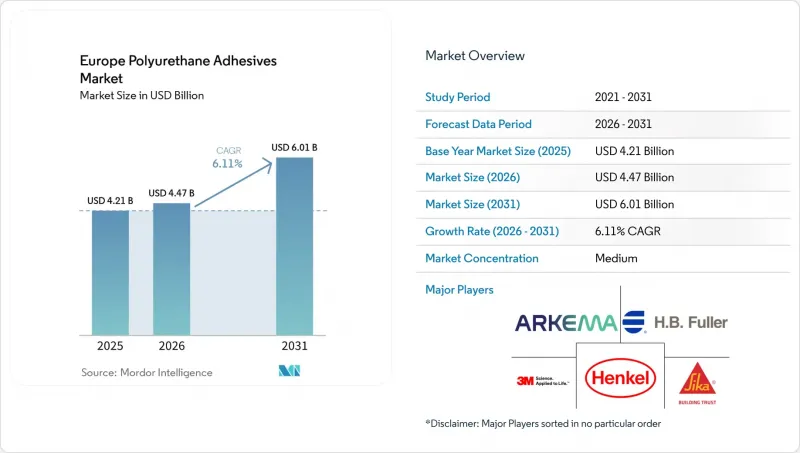
本報告按終端用戶產業(航太、汽車、建築施工、鞋類和皮革、木工和細木工等)、技術(熱熔膠、反應型膠、溶劑型膠、紫外光固化膠、水性膠)和地區(德國、法國、義大利、俄羅斯、西班牙、英國、北歐國家和其他歐洲國家)進行細分。市場預測以美元計價。
歐洲聚氨酯黏合劑市場趨勢與洞察
輕型汽車和結構膠粘劑的快速發展
在歐洲,電池式電動車(BEV) 的產量正顯著成長,與前一年相比增幅顯著。目前,每輛純電動車使用的結構性黏著劑數量遠超過內燃機汽車。隨著德國、法國和西班牙的超級工廠擴大產能,未來幾年,驅動電池黏接用反應型聚氨酯的需求成長速度預計將超過汽車整體產量的成長速度。先進的聚氨酯系統在電動車電池組的組裝上應用日益廣泛。這些系統在提供結構強度和導熱性的同時,取代了傳統的機械緊固件,從而顯著降低了電池組的重量。 「SikaForce-7888 L30」因其在鋁和複合材料黏合方面的卓越性能而備受認可,目前已被德國和法國的多家主要汽車製造商採用。此外,贏創的室溫固化灌封膠具有高介電強度,可同時滿足電氣絕緣和減振需求。這凸顯了現代聚氨酯系統在不斷發展的汽車產業中扮演的重要角色。
強制使用節能型建築隔熱材料
《建築能源性能指令》規定新建築必須實現零排放,並要求成員國維修非住宅建築中能源效率最低的部分。在外牆維修中,聚氨酯黏合劑用於固定硬發泡板,這些配方必須符合歐盟《裝飾塗料指令》的要求,該指令對揮發性有機化合物(VOC)進行監管。德國的獎勵措施顯著提高了對保溫外牆的需求,導致黏合劑消耗量大幅增加。儘管價格較高,漢高公司推出的無溶劑型黏合劑「Patex PL Premium」在上市後迅速佔據了德國DIY市場的大部分佔有率。這顯示消費者強烈願意投資低排放產品。北歐建築標準對U值有嚴格的要求,芬蘭每平方公尺建築圍護結構的黏合劑用量高於歐洲平均。這被認為是西歐未來消費趨勢的指標。
二異氰酸酯的價格和供應波動
2025年第一季,受亞洲地區不可抗力因素導致的停工以及紅海航運延誤的影響,甲苯二異氰酸酯現貨價格出現兩位數成長,歐洲加工商的原料成本較上一季度上漲高達18%。亞二苯基甲烷二異氰酸酯酯的合約價格也出現類似上漲。為因應地緣政治動盪導致的原物料價格飆升,陶氏化學在2026年初大幅提高了聚合物分散體的價格。瓦克化學在其位於Nunkrits的工廠擴大了α-矽烷雜化產品的產能,旨在減少對芳香族異氰酸酯的依賴,但其高昂的單位成本限制了其在高階應用領域的應用。中小規模的混煉生產商缺乏整合上游工程所需的資金,因此極易受到市場供應波動的影響,並且在現貨價格飆升時面臨營運資金短缺的問題。
細分市場分析
2025年,汽車產業佔據了歐洲聚氨酯黏合劑市場23.18%的佔有率。這主要歸功於電池組、結構和內裝應用領域對反應型黏合劑的需求。電動車電池的黏合需要大量的黏合劑,而陶氏化學的VORATRON和西卡Force平台已佔據了大部分新規格的市場。儘管目前規模仍然相對較小,但電氣和電子產業預計將呈現最高的成長率,2026年至2031年的複合年成長率將達到6.58%。這是因為功率半導體模組受益於聚氨酯灌封化合物,該化合物能夠有效防止熱循環和振動。建築業正在積極響應《建築能源性能指令》(EPBD)的修訂,強制性維修工程佔據了相當大的市場佔有率。在歐洲,義大利和西班牙的鞋類製造商擴大採用低揮發性有機化合物(VOC)排放的水性分散體,從而實現了穩定的年成長。雖然醫療產業是一個小眾領域,但其利潤率很高,尤其是在通過 ISO 10993 認證的等級產品方面,例如廣泛用於胰島素幫浦的「樂泰 AA 3952」。包裝、木工和航太等行業的需求趨勢進一步多元化,預計未來幾年木工行業對濕固化單組分組合藥物的需求將顯著成長。
其他好處:
- Excel格式的市場預測(ME)表
- 3個月的分析師支持
目錄
第1章:引言
- 研究假設和市場定義
- 調查範圍
第2章:調查方法
第3章執行摘要
第4章 市場狀況
- 市場概覽
- 市場促進因素
- 汽車輕量化和結構黏合技術的蓬勃發展。
- 強制使用節能建築隔熱材料
- 透過歐盟綠色新政推廣低揮發性有機化合物和無溶劑體系
- 模組化木造建築的普及
- 歐洲醫療設備組裝中的反應性聚氨酯
- 市場限制因素
- 二異氰酸酯的價格和供應波動
- 關於免費NCO內容的REACH法規更嚴格
- 生物基黏合劑替代品的市場佔有率正在擴大。
- 價值鏈分析
- 監管分析
- 波特五力分析
- 分銷通路分析
第5章 市場規模與成長預測
- 終端用戶產業
- 航太
- 車
- 建築/施工
- 鞋類和皮革
- 衛生保健
- 包裝
- 木工和細木工
- 其他終端用戶產業
- 科技
- 熱熔膠
- 反應型
- 溶劑型
- 紫外線固化
- 水系
- 地區
- 德國
- 法國
- 義大利
- 俄羅斯
- 西班牙
- 英國
- 北歐國家
- 其他歐洲國家
第6章 競爭情勢
- 市場集中度
- 關鍵策略趨勢
- 市佔率和排名分析
- 公司簡介
- 3M
- Arkema
- BASF
- Beardow Adams
- DELO Industrial Adhesives
- Dow Inc.
- HB Fuller Company
- Henkel AG & Co. KGaA
- Huntsman International LLC
- ITW Performance Polymers
- Jowat SE
- MAPEI SpA
- Momentive Performance Materials
- PARKER HANNIFIN CORP
- Sika AG
- Soudal Holding NV
- Tesa Tapes(India)Private Limited
- ThreeBond Europe
- Wacker Chemie AG
第7章 市場機會與未來展望
According to Mordor Intelligence, the europe polyurethane adhesives market size was valued at USD 4.21 billion in 2025 and is estimated to grow from USD 4.47 billion in 2026 to reach USD 6.01 billion by 2031, at a CAGR of 6.11% during the forecast period (2026-2031).
This report is Segmented by End-User Industry (Aerospace, Automotive, Building and Construction, Footwear and Leather, Woodworking and Joinery, and More), Technology (Hot Melt, Reactive, Solvent-Borne, UV Cured, and Water-Borne), and Geography (Germany, France, Italy, Russia, Spain, United Kingdom, NORDIC Countries, and Rest of Europe). The Market Forecasts are Provided in Terms of Value (USD).
Europe Polyurethane Adhesives Market Trends and Insights
Automotive Lightweighting and Structural Bonding Boom
Europe has seen significant growth in battery electric vehicle (BEV) production, with a notable increase compared to the previous year. Each BEV now uses significantly more structural adhesive than internal-combustion vehicles. As gigafactories in Germany, France, and Spain expand their output, the demand for reactive polyurethane in traction-battery bonding is expected to grow at a faster pace than overall automotive production in the coming years. Electric-vehicle battery pack assembly increasingly relies on advanced polyurethane systems. These systems provide structural strength and thermal conductivity while replacing traditional mechanical fasteners, resulting in a notable reduction in pack weight. SikaForce-7888 L30 has gained approval for its effectiveness in aluminum-to-composite joints and is now specified by several major car manufacturers in Germany and France. Additionally, Evonik's ambient-cure potting compounds offer high dielectric strength, addressing both electrical isolation and vibration damping, highlighting the critical role of modern polyurethane systems in the evolving automotive industry.
Energy-Efficient Building Insulation Mandates
The Energy Performance of Buildings Directive mandates zero-emission new constructions and requires member states to renovate the least energy-efficient portion of non-residential buildings. In facade retrofits, polyurethane adhesives are used to secure rigid foam panels, but these formulations must comply with the EU Decopaint Directive, which limits volatile organic compounds (VOCs). Incentives in Germany have significantly increased demand for insulated facades, driving notable growth in adhesive consumption. Despite being priced higher, Henkel's solvent-free Pattex PL Premium has gained a significant share of the German DIY market shortly after its launch, highlighting consumers' willingness to invest in low-emission products. Nordic building codes enforce strict U-value requirements, and Finland's adhesive usage per square meter of building envelope exceeds the European average, indicating potential consumption trends for Western Europe.
Diisocyanate Price and Supply Volatility
Force-majeure outages in Asia and Red Sea shipping delays lifted toluene diisocyanate spot prices by double digits in Q1 2025, raising European converters' input costs by up to 18% quarter-on-quarter. Contract methylene-diphenyl diisocyanate prices moved in tandem, and Dow passed through broad polymer dispersion hikes in early 2026 to counter feedstock inflation amid geopolitical unrest. Wacker Chemie's capacity ramp-up of alpha-silane hybrids at Nunchritz provides a hedge against aromatic-isocyanate dependency, but higher unit costs limit adoption to premium uses. Smaller formulators lack the capital to integrate upstream, leaving them exposed to merchant-supply shocks and squeezing working capital when spot prices spike.
Other drivers and restraints analyzed in the detailed report include:
- EU Green Deal Push for Low- Volatile Organic Compound (VOC), Solvent-Free Systems
- Reactive Polyurethanes in European Medical-Device Assembly
- Tightening REACH Limits on Free NCO Content
For complete list of drivers and restraints, kindly check the Table Of Contents.
Segment Analysis
The automotive segment accounted for 23.18% of the Europe Polyurethane Adhesives market size in 2025, as battery pack, structural, and interior applications all require reactive systems. The bonding of electric vehicle batteries required a significant amount of adhesive, with Dow's VORATRON and SikaForce platforms winning most new specifications. Electrical and electronics remain smaller but post the fastest 6.58% CAGR between 2026 and 2031 as power-semiconductor modules benefit from polyurethane potting compounds, which shield them from heat cycling and vibrations. The building and construction sector, responding to the Energy Performance of Buildings Directive (EPBD) recast, represents a significant share of the volume under mandated retrofits. In Europe, footwear manufacturers in Italy and Spain are increasingly adopting water-borne dispersions with low volatile organic compound (VOC) emissions, showing steady annual growth. While healthcare occupies a niche segment, it commands premium margins, especially for ISO 10993-certified grades like Loctite AA 3952, prominently used in insulin pumps. The demand landscape is further diversified by packaging, woodworking, and aerospace sectors, with woodworking expected to see notable consumption of moisture-cure one-component formulations in the coming years.
List of Companies Covered in this Report:
- 3M
- Arkema
- BASF
- Beardow Adams
- DELO Industrial Adhesives
- Dow Inc.
- H.B. Fuller Company
- Henkel AG & Co. KGaA
- Huntsman International LLC
- ITW Performance Polymers
- Jowat SE
- MAPEI S.p.A.
- Momentive Performance Materials
- PARKER HANNIFIN CORP
- Sika AG
- Soudal Holding N.V.
- Tesa Tapes (India) Private Limited
- ThreeBond Europe
- Wacker Chemie AG
Additional Benefits:
- The market estimate (ME) sheet in Excel format
- 3 months of analyst support
TABLE OF CONTENTS
1 Introduction
- 1.1 Study Assumptions and Market Definition
- 1.2 Scope of the Study
2 Research Methodology
3 Executive Summary
4 Market Landscape
- 4.1 Market Overview
- 4.2 Market Drivers
- 4.2.1 Automotive lightweighting and structural bonding boom
- 4.2.2 Energy-efficient building insulation mandates
- 4.2.3 EU Green Deal push for low-VOC, solvent-free systems
- 4.2.4 Modular timber construction adoption
- 4.2.5 Reactive PURs in European medical-device assembly
- 4.3 Market Restraints
- 4.3.1 Diisocyanate price and supply volatility
- 4.3.2 Tightening REACH limits on free NCO content
- 4.3.3 Bio-based adhesive substitutes gaining share
- 4.4 Value Chain Analysis
- 4.5 Regulatory Analysis
- 4.6 Porter's Five Forces Analysis
- 4.6.1 Threat of New Entrants
- 4.6.2 Bargaining Power of Suppliers
- 4.6.3 Bargaining Power of Buyers
- 4.6.4 Threat of Substitutes
- 4.6.5 Competitive Rivalry
- 4.7 Distribution Channel Analysis
5 Market Size and Growth Forecasts (Value)
- 5.1 End-User Industry
- 5.1.1 Aerospace
- 5.1.2 Automotive
- 5.1.3 Building and Construction
- 5.1.4 Footwear and Leather
- 5.1.5 Healthcare
- 5.1.6 Packaging
- 5.1.7 Woodworking and Joinery
- 5.1.8 Other End-user Industries
- 5.2 Technology
- 5.2.1 Hot-Melt
- 5.2.2 Reactive
- 5.2.3 Solvent-borne
- 5.2.4 UV-Cured
- 5.2.5 Water-borne
- 5.3 Geography
- 5.3.1 Germany
- 5.3.2 France
- 5.3.3 Italy
- 5.3.4 Russia
- 5.3.5 Spain
- 5.3.6 United Kingdom
- 5.3.7 NORDIC Countries
- 5.3.8 Rest of Europe
6 Competitive Landscape
- 6.1 Market Concentration
- 6.2 Key Strategic Moves
- 6.3 Market Share (%)/Ranking Analysis
- 6.4 Company Profiles (includes Global-level Overview, Market-level Overview, Core Segments, Financials as available, Strategic Information, Products & Services, and Recent Developments)
- 6.4.1 3M
- 6.4.2 Arkema
- 6.4.3 BASF
- 6.4.4 Beardow Adams
- 6.4.5 DELO Industrial Adhesives
- 6.4.6 Dow Inc.
- 6.4.7 H.B. Fuller Company
- 6.4.8 Henkel AG & Co. KGaA
- 6.4.9 Huntsman International LLC
- 6.4.10 ITW Performance Polymers
- 6.4.11 Jowat SE
- 6.4.12 MAPEI S.p.A.
- 6.4.13 Momentive Performance Materials
- 6.4.14 PARKER HANNIFIN CORP
- 6.4.15 Sika AG
- 6.4.16 Soudal Holding N.V.
- 6.4.17 Tesa Tapes (India) Private Limited
- 6.4.18 ThreeBond Europe
- 6.4.19 Wacker Chemie AG
7 Market Opportunities and Future Outlook
- 7.1 White-space and Unmet-Need Assessment

 擋風玻璃聚氨酯接著劑市場:全球市場預測,2026-2032年複合薄膜用雙組分聚氨酯接著劑市場:全球市場預測(2026-2032年)
 聚氨酯黏合劑市場:按產品類型、技術、終端應用產業和地區分類
 全球聚氨酯黏合劑市場:按技術、類型、終端應用產業和地區分類-預測至2031年聚氨酯黏合劑市場:按類型、技術、形態、終端應用產業和分銷管道分類-2026-2032年全球市場預測
 聚氨酯黏合劑市場規模、佔有率和成長分析:按類型、樹脂類型、基材、應用和地區分類-2026-2033年產業預測
 全球聚氨酯接著劑市場規模、佔有率、趨勢和成長分析報告(2026-2034年)
 2026年全球聚氨酯接著劑市場報告
 電子產業用聚氨酯(PU)黏合劑:市場佔有率分析、產業趨勢與統計、成長預測(2026-2031)中東和非洲聚氨酯(PU)黏合劑市場佔有率分析、產業趨勢和成長預測(2025-2030)