


 |
市場調查報告書
商品編碼
2063684
歐洲加工中心:市場佔有率分析、產業趨勢與統計及成長預測(2026-2031 年)Europe Machining Centers - Market Share Analysis, Industry Trends & Statistics, Growth Forecasts (2026 - 2031) |
||||||

※ 本網頁內容可能與最新版本有所差異。詳細情況請與我們聯繫。
據 Mordor Intelligence 稱,2025 年歐洲加工中心市場價值為 49.3 億美元,預計到 2031 年將達到 60.4 億美元,而 2026 年為 51.1 億美元,預測期(2026-2031 年)複合年成長率為 3.40%。
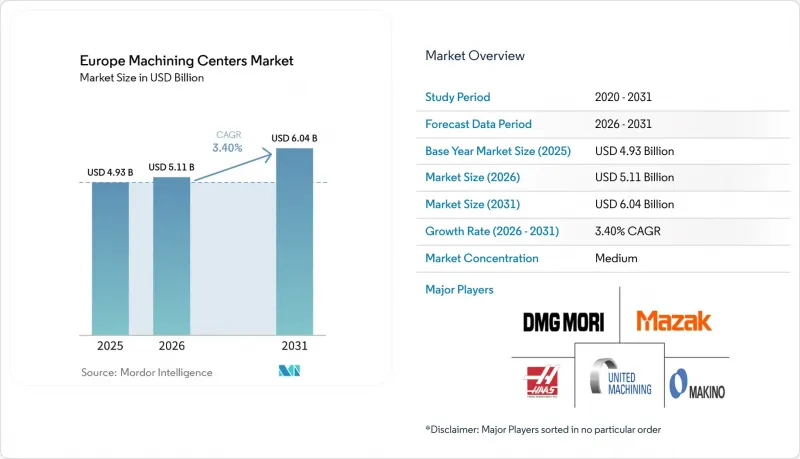
本報告按工具機類型(例如,水平加工中心)、軸配置(3軸、4軸、5軸或更多軸)、主軸方向(水平、垂直、多主軸)、結構類型(立柱式、龍門式、行動工作台式)、最終用戶產業(汽車、其他)和國家(德國、其他國家)進行細分。市場預測以美元 (USD) 為單位。
歐洲加工中心市場的趨勢與洞察
主導車對輕量化零件加工的需求正在加速多軸工具機的普及。
在電池式電動車,鋁製馬達外殼和碳纖維增強複合材料(CFRP)車身部件正取代鑄鐵引擎缸體。這些部件需要採用五軸聯動加工進行輪廓加工,以防止熱變形。寶馬公司投資2.16億美元對其位於蘭斯圖特的工廠進行設備升級,引入了17台工業印表機,日產量達到4500個砂型芯,從而縮短了鑄造週期並降低了能耗。 Stellantis公司在薩拉戈薩的超級工廠進行了大規模投資,產生了大規模的就業需求,遠遠超過了當地的勞動力供應。這種嚴重的勞動力短缺促使製造商採用人工智慧驅動的刀具路徑最佳化技術,以彌補熟練工具機操作員的不足。奇瑞-埃布羅在巴塞隆納的合資企業計劃在2029年實現年產15萬輛的目標,並引入了一台多軸加工中心,該中心可以在一次裝夾中完成帶冷卻通道的鋁製電池托盤的加工。西雅特佔地6.4萬平方公尺的電池工廠預計2026年運作,屆時年產量將達30萬套。每組電池的殼體加工均需通過ISO 9001認證,並具備嚴格的公差要求。整體而言,從三軸臥式加工中心過渡到通用加工中心將縮短設定時間,減少廢品,並加快高精度機械設備的投資回報。
將 HMC/VMC 改造為與工業 4.0 相容,擴展了整個工廠的智慧加工能力。
德國和義大利工具機的平均使用壽命為10-15年,但其堅固的鋼製底座可以透過升級到最新的控制系統,將運作延長10年。海德漢第三代TNC7系統將於2025年發布,支援24個控制迴路,區塊處理時間僅0.5毫秒,能夠根據主軸負載遙測資料即時調整進給速度。 VDW公司的一項案例研究展示了這一潛力:在對一台使用了12年的水平工具機進行改造,加裝西門子SINUMERIK 840D sl控制系統和狀態監測感測器後,加工週期顯著縮短,生產效率顯著提高。為了支持此類升級,歐盟的IPCEI計畫提供了大量資金,降低了改造方案的投資門檻,使中小企業能夠實施數位雙胞胎和自主管理的本地人工智慧系統。有針對性的維修也能顯著提高效率。例如,在馬扎克位於伍斯特的工廠,用兩套自動化光纖系統取代四台老舊的二氧化碳雷射器,使產量提高了40%,電力消耗降低了67%。最終,透過推遲購買新設備,此次維修使資本支出減少了高達70%,從而在訂單減少時提供了顯著的財務靈活性。
歐盟工業生產波動導致的資本投資週期性減少將導致資本投資下降。
2025年上半年,由於汽車製造商因電池化學成分的不確定性而推遲電動車平台模具的投入使用,德國工具機訂單大幅下滑。產量下降了3%,但由於製造商採取減少工時而非裁員的方式,員工人數仍維持在6.4萬人左右,這給利潤率帶來了壓力。根據歐盟統計局的數據,資本財通膨率為1.8%,但儘管2025年略有下降,電力價格仍高於2022年之前的水平。化工產能萎縮了10%,投資暴跌了80%,凸顯了德國製造商在與能源成本更低的美國製造商競爭中的劣勢。客戶正在透過將設備更換週期延長至12-15年並向原始設備製造商(OEM)施壓以尋求長期融資來應對這一局面,這抑制了歐洲加工中心市場的短期成長勢頭。
細分市場分析
2025年,立式加工中心將佔據歐洲加工中心市場35%的佔有率。這主要歸功於其在沖壓模具精加工、醫療微銑床和通用合約加工等領域的靈活應用。三軸機型能夠以極具吸引力的資本投資成本完成模具和矩形汽車零件的粗加工,而四軸旋轉工作台則增加了側銑的定位功能。成長最快的細分市場—通用/五軸平台—預計到2031年將以5.8%的複合年成長率持續成長,因為領先的航太和醫療設備製造商對一次裝夾輪廓加工的需求日益成長。像Okuma的「MULTUS U3000 2SW」這樣的先進車銑複合平台,將12,000轉/分的重型銑床功能整合於雙主軸機架中,面積減少30%,庫存減少40%。隨著人手不足增加無人加工的價值,製造商正在打包托盤池、進程內探測和基於雲端的狀態監控功能,新訂單也正在從基本的立式加工中心轉向其他設備。
零件複雜性的不斷提高進一步推動了這一轉變趨勢。鈦合金渦輪葉片、整形外科關節和鋁製電池托盤都需要使用刀具向量來加工具有可變導程角和倒角的自由曲面。五軸加工循環可將設定時間縮短一半,並提高一次合格率,從而抵消其比同類三軸工具機高出 40-60% 的價格差異。雖然垂直加工中心 (VMC) 已佔據了很大一部分市場佔有率,並且有加裝軸頸和旋轉工作台的轉換套件可供選擇,但許多買家現在選擇從一開始就採用龍門式 Y 軸支撐的全能型機床,以抑制插補過程中的振動。這既能整合程式設計專業知識,又能確保面向未來的生產能力。
到2025年,三軸系統將佔據歐洲加工中心市場42%的佔有率,這主要得益於汽車零件的大規模生產,因為汽車零件的加工元件通常排列在同一平面上。然而,五軸及以上系統的複合年成長率預計將達到6.2%。這是因為同步輪廓加工無需重新定位,可將加工週期縮短一半,並能夠加工各種複雜形狀。 DMG MORI公司將於2026年推出的「DMU 65 H monoBLOCK」擁有453把刀庫,定位精度高達5微米,專為需要連續刀具接觸的渦輪機殼體加工而設計。 FANUCFANUC的緊湊型「Robodrill a-D14MiA5」將五軸運動機構整合到面積不足2平方公尺的超緊湊空間內,使其非常適合安裝在空間有限的醫療植入潔淨室中。
四軸臥式加工中心在引擎缸體和變速箱殼體的加工中仍然很受歡迎,其採用加法托盤的無人值守操作循環允許使用單一夾具進行雙面加工。然而,鈦合金和因科鎳合金加工的激增需要刀具傾斜功能,而四軸機床在不手動重新夾緊的情況下無法實現這一功能,這迫使航太供應商過渡到能夠處理高達 1200 Nm 主軸扭矩的全五軸臥式加工中心。目前,認證機構要求在工廠驗收測試中提供符合 ISO 230-1 和 ISO 230-2 標準的合規報告,這迫使中小型工廠在購買工具機的同時升級其測量儀器和環境控制系統。
其他好處:
- Excel格式的市場預測(ME)表
- 3個月的分析師支持
目錄
第1章:引言
- 研究假設和市場定義
- 調查範圍
第2章:調查方法
第3章執行摘要
第4章 市場狀況
- 市場概覽
- 市場促進因素
- 受電動車 (EV) 需求的推動,對輕量化零件加工的需求正在加速多軸工具機。
- 符合工業 4.0 標準的 HMC/VMC 改造擴展了整個工廠的智慧加工能力。
- 歐盟IPCEI基金促進了對先進工具機生產能力的策略性投資。
- 航太鈦加工業務向東歐的近岸外包增加了對精密加工的需求。
- 引入混合積層製造和切割中心將提高生產的柔軟性和效率。
- 醫療植入對微加工技術的需求不斷成長,推動了超精密機械的應用。
- 市場限制因素
- 歐盟工業生產的波動導致資本投資週期性減少,進而加劇了資本投資的下降。
- 儘管自動化技術的應用日益普及,但熟練的操作人員短缺仍然存在。
- 能源成本上漲正在影響大型龍門式加工中心的業務永續營運。
- 精密主軸和控制器的交付延遲,導致機器部署延遲。
- 價值/供應鏈分析
- 監理情勢
- 技術展望
- 產業吸引力—五力分析
- 新進入者的威脅
- 供應商的議價能力
- 買方的議價能力
- 替代品的威脅
- 競爭公司之間的競爭
第5章 市場規模與成長預測
- 按機器類型
- 臥式加工中心(HMC)
- 立式加工中心(VMC)
- 通用/五軸加工中心
- 多功能加工中心(MTM)
- 其他(龍門/橋式加工中心、車銑複合機床)
- 按軸配置
- 3軸
- 四軸
- 5個或更多軸
- 通過主軸的方位
- 橫版
- 垂直的
- 多軸
- 依結構類型
- 列類型
- 龍門式
- 移動桌類型
- 按最終用戶行業分類
- 車
- 航太/國防
- 能源(石油和天然氣、可再生能源)
- 醫療器材
- 模具製造
- 其他行業(一般製造業、合約製造業、電子產品等)
- 國家
- 德國
- 法國
- 英國
- 西班牙
- 義大利
- 其他歐洲國家
第6章 競爭情勢
- 市場集中度
- 策略趨勢
- 市佔率分析
- 公司簡介
- DMG MORI AG
- Yamazaki Mazak Europe
- GF Machining Solutions(United Grinding Group)
- Makino Europe GmbH
- Haas Automation Europe
- Okuma Europe GmbH
- Doosan Machine Tools
- Chiron Group SE
- Gebr. Heller Maschinenfabrik
- FFG Europe & Americas
- GROB-Werke GmbH
- Hermle AG
- Starrag Group
- Hyundai WIA Europe
- EMCO Group
- Hurco Europe Ltd.
- INDEX-TRAUB Group
- Brother Europe Ltd.
- FANUC Robodrill Europe
- JTEKT Toyoda Europe
第7章 市場機會與未來展望
According to Mordor Intelligence, the europe machining centers market size was valued at USD 4.93 billion in 2025 and is estimated to grow from USD 5.11 billion in 2026 to reach USD 6.04 billion by 2031, at a CAGR of 3.40% during the forecast period (2026-2031).
This report is Segmented by Machine Type (Horizontal Machining Centers, and More), by Axis Configuration (3-Axis, 4-Axis, 5-Axis & Above), by Spindle Orientation (Horizontal, Vertical, Multi-Spindle), by Structure Type (Column-Type, Gantry-Type, Moving-Table), by End-User Industry (Automotive, and More), and by Country (Germany, and More). The Market Forecasts are Provided in Terms of Value (USD).
Europe Machining Centers Market Trends and Insights
EV-Driven Lightweight Component Machining Demand Accelerates Multi-Axis Machine Adoption
Battery-electric vehicles swap cast-iron engine blocks for aluminum e-motor housings and CFRP body parts that require simultaneous five-axis contouring to avoid thermal distortion. BMW's USD 216 million upgrade in Landshut added 17 industrial printers to supply 4,500 sand cores daily, cutting casting cycle time and energy use. Stellantis is directing massive capital investments toward its Zaragoza gigafactory, triggering a large-scale hiring demand that severely outpaces the local talent pool. This profound labor gap is pushing builders to embed AI-assisted tool-path optimization to compensate for the scarcity of master machinists. Chery-Ebro's Barcelona joint venture aims to reach 150,000 units annually by 2029 and is sourcing multi-axis centers capable of finishing aluminum battery trays with cooling channels in a single setup. Seat's 64,000-square-meter battery plant will ship 300,000 systems per year once operational in 2026, each calling for ISO 9001-certified machining of tight-tolerance housings. Altogether, the migration from three-axis horizontals to universal centers shortens changeovers, lowers scrap, and accelerates payback on high-precision machinery.
Industry 4.0-Ready HMC/VMC Retrofits Expand Smart-Machining Capabilities Across Factories
Machine parks across Germany and Italy average 10 to 15 years in age, yet they retain rigid iron foundations capable of performing for another decade when upgraded with modern controls. HEIDENHAIN's TNC7 Generation 3, released in 2025, supports 24 control loops and 0.5-millisecond block times, unlocking real-time feed-rate adaptations based on spindle-load telemetry. Demonstrating this potential, a VDW case study showed significant cycle-time reductions and productivity lifts after a 12-year-old horizontal machine was retrofitted with a Siemens SINUMERIK 840D sl and condition-monitoring sensors. To support these upgrades, vast EU IPCEI funding helps SMEs deploy digital twins and sovereign on-premise AI, easing the investment hurdle for retrofit packages. Targeted retrofits also yield massive efficiency gains; for instance, Mazak's Worcester site swapped four legacy CO2 lasers for two automated fiber systems, boosting output by 40% and trimming power use by 67%. Ultimately, by postponing greenfield purchases, retrofits can shave as much as 70% off capital outlay, a vital financial cushion when order books thin.
Cyclical Capex Cuts Driven by EU Industrial-Output Volatility Reduce Equipment Investments
German machine-tool orders declined sharply in the first half of 2025 as automakers deferred EV-platform tooling amid uncertainty over battery chemistry. Production dropped 3%, yet headcount stayed near 64,000 because builders leaned on shorter workweeks over layoffs, compressing profit margins. Eurostat shows capital-goods inflation at 1.8%, while electricity prices remain structurally above pre-2022 levels despite modest 2025 retreats. Chemical capacity shrank by 10%, and investment plummeted by 80%, underscoring the erosion of competitiveness against the United States producers that enjoy lower energy costs. Customers answer by stretching replacement cycles to 12-15 years and pushing OEMs to finance extended terms, sapping near-term momentum in the Europe machining centers market.
Other drivers and restraints analyzed in the detailed report include:
- EU IPCEI Funding Boosts Strategic Investment in Advanced Machine-Tool Capacity
- Near-Shoring of Aerospace Titanium Machining to Eastern Europe Increases Precision-Machining Demand
- Skilled-Operator Shortages Persist Despite Increasing Automation Adoption
For complete list of drivers and restraints, kindly check the Table Of Contents.
Segment Analysis
Vertical machining centers accounted for 35% of the Europe machining centers market in 2025, thanks to their flexibility across stamping-die finishing, medical micro-milling, and general job-shop tasks. Three-axis versions serve mold roughing or prismatic automotive parts at attractive capital costs, while four-axis rotary tables add indexed positioning for side features. The fastest-growing slice, universal/5-axis platforms, is expanding at a 5.8% CAGR through 2031 as aerospace primes and medical-device makers chase one-setup contouring. Advanced mill-turn platforms like Okuma's MULTUS U3000 2SW fold heavy-duty 12,000-rpm milling inside a twin-spindle frame, trimming floor space 30% and inventory 40%. As labor scarcity lifts the value of unattended machining, builders bundle pallet pools, in-process probing, and cloud condition monitoring, tilting new orders away from basic verticals.
The migration is reinforced by the complexity of the parts. Titanium turbine blades, orthopedic joints, and aluminum battery trays all need tool vectors that strike freeform surfaces at variable lead and tilt angles. Five-axis cycles cut setup time in half and raise first-pass yield, offsetting sticker premiums that run 40-60% above equivalent three-axis units. Because VMC iron already dominates the install base, retrofit kits that add trunnions or rotary tables offer a transition path, but most buyers now opt for ground-up universal machines with gantry-style Y-axis support that suppresses vibration on interpolated moves, future-proofing capacity while consolidating programming know-how.
Three-axis systems held 42% of the Europe machining centers market share in 2025, underpinned by high-volume automotive work where features lie in a single plane. Yet the 5-axis & above cohort is forecast to grow at 6.2% CAGR because simultaneous contouring eliminates re-fixturing, halves cycle times, and unlocks sculptured geometries. DMG MORI's DMU 65 H monoBLOCK, released in 2026, carries a 453-tool magazine and 5-µm positioning accuracy, targeting turbine casings that demand continuous tool engagement. FANUC's compact Robodrill a-D14MiA5 squeezes five-axis kinematics into an ultra-compact footprint of less than 2 square meters, making it highly viable for space-constrained medical implant cleanrooms.
Indexed four-axis horizontals remain popular for engine blocks and transmission housings, offering two-face machining in a single clamp with adder pallets for lights-out cycles. However, soaring titanium and Inconel volumes require tool tilts that four-axis units cannot deliver without manual reclamping, pushing aerospace suppliers toward full five-axis horizontals rated for 1,200 Nm spindle torque. Certification bodies now expect ISO 230-1 and ISO 230-2 compliance reports during factory acceptance testing, nudging smaller shops to upgrade metrology and environmental controls alongside machine purchases.
List of Companies Covered in this Report:
- DMG MORI AG
- Yamazaki Mazak Europe
- GF Machining Solutions (United Grinding Group)
- Makino Europe GmbH
- Haas Automation Europe
- Okuma Europe GmbH
- Doosan Machine Tools
- Chiron Group SE
- Gebr. Heller Maschinenfabrik
- FFG Europe & Americas
- GROB-Werke GmbH
- Hermle AG
- Starrag Group
- Hyundai WIA Europe
- EMCO Group
- Hurco Europe Ltd.
- INDEX-TRAUB Group
- Brother Europe Ltd.
- FANUC Robodrill Europe
- JTEKT Toyoda Europe
Additional Benefits:
- The market estimate (ME) sheet in Excel format
- 3 months of analyst support
TABLE OF CONTENTS
1 Introduction
- 1.1 Study Assumptions & Market Definition
- 1.2 Scope of the Study
2 Research Methodology
3 Executive Summary
4 Market Landscape
- 4.1 Market Overview
- 4.2 Market Drivers
- 4.2.1 EV-driven lightweight component machining demand accelerates multi-axis machine adoption
- 4.2.2 Industry 4.0-ready HMC/VMC retrofits expand smart machining capabilities across factories
- 4.2.3 EU IPCEI funding boosts strategic investment in advanced machine-tool capacity
- 4.2.4 Near-shoring of aerospace titanium machining to Eastern Europe increases precision machining demand
- 4.2.5 Hybrid additive-subtractive machining center rollout enhances production flexibility and efficiency
- 4.2.6 Rising demand for micro-machining in medical implants drives ultra-precision machine adoption
- 4.3 Market Restraints
- 4.3.1 Cyclical capex cuts driven by EU industrial output volatility reduce equipment investments
- 4.3.2 Skilled operator shortages persist despite increasing automation adoption
- 4.3.3 High energy costs impact operational viability of large-format gantry machining centers
- 4.3.4 Extended lead times for precision spindles and controllers delay machine deployment
- 4.4 Value/Supply-Chain Analysis
- 4.5 Regulatory Landscape
- 4.6 Technological Outlook
- 4.7 Industry Attractiveness - Porter's Five Forces
- 4.7.1 Threat of New Entrants
- 4.7.2 Bargaining Power of Suppliers
- 4.7.3 Bargaining Power of Buyers
- 4.7.4 Threat of Substitutes
- 4.7.5 Competitive Rivalry
5 Market Size and Growth Forecasts (Value, USD)
- 5.1 By Machine Type
- 5.1.1 Horizontal Machining Centers (HMC)
- 5.1.2 Vertical Machining Centers (VMC)
- 5.1.3 Universal/5-Axis Machining Centers
- 5.1.4 Multi-Tasking Machining Centers (MTM)
- 5.1.5 Others (Gantry/Bridge-Type Centers, Turn-Mill Centers)
- 5.2 By Axis Configuration
- 5.2.1 3-Axis
- 5.2.2 4-Axis
- 5.2.3 5-Axis & Above
- 5.3 By Spindle Orientation
- 5.3.1 Horizontal
- 5.3.2 Vertical
- 5.3.3 Multi-spindle
- 5.4 By Structure Type
- 5.4.1 Column-Type
- 5.4.2 Gantry-Type
- 5.4.3 Moving-Table
- 5.5 By End-User Industry
- 5.5.1 Automotive
- 5.5.2 Aerospace & Defense
- 5.5.3 Energy (Oil-Gas, Renewables)
- 5.5.4 Medical Devices
- 5.5.5 Mold and Die Manufacturing
- 5.5.6 Others (General Manufacturing, Job Shops, Electronics, etc.)
- 5.6 By Country
- 5.6.1 Germany
- 5.6.2 France
- 5.6.3 United Kingdom
- 5.6.4 Spain
- 5.6.5 Italy
- 5.6.6 Rest of Europe
6 Competitive Landscape
- 6.1 Market Concentration
- 6.2 Strategic Moves
- 6.3 Market Share Analysis
- 6.4 Company Profiles (includes Global Level Overview, Market Level Overview, Core Segments, Financials as Available, Strategic Information, Products & Services, and Recent Developments)
- 6.4.1 DMG MORI AG
- 6.4.2 Yamazaki Mazak Europe
- 6.4.3 GF Machining Solutions (United Grinding Group)
- 6.4.4 Makino Europe GmbH
- 6.4.5 Haas Automation Europe
- 6.4.6 Okuma Europe GmbH
- 6.4.7 Doosan Machine Tools
- 6.4.8 Chiron Group SE
- 6.4.9 Gebr. Heller Maschinenfabrik
- 6.4.10 FFG Europe & Americas
- 6.4.11 GROB-Werke GmbH
- 6.4.12 Hermle AG
- 6.4.13 Starrag Group
- 6.4.14 Hyundai WIA Europe
- 6.4.15 EMCO Group
- 6.4.16 Hurco Europe Ltd.
- 6.4.17 INDEX-TRAUB Group
- 6.4.18 Brother Europe Ltd.
- 6.4.19 FANUC Robodrill Europe
- 6.4.20 JTEKT Toyoda Europe
7 Market Opportunities and Future Outlook
- 7.1 White-space and Unmet-Need Assessment

 滾珠螺桿執行器市場規模、佔有率和成長分析:按產品類型、負載能力、應用、最終用戶產業、安裝類型、分銷管道和地區分類-產業預測(2026-2033 年)
 加工中心市場-2026-2032年全球市場預測
 2026-2030年全球五軸CNC加工中心市場
 結構木螺絲全球市場規模、佔有率、趨勢和成長分析報告(2026-2034)
 全球木結構螺絲市場報告:2021-2032年歷史表現及預測
 結構木螺絲市場規模、佔有率和成長分析:按類型、材質、驅動系統、應用、通路和地區分類-2026-2033年產業預測
 銑床主軸市場機會、成長要素、產業趨勢分析及2026-2035年預測。
 亞太地區加工中心:市場佔有率分析、產業趨勢與統計及成長預測(2026-2031)德國加工中心:市場佔有率分析、產業趨勢與統計及成長預測(2026-2031)加工中心:市場佔有率分析、產業趨勢與統計、成長預測(2026-2031)