


 |
市場調查報告書
商品編碼
2063643
德國加工中心:市場佔有率分析、產業趨勢與統計及成長預測(2026-2031)Germany Machining Centers - Market Share Analysis, Industry Trends & Statistics, Growth Forecasts (2026 - 2031) |
||||||

※ 本網頁內容可能與最新版本有所差異。詳細情況請與我們聯繫。
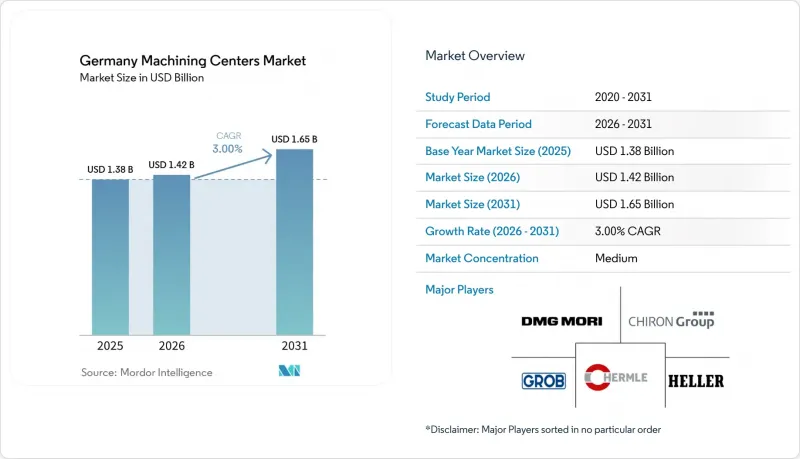
根據 Mordor Intelligence 預測,德國加工中心市場規模將從 2025 年的 13.8 億美元和 2026 年的 14.2 億美元成長到 2031 年的 16.5 億美元,2026 年至 2031 年的複合年成長率為 3%。
本報告按工具機類型(水平加工中心、垂直加工中心等)、軸配置(三軸、四軸、五軸及以上)、主軸佈置(水平、垂直、多軸)、結構類型(立柱式、龍門式、移動工作台式)以及最終用戶行業(汽車及其他)進行分類。市場預測以美元計價。
德國加工中心市場的趨勢與洞察
工業4.0的需求正加速互聯數控加工中心的普及。
德國製造企業目前正將 OPC UA(開放平台通訊統一架構)和邊緣模組作為標準規範,以實現生產數據的本地存儲,這是 Manufacturing X 的核心要求。博世力士樂的 ctrlX 自動化平台已通過 IEC 62443-4-2 認證,它將運動控制與人機介面分離,從而將勒索軟體風險降低了 85%。西門子將於 2025 年更新其 SINUMERIK 828D 系列,新增「運行我的虛擬機器」功能,透過離線干涉檢查將設定時間縮短 20%。聯邦政府的大量數位津貼正在加速設備現代化,使中小型訂單的工廠能夠用完全互聯的、支持工業 4.0 的替代設備取代孤立的、過時的銑床。因此,不具備原生 OPC UA 連接埠或數位雙胞胎許可的設備訂單往往會下降。
汽車電氣化正在推動對高精度多軸加工的需求。
電池外殼、馬達定子和逆變器外殼的公差需求小於 50 微米,表面粗糙度 Ra 小於 1.6,以最佳化冷卻和電磁屏蔽效果。 ZF 公司引進 Nagel 精密研磨後,鋁製馬達外殼的表面粗糙度 Ra 達到了 0.2 微米。 DMG MORI 的新型 DMU 65 H monoBLOCK 一體式加工中心採用熱穩定性鑄造本體,並配備 18,000 rpm 的主軸,可將電池托盤的加工週期縮短 18%。德國汽車工業協會預測,到 2028 年,德國國內電動車產量將達到 210 萬輛,這將帶來約 4,500 台加工中心的額外需求。多功能車銑複合加工平台透過在一次裝夾中完成銑削、車削和滾齒加工,更具吸引力,可幫助一級供應商減少 30% 的在製品庫存。
高額資本投入和不斷上漲的利率抑制了對新建加工中心的投資。
歐洲央行將2026年3月的存款利率維持在2.75%不變,這意味著7年期設備貸款利率仍比2019年水準高出1.5個百分點。製造業產運轉率的顯著下降凸顯了謹慎的投資環境,這主要是由於企業等待持續高企的借貸成本下降所致。一台通常售價160萬美元的五軸臥式機床的投資回收期目前為4年,遠低於先前平均的6年。因此,2026年42%的出貨量將以租賃方式交付,高於三年前的31%。同時,2025年二手設備的銷售量激增19%。這些高昂的資金籌措成本將使德國加工中心市場的預期成長率下降0.5個百分點。
細分市場分析
由於立式加工中心購置成本較低,且廣泛應用於汽車鑄件返工和模具加工,預計到2025年,其在德國加工中心市場的佔有率將達到45.4%。工廠青睞立式加工中心,是因為它們設定快捷,操作人員也比較熟悉,導致三軸立式銑床的市佔率嚴重偏向三軸立式銑床。然而,航太總承包商和醫療設備分包商正在將預算轉向通用型和五軸平台,這些平台無需二次設置,可以將渦輪葉片和脊椎移植的加工週期縮短高達22%。
預計到2031年,通用/五軸加工中心將以4.8%的複合年成長率成長,成為所有工具機類型中成長率最高的。這一成長主要得益於高精度項目,例如未來戰鬥機系統(FCAS)的機身面板和電動車(EV)的馬達外殼,這些項目都需要同時進行多面加工。龍門式和橋式工具機傳統上一直處於小眾市場,但可再生能源領域對重型切削的需求不斷成長,正在顯著擴大新的市場需求,並拓寬整體客戶群。儘管如此,德國立式加工中心市場預計仍將保持強勁的估值,因為中型合約製造商仍將其視為向工業4.0轉型的理想切入點。
預計到2025年,三軸加工中心將占到總裝置量的52%,鞏固其作為鋁板銑削和鋼骨製造領域入門級主力設備的地位。同時,國防和醫療產業的買家正在加速訂購五軸及以上系統的訂單,預計到2031年,這些系統的年複合成長率將達到5.1%。主要航太和國防承包商對用於複雜鈦加工的先進五軸平台的戰略投資,顯示航太領域嚴苛的需求正在加速這一轉型。
德國五軸加工中心市場反映出對精度小於10微米的重複加工能力的需求日益成長。西門子的SINUMERIK ONE控制器採用離線數位雙胞胎模擬技術,顯著加快了無干涉刀具路徑檢驗,有效降低了小規模代工製造商的技術准入門檻。儘管四軸加工中心在凸輪軸和曲軸生產線中仍佔據著一定的市場佔有率,但隨著電動車設計的興起,複雜的內燃機部件逐漸被淘汰,四軸加工中心的產量成長遠不及五軸加工中心。
其他好處:
- Excel格式的市場預測(ME)表
- 3個月的分析師支持
目錄
第1章:引言
- 研究假設和市場定義
- 調查範圍
第2章:調查方法
第3章執行摘要
第4章 市場狀況
- 市場概覽
- 市場促進因素
- 工業 4.0 的需求正在加速網路連接的CNC加工中心的普及。
- 汽車電氣化提高了對高精度多軸加工的需求。
- 在整個米特爾展台上,老舊工具機的更新換代帶動了對新設備需求的成長。
- 歐盟「淨零排放產業法案」的獎勵正在推動可再生能源零件加工的成長。
- Manufacturing-X 的網路安全合規性正在推動人工智慧驅動的安全數控控制器的普及。
- 航太和國防領域對機械加工的需求不斷成長,推動了先進多軸工具機的使用。
- 市場限制因素
- 高昂的資本投資成本和不斷上漲的利率抑制了對新加工中心的投資。
- 熟練的五軸編程人員和操作員短缺,限制了先進工具機的使用。
- 出口限制阻礙了雲端連線數控系統的應用。
- 由於半導體短缺,加工中心的生產和交付出現延誤。
- 價值/供應鏈分析
- 監理情勢
- 技術展望
- 產業吸引力—五力分析
- 新進入者的威脅
- 供應商的議價能力
- 買方的議價能力
- 替代品的威脅
- 競爭公司之間的競爭
第5章 市場規模與成長預測
- 按機器類型
- 臥式加工中心(HMC)
- 立式加工中心(VMC)
- 通用/五軸加工中心
- 多功能加工中心(MTM)
- 其他(龍門/橋式加工中心、車銑複合機床)
- 按軸配置
- 3軸
- 四軸
- 5個或更多軸
- 通過主軸的方位
- 橫版
- 垂直的
- 多軸
- 依結構類型
- 列類型
- 龍門式
- 移動桌類型
- 按最終用戶行業分類
- 車
- 航太/國防
- 能源(石油和天然氣、可再生能源)
- 醫療器材
- 模具製造
- 其他(一般製造業、合約製造業、電子產品等)
第6章 競爭情勢
- 市場集中度
- 策略趨勢
- 市佔率分析
- 公司簡介
- DMG MORI AG
- TRUMPF GmbH+Co. KG
- CHIRON Group SE
- Gebr. Heller Maschinenfabrik GmbH
- Hermle AG
- Siemens AG
- EMAG GmbH & Co. KG
- INDEX-WERKE GmbH & Co. KG
- GROB-WERKE GmbH & Co. KG
- Knuth Werkzeugmaschinen GmbH
- MAG IAS GmbH
- Spinner Werkzeugmaschinenfabrik GmbH
- Okuma Europe GmbH
- Yamazaki Mazak Deutschland GmbH
- Haas Automation Europe
- Makino Europe GmbH
- FANUC Deutschland GmbH
- Hyundai WIA Europe
- Doosan Machine Tools Europe
- GF Machining Solutions GmbH
第7章 市場機會與未來展望
According to Mordor Intelligence, germany machining centers market size is projected to expand from USD 1.38 billion in 2025 and USD 1.42 billion in 2026 to USD 1.65 billion by 2031, registering a CAGR of 3% between 2026 and 2031.
This report is Segmented by Machine Type (Horizontal Machining Centers, Vertical Machining Centers, and More), by Axis Configuration (3-Axis, 4-Axis, and 5-Axis & Above), by Spindle Orientation (Horizontal, Vertical, Multi-Spindle), by Structure Type (Column-Type, Gantry-Type, Moving-Table), and by End-User Industry (Automotive and More). The Market Forecasts are Provided in Terms of Value (USD).
Germany Machining Centers Market Trends and Insights
Industry 4.0 Demand Accelerates Adoption of Connected CNC Machining Centers
German facilities now specify Open Platform Communications Unified Architecture (OPC UA) and edge modules as standard so that production data stays on-premises, a core Manufacturing-X requirement. Bosch Rexroth's ctrlX Automation platform, certified under IEC 62443-4-2, separates motion control from the human-machine interface and cuts ransomware risk by 85%. Siemens refreshed its SINUMERIK 828D line in 2025 with Run MyVirtual Machine, trimming setup times 20% through offline collision checks. Substantial federal digitalization grants are accelerating equipment modernization, empowering small- to medium-sized job shops to replace their isolated, legacy mills with fully connected, Industry 4.0-ready alternatives. As a result, machines that arrive without native OPC UA ports or digital-twin licenses face shrinking order books.
Automotive Electrification Drives High-Precision Multi-Axis Machining Requirements
Battery housings, motor stators, and inverter casings demand sub-50-micron tolerances plus surface finishes below Ra 1.6 to optimize cooling and electromagnetic shielding. ZF achieved a Ra of 0.2 microns on aluminum e-motor housings after installing Nagel precision grinders. DMG MORI's new DMU 65 H monoBLOCK pairs a thermally stable casting with an 18,000 rpm spindle to shave 18% off battery-tray cycle time. The German Association of the Automotive Industry projects domestic EV output to hit 2.1 million units by 2028, implying the need for roughly 4,500 additional machining centers. Multi-tasking turn-mill platforms broaden appeal by combining milling, turning, and gear hobbing in a single setup, thereby reducing work-in-process inventory by 30% for Tier-1 suppliers.
High CAPEX and Rising Interest Rates Constrain New Machining Center Investments
The European Central Bank kept its deposit rate at 2.75% in March 2026, so seven-year equipment loans are still priced 1.5 percentage points above 2019 levels. A notable decline in manufacturing capacity utilization underscores a cautious capital expenditure environment, driven largely by operators waiting for relief from elevated borrowing costs. A 5-axis horizontal machine, often quoted at USD 1.6 million, now faces a 4-year payback period, well below the historic 6-year norm. Leasing, therefore, covers 42% of 2026 shipments, up from 31% three years earlier, while used-machine sales jumped 19% in 2025. High financing costs thus shave 0.5 percentage points off projected growth in the Germany machining centers market.
Other drivers and restraints analyzed in the detailed report include:
- Replacement of Aging Machine-Tool Base Boosts New Equipment Demand Across Mittelstand
- EU Net-Zero Industry Act Incentives Increase Machining for Renewable-Energy Components
- Shortage of Skilled 5-Axis Programmers and Operators Limits Advanced Machine Usage
For complete list of drivers and restraints, kindly check the Table Of Contents.
Segment Analysis
Vertical machining centers held a 45.4% of the Germany machining centers market share in 2025, thanks to their lower purchase price and wide use in automotive casting rework and mold-and-die jobs. Shops favor them for quick installation and operator familiarity, so the installed base skews heavily toward three-axis vertical mills. However, aerospace primes and medical-device subcontractors are reallocating budgets toward universal and five-axis platforms that remove secondary setups and cut cycle time by up to 22% on turbine blades and spinal implants.
Universal/five-axis machining centers are projected to register a 4.8% CAGR through 2031, the fastest among all machine types. Their growth rests on tight-tolerance programs for Future Combat Air System fuselage panels and electric-vehicle (EV) motor housings, both of which demand simultaneous multi-face milling. While gantry and bridge-style machines have historically occupied a niche segment, the heavy machining requirements of the renewable energy sector are now driving significant new demand and expanding the overall customer pool. Even so, the Germany machining centers market for vertical models will maintain a robust valuation, as Mittelstand job shops continue to view them as the ideal entry point for Industry 4.0 retrofits.
Three-axis machines represented 52% of 2025 installations, cementing their role as entry-level workhorses for aluminum plate milling and steel frame fabrication. Yet defense and medical buyers are accelerating orders for five-axis and above systems, which are forecast to expand at a 5.1% CAGR to 2031. Strategic investments by major aerospace and defense contractors in advanced five-axis platforms for complex titanium machining demonstrate how heavy aerospace requirements are accelerating this pivot.
The Germany machining centers market for five-axis units reflects heightened demand for sub-10-micron repeatability. Siemens' SINUMERIK ONE controller, which uses offline digital twin simulation, drastically accelerates the verification of collision-free toolpaths, effectively lowering the technical barrier to entry for smaller job shops. Four-axis tables hold their mid-tier niche on camshaft and crankshaft lines, but their volume growth trails the five-axis surge as EV designs phase out complex internal-combustion components.
List of Companies Covered in this Report:
- DMG MORI AG
- TRUMPF GmbH + Co. KG
- CHIRON Group SE
- Gebr. Heller Maschinenfabrik GmbH
- Hermle AG
- Siemens AG
- EMAG GmbH & Co. KG
- INDEX-WERKE GmbH & Co. KG
- GROB-WERKE GmbH & Co. KG
- Knuth Werkzeugmaschinen GmbH
- MAG IAS GmbH
- Spinner Werkzeugmaschinenfabrik GmbH
- Okuma Europe GmbH
- Yamazaki Mazak Deutschland GmbH
- Haas Automation Europe
- Makino Europe GmbH
- FANUC Deutschland GmbH
- Hyundai WIA Europe
- Doosan Machine Tools Europe
- GF Machining Solutions GmbH
Additional Benefits:
- The market estimate (ME) sheet in Excel format
- 3 months of analyst support
TABLE OF CONTENTS
1 Introduction
- 1.1 Study Assumptions & Market Definition
- 1.2 Scope of the Study
2 Research Methodology
3 Executive Summary
4 Market Landscape
- 4.1 Market Overview
- 4.2 Market Drivers
- 4.2.1 Industry 4.0 demand accelerates adoption of connected CNC machining centers
- 4.2.2 Automotive electrification drives high-precision multi-axis machining requirements
- 4.2.3 Replacement of aging machine-tool base boosts new equipment demand across Mittelstand
- 4.2.4 EU Net-Zero Industry Act incentives increase machining for renewable energy components
- 4.2.5 Manufacturing-X cybersecurity compliance drives adoption of AI-enabled secure CNC controllers
- 4.2.6 Growing aerospace and defense machining demand strengthens advanced multi-axis machine utilization
- 4.3 Market Restraints
- 4.3.1 High CAPEX and rising interest rates constrain new machining center investments
- 4.3.2 Shortage of skilled 5-axis programmers and operators limits advanced machine usage
- 4.3.3 Export-control regulations restrict deployment of cloud-connected CNC systems
- 4.3.4 Semiconductor shortages delay machining center production and delivery timelines
- 4.4 Value/Supply-Chain Analysis
- 4.5 Regulatory Landscape
- 4.6 Technological Outlook
- 4.7 Industry Attractiveness - Porter's Five Forces
- 4.7.1 Threat of New Entrants
- 4.7.2 Bargaining Power of Suppliers
- 4.7.3 Bargaining Power of Buyers
- 4.7.4 Threat of Substitutes
- 4.7.5 Competitive Rivalry
5 Market Size and Growth Forecasts (Value, USD)
- 5.1 By Machine Type
- 5.1.1 Horizontal Machining Centers (HMC)
- 5.1.2 Vertical Machining Centers (VMC)
- 5.1.3 Universal/5-Axis Machining Centers
- 5.1.4 Multi-Tasking Machining Centers (MTM)
- 5.1.5 Others (Gantry/Bridge-Type Centres, Turn-Mill Centers)
- 5.2 By Axis Configuration
- 5.2.1 3-Axis
- 5.2.2 4-Axis
- 5.2.3 5-Axis & Above
- 5.3 By Spindle Orientation
- 5.3.1 Horizontal
- 5.3.2 Vertical
- 5.3.3 Multi-spindle
- 5.4 By Structure Type
- 5.4.1 Column-Type
- 5.4.2 Gantry-Type
- 5.4.3 Moving-Table
- 5.5 By End-User Industry
- 5.5.1 Automotive
- 5.5.2 Aerospace & Defense
- 5.5.3 Energy (Oil-Gas, Renewables)
- 5.5.4 Medical Devices
- 5.5.5 Mold and Die Manufacturing
- 5.5.6 Others (General Manufacturing, Job Shops, Electronics, etc.)
6 Competitive Landscape
- 6.1 Market Concentration
- 6.2 Strategic Moves
- 6.3 Market Share Analysis
- 6.4 Company Profiles (includes Global Level Overview, Market Level Overview, Core Segments, Financials as Available, Strategic Information, Products & Services, and Recent Developments)
- 6.4.1 DMG MORI AG
- 6.4.2 TRUMPF GmbH + Co. KG
- 6.4.3 CHIRON Group SE
- 6.4.4 Gebr. Heller Maschinenfabrik GmbH
- 6.4.5 Hermle AG
- 6.4.6 Siemens AG
- 6.4.7 EMAG GmbH & Co. KG
- 6.4.8 INDEX-WERKE GmbH & Co. KG
- 6.4.9 GROB-WERKE GmbH & Co. KG
- 6.4.10 Knuth Werkzeugmaschinen GmbH
- 6.4.11 MAG IAS GmbH
- 6.4.12 Spinner Werkzeugmaschinenfabrik GmbH
- 6.4.13 Okuma Europe GmbH
- 6.4.14 Yamazaki Mazak Deutschland GmbH
- 6.4.15 Haas Automation Europe
- 6.4.16 Makino Europe GmbH
- 6.4.17 FANUC Deutschland GmbH
- 6.4.18 Hyundai WIA Europe
- 6.4.19 Doosan Machine Tools Europe
- 6.4.20 GF Machining Solutions GmbH
7 Market Opportunities and Future Outlook
- 7.1 White-space and Unmet-Need Assessment

 滾珠螺桿執行器市場規模、佔有率和成長分析:按產品類型、負載能力、應用、最終用戶產業、安裝類型、分銷管道和地區分類-產業預測(2026-2033 年)
 加工中心市場-2026-2032年全球市場預測
 2026-2030年全球五軸CNC加工中心市場
 結構木螺絲全球市場規模、佔有率、趨勢和成長分析報告(2026-2034)
 全球木結構螺絲市場報告:2021-2032年歷史表現及預測
 結構木螺絲市場規模、佔有率和成長分析:按類型、材質、驅動系統、應用、通路和地區分類-2026-2033年產業預測
 銑床主軸市場機會、成長要素、產業趨勢分析及2026-2035年預測。
 歐洲加工中心:市場佔有率分析、產業趨勢與統計及成長預測(2026-2031 年)亞太地區加工中心:市場佔有率分析、產業趨勢與統計及成長預測(2026-2031)加工中心:市場佔有率分析、產業趨勢與統計、成長預測(2026-2031)