


 |
市場調查報告書
商品編碼
2063615
北美藝術品物流:市場佔有率分析、產業趨勢與統計、成長預測(2026-2031)North America Art Logistics - Market Share Analysis, Industry Trends & Statistics, Growth Forecasts (2026 - 2031) |
||||||

※ 本網頁內容可能與最新版本有所差異。詳細情況請與我們聯繫。
據 Mordor Intelligence 稱,北美藝術品物流市場預計將從 2025 年的 13.6 億美元成長到 2026 年的 14 億美元,到 2031 年達到 17.1 億美元,2026 年至 2031 年的複合年成長率為 4.11%。
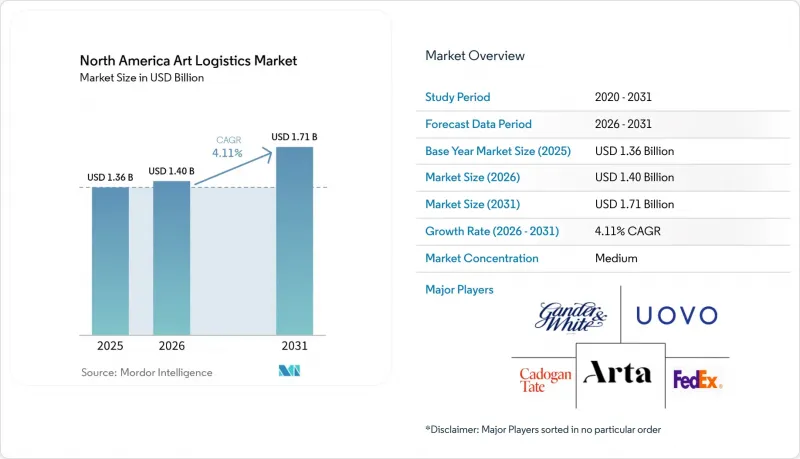
這些關鍵數據背後蘊藏著持續的結構性變化。本報告按服務類型(運輸、倉儲和配送、附加價值服務[貼標、套件組裝、諮詢])、應用領域(藝術品經銷商和畫廊、競標行、博物館、藝術博覽會、私人收藏家及其他)和國家(美國、加拿大、墨西哥)進行細分。市場預測以美元計價。
北美藝術品物流市場趨勢與洞察
北美富裕階層的財富正在成長,他們對藝術品的投資也在增加。
科技和私募股權領域的財富累積促使高淨值收藏家將相當一部分資產配置於藝術品,這一比例呈現顯著的同比成長。藝術品配置的增加帶動了對溫控運輸、即時追蹤和客製化保險的需求,而這些服務的價格也水漲船高。美國西部地區已佔據國內藝術品交易的大部分佔有率,但像鳳凰城和西雅圖這樣的地區缺乏紐約那樣的倉儲能力,這為富有冒險精神的交易者創造了地域套利的機會。年輕的高淨值人士(HNWI)是大型競標行日益成長的重要買家群體,他們對基於區塊鏈的證書和低碳運輸車輛的需求也十分旺盛。像Crown Fine Art這樣的行業領導者正在透過大幅減少排放和引入電動貨車來應對這一需求,這表明行業正在向「綠色」轉型,並將迫使落後的公司效仿。
擴大千禧世代和Z世代消費者的市場佔有率。
年輕買家在佳士得近期的客戶群中佔據了相當大的比例。他們更重視透明度和永續性,而非保密性和謹慎性,並要求提供行動追蹤、NFC標籤報告和可重複使用的木箱等功能。 Gander & White正與ROKBOX Loop合作,提供可回收的箱子,並在紐約和洛杉磯部署電動貨車,直接服務於這個環保意識的群體。雖然價格敏感度影響了每筆交易的利潤率,但對涵蓋運輸、倉儲和編目服務的訂閱服務的需求不斷成長,且使用頻率也日益提高,這為那些及早適應的公司帶來了可預測的現金流。
高階市場崩壞(超過1000萬美元)
2025年上半年,一系列重大拍賣失敗,迫使競標行撤回拍品並停止運作豪華運輸車輛。下半年,蘇富比拍賣行以5.275億美元售出倫納德·A·勞德的遺產,提振了市場,但這感覺只是暫時的,而非結構性的。前50名拍品中有39件在紐約售出,這種地理集中加劇了市場下滑的風險。紐約晚間拍賣會78%的成交價都由訂金支付,如果2026年市場情緒降溫,這一比例可能難以維持,再次威脅到拍品供應。
細分市場分析
到2025年,運輸將佔北美藝術品物流市場佔有率的60.39%,凸顯其在將拍品從競標運送至收藏家手中的關鍵作用。然而,預計到2031年,附加價值服務將以5.20%的複合年成長率成長,成為北美藝術品物流市場中成長最快的領域。除了包裝和運輸之外,年輕的買家還要求基於區塊鏈的來源證明、數位化狀況報告和永續性審計。 Verisart與Arta的合作在交付時提供數位證書,滿足了保險承保人和精通技術的收藏家的需求。美國海關與邊防安全局(CBP)嚴格的文件審查以及《瀕危野生動植物種國際貿易公約》(CITES)規定的5至30天等待期,推高了合規諮詢的費用,使得利潤率從通常10-15%的運輸利潤率提升至包含諮詢服務後的30%以上。
營運升級也是推動這項變革的因素之一。 Crozier Fine Arts 已為其全部 180 輛車安裝了柴油顆粒過濾器;Gander & White 從 ROKBOX Loop 租賃可重複使用的包裝箱;Crown Fine Art 則積極通過廣泛的範圍 1 和範圍 2排放以及早期車輛電氣化來降低運營碳排放。這些措施在長期內降低了每次運輸的成本,同時滿足了千禧年碳排放標準。倉儲對於銷售週期之間的庫存管理仍然至關重要,但蘇富比和佳士得提供的免費倉儲服務給收入來源帶來了壓力,促使運營商交叉銷售氣候監測、蟲害控制和數位化編目等服務。運輸仍將是主要的收入來源,但盈利將取決於能否將增值模組融入到每次運輸中,以及能否在監管阻力最大的地區提供更高的費率。
其他好處:
- Excel格式的市場預測(ME)表
- 3個月的分析師支持
目錄
第1章:引言
- 研究假設和市場定義
- 調查範圍
第2章:調查方法
第3章執行摘要
第4章 市場狀況
- 市場概覽
- 市場促進因素
- 雖然交易量有所下降,但交易量依然保持強勁。
- 北美高淨值人士 (HNWI) 的資產擴張和對藝術品的投資配置增加。
- 加速向線上競標和數位銷售管道的轉型
- 千禧世代和Z世代的購買者比例正在增加。
- 北美航空貨運能力與需求強勁成長
- 美國的博物館和機構已恢復到接近疫情前的水準。
- 市場限制因素
- 全球藝術品市場正在萎縮。
- 高階市場崩壞(超過1000萬美元)
- 當代藝術的嚴重衰退(自2000年以來)
- 預計競標市場低迷狀況將持續到2025年。
- 價值供應鏈分析
- 監理情勢
- 技術展望
- 波特五力模型
第5章 市場規模與成長預測
- 按服務類型
- 運輸
- 倉儲/物流
- 附加價值服務(貼標籤、套件組裝、諮詢)
- 透過使用
- 藝術品經銷商和畫廊
- 競標行
- 博物館
- 藝術博覽會
- 私人收藏家
- 其他用途
- 國家
- 美國
- 加拿大
- 墨西哥
第6章 競爭情勢
- 市場集中度
- 策略趨勢
- 市佔率分析
- 公司簡介
- Gander & White
- UOVO
- Cadogan Tate
- Crozier Fine Arts
- Sotheby's Art Logistics
- Christie's Fine Art Storage Services
- Crown Fine Art
- Atelier 4
- Artech Fine Art Services
- United States Art Company
- AirSea Packing Group
- Aetna Fine Art Logistics
- PACART
- Dietl International
- Arta Shipping Inc.
- FedEx
- The UPS Store, Inc.
- DHL International GmbH
- Fine Art Shippers
- Acumen International Inc.
第7章 市場機會與未來展望
According to Mordor Intelligence, the north america art logistics market size is expected to increase from USD 1.36 billion in 2025 to USD 1.40 billion in 2026 and reach USD 1.71 billion by 2031, growing at a CAGR of 4.11% over 2026-2031.
The headline numbers disguise an ongoing structural shift. This report is Segmented by Service Type (Transportation, Warehousing and Distribution, and Value Added Services [Labelling, Kitting, Consulting]), by Application (Art Dealers and Galleries, Auction Houses, Museums, Art Fairs, Private Collectors, and Other Applications), and by Country (United States, Canada, and Mexico). The Market Forecasts are Provided in Terms of Value (USD).
North America Art Logistics Market Trends and Insights
Expanding High-Net-Worth Individual Wealth and Art Allocation in North America
Tech and private-equity fortunes have pushed HNWI collectors to devote a substantially larger share of their wealth portfolios to art, marking a distinct increase year-over-year. This growing allocation drives demand for climate-controlled trucks, real-time tracking, and tailored insurance, which command premium pricing. The western United States already accounts for a major share of domestic art purchases, yet regional hubs like Phoenix and Seattle lack the vault capacity of New York, creating geographic arbitrage opportunities for adventurous providers. Younger HNWIs, who now make up a significant and growing segment of buyers at major auction houses, also insist on blockchain certificates and low-carbon fleets; industry leaders like Crown Fine Art have answered with meaningful emission reductions and electric vans, signaling a green pivot that laggards must match.
Rising Share of Millennial and Gen-Z Buyers
A notable segment of Christie's recent clientele was younger buyers. They prize transparency and sustainability over hush-hush discretion, demanding mobile tracking, NFC-tagged reports, and reusable crates. Gander & White partnered with ROKBOX Loop to supply recyclable cases and rolled out electric vans in New York and Los Angeles, directly courting the eco-minded cohort. Price sensitivity pressures margins per job, yet higher frequency and appetite for subscription services covering transport, storage, and cataloging offer predictable cash flow for firms that adapt early.
Collapse of the High-End Segment (More Than USD 10 Million)
H1 2025 saw marquee failures, forcing auction houses to pull consignments and leaving white-glove fleets idle. H2 bounce, powered by the Leonard A. Lauder estate that fetched USD 527.5 million at Sotheby's, feels episodic rather than structural. With 39 of the year's top 50 lots hammered in New York, geographic concentration magnifies downside risk. Guarantees covered 78% of New York evening-sale value, a level that may not hold if sentiment cools in 2026, threatening shipment pipelines again.
Other drivers and restraints analyzed in the detailed report include:
- Resilient Transaction Volume Despite Lower Values
- Accelerated Shift to Online Bidding and Digital Sales Channels
- Contraction in the Global Art Market Value
For complete list of drivers and restraints, kindly check the Table Of Contents.
Segment Analysis
Transportation accounted for 60.39% of the North America art logistics market share in 2025, underscoring its role in transporting lots from auction to collector. Yet value-added services are on course for a 5.20% CAGR to 2031, the fastest within the North America art logistics market. Younger buyers want blockchain provenance, digital condition reports, and sustainability audits, in addition to crating and trucks. Verisart's tie-up with Arta delivers digital certificates at the hand-off, satisfying both insurance underwriters and tech-savvy collectors. CBP's strict documentation checks and 5- to 30-day CITES waits increase the payout for compliance consulting, lifting margins from the usual 10-15% on transport to more than 30% for bundled advisory packages.
Operational upgrades reinforce this shift. Crozier Fine Arts fitted diesel particulate filters across its 180-vehicle fleet, Gander & White rents ROKBOX Loop's reusable crates, and Crown Fine Art is aggressively decarbonizing its operations through broad Scope 1 and 2 emissions reductions and early fleet electrification. These moves meet Millennial carbon standards while reducing long-term cost per trip. Warehousing remains vital for inventory between sale cycles, but free storage offers from Sotheby's and Christie's squeeze that revenue line, prompting operators to cross-sell climate monitoring, pest control, and digital cataloging. Transportation will remain the revenue heavyweight, yet profitability will hinge on stitching value-added modules into every shipment and quoting premiums where regulatory friction is highest.
List of Companies Covered in this Report:
- Gander & White
- UOVO
- Cadogan Tate
- Crozier Fine Arts
- Sotheby's Art Logistics
- Christie's Fine Art Storage Services
- Crown Fine Art
- Atelier 4
- Artech Fine Art Services
- United States Art Company
- AirSea Packing Group
- Aetna Fine Art Logistics
- PACART
- Dietl International
- Arta Shipping Inc.
- FedEx
- The UPS Store, Inc.
- DHL International GmbH
- Fine Art Shippers
- Acumen International Inc.
Additional Benefits:
- The market estimate (ME) sheet in Excel format
- 3 months of analyst support
TABLE OF CONTENTS
1 Introduction
- 1.1 Study Assumptions and Market Definition
- 1.2 Scope of the Study
2 Research Methodology
3 Executive Summary
4 Market Landscape
- 4.1 Market Overview
- 4.2 Market Drivers
- 4.2.1 Resilient Transaction Volume Despite Lower Values
- 4.2.2 Expanding High-net-worth Individual (HNWI) Wealth and Art Allocation in North America
- 4.2.3 Accelerated Shift to Online Bidding and Digital Sales Channels
- 4.2.4 Rising Share of Millennial and Gen-Z Buyers
- 4.2.5 Strong North American Air-Cargo Capacity and Demand Growth
- 4.2.6 United States Museum and Institutional Recovery to Near Pre-pandemic Levels
- 4.3 Market Restraints
- 4.3.1 Contraction in the Global Art Market Value
- 4.3.2 Collapse of the High-end Segment (More Than USD 10 Million)
- 4.3.3 Severe Slump in Contemporary (Post-2000) Art
- 4.3.4 Persistent Auction Weakness into 2025
- 4.4 Value / Supply-Chain Analysis
- 4.5 Regulatory Landscape
- 4.6 Technological Outlook
- 4.7 Porter's Five Forces
- 4.7.1 Threat of New Entrants
- 4.7.2 Bargaining Power of Suppliers
- 4.7.3 Bargaining Power of Buyers
- 4.7.4 Threat of Substitutes
- 4.7.5 Industry Rivalry
5 Market Size and Growth Forecasts (Value)
- 5.1 By Service Type
- 5.1.1 Transportation
- 5.1.2 Warehousing & Distribution
- 5.1.3 Value-added Services (Labelling, Kitting, Consulting)
- 5.2 By Application
- 5.2.1 Art Dealers and Galleries
- 5.2.2 Auction Houses
- 5.2.3 Museums
- 5.2.4 Art Fairs
- 5.2.5 Private Collectors
- 5.2.6 Other Applications
- 5.3 By Country
- 5.3.1 United States
- 5.3.2 Canada
- 5.3.3 Mexico
6 Competitive Landscape
- 6.1 Market Concentration
- 6.2 Strategic Moves
- 6.3 Market Share Analysis
- 6.4 Company Profiles {(includes Global level Overview, Market level overview, Core Segments, Financials as available, Strategic Information, Market Rank/Share for key companies, Products & Services, and Recent Developments)}
- 6.4.1 Gander & White
- 6.4.2 UOVO
- 6.4.3 Cadogan Tate
- 6.4.4 Crozier Fine Arts
- 6.4.5 Sotheby's Art Logistics
- 6.4.6 Christie's Fine Art Storage Services
- 6.4.7 Crown Fine Art
- 6.4.8 Atelier 4
- 6.4.9 Artech Fine Art Services
- 6.4.10 United States Art Company
- 6.4.11 AirSea Packing Group
- 6.4.12 Aetna Fine Art Logistics
- 6.4.13 PACART
- 6.4.14 Dietl International
- 6.4.15 Arta Shipping Inc.
- 6.4.16 FedEx
- 6.4.17 The UPS Store, Inc.
- 6.4.18 DHL International GmbH
- 6.4.19 Fine Art Shippers
- 6.4.20 Acumen International Inc.
7 Market Opportunities and Future Outlook
- 7.1 White-space and Unmet-need Assessment

 藝術品物流市場規模及預測(2021-2034年),全球及區域佔有率、趨勢及成長機會分析報告:按類型、最終用戶及地區分類
 藝術品物流市場-2026-2032年全球市場預測
 藝術品保險市場規模、佔有率和成長分析:按保險類型、承保類型、藝術品類型、最終用戶、分銷管道、應用和地區分類——2026-2033年行業預測
 藝術品物流:市場佔有率分析、產業趨勢與統計、成長預測(2026-2031)
 美術和雕塑市場規模、佔有率和成長分析:按主題、時代/風格、價格範圍、最終用戶、分銷管道和地區分類-2026-2033年產業預測
 2026-2030年全球藝術品經銷市場
 藝術基金市場:按基金類型、用途和地區分類藝術品物流:市場佔有率分析、產業趨勢/統計、成長預測(2025-2030)
 美術品·雕刻的全球市場:產業分析,規模,佔有率,成長,趨勢,預測(2024年~2031年)