


 |
市場調查報告書
商品編碼
2063280
英國汽車資訊娛樂系統:市場佔有率分析、產業趨勢與統計、成長預測(2026-2031)United Kingdom Automotive Infotainment - Market Share Analysis, Industry Trends & Statistics, Growth Forecasts (2026 - 2031) |
||||||

※ 本網頁內容可能與最新版本有所差異。詳細情況請與我們聯繫。
據 Mordor Intelligence 稱,英國汽車資訊娛樂市場在 2025 年的價值為 4.6 億美元,預計到 2031 年將達到 7.1 億美元,而 2026 年為 4.9 億美元,2026 年至 2031 年的複合年成長率為 7.59%。
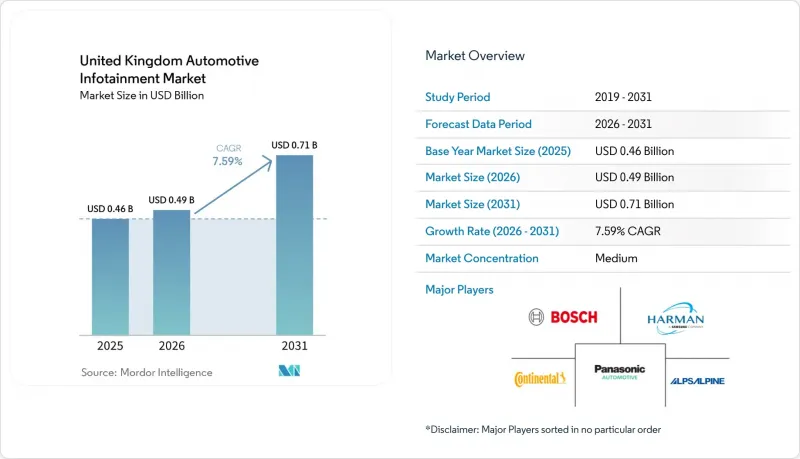
本報告按安裝類型(儀錶板整合式資訊娛樂系統和後座資訊娛樂系統)、車輛類型(乘用車、輕型商用車等)、組件(顯示/觸控螢幕模組、主機/網域控制器等)、動力系統、連接方式、作業系統和銷售管道進行細分。市場預測以美元(USD)計價。
英國汽車資訊娛樂市場趨勢與洞察
電動車的加速普及將催生對更豐富的人機互動(HMI)體驗的需求。
2025年,電池式電動車(BEV)註冊量達到473,348輛,佔新車銷量的23.4%。此外,2026年初的數據表明,儘管獎勵減少,但這一成長勢頭仍將持續。零排放車型的買家期望更大的OLED面板、擴增實境(AR)導航以及可安排充電的語音助手,這促使汽車製造商(OEM)在顯示器創新和軟體生態系統建設方面加大投入。集中式電氣架構為覆蓋A柱之間的螢幕提供了車內空間,而空中下載(OTA)更新則帶來了永續的收入來源。政府資金正在加速充電網路的整合,為供應商創造了明確的商機。純電動車普及和駕駛座內容的良性循環正推動這一細分市場保持兩位數的成長。
對聯網汽車和智慧型手機連接功能的需求日益成長
消費者要求智慧型手機與汽車儀錶板無縫整合,這促使汽車製造商採用精選應用商店。然而,由於監管機構將螢幕互動與駕駛員注意力分散導致的事故聯繫起來,供應商正在整合駕駛員監視錄影機,以便在駕駛員注意力分散時降低螢幕亮度。如何在便利性和合規性之間取得平衡,正在塑造使用者介面的發展藍圖,並穩步提高互聯服務的普及率。
先進顯示器和處理器高成本
正如原始設備製造商 (OEM) 正在尋求降低電池成本的方法一樣,記憶體和 OLED 面板價格的飆升也正在擠壓供應商的利潤空間。雖然大型成熟企業正透過垂直整合和長期供貨合約來緩解這種壓力,但規模較小的二級供應商卻面臨專案延期的風險。價格波動可能會抑制顯示器市場的短期擴張,並略微減緩其成長前景。
細分市場分析
至2025年,嵌入系統系統將佔英國汽車資訊娛樂市場85.15%的佔有率。這一主導地位源自於其作為主要人機互動介面的地位,將導航、媒體和駕駛輔助資訊整合於一體中。為了滿足安全監管機構和精通技術的駕駛員的需求,汽車製造商正在透過更高解析度的圖像、自適應Widgets和語音優先控制功能來增強這些前置顯示器。供應商正與晶片製造商和用戶介面工作室合作,以降低延遲並提供可在儀錶板和中央螢幕之間無縫切換的情境感知內容。持續的空中下載更新使介面能夠保持最新狀態,而無需更換硬體。
到2031年,後座娛樂系統將以8.54%的複合年成長率持續成長,成為車載系統市場中成長最快的領域。豪華汽車品牌和共享旅遊營運商將為每位乘客提供獨立螢幕視為一項差異化優勢,並以此作為提高票價的依據。電動車的地板佈局為更大的座椅靠背面板提供了空間,而5G網路連接則讓每位乘客都能流暢地觀看個人化內容。為了拓展市場,系統整合商正在添加無線投影、多區域音訊和家長監控等功能,以吸引更多用戶,而不僅限於商務用車。由此,一個良性循環正在形成:業務收益的成長將進一步推動車內娛樂系統的創新。
到2025年,乘用車將佔據英國汽車資訊娛樂市場67.13%的佔有率。如此龐大的潛在基本客群使得製造商能夠透過大規模生產來分攤軟體開發成本,從而即使在入門級車型中也能配備功能豐富的儀錶板。來自新參與企業的競爭迫使老牌製造商縮短產品週期,並整合類似智慧型手機的生態系統。如今,消費者期望直覺的語音助理、無縫的智慧型手機配對以及雲端同步設定等功能成為標配。這些期望使得資訊娛樂系統從「錦上添花」躍升為主要的購買考量。
該細分市場正經歷最快的成長,預計到2031年將以10.47%的複合年成長率成長。隨著動力傳動系統噪音的降低,車內聲學環境和螢幕清晰度成為關注焦點,促使汽車製造商透過諸如覆蓋A柱的OLED條形顯示器和擴增實境(AR)導航等功能來提升感官體驗。統一的電子架構使得添加用於管理能源使用和搜尋快速充電樁的新應用程式變得輕而易舉。支持零排放汽車的監管機構透過將獎勵與互聯服務的部署掛鉤,進一步推動了這一領域的發展。所有這些因素共同作用,使得純電動車資訊娛樂系統成為未來設計語言的標竿。
到2025年,顯示模組將佔據英國汽車資訊娛樂市場45.25%的佔有率,成為最大的單一硬體組件。面板製造商正投資研發更薄、層壓結構更精細、亮度更高的產品,以在日益激烈的競爭中保持主導。汽車設計師正利用這些技術進步,打造將儀錶板和中央螢幕整合到一體式玻璃駕駛座中的曲面設計。同時,黏合劑和層壓板供應商也在改進光學黏合技術,以減少眩光並提升觸控反應速度。這種合作的成果正在鞏固面板在駕駛座價值創造中的核心地位。
作業系統軟體和應用程式正以 8.15% 的複合年成長率 (CAGR) 成長,是各組成部分中成長最快的。隨著經營模式向經常性收入轉型,透過 OTA(空中下載)更新提供的功能比硬體更具盈利潛力。汽車製造商將導航、串流媒體和診斷功能捆綁為訂閱服務,並經營自有品牌的應用程式商店。開發者瞄準這些應用程式商店,因為裝置量能夠保證持續的利潤。平台所有者和內容提供者之間的這種共生關係,正在將議價能力轉移到能夠長期保持車輛吸引力的軟體公司手中。
其他好處:
- Excel格式的市場預測(ME)表
- 3個月的分析師支持
目錄
第1章:引言
- 研究假設和市場定義
- 調查範圍
第2章:調查方法
第3章執行摘要
第4章 市場狀況
- 市場概覽
- 市場促進因素
- 隨著電動車的普及,人們對更豐富的人機互動(HMI)體驗的需求也日益成長。
- 對聯網汽車和智慧型手機連接功能的需求日益成長
- 全國範圍內的 5G 部署將實現高頻寬的車載服務。
- 軟體定義車輛中的集中式網域控制器
- 利用車載資訊娛樂系統將基於里程的保險數據貨幣化。
- 旅遊即服務 (MaaS) 和共乘在舒適度上的差異
- 市場限制因素
- 先進顯示器和處理器高成本
- 透過限制視覺使用者體驗來防止駕駛分心的法規
- 改裝現有車輛的複雜度以及CAN總線的差異。
- 聯網汽車。
- 價值供應鏈分析
- 監理情勢
- 技術展望
- 波特五力模型
第5章 市場規模與成長預測
- 按安裝類型
- 嵌入系統資訊娛樂系統
- 後座資訊娛樂系統
- 車輛類型
- 搭乘用車
- 輕型商用車
- 中型和大型商用車輛
- 按組件
- 顯示/觸控螢幕模組
- 主機/網域控制器
- 作業系統、軟體和應用程式
- 連接IC和天線模組
- 依推進類型
- 內燃機車
- 油電混合車
- 電池式電動車
- 透過連接生成
- 4G LTE
- 5G
- 傳統 2G/3G
- 透過作業系統
- 基於 Linux 的(AAOS、AGL 等)
- QNX
- Android Automotive OS
- 其他(專有作業系統、即時作業系統)
- 按銷售管道
- OEM設備
- 售後市場
第6章 競爭情勢
- 市場集中度
- 策略趨勢
- 市佔率分析
- 公司簡介
- Robert Bosch GmbH
- Harman International
- Continental AG
- Panasonic Automotive Systems Co., Ltd.
- Alps Alpine
- Pioneer Corporation
- DENSO Corporation
- Visteon Corporation
- Aptiv PLC
- Magna International
- Valeo SA
- Hyundai Mobis Co., Ltd.
- Forvia SE
- JVC Kenwood
- BlackBerry Limited(QNX)
- Google LLC
- Qualcomm Technologies, Inc.
- NXP Semiconductors NV
第7章 市場機會與未來展望
According to Mordor Intelligence, the united kingdom automotive infotainment market size was valued at USD 0.46 billion in 2025 and is expected to increase from USD 0.49 billion in 2026 to reach USD 0.71 billion by 2031, growing at a 7.59% CAGR over 2026-2031.
This report is Segmented by Installation Type (In-Dash Infotainment and Rear-Seat Infotainment), Vehicle Type (Passenger Cars, Light Commercial Vehicles, and More), Component (Display/Touch-screen Module, Head Unit/Domain Controller, and More), Propulsion Type, Connectivity Generation, Operating System, and Sales Channel. The Market Forecasts are Provided in Terms of Value (USD).
United Kingdom Automotive Infotainment Market Trends and Insights
Accelerated EV Adoption Requiring Richer HMI Experiences
BEV registrations reached 473,348 units in 2025, equal to 23.4% of new-car sales, and early-2026 figures show continued momentum despite tapering incentives. Buyers of emission-free models expect wider OLED panels, augmented-reality navigation, and voice assistants that schedule charging, so OEMs invest in display innovation and software ecosystems. Centralized electrical architectures free cabin space for pillar-to-pillar screens, while over-the-air updates create durable revenue streams. Government funding accelerates charging-network integration, giving suppliers a clear commercial path. The positive feedback loop between BEV uptake and cockpit content sustains double-digit growth for this sub-segment.
Rising Demand for Connected-Car and Smartphone-Integrated Features
Consumers want seamless handoffs between phones and dashboards, driving the adoption of automaker-curated app stores. Regulators, however, link screen interaction to distracted-driving incidents, so suppliers integrate driver-monitoring cameras that dim displays when attention strays. Balancing convenience and compliance shapes the user interface roadmap and keeps connected-service adoption on a steady climb.
High BOM Cost for Advanced Displays and Processors
Sharp increases in memory and OLED panel pricing squeeze supplier margins just when OEMs seek cost offsets for batteries. Larger incumbents mitigate pressure through vertical integration and long-term supply contracts, yet smaller tier-twos risk program delays. Price volatility may temper near-term display-area expansion, slightly dampening growth expectations.
Other drivers and restraints analyzed in the detailed report include:
- Nationwide 5G Roll-Out Enabling High-Bandwidth In-Car Services
- Centralized Domain Controllers in Software-Defined Vehicles
- Driver-Distraction Regulations Limiting Visual UX
For complete list of drivers and restraints, kindly check the Table Of Contents.
Segment Analysis
In-dash systems held 85.15% of the United Kingdom automotive infotainment market share in 2025. Their dominance stems from being the primary human-machine interface, combining navigation, media, and driver-assistance cues in a single focal point. Carmakers refine these front-row displays with richer graphics, adaptive widgets, and voice-first controls to satisfy safety regulators and tech-savvy drivers. Suppliers collaborate with chipmakers and UI studios to reduce latency and deliver context-aware content that shifts seamlessly between the cluster and the center screen. Continuous over-the-air updates keep the interface up to date without requiring hardware swaps.
Rear-seat systems are expanding at an 8.54% CAGR through 2031, the fastest rate within the installation segment. Luxury brands and ride-hailing fleets view individual passenger screens as a differentiator that justifies premium fares. Electric-vehicle floor layouts free space for larger seat-back panels, while 5G connectivity lets each rider stream personalized content without buffering. Integrators are adding wireless-casting, multi-zone audio, and parental-control modes to broaden appeal beyond executive shuttles. The result is a virtuous circle in which rising service revenues encourage still more cabin-entertainment innovation.
Passenger cars accounted for 67.13% of the United Kingdom automotive infotainment market share in 2025. Their large addressable base lets manufacturers amortize software-development costs across high volumes, encouraging feature-rich dashboards even in entry trims. Competitive pressure from new entrants pushes incumbents to shorten release cycles and integrate smartphone-style ecosystems. Consumers now expect intuitive voice assistants, seamless phone pairing, and cloud-synced preferences as standard equipment. These expectations elevate infotainment from a nice-to-have to a central purchase criterion.
The segment posts the fastest growth, advancing at a 10.47% CAGR through 2031. Silent powertrains spotlight cabin acoustics and screen clarity, so OEMs fit pillar-to-pillar OLED bars and augmented-reality navigation to heighten the sensory experience. Centralized electronic architectures simplify adding new apps that manage energy use or locate high-speed chargers. Regulators rewarding zero-emission fleets add momentum by aligning incentives with connected services rollouts. Together, these factors make BEV infotainment a bellwether for future design language.
Display modules accounted for 45.25% of the United Kingdom automotive infotainment market share in 2025, making them the largest single hardware component. Panel makers invest in thinner stacks and improved brightness to maintain leadership amid rising competition. Automotive stylists use these advances to create curved surfaces that blend clusters and center screens into unified glass cockpits. Adhesive and lamination suppliers, meanwhile, refine optical bonding techniques that reduce glare and enhance touch response. These collaborative gains reinforce the panel's position at the heart of cockpit value creation.
Operating-system software and apps are climbing at an 8.15% CAGR, the fastest within the component mix. As business models tilt toward recurring revenue, OTA-delivered features become more lucrative than hardware margins. Carmakers curate branded app stores, bundling navigation, streaming, and diagnostics under subscription umbrellas. Developers target these storefronts because the installed base ensures predictable monetization. This symbiosis between platform owners and content providers shifts bargaining power toward software firms that can keep vehicles fresh over time.
List of Companies Covered in this Report:
- Robert Bosch GmbH
- Harman International
- Continental AG
- Panasonic Automotive Systems Co., Ltd.
- Alps Alpine
- Pioneer Corporation
- DENSO Corporation
- Visteon Corporation
- Aptiv PLC
- Magna International
- Valeo SA
- Hyundai Mobis Co., Ltd.
- Forvia SE
- JVC Kenwood
- BlackBerry Limited (QNX)
- Google LLC
- Qualcomm Technologies, Inc.
- NXP Semiconductors N.V.
Additional Benefits:
- The market estimate (ME) sheet in Excel format
- 3 months of analyst support
TABLE OF CONTENTS
1 Introduction
- 1.1 Study Assumptions & Market Definition
- 1.2 Scope of the Study
2 Research Methodology
3 Executive Summary
4 Market Landscape
- 4.1 Market Overview
- 4.2 Market Drivers
- 4.2.1 Accelerated EV Adoption Requiring Richer HMI Experiences
- 4.2.2 Rising Demand for Connected-Car and Smartphone-Integrated Features
- 4.2.3 Nationwide 5G Roll-Out Enabling High-Bandwidth In-Car Services
- 4.2.4 Centralized Domain Controllers in Software-Defined Vehicles
- 4.2.5 Usage-Based-Insurance Data Monetization via Infotainment
- 4.2.6 Mobility-as-a-Service and Ride-Hailing Comfort Differentiation
- 4.3 Market Restraints
- 4.3.1 High BOM Cost for Advanced Displays and Processors
- 4.3.2 Driver-Distraction Regulations Limiting Visual UX
- 4.3.3 Legacy Fleet Retrofit Complexity and CAN-Bus Variance
- 4.3.4 Escalating Cyber-Insurance Premiums for Connected Vehicles
- 4.4 Value / Supply-Chain Analysis
- 4.5 Regulatory Landscape
- 4.6 Technological Outlook
- 4.7 Porter's Five Forces
- 4.7.1 Threat of New Entrants
- 4.7.2 Bargaining Power of Suppliers
- 4.7.3 Bargaining Power of Buyers
- 4.7.4 Threat of Substitutes
- 4.7.5 Competitive Rivalry
5 Market Size & Growth Forecasts (Value, USD)
- 5.1 By Installation Type
- 5.1.1 In-dash Infotainment
- 5.1.2 Rear-seat Infotainment
- 5.2 By Vehicle Type
- 5.2.1 Passenger Cars
- 5.2.2 Light Commercial Vehicles
- 5.2.3 Medium and Heavy Commercial Vehicles
- 5.3 By Component
- 5.3.1 Display / Touch-screen Module
- 5.3.2 Head Unit / Domain Controller
- 5.3.3 Operating-System Software and Apps
- 5.3.4 Connectivity ICs and Antenna Modules
- 5.4 By Propulsion Type
- 5.4.1 Internal-Combustion Engine Vehicles
- 5.4.2 Hybrid Electric Vehicles
- 5.4.3 Battery Electric Vehicles
- 5.5 By Connectivity Generation
- 5.5.1 4G LTE
- 5.5.2 5G
- 5.5.3 Legacy 2G/3G
- 5.6 By Operating System
- 5.6.1 Linux-Based (AAOS, AGL, etc.)
- 5.6.2 QNX
- 5.6.3 Android Automotive OS
- 5.6.4 Others (Proprietary, RTOS)
- 5.7 By Sales Channel
- 5.7.1 OEM-Installed
- 5.7.2 Aftermarket
6 Competitive Landscape
- 6.1 Market Concentration
- 6.2 Strategic Moves
- 6.3 Market Share Analysis
- 6.4 Company Profiles (Includes Global Level Overview, Market Level Overview, Core Segments, Financials as Available, Strategic Information, Market Rank/Share for Key Companies, Products and Services, SWOT Analysis, and Recent Developments)
- 6.4.1 Robert Bosch GmbH
- 6.4.2 Harman International
- 6.4.3 Continental AG
- 6.4.4 Panasonic Automotive Systems Co., Ltd.
- 6.4.5 Alps Alpine
- 6.4.6 Pioneer Corporation
- 6.4.7 DENSO Corporation
- 6.4.8 Visteon Corporation
- 6.4.9 Aptiv PLC
- 6.4.10 Magna International
- 6.4.11 Valeo SA
- 6.4.12 Hyundai Mobis Co., Ltd.
- 6.4.13 Forvia SE
- 6.4.14 JVC Kenwood
- 6.4.15 BlackBerry Limited (QNX)
- 6.4.16 Google LLC
- 6.4.17 Qualcomm Technologies, Inc.
- 6.4.18 NXP Semiconductors N.V.
7 Market Opportunities & Future Outlook
- 7.1 White-space & Unmet-Need Assessment

 汽車資訊娛樂市場預測至2034年-全球分析(按組件、車輛類型、安裝配置、顯示類型、連接技術、作業系統、應用、驅動系統和地區分類)
 汽車資訊娛樂市場規模、佔有率和成長分析:按組件、安裝類型、車輛類型、連接技術、應用、作業系統、最終用戶和地區分類-2026-2033年產業預測
 汽車資訊娛樂市場:依系統類型、車輛類型、銷售管道和地區分類
 2026年全球汽車資訊娛樂市場報告
 汽車資訊娛樂市場規模、佔有率、趨勢和預測:按產品類型、車輛類型、作業系統、安裝方式、銷售管道、技術、連接方式和地區分類,2026-2034 年
 汽車資訊娛樂市場:依組件、車輛類型、作業系統和銷售管道劃分 - 至2036年的全球預測日本汽車資訊娛樂市場規模、佔有率、趨勢和預測(按產品類型、車輛類型、作業系統、安裝類型、銷售管道、技術、連接方式、性別和地區分類),2026-2034年
 汽車資訊娛樂市場機會、成長要素、產業趨勢分析及預測(2026-2035年)車載資訊娛樂系統市場預測至2032年:按組件、作業系統、顯示類型、應用和地區分類的全球分析
 汽車資訊娛樂市場規模、佔有率、成長分析(按產品類型、按安裝類型、按車輛、按操作系統、按配銷通路和按地區)- 2025 年至 2032 年行業預測