


 |
市場調查報告書
商品編碼
2062346
模塑電路元件(MID):市場佔有率分析、產業趨勢與統計、成長預測(2026-2031)Molded Interconnect Device - Market Share Analysis, Industry Trends & Statistics, Growth Forecasts (2026 - 2031) |
||||||

※ 本網頁內容可能與最新版本有所差異。詳細情況請與我們聯繫。
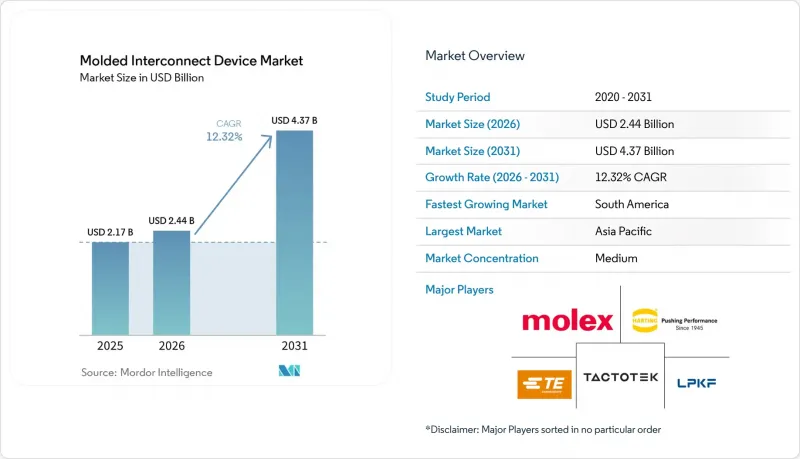
根據 Mordor Intelligence 預測,模塑電路元件 (MID) 的市場規模預計將從 2025 年的 21.7 億美元和 2026 年的 24.4 億美元成長到 2031 年的 43.7 億美元,2026 年至 2031 年的年複合成長率(CAGR)為 12.3%。
本報告按製程(例如雷射直接成型)、產品類型(如天線和連接模組)、終端應用產業(例如汽車、家用電子電器和穿戴式裝置)、材料(例如液晶聚合物、聚丁烯對苯二甲酸酯)和地區(例如北美、南美)進行細分。市場預測以美元計價。
全球模塑電路元件 (MID) 市場趨勢與洞察
汽車產業向基於區域的電子電氣架構的轉變正在推動對 3D 天線 MID 的需求。
汽車製造商正在將數十個電控系統整合到區域閘道器中,將車輛線束重量減輕高達 40%。3D模塑互連裝置 (MID) 將 GPS、行動電話和 V2X(車聯網)天線整合到單一液晶聚合物載體上,無需同軸電纜,並提高了不同頻段之間的電磁隔離度。這種基於區域的射出成型縮短了線束長度,並允許將天線模組安裝在車頂內襯後面。由於 MID 將機械功能和射頻功能整合到單一注塑成型部件中,因此該位置非常適合安裝,因為其可在 125 度C的環境溫度下使用長達 15 年。大陸集團、大眾汽車和寶馬汽車的項目現已將 MID 標準化,從而加速了其在全球範圍內的普及應用。
LDS製程在5G智慧型手機中的快速普及
智慧型手機廠商正擴大採用雷射直接成型(LDS)技術,無需使用軟硬複合或黏合劑層,即可將毫米波天線陣列定位在曲面機殼中。釹摻雜雷射激活液晶聚合物中的銅種子顆粒,然後透過無電電鍍形成插入損耗低於0.5 dB/cm(28 GHz)的線路。這種方法可將組件成本降低1.20至1.80美元,並允許單一天線兼作結構肋。這在印度和東南亞尤其重要,因為這些地區的旗艦機型零售價低於600美元。短期成長主要由中國、韓國和台灣地區主導,隨後歐洲市場將受益於需要共形輻射器的折疊式設計。
多色模具成本高昂
一套採用旋轉型芯和順序澆口的模具成本在 5 萬至 15 萬美元之間,前置作業時間為 6 至 12 週。對於年產量低於 1 萬件的產品,折舊成本將使每件產品增加 4 至 6 美元,這降低了模塑電路元件 (MID) 在航太和特種醫療領域相對於手工組裝的軟硬複合電路的競爭力。在歐美地區,模具精加工的人工成本高達每小時 75 至 120 美元,短期內採用此技術的門檻更高。
細分市場分析
預計到2025年,雷射直接成型技術將佔銷售額的47.21%,凸顯其在智慧型手機和汽車天線小型化方面的關鍵作用。該技術能夠實現精確且高效的設計,滿足市場對緊湊型高性能設備日益成長的需求。雙色射出成型技術滿足了需要不同樹脂和環境密封的細分市場需求,為各種應用提供了靈活性。同時,薄膜嵌入射出成型技術也越來越受歡迎,尤其是在汽車和家用電子電器產業,用於製造內裝面板。增材氣溶膠噴射和噴墨列印技術無需電鍍即可實現小於10µm的線寬,為複雜設計提供了可能,但目前的產能尚未達到大規模生產標準。
在模塑互連裝置市場,對雷射二極體(LDS)光束控制和自動光學檢測(AOI)升級的持續投入,已顯著提升了首件良率,超過95%。這些進步提高了生產效率並減少了廢棄物。同時,積層製造技術在穿戴式裝置和航太原型製造領域日益受到關注,因為在這些領域,快速迭代設計和客製化比單位成本更為重要。隨著印字頭速度的提升,預計到預測期後半段,這些新興技術將在模塑互連裝置市場佔據兩位數的市場佔有率,這反映出它們在市場中日益成長的重要性。
到2025年,天線和連接模組將佔銷售額的41.37%,反映出行動裝置和車載資訊服務應用的強勁需求。目前規模小規模的結構電子麵板預計將以12.96%的複合年成長率成長。這一成長主要得益於電容式智慧表面的日益普及,這種表面取代了傳統的機械按鈕,減少了電纜數量,並實現了曲面主機的設計。
在照明組件領域,模塑互連裝置 (MID) 用於將 LED 陣列、光學元件和散熱器整合到單一聚碳酸酯載體中。這種整合方式可顯著縮短組裝時間 50% 以上,使其成為製造商的理想選擇。感測器和開關仍然佔據很大的市場佔有率,尤其是在輪胎壓力監測系統、慣性測量單元和無刷馬達整流等應用中。在這些應用中,模塑互連裝置為精密電子元件提供了強大的屏蔽,透過保護它們免受電磁干擾和潮濕的影響,從而提高可靠性和使用壽命。
區域分析
預計到2025年,亞太地區將佔全球銷售額的38.92%,主要得益於中國279.5億美元的印刷電路基板市場以及密集的智慧型手機組裝廠商網路。日本預計2024年將貢獻115.3億美元的基板銷售額,其中軟式電路板佔51.3%,像IBIDEN這樣的公司正在將模塑互連裝置應用於雷達模組。韓國緊追在後,預計2024年基板產量將達到78.6億美元,主要得益於三星電機公司擴大其多層HDI生產線。
南美洲是成長最快的地區,預計將以 13.06% 的複合年成長率成長,這主要得益於墨西哥在 2025 年第四季投資 7.6645 億美元用於建造符合美墨加協定 (USMCA)在地採購要求的電子元件工廠。供應商正面臨 25 億美元的設備升級成本,因為他們正從內燃機零件轉向電動車電子產品,這推動了該地區 LDS 和雙色注塑單元的採用。
預計到2025年,北美和歐洲將分別佔總銷售額的五分之一左右,其主要業務是醫療設備和航太感測器模組的契約製造,這些模組需要符合ISO 13485和AS9100認證標準。德國勞力密集的模具精加工製程使模具成本比亞洲高出40-50%,但功能安全標準的實施正在加速企業內部LDS生產線的擴張。中東和非洲地區仍處於發展階段,主要集中在通訊設備和地下感測器領域,這些領域較長的使用壽命可以抵消較高的聚合物成本。
其他好處:
- Excel格式的市場預測(ME)表
- 3個月的分析師支持
目錄
第1章:引言
- 研究假設和市場定義
- 調查範圍
第2章:調查方法
第3章執行摘要
第4章 市場狀況
- 市場概覽
- 市場促進因素
- 汽車產業向基於區域的電子電氣架構的轉變正在推動對 3D 天線 MID 的需求。
- LDS處理技術在5G智慧型手機的快速普及
- 助聽器和植入式醫療設備小型化的要求
- 用於電動車電池組的感測器,需要耐150°C塑膠。
- 高階車輛中的下一代智慧表面人機互動介面
- 低地球軌道衛星用戶終端的封裝內天線整合
- 市場限制因素
- 多色模具成本高昂
- 全球LDS聚合物化合物產能短缺
- 白銀價格波動對金屬化化學的影響
- 航太座艙感知器可靠性差距超過 180 度C
- 產業價值鏈分析
- 技術展望
- 監理情勢
- 宏觀經濟因素對市場的影響
- 波特五力分析
第5章 市場規模與成長預測
- 透過流程
- 雷射直接成形(LDS)
- 雙色射出成型
- 雙組分(2K)選擇性金屬化
- 薄膜嵌入,套模電子元件
- 積層製造和其他新興工藝
- 依產品類型
- 天線和連接模組
- 感應器和開關
- 照明部件
- 結構電子麵板
- 其他產品類型
- 按最終用途行業分類
- 車
- 家用電子電器和穿戴式裝置
- 醫療保健和醫療設備
- 工業自動化
- 通訊基礎設施
- 航太/國防
- 其他終端用戶產業
- 材料
- 液晶聚合物(LCP)
- 聚丁烯對苯二甲酸酯(PBT)
- 聚醯胺(PA 6/6T)
- 聚碳酸酯(PC)及其混合物
- 聚醚醚酮(PEEK)
- 其他材料
- 按地區
- 北美洲
- 美國
- 加拿大
- 墨西哥
- 歐洲
- 德國
- 英國
- 法國
- 俄羅斯
- 其他歐洲國家
- 亞太地區
- 中國
- 日本
- 印度
- 韓國
- 澳洲
- 其他亞太國家
- 南美洲
- 中東和非洲
- 北美洲
第6章 競爭情勢
- 市場集中度
- 策略趨勢
- 市佔率分析
- 公司簡介
- Molex LLC
- TE Connectivity Ltd.
- HARTING Technology Group
- LPKF Laser & Electronics SE
- TactoTek Oy
- 2E mechatronic GmbH & Co. KG
- Phillips-Medisize LLC
- Omnetics Connector Corporation
- iwis mechatronics GmbH
- Cicor Group AG
- Carclo Technical Plastics(division of Carclo plc)
- SelectConnect Technologies LLC
- Moulded Circuits Ltd.
- Beta LAYOUT GmbH
- Amphenol ICC(Amphe-Power)Division
- Linxens Holding SAS
- Zhejiang Zhaoyi Technology Co., Ltd.
- Tritone Technologies Ltd.
- Metalis Group SA
- Advanced Interconnections Corp.
- MacDermid Alpha Electronics Solutions
- Murata Manufacturing Co., Ltd.
- Sumitomo Electric Industries, Ltd.
- Panasonic Holdings Corporation
- HELLA GmbH & Co. KGaA
第7章 市場機會與未來展望
According to Mordor Intelligence, the molded interconnect device market size is projected to expand from USD 2.17 billion in 2025 and USD 2.44 billion in 2026 to USD 4.37 billion by 2031, registering a CAGR of 12.32% between 2026 and 2031.
This report is Segmented by Process (Laser Direct Structuring, and More), Product Type (Antenna and Connectivity Modules, and More), End-Use Industry (Automotive, Consumer Electronics and Wearables, and More), Material (Liquid-Crystal Polymer, Polybutylene Terephthalate, and More), and Geography (North America, South America, and More). The Market Forecasts are Provided in Terms of Value (USD).
Global Molded Interconnect Device Market Trends and Insights
Automotive shift to zonal E/E architecture driving 3-D antenna MID demand
Automakers are consolidating dozens of electronic control units into regional gateways, cutting vehicle wiring mass up to 40 %. Three-dimensional molded interconnect devices integrate GPS, cellular, and vehicle-to-everything antennas onto a single liquid-crystal-polymer carrier, eliminating coax cables and improving electromagnetic isolation between bands. Zonal architectures also shorten harness lengths, allowing antenna modules to mount behind the roof liner where ambient temperatures reach 125 °C for 15 years, a condition matched by molded interconnect devices that combine mechanical and radio-frequency functions in one injection-molded part. Continental, Volkswagen, and BMW programs now specify molded interconnect devices as standard, accelerating global pull-through.
Rapid adoption of LDS processing in 5 G smartphones
Smartphone OEMs increasingly employ laser direct structuring to place millimeter-wave antenna arrays on curved housings without rigid-flex or adhesive layers. A neodymium-doped laser activates copper-seed particles within liquid-crystal polymer, after which electroless plating forms lines with insertion loss below 0.5 dB/cm at 28 GHz. The method shaves USD 1.20-1.80 from the bill-of-materials and allows a single antenna to double as a structural rib, critical as flagship phones retail below USD 600 in India and Southeast Asia. China, South Korea, and Taiwan dominate short-term growth while Europe follows with foldable designs that need conformal radiators.
High Tooling Cost for Multi-Shot Moulds
Family molds with rotating cores and sequential gates cost USD 50,000-150,000 and require 6-12 weeks lead time. At volumes below 10,000 parts annually, amortization adds USD 4.00-6.00 per unit, rendering molded interconnect devices uncompetitive versus hand-assembled rigid-flex circuits in aerospace and specialty medical runs. Western labor rates, often USD 75-120 per hour for mold finishing, magnify near-term adoption hurdles.
Other drivers and restraints analyzed in the detailed report include:
- Miniaturization requirements in hearing aids and implantables
- EV-Battery Pack Sensors Needing 150 °C Plastics
- Limited Global Capacity for LDS Polymer Compounds
For complete list of drivers and restraints, kindly check the Table Of Contents.
Segment Analysis
Laser direct structuring commanded 47.21% of the 2025 revenue, underscoring its critical role in antenna miniaturization across smartphones and cars. This technology enables precise and efficient designs, meeting the growing demand for compact and high-performance devices. Two-shot molding fills niches requiring dissimilar resins and environmental sealing, offering versatility for various applications. Meanwhile, film-insert methods are gaining traction for decorative interior panels, particularly in the automotive and consumer electronics industries. Additive aerosol-jet and inkjet printing promise sub-10 µm lines without plating, presenting opportunities for intricate designs, although throughput currently lags behind mass-production benchmarks.
The molded interconnect device market continues to invest in LDS beam-steering and automated optical inspection upgrades, which have significantly improved first-pass yield to beyond 95%. These advancements enhance production efficiency and reduce waste. Meanwhile, additive approaches are increasingly attracting wearables and aerospace prototypes, where rapid iteration and customization outweigh unit cost concerns. As printhead speeds improve, these emerging technologies are expected to capture double-digit market share in molded interconnect devices by the late forecast window, reflecting their growing importance in the market.
Antenna and connectivity modules generated 41.37% of the 2025 revenue, reflecting the high demand driven by mobile devices and telematics applications. Structural electronics panels, although currently a smaller segment, are projected to grow at a compound annual growth rate (CAGR) of 12.96%. This growth is fueled by the increasing adoption of capacitive smart surfaces, which are replacing traditional mechanical buttons, reducing wire counts, and enabling the development of curved console designs.
Lighting components are leveraging molded interconnect devices to integrate LED arrays, optics, and heat sinks into single polycarbonate carriers. This integration has significantly reduced assembly times by more than 50%, making it a preferred choice for manufacturers. Sensors and switches continue to hold a substantial market share, particularly in applications such as tire-pressure monitoring systems, inertial measurement units, and brushless motor commutation. Molded interconnect devices in these applications provide robust shielding for delicate electronics, protecting them from electromagnetic interference and moisture, thereby enhancing their reliability and lifespan.
Geography Analysis
Asia-Pacific accounted for 38.92% of 2025 revenue, driven by China's USD 27.95 billion printed-circuit-board base and its dense network of smartphone assemblers. Japan contributed USD 11.53 billion in 2024 board revenue, with flexible substrates at 51.3%, and companies such as Ibiden applying molded interconnect devices in radar modules. South Korea followed with USD 7.86 billion in 2024 board output as Samsung Electro-Mechanics expanded its multi-layer HDI lines.
South America is the fastest-growing region, projected to grow at a 13.06% CAGR, thanks to Mexico's USD 766.45 million fourth-quarter 2025 investment in electrical-component plants that meet USMCA local-content mandates. Suppliers face a USD 2.5 billion retooling bill to upgrade from combustion-engine parts to electric-vehicle electronics, nudging regional uptake of LDS and two-shot molding cells.
North America and Europe each controlled roughly one-fifth of 2025 revenue, anchored by medical-device contract manufacturing and aerospace sensor modules that require ISO 13485 and AS9100 certification. Germany's labor-intensive mold finishing pushes tooling 40-50 % above Asia, yet functional-safety standards accelerate internal LDS line additions. The Middle East and Africa remain nascent, gravitating toward telecom and downhole sensors where long service life offsets higher polymer costs.
- Molex LLC
- TE Connectivity Ltd.
- HARTING Technology Group
- LPKF Laser & Electronics SE
- TactoTek Oy
- 2E mechatronic GmbH & Co. KG
- Phillips-Medisize LLC
- Omnetics Connector Corporation
- iwis mechatronics GmbH
- Cicor Group AG
- Carclo Technical Plastics (division of Carclo plc)
- SelectConnect Technologies LLC
- Moulded Circuits Ltd.
- Beta LAYOUT GmbH
- Amphenol ICC (Amphe-Power) Division
- Linxens Holding SAS
- Zhejiang Zhaoyi Technology Co., Ltd.
- Tritone Technologies Ltd.
- Metalis Group SA
- Advanced Interconnections Corp.
- MacDermid Alpha Electronics Solutions
- Murata Manufacturing Co., Ltd.
- Sumitomo Electric Industries, Ltd.
- Panasonic Holdings Corporation
- HELLA GmbH & Co. KGaA
Additional Benefits:
- The market estimate (ME) sheet in Excel format
- 3 months of analyst support
TABLE OF CONTENTS
1 INTRODUCTION
- 1.1 Study Assumptions and Market Definition
- 1.2 Scope of the Study
2 RESEARCH METHODOLOGY
3 EXECUTIVE SUMMARY
4 MARKET LANDSCAPE
- 4.1 Market Overview
- 4.2 Market Drivers
- 4.2.1 Automotive Shift to Zonal E/E Architecture Driving 3-D Antenna MID Demand
- 4.2.2 Rapid Adoption of LDS Processing in 5G Smartphones
- 4.2.3 Miniaturisation Requirements in Hearing Aids and Implantables
- 4.2.4 EV-Battery Pack Sensors Needing 150 °C Plastics
- 4.2.5 Next-Gen Smart-Surface HMIs in Premium Vehicles
- 4.2.6 Antenna-in-Package Integration for LEO Satellite User-Terminals
- 4.3 Market Restraints
- 4.3.1 High Tooling Cost for Multi-Shot Moulds
- 4.3.2 Limited Global Capacity for LDS Polymer Compounds
- 4.3.3 Silver Price Volatility Impacting Metallisation Chemistries
- 4.3.4 Reliability Gaps Above 180 °C for Aerospace Cabin Sensors
- 4.4 Industry Value-Chain Analysis
- 4.5 Technological Outlook
- 4.6 Regulatory Landscape
- 4.7 Impact of Macroeconomic Factors on the Market
- 4.8 Porter's Five Forces Analysis
- 4.8.1 Threat of New Entrants
- 4.8.2 Supplier Power
- 4.8.3 Buyer Power
- 4.8.4 Threat of Substitutes
- 4.8.5 Intensity of Competitive Rivalry
5 MARKET SIZE AND GROWTH FORECASTS (VALUE)
- 5.1 By Process
- 5.1.1 Laser Direct Structuring (LDS)
- 5.1.2 Two-Shot Injection Moulding
- 5.1.3 Two-Component (2K) Selective Metallisation
- 5.1.4 Film-Insert, In-Mould Electronics
- 5.1.5 Additive and Other Emerging Processes
- 5.2 By Product Type
- 5.2.1 Antenna and Connectivity Modules
- 5.2.2 Sensors and Switches
- 5.2.3 Lighting Components
- 5.2.4 Structural Electronics Panels
- 5.2.5 Other Product Type
- 5.3 By End-Use Industry
- 5.3.1 Automotive
- 5.3.2 Consumer Electronics and Wearables
- 5.3.3 Healthcare and Medical Devices
- 5.3.4 Industrial Automation
- 5.3.5 Telecommunications Infrastructure
- 5.3.6 Aerospace and Defence
- 5.3.7 Other End-Use Industry
- 5.4 By Material
- 5.4.1 Liquid-Crystal Polymer (LCP)
- 5.4.2 Polybutylene Terephthalate (PBT)
- 5.4.3 Polyamide (PA 6/6T)
- 5.4.4 Polycarbonate (PC) and Blends
- 5.4.5 Polyether Ether Ketone (PEEK)
- 5.4.6 Other Material
- 5.5 By Geography
- 5.5.1 North America
- 5.5.1.1 United States
- 5.5.1.2 Canada
- 5.5.1.3 Mexico
- 5.5.2 Europe
- 5.5.2.1 Germany
- 5.5.2.2 United Kingdom
- 5.5.2.3 France
- 5.5.2.4 Russia
- 5.5.2.5 Rest of Europe
- 5.5.3 Asia-Pacific
- 5.5.3.1 China
- 5.5.3.2 Japan
- 5.5.3.3 India
- 5.5.3.4 South Korea
- 5.5.3.5 Australia
- 5.5.3.6 Rest of Asia-Pacific
- 5.5.4 South America
- 5.5.5 Middle East and Africa
- 5.5.1 North America
6 COMPETITIVE LANDSCAPE
- 6.1 Market Concentration
- 6.2 Strategic Moves
- 6.3 Market Share Analysis
- 6.4 Company Profiles (includes Global Level Overview, Market Level Overview, Core Segments, Financials as available, Strategic Information, Market Rank/Share, Products and Services, Recent Developments)
- 6.4.1 Molex LLC
- 6.4.2 TE Connectivity Ltd.
- 6.4.3 HARTING Technology Group
- 6.4.4 LPKF Laser & Electronics SE
- 6.4.5 TactoTek Oy
- 6.4.6 2E mechatronic GmbH & Co. KG
- 6.4.7 Phillips-Medisize LLC
- 6.4.8 Omnetics Connector Corporation
- 6.4.9 iwis mechatronics GmbH
- 6.4.10 Cicor Group AG
- 6.4.11 Carclo Technical Plastics (division of Carclo plc)
- 6.4.12 SelectConnect Technologies LLC
- 6.4.13 Moulded Circuits Ltd.
- 6.4.14 Beta LAYOUT GmbH
- 6.4.15 Amphenol ICC (Amphe-Power) Division
- 6.4.16 Linxens Holding SAS
- 6.4.17 Zhejiang Zhaoyi Technology Co., Ltd.
- 6.4.18 Tritone Technologies Ltd.
- 6.4.19 Metalis Group SA
- 6.4.20 Advanced Interconnections Corp.
- 6.4.21 MacDermid Alpha Electronics Solutions
- 6.4.22 Murata Manufacturing Co., Ltd.
- 6.4.23 Sumitomo Electric Industries, Ltd.
- 6.4.24 Panasonic Holdings Corporation
- 6.4.25 HELLA GmbH & Co. KGaA
7 MARKET OPPORTUNITIES AND FUTURE OUTLOOK
- 7.1 White-Space and Unmet-Need Assessment

 模塑電路元件市場-2026-2032年全球市場預測
 模塑互連裝置市場預測至2034年-按產品類型、製造流程、最終用戶和地區分類的全球分析
 2026年全球模塑互連裝置(MID)市場報告2026年全球液晶聚合物(LCP)模塑互連裝置市場報告
 模塑電路元件市場-全球產業規模、佔有率、趨勢、機會、預測:按製程、應用、區域和競爭格局分類,2021-2031年
 全球模塑互連裝置 (MID) 市場 - 2025-2030 年預測
 全球基於液晶聚合物(LCP)的模塑互連組件市場:市場規模、佔有率、趨勢分析(按製程、產品、最終用途和地區分類)、展望與預測(2025-2032 年)
 模塑互連裝置 (MID) 市場規模、佔有率和趨勢分析報告:按裝置、產品、最終用途、地區和細分市場預測 (2025-2033)
 模塑電路基板(MIS):全球市場佔有率和排名、總銷售額和需求預測(2025-2031 年)基於液晶聚合物(LCP)的模塑互連裝置(MID)市場規模、佔有率和趨勢分析報告:按製造流程、產品、最終用途、地區和細分市場預測(2025-2030 年)