


 |
市場調查報告書
商品編碼
2061640
3D食品列印:市場佔有率分析、產業趨勢與統計、成長預測(2026-2031年)3D Food Printing - Market Share Analysis, Industry Trends & Statistics, Growth Forecasts (2026 - 2031) |
||||||

※ 本網頁內容可能與最新版本有所差異。詳細情況請與我們聯繫。
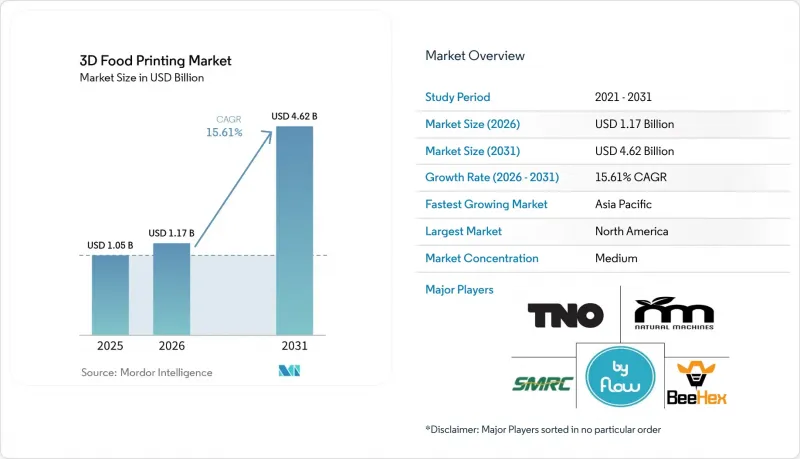
據 Mordor Intelligence 稱,2026 年 3D 食品列印市場價值為 11.7 億美元,高於 2025 年的 10.5 億美元,預計到 2031 年將達到 46.2 億美元。
預計複合年成長率為 15.61%。
本報告按產品類型(巧克力及糖果甜點、烘焙食品、肉類及魚貝類、其他)、最終用戶(政府、商業、住宅)和地區(北美、歐洲、亞太、南美、中東和非洲)進行細分。報告提供了上述所有細分市場的市場規模和預測(以美元計)。
全球3D食品列印市場趨勢與洞察
對個人化營養和客製化食品的需求日益成長
3D食品印表機正在改變個人化營養的格局,使其從行銷概念變為現實。山形大學開發了一種3D食品列印機,它使用柔軟的凝膠狀材料,為吞嚥困難的老年患者製作質地可控的餐點。這項創新凸顯了數位設計的強大功能,能夠在單一生產過程中調整食物的硬度、營養密度和過敏原含量。該技術解決了機構餐飲服務業中的一項重大挑戰。傳統上,為滿足患有糖尿病、過敏和吞嚥困難等特殊飲食限制的居民的需求,需要單獨的烹飪流程,從而導致人事費用增加。然而,這項技術的應用遠不止於老年照護。醫院和專科診所現在無需並行生產線,即可有效地提供符合患者個別需求和治療飲食要求的客製化餐點。武藏工程公司憑藉其FOODMASTER 3D列印機引領市場,該印表機整合了其專有的Mu-SLICER軟體。該公司強調,該印表機能夠同時精確控制擠出和運動,從而確保生產出符合特定客戶需求的、品質始終如一的食品形狀。這種從傳統批量生產向大規模客製化的轉變,正在重新定義小眾食品領域的經濟格局,使以往無利可圖的小規模患者和消費群組也能獲得盈利服務。
生物列印技術在肉類、魚貝類和營養豐富產品領域的創新
生物列印技術已從學術研究發展到商業性化規模應用,監管部門的批准掃清了先前阻礙其發展的資本投資障礙,推動了這一進程。 2023年12月,Aleph Farms公司獲得以色列衛生署初步批准,可以生產和銷售人造牛肉牛排。這些牛排採用安格斯牛受精卵中提取的細胞培育而成。在獲得最終標籤批准和測試後,這些產品預計將上市銷售。這項突破性進展對於建立3D生物列印「全肌肉切割」的技術和監管框架至關重要,此類產品比碎肉或結構鬆散的細胞衍生產品利潤更高。同時,Revo Foods和Paleo公司正在主導一項由歐盟資助的220萬歐元(約240萬美元)的計劃,旨在開發3D列印的舉措鮭魚。這兩家公司致力於研發植物和細胞混合技術,將培養脂肪和植物蛋白結合,與完全細胞培養的水產品相比,能夠更快進入市場並降低生產成本。這種做法凸顯了早期採用者如何將業務多元化拓展至純培養肉、混合型和植物來源蛋白平台,以隨著細胞培養技術經濟性的不斷發展最佳化盈利能力。此外,2024年5月,Aleph Farms與BioRaptor合作,透過人工智慧驅動的生物製程最佳化來擴大培養肉的生產規模。此次合作強調了計算工具在實現與傳統肉類的成本競爭力方面所發揮的關鍵作用。
3D列印機和材料的初始成本較高。
資本密集仍是工業級3D食品印表機廣泛應用的主要障礙。這些系統需要大量的初始投資,而且由於缺乏明確的投資回報前景,中小企業很難證明投資的合理性。 Stakeholder Foods公司2024年上半年的業績清楚地表明了這項挑戰的嚴峻性。儘管相關利益者公司研發支出較去年同期削減了54%,至160萬美元,但累計440萬美元的淨虧損,相當於消耗了同等數額的經營現金流。這凸顯了資本密集食品科技平台商業化帶來的長期現金消耗。終端用戶也面臨類似的經濟挑戰。確保穩定加工能力和食品安全所需的商用系統通常成本超過10萬美元。此外,由於供應商之間的競爭有限,專有的食品級油墨和預混合料價格也更高。 LaserCook公司成立於2023年8月,推出了一款以雷射為基礎的3D食品印表機,利用雷射照射來固化液體成分的特定區域。該公司聲稱,與Apptec提供的螺桿擠出系統相比,其系統成本更低,機械結構也更簡單。這項創新體現了設備製造商為追求突破性的成本降低策略所做的努力。然而,市場仍然由價格高昂的傳統平台主導。從策略角度來看,製造商若想進入高階飯店餐飲業和機構食品服務以外的市場,就需要採用設備租賃模式或大幅降低硬體成本。
細分市場分析
預計2026年至2031年間,肉類和水產品市場將以18.02%的複合年成長率成長,儘管巧克力和糖果甜點在2025年佔據了38.58%的市場佔有率,但其成長速度仍將超過所有其他產品類型。這種差異反映了價值創造方式的根本轉變。糖果甜點應用利用了消費者已有的認可度和較低的技術門檻,而結構化蛋白產品則瞄準了人造肉和水產品領域的高利潤機會。在這一領域,3D列印技術正在解決擠出成型無法解決的質地和外觀難題。 Aleph Farms公司於2024年1月獲得監管部門批准其培育牛肉牛排,這凸顯了生物列印塊狀肉品的技術可行性,此類產品的售價可以高於碎肉或非結構化細胞衍生產品。
烘焙業的應用持續穩定成長,3D列印技術能夠打造複雜形狀和精細設計,從而在餐飲和零售業中脫穎而出,為高階產品樹立標竿。山形大學開發的一款專為老年人食品設計的3D食品印表機,能夠製作出外觀精美、口感已調整的菜餚,與普通餐食相媲美,展現了這項技術在蛋白質和糖果甜點之外的廣泛應用前景。其他產品類型,例如醬料、乳製品替代品和機能性食品,也代表著3D列印技術在精準營養分層和定製配方方面的新機會。武藏工程公司與東京醫科齒科大學以及專攻法式料理、致力於改善吞嚥困難患者飲食的廚師合作,開發了2D和3D慕斯,旨在提升老年患者的營養狀況和用餐體驗。正如武藏工程公司所指出的,小眾應用能夠推動3D列印技術在醫療機構中的普及。從策略角度來看,糖果甜點業的成熟企業必須加快客製化和複雜化設計的創新,才能鞏固其市場佔有率。同時,肉品和魚貝類產業的顛覆者們正在競相與傳統蛋白質產品實現成本持平,以免資本市場失去耐心。
區域分析
從2026年到2031年,亞太地區預計將以17.85%的複合年成長率成長,超過其他所有地區。這一成長得益於日本政府支持的研發聯盟、中國快速的商業化進程以及新加坡有利的監管政策,這些因素共同為3D食品列印技術的應用創造了理想的環境。 2024年5月,GOOD Meat在新加坡成功推出全球首款零售培育雞,並取得了突破性的成功。每120克包裝售價7.20新加坡元(約5.30美元),顯示簡化的核准流程使各個地區能夠在向消費者提供3D列印和培育食品方面超越西方市場。日本的「Soft3D共創聯盟」旨在與食品業的相關人員合作,促進3D食品印表機的研發,目前正取得顯著進展。諸如在國立未來科學館(Miraikan)舉辦的2024年壽司展等公共活動,凸顯了這項技術在減少食物廢棄物和將低成本食材轉化為優質產品方面的潛力。中國和印度正在加強其替代蛋白基礎設施建設,本土製造商和供應商不斷湧現,以具有競爭力的價格供應國內市場。澳洲的餐飲服務業正在探索將3D列印技術應用於高階飯店餐飲領域,而韓國正在更新法律規範,以適應細胞培養和3D列印食品。
預計到2025年,北美將佔據41.12%的市場佔有率。這得益於其完善的餐飲服務基礎設施、FDA和USDA聯合製定的細胞培養產品監管框架帶來的早期監管澄清,以及對食品科技新創企業的大量創業投資相關利益者。 Stakeholder Foods公司於2024年與Wyler Farms和台灣工業技術研究院的合作,體現了北美同時瞄準國內和亞太市場的策略。這些公司正利用其獨特的技術,不僅促進設備銷售,還透過原料供應創造持續收入。美國仍然是最大的單一國家市場,這主要得益於高檔餐廳、酒店和商用餐飲服務業的應用。然而,各州監管政策的不一致,例如佛羅裡達州將於2024年禁止銷售培養肉,可能會帶來合規挑戰並阻礙市場成長。加拿大和墨西哥正在崛起為次市場,加拿大公司專注於為特殊飲食提供3D列印技術,而墨西哥餐飲連鎖店則在探索菜單客製化。
歐洲食品安全局 (EFSA) 實施的嚴格新食品法規正在重塑歐洲的 3D 食品列印市場。這些法規往往更有利於成熟企業而非新創公司,因為它們需要冗長的審查流程和提交大量資料。德國、英國、法國和義大利在 3D 食品列印技術的普及應用方面處於主導。一家德國工程公司向歐洲各地的餐飲企業供應工業級 3D 列印機,而一家英國連鎖飯店正在試行使用 3D 列印技術客製化季節性菜單。在南美洲、中東和非洲,3D 食品列印市場仍處於起步階段。基礎設施不足、設備成本高昂以及消費者認知度低等挑戰阻礙了該技術的廣泛應用。然而,都市區和高階酒店業對 3D 食品列印的興趣正在逐漸成長。
其他好處:
- Excel格式的市場預測(ME)表
- 3個月的分析師支持
目錄
第1章:引言
- 研究假設和市場定義
- 調查範圍
第2章:調查方法
第3章執行摘要
第4章 市場狀況
- 市場概覽
- 市場促進因素
- 對個人化營養和客製化食品的需求日益成長
- 透過精確的數量控制和按需生產來減少食物廢棄物。
- 生物列印技術在肉類、魚貝類和營養豐富產品生產的創新
- 忙碌的生活方式推動了人們對既方便又奢華的零食的需求。
- 利用3D列印技術發展植物來源替代品
- 製造商在技術創新方面的進步
- 市場限制因素
- 3D列印機和材料的初始成本較高。
- 食品安全、衛生和標籤方面的監管障礙。
- 消費者對3D列印食品的不熟悉與懷疑
- 特種油墨和粉末供應鏈面臨的挑戰
- 供應鏈分析
- 監理展望
- 波特五力模型
第5章 市場規模與成長預測
- 依產品類型
- 巧克力和糖果甜點
- 麵包店
- 肉類和水產品
- 其他產品類型
- 最終用戶
- 政府
- 商業
- 住宅
- 按地區
- 北美洲
- 美國
- 加拿大
- 墨西哥
- 其他北美國家
- 歐洲
- 德國
- 英國
- 法國
- 義大利
- 其他歐洲國家
- 亞太地區
- 印度
- 中國
- 日本
- 澳洲
- 其他亞太國家
- 南美洲
- 中東和非洲
- 北美洲
第6章 競爭情勢
- 市場集中度
- 策略趨勢
- 市場排名分析
- 公司簡介
- BeeHex
- byFlow
- Natural Machines
- TNO
- SMRC
- Choc Edge
- NuFood
- CandyFab
- Redefine Meat
- SavorEat
- Modern Meadow
- Print2Taste GmbH
- Procusini
- Barilla(BluRhapsody)
- Revo Foods
- Aleph Farms
- Steakholder Foods
- Upprinting Food
- North Branch Everbright
- Wiiboox
- Dovetailed
- WASP
第7章 市場機會與未來展望
According to Mordor Intelligence, the 3D food printing market size is valued at USD 1.17 billion in 2026, growing from the 2025 value of USD 1.05 billion, and is forecast to climb to USD 4.62 billion by 2031, advancing at a 15.61% CAGR.
This report is Segmented by Product Type (Chocolates and Confectionery, Bakery, Meat and Seafood, and Other Product Types), End User (Government, Commercial, and Residential), and Geography (North America, Europe, Asia-Pacific, South America, and Middle East and Africa). The Report Offers Market Size and Forecasts in Value (USD) for all the Above Segments.
Global 3D Food Printing Market Trends and Insights
Rising demand for personalized nutrition and customized foods
3D food printers are transforming personalized nutrition, shifting it from a marketing concept to a practical reality. Yamagata University has developed 3D food printers that use soft gel materials to create texture-modified meals for elderly patients with swallowing difficulties. This innovation highlights the capabilities of digital design: modifying hardness, nutrient density, and allergen content within a single production run. This technology addresses a critical gap in institutional food services, where accommodating residents with specific dietary needs, such as diabetes, allergies, or dysphagia, traditionally required separate kitchen workflows, increasing labor costs. However, the applications of this technology extend beyond eldercare. Hospitals and specialty clinics can now efficiently provide meals customized to individual patient requirements, adhering to therapeutic diets without the need for parallel production lines. Musashi Engineering leads the market with its FOODMASTER 3D printer, integrated with proprietary Mu-SLICER software. The company emphasizes the printer's ability to precisely control both extrusion and motion simultaneously, ensuring the production of stable, high-quality food shapes tailored to specific customer needs. This shift from conventional batch production to mass customization is redefining the economics of niche food segments, enabling the profitable service of smaller patient or consumer groups that were previously unviable.
Innovations in bio-printing for meat, seafood, and nutrient-rich products
Bio-printing has progressed from academic research to commercially scalable programs, driven by regulatory approvals that have unlocked previously stalled capital investments. In December 2023, Aleph Farms obtained preliminary approval from the Israeli Health Ministry to produce and sell cultivated beef steaks. These steaks are developed from cells sourced from a fertilized egg of a Black Angus cow. Following final label approval and inspection, these products are expected to reach consumers. This milestone is crucial as it establishes the technical and regulatory framework for 3D-bioprinted whole-muscle cuts, which yield higher profit margins compared to ground or less structured cell-based products. Concurrently, Revo Foods and Paleo are leading a EUR 2.2 million (USD 2.4 million) EU-funded initiative to create 3D-printed vegan salmon. Their efforts focus on the hybrid plant-cell segment, where combining cultivated fats with plant proteins enables faster market entry and reduces production costs compared to fully cell-cultured seafood. This approach highlights how early adopters are diversifying across pure cultivated, hybrid, and plant-based protein platforms to optimize revenue as cell-culture economics continue to develop. Additionally, Aleph Farms partnered with BioRaptor in May 2024 to leverage AI-driven bioprocess optimization for scaling cultivated meat production. This collaboration emphasizes the critical role of computational tools in achieving cost competitiveness with conventional meat.
High initial costs of 3D printers and materials
Capital intensity remains a major obstacle to the broader adoption of industrial 3D food printers. These systems require significant upfront investments, which small and mid-sized operators struggle to justify without clear payback timelines. Steakholder Foods' financial results for the first half of 2024 illustrate the scale of this challenge. Despite cutting research and development expenses by 54% year-over-year to USD 1.6 million, the company reported a net loss of USD 4.4 million and consumed an equivalent amount in operating cash, highlighting the prolonged cash burn associated with commercializing capital-intensive food technology platforms. End users face similar economic challenges: commercial-grade systems, necessary for consistent throughput and food-safe operations, often cost more than USD 100,000. Furthermore, proprietary food-grade inks and premix blends are priced at a premium due to limited supplier competition. LaserCook Inc., established in August 2023, is introducing a laser-based 3D food printer that uses laser irradiation to solidify specific regions of a liquid feedstock. The company claims its system offers lower costs and reduced mechanical complexity compared to the screw-extrusion systems provided by Apptec. This innovation reflects efforts by equipment manufacturers to pursue disruptive cost-reduction strategies. However, the market remains dominated by higher-priced legacy platforms. Strategically, for manufacturers to penetrate markets beyond premium hospitality and institutional food services, they will need to adopt equipment leasing models or achieve significant reductions in hardware costs.
Other drivers and restraints analyzed in the detailed report include:
- Food waste reduction through precise portioning and on-demand production
- Growth in plant-based alternatives using 3D printing
- Regulatory hurdles on food safety, hygiene, and labeling
For complete list of drivers and restraints, kindly check the Table Of Contents.
Segment Analysis
Meat and seafood segments are forecast to grow at 18.02% CAGR from 2026 to 2031, outpacing all other product categories despite chocolates and confectionery holding a 38.58% share in 2025. This divergence reflects a fundamental shift in value capture: confectionery applications monetize established consumer acceptance and low technical barriers, while structured protein formats target the higher-margin opportunity in alternative meat and seafood, where 3D printing solves texture and appearance challenges that extrusion cannot address. Aleph Farms' January 2024 regulatory approval for cultivated beef steaks validates the technical pathway for bioprinted whole-muscle cuts, which command premium pricing relative to ground or unstructured cell-based products.
Bakery applications remain a steady contributor, leveraging 3D printing to produce complex shapes and intricate designs that differentiate premium offerings in hospitality and retail. Yamagata University's development of 3D food printers for eldercare foods, which can produce visually appealing texture-modified dishes resembling regular meals, illustrates the technology's versatility beyond protein and confectionery. Other product types, including sauces, dairy analogs, and functional foods, represent emerging opportunities where 3D printing enables precise nutrient layering and customized formulations. Musashi Engineering's collaboration with Tokyo Medical and Dental University and a chef specializing in dysphagia-friendly French cuisine produced 2D and 3D mousse forms aimed at improving nutrition and meal enjoyment for elderly patients, demonstrating that niche applications can drive adoption in institutional settings, as noted by Musashi Engineering. The strategic implication is that incumbents in confectionery must defend share by accelerating innovation in customization and design complexity, while disruptors in meat and seafood race to achieve cost parity with conventional proteins before capital markets lose patience.
Geography Analysis
From 2026 to 2031, the Asia-Pacific region is expected to grow at a CAGR of 17.85%, surpassing all other regions. This growth is driven by Japan's government-supported Research and Development consortia, China's rapid commercialization efforts, and Singapore's favorable regulatory policies, creating an ideal environment for 3D food printing adoption. In May 2024, GOOD Meat achieved a milestone by launching the world's first retail sale of cultivated chicken in Singapore. Priced at SGD 7.20 (USD 5.30) for a 120-gram package, this development highlights how streamlined approval processes can enable jurisdictions to outpace Western markets in delivering 3D-printed and cultivated foods to consumers. Japan's Soft3D Co-Creation Consortium, established to advance 3D food printer R&D in collaboration with food industry stakeholders, has demonstrated significant progress. Public showcases, such as the 2024 sushi exhibition at Miraikan's National Museum of Emerging Science, emphasize the technology's potential to minimize food waste and transform low-cost ingredients into premium products. China and India are strengthening their alternative protein infrastructures, with local manufacturers and suppliers emerging to serve domestic markets at competitive prices. Australia's foodservice industry is exploring 3D printing for high-end hospitality applications, while South Korea is updating its regulatory framework to accommodate cell-cultured and 3D-printed foods.
In 2025, North America held a 41.12% market share, supported by its well-established foodservice infrastructure, early regulatory clarity under the FDA-USDA joint framework for cell-cultured products, and substantial venture capital investments in food technology startups. Steakholder Foods' 2024 partnerships with Wyler Farm and Taiwan's Industrial Technology Research Institute illustrate North America's strategy to target both domestic and Asia-Pacific markets. By utilizing proprietary technologies, these companies are not only driving equipment sales but also generating recurring revenue from ingredient supplies. The United States remains the largest single-country market, fueled by adoption in premium restaurants, hotels, and institutional food services. However, state-level regulatory inconsistencies, such as Florida's 2024 ban on cultivated meat sales, create compliance challenges that could hinder market growth. Canada and Mexico are emerging as secondary markets, with Canadian companies focusing on 3D printing for specialized diets and Mexican foodservice chains experimenting with menu customization.
Europe's 3D food printing market is shaped by strict novel food regulations enforced by the European Food Safety Authority. These regulations, which require lengthy reviews and extensive data submissions, tend to favor established players over startups. Germany, the United Kingdom, France, and Italy are leading adoption efforts. German engineering firms are supplying industrial 3D printers to foodservice operators across Europe, while United Kingdom, hospitality chains are testing customization for seasonal menus. In South America, the Middle East, and Africa, the 3D food printing market is still in its early stages. Challenges such as limited infrastructure, high equipment costs, and low consumer awareness hinder adoption. However, interest is beginning to grow in urban areas and premium hospitality segments.
- BeeHex
- byFlow
- Natural Machines
- TNO
- SMRC
- Choc Edge
- NuFood
- CandyFab
- Redefine Meat
- SavorEat
- Modern Meadow
- Print2Taste GmbH
- Procusini
- Barilla (BluRhapsody)
- Revo Foods
- Aleph Farms
- Steakholder Foods
- Upprinting Food
- North Branch Everbright
- Wiiboox
- Dovetailed
- WASP
Additional Benefits:
- The market estimate (ME) sheet in Excel format
- 3 months of analyst support
TABLE OF CONTENTS
1 INTRODUCTION
- 1.1 Study Assumptions and Market Definition
- 1.2 Scope of the Study
2 RESEARCH METHODOLOGY
3 EXECUTIVE SUMMARY
4 MARKET LANDSCAPE
- 4.1 Market Overview
- 4.2 Market Drivers
- 4.2.1 Rising Demand for Personalized Nutrition and Customized Foods
- 4.2.2 Food Waste Reduction Through Precise Portioning and On-Demand Production
- 4.2.3 Innovations in Bio-Printing for Meat, Seafood, and Nutrient-Rich Products
- 4.2.4 Busy Lifestyles Drive Need for Quick, Indulgent Snacks
- 4.2.5 Growth in Plant-Based Alternatives Using 3D Printing
- 4.2.6 Rising Technology Innovations by Manufacturers
- 4.3 Market Restraints
- 4.3.1 High Initial Costs of 3D Printers and Materials
- 4.3.2 Regulatory Hurdles on Food Safety, Hygiene, and Labeling
- 4.3.3 Consumer Unfamiliarity and Skepticism Toward 3D-Printed Food
- 4.3.4 Supply Chain Issues for Specialized Inks and Powders
- 4.4 Supply Chain Analysis
- 4.5 Regulatory Outlook
- 4.6 Porter's Five Forces
- 4.6.1 Threat of New Entrants
- 4.6.2 Bargaining Power of Buyers/Consumers
- 4.6.3 Bargaining Power of Suppliers
- 4.6.4 Threat of Substitute Products
- 4.6.5 Intensity of Competitive Rivalry
5 MARKET SIZE AND GROWTH FORECAST (VALUE)
- 5.1 By Product Type
- 5.1.1 Chocolates and Confectionery
- 5.1.2 Bakery
- 5.1.3 Meat & Seafood
- 5.1.4 Other Product Types
- 5.2 By End User
- 5.2.1 Government
- 5.2.2 Commercial
- 5.2.3 Residential
- 5.3 By Geography
- 5.3.1 North America
- 5.3.1.1 United States
- 5.3.1.2 Canada
- 5.3.1.3 Mexico
- 5.3.1.4 Rest of North America
- 5.3.2 Europe
- 5.3.2.1 Germany
- 5.3.2.2 United Kingdom
- 5.3.2.3 France
- 5.3.2.4 Italy
- 5.3.2.5 Rest of Europe
- 5.3.3 Asia-Pacific
- 5.3.3.1 India
- 5.3.3.2 China
- 5.3.3.3 Japan
- 5.3.3.4 Australia
- 5.3.3.5 Rest of Asia-Pacific
- 5.3.4 South America
- 5.3.5 Middle East and Africa
- 5.3.1 North America
6 COMPETITIVE LANDSCAPE
- 6.1 Market Concentration
- 6.2 Strategic Moves
- 6.3 Market Ranking Analysis
- 6.4 Company Profiles (includes Global-level Overview, Market-level Overview, Core Segments, Financials (if available), Strategic Information, Market Rank/Share, Products & Services, Recent Developments)
- 6.4.1 BeeHex
- 6.4.2 byFlow
- 6.4.3 Natural Machines
- 6.4.4 TNO
- 6.4.5 SMRC
- 6.4.6 Choc Edge
- 6.4.7 NuFood
- 6.4.8 CandyFab
- 6.4.9 Redefine Meat
- 6.4.10 SavorEat
- 6.4.11 Modern Meadow
- 6.4.12 Print2Taste GmbH
- 6.4.13 Procusini
- 6.4.14 Barilla (BluRhapsody)
- 6.4.15 Revo Foods
- 6.4.16 Aleph Farms
- 6.4.17 Steakholder Foods
- 6.4.18 Upprinting Food
- 6.4.19 North Branch Everbright
- 6.4.20 Wiiboox
- 6.4.21 Dovetailed
- 6.4.22 WASP
7 MARKET OPPORTUNITIES AND FUTURE OUTLOOK

 全球3D食品列印市場規模、佔有率、趨勢和成長分析報告(2026-2034年)
 3D食品列印市場:依組件、印表機技術、列印流程、終端用戶應用、食品類別及通路分類-2026-2032年全球市場預測
 3D食品列印市場規模、佔有率及成長分析(按組件、技術、原料、最終用途及地區分類)-2026-2033年產業預測
 2032年3D食品列印市場預測:按組件、原料、技術、最終用戶和地區分類的全球分析
 3D食品列印材料市場機會、成長促進因素、產業趨勢分析及預測(2025-2034年)3D食品列印商用設備市場機會、成長動力、產業趨勢分析及2025-2034年預測全球3D食品列印市場規模:依原料、產業、地區、範圍及預測