


 |
市場調查報告書
商品編碼
1940777
歐洲智慧電錶:市場佔有率分析、產業趨勢與統計、成長預測(2026-2031 年)Europe Smart Meter - Market Share Analysis, Industry Trends & Statistics, Growth Forecasts (2026 - 2031) |
||||||

※ 本網頁內容可能與最新版本有所差異。詳細情況請與我們聯繫。
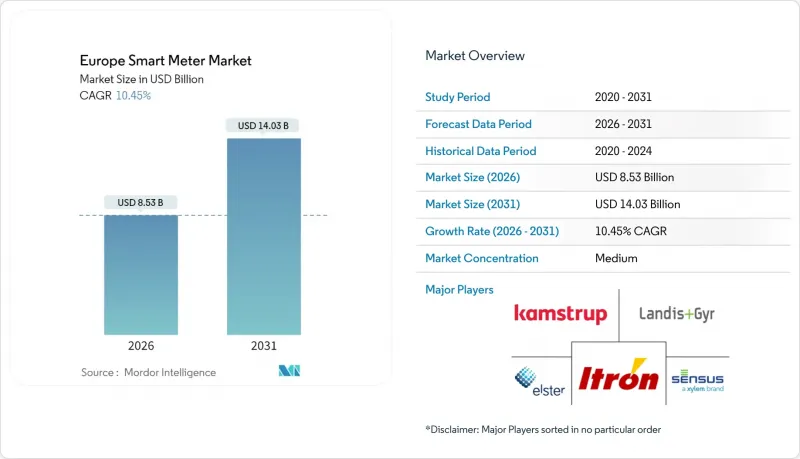
預計到 2026 年,歐洲智慧電錶市場規模將達到 85.3 億美元,高於 2025 年的 77.2 億美元。
預計到 2031 年將達到 140.3 億美元,2026 年至 2031 年的複合年成長率為 10.45%。
嚴格的合規要求、電網現代化改造以及緊迫的數位化專案持續推動著這一成長趨勢。歐盟指令2019/944強制要求所有成員國完成高階計量系統的建設,即使短期成本效益看似有限,也能確保安裝量的穩定成長。公共產業正在大規模部署可再生能源之前升級其計量基礎設施,而新興的交易型能源示範專案也為近即時資料交換的商業價值提供了支援。硬體商品化降低了計量表的初始成本,而隨著公用事業公司將數據豐富的服務貨幣化,軟體和分析服務的收入正在快速成長。隨著差異化的通訊協定、網路安全安全功能和邊緣分析能力成為決定性競爭優勢,供應商之間的整合正在加速。
歐洲智慧電錶市場趨勢與洞察
歐盟範圍內的強制採用目標推動了合規速度的加快
根據2019/944號指令,安裝義務確保了計量表供應商即使在成本敏感型市場也能獲得銷售量資訊。奧地利的目標是到2024年達到95%以上的普及率,而比利時已達到70%的覆蓋率,擁有440萬台設備。同時,政府也推出了產消者投資補貼,縮短了家庭用戶的投資回收期。在德國,2032年這項法定完成日期已成為一個明確的里程碑,促進了現有公共產業和數位零售商之間的合作。圍繞DLMS/COSEM通訊協定的整合消除了傳統的互通性障礙,使供應商能夠最佳化規模經濟並進一步降低單位成本。
智慧電網和分散式能源(DER)的日益整合增加了數據需求。
屋頂光電發電和儲能系統的快速普及,使得電網營運商必須在不到一小時內收集到負載曲線,以實現動態計費。荷蘭一項針對1400個智慧水錶的試點研究表明,增加壓力和洩漏分析功能可使電網效率提高89%,這充分證明了詳細數據如何支持資產最佳化。在德國,動態計費系統依靠雙向連接來引導靈活的需求,並使本地發電與用電量相符。由歐盟「地平線計畫」資助的BeFlexible計畫匯集了來自七個國家的21個合作夥伴,旨在建立互通性框架,該框架以先進的計量技術作為底層感測器層。
高昂的前期成本和網路安全風險限制了採用速度。
在德國,安裝成本仍維持在 643 至 883 歐元之間,遠超過法律規定的客戶自付上限。圍繞這些成本的法律挑戰導致專案進度延誤,並增加了公共產業的資金籌措需求。同時,NIS2 指令增加了加密和持續威脅監控的義務,從而增加了資本和營運成本。在英國,早期設備故障削弱了用戶信心,迫使供應商撥出額外預算用於客戶支援宣傳活動和更換計畫。儘管有證據顯示長期來看可以節省成本,但這些摩擦正在減緩短期內的普及速度。
細分市場分析
智慧能源設備將在2025年繼續推動營收成長,其中水務產業預計到2031年將以11.6%的複合年成長率領先。歐洲智慧水錶市場正在擴張,這主要得益於超音波技術,該技術可提供15-20年的電池壽命、聲學洩漏檢測和遠端壓力監測功能,這些功能已在比利時得到驗證,目前已安裝20.5萬台。在義大利強制實施無線M-Bus連接政策的推動下,超音波燃氣表近期獲得了4.5萬台的訂單。日益嚴峻的水資源短缺問題凸顯了洩漏分析的商業價值,公共產業即時進行升級改造。
物聯網賦能的維修具有更大的交叉銷售潛力,尤其是在LoRaWAN和NB-IoT回程傳輸無需電網站點配電的情況下。隨著電錶規模的擴大,價格面臨下行壓力,而專用水和燃氣設備由於內置壓力、防篡改和聲學特徵感測器,仍能保持較高的利潤率。隨著網路洩漏檢測技術在減少非收益用水方面展現出直接作用,即使在價格管制嚴格的地區,董事會也越來越傾向於核准相關投資。
儘管電力線通訊(PLC)仍保持著43.10%的市場佔有率,但歐洲智慧電錶市場正迅速採用蜂窩技術,因為營運商可以將網路維護外包給通訊業者。目前,NB-IoT和LTE-M模組的電池壽命已達10年,並具備遠端韌體空中升級(FOTA)功能。英國正在進行基於4G的電錶回程傳輸試驗,為計畫中的2G/3G服務終止做準備。供水事業已訂購了200萬個蜂窩單元,並表示需要運營商級別的服務等級協定(SLA)。在PLC方面投入巨資的公用事業公司正在製定分階段遷移計劃,以防止資產閒置,但大多數新競標都集中在混合或全蜂窩解決方案上。
蜂窩網路管理服務模式將資本支出 (CapEx) 轉變為營運支出 (OpEx),並符合允許收取網路服務費用但限制消費者價格的法規結構。除了能源數據外,同一張 SIM 卡還可以承載可升級的應用程式,涵蓋電能品質指標和變壓器級分析,與一次性 PLC 鏈路相比,可提高生命週期投資回報率。
其他福利:
- Excel格式的市場預測(ME)表
- 分析師支持(3個月)
目錄
第1章 引言
- 研究假設和市場定義
- 調查範圍
第2章調查方法
第3章執行摘要
第4章 市場情勢
- 市場概覽
- 市場促進因素
- 歐盟內部強制實施目標(2019/944)
- 對智慧電網和分散式能源(DER)整合的需求日益成長
- 智慧城市數位化計劃
- 交易能源試點項目
- 市場數據需要即時柔軟性
- 包含物聯網漏水偵測系統維修工程的套裝出售
- 市場限制
- 高昂的初始成本和網路安全風險
- 舊有系統互通性差距
- 消費者隱私引發的強烈反彈以及資料片段化問題
- 半導體供應鏈瓶頸
- 產業價值鏈分析
- 監管環境
- 技術展望
- 波特五力分析
- 供應商的議價能力
- 買方的議價能力
- 新進入者的威脅
- 替代品的威脅
- 競爭對手之間的競爭
- 宏觀經濟趨勢的影響
第5章 市場規模與成長預測
- 按計量類型
- 智慧電錶
- 智慧燃氣表
- 智慧水錶
- 透過通訊技術
- 電力線路通訊(PLC)
- 射頻(RF網狀)
- 蜂窩通訊(2G/4G/NB-IoT)
- 有線乙太網路/光纖
- 按組件
- 硬體
- 軟體和分析
- 服務(實施、AMI 管理)
- 最終用戶
- 住宅
- 商業的
- 工業的
- 愛別
- 單相
- 三相
- 按國家/地區
- 英國
- 德國
- 法國
- 義大利
- 西班牙
- 比利時
- 荷蘭
- 其他歐洲地區
第6章 競爭情勢
- 市場集中度
- 策略趨勢
- 市佔率分析
- 公司簡介
- Landis+Gyr Group AG
- Itron, Inc.
- Kamstrup A/S
- Sensus USA Inc.(Xylem)
- Elster GmbH(Honeywell)
- Diehl Metering GmbH
- Apator SA
- Zenner International GmbH and Co. KG
- Arad Ltd.
- Aclara Technologies LLC
- Aidon Oy
- ADD GRUP SRL
- Networked Energy Services Corp.
- Iskraemeco dd
- Elgama-Elektronika UAB
- Holley Technology Ltd.
- ZIV Automation SL
- Wasion Group Holdings Ltd.
- Kaifa Technology(Europe)
- Secure Meters Europe Ltd.
- Sagemcom Energy and Telecom SAS
第7章 市場機會與未來展望
Europe smart meter market size in 2026 is estimated at USD 8.53 billion, growing from 2025 value of USD 7.72 billion with 2031 projections showing USD 14.03 billion, growing at 10.45% CAGR over 2026-2031.
Robust compliance mandates, grid-modernization efforts, and urgent digitalization programs continue to anchor this growth path. EU Directive 2019/944 obliges every member state to complete advanced metering rollouts, guaranteeing consistent installation volumes even when short-term cost-benefit arguments appear marginal. Utilities are upgrading measurement infrastructure ahead of large-scale renewable additions, while emerging transactive-energy pilots confirm the business case for near-real-time data exchange. Hardware commoditization is lowering upfront meter prices, but software and analytics revenues are rising fast as utilities monetize data-rich services. Consolidation among equipment vendors is intensifying because differentiated communication protocols, cybersecurity features, and edge analytics capabilities now define competitive advantage.
Europe Smart Meter Market Trends and Insights
EU-wide Mandatory Rollout Targets Drive Compliance Acceleration
Binding installation obligations under Directive 2019/944 guarantee volume visibility for metering suppliers even in cost-sensitive markets. Austria surpassed 95% penetration in 2024, and Belgium achieved 70% coverage with 4.4 million devices while offering prosumer investment premiums that ease household payback periods. Germany's legally enshrined completion deadline in 2032 imposes clear milestones, encouraging partnerships between incumbent utilities and digital retailers. Convergence around DLMS/COSEM protocols now removes the former interoperability barrier, letting vendors optimize economies of scale and lowering unit prices further.
Growing Smart-Grid and DER Integration Amplifies Data Requirements
Surging rooftop PV and battery uptake oblige network operators to collect sub-hourly load profiles for dynamic-tariff settlement. Dutch pilots using 1,400 smart water meters delivered 89% network-efficiency gains after adding pressure and leak analytics, demonstrating how granular data supports asset optimization. In Germany, dynamic tariffs rely on bidirectional connectivity to nudge flexible demand and align local generation with consumption. Horizon-Europe-funded BeFlexible connects 21 partners across seven countries, establishing interoperability frameworks that require advanced metering as the foundational sensor layer.
High Upfront Costs and Cybersecurity Risks Constrain Deployment Velocity
Installation prices in Germany still range from EUR 643-883, well above the legally capped customer charge. Legal challenges over those costs delay schedules and inflate utility financing needs. Parallelly, the NIS2 directive adds encryption and continuous threat-monitoring mandates that raise equipment and operating expenditure. Earlier U.K. device malfunctions undermined user confidence, compelling suppliers to allocate extra budgets for customer-support campaigns and replacement programs. These frictions slow short-term uptake despite long-term cost-savings evidence.
Other drivers and restraints analyzed in the detailed report include:
- Smart-City Digitalization Programs Create Cross-Sector Synergies
- Transactive-Energy Pilots Establish New Revenue Models
- Semiconductor Supply-Chain Bottlenecks Extend Lead Times
For complete list of drivers and restraints, kindly check the Table Of Contents.
Segment Analysis
Smart electricity devices continued to dominate revenue in 2025, yet the water category is forecast to log the highest 11.6% CAGR through 2031. The Europe smart meter market size for water applications is expanding because ultrasonic technology offers 15-20 year battery life, acoustic leak detection, and remote pressure monitoring capabilities already validated through 205,000-unit deployments in Belgium. Ultrasonic gas meters benefit from Italian mandates requiring wireless M-Bus connectivity, with recent awards covering 45,000 units. Water scarcity concerns enhance the business case for leak analytics, pushing utilities toward immediate upgrades.
IoT-enabled retrofits increase cross-selling potential, especially when LoRaWAN or NB-IoT backhaul eliminates the need for grid-site power. Electricity meters face price compression as scale grows; meanwhile, specialized water and gas devices maintain higher margins because they include pressure, tamper, and acoustic-signature sensors. As networked leak-detection proves its direct non-revenue-water savings, boards authorize faster investments even in price-controlled regions.
While PLC retains a 43.10% share, the Europe smart meter market is witnessing rapid cellular uptake because operators can outsource network maintenance to telcos. NB-IoT and LTE-M modules now ship with 10-year battery life profiles and remote firmware-over-the-air features. U.K. trials using 4G for meter backhaul prepare the estate for planned 2G/3G sunsets, and water utilities have already ordered 2 million cellular units, citing carrier-grade SLAs. Utilities with deep PLC investments are mapping phased migrations to prevent stranded-asset losses, but most new tenders emphasize hybrid or full-cellular architectures.
Cellular's managed-service model shifts capex to opex, fitting regulatory frameworks that cap consumer charges yet allow network-service fees. Beyond energy data, the same SIM can host upgradeable applications covering power-quality metrics or transformer-level analytics, improving lifetime ROI compared with single-purpose PLC links.
The Europe Smart Meter Market Report is Segmented by Meter Type (Smart Electricity Meter, Smart Gas Meter, and Smart Water Meter), Communication Technology (Power-Line Communication, Radio Frequency, and More), Component (Hardware, Software and Analytics, and Services), End-User (Residential, Commercial, and Industrial), Phase (Single-Phase and Three-Phase), and Country. The Market Forecasts are Provided in Terms of Value (USD).
List of Companies Covered in this Report:
- Landis+Gyr Group AG
- Itron, Inc.
- Kamstrup A/S
- Sensus USA Inc. (Xylem)
- Elster GmbH (Honeywell)
- Diehl Metering GmbH
- Apator SA
- Zenner International GmbH and Co. KG
- Arad Ltd.
- Aclara Technologies LLC
- Aidon Oy
- ADD GRUP SRL
- Networked Energy Services Corp.
- Iskraemeco d.d.
- Elgama-Elektronika UAB
- Holley Technology Ltd.
- ZIV Automation S.L.
- Wasion Group Holdings Ltd.
- Kaifa Technology (Europe)
- Secure Meters Europe Ltd.
- Sagemcom Energy and Telecom SAS
Additional Benefits:
- The market estimate (ME) sheet in Excel format
- 3 months of analyst support
TABLE OF CONTENTS
1 INTRODUCTION
- 1.1 Study Assumption And Market Definition
- 1.2 Scope of the study
2 RESEARCH METHODOLOGY
3 EXECUTIVE SUMMARY
4 MARKET LANDSCAPE
- 4.1 Market Overview
- 4.2 Market Drivers
- 4.2.1 EU?wide mandatory rollout targets (2019/944)
- 4.2.2 Growing smart-grid and DER integration needs
- 4.2.3 Smart-city digitalisation programs
- 4.2.4 Transactive-energy pilot schemes
- 4.2.5 Real-time flexibility-market data demand
- 4.2.6 IoT leak-detection bundling with retrofits
- 4.3 Market Restraints
- 4.3.1 High upfront cost and cyber-security risk
- 4.3.2 Legacy-system interoperability gaps
- 4.3.3 Consumer privacy backlash vs data granularity
- 4.3.4 Semiconductor supply-chain bottlenecks
- 4.4 Industry Value Chain Analysis
- 4.5 Regulatory Landscape
- 4.6 Technological Outlook
- 4.7 Porter's Five Forces Analysis
- 4.7.1 Bargaining Power of Suppliers
- 4.7.2 Bargaining Power of Buyers
- 4.7.3 Threat of New Entrants
- 4.7.4 Threat of Substitutes
- 4.7.5 Intensity of Competitive Rivalry
- 4.8 Impact of Macroeconomic Trends
5 MARKET SIZE AND GROWTH FORECASTS (VALUES)
- 5.1 By Meter Type
- 5.1.1 Smart Electricity Meter
- 5.1.2 Smart Gas Meter
- 5.1.3 Smart Water Meter
- 5.2 By Communication Technology
- 5.2.1 Power-Line Communication (PLC)
- 5.2.2 Radio Frequency (RF Mesh)
- 5.2.3 Cellular (2G/4G/NB-IoT)
- 5.2.4 Wired Ethernet/Fiber
- 5.3 By Component
- 5.3.1 Hardware
- 5.3.2 Software and Analytics
- 5.3.3 Services (Deployment, AMI-managed)
- 5.4 By End-User
- 5.4.1 Residential
- 5.4.2 Commercial
- 5.4.3 Industrial
- 5.5 By Phase
- 5.5.1 Single-Phase
- 5.5.2 Three-Phase
- 5.6 By Country
- 5.6.1 United Kingdom
- 5.6.2 Germany
- 5.6.3 France
- 5.6.4 Italy
- 5.6.5 Spain
- 5.6.6 Belgium
- 5.6.7 Netherlands
- 5.6.8 Rest of Europe
6 COMPETITIVE LANDSCAPE
- 6.1 Market Concentration
- 6.2 Strategic Moves
- 6.3 Market Share Analysis
- 6.4 Company Profiles (includes Global level Overview, Market level overview, Core Segments, Financials as available, Strategic Information, Market Rank/Share, Products and Services, Recent Developments)
- 6.4.1 Landis+Gyr Group AG
- 6.4.2 Itron, Inc.
- 6.4.3 Kamstrup A/S
- 6.4.4 Sensus USA Inc. (Xylem)
- 6.4.5 Elster GmbH (Honeywell)
- 6.4.6 Diehl Metering GmbH
- 6.4.7 Apator SA
- 6.4.8 Zenner International GmbH and Co. KG
- 6.4.9 Arad Ltd.
- 6.4.10 Aclara Technologies LLC
- 6.4.11 Aidon Oy
- 6.4.12 ADD GRUP SRL
- 6.4.13 Networked Energy Services Corp.
- 6.4.14 Iskraemeco d.d.
- 6.4.15 Elgama-Elektronika UAB
- 6.4.16 Holley Technology Ltd.
- 6.4.17 ZIV Automation S.L.
- 6.4.18 Wasion Group Holdings Ltd.
- 6.4.19 Kaifa Technology (Europe)
- 6.4.20 Secure Meters Europe Ltd.
- 6.4.21 Sagemcom Energy and Telecom SAS
7 MARKET OPPORTUNITIES AND FUTURE OUTLOOK
- 7.1 White-space and Unmet-Need Assessment

 智慧電錶市場:按類型、通訊技術、技術、組件、階段、應用、最終用途、部署模式和客戶類型分類-2026-2032年全球市場預測
 歐洲智慧電錶市場(第20版)
 智慧電錶:市場佔有率分析、產業趨勢與統計、成長預測(2026-2031)
 智慧電錶市場規模、佔有率和趨勢分析報告:按組件、類型、技術、最終用途、地區和細分市場分類(2026-2033 年)
 智慧電錶市場預測——全球產品、組件、通訊技術、技術、應用、最終用戶和地區分析——2034年
 物聯網市場追蹤調查:計量北美智慧電錶:市場佔有率分析、產業趨勢與統計及成長預測(2026-2031 年)
 2026年全球智慧電錶市場報告多功能智慧電錶市場(按最終用戶、應用、通訊技術、相型、部署模式和安裝類型分類),全球預測,2026-2032年美國智慧電錶:市場佔有率分析、產業趨勢與統計、成長預測(2026-2031 年)