


 |
市場調查報告書
商品編碼
2043991
印度企業資源規劃:市場佔有率分析、產業趨勢與統計、成長預測(2026-2031)India Enterprise Resource Planning - Market Share Analysis, Industry Trends & Statistics, Growth Forecasts (2026 - 2031) |
||||||

※ 本網頁內容可能與最新版本有所差異。詳細情況請與我們聯繫。
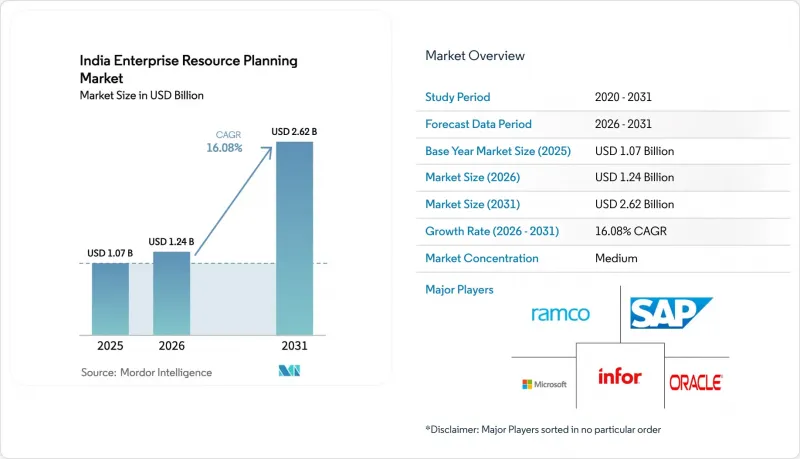
印度企業資源規劃 (ERP) 市場預計將從 2025 年的 10.7 億美元成長到 2026 年的 12.4 億美元,到 2031 年達到 26.2 億美元,2026 年至 2031 年的複合年成長率為 16.08%。
受商品和服務稅 (GST) 合規期限加快、印度數字 2.0 補貼以及中型製造商積極向雲端遷移等因素的推動,市場對企業資源規劃 (ERP) 的需求仍然強勁。隨著超過 5,000 萬印度盧比的交易必須電子帳單,以及印度儲備銀行 (RBI) 引入即時詐欺監控規則,ERP 已成為一項法律要求。雲端超大規模資料中心業者目前在古吉拉突邦、浦那和孟買營運可用區,將延遲降低到個位數毫秒,徹底消除了採用本地部署系統的最後一個技術理由。與此同時,一股「邊緣 ERP」浪潮——將現場感測器與後勤部門財務模組近乎即時地同步——正在馬哈拉斯特拉邦、泰米爾納德邦和馬哈拉施特拉邦等二線製造業中心地帶迅速蔓延,這證明工業IoT不再是財富 500 強企業的專屬領域。
印度企業資源規劃 (ERP) 市場的趨勢與洞察
政府對商品及服務稅(GST)的推廣及合規
電子帳單的分階段實施正迫使280萬家企業採用符合合規要求的ERP套件。企業部強制要求的審計追蹤新增了時間戳和雜湊值等信息,這是電子表格無法處理的。在2025年上半年,提供預認證GST軟體套件的供應商佔了中小企業採用率的68%。隨著跨境服務反向徵收機制即將推出,採購模組已在進行升級,電子運輸憑證(電子運稅額扣抵)整合率增加22%,顯示物流工作流程也受到了類似的影響。由於各州的傳統增值稅(VAT)規則各不相同,區域配置功能成為供應商之間的關鍵差異化因素。
擴大數位轉型計劃
「數位印度2.0」計畫撥款1,400億印度盧比用於公共部門數位化,目標是在2027年前將50萬家微企業企業遷移到雲端平台。透過公共服務中心提供的ERP補貼許可,可使符合資格的企業降低高達60%的實施成本。一項針對1,200名財務長的私人調查顯示,71%的財務長已在對其核心系統進行現代化改造,其中雲端ERP是首要投資目標。電子、製藥和紡織業的生產連結獎勵計畫計畫明確要求提供即時生產數據,而ERP實施已成為獲得補貼的必要條件。像印度電子公司(Bharat Electronics)這樣的國有企業正在進行統一的ERP競標,並鼓勵希望參與競標的中小型供應商獲得ISO 27001和CERT-In認證。
高昂的實施成本
中型企業實施數位化解決方案的總擁有成本在 15 萬至 50 萬美元之間,遠遠超出微企業的預算。印度小型工業發展銀行 (SIDBI) 的一項調查顯示,即使簽訂了 36 個月的雲端服務契約,仍有 48% 的中小企業表示成本是最大的障礙。客製化服務(例如針對非正式信貸週期和寄售銷售的客製化代碼)會使預算增加 40%。截至 2026 年 1 月,無抵押數位化貸款的核准僅為 1.2 萬筆,反映出貸款機構的謹慎態度和借款人的猶豫不決。供應商提供的入門套餐價格為每位用戶每月 499 盧比,但這些套餐包含多種功能,通常需要在合約期間內升級,這再次造成了他們試圖解決的負擔能力障礙。
細分市場分析
到2025年,雲端原生套件將佔總採用量的53.77%。供應商正在解耦模組,使客戶能夠按需利用微服務,並在不停機的情況下更新功能。這種基於交易的定價模式,使成本與業務週期保持一致,預計到2031年將實現17.68%的複合年成長率。行動優先的ERP系統正受到倉庫員工和現場銷售負責人需要在智慧型手機上查看庫存和訂單資訊。大型零售商的採用凸顯了其在大規模環境中的效用。社交協作型ERP將聊天和協同編輯功能整合到交易介面中,但目前在專業服務公司中仍屬於小眾選擇。雙層ERP和邊緣ERP預計將以18.7%的複合年成長率成長,它們正受到跨國公司的歡迎,這些公司在全球範圍內進行業務整合,同時保持區域賬簿的精簡以滿足稅務合規要求。 2026年1月,塔塔汽車在其位於薩南德和普納的工廠開展了先導計畫,現場處理高品質影像,展示了邊緣ERP的低延遲優勢。印度標準局(BIS)制定的網實整合系統標準草案建議採用邊緣運算來實現低於100毫秒的工業延遲,進一步佐證了該架構的有效性。
截至2025年,財務和會計板塊將佔功能佔有率的29.45%。由於強制性的持續審計追蹤和GST電子帳單的應用標準,自動化對帳至關重要。 ICICI銀行的API透過將ERP現金餘額與財務部門連接,推動了更深層的整合,從而實現了即時流動性最佳化。供應鏈和營運模組透過演算法補貨維護EC倉庫庫存,而人力資源模組的更新則追蹤儲備資金的合規性。生產執行和品管成長最快,複合年成長率達17.1%,這得益於PLI(生產連結獎勵計畫)計劃將補貼與檢驗的數位化成果掛鉤。製藥公司正在實施電子批記錄以滿足新的M類藥品管理條例(Schedule M)的要求,客戶關係管理模組正在連接傳統管道和數位管道,使曳引機買家能夠在線上配置設備。提供預先整合MES(製造執行系統)和ERP套件的供應商在下一輪升級週期中佔據優勢。
其他好處
- Excel格式的市場預測(ME)表
- 3個月的分析師支持
目錄
第1章:引言
- 研究假設和市場定義
- 調查範圍
第2章:調查方法
第3章執行摘要
第4章 市場狀況
- 市場概覽
- 市場促進因素
- 擴大數位轉型計劃
- 擴大雲端解決方案的採用
- 政府對商品及服務稅(GST)的推廣及合規
- 二線製造業叢集對支援工業 4.0 的邊緣 ERP 的需求不斷成長。
- 中小微型企業的統一支付介面(UPI)整合ERP的興起
- 印度專用人工智慧語言模型的快速成長,使得創建支援本地語言的ERP介面成為可能。
- 市場限制因素
- 高昂的實施成本
- 資料安全和隱私問題
- 區域城市缺乏具備ERP專業知識的顧問
- 家族式中小企業對流程標準化的抵制
- 宏觀經濟因素對市場的影響
- 產業價值鏈分析
- 監理情勢
- 技術展望
- 波特五力分析
- 供應商的議價能力
- 買方的議價能力
- 新進入者的威脅
- 替代品的威脅
- 競爭程度
第5章 市場規模與成長預測
- 按類型
- 雲端原生套件
- 行動優先的ERP
- 社交/協作型企業資源規劃
- 雙層/邊緣ERP
- 按部門
- 財會
- 供應鍊和營運
- 人力資本管理
- 客戶關係與商務
- 生產執行和品管
- 按部署模式
- 現場
- 雲
- 按組織規模
- 大公司
- 小型企業
- 按行業
- 製造業
- 零售與電子商務
- BFSI
- 政府/公共部門
- 資訊科技和通訊
- 醫療保健和生命科學
- 其他
第6章 競爭情勢
- 市場集中度
- 策略趨勢
- 市佔率分析
- 公司簡介
- SAP SE
- Oracle Corporation
- Microsoft Corporation
- Infor Inc.
- Epicor Software Corporation
- The Sage Group plc
- Tally Solutions Pvt. Ltd.
- Zoho Corporation Pvt. Ltd.
- Focus Softnet Pvt. Ltd.
- Acumatica Inc.
- Deltek Inc.
- SYSPRO(Pty)Ltd
- Deskera Holdinigs Ltd.
- Unit4 NV
- Intuit Inc.
- Marg ERP Ltd.
- Busy Infotech Pvt. Ltd.
- Ramco Systems Limited
- Prismatic Technologies Pvt. Ltd.
- IFS AB
第7章 市場機會與未來展望
The India Enterprise Resource Planning Market size is expected to grow from USD 1.07 billion in 2025 to USD 1.24 billion in 2026 and is forecast to reach USD 2.62 billion by 2031 at 16.08% CAGR over 2026-2031.
Accelerated Goods and Services Tax compliance deadlines, Digital India 2.0 subsidies, and aggressive cloud migration among mid-market manufacturers keep the demand curve steep. Regulatory mandates for e-invoicing above INR 5 crore, coupled with the Reserve Bank of India's real-time fraud monitoring rules, make ERP a statutory necessity. Cloud hyperscalers now operate availability zones in Hyderabad, Pune, and Mumbai, reducing latency to single-digit milliseconds and eliminating the last technical argument for on-premise systems. Tier-II manufacturing belts in Gujarat, Tamil Nadu, and Maharashtra feed a parallel edge-ERP wave that synchronizes shop-floor sensors with back-office finance modules in near real time, proving that industrial IoT is no longer a privilege reserved for Fortune 500 companies.
India Enterprise Resource Planning Market Trends and Insights
Government Push for GST and Compliance
The phased e-invoice rollout forces 2.8 million enterprises to adopt compliant ERP suites. Ministry of Corporate Affairs audit-trail mandates add timestamp and hash requirements that spreadsheets cannot meet. Vendors with pre-certified GST packs captured 68% of SME installations in H1 2025. A looming reverse-charge mechanism for cross-border services is already driving upgrades to procurement modules, while the 22% jump in e-way bill integrations shows logistics workflows are equally exposed. States differ in legacy VAT nuances, so hyper-local configuration capability has become a decisive vendor differentiator.
Growing Digital Transformation Initiatives
Digital India 2.0 earmarks INR 14,000 crore for public-sector digitization and sets a target of onboarding 500,000 MSMEs onto cloud platforms by 2027. Subsidized ERP licenses offered via Common Services Centres drop acquisition costs by up to 60% for eligible firms. Private surveys of 1,200 CFOs show 71% already executing core-system modernization, with cloud ERP topping the investment list. Production-Linked Incentive schemes across electronics, pharma, and textiles explicitly require real-time production data, embedding ERP deep into subsidy compliance. State-owned enterprises such as Bharat Electronics issue unified ERP tenders, encouraging smaller vendors to obtain ISO 27001 and CERT-In certifications if they wish to compete.
High Implementation Costs
Total ownership for a mid-market roll-out spans USD 150,000-500,000, well above the comfort zone of micro-enterprises. A SIDBI survey shows 48% of SMEs cite cost as the top deterrent, even with 36-month cloud subscriptions. Customization inflates budgets by another 40% because informal credit cycles and consignment sales need bespoke code. Collateral-free loans for digitization posted only 12,000 approvals by January 2026, reflecting both lender caution and borrower reluctance. Vendors experiment with starter tiers priced at INR 499 per user per month, yet stripped-down features often trigger mid-contract upgrades, recreating the affordability barrier they aimed to solve.
Other drivers and restraints analyzed in the detailed report include:
- Increasing Adoption of Cloud-Based Solutions
- Rising Demand for Industry 4.0-Ready Edge ERP in Tier II Manufacturing Clusters
- Data Security and Privacy Concerns
For complete list of drivers and restraints, kindly check the Table Of Contents.
Segment Analysis
Cloud-native suites represented 53.77% of deployments in 2025. Vendors decouple modules, letting customers consume microservices on demand and update features without downtime. This approach delivers a 17.68% CAGR by 2031, as transaction-based pricing aligns costs with business cycles. Mobile-first ERP appeals to warehouse staff and field sales who need inventory and order visibility on smartphones; roll-outs at large retailers validate its utility at scale. Social and collaborative ERP weaves chat and co-editing into transactional screens but remains a niche preference among professional-services firms. Two-tier and edge ERP, forecast to expand at 18.7% CAGR, wins favor with multinationals that keep a lean regional ledger for tax compliance while aggregating globally. Tata Motors' January 2026 pilot at Sanand and Pune plants processes quality images locally, proving edge ERP's latency advantage. Draft cyber-physical standards from the Bureau of Indian Standards recommend edge computing for industrial latency under 100 milliseconds, further legitimizing the architecture.
Finance and accounting accounted for 29.45% of the functional share in 2025. Continuous audit-trail mandates and GST e-invoice thresholds make automated reconciliation non-negotiable. ICICI Bank APIs link ERP cash positions to treasury desks for real-time liquidity optimization, driving deeper integration. Supply-chain and operations modules keep e-commerce warehouses stocked through algorithmic replenishment, while HR updates track provident-fund compliance. Manufacturing execution and quality grow fastest, at a 17.1% CAGR, as PLI schemes tie subsidies to verified digital output. Pharma producers embed electronic batch records to meet new Schedule M guidelines, and customer relationship modules let tractor buyers configure equipment online, bridging traditional and digital channels. Vendors offering pre-integrated MES and ERP suites secure the inside track for the next upgrade cycle.
The India Enterprise Resource Planning Market Report is Segmented by Type (Cloud-Native Suite, Mobile-First ERP, and More), Business Function (Finance and Accounting, and More), Deployment Model (On-Premise, and Cloud), Organization Size (Large Enterprises, and Small and Medium Enterprises), and Industry Vertical (Manufacturing, BFSI, and More). The Market Forecasts are Provided in Terms of Value (USD).
List of Companies Covered in this Report:
- SAP SE
- Oracle Corporation
- Microsoft Corporation
- Infor Inc.
- Epicor Software Corporation
- The Sage Group plc
- Tally Solutions Pvt. Ltd.
- Zoho Corporation Pvt. Ltd.
- Focus Softnet Pvt. Ltd.
- Acumatica Inc.
- Deltek Inc.
- SYSPRO (Pty) Ltd
- Deskera Holdinigs Ltd.
- Unit4 N.V.
- Intuit Inc.
- Marg ERP Ltd.
- Busy Infotech Pvt. Ltd.
- Ramco Systems Limited
- Prismatic Technologies Pvt. Ltd.
- IFS AB
Additional Benefits:
- The market estimate (ME) sheet in Excel format
- 3 months of analyst support
TABLE OF CONTENTS
1 INTRODUCTION
- 1.1 Study Assumptions and Market Definition
- 1.2 Scope of the Study
2 RESEARCH METHODOLOGY
3 EXECUTIVE SUMMARY
4 MARKET LANDSCAPE
- 4.1 Market Overview
- 4.2 Market Drivers
- 4.2.1 Growing Digital Transformation Initiatives
- 4.2.2 Increasing Adoption of Cloud-Based Solutions
- 4.2.3 Government Push for GST and Compliance
- 4.2.4 Rising Demand for Industry 4.0-Ready Edge ERP in Tier II Manufacturing Clusters
- 4.2.5 Emergence of Unified Payments Interface-Integrated ERP for MSMEs
- 4.2.6 Surge in India-Specific AI Language Models Enabling Vernacular ERP Interfaces
- 4.3 Market Restraints
- 4.3.1 High Implementation Costs
- 4.3.2 Data Security and Privacy Concerns
- 4.3.3 Shortage of Domain-Skilled ERP Consultants in Non-Metro Cities
- 4.3.4 Resistance from Family-Owned SMEs to Process Standardization
- 4.4 Impact of Macroeconomic Factors on the Market
- 4.5 Industry Value Chain Analysis
- 4.6 Regulatory Landscape
- 4.7 Technological Outlook
- 4.8 Porter's Five Forces Analysis
- 4.8.1 Bargaining Power of Suppliers
- 4.8.2 Bargaining Power of Buyers
- 4.8.3 Threat of New Entrants
- 4.8.4 Threat of Substitutes
- 4.8.5 Degree of Competition
5 MARKET SIZE AND GROWTH FORECASTS (VALUE)
- 5.1 By Type
- 5.1.1 Cloud-Native Suite
- 5.1.2 Mobile-First ERP
- 5.1.3 Social / Collaborative ERP
- 5.1.4 Two-Tier / Edge ERP
- 5.2 By Business Function
- 5.2.1 Finance and Accounting
- 5.2.2 Supply-Chain and Operations
- 5.2.3 Human Capital Management
- 5.2.4 Customer Relationship and Commerce
- 5.2.5 Manufacturing Execution and Quality
- 5.3 By Deployment Model
- 5.3.1 On-Premise
- 5.3.2 Cloud
- 5.4 By Organization Size
- 5.4.1 Large Enterprises
- 5.4.2 Small and Medium Enterprises
- 5.5 By Industry Vertical
- 5.5.1 Manufacturing
- 5.5.2 Retail and E-commerce
- 5.5.3 BFSI
- 5.5.4 Government and Public Sector
- 5.5.5 IT and Telecom
- 5.5.6 Healthcare and Life Sciences
- 5.5.7 Others Industry Vertical
6 COMPETITIVE LANDSCAPE
- 6.1 Market Concentration
- 6.2 Strategic Moves
- 6.3 Market Share Analysis
- 6.4 Company Profiles (includes Global Level Overview, Market Level Overview, Core Segments, Financials as available, Strategic Information, Market Rank/Share, Products and Services, Recent Developments)
- 6.4.1 SAP SE
- 6.4.2 Oracle Corporation
- 6.4.3 Microsoft Corporation
- 6.4.4 Infor Inc.
- 6.4.5 Epicor Software Corporation
- 6.4.6 The Sage Group plc
- 6.4.7 Tally Solutions Pvt. Ltd.
- 6.4.8 Zoho Corporation Pvt. Ltd.
- 6.4.9 Focus Softnet Pvt. Ltd.
- 6.4.10 Acumatica Inc.
- 6.4.11 Deltek Inc.
- 6.4.12 SYSPRO (Pty) Ltd
- 6.4.13 Deskera Holdinigs Ltd.
- 6.4.14 Unit4 N.V.
- 6.4.15 Intuit Inc.
- 6.4.16 Marg ERP Ltd.
- 6.4.17 Busy Infotech Pvt. Ltd.
- 6.4.18 Ramco Systems Limited
- 6.4.19 Prismatic Technologies Pvt. Ltd.
- 6.4.20 IFS AB
7 MARKET OPPORTUNITIES AND FUTURE OUTLOOK
- 7.1 White-space and Unmet-Need Assessment

 企業資源計畫 (ERP) 市場 - 全球產業規模、佔有率、趨勢、機會和預測:按組件、部署模式、業務功能、最終用戶、行業、地區和競爭對手分類,2021-2031 年
 企業資源計畫 (ERP) 市場:按部署類型、組件、組織規模和產業分類-2026-2032 年全球市場預測
 企業資源規劃:市場佔有率分析、產業趨勢與統計、成長預測(2026-2031)
 2026年全球產品實施服務市場報告2026年全球開放原始碼企業資源規劃(ERP)市場報告
 物聯網資源最佳化解決方案市場預測至2034年-按解決方案類型、元件、部署模式、應用、最終用戶和地區分類的全球分析電子商務ERP整合:市場佔有率分析、產業趨勢與統計、成長預測(2026-2031年)2026年全球ERP和ECM整合市場報告2026年企業資源規劃(ERP)區塊鏈全球市場報告亞太地區企業資源規劃(ERP):市場佔有率分析、產業趨勢與統計、成長預測(2026-2031)