


 |
市場調查報告書
商品編碼
2043983
南美洲工廠自動化與工業控制:市場佔有率分析、產業趨勢與統計、成長預測(2026-2031 年)South America Factory Automation And Industrial Controls - Market Share Analysis, Industry Trends & Statistics, Growth Forecasts (2026 - 2031) |
||||||

※ 本網頁內容可能與最新版本有所差異。詳細情況請與我們聯繫。
預計南美工廠自動化和工業控制市場將從 2025 年的 199.3 億美元成長到 2026 年的 211.3 億美元,到 2031 年將達到 275.2 億美元,2026 年至 2031 年的複合年成長率為 5.43%。
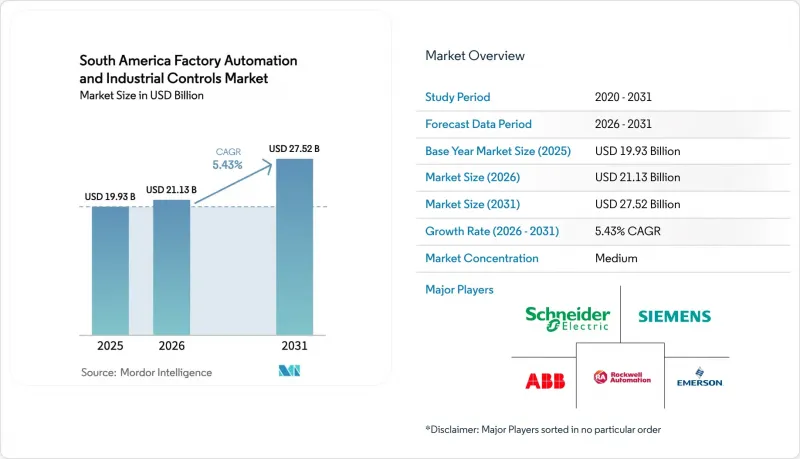
儘管貨幣波動和中小企業謹慎的資本投資正在減緩整體市場成長,但巴西聯邦政府對智慧工廠的津貼、墨西哥近岸外包的增加以及阿根廷出口主導製藥業的設備升級,正在催生一些有望實現兩位數成長的領域。供應商正將其業務模式從一次性硬體銷售轉向基於結果的契約,這些合約包含預測性維護、網路安全管理和遠端試運行等服務。雲端原生分析和低程式碼編配正在縮短現有設備維修的投資回收期。同時,巴西豐富的可再生能源吸引了能源密集的金屬、紙漿和資料中心項目,這些項目從一開始就採用了先進的製程控制技術。市場競爭適中,前五大公司約佔40%的市場佔有率,這為區域性專業供應商在紙漿和造紙、採礦和化學行業獲得產業專用的項目留下了空間。
南美工廠自動化與工業控制市場趨勢及洞察
工業4.0和工業物聯網生態系的廣泛應用。
製造商正在部署感測器網路、邊緣閘道器和雲端儀錶板,以彌合現場設備與企業系統之間的可視性差距。巴西國家物聯網計畫在2024年為70個工業園區提供連接硬體津貼,從而實現對整體設備效率 (OEE) 的即時追蹤。墨西哥一家一級汽車零件供應商在2025年新增了超過12,000個工業物聯網 (IIoT) 終端,以滿足準時制可追溯性法規的要求。阿根廷一家藥品出口商部署了符合世界衛生組織 (WHO) 預認證要求的低溫運輸感測器,在2024年避免了因溫度偏差造成的價值2,200萬美元的批次損失。智利國家銅業公司 (Codelco) 在智利試點應用低延遲無線鏈路,用於自動駕駛運輸車輛,使其埃爾特尼恩特礦的礦石回收率在2025年提高了14%。這些項目正在加速對工業乙太網、5G專用網路和延遲低於10毫秒的邊緣運算的需求。
政府獎勵加速智慧工廠投資
稅額扣抵、利息補貼貸款和加速折舊正在縮短投資回收期。巴西的「新工業巴西」(Nova Industria Brasil)計畫累計3,000億雷亞爾(約600億美元),涵蓋高達40%的符合條件的自動化成本。阿根廷將控制硬體的折舊免稅額期縮短至三個財政年度,促進了2025年價值1.8億美元的PLC和MES系統的採購。哥倫比亞的Bancordex銀行將其用於工業4.0項目的1.2億美元貸款(年利率4%)擴大至2025年。墨西哥的《美墨加協定》(USMCA)合規規則現在將加工出口區(maquiladoras)的稅收優惠與透過序列化人機介面(HMI)資料追蹤的區域增加值證明掛鉤。儘管宏觀經濟波動,但這些獎勵仍在推動需求成長。
中小企業初始資本投入高且投資報酬率不確定性。
中小企業佔製造業就業人數的65%,但只有28%的企業在自動化方面投入資金。在阿根廷,一家紡織廠原計劃於2025年進行一項價值9500萬美元的PLC和視覺系統升級,但由於披索疲軟扭曲了投資回報模型,該項目已被推遲。作為應對措施,供應商開始提供價格低於5萬美元的入門套件,其中包括一台小型PLC、人機介面(HMI)以及為期六個月的分析服務訂閱。在哥倫比亞,由於借款人缺乏整合的人員,Bancordex的融資利用率仍然很低。在墨西哥,在加工出口區(maquiladoras)引入計量型機器人正在減輕企業的資產負債表負擔,但合約的複雜性仍然阻礙著專案的實施。
細分市場分析
到2025年,工業控制系統將佔據南美工廠自動化和工業控制市場47.38%的佔有率,為大規模製程工廠提供支援。然而,軟體平台正以7.32%的複合年成長率成長,預計到2031年將在南美工廠自動化和工業控制市場佔據更大的佔有率。供應商正在將低程式碼工業物聯網中心、人工智慧驅動的預測性維護以及可改造而非替換現有PLC的行動人機介面(HMI)打包出售。在汽車和製藥生產線中,對機器視覺的需求日益成長,因為這些產業對零缺陷的要求極高。在巴西和墨西哥的工廠中測試的、支援邊緣運算的5G核心網,其循環時間已低於10毫秒,從而能夠實現對延遲敏感的封閉回路型部署。
現有的分散式控制系統供應商,例如艾默生的DeltaV和Honeywell的Experion,仍然主導著石油、天然氣和化學工業,但它們現在提供的模組化配置可以將工程工作量減少40%。 PLC環境正朝著符合IEC 61131-3標準的方向發展,從而提高了不同供應商之間的代碼可移植性。 MES和產品生命週期管理工具正在被整合,為生產線工程師提供端到端的數位線程。能夠疊加維護程序的移動AR頭顯正在縮短平均維修時間(MTTR),尤其是在偏遠礦區。因此,南美工廠自動化和工業控制市場正在將其收入結構從硬體轉向數位平台,同時又不影響控制系統部署的核心基礎設施。
預計到2025年,硬體銷售額將佔總銷售額的61.27%,但隨著預測性維護的普及,設備更換週期將從7年延長至10年。同時,服務業務正以8.07%的複合年成長率快速成長,反映出市場遠距離診斷、網路安全修補程式和效能保障(將供應商收入與資產運作掛鉤)的需求日益成長。隨著原始設備製造商(OEM)將培訓、韌體和分析功能重新打包成訂閱計劃,南美工廠自動化和工業控制市場的服務業務規模正在擴大。
到2025年,ABB、Schneider Electric和西門子各自新增了超過1,200個區域服務用戶。同時,Festo等整合商面向中小企業推出了自動化即服務(AaaS),並引入了基於吞吐量的收費系統,從而降低了資本投資門檻。 2024年至2025年間,針對製造業企業的勒索軟體攻擊增加了47%,因此,營運技術(OT)網路的託管偵測與回應(MDR)正逐漸成為一個獨立的類別。去年,超過3500名技術人員在聖保羅和墨西哥城的培訓中心完成了培訓,有助於彌合技能差距,但技能差距尚未完全消除。
其他好處:
- Excel格式的市場預測(ME)表
- 3個月的分析師支持
目錄
第1章:引言
- 市場分析與定義的前提條件
- 分析範圍
第2章 分析方法
第3章執行摘要
第4章 市場狀況
- 市場概覽
- 市場促進因素
- 工業4.0和工業物聯網生態系的廣泛應用。
- 政府獎勵加速對智慧工廠的投資
- 成本壓力和提高生產力的需求
- 可再生能源的優勢正在推動電力回流巴西。
- 近岸外包和加工出口區的擴張正在推動墨西哥的自動化進程。
- 利用人工智慧技術實現數位雙胞胎的先導計畫正在加速現有設施的最佳化。
- 市場限制因素
- 中小企業初始資本投入高且投資報酬率不確定性。
- 高度自動化崗位上的技術純熟勞工嚴重短缺。
- 受該地貨幣波動影響,投資延期
- 針對工業控制系統的網路/實體攻擊日益增多
- 產業供應鏈分析
- 監理情勢
- 技術展望
- 對影響市場的宏觀經濟因素進行評估
- 波特五力分析
- 新參與企業的威脅
- 供應商議價能力
- 買方的議價能力
- 替代品的威脅
- 競爭公司之間的競爭關係
第5章:預測市場規模與成長率
- 依產品類型
- 工業控制系統
- DCS(分散式控制系統)
- PLC(可程式邏輯控制器)
- SCADA(監控與資料收集)
- MES(製造執行系統)
- 產品生命週期管理 (PLM)
- 人機介面 (HMI)
- ERP(企業資源計畫)
- 現場設備
- 機器視覺
- 工業機器人
- 感測器發射器
- 馬達驅動
- 繼電器開關
- 自動化軟體平台
- 邊緣雲工業物聯網平台
- 人工智慧驅動的預測性維護套件
- 低程式碼工業應用
- 連結與網路
- 工業乙太網
- 5G專用網路
- 無線感測器網路
- 工業控制系統
- 依組件類型
- 硬體
- 軟體
- 服務
- 按最終用戶行業分類
- 車
- 食品/飲料
- 石油和天然氣
- 化工/石油化工
- 電力和公用事業
- 製藥
- 電子與電機工程
- 採礦和金屬
- 紙漿和造紙
- 其他終端用戶產業
- 透過部署方法
- 現場
- 雲
- 混合
- 按公司規模
- 大公司
- 小型企業
- 國家
- 巴西
- 墨西哥
- 阿根廷
- 智利
- 哥倫比亞
- 南美洲其他地區
第6章 競爭情勢
- 市場集中度
- 策略趨勢
- 市佔率分析
- 公司簡介
- Siemens AG
- ABB Ltd
- Rockwell Automation Inc.
- Schneider Electric SE
- Emerson Electric Co.
- Honeywell International Inc.
- Mitsubishi Electric Corporation
- General Electric Co.
- PTC Inc.
- Aveva Group
- Aspen Technology Inc.
- Bosch Rexroth AG
- Yokogawa Electric Corporation
- Omron Corporation
- FANUC Corporation
- Yaskawa Electric Corporation
- KUKA AG
- Festo SE and Co. KG
- Endress+Hauser Group Services AG
- WEG Industrias SA
- Danfoss A/S
- Beckhoff Automation GmbH & Co. KG
- Delta Electronics Inc.
- Advantech Co., Ltd.
第7章 市場機會與未來展望
The South America Factory Automation And Industrial Controls Market size is expected to grow from USD 19.93 billion in 2025 to USD 21.13 billion in 2026 and is forecast to reach USD 27.52 billion by 2031 at 5.43% CAGR over 2026-2031.
Currency volatility and capital-expenditure caution among small and medium enterprises (SMEs) are muting headline growth, yet federal smart-factory grants in Brazil, rising near-shoring flows into Mexico, and export-driven pharmaceutical upgrades in Argentina are creating pockets of double-digit outlays. Vendors are pivoting from one-time hardware sales to outcome-based contracts that bundle predictive maintenance, managed cybersecurity, and remote commissioning. Cloud-native analytics and low-code orchestration are lowering the payback horizon for brownfield retrofits, while abundant renewable electricity in Brazil is attracting energy-intensive metals, pulp, and data-center projects that embed advanced process control from day one. Moderate competitive intensity, with the top five suppliers holding roughly 40% share, leaves room for regional specialists to win sector-specific deals in pulp-and-paper, mining, and chemicals.
South America Factory Automation And Industrial Controls Market Trends and Insights
Growing Adoption of Industry 4.0 and IIoT Ecosystems
Manufacturers are rolling out sensor networks, edge gateways, and cloud dashboards to close the visibility gap between shop-floor equipment and enterprise systems. Brazil's National IoT Plan subsidized connectivity hardware across 70 industrial parks in 2024, enabling real-time overall-equipment-effectiveness tracking. Mexico's tier-1 automotive suppliers added more than 12,000 IIoT endpoints during 2025 to satisfy just-in-time traceability rules. Argentina's pharmaceutical exporters deployed cold-chain sensors that meet World Health Organization pre-qualification, preventing batch losses after USD 22 million in temperature excursions during 2024. Chile's Codelco piloted low-latency wireless links for autonomous haulage, boosting ore recovery by 14% at El Teniente in 2025. These projects are accelerating demand for industrial Ethernet, 5G private networks, and edge compute that keep latency under ten milliseconds.
Government Incentives Accelerating Smart-Factory Investments
Tax credits, subsidized loans, and accelerated depreciation are compressing payback periods. Brazil's Nova Industria Brasil program earmarked BRL 300 billion (USD 60 billion) from 2024-2027, covering up to 40% of eligible automation spend. Argentina cut depreciation on control hardware to three tax years, unlocking USD 180 million in PLC and MES purchases during 2025. Colombia's Bancoldex extended USD 120 million in 4% loans for Industry 4.0 projects in 2025. Mexico's USMCA compliance rules now tie maquiladora tax benefits to proof of regional value content tracked by serialized HMI data. Such incentives are front-loading demand despite macro volatility.
High Upfront Capex and ROI Uncertainty for SMEs
SMEs supply 65% of manufacturing jobs yet account for only 28% of automation spend. Textile mills in Argentina postponed USD 95 million in PLC and vision upgrades during 2025 as peso depreciation distorted payback models. Vendors are countering with starter kits priced below USD 50,000 that bundle compact PLCs, HMIs, and six-month analytics subscriptions. Colombia's Bancoldex loans remain under-drawn because borrowers lack integration talent. Pay-per-use robotics in Mexican maquiladoras are easing balance-sheet stress, but contract complexity still deters late adopters.
Other drivers and restraints analyzed in the detailed report include:
- Cost-Pressure and Productivity Optimization Mandates
- Renewable-Power Advantages Attracting Power shoring to Brazil
- Severe Skilled-Labor Shortage for Advanced Automation Roles
For complete list of drivers and restraints, kindly check the Table Of Contents.
Segment Analysis
Industrial control systems accounted for 47.38% of the South America factory automation and industrial controls market share in 2025, anchoring large process plants. Yet software platforms are on course for a 7.32% CAGR and are projected to capture an expanded slice of the South America factory automation and industrial controls market size by 2031. Vendors are packaging low-code IIoT hubs, AI-driven predictive maintenance, and mobile HMIs that retrofit installed PLCs instead of replacing them. Machine-vision demand is climbing in automotive and pharmaceutical lines where zero-defect mandates prevail. Edge-ready 5G cores tested in Brazilian and Mexican factories during 2025 prove sub-ten-millisecond loop times, encouraging latency-sensitive closed-loop deployments.
Distributed control system incumbents, including Emerson's DeltaV and Honeywell's Experion, still dominate oil, gas, and chemicals but now offer modular configurations with 40% fewer engineering hours. PLC environments are migrating toward IEC 61131-3 compliance, easing cross-vendor code portability. MES and product lifecycle tools are merging, giving line engineers end-to-end digital threads. Mobile augmented-reality headsets that overlay maintenance steps are reducing mean-time-to-repair, especially in remote mines. As a result, the South America factory automation and industrial controls market is witnessing a shift in revenue mix from hardware to digital platforms without cannibalizing the core control install base.
Hardware represented 61.27% of 2025 revenue, yet replacement cycles are stretching from seven to ten years as predictive maintenance becomes mainstream. Services, however, are expanding at 8.07% CAGR, reflecting the appetite for remote diagnostics, cybersecurity patches, and performance guarantees that peg vendor revenue to asset uptime. The South America factory automation and industrial controls market size linked to services is widening as OEMs rebundle training, firmware, and analytics into subscription tiers.
ABB, Schneider Electric, and Siemens each added more than 1,200 regional service subscribers in 2025, while integrators such as Festo launched automation-as-a-service for SMEs, charging throughput-indexed fees that remove capex hurdles. Managed detection and response for operational-technology networks is emerging as its own category, spurred by a 47% rise in ransomware incidents targeting manufacturers during 2024-2025. Training centers in Sao Paulo and Mexico City graduated over 3,500 technicians last year, helping close, but not yet eliminate, the skills gap.
The South America Factory Automation and Industrial Controls Market Report is Segmented by Product Type (Industrial Control Systems, Field Devices, and More), Component Type (Hardware, Software, and More), End-User Industry (Automotive, Food and Beverages, and More), Deployment Mode (On-Premise, Cloud, and More), Enterprise Size (Large Enterprises, and SMEs), and Geography. The Market Forecasts are Provided in Terms of Value (USD).
List of Companies Covered in this Report:
- Siemens AG
- ABB Ltd
- Rockwell Automation Inc.
- Schneider Electric SE
- Emerson Electric Co.
- Honeywell International Inc.
- Mitsubishi Electric Corporation
- General Electric Co.
- PTC Inc.
- Aveva Group
- Aspen Technology Inc.
- Bosch Rexroth AG
- Yokogawa Electric Corporation
- Omron Corporation
- FANUC Corporation
- Yaskawa Electric Corporation
- KUKA AG
- Festo SE and Co. KG
- Endress+Hauser Group Services AG
- WEG Industrias S.A.
- Danfoss A/S
- Beckhoff Automation GmbH & Co. KG
- Delta Electronics Inc.
- Advantech Co., Ltd.
Additional Benefits:
- The market estimate (ME) sheet in Excel format
- 3 months of analyst support
TABLE OF CONTENTS
1 INTRODUCTION
- 1.1 Study Assumptions and Market Definition
- 1.2 Scope of the Study
2 RESEARCH METHODOLOGY
3 EXECUTIVE SUMMARY
4 MARKET LANDSCAPE
- 4.1 Market Overview
- 4.2 Market Drivers
- 4.2.1 Growing Adoption of Industry 4.0 and IIoT Ecosystems
- 4.2.2 Government Incentives Accelerating Smart-Factory Investments
- 4.2.3 Cost-Pressure and Productivity Optimisation Mandates
- 4.2.4 Renewable-Power Advantages Attracting Powershoring to Brazil
- 4.2.5 Near-Shoring and Maquiladora Expansion Increasing Automation in Mexico
- 4.2.6 AI-Enabled Digital Twin Pilots Accelerating Brownfield Optimization
- 4.3 Market Restraints
- 4.3.1 High Upfront Capex and ROI Uncertainty for SMEs
- 4.3.2 Severe Skilled-Labor Shortage for Advanced Automation Roles
- 4.3.3 Local-Currency Volatility Causing Investment Deferral
- 4.3.4 Rising Cyber-Physical Attacks on Industrial Control Systems
- 4.4 Industry Value Chain Analysis
- 4.5 Regulatory Landscape
- 4.6 Technological Outlook
- 4.7 Impact of Macroeconomic Factors on the Market
- 4.8 Porter's Five Forces Analysis
- 4.8.1 Threat of New Entrants
- 4.8.2 Bargaining Power of Suppliers
- 4.8.3 Bargaining Power of Buyers
- 4.8.4 Threat of Substitute Products
- 4.8.5 Intensity of Competitive Rivalry
5 MARKET SIZE AND GROWTH FORECASTS (VALUE)
- 5.1 By Product Type
- 5.1.1 Industrial Control Systems
- 5.1.1.1 Distributed Control System (DCS)
- 5.1.1.2 Programmable Logic Controller (PLC)
- 5.1.1.3 Supervisory Control and Data Acquisition (SCADA)
- 5.1.1.4 Manufacturing Execution System (MES)
- 5.1.1.5 Product Lifecycle Management (PLM)
- 5.1.1.6 Human Machine Interface (HMI)
- 5.1.1.7 Enterprise Resource Planning (ERP)
- 5.1.2 Field Devices
- 5.1.2.1 Machine Vision
- 5.1.2.2 Industrial Robotics
- 5.1.2.3 Sensors and Transmitters
- 5.1.2.4 Motors and Drives
- 5.1.2.5 Relays and Switches
- 5.1.3 Automation Software Platforms
- 5.1.3.1 Edge and Cloud IIoT Platforms
- 5.1.3.2 AI-Powered Predictive Maintenance Suites
- 5.1.3.3 Low-Code Industrial Apps
- 5.1.4 Connectivity and Networking
- 5.1.4.1 Industrial Ethernet
- 5.1.4.2 5G Private Networks
- 5.1.4.3 Wireless Sensor Networks
- 5.1.1 Industrial Control Systems
- 5.2 By Component Type
- 5.2.1 Hardware
- 5.2.2 Software
- 5.2.3 Services
- 5.3 By End-user Industry
- 5.3.1 Automotive
- 5.3.2 Food and Beverages
- 5.3.3 Oil and Gas
- 5.3.4 Chemical and Petrochemical
- 5.3.5 Power and Utilities
- 5.3.6 Pharmaceutical
- 5.3.7 Electronics and Electrical
- 5.3.8 Mining and Metals
- 5.3.9 Pulp and Paper
- 5.3.10 Other End-user Industries
- 5.4 By Deployment Mode
- 5.4.1 On-premise
- 5.4.2 Cloud
- 5.4.3 Hybrid
- 5.5 By Enterprise Size
- 5.5.1 Large Enterprises
- 5.5.2 Small and Medium Enterprises
- 5.6 By Country
- 5.6.1 Brazil
- 5.6.2 Mexico
- 5.6.3 Argentina
- 5.6.4 Chile
- 5.6.5 Colombia
- 5.6.6 Rest of South America
6 COMPETITIVE LANDSCAPE
- 6.1 Market Concentration
- 6.2 Strategic Moves
- 6.3 Market Share Analysis
- 6.4 Company Profiles (includes Global Level Overview, Market Level Overview, Core Segments, Financials as available, Strategic Information, Market Rank/Share, Products and Services, Recent Developments)
- 6.4.1 Siemens AG
- 6.4.2 ABB Ltd
- 6.4.3 Rockwell Automation Inc.
- 6.4.4 Schneider Electric SE
- 6.4.5 Emerson Electric Co.
- 6.4.6 Honeywell International Inc.
- 6.4.7 Mitsubishi Electric Corporation
- 6.4.8 General Electric Co.
- 6.4.9 PTC Inc.
- 6.4.10 Aveva Group
- 6.4.11 Aspen Technology Inc.
- 6.4.12 Bosch Rexroth AG
- 6.4.13 Yokogawa Electric Corporation
- 6.4.14 Omron Corporation
- 6.4.15 FANUC Corporation
- 6.4.16 Yaskawa Electric Corporation
- 6.4.17 KUKA AG
- 6.4.18 Festo SE and Co. KG
- 6.4.19 Endress+Hauser Group Services AG
- 6.4.20 WEG Industrias S.A.
- 6.4.21 Danfoss A/S
- 6.4.22 Beckhoff Automation GmbH & Co. KG
- 6.4.23 Delta Electronics Inc.
- 6.4.24 Advantech Co., Ltd.
7 MARKET OPPORTUNITIES AND FUTURE OUTLOOK
- 7.1 White-space and Unmet-need Assessment

 4U工業電腦市場-2026年至2032年全球市場預測
 2034 年工業自動化網路安全市場預測—按部署類型、安全類型、組件、服務類型、技術、應用、最終用戶和地區分類的全球分析
 北美工廠自動化和工業控制:市場佔有率分析、行業趨勢和統計數據以及成長預測(2026-2031 年)工廠自動化與工業控制:市場佔有率分析、產業趨勢與統計、成長預測(2026-2031)德國工廠自動化和工業控制:市場佔有率分析、行業趨勢和統計數據以及成長預測(2026-2031 年)美國工廠自動化和工業控制:市場佔有率分析、行業趨勢和統計數據以及成長預測(2026-2031 年)日本工廠自動化和工業控制:市場佔有率分析、行業趨勢和統計數據以及成長預測(2026-2031 年)歐洲工廠自動化和工業控制:市場佔有率分析、行業趨勢和統計數據以及成長預測(2026-2031 年)義大利工廠自動化和工業控制:市場佔有率分析、行業趨勢和統計數據以及成長預測(2026-2031 年)法國工廠自動化和工業控制:市場佔有率分析、行業趨勢和統計數據以及成長預測(2026-2031 年)