


 |
市場調查報告書
商品編碼
2043880
美國微型菜苗:市場佔有率分析、行業趨勢和統計數據以及成長預測(2026-2031 年)United States Microgreens - Market Share Analysis, Industry Trends & Statistics, Growth Forecasts (2026 - 2031) |
||||||

※ 本網頁內容可能與最新版本有所差異。詳細情況請與我們聯繫。
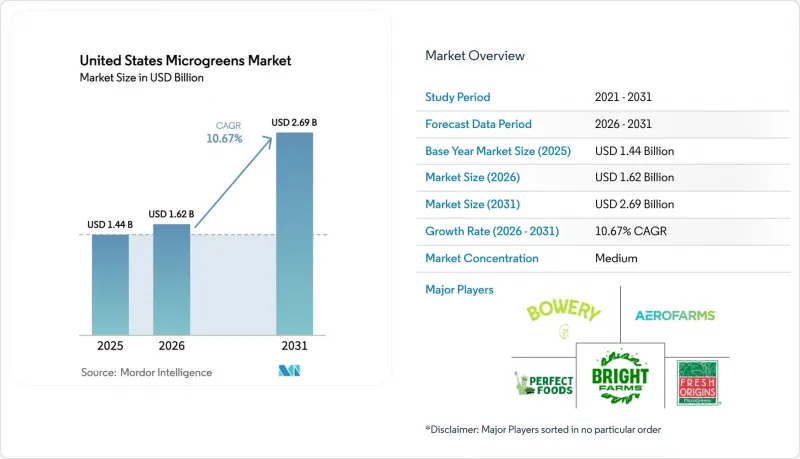
美國微型菜苗市場預計將從 2025 年的 14.4 億美元和 2026 年的 16.2 億美元成長到 2031 年的 26.9 億美元,2026 年至 2031 年的年複合成長率(CAGR)為 10.67%。
這一成長是由保護性栽培技術的進步、機能性食品的廣泛應用以及自動化帶來的成本降低所推動的。
垂直農業對國內生產做出了重大貢獻,其在滿足都市區需求和保護土地、水等資源方面的重要性日益凸顯。西蘭花微型菜苗正引領市場,吸引高階消費者和產品開發商的注意。研究表明,蘿蔔硫苷含量與蘿蔔硫素的生物利用度之間存在相關性,這為其發展提供了有力支撐。零售商正在拓展自有品牌產品線,而線上食品平台則透過縮短從採摘到餐桌的時間(僅需幾個小時),確保產品新鮮度並最大限度地減少廢棄物。儘管面臨能源價格波動和食品安全標準合規等挑戰,但人工智慧(AI)控制、可再生能源合約和聯邦津貼的引入,正有助於穩定利潤率並吸引新的投資。
美國微型菜苗市場的趨勢與洞察
加速保護性農業基礎設施的轉型
聯邦和州政府的獎勵計劃正為溫室和垂直農場投入大量資金,以縮短運輸距離並實現全年生產。賓州透過其重建資本支持計畫撥款300萬美元,用於支持佔地150萬平方英尺的BrightFarms溫室項目,該項目計畫於2024年竣工。這座溫室將取代目前從亞利桑那州運輸的生菜,轉而使用費城附近本地生產的農產品。 2025年6月,Little Leaf Farms, LLC宣布計劃在田納西州建造一座價值7,500萬美元的園區。該園區預計將於2026年開放,並將在該地區創造318個就業機會。美國農業部的「城市農業和創新生產」津貼正在支持對氣候控制系統、灌溉基礎設施和採後冷卻設施的投資,這些投資原本可能面臨資金挑戰。這些舉措已將產品到達市場的時間從5天縮短到不到24小時,並保護生產者免受西部地區乾旱和野火煙霧等威脅露天農業的風險。隨著越來越多的州對環境控制農業實施稅額扣抵,預計美國微型菜苗市場將繼續集中在人口稠密的主要地區,這反映了全球微型菜苗市場正在發生的更廣泛的結構性變化。
來自注重健康的消費者和機能性食品品牌的需求日益成長
追求科學營養的消費者越來越青睞微型菜苗,因為與成熟蔬菜相比,微型蔬菜每克所含的維生素、礦物質和植物化學物質含量更高。奧勒岡州立大學2023年進行的一項人體臨床試驗表明,單次服用16克微型菜苗後三小時內,尿液中即可檢測到蘿蔔硫素代謝物。機能性食品品牌正將冷凍乾燥微型菜苗添加到粉末和營養棒中,並聲稱一茶匙的營養價值相當於八杯蔬菜。美國微型菜苗市場受益於健康意識增強的家庭重複購買率的提高。零售商和線上平台透過教育展示、社交媒體上的烹飪教學以及忠誠度計畫獎勵計劃等方式進一步推動了這一趨勢,鼓勵消費者嘗試新產品並培養消費習慣。
封閉式室內栽培中對病蟲害的易感性
茂密的葉冠、高溫和高濕度會增加細菌和真菌爆發的風險,可能導致代價高昂的產品召回。美國食品藥物管理局(FDA) 的《農業產品安全條例》要求大型農場在 2025 年前消除每 100 毫升灌溉水中可檢測到的大腸桿菌總數,小規模農場則需分階段完成。賓州州立大學推廣中心指出,立枯絲核菌和灰黴病菌是商業微型菜苗生產的主要威脅。應對措施包括使用紫外線處理水、冗餘過濾系統、益蟲和 ATP 生物發光拭子,但這些措施會使每公斤運作成本增加 0.10 至 0.20 美元。此外,超級市場對第三方審核的要求日益提高,使得許多財務狀況較差的農場難以承擔相關費用。這導致分銷管道集中到資金雄厚的大規模企業手中,最終限制了美國微型菜苗市場的整體成長。
細分市場分析
預計到2025年,西蘭微型菜苗將佔據美國微型菜苗市場24.1%的佔有率,成為該品種中市場佔有率最大的微型蔬菜。西蘭花苗生長週期短(僅15天),產量高,口味清淡,方便高效生產計畫,並能輕鬆融入各種菜單。同行評審的研究表明,16克西蘭花苗可提供約100微莫耳的蘿蔔硫素當量,這引起了追求機能性食品的消費者的關注。零售商通常將西蘭花苗與酪梨醬或鷹嘴豆醬搭配,製成即食包裝出售,每盎司售價0.50至0.75美元。此外,餐廳也開始將這些微型菜苗微型菜苗用作裝飾,在不影響菜餚口感的前提下提升營養密度,進一步促進了銷售量成長。
莧菜微型菜苗,2026年至2031年的複合年成長率將達到12.8%。其營養價值極高,每100克含約1.7毫克鐵和超過35毫克維生素C,因此備受那些主打預防貧血和增強免疫力功效的產品開發商的青睞。莧菜鮮紅的莖稈和略帶泥土氣息的風味,也使其成為一種賞心悅目的裝飾,尤其受到注重健康的千禧一代的喜愛。雖然種植者反映莧菜苗的發芽率略低於西蘭花,但其較高的平均售價彌補了產量上的不足。莧菜在奶昔粉和運動員膳食計劃中的應用日益廣泛,預計將推動其在D2C(直接面對消費者)訂閱盒中的普及,從而進一步擴大其在美國微型菜苗市場的佔有率。
其他好處:
- Excel格式的市場預測(ME)表
- 3個月的分析師支持
目錄
第1章:引言
- 研究假設和市場定義
- 調查範圍
第2章:調查方法
第3章執行摘要
第4章 市場狀況
- 市場概覽
- 市場促進因素
- 向防護性農業基礎設施的轉型正在加速。
- 來自注重健康的消費者和機能性食品品牌的需求日益成長
- 擴大與推廣「從農場到餐桌」理念的餐廳的合作關係。
- 超級市場自有品牌的發展正在擴大零售商店的貨架空間。
- 冷凍乾燥微型菜苗作為營養濃縮物的使用正在迅速增加。
- 透過人工智慧驅動的產量最佳化平台降低單位成本。
- 市場限制因素
- 高密度室內生產中對害蟲和病原體的易感性
- 有機認證種子的供應不穩定
- 電力價格波動給垂直農場的利潤率帶來了壓力。
- 熟練技工和農業技工短缺
- 監理情勢
- 技術展望
- 波特五力分析
- 供應商的議價能力
- 買方的議價能力
- 新進入者的威脅
- 替代品的威脅
- 競爭公司之間的競爭
第5章 市場規模與成長預測
- 按類型
- 綠色花椰菜
- 生菜和菊苣
- 羅勒
- 茴香
- 紅蘿蔔
- 蘿蔔
- 莧菜
- 芝麻菜
- 甜菜
- 芥末
- 羽衣甘藍
- 西洋菜和瑞士甜菜
- 按銷售管道
- 大賣場和超級市場
- 餐廳及餐飲服務業
- 消費者訂閱
- 農夫市集
- 網上雜貨購物
- 透過栽培方法
- 室內水平農業
- 垂直農業
- 商業溫室
- 水耕栽培櫃
第6章 競爭情勢
- 市場集中度
- 策略趨勢
- 市佔率分析
- 公司簡介
- Fresh Origins, LLC(Sun Capital Partners)
- Bowery Farming Inc.
- AeroFarms, Inc.
- Perfect Foods, Inc.
- BrightFarms, Inc.(Cox Enterprises, Inc.)
- Shenandoah Growers, Inc.(Soli Organic Inc.)
- 80 Acres Farms, Inc
- Little Leaf Farms, LLC
- The Chef's Garden, Inc.
- GoodLeaf Community Farms Limited
- Farmbox Greens
- Metro Microgreens, LLC
- Quantum Microgreens, LLC
- Florida Microgreens, LLC
- Greenbelt Microgreens Ltd.
第7章 市場機會與未來展望
The United States microgreens market is projected to expand from USD 1.44 billion in 2025 and USD 1.62 billion in 2026 to USD 2.69 billion by 2031, registering a CAGR of 10.67% between 2026 to 2031. Advancements in protected cultivation technologies, the increasing adoption of functional foods, and cost reductions achieved through automation drive this growth.
Vertical farming makes a significant contribution to national output, underscoring its importance in meeting urban demand while conserving resources such as land and water. Broccoli microgreens lead the market, supported by studies linking glucoraphanin content to sulforaphane bioavailability, which appeals to premium consumers and product developers. Retailers are expanding private-label offerings, while online grocery platforms are reducing the time from harvest to table to just a few hours, ensuring fresher products and minimizing waste. Despite challenges such as energy price fluctuations and food safety compliance, the integration of artificial intelligence (AI) controls, renewable energy contracts, and federal grants is helping to stabilize margins and attract new investments.
United States Microgreens Market Trends and Insights
Accelerated Shift Toward Protected Cultivation Infrastructure
Federal and state incentive programs are allocating significant funding to greenhouses and vertical farms, reducing transportation distances and enabling year-round production. Pennsylvania has allocated USD 3 million through its Redevelopment Capital Assistance Program for a 1.5-million-square-foot BrightFarms greenhouse, slated for completion in 2024. This greenhouse will replace lettuce currently transported from Arizona with locally grown produce near Philadelphia. Little Leaf Farms, LLC, announced plans in June 2025 for a USD 75 million campus in Tennessee, projected to open in 2026 and create 318 regional jobs. The United States Department of Agriculture's Urban Agriculture and Innovative Production grants support investments in climate-control systems, irrigation infrastructure, and post-harvest cooling equipment, which would otherwise pose financial challenges. These initiatives have collectively reduced shelf-arrival times from five days to less than twenty-four hours, while protecting growers from risks such as western droughts and wildfire smoke that threaten open-field agriculture. As more states implement controlled-environment tax credits, the United States microgreens market is projected to continue concentrating near major population centers, reflecting broader structural shifts observed across the global microgreens market.
Rising Demand From Health-Conscious Consumers and Functional-Food Brands
Consumers seeking nutrition supported by scientific evidence are increasingly turning to microgreens, which offer higher concentrations of vitamins, minerals, and phytochemicals per gram compared to mature plants. In 2023, a human trial conducted at Oregon State University identified sulforaphane metabolites in urine within three hours of consuming a single 16-gram serving. Functional food brands are incorporating freeze-dried microgreens into powders and nutrition bars, with claims that one teaspoon provides the nutritional equivalent of eight cups of vegetables. The United States microgreens market is benefiting from an increase in repeat purchases among health-conscious households. Retailers and online platforms are further driving this trend through educational displays, social media cooking tutorials, and loyalty program incentives, which encourage trial and foster habitual consumption.
Pest and Pathogen Susceptibility in Dense Indoor Production
Dense canopy layers, warm temperatures, and high humidity increase the likelihood of bacterial and fungal outbreaks, which can lead to costly product recalls. The Food and Drug Administration's Produce Safety Rule requires zero detectable generic Escherichia coli in 100 milliliters of irrigation water by 2025 for large farms, with phased deadlines for smaller farms. According to Penn State Extension, damping-off diseases caused by Rhizoctonia and Botrytis are the primary threats to yields in commercial microgreens production. Mitigation strategies include the use of ultraviolet-treated water, redundant filtration systems, beneficial insects, and ATP bioluminescence swabs, which add USD 0.10-0.20 per kilogram to operating costs. Additionally, supermarkets are increasingly requiring third-party audits, which many undercapitalized farms find difficult to afford. This has led to a concentration of distribution among larger, well-funded players, thereby limiting the overall growth of the United States microgreens market.
Other drivers and restraints analyzed in the detailed report include:
- Expansion of Farm-to-Table Restaurant Partnerships
- AI-Driven Yield-Optimization Platforms Lowering Unit Costs
- Volatile Supply of Certified-Organic Seeds
For complete list of drivers and restraints, kindly check the Table Of Contents.
Segment Analysis
Broccoli microgreens accounted for 24.1% of the United States microgreens market share in 2025, establishing themselves as the largest variety-based contributor. Their short fifteen-day crop cycle, high yields, and mild flavor facilitate efficient production planning and seamless integration into menus. Peer-reviewed studies indicate that a 16-gram serving provides approximately 100 micromoles of sulforaphane equivalent, enhancing its appeal among functional food consumers. Retailers often pair broccoli microgreens with avocado or chickpea spreads in ready-to-eat packs, which command price premiums of USD 0.50-0.75 per ounce. Additionally, restaurants use these microgreens as garnishes to increase nutrient density without affecting texture, further driving volume growth.
Amaranth microgreens are anticipated to achieve the fastest growth, with a 12.8% CAGR from 2026 to 2031. Their nutritional profile, including iron levels of approximately 1.7 milligrams per 100 grams and vitamin C concentrations exceeding 35 milligrams per 100 grams, appeals to formulators targeting anti-anemia and immune-support claims. The bright red stems and earthy flavor make amaranth a visually appealing garnish, particularly popular among health-conscious millennials. While growers report slightly uneven germination compared to broccoli, higher average selling prices offset potential yield losses. The increasing use of amaranth in smoothie powders and athlete meal plans is projected to drive its adoption in direct-to-consumer subscription boxes, further expanding its presence in the United States microgreens market.
The United States Microgreens Market Report is Segmented by Type (Broccoli, Lettuce and Chicory, Basil, Fennel, Carrots, Radish, Amaranth, and More), by Sales Channel (Hypermarket and Supermarkets, Restaurants and Foodservice, and More), and by Farming Method (Indoor Horizontal Farming, Vertical Farming, Commercial Greenhouses, and More). The Market Forecasts are Provided in Terms of Value (USD).
List of Companies Covered in this Report:
- Fresh Origins, LLC (Sun Capital Partners)
- Bowery Farming Inc.
- AeroFarms, Inc.
- Perfect Foods, Inc.
- BrightFarms, Inc. (Cox Enterprises, Inc.)
- Shenandoah Growers, Inc. (Soli Organic Inc.)
- 80 Acres Farms, Inc
- Little Leaf Farms, LLC
- The Chef's Garden, Inc.
- GoodLeaf Community Farms Limited
- Farmbox Greens
- Metro Microgreens, LLC
- Quantum Microgreens, LLC
- Florida Microgreens, LLC
- Greenbelt Microgreens Ltd.
Additional Benefits:
- The market estimate (ME) sheet in Excel format
- 3 months of analyst support
TABLE OF CONTENTS
1 Introduction
- 1.1 Study Assumptions and Market Definition
- 1.2 Scope of the Study
2 Research Methodology
3 Executive Summary
4 Market Landscape
- 4.1 Market Overview
- 4.2 Market Drivers
- 4.2.1 Accelerated shift toward protected cultivation infrastructure
- 4.2.2 Rising demand from health-conscious consumers and functional-food brands
- 4.2.3 Expansion of farm-to-table restaurant partnerships
- 4.2.4 Supermarket private-label roll-outs boosting retail shelf space
- 4.2.5 Surging adoption of freeze-dried microgreens as nutrient concentrates
- 4.2.6 AI-driven yield-optimization platforms lowering unit costs
- 4.3 Market Restraints
- 4.3.1 Pest and pathogen susceptibility in dense indoor production
- 4.3.2 Volatile supply of certified-organic seeds
- 4.3.3 Grid-energy price volatility undermining vertical-farm margins
- 4.3.4 Scarcity of skilled technicians and agronomists
- 4.4 Regulatory Landscape
- 4.5 Technological Outlook
- 4.6 Porter's Five Forces Analysis
- 4.6.1 Bargaining Power of Suppliers
- 4.6.2 Bargaining Power of Buyers
- 4.6.3 Threat of New Entrants
- 4.6.4 Threat of Substitute Products
- 4.6.5 Intensity of Competitive Rivalry
5 Market Size and Growth Forecasts (Value)
- 5.1 By Type
- 5.1.1 Broccoli
- 5.1.2 Lettuce and Chicory
- 5.1.3 Basil
- 5.1.4 Fennel
- 5.1.5 Carrots
- 5.1.6 Radish
- 5.1.7 Amaranth
- 5.1.8 Arugula
- 5.1.9 Beets
- 5.1.10 Mustard
- 5.1.11 Kale
- 5.1.12 Cress and Chard
- 5.2 By Sales Channel
- 5.2.1 Hypermarkets and Supermarkets
- 5.2.2 Restaurants and Foodservice
- 5.2.3 Direct-to-Consumer Subscription
- 5.2.4 Farmers Markets
- 5.2.5 Online Grocery
- 5.3 By Farming Method
- 5.3.1 Indoor Horizontal Farming
- 5.3.2 Vertical Farming
- 5.3.3 Commercial Greenhouses
- 5.3.4 Hydroponic Grow Cabinets
6 Competitive Landscape
- 6.1 Market Concentration
- 6.2 Strategic Moves
- 6.3 Market Share Analysis
- 6.4 Company Profiles (Includes Global Level Overview, Market Level Overview, Core Segments, Financials as Available, Strategic Information, Market Rank/Share for Key Companies, Products and Services, and Recent Developments)
- 6.4.1 Fresh Origins, LLC (Sun Capital Partners)
- 6.4.2 Bowery Farming Inc.
- 6.4.3 AeroFarms, Inc.
- 6.4.4 Perfect Foods, Inc.
- 6.4.5 BrightFarms, Inc. (Cox Enterprises, Inc.)
- 6.4.6 Shenandoah Growers, Inc. (Soli Organic Inc.)
- 6.4.7 80 Acres Farms, Inc
- 6.4.8 Little Leaf Farms, LLC
- 6.4.9 The Chef's Garden, Inc.
- 6.4.10 GoodLeaf Community Farms Limited
- 6.4.11 Farmbox Greens
- 6.4.12 Metro Microgreens, LLC
- 6.4.13 Quantum Microgreens, LLC
- 6.4.14 Florida Microgreens, LLC
- 6.4.15 Greenbelt Microgreens Ltd.
7 Market Opportunities and Future Outlook

 微型菜苗市場-2026-2032年全球市場預測
 微型菜苗市場:依產品類型、栽培方法、通路及地區分類
 2026年全球微型菜苗市場報告捲心菜和微型菜苗市場:按產品、栽培方法、應用和分銷管道分類,全球預測(2026-2032年)
 微型菜苗:市場佔有率分析、產業趨勢與統計、成長預測(2026-2031)
 日本微型菜苗市場規模、佔有率、趨勢及預測(按類型、栽培方法、通路、應用及地區分類),2026-2034年
 微型菜苗市場規模、佔有率和成長分析(按類型、栽培方法、通路、應用和地區分類)-2026-2033年產業預測
 2025-2029年全球微型菜苗市場
 全球微型菜苗市場預測(2025-2030)
 微型菜苗市場:各產品類型,成長循環,各栽培類型,各流通管道,各地區,機會,預測,2017年~2031年