

 |
市場調查報告書
商品編碼
2035021
日本戶外廣告和數位戶外廣告:市場佔有率分析、行業趨勢和統計數據以及成長預測(2026-2031 年)Japan OOH And DOOH - Market Share Analysis, Industry Trends & Statistics, Growth Forecasts (2026 - 2031) |
||||||

※ 本網頁內容可能與最新版本有所差異。詳細情況請與我們聯繫。
2025年日本戶外廣告和數位戶外廣告市場價值為38.6億美元,預計到2031年將達到42.8億美元,而2026年為39.3億美元,預測期(2026-2031年)複合年成長率為1.72%。
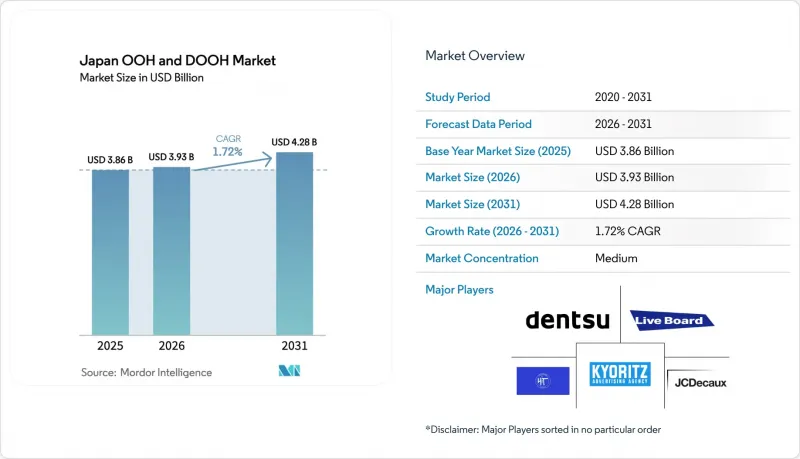
儘管靜態廣告形式仍佔據市場主導地位,但數位戶外廣告以4.47%的複合年成長率 (CAGR) 超越了靜態廣告,顯示廣告購買正逐漸轉向基於曝光量的模式。像澀谷十字路口這樣人潮眾多的路口仍然稀缺,導致廣告看板租金居高不下。但隨著2025年東京世博會的臨近,數位化進程正在加速大阪交通走廊的螢幕安裝。 5G的快速部署正在將基於位置的交易模式轉變為基於受眾的交易模式,使廣告主能夠將通訊業者行動數據與程序化平台整合,實現近乎即時的最佳化。同時,零售媒體網路與戶外螢幕的整合正在建立全通路路徑,將店內第一方數據與街頭曝光量連接起來,從而提高衡量精度。市場分散化依然存在,前三大供應商僅佔20%的廣告庫存,迫使廣告主仍需要與多家供應商協調才能確保覆蓋全國範圍。但像MASTRUM這樣的軟體平台正開始整合購買流程。
日本戶外和數位戶外市場的發展趨勢和洞察
5G賦能的程式化交易平台加速媒體購買
由NTT Docomo和電通合資成立的LIVE BOARD,透過將匿名化的行動網路數據與螢幕播放日誌結合,打造了日本首個基於曝光量的數位戶外廣告交易平台。其成功促使機場營運商和市政特許經營經營商透過openRTB管道開放廣告資源,將前置作業時間從數週縮短至數小時,並使CPM估算能夠根據動態的受眾成長進行調整。 2025年4月,德高集團在其程式化廣告系統中新增了關西國際機場和大阪國際機場的55塊螢幕,展現了其在交通樞紐日益成長的覆蓋範圍。如今,廣告主通常會將通訊業者檢驗的訪客估計值疊加到競標請求中,從而擴大有效覆蓋範圍並減少浪費。此外,由於廣告主能夠收到與來自獨立通訊業者的匯總數據關聯的統一的廣告宣傳活動後曝光證明,該功能還有助於提高課責。這些成就共同支撐了日本戶外廣告市場的預期成長。
2025年東京世博會將促進數位街道家具的普及。
2025年4月13日至10月13日世博會期間,預計將有2,820萬遊客到訪。連接大阪灣和關西郊區的鐵路沿線正在快速安裝耐候型液晶廣告看板和太陽能LED廣告亭。由於主辦單位已獲得多年營運權,且營運權將延續至世博會結束後,預計2025年以後,都市區的廣告螢幕數量將大幅成長。在世博會期間投放宣傳活動的品牌將受益於持續的影響力,因為他們的合約將延續至「世博會後」時期,屆時區域旅遊和通勤模式仍將保持活躍。此外,世博會的「生活實驗室」主題將成為非接觸式介面和人工智慧驅動的創新輪播的試驗平台,為情境相關性樹立新的標竿。這些因素共同推動了日本戶外廣告市場在世博會期間及之後的需求成長。
都市區房地產所有權的分散化推高了安裝成本。
由於前三大供應商僅佔20%的廣告位,廣告公司即使是小規模的全國性廣告投放,仍需與多個相關人員進行談判。在歷史街區,由於地塊分散在家族信託、零售商、運輸公司等不同所有者手中,租賃期限更長,進入門檻更高,這個問題尤其突出。雖然像MASTRUM這樣的自動化工具在一定程度上減少了摩擦,但它們無法凌駕於土地所有者的同意之上,因此螢幕部署速度無法滿足廣告商的需求。最終,供應端的瓶頸阻礙了日本戶外廣告市場預期的擴張。
細分市場分析
2025年,靜態廣告形式佔廣告支出的62.68%,在通勤鐵路和市政海報網路上實現了廣泛的曝光。由於單次投放成本低且易於遵守當地法規,傳統海報仍是日常消費品(FMCG)產品上市時密集宣傳活動的主要媒介。然而,在程序化購買保障和富媒體敘事的推動下,數位戶外廣告預計到2031年將以4.38%的年均成長率成長。程序化購買目前已佔數位廣告曝光量的四分之一,透過通訊數據進行豐富化處理進一步提升了獲利能力。預計到2031年,日本數位螢幕戶外廣告市場規模將超過16.7億美元,反映出成長速度差距的擴大。靜態廣告的成長速度仍然緩慢,這主要是由於廣告素材從乙烯基轉向紙張以降低維護成本,但隨著廣告主追求觸發式創新和時段最佳化,其市場佔有率將會下降。
其他因素也印證了這個趨勢。 LIVE BOARD 以 NFT 形式出售青山黃金地段的戶外廣告牌,展現了能引起數位資產投資者共鳴的另類交易模式。同時,市政競標中對永續性指標的要求日益提高,節能型 LED 面板的價值也高於黏合式鋼架。這些因素共同推動數位廣告保持著複雜的成長軌跡,並持續支撐著日本整體戶外廣告市場的顯著成長。
其他好處:
- Excel格式的市場預測(ME)表
- 3個月的分析師支持
目錄
第1章:引言
- 研究假設和市場定義
- 調查範圍
第2章:調查方法
第3章執行摘要
第4章 市場狀況
- 市場概覽
- 市場促進因素
- 一個支援 5G 的程序化交易平台,旨在加速媒體購買。
- 2025年東京世博會將促進數位街道家具的普及。
- 政府放寬風景名勝區電子標牌的相關規定
- 將零售媒體網路擴展到戶外螢幕,實現全通路部署。
- 市場限制因素
- 都市區房地產所有權的分散化推高了安裝成本。
- 不斷上漲的電費正在降低LED顯示器的投資報酬率。
- 監理展望
- 技術展望
- 受眾測量與分析平台
- 動態創新最佳化引擎
- 波特五力分析
- 供應商的議價能力
- 買方議價能力/廣告商議價能力
- 新進入者的威脅
- 替代品的威脅
- 競爭公司之間的競爭
- 產業生態系分析
- 重大技術創新
- 基於電腦視覺的印跡測量
- 即時庫存狀態儀錶板
- 日本戶外廣告和數位戶外宣傳活動的關鍵案例研究
- 戶外廣告和數位戶外廣告支出及其相對於其他廣告形式的定位
第5章 市場規模與成長預測
- 按類型
- 靜態 OOH
- 數位戶外廣告
- 程序化戶外廣告
- 其他數位戶外廣告類型
- 透過使用
- 廣告看板
- 運輸
- 飛機場
- 其他交通方式
- 街道家具
- 其他特定地點媒體
- 按最終用戶行業分類
- 車
- 零售和消費品
- 衛生保健
- 銀行、金融和保險(BFSI)
- 娛樂媒體
- 其他終端用戶產業
第6章 競爭情勢
- 策略發展
- 公司簡介
- Dentsu Inc.
- MCDecaux(JCDecaux Group)
- LIVE BOARD Inc.
- Kyoritz Advertising Agency Co., Ltd.
- Hit Co., Ltd.
- Advertising Nagata Co., Ltd.
- Kesion Co., Ltd.
- Asahi Agency Inc.
- Fujikyuko OOH Media
- Tokyo Outdoor Advertising Co.
- Nishinippon Advertising Co.
- Hivestack Japan KK
- Moving Walls Pte Ltd
- One Day Agency(1D Agency Ltd)
- ASIAPAC Net Media Ltd
- United Screen Co.
- Pats Inc.
- Seiko Advance Ltd.
- Panasonic System Solutions Japan
- Sony Professional Solutions Japan
第7章 市場機會與未來展望
The Japan OOH and DOOH market size was valued at USD 3.86 billion in 2025 and estimated to grow from USD 3.93 billion in 2026 to reach USD 4.28 billion by 2031, at a CAGR of 1.72% during the forecast period (2026-2031).
Static formats continue to supply volume, yet Digital OOH outperforms with a 4.47% CAGR, signaling a gradual share shift toward impression-based buying. Billboards command premium rents because high-visibility intersections such as Shibuya Crossing remain scarce, while the digital upgrade cycle ahead of the Tokyo 2025 World Expo accelerates screen deployments in Osaka's transit corridors. Rapid 5G rollout is converting location-based transactions to audience-based deals, letting buyers fuse telecom mobility data with programmatic platforms for near-real-time optimisation. Meanwhile, integration of retail media networks with outdoor screens creates omnichannel paths that join in-store first-party data with street-level impressions, lifting measurement precision. Market fragmentation persists top three vendors holding only 20% of inventory, so advertisers still juggle multiple owners to achieve national reach, yet software layers such as MASTRUM start to harmonise buying workflows.
Japan OOH And DOOH Market Trends and Insights
5G-enabled Programmatic Transaction Platforms Accelerating Media Buys
LIVE BOARD, the venture between NTT DOCOMO and Dentsu, delivers Japan's first impression-based Digital OOH exchange by combining anonymised mobile network data with screen playout logs. Its success pushes airport operators and municipal concessionaires to open inventory via openRTB pipes, cutting lead times from weeks to hours and aligning CPM quotes with dynamic audience swell. In April 2025, MCDecaux added 55 screens at Kansai and Osaka International Airports to its programmatic stack, signalling mainstream uptake across transport hubs. Buyers now routinely overlay telecom-verified foot-fall estimates on bid requests, raising effective reach while reducing waste. The capability also boosts accountability because advertisers receive unified post-campaign impression certificates tied to independent telecom counts. Together, these gains underpin the forecast uplift in the Japan OOH advertising market.
Tokyo 2025 World Expo Boosting Digital Street Furniture Expansion
From April 13 to October 13 2025 the Expo expects 28.2 million visitors, driving a fast rollout of weather-proof LCD totems and solar-powered LED shelters along rail lines linking Osaka Bay with Kansai suburbs.. Operators secure multiyear concessions that outlive the event, so the installed base of urban screens rises well beyond 2025. Brands booking Expo-era campaigns gain continuity because contracts extend into the legacy period when regional tourism and commuting patterns stay elevated. The Expo's "Living Lab" theme also provides a testbed for touch-free interfaces and AI-driven creative rotation, setting new benchmarks for contextual relevance. These factors combine to lift demand curves within the Japan OOH advertising market both during and after the event window.
Fragmented Ownership of Prime Urban Real Estate Elevating Installation Costs
With top three vendors holding only 20% inventory, agencies still face multi-party negotiations for even modest national roadmaps. The issue deepens in heritage neighborhoods where property plots are subdivided across family trusts, retailers and transport entities, lengthening lease cycles and raising entry costs. Automation layers such as MASTRUM reduce some friction yet cannot over-ride landowner consents, so screen roll-outs lag advertiser demand. Consequently, supply bottlenecks temper the projected expansion of the Japan OOH advertising market.
Other drivers and restraints analyzed in the detailed report include:
- Government Relaxation on Digital Billboard Regulation in Scenic Zones
- Retail Media Networks Extending to Outdoor Screens for Omnichannel Reach
- Rising Electricity Tariffs Eroding LED Board ROI
For complete list of drivers and restraints, kindly check the Table Of Contents.
Segment Analysis
Static formats contribute 62.68% of 2025 spend, underpinning broad visibility across commuter rail and municipal poster networks. Traditional posters cost less per play cycle and comply easily with local ordinances, so they remain a staple for FMCG launch bursts. Nevertheless, Digital OOH grows at 4.38% through 2031, driven by programmatic guarantees and rich-media storytelling. Programmatic already underwrites one-quarter of digital impressions, and telecom-data enrichment lifts yield. The Japan OOH advertising market size for digital screens will likely exceed USD 1.67 billion by 2031, reflecting the widening gap in growth paces. Static still posts modest upgrades, chiefly vinyl-to-paper substitutions that pare maintenance outlays, yet share will slip as advertisers chase trigger-based creatives and day-part optimisation.
Second-order signals reinforce the tilt. LIVE BOARD's NFT sale of a prime Aoyama facade validated alternative transaction models that resonate with digital asset investor.. Meanwhile, municipal tenders increasingly require sustainability metrics, where power-efficient LED packs score higher than paste-up steel frames. These forces keep digital on a compound trajectory and sustain headline growth inside the Japan OOH advertising market.
Japan OOH and DOOH Market Report is Segmented by Type (Static OOH, Digital OOH [Programmatic DOOH, Interactive OOH]), Application (Billboards, Transportation, and More), End-User Industry (Retail and Consumer Goods, Automotive, and More). The Market Forecasts are Provided in Terms of Value (USD).
List of Companies Covered in this Report:
- Dentsu Inc.
- MCDecaux (JCDecaux Group)
- LIVE BOARD Inc.
- Kyoritz Advertising Agency Co., Ltd.
- Hit Co., Ltd.
- Advertising Nagata Co., Ltd.
- Kesion Co., Ltd.
- Asahi Agency Inc.
- Fujikyuko OOH Media
- Tokyo Outdoor Advertising Co.
- Nishinippon Advertising Co.
- Hivestack Japan K.K.
- Moving Walls Pte Ltd
- One Day Agency (1D Agency Ltd)
- ASIAPAC Net Media Ltd
- United Screen Co.
- Pats Inc.
- Seiko Advance Ltd.
- Panasonic System Solutions Japan
- Sony Professional Solutions Japan
Additional Benefits:
- The market estimate (ME) sheet in Excel format
- 3 months of analyst support
TABLE OF CONTENTS
1 INTRODUCTION
- 1.1 Study Assumptions and Market Definition
- 1.2 Scope of the Study
2 RESEARCH METHODOLOGY
3 EXECUTIVE SUMMARY
4 MARKET LANDSCAPE
- 4.1 Market Overview
- 4.2 Market Drivers
- 4.2.1 5G-enabled Programmatic Transaction Platforms Accelerating Media Buys
- 4.2.2 Tokyo 2025 World Expo Boosting Digital Street Furniture Expansion
- 4.2.3 Government Relaxation on Digital Billboard Regulation in Scenic Zones
- 4.2.4 Retail Media Networks Extending to Outdoor Screens for Omnichannel Reach
- 4.3 Market Restraints
- 4.3.1 Fragmented Ownership of Prime Urban Real Estate Elevating Installation Costs
- 4.3.2 Rising Electricity Tariffs Eroding LED Board ROI
- 4.4 Regulatory Outlook
- 4.5 Technological Outlook
- 4.5.1 Audience Measurement and Analytics Platforms
- 4.5.2 Dynamic Creative Optimization Engines
- 4.6 Porter's Five Forces Analysis
- 4.6.1 Bargaining Power of Suppliers
- 4.6.2 Bargaining Power of Buyers/Advertisers
- 4.6.3 Threat of New Entrants
- 4.6.4 Threat of Substitutes
- 4.6.5 Intensity of Competitive Rivalry
- 4.7 Industry Ecosystem Analysis
- 4.8 Key Technological Innovations
- 4.8.1 Computer-Vision Based Impression Counting
- 4.8.2 Real-time Inventory Availability Dashboards
- 4.9 Key Case Studies of OOH and DOOH Campaigns in Japan
- 4.10 Positioning of OOH and DOOH Spend Versus Other Advertising Formats
5 MARKET SIZE AND GROWTH FORECASTS (VALUE)
- 5.1 By Type
- 5.1.1 Static OOH
- 5.1.2 Digital OOH
- 5.1.2.1 Programmatic OOH
- 5.1.2.2 Other Digital OOH Types
- 5.2 By Application
- 5.2.1 Billboard
- 5.2.2 Transportation
- 5.2.2.1 Airports
- 5.2.2.2 Other Transportation
- 5.2.3 Street Furniture
- 5.2.4 Other Place-Based Media
- 5.3 By End-user Industry
- 5.3.1 Automotive
- 5.3.2 Retail and Consumer Goods
- 5.3.3 Healthcare
- 5.3.4 Banking, Financial Services and Insurance (BFSI)
- 5.3.5 Entertainment and Media
- 5.3.6 Other End-user Industries
6 COMPETITIVE LANDSCAPE
- 6.1 Strategic Developments
- 6.2 Company Profiles (includes Global Level Overview, Market Level Overview, Core Segments, Financials as available, Strategic Information, Products and Services, Recent Developments)
- 6.2.1 Dentsu Inc.
- 6.2.2 MCDecaux (JCDecaux Group)
- 6.2.3 LIVE BOARD Inc.
- 6.2.4 Kyoritz Advertising Agency Co., Ltd.
- 6.2.5 Hit Co., Ltd.
- 6.2.6 Advertising Nagata Co., Ltd.
- 6.2.7 Kesion Co., Ltd.
- 6.2.8 Asahi Agency Inc.
- 6.2.9 Fujikyuko OOH Media
- 6.2.10 Tokyo Outdoor Advertising Co.
- 6.2.11 Nishinippon Advertising Co.
- 6.2.12 Hivestack Japan K.K.
- 6.2.13 Moving Walls Pte Ltd
- 6.2.14 One Day Agency (1D Agency Ltd)
- 6.2.15 ASIAPAC Net Media Ltd
- 6.2.16 United Screen Co.
- 6.2.17 Pats Inc.
- 6.2.18 Seiko Advance Ltd.
- 6.2.19 Panasonic System Solutions Japan
- 6.2.20 Sony Professional Solutions Japan
7 MARKET OPPORTUNITIES AND FUTURE OUTLOOK
- 7.1 White-Space and Unmet-Need Assessment

 2026年全球程序化戶外廣告平台市場報告
 數位戶外廣告市場:按形式、終端用戶產業、技術、互動性和應用程式分類-全球預測,2026-2032年2026年全球戶外數位廣告市場報告
 數位戶外廣告市場報告:按形式、應用程式、最終用戶和地區分類(2026-2034 年)
 亞太地區數位戶外(DOOH):市場佔有率分析、產業趨勢與統計、成長預測(2026-2031)東南亞數位戶外(DOOH):市場佔有率分析、產業趨勢與統計、成長預測(2026-2031)
 全球數位戶外廣告市場規模、佔有率、趨勢和成長分析報告(2026-2034年)全球數位戶外廣告市場:市場規模、佔有率、成長率、產業分析、依類型、應用和地區劃分的分析及預測(2026-2034 年)戶外媒體廣告市場按媒體類型、形式、所有權、應用程式和最終用戶產業分類,全球預測(2026-2032年)中東和非洲數位戶外廣告 (DOOH) - 市場佔有率分析、行業趨勢、統計數據和成長預測 (2026-2031)