


 |
市場調查報告書
商品編碼
1937282
南美汽車市場:市場佔有率分析、產業趨勢與統計、成長預測(2026-2031)South America Automotive - Market Share Analysis, Industry Trends & Statistics, Growth Forecasts (2026 - 2031) |
||||||

※ 本網頁內容可能與最新版本有所差異。詳細情況請與我們聯繫。
預計南美汽車市場將從 2025 年的 272.8 億美元成長到 2026 年的 294.6 億美元,到 2031 年將達到 433.3 億美元,2026 年至 2031 年的複合年成長率為 8.02%。
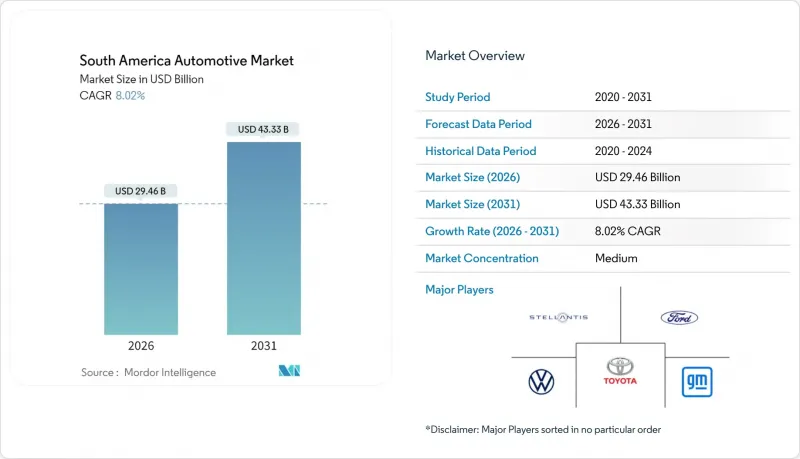
南美汽車市場持續受惠於快速的基礎設施投資、日益靈活的燃油政策(例如巴西的E30強制令)以及數位化零售平台的蓬勃發展,這些因素縮短了購買週期並擴大了消費群體。儘管不斷上漲的借貸成本和半導體短缺仍構成短期不利因素,但強勁的家庭消費和不斷壯大的中產階級支撐著該地區的長期成長。日益激烈的競爭,例如Stellantis承諾到2030年投資56億歐元,以及中國汽車製造商為規避南方共同市場不斷上漲的關稅而將生產本地化,正在重塑產品組合、技術應用和供應商生態系統。
南美洲汽車市場趨勢與洞察
OEM廠商對區域汽車平臺的投資
在南美,傳統汽車和電動車銷量的成長,以及大眾汽車集團和Stellantis NV等主要廠商加大投資,正在推動盈利的提升。光是Stellantis就投資了56億歐元,創下該地區歷史上單筆投資額的最高紀錄。大眾汽車集團為其在阿根廷的Amarq計畫撥款5.8億美元,以滿足當地的運作週期需求。同時,豐田汽車公司和寶馬集團也宣布了專注於混合動力和靈活燃料驅動系統的多年擴張計畫。通用汽車和現代汽車的合資計劃(目標是在五款車型中實現年銷量80萬輛)等合作項目,標誌著南美汽車市場正朝著共用分攤和產品週期加速的方向發展。這些本地化平台降低了外匯風險,符合當地監管標準,並享受南方共同市場(Mercosur)的關稅優惠,從而提升了南美汽車市場的整體競爭力。
疫情後GDP復甦與消費信貸成長
預計2025年區域GDP將年增2.5%(2016年為1.9%),儘管基準利率較高,但仍將支撐家庭收入成長和汽車融資。巴西經濟預計2024年將成長3.4%,失業率為6.5%,為購車創造了有利環境。阿根廷的改革已將月通膨率降至2.8%,為購車者開闢了新的融資管道。同時,哥倫比亞的製造業產出年增,進一步增強了南美汽車市場的成長動能。儘管融資成本仍然較低,但大多數央行的寬鬆貨幣政策預計將逐步恢復信貸管道。預計更強勁的宏觀經濟基本面將支撐2025年全年展示室客流量和累積訂單的成長。
由於通貨膨脹,融資利率高企,汽車價格也不斷上漲。
巴西的政策利率(Selic)預計在2025年升至14.25%,這將推高汽車貸款利率,使購車更加困難。儘管阿根廷的通膨有所緩解,但由於披索動,貸款利差仍然較大,而本幣的波動也使得進口價格前景不明朗。雖然汽車製造商目前提供貸款延期和利率補貼,但信貸滲透率仍低於疫情前水準。因此,在金融環境好轉之前,南美汽車市場的短期銷售可能仍將低於潛在水準。
細分市場分析
截至2025年,乘用車佔南美汽車市場的73.68%,預計到2031年將以11.95%的複合年成長率成長,這主要得益於都市化和中產階級收入的成長。 SUV和跨界車因其更高的乘坐位置和安全性而成為市場需求的主要驅動力,而緊湊型轎車則憑藉其燃油效率在汽油價格上漲的背景下保持著一定的市場佔有率。商用車雖然銷售量較小,但卻在農業和礦業走廊的物流運輸中扮演重要角色。小型皮卡是巴西農場的主要交通工具,而大型卡車則是智利銅出口的主要運輸工具。摩托車作為一種經濟實惠的交通方式,在擁擠的大都會圈越來越受歡迎,而非公路用車則受益於公共工程支出。
Stellantis計劃在2030年推出40多款新產品,其中許多產品將採用在地化平台,並相容於靈活燃料驅動系統,這將進一步增強乘用車市場的成長動能。融資促銷活動旨在緩解利率上升導致的銷售放緩,並維持展示室的客流量;同時,二手車平台提高了置換流動性,降低了實際更換成本,並保持了銷售周轉率。車輛組合凸顯了南美洲汽車市場如何在個人出行需求和商務傳輸需求之間取得平衡。
儘管到2025年,內燃機汽車仍將佔據南美汽車市場72.95%的佔有率,但由於財政激勵措施和中國本地化生產縮小了價格差距,電池式電動車正以11.15%的複合年成長率快速成長。巴西的E30計畫為靈活燃料引擎提供了成本競爭力保護,有助於減少汽油進口並提高國內乙醇需求。混合動力汽車,尤其是可使用乙醇的車型,正發揮過渡技術的作用,與汽油動力汽車相比,它們能夠實現更大的排放效果。
柴油車在長途運輸(跨越數千公里)中仍然扮演著重要角色,而壓縮天然氣(CNG)汽車則在擁有完善加氣網路的市政車隊中找到了自己的應用領域。燃料電池技術的研究尚處於起步階段,但隨著現代汽車宣佈在巴西投資11億美元發展氫能的藍圖,該技術正日益受到關注。預計到2026年,C級純電動車的進口關稅將提高至35%,屆時,當地的電機和電池工廠將努力維持價格優勢並加速普及,逐步改變南美汽車市場的動力系統結構。
其他福利:
- Excel格式的市場預測(ME)表
- 3個月的分析師支持
目錄
第1章 引言
- 研究假設和市場定義
- 調查範圍
第2章調查方法
第3章執行摘要
第4章 市場情勢
- 市場概覽
- 市場促進因素
- 疫情後GDP復甦與消費信貸擴張
- 巴西擴大彈性燃料獎勵
- 按地區分類的汽車平臺OEM投資
- 中國汽車製造商利用南方共同市場關稅優惠建造待開發區電動車工廠
- 二手車平台正在促進以舊換新交易。
- 礦業特許權使用費基金補貼電動車購買
- 市場限制
- 融資利率上升和車輛價格通膨上漲
- 本地組裝半導體供應的波動
- 港口擁塞導致CKD套件和電池進口延誤
- 消費者對城際充電網路可靠性的不信任
- 價值/供應鏈分析
- 監管環境
- 技術展望
- 波特五力模型
- 新進入者的威脅
- 買方的議價能力
- 供應商的議價能力
- 替代品的威脅
- 競爭對手之間的競爭
第5章 市場規模與成長預測
- 按車輛類型
- 搭乘用車
- 掀背車
- 轎車
- SUV 與跨界車
- MPV
- 商用車輛
- 輕型商用皮卡
- 輕型商用貨車
- 大型卡車
- 巴士和長途汽車
- 摩托車
- 摩托車
- Scooter/輕型機踏車
- 非公路用車輛
- 農用曳引機
- 施工機械
- 搭乘用車
- 依推進類型
- 內燃機(ICE)
- 汽油
- 柴油引擎
- 彈性燃料(乙醇)
- 天然氣(CNG/LNG)
- 電動車
- 電池式電動車(BEV)
- 混合動力電動車(HEV)
- 插電式混合動力汽車(PHEV)
- 燃料電池汽車(FCEV)
- 內燃機(ICE)
- 按銷售管道
- OEM/直銷
- 經銷商/零售
- 車隊和企業銷售
- 線上直接面對消費者
- 最終用戶
- 個人/一般消費者
- 小型企業車隊
- 企業艦隊
- 政府和地方政府車隊
- 出行業者(叫車、共乘)
- 按國家/地區
- 巴西
- 阿根廷
- 智利
- 秘魯
- 哥倫比亞
- 厄瓜多
- 南美洲其他地區
第6章 競爭情勢
- 市場集中度
- 策略趨勢
- 市佔率分析
- 公司簡介
- Stellantis NV
- Volkswagen AG
- General Motors Company
- Toyota Motor Corporation
- Ford Motor Company
- Hyundai Motor Company
- Nissan Motor Co. Ltd.
- Honda Motor Co. Ltd.
- Renault SA
- Mercedes-Benz Group AG
- Kia Corporation
- BYD Company Limited
- Chery Automobile Co. Ltd.
- Great Wall Motor Co. Ltd.
- Geely Automobile Holdings
- BMW AG
- Volvo Car AB
第7章 市場機會與未來展望
The South American automotive market is expected to grow from USD 27.28 billion in 2025 to USD 29.46 billion in 2026 and is forecast to reach USD 43.33 billion by 2031 at 8.02% CAGR over 2026-2031.
The South American automotive market continues to benefit from swift infrastructure spending, flexible-fuel policy enhancements such as Brazil's E30 mandate, and the proliferation of digital retail platforms that shorten purchase cycles and expand consumer reach. Elevated borrowing costs and semiconductor shortages continue to pose near-term headwinds, yet resilient household consumption and an expanding middle class underpin the region's long-term growth profile. Competitive intensity has risen as Stellantis commits EUR 5.6 billion through 2030, and Chinese OEMs localize production to avoid rising Mercosur tariffs, all of which is reshaping the product mix, technology adoption, and supplier ecosystems.
South America Automotive Market Trends and Insights
OEM Investments in Regional Vehicle Platforms
In South America, growing sales of traditional and electrified vehicles and heightened investments from major players like Volkswagen AG and Stellantis NV have increased profitability. Stellantis alone invested EUR 5.6 billion, the most significant single commitment in regional history . Volkswagen AG allocated USD 580 million to an Argentina-based Amarok program tailored to local duty-cycle needs. At the same time, Toyota Motor and BMW Group announced multi-year expansions focusing on hybrid and flex-fuel drivetrains. Joint projects such as the GM-Hyundai collaboration covering five models and targeting 800,000 annual sales illustrate a pivot toward shared cost structures and accelerated product cadence. These localized platforms reduce currency risk, meet regional regulatory norms, and leverage Mercosur tariff preferences, collectively enhancing the competitiveness of the South American automotive market.
Post-Pandemic Rebound in GDP and Consumer Credit Availability
Regional GDP is projected to increase by 2.5% in 2025, up from 1.9% the previous year, which is expected to lift household incomes and stimulate automotive lending, even as benchmark rates remain elevated . Brazil's economy expanded by 3.4% in 2024, with an unemployment rate of 6.5%, creating a supportive backdrop for vehicle purchases. Argentina's reforms have cut monthly inflation to 2.8%, unlocking new credit channels for auto buyers, while Colombia's manufacturing output is growing annually, reinforcing the momentum in the South American automotive market. Although financing costs remain restrained, easing monetary conditions across most central banks should gradually revive loan accessibility. Stronger macroeconomic fundamentals are expected to translate into higher showroom traffic and order backlogs throughout 2025.
Elevated Financing Rates and Inflation-Driven Vehicle Prices
Brazil's Selic rate climbed to 14.25% in 2025, pushing automotive loan coupons as high as and squeezing affordability. Although Argentina's inflation has moderated, peso volatility keeps lending spreads wide, while regional currency fluctuations cloud import-price visibility. OEMs now offer tenures and subsidized rates, but credit penetration still lags pre-pandemic norms. Consequently, near-term volumes in the South American automotive market may undershoot potential until monetary conditions ease.
Other drivers and restraints analyzed in the detailed report include:
- Chinese OEM Green-Field EV Plants Using Mercosur Tariff Breaks
- Digitally Enabled Used-Car Platforms Boosting Trade-Ins
- Semiconductor Supply Volatility for Local Assembly
For complete list of drivers and restraints, kindly check the Table Of Contents.
Segment Analysis
Passenger cars accounted for 73.68% of the South American automotive market size in 2025 and are projected to expand at a 11.95% CAGR through 2031, benefiting from rising urbanization and middle-class income gains. SUVs and crossovers lead the surge, prized for higher seating positions and perceived safety, whereas compact sedans preserve a foothold due to fuel efficiency at premium pump prices. Though smaller in unit terms, commercial vehicles underpin logistics in agriculture and mining corridors, with light pickups favored by Brazilian farms and heavy trucks powering Chilean copper exports. Two-wheelers are proliferating in congested megacities as cost-effective mobility, while off-highway equipment enjoys tailwinds from public works spending.
The passenger-car momentum is reinforced by Stellantis' plan to launch more than 40 new products by 2030, many of them on localized platforms geared to flexible-fuel drivetrains. Financing promotions aim to mitigate loan-rate headwinds that otherwise dampen showroom traffic. Meanwhile, used-car digital platforms improve trade-in liquidity, lowering the effective upgrade cost and sustaining turnover. The vehicle-type mix underscores how the South American automotive market balances personal-mobility aspirations with commercial transport imperatives.
Internal-combustion engines retained 72.95% of the South American automotive market in 2025; however, battery electrics are accelerating at a 11.15% CAGR as fiscal incentives and localized Chinese production narrow the price gaps. Brazil's E30 scheme provides a cost-parity hedge for flex-fuel engines, reducing gasoline imports and increasing domestic ethanol demand. Hybrids serve as a bridge technology, especially ethanol-compatible variants that achieve greater emission reductions compared to gasoline equivalents.
Diesel retains relevance in heavy-duty routes that span thousands of kilometers, while CNG finds niche use in municipal fleets where refueling networks exist. Fuel-cell exploration is nascent but gaining attention following Hyundai's USD 1.1 billion hydrogen roadmap for Brazil. As import tariffs on C-segment BEVs rise to 35% by 2026, localized motor and battery plants are expected to protect affordability and accelerate adoption, gradually shifting the propulsion landscape of the South American automotive market.
The South America Automotive Market Report is Segmented by Vehicle Type (Passenger Cars, Commercial Vehicles, Two-Wheelers, and Off-Highway Vehicles), Propulsion Type (Internal-Combustion Engine and Electrified Vehicles), Sales Channel (OEM/Direct, Dealer/Retail, and More), End User (Individual/Private, SME Fleets, and More), and Country. The Market Forecasts are Provided in Terms of Value (USD).
List of Companies Covered in this Report:
- Stellantis NV
- Volkswagen AG
- General Motors Company
- Toyota Motor Corporation
- Ford Motor Company
- Hyundai Motor Company
- Nissan Motor Co. Ltd.
- Honda Motor Co. Ltd.
- Renault S.A.
- Mercedes-Benz Group AG
- Kia Corporation
- BYD Company Limited
- Chery Automobile Co. Ltd.
- Great Wall Motor Co. Ltd.
- Geely Automobile Holdings
- BMW AG
- Volvo Car AB
Additional Benefits:
- The market estimate (ME) sheet in Excel format
- 3 months of analyst support
TABLE OF CONTENTS
1 Introduction
- 1.1 Study Assumptions and Market Definition
- 1.2 Scope of the Study
2 Research Methodology
3 Executive Summary
4 Market Landscape
- 4.1 Market Overview
- 4.2 Market Drivers
- 4.2.1 Post-Pandemic Rebound in GDP and Consumer Credit Availability
- 4.2.2 Expansion of Flexible-Fuel Incentives in Brazil
- 4.2.3 OEM Investments in Regional Vehicle Platforms
- 4.2.4 Chinese OEM Green-Field EV Plants Using Mercosur Tariff Breaks
- 4.2.5 Digitally Enabled Used-Car Platforms Boosting Trade-Ins.
- 4.2.6 Mining-Royalty Funded EV Purchase Subsidies
- 4.3 Market Restraints
- 4.3.1 Elevated Financing Rates and Inflation-Driven Vehicle Prices
- 4.3.2 Semiconductor Supply Volatility for Local Assembly
- 4.3.3 Port Congestion Delaying CKD Kits and Battery Imports
- 4.3.4 Consumer Distrust in Inter-City Charging-Network Reliability
- 4.4 Value / Supply-Chain Analysis
- 4.5 Regulatory Landscape
- 4.6 Technological Outlook
- 4.7 Porter's Five Forces
- 4.7.1 Threat of New Entrants
- 4.7.2 Bargaining Power of Buyers
- 4.7.3 Bargaining Power of Suppliers
- 4.7.4 Threat of Substitutes
- 4.7.5 Intensity of Competitive Rivalry
5 Market Size and Growth Forecasts (Value, USD)
- 5.1 By Vehicle Type
- 5.1.1 Passenger Cars
- 5.1.1.1 Hatchbacks
- 5.1.1.2 Sedans
- 5.1.1.3 SUVs and Crossovers
- 5.1.1.4 MPVs
- 5.1.2 Commercial Vehicles
- 5.1.2.1 Light Commercial Pick-ups
- 5.1.2.2 Light Commercial Vans
- 5.1.2.3 Heavy Trucks
- 5.1.2.4 Buses and Coaches
- 5.1.3 Two-Wheelers
- 5.1.3.1 Motorcycles
- 5.1.3.2 Scooters/Mopeds
- 5.1.4 Off-Highway Vehicles
- 5.1.4.1 Agricultural Tractors
- 5.1.4.2 Construction Equipment
- 5.1.1 Passenger Cars
- 5.2 By Propulsion Type
- 5.2.1 Internal-Combustion (ICE)
- 5.2.1.1 Gasoline
- 5.2.1.2 Diesel
- 5.2.1.3 Flexible-Fuel (Ethanol)
- 5.2.1.4 Natural Gas (CNG/LNG)
- 5.2.2 Electrified Vehicles
- 5.2.2.1 Battery-Electric (BEV)
- 5.2.2.2 Hybrid Electric (HEV)
- 5.2.2.3 Plug-in Hybrid (PHEV)
- 5.2.2.4 Fuel-Cell (FCEV)
- 5.2.1 Internal-Combustion (ICE)
- 5.3 By Sales Channel
- 5.3.1 OEM / Direct Sales
- 5.3.2 Dealer and Retail Sales
- 5.3.3 Fleet and Corporate Sales
- 5.3.4 Online Direct-to-Consumer
- 5.4 By End User
- 5.4.1 Individual / Private Consumers
- 5.4.2 Small and Medium Enterprise Fleets
- 5.4.3 Large Corporate Fleets
- 5.4.4 Government and Municipal Fleets
- 5.4.5 Mobility Operators (Ride-hailing, Car-sharing)
- 5.5 By Country
- 5.5.1 Brazil
- 5.5.2 Argentina
- 5.5.3 Chile
- 5.5.4 Peru
- 5.5.5 Colombia
- 5.5.6 Ecuador
- 5.5.7 Rest of South America
6 Competitive Landscape
- 6.1 Market Concentration
- 6.2 Strategic Moves
- 6.3 Market Share Analysis
- 6.4 Company Profiles (Includes Global level Overview, Market-level Overview, Core Segments, Financials as available, Strategic Information, Market Rank/Share for key companies, Products & Services, Recent Developments)
- 6.4.1 Stellantis NV
- 6.4.2 Volkswagen AG
- 6.4.3 General Motors Company
- 6.4.4 Toyota Motor Corporation
- 6.4.5 Ford Motor Company
- 6.4.6 Hyundai Motor Company
- 6.4.7 Nissan Motor Co. Ltd.
- 6.4.8 Honda Motor Co. Ltd.
- 6.4.9 Renault S.A.
- 6.4.10 Mercedes-Benz Group AG
- 6.4.11 Kia Corporation
- 6.4.12 BYD Company Limited
- 6.4.13 Chery Automobile Co. Ltd.
- 6.4.14 Great Wall Motor Co. Ltd.
- 6.4.15 Geely Automobile Holdings
- 6.4.16 BMW AG
- 6.4.17 Volvo Car AB
7 Market Opportunities & Future Outlook

 2034年汽車銷售市場預測-按車輛類型、驅動方式、所有權類型、價格範圍、自動化程度、銷售管道和地區分類的全球分析
 2026年全球汽車市場報告
 中國汽車市場展望(2026年)2026年東協汽車產業的成長機遇
 撒哈拉以南非洲汽車市場:市場佔有率分析、行業趨勢和統計數據、成長預測(2026-2031 年)非洲汽車市場:市場佔有率分析、產業趨勢與統計、成長預測(2026-2031年)北美汽車市場:市場佔有率分析、產業趨勢與統計、成長預測(2026-2031)
 越南汽車塗料市場(2025)中國的汽車用塗料市場(2025年)印尼的汽車用塗料市場(2025年)