


 |
市場調查報告書
商品編碼
1934847
西班牙電信行動網路業者:市場佔有率分析、產業趨勢與統計、成長預測(2026-2031 年)Spain Telecom MNO - Market Share Analysis, Industry Trends & Statistics, Growth Forecasts (2026 - 2031) |
||||||

※ 本網頁內容可能與最新版本有所差異。詳細情況請與我們聯繫。
預計到 2026 年,西班牙電信行動網路營運商 (MNO) 市場的規模將達到 237.5 億美元。
這代表著從 2025 年的 229.9 億美元成長到 2031 年的 279.6 億美元,2026 年至 2031 年的複合年成長率為 3.31%。
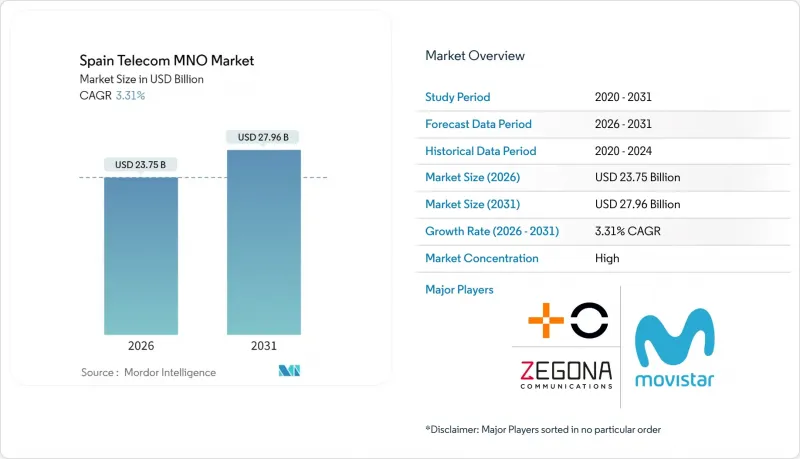
這種溫和的成長反映了成熟的市場環境,營運商們正專注於以數據為中心的收入模式、高效的網路共用以及嚴謹的資本配置。光纖到府 (FTTH) 的普及率不斷提高,目前已覆蓋 95.2% 的家庭,這支撐了優質整合配套服務帶來的平均每用戶收入 (ARPU),即便麵臨價格競爭。產業整合改變了競爭格局。由 Orange 和 MasMóvil 聯盟成立的 MasOrange 已佔據 42% 的用戶佔有率,縮小了與 Telefónica 25% 的差距。新的合作模式正在湧現,例如與 Vodafone 合作的價值 900-100 億歐元的 FiberCo 項目。能源成本的波動(佔營運支出的 10-15%)以及懸而未決的頻譜訴訟限制了利潤率的提升。同時,一項由政府支持的 10 億歐元獨立農村 5G 基金確保了 96% 人口的 5G 網路覆蓋,鞏固了西班牙在先進行動技術領域的領先地位。
西班牙電信行動網路營運商市場趨勢與分析
5G覆蓋範圍擴大和頻率重組
西班牙在獨立組網(SA)5G領域領先歐洲,預計到2025年將實現96%的人口覆蓋率,這得益於政府為農村基地台提供的10億歐元公共資金。 Movistar、MasOrange和沃達豐聯合使用700MHz頻譜將加速農村地區的部署,同時降低部署成本。 MasOrange和愛立信的開放式無線接取網路(Open RAN)專案將為具有彈性容量擴充能力的軟體定義網路鋪平道路。根據歐盟委員會5G觀察站的數據,到2024年3月,西班牙的家庭覆蓋率將達到92.3%,遠高於歐盟平均水準。這些成就使通訊業者能夠將資源重新分配,用於實現5G-SA在企業服務和低延遲應用方面的商業化。
行動數據需求不斷成長,無限流量套餐也日益普及
以購買力平價計算,其無限流量套餐價格為17.39美元,是歐洲最便宜的套餐之一,因此在大都會圈使用率很高。 2024年初,流量成長放緩至年增12%,但通訊業者正透過分階段推出每GB價格合理的5G提案來保障用戶價值。隨著價格優勢日益凸顯,傳統業者的市佔率被注重價格的新興企業蠶食,低價品牌之間的競爭也愈演愈烈。營運商的策略性應對措施著重於透過增值套裝、加值內容和忠誠度計畫來提升服務質量,而不是依賴大幅折扣。
用戶群已飽和
截至2025年3月,活躍SIM卡數量將達到6,162萬張,相當於每百人擁有125.6條線路,這意味著用戶自然成長空間有限。行動號碼可攜性案例較去年同期成長7.6%,凸顯市場佔有率競爭激烈,而非淨成長。固定寬頻也接近普及,促使營運商加快開發數位服務等新的收入來源。人口老化加劇了成長停滯,老年人使用數據密集型服務的可能性較低。因此,西班牙電信行動網路營運商(MNO)市場正將資金轉向企業服務、物聯網和邊緣雲端提案,以避免消費市場飽和。
細分市場分析
截至2025年,資料通訊和網路業務將佔西班牙電信行動網路營運商(MNO)市場佔有率的50.39%,這反映了前所未有的光纖普及率和極具競爭力的無限流量移動套餐。語音服務仍主要透過融合套餐保持穩定,但簡訊收入持續下降。物聯網(IoT)和機器對機器(M2M)連接雖然用戶基數較小,但預計將以3.40%的複合年成長率(CAGR)成為成長最快的領域,這主要得益於物流、能源和智慧城市解決方案的推動。隨著衛星網路終端(NTN)消除遍遠地區的覆蓋障礙,西班牙面向物聯網連接的電信行動網路營運商市場規模預計將穩步擴大。 OTT和付費電視服務將受益於光纖到府(FTTH)的廣泛應用,使營運商能夠將佔用頻寬的優質影片和雲端遊戲服務整合到現有數據套餐中。
營運商將利用西班牙電信行動網路營運商 (MNO) 市場規模中,盡力而為的 4G 網路和麵向企業用戶的有保障的 5G-SA 網路之間的差異來獲利。網路 API 將使開發人員能夠將按需品質功能整合到他們的應用程式中,從而產生增量收入。隨著雲端遊戲等對延遲敏感的服務日趨成熟,營運商預計高階用戶群將實現兩位數成長,從而抵消傳統語音服務的商品化趨勢。
其他福利:
- Excel格式的市場預測(ME)表
- 分析師支持(3個月)
目錄
第1章 引言
- 研究假設和市場定義
- 調查範圍
第2章調查方法
第3章執行摘要
第4章 市場情勢
- 市場概覽
- 監理與政策框架
- 頻譜環境和競爭性擁有情形
- 通訊業生態系統
- 宏觀經濟與外在因素
- 波特五力分析
- 競爭對手之間的競爭
- 新進入者的威脅
- 供應商的議價能力
- 買方的議價能力
- 替代品的威脅
- 領先行動網路營運商的關鍵績效指標(2020-2025)
- 獨立行動用戶和滲透率
- 行動網路使用者數量和普及率
- 按接入技術分類的SIM卡連線數和滲透率
- 蜂巢式物聯網/M2M連接
- 寬頻連線(移動和固定)
- ARPU(每位用戶平均收入)
- 每用戶平均數據使用量(GB/月)
- 市場促進因素
- 5G覆蓋範圍擴大和頻率重組
- 行動數據和包月套餐的需求不斷成長
- 光纖到府的蓬勃發展將促成融合套餐的出現
- 物聯網在企業中的應用(智慧電網、物流)
- 由於有利於行動虛擬網路營運商(MVNO)的批發規則,租賃收入增加。
- 歐盟復甦基金支持農村地區5G和中立主機
- 市場限制
- 用戶群已飽和
- 價格競爭和低價品牌對每位用戶平均收入(ARPU)帶來壓力。
- 頻譜使用訴訟的不確定性
- 能源成本波動推高了營運成本。
- 技術展望
- 電信業主要經營模式分析
- 定價模式和定價分析
第5章 市場規模與成長預測
- 通訊總收入和每位用戶平均收入
- 服務類型
- 語音服務
- 數據和網際網路服務
- 通訊服務
- 物聯網和機器對機器服務
- OTT和付費電視服務
- 其他服務(附加價值服務、漫遊和國際服務、企業和批發服務等)
- 最終用戶
- 公司
- 一般消費者
第6章 競爭情勢
- 市場集中度
- 主要供應商的策略與投資動向(2023-2025)
- 2024年行動網路營運商市場佔有率分析
- Product Benchmarking Analysis for mobile network services
- MNO snapshot(subscribers, churn rate, ARPU, etc.)
- 行動網路營運商公司簡介*
- Telefonica Spain(Movistar)
- MASORANGE, SL
- Zegona Communications(Vodafone Spain)
第7章 市場機會與未來展望
Spain Telecom MNO Market size in 2026 is estimated at USD 23.75 billion, growing from 2025 value of USD 22.99 billion with 2031 projections showing USD 27.96 billion, growing at 3.31% CAGR over 2026-2031.
Moderate growth reflects a mature environment where operators focus on data-centric revenues, network-sharing efficiency, and disciplined capital allocation. Intensifying fiber-to-the-home penetration, which now covers 95.2% of premises, sustains premium converged bundles that lift average revenue per user despite price competition. Consolidation has reshaped rivalry after the Orange-MasMovil tie-up created MasOrange with 42% subscriber share, narrowing the gap with Telefonica's 25% stake while prompting new partnering models such as the EUR 9-10 billion FibreCo with Vodafone. Energy-cost volatility, which absorbs 10-15% of operating expenses, and unresolved spectrum-fee litigation temper margin expansion. Meanwhile, government-backed EUR 1 billion funding for rural standalone 5G ensures 96% population coverage, reinforcing Spain's leadership in advanced mobile technology.
Spain Telecom MNO Market Trends and Insights
5G Coverage Expansion and Spectrum Refarming
Spain leads Europe in standalone 5G, achieving 96% population coverage by 2025 on the strength of EUR 1 billion public funding for rural base-stations. Joint use of the 700 MHz band by Movistar, MasOrange, and Vodafone reduces deployment cost while speeding suburban roll-outs. MasOrange's Open RAN program with Ericsson ushers in software-defined networks capable of elastic capacity scaling. The European Commission's 5G Observatory confirms Spain's 92.3% household coverage by March 2024, well ahead of the EU mean . These achievements allow operators to pivot resources toward 5G-SA monetization in enterprise and low-latency applications.
Rising Mobile-Data Demand and Unlimited Plans
Unlimited bundles priced at USD 17.39 purchasing-power-parity rank among Europe's cheapest, stimulating heavy usage in metropolitan corridors. Although traffic growth slowed to 12% year-over-year in early-2024, operators defend value through tiered 5G propositions with superior cost-per-GB economics. Competitive migration toward low-cost brands intensified, with incumbents losing share to price-focused challengers. The strategic response centers on value-added bundles, premium content, and loyalty programs that elevate perceived service quality without relying solely on heavy discounts.
Saturated Subscriber Base
Active SIMs reached 61.62 million by March 2025, equating to 125.6 lines per 100 residents and signaling limited room for organic user growth. Portability volumes climbed 7.6% year-over-year, underlining a zero-sum battle for share rather than net additions. Fixed broadband likewise nears total household penetration, intensifying operators' hunt for incremental revenue in digital services. Demographic aging compounds stagnation because older cohorts adopt fewer data-intensive offerings. Consequently, the Spain telecom MNO market shifts capital toward enterprise, IoT, and edge-cloud propositions that sidestep consumer saturation.
Other drivers and restraints analyzed in the detailed report include:
- FTTH Boom Enabling Converged Bundles
- Enterprise IoT Uptake in Smart Grids and Logistics
- ARPU Pressure from Price Wars and Low-Cost Brands
For complete list of drivers and restraints, kindly check the Table Of Contents.
Segment Analysis
Data and internet generated 50.39% of Spain telecom MNO market share in 2025, reflecting unmatched fiber penetration and aggressive unlimited mobile bundles. Voice remains sticky via converged offers, whereas SMS revenue declines continue. IoT and M2M lines constitute a smaller base but post the fastest 3.40% CAGR, propelled by logistics, energy, and smart-city solutions. The Spain telecom MNO market size for IoT-centric connectivity is projected to expand steadily as satellite NTNs remove rural coverage barriers. OTT and PayTV services leverage ubiquitous FTTH, enabling operators to embed premium video and cloud gaming that absorb bandwidth within existing allowances.
Operators monetize the Spain telecom MNO market size differential between best-effort 4G and guaranteed 5G-SA slices for corporate users. Network APIs open incremental revenue as developers integrate quality-on-demand features into applications. As latency-sensitive services such as cloud gaming mature, operators expect double-digit growth in premium tiers that counterbalance the commoditization of legacy voice.
The Spain Telecom MNO Market is Segmented by Service Type (Voice Services, Data and Internet Services, Messaging Services, Iot and M2M Services, OTT and PayTV Services, and Other Services), and End User (Enterprises, Consumer). The Market Forecasts are Provided in Terms of Value (USD).
List of Companies Covered in this Report:
- Telefonica Spain (Movistar)
- MASORANGE, S.L.
- Zegona Communications (Vodafone Spain)
Additional Benefits:
- The market estimate (ME) sheet in Excel format
- 3 months of analyst support
TABLE OF CONTENTS
1 INTRODUCTION
- 1.1 Study Assumptions and Market Definition
- 1.2 Scope of the Study
2 RESEARCH METHODOLOGY
3 EXECUTIVE SUMMARY
4 MARKET LANDSCAPE
- 4.1 Market Overview
- 4.2 Regulatory and Policy Framework
- 4.3 Spectrum Landscape and Competitive Holdings
- 4.4 Telecom Industry Ecosystem
- 4.5 Macroeconomic and External Drivers
- 4.6 Porter's Five Forces Analysis
- 4.6.1 Competitive Rivalry
- 4.6.2 Threat of New Entrants
- 4.6.3 Bargaining Power of Suppliers
- 4.6.4 Bargaining Power of Buyers
- 4.6.5 Threat of Substitutes
- 4.7 Key MNO KPIs (2020-2025)
- 4.7.1 Unique Mobile Subscribers and Penetration Rate
- 4.7.2 Mobile Internet Users and Penetration Rate
- 4.7.3 SIM Connections by Access Technology and Penetration
- 4.7.4 Cellular IoT / M2M Connections
- 4.7.5 Broadband Connections (Mobile and Fixed)
- 4.7.6 ARPU (Average Revenue Per User)
- 4.7.7 Average Data Usage per Subscription (GB/month)
- 4.8 Market Drivers
- 4.8.1 5G coverage expansion and spectrum refarming
- 4.8.2 Rising mobile-data demand and unlimited plans
- 4.8.3 FTTH boom enabling converged bundles
- 4.8.4 Enterprise IoT uptake (smart grids, logistics)
- 4.8.5 MVNO-friendly wholesale rules boosting lease revenue
- 4.8.6 EU RRF funds for rural 5G and neutral hosts
- 4.9 Market Restraints
- 4.9.1 Saturated subscriber base
- 4.9.2 ARPU pressure from price wars and low-cost brands
- 4.9.3 Spectrum-fee litigation uncertainty
- 4.9.4 Energy-cost volatility inflating OPEX
- 4.10 Technological Outlook
- 4.11 Analysis of key business models in Telecom Sector
- 4.12 Analysis of Pricing Models and Pricing
5 MARKET SIZE AND GROWTH FORECASTS (VALUE)
- 5.1 Overall Telecom Revenue and ARPU
- 5.2 Service Type
- 5.2.1 Voice Services
- 5.2.2 Data and Internet Services
- 5.2.3 Messaging Services
- 5.2.4 IoT and M2M Services
- 5.2.5 OTT and PayTV Services
- 5.2.6 Other Services (VAS, Roaming and International Services, Enterprise and Wholesale Services, etc.)
- 5.3 End-user
- 5.3.1 Enterprises
- 5.3.2 Consumer
6 COMPETITIVE LANDSCAPE
- 6.1 Market Concentration
- 6.2 Strategic Moves and Investments by key vendors, 2023-2025
- 6.3 Market share analysis for MNOs, 2024
- 6.4 Product Benchmarking Analysis for mobile network services
- 6.5 MNO snapshot (subscribers, churn rate, ARPU, etc.)
- 6.6 Company Profiles* of MNOs (Includes Business Overview | Service Portfolio | Financials | Business Strategy and Recent Developments | SWOT Analysis)
- 6.6.1 Telefonica Spain (Movistar)
- 6.6.2 MASORANGE, S.L.
- 6.6.3 Zegona Communications (Vodafone Spain)
7 MARKET OPPORTUNITIES AND FUTURE OUTLOOK
- 7.1 White-space and Unmet-Need Assessment

 5G MVNO市場:按套餐類型、最終用戶、設備類型、銷售管道、產業和網路類型分類-2026-2032年全球市場預測
 2026年全球行動虛擬網路營運商(MVNO)市場報告
 行動虛擬網路營運商 (MVNO) 市場規模、佔有率、趨勢和預測:按類型、商業模式、服務類型、用戶數量和地區分類,2026-2034 年
 行動虛擬網路營運商 (MVNO) 市場分析及預測(至 2035 年):按類型、產品類型、服務、技術、組件、應用、部署類型、最終用戶、解決方案和功能分類
 亞太地區行動虛擬網路營運商(MVNO):市場佔有率分析、產業趨勢與統計、成長預測(2026-2031)新加坡電信行動網路業者:市場佔有率分析、產業趨勢與統計、成長預測(2026-2031)東協行動虛擬網路營運商(MVNO):市場佔有率分析、產業趨勢與統計、成長預測(2026-2031)泰國電信行動網路營運商:市場佔有率分析、產業趨勢與統計數據、成長預測(2026-2031)美國行動虛擬網路營運商:市場佔有率分析、行業趨勢和統計數據、成長預測(2026-2031 年)美國電信行動網路營運商:市場佔有率分析、產業趨勢與統計數據、成長預測(2026-2031 年)