


 |
市場調查報告書
商品編碼
1940848
東協行動虛擬網路營運商(MVNO):市場佔有率分析、產業趨勢與統計、成長預測(2026-2031)ASEAN Mobile Virtual Network Operator (MVNO) - Market Share Analysis, Industry Trends & Statistics, Growth Forecasts (2026 - 2031) |
||||||

※ 本網頁內容可能與最新版本有所差異。詳細情況請與我們聯繫。
預計東協行動虛擬網路營運商 (MVNO) 市場將從 2025 年的 6.6625 億美元成長到 2026 年的 6.9257 億美元,到 2031 年將達到 8.4058 億美元,2026 年至 2031 年的複合年成長率為 3.95%。
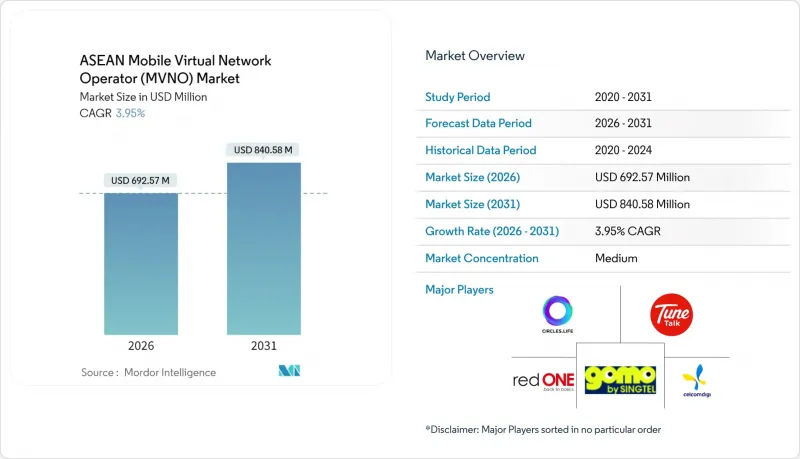
就用戶數而言,市場規模預計將從2025年的814萬成長到2030年的945萬,預測期間(2025-2030年)複合年成長率(CAGR)為3.03%。這一顯著成長主要得益於衛星和其他非地面電波網路(NTN)的擴張,虛擬通訊業者採用混合架構,規避了傳統行動通訊業者(MNO)的基礎設施限制。雲端原生核心網、跨境eSIM套餐和放鬆管制正在共同重塑競爭格局,使靈活的新進入者無需大量資本支出即可實現規模化發展。對年輕人資料方案和企業物聯網連接的需求正在推動流量成長,而行動網路營運商的數位子品牌則加劇了價格競爭,並透過附加價值服務迫使市場差異化。主權資料法規和區域漫遊要求之間的相互作用,使得合規專業知識成為東協虛擬行動網路營運商(MVNO)市場所有參與者的策略資產。
東協行動虛擬網路營運商(MVNO)市場趨勢與洞察
行動網際網路和智慧型手機普及率不斷提高
到2025年,東協地區的智慧型手機普及率將超過67%,超過4.4億行動網路用戶將期待高容量資料通訊和流暢的應用體驗。越南新頒布的《電信法》將機器對機器(M2M)通訊歸類為基礎服務,允許行動虛擬網路營運商(MVNO)無需附加價值服務許可證即可銷售物聯網連接服務。這項明確規定正在加速工業領域的應用,尤其是在中國當地以外地區多元化發展的電子和服飾產業叢集中。虛擬通訊業者( VOC)受惠於提供純數據套餐,因此免去了傳統的語音通話費用。然而,數據使用量的快速成長正在壓縮單位成本,因此需要先進的流量管理工具來維持東協MVNO市場的利潤率。
關於批發准入的監理改革
越南第163/2024號法令規定了非歧視性的批發條款,為海外雲端服務提供了明確的程序,並縮短了境外託管MVNO核心網的核准週期。馬來西亞的單一批發網路模式為覆蓋率高達80%的人口提供折扣5G資費,但其集中式結構限制了MNO產品的差異化,並為面向企業垂直領域的全功能MVNO拓展了機會。泰國繼續以區域區塊進行頻譜競標,迫使MVNO在多個省份之間協商漫遊協議。這些政策轉變將為東協MVNO市場引入新進者,並使其能夠在不同的法規環境下維持統一的服務品質。
批發定價柔軟性有限
儘管存在鼓勵競爭的政策,但真正基於成本的批發價格談判仍然充滿挑戰,尤其是在現有業者擁有頻譜優勢的地區。泰國區域頻譜碎片化迫使虛擬營運商(MVNO)簽訂多份漫遊協定,削弱了它們的議價能力。不斷上漲的5G基礎設施成本促使行動網路營運商(MNO)收取高額接取附加費,限制了虛擬業者建立維持利潤率的入門級套餐的能力。這種限制迫使東協虛擬營運商市場的許多品牌要麼透過附加價值服務來抵消高昂的網路費用,要麼探索衛星卸載策略。
細分市場分析
預計到2025年,基於雲端的核心網路將佔東協虛擬營運商(MVNO)市場規模的65.32%,並在2031年之前以8.83%的複合年成長率成長。這主要得益於虛擬業者優先考慮營運支出(OpEx)而非資本支出(CapEx),並積極尋求快速的跨境擴張。越南2024年第163號法令(將海外雲端視為基於註冊而非許可證的系統)的監管澄清,進一步加速了雲端技術的普及。雲端的擴充性降低了小眾品牌進入市場的門檻,並支援即時分析,從而最佳化東協MVNO市場的定價、行銷和反詐騙策略。
在延遲、冗餘和資料居住規則比成本更重要的情況下,本地部署仍將繼續。金融機構和公共機構通常會在國家資料中心內申請私人核心網路。混合部署結合了雲端控制和邊緣處理,並利用 5G 非地面電波網路閘道器來擴展覆蓋範圍。採用這種混合模式的營運商報告稱,在光纖中斷期間,服務連續性得到了改善,並且對重視確定性性能的工業客戶更具吸引力。
轉售/精簡模式仍佔據東協虛擬行動網路營運商 (MVNO) 市場 60.85% 的佔有率,因為它能夠以最少的基礎設施實現快速商業化。然而,其對主機運營商的高度依賴限制了服務的客製化。全功能 MVNO 雖然資本密集,但在對直接互聯的需求推動下,正以 18.12% 的複合年成長率成長。這種直接互聯能夠實現企業路由自主性、網路切片能力以及差異化的物聯網和企業服務。這些業者直接控制 IMS 核心網路、發卡銀行配置伺服器和批發採購,從而帶來更高的每用戶平均收入 (ARPU)。
服務供應商型虛擬營運商 (MVNO) 佔據中間位置,擁有 HLR/HSS 等技術,但將無線存取控制權交給行動網路營運商 (MNO)。這吸引了那些重視忠誠度整合但又希望避免大規模電信投資的大型電商公司。因此,東協 MVNO 市場呈現多元化格局,涵蓋了從純粹的品牌建設企業到垂直整合的新興企業,每家公司都根據其目標細分市場的經濟狀況量身定做架構。
這份《東協行動虛擬網路營運商(MVNO)市場報告》依部署模式(例如,雲端/本地部署)、營運模式(例如,服務供應商)、用戶類型(例如,消費者)、使用情況(例如,折扣服務)、網路技術(例如,2G/3G)、分銷通路(例如,線上/純數位通路)和國家/地區進行細分。市場預測以價值(美元)和數量(用戶數)為單位。
其他福利:
- Excel格式的市場預測(ME)表
- 3個月的分析師支持
目錄
第1章 引言
- 研究假設和市場定義
- 調查範圍
第2章調查方法
第3章執行摘要
第4章 市場情勢
- 市場概覽
- 市場促進因素
- 行動網際網路和智慧型手機普及率不斷提高
- 關於批發准入的監理改革
- 年輕人對價格實惠的資料方案的需求
- 行動網路營運商數位子品牌整合策略
- 跨境eSIM旅遊套裝快速成長
- 面向物聯網的企業MVNO採用情況
- 市場限制
- 批發定價柔軟性有限
- 跨國授權的複雜性
- 雲端核心中的資料主權問題
- 5G-SA資源對MVNO QoS的限制
- 價值鏈分析
- 監管環境
- 波特五力分析
- 新進入者的威脅
- 買方的議價能力
- 供應商的議價能力
- 替代品的威脅
- 競爭對手之間的競爭
- 對影響市場的宏觀經濟因素進行評估
第5章 市場規模與成長預測
- 按部署模式
- 雲
- 本地部署
- 按操作模式
- 經銷商/精簡版/品牌虛擬營運商
- 服務提供者
- 完整的虛擬營運商
- 用戶類型
- 消費者
- 對於企業
- 物聯網專用類型
- 透過使用
- 折扣
- 商業
- 細胞M2M
- 其他
- 透過網路技術
- 2G/3G
- 4G/LTE
- 5G
- 衛星通訊/NTN
- 透過分銷管道
- 線上/數位獨家
- 傳統零售店
- 通訊業者子品牌商店
- 第三方/批發
- 按國家/地區
- 汶萊
- 柬埔寨
- 印尼
- 寮國
- 馬來西亞
- 緬甸
- 菲律賓
- 新加坡
- 泰國
- 越南
第6章 競爭情勢
- 市場集中度
- 策略趨勢
- 市佔率分析
- 公司簡介
- Circles.Life(Liberty Wireless Pte Ltd.)
- GOMO(Singtel Mobile Singapore Pte Ltd.)
- redONE Network Sdn Bhd
- Tune Talk Sdn Bhd
- Celcom Berhad
- XOX Mobile Sdn Bhd
- MyRepublic Limited
- Cherry Prepaid(Cosmic Technologies Inc.)
- Itel Mobile(Transsion Holdings)
- Wintel(Masan Group Corporation)
- Penguin Telecom(Advanced Wireless Network Co., Ltd.)
第7章 市場機會與未來展望
The ASEAN Mobile Virtual Network Operator Market is expected to grow from USD 666.25 million in 2025 to USD 692.57 million in 2026 and is forecast to reach USD 840.58 million by 2031 at 3.95% CAGR over 2026-2031.
In terms of subscriber volume, the market is expected to grow from 8.14 million subscribers in 2025 to 9.45 million subscribers by 2030, at a CAGR of 3.03% during the forecast period (2025-2030). Behind this headline growth, satellite and other non-terrestrial networks (NTN) expand as virtual operators adopt hybrid architectures that bypass traditional mobile-network-operator (MNO) infrastructure constraints. Cloud-native cores, cross-border eSIM packages, and regulatory liberalization collectively reshape competitive dynamics, allowing nimble entrants to scale without heavy capex. Demand for youth-centric data plans and enterprise IoT connectivity amplifies traffic volumes, while MNO digital sub-brands intensify price competition and force differentiation through value-added services. The interplay of sovereign data rules and regional roaming requirements makes compliance expertise a strategic asset for every participant in the ASEAN MVNO market.
ASEAN Mobile Virtual Network Operator (MVNO) Market Trends and Insights
Rising Mobile-Internet and Smartphone Penetration
Smartphone ownership surpassed 67% of the ASEAN population in 2025, translating into more than 440 million mobile internet users who expect high-data allowances and seamless app experiences. Vietnam's new telecom framework classifies machine-to-machine (M2M) traffic as a basic service, enabling MVNOs to sell IoT connectivity without value-added service permits . The clarification accelerates industrial adoption, especially in electronics and garment clusters that diversify beyond mainland China. Virtual operators capitalize by offering data-only plans free from legacy voice costs, yet the surge in data usage compresses unit prices and demands sophisticated traffic-management tools to sustain margins within the ASEAN MVNO market.
Regulatory Reforms on Wholesale Access
Vietnam's Decree 163/2024 mandates nondiscriminatory wholesale terms and codifies clear procedures for offshore cloud services, reducing approval cycles for MVNO cores hosted outside the country . Malaysia's single-wholesale-network model offers discounted 5G rates until 80% population coverage, but its centralized structure limits MNO product differentiation and widens opportunities for full MVNOs targeting enterprise verticals. Thailand continues to auction spectrum in regional blocks, compelling MVNOs to negotiate roaming in multiple provinces. Collectively, these policy shifts open the ASEAN MVNO market to new entrants that can juggle divergent regimes while maintaining uniform quality of service.
Limited Wholesale Pricing Flexibility
Despite pro-competition mandates, negotiating genuinely cost-based wholesale rates remains difficult, particularly where incumbent operators wield spectrum advantages. Thailand's provincial spectrum fragmentation forces MVNOs into multiple roaming contracts that dilute bargaining power. Elevated 5G infrastructure costs prompt MNOs to impose premium access surcharges, limiting the ability of virtual players to craft entry-level plans that preserve margin. This restraint compels many brands in the ASEAN MVNO market to offset higher network charges with value-added services or to explore satellite offload strategies.
Other drivers and restraints analyzed in the detailed report include:
- Demand for Affordable Youth-Centric Data Plans
- MNO Digital-Sub-Brand Convergence Strategies
- Multi-Country Licensing Complexity
For complete list of drivers and restraints, kindly check the Table Of Contents.
Segment Analysis
Cloud-based cores generated 65.32% of the ASEAN MVNO market size in 2025 and will rise at an 8.83% CAGR to 2031 as virtual operators favor opex over capex and pursue rapid cross-border launches. Regulatory clarity under Vietnam's Decree 163/2024, which treats offshore clouds as registrable rather than licensable, further accelerates adoption. Cloud elasticity lowers onboarding costs for niche brands and empowers real-time analytics that optimize pricing, marketing, and fraud controls across the ASEAN MVNO market.
On-premise deployments persist in sectors where latency, redundancy, or data-residency rules override cost considerations. Financial institutions and public-safety agencies often demand private cores within domestic data centers. Hybrid variants blend cloud control with edge processing, leveraging 5G non-terrestrial-network gateways to extend coverage. Operators adopting this mix report smoother service continuity during fiber outages and a stronger appeal among industrial clients that value deterministic performance.
Reseller/light models still represent 60.85% of ASEAN MVNO market share because they require minimal infrastructure and yield fast commercialization. Yet their dependence on host operators curbs service customization. Full MVNOs, while capital-intensive, grow at 18.12% CAGR as firms seek routing autonomy, network-slicing capabilities, and direct interconnects that enable differentiated IoT and enterprise offerings. These players directly manage IMS cores, issuer provisioning servers, and wholesale procurement, culminating in higher average revenue per user.
Service-operator MVNOs occupy a midpoint, owning elements such as HLR/HSS but leaving radio-access control to MNOs. They appeal to e-commerce majors that value loyalty integration but shun deep telecom investment. The operational spectrum within the ASEAN MVNO market thus ranges from pure-branding ventures to vertically integrated challengers, each aligning architecture with target segment economics.
The ASEAN Mobile Virtual Network Operator (MVNO) Market Report is Segmented by Deployment Model (Cloud, On-Premise), Operational Mode (Service Operator, and More), Subscriber Type (Consumer, and More), Application (Discount, and More), Network Technology (2G/3G, and More), Distribution Channel (Online/Digital-only, and More), and Country. The Market Forecasts are Provided in Terms of Value (USD) and Volume (Subscribers).
List of Companies Covered in this Report:
- Circles.Life (Liberty Wireless Pte Ltd.)
- GOMO (Singtel Mobile Singapore Pte Ltd.)
- redONE Network Sdn Bhd
- Tune Talk Sdn Bhd
- Celcom Berhad
- XOX Mobile Sdn Bhd
- MyRepublic Limited
- Cherry Prepaid (Cosmic Technologies Inc.)
- Itel Mobile (Transsion Holdings)
- Wintel (Masan Group Corporation)
- Penguin Telecom (Advanced Wireless Network Co., Ltd.)
Additional Benefits:
- The market estimate (ME) sheet in Excel format
- 3 months of analyst support
TABLE OF CONTENTS
1 INTRODUCTION
- 1.1 Study Assumptions and Market Definition
- 1.2 Scope of the Study
2 RESEARCH METHODOLOGY
3 EXECUTIVE SUMMARY
4 MARKET LANDSCAPE
- 4.1 Market Overview
- 4.2 Market Drivers
- 4.2.1 Rising mobile-internet and smartphone penetration
- 4.2.2 Regulatory reforms on wholesale access
- 4.2.3 Demand for affordable youth-centric data plans
- 4.2.4 MNO digital-sub-brand convergence strategies
- 4.2.5 Cross-border eSIM tourism packs boom
- 4.2.6 IoT-focused enterprise MVNO uptake
- 4.3 Market Restraints
- 4.3.1 Limited wholesale pricing flexibility
- 4.3.2 Multi-country licensing complexity
- 4.3.3 Data-sovereignty concerns with cloud cores
- 4.3.4 5G-SA resource constraints on MVNO QoS
- 4.4 Value-Chain Analysis
- 4.5 Regulatory Landscape
- 4.6 Porter's Five Forces Analysis
- 4.6.1 Threat of New Entrants
- 4.6.2 Bargaining Power of Buyers
- 4.6.3 Bargaining Power of Suppliers
- 4.6.4 Threat of Substitutes
- 4.6.5 Intensity of Competitive Rivalry
- 4.7 Assessment of Macroeconomic Factors on the Market
5 MARKET SIZE AND GROWTH FORECASTS (VALUE)
- 5.1 By Deployment Model
- 5.1.1 Cloud
- 5.1.2 On-premise
- 5.2 By Operational Mode
- 5.2.1 Reseller / Light / Brand MVNO
- 5.2.2 Service Operator
- 5.2.3 Full MVNO
- 5.3 By Subscriber Type
- 5.3.1 Consumer
- 5.3.2 Enterprise
- 5.3.3 IoT-specific
- 5.4 By Application
- 5.4.1 Discount
- 5.4.2 Business
- 5.4.3 Cellular M2M
- 5.4.4 Others
- 5.5 By Network Technology
- 5.5.1 2G/3G
- 5.5.2 4G/LTE
- 5.5.3 5G
- 5.5.4 Satellite/NTN
- 5.6 By Distribution Channel
- 5.6.1 Online/Digital-only
- 5.6.2 Traditional Retail Stores
- 5.6.3 Carrier Sub-brand Stores
- 5.6.4 Third-Party/Wholesale
- 5.7 By Country
- 5.7.1 Brunei
- 5.7.2 Cambodia
- 5.7.3 Indonesia
- 5.7.4 Laos
- 5.7.5 Malaysia
- 5.7.6 Myanmar
- 5.7.7 Philippines
- 5.7.8 Singapore
- 5.7.9 Thailand
- 5.7.10 Vietnam
6 COMPETITIVE LANDSCAPE
- 6.1 Market Concentration
- 6.2 Strategic Moves
- 6.3 Market Share Analysis
- 6.4 Company Profiles (includes Global level Overview, Market level overview, Core Segments, Financials as available, Strategic Information, Market Rank/Share for key companies, Products and Services, and Recent Developments)
- 6.4.1 Circles.Life (Liberty Wireless Pte Ltd.)
- 6.4.2 GOMO (Singtel Mobile Singapore Pte Ltd.)
- 6.4.3 redONE Network Sdn Bhd
- 6.4.4 Tune Talk Sdn Bhd
- 6.4.5 Celcom Berhad
- 6.4.6 XOX Mobile Sdn Bhd
- 6.4.7 MyRepublic Limited
- 6.4.8 Cherry Prepaid (Cosmic Technologies Inc.)
- 6.4.9 Itel Mobile (Transsion Holdings)
- 6.4.10 Wintel (Masan Group Corporation)
- 6.4.11 Penguin Telecom (Advanced Wireless Network Co., Ltd.)
7 MARKET OPPORTUNITIES AND FUTURE OUTLOOK
- 7.1 White-Space and Unmet-Need Assessment

 行動虛擬網路啟用器市場規模、佔有率和趨勢分析報告:按服務類型、部署模式、最終用戶產業、地區和細分市場預測(2026-2033 年)行動虛擬網路聚合器市場規模、佔有率和趨勢分析報告:按服務、最終用途、地區和細分市場分類(2026-2033 年)
 全球行動虛擬網路營運商(MVNO)市場規模、佔有率、趨勢和成長分析報告(2026-2034年)虛擬行動服務業者(MVNO) 市場:市場規模、佔有率和趨勢分析(按類型、商業模式、服務類型、合約類型、最終用途和地區分類),細分市場預測(2026-2033 年)
 行動虛擬網路營運商 (MVNO) 市場:2026-2032 年全球市場預測(按服務類型、費率方案、銷售管道、最終用戶產業和應用程式分類)5G MVNO市場:按套餐類型、最終用戶、設備類型、銷售管道、產業和網路類型分類-2026-2032年全球市場預測
 2026年全球行動虛擬網路營運商(MVNO)市場報告
 行動虛擬網路營運商 (MVNO) 市場規模、佔有率、趨勢和預測:按類型、商業模式、服務類型、用戶數量和地區分類,2026-2034 年
 行動虛擬網路營運商 (MVNO) 市場分析及預測(至 2035 年):按類型、產品類型、服務、技術、組件、應用、部署類型、最終用戶、解決方案和功能分類
 亞太地區行動虛擬網路營運商(MVNO):市場佔有率分析、產業趨勢與統計、成長預測(2026-2031)