


 |
市場調查報告書
商品編碼
1934813
澱粉及澱粉衍生物:市佔率分析、產業趨勢及統計、成長預測(2026-2031)Starch And Starch Derivatives - Market Share Analysis, Industry Trends & Statistics, Growth Forecasts (2026 - 2031) |
||||||

※ 本網頁內容可能與最新版本有所差異。詳細情況請與我們聯繫。
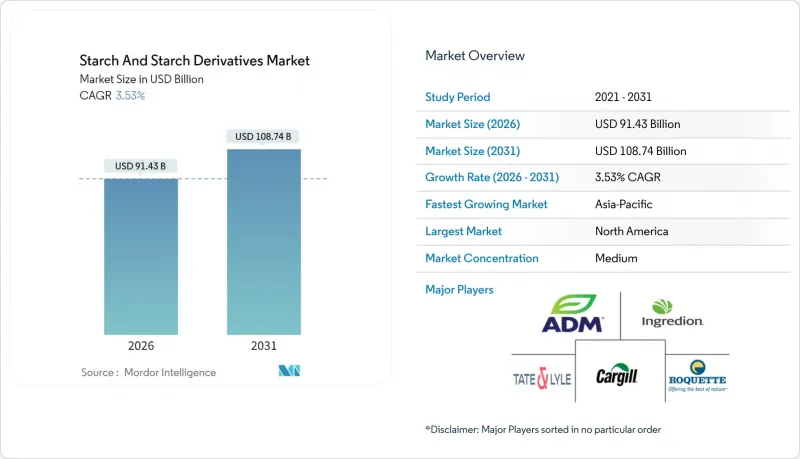
預計到 2026 年,澱粉及澱粉衍生物市場價值將達到 914.3 億美元,高於 2025 年的 883.1 億美元,預計到 2031 年將達到 1,087.4 億美元。
預計2026年至2031年年複合成長率(CAGR)為3.53%。
市場成長主要由滿足潔淨標示、植物來源配方和工業生物解決方案等需求的專業細分市場所驅動。這些細分市場滿足了消費者對食品、醫藥和工業應用中天然成分和永續產品日益成長的需求。儘管原料成本(尤其是玉米和小麥價格)的波動會影響盈利,但監管機構對永續性重視為澱粉基生質塑膠和藥用輔料創造了機會。針對特定應用開發創新型澱粉衍生物,例如用於食品增稠和穩定的改性澱粉,也促進了市場擴張。北美以34.76%的市佔率主導,這得益於其成熟的食品加工業和技術進步。亞太地區成長更為強勁,複合年成長率達5.66%,這主要得益於新增產能、木薯用途的拓展以及在醫療保健領域的應用日益廣泛。新興經濟體可支配收入的增加、飲食習慣的改變以及工業應用的拓展也進一步推動了這一成長。
全球澱粉及澱粉衍生物市場趨勢與洞察
全球加工食品和簡便食品產業的快速擴張
加工食品產業的演變正在顯著改變澱粉的需求模式。製造商正在尋求更專業的澱粉解決方案,以在各種加工條件下保持穩定性並延長產品的保存期限。這一趨勢在調理食品領域尤其明顯,改性澱粉因其更優異的凍融穩定性和更佳的質地保持性,正日益取代傳統澱粉。業界向潔淨標示配方的轉變,為提供未經化學加工的功能性改質澱粉的供應商創造了巨大的機會。食品製造商正積極探索既能滿足功能性要求又能滿足消費者對清潔配料偏好的天然替代品。例如,英聯食品配料公司(Ingredion)於2024年8月推出了一款功能性天然玉米粉,以擴展其潔淨標示產品系列,從而響應市場對天然澱粉解決方案日益成長的需求。此舉反映了行業整體趨勢,即在保持食品應用所需技術性能的同時,致力於開發永續、以消費者為導向的配料。
消費者趨勢正轉向植物來源和功能性成分。
消費者對植物來源替代品的需求不斷成長,為澱粉生產商創造了開發能夠模擬動物基成分特性的專用質地改良劑的機會。根據美國農業部2023年的數據,德國已有158萬人開始採用植物性飲食,這標誌著飲食習慣發生了顯著轉變。目前,澱粉基解決方案不僅能改善消化率和持續釋放能量等功能性優勢,還能創造新的質地。這些解決方案使食品生產商能夠改善植物來源替代品的質地、穩定性以及整體口感。研發重點正轉向具有特定營養成分的澱粉,例如可作為益生元纖維的抗解澱粉。這使得生產商能夠在滿足監管要求、提高加工食品營養價值的同時,在注重健康的食品類別中實施高價策略。澱粉技術的進步也促進了潔淨標示產品的開發,滿足了消費者對天然、低加工成分的需求。
農產品原物料價格波動會影響利潤率。
原料價格波動給澱粉加工商帶來了巨大挑戰,氣候變遷和地緣政治緊張局勢導致供應鏈中斷和生產成本上升。美國農業部近期數據顯示,2024年玉米價格波動劇烈,影響了製造商維持價格穩定的能力。原料品質的波動會降低澱粉萃取效率並增加加工成本,進而影響投入成本和產量。農業多樣性有限且倉儲基礎設施不足的地區受到的影響尤其嚴重,更容易受到市場波動的影響。澱粉加工商正透過原料來源多元化和採用即使在原料品質較低的情況下也能保持產品品質的技術來應對這些挑戰。這些措施包括與不同地區的多個供應商建立合作關係,以及投資建造先進的加工設施。行業適應策略還包括改善庫存管理系統和開發避險機制,以減輕市場不確定性的影響。
細分市場分析
截至2025年,澱粉衍生物市佔率達到54.02%,這主要得益於其在食品、醫藥和工業領域的廣泛應用。改性澱粉雖然目前規模較小,但憑藉其更優異的功能性和潔淨標示潛力,正迅速成為創新前沿,預計2026年至2031年的複合年成長率將達到5.30%。天然澱粉雖然仍持續用於傳統應用,但其面臨來自改性澱粉日益激烈的競爭,後者在嚴苛的加工條件下表現較佳。
在澱粉衍生物中,葡萄糖漿和高果糖玉米糖漿(HFCS)佔據重要地位,尤其是在飲料應用領域。同時,麥芽糊精作為一種用途廣泛的配料,在需要特定黏度和質地特性的食品配方中發揮重要作用。糊精類產品因其特殊的溶解性和黏附性,在需要特定溶解性和黏附性的特殊應用領域中也日益受到關注。
玉米澱粉因其供應充足、成本效益高以及用途廣泛,預計2025年將佔據市場主導地位,市佔率高達68.95%。馬鈴薯澱粉預計將成為成長最快的原料,2026年至2031年的複合年成長率將達到5.05%,這主要得益於其優異的黏度和透明度,尤其是在馬鈴薯種植基地發達的地區,馬鈴薯澱粉在食品應用中具有顯著優勢。
小麥澱粉憑藉其本地農業生產和完善的加工設施,在歐洲,尤其是在歐洲,佔據著重要的市場地位。木薯澱粉因其風味中性且非基因改造,在潔淨標示應用領域備受關注。同時,米和木薯等其他原料也在為特殊應用開闢利基市場。市場參與者正不斷推出新的澱粉產品以滿足日益成長的需求。例如,2024年8月,羅蓋特兄弟公司推出了「Creamu」系列烹飪用木薯澱粉,該產品可用於烘焙餡料、甜點和乳製品。
區域分析
預計到2025年,北美將以34.41%的市佔率引領澱粉及澱粉衍生物市場,這主要得益於該地區豐富的玉米產量和先進的加工基礎設施。該地區強大的食品加工和製藥業維持對特種澱粉產品的穩定需求。該產業正從提供大宗商品產品轉向專注於高附加價值衍生物和特種產品,以期獲得更高的利潤率。此外,文明病的增加也推動了該地區對澱粉作為脂肪替代品的需求。根據美國疾病管制與預防中心(CDC)2023年的數據,美國成年人肥胖率為40.3%。
亞太地區擁有最高的成長潛力,2026年至2031年的複合年成長率將達到5.38%。這一成長主要得益於快速的工業化、不斷擴張的食品加工業以及日益成長的製藥業。日本專注於高品質特種澱粉產品,而澳洲則透過澱粉改質技術的研究做出貢獻。該地區豐富的農業資源,包括水稻、玉米和木薯,使得澱粉生產來源多樣化成為可能,從而支持了本地供應鏈和特種產品的開發。
歐洲憑藉其成熟的食品加工業和對永續植物來源原料的重視,擁有強大的市場地位。嚴格的食品標籤和永續性法規結構正在推動潔淨標示澱粉解決方案和可生物分解應用領域的創新,這不僅給市場參與企業帶來了挑戰,也帶來了機會。
其他福利:
- Excel格式的市場預測(ME)表
- 3個月的分析師支持
目錄
第1章 引言
- 研究假設和市場定義
- 調查範圍
第2章調查方法
第3章執行摘要
第4章 市場情勢
- 市場概覽
- 市場促進因素
- 全球加工食品和簡便食品產業的快速擴張
- 消費者趨勢正轉向植物來源和功能性成分。
- 與其他水溶性多醣相比,澱粉的成本效益
- 澱粉在食品和飲料應用中被廣泛用作脂肪替代品
- 酶法和物理改質技術的進步
- 澱粉衍生物在非食品工業領域的應用
- 市場限制
- 農產品原物料價格波動對利潤率的影響
- 天然澱粉的功能穩定性與保存期限限制
- 由於含有基因改造成分,引發了品質問題。
- 改質澱粉或功能性澱粉標籤方面的監管複雜性
- 供應鏈分析
- 監理展望
- 波特五力模型
- 新進入者的威脅
- 買方和消費者的議價能力
- 供應商的議價能力
- 替代品的威脅
- 競爭對手之間的競爭
第5章 市場規模與成長預測
- 按類型
- 天然澱粉
- 改性澱粉
- 澱粉衍生物
- 葡萄糖漿
- 高果糖玉米糖漿(HFCS)
- 麥芽糊精
- 糊精
- 其他
- 按原料
- 玉米
- 小麥
- 馬鈴薯
- 木薯
- 其他
- 按形式
- 粉末
- 液體
- 透過使用
- 食品/飲料
- 製藥
- 個人護理和化妝品
- 飼料
- 紡織品
- 紙張和紙板
- 其他
- 按地區
- 北美洲
- 美國
- 加拿大
- 墨西哥
- 北美其他地區
- 歐洲
- 英國
- 德國
- 西班牙
- 法國
- 義大利
- 俄羅斯
- 其他歐洲地區
- 亞太地區
- 中國
- 印度
- 日本
- 澳洲
- 亞太其他地區
- 南美洲
- 巴西
- 阿根廷
- 其他南美洲
- 中東和非洲
- 沙烏地阿拉伯
- 南非
- 其他中東和非洲地區
- 北美洲
第6章 競爭情勢
- 市場集中度
- 策略趨勢
- 市場排名分析
- 公司簡介
- Archer Daniels Midland Company
- Cargill, Incorporated
- Ingredion Inc.
- Tate & Lyle PLC
- Roquette Freres SA
- Sudzucker Group
- Avebe UA
- AGRANA Beteiligungs-AG
- Tereos SA
- Grain Processing Corporation
- Manildra Group
- Japan Corn Starch Co. Ltd
- Angel Starch & Food Pvt Ltd
- Gulshan Polyols Ltd
- Universal Starch-Chem Allied Ltd
- SPAC Starch Products(India)Private Ltd.
- Everest Starch India Pvt. Ltd.
- Sage Oil LLC
- Medikonda Nutrients
- Meelunie BV
第7章 市場機會與未來展望
The starch and starch derivatives market size in 2026 is estimated at USD 91.43 billion, growing from 2025 value of USD 88.31 billion with 2031 projections showing USD 108.74 billion, growing at 3.53% CAGR over 2026-2031.
The market growth is driven by specialized segments that meet the requirements for clean labels, plant-based formulations, and industrial biosolutions. These segments are responding to increasing consumer demand for natural ingredients and sustainable products across food, pharmaceutical, and industrial applications. Fluctuations in raw material costs, particularly corn and wheat, influence profitability, while increasing regulatory focus on sustainability creates opportunities in starch-based bioplastics and pharmaceutical excipients. The development of innovative starch derivatives for specific applications, such as modified starches for food thickening and stabilization, is contributing to market expansion. North America dominates the market with a 34.76% share, driven by established food processing industries and technological advancements. The Asia-Pacific region exhibits stronger growth at a 5.66% CAGR, supported by new production capacity, cassava diversification, and increased healthcare applications. This growth is further enhanced by rising disposable incomes, changing dietary preferences, and expanding industrial applications in emerging economies.
Global Starch And Starch Derivatives Market Trends and Insights
Rapid Expansion of the Global Processed and Convenience Food Industry
The processed food industry's evolution is driving significant changes in starch demand patterns, as manufacturers require increasingly specialized starch solutions that maintain stability during various processing conditions and extend product shelf life. This trend is particularly prominent in the ready-meal segment, where modified starches are replacing traditional varieties due to their enhanced freeze-thaw stability and superior texture retention capabilities. The industry's shift toward clean-label formulations presents substantial opportunities for suppliers offering functionally modified starches without chemical processing. Food manufacturers are actively seeking natural alternatives that meet both functional requirements and consumer preferences for cleaner ingredients. For example, Ingredion launched a functional native corn starch in August 2024 to expand its clean-label product portfolio, responding to the growing market demand for natural starch solutions. This development reflects the broader industry movement toward sustainable and consumer-friendly ingredients while maintaining the necessary technical performance in food applications.
Shifting Consumer Trends Towards Plant-Based and Functional Ingredients
The growing consumer demand for plant-based alternatives has created opportunities for starch producers to develop specialized texturizing agents that mimic the characteristics of animal-derived ingredients. According to the United States Department of Agriculture data from 2023, 1.58 million people in Germany adopted plant-based diets, reflecting a significant shift in dietary preferences. Starch-based solutions now deliver functional benefits, including improved digestibility and sustained energy release, while creating new sensory experiences. These solutions enable food manufacturers to enhance product texture, stability, and overall mouthfeel in plant-based alternatives. The development focus has shifted toward starches with specific nutritional profiles, such as resistant starches that act as prebiotic fiber. This enables manufacturers to implement premium pricing strategies in health-focused food categories while meeting regulatory requirements for improved nutritional content in processed foods. The advancement in starch technology has also facilitated the creation of clean-label products, addressing consumer demands for natural and minimally processed ingredients.
Volatility in Agricultural Raw Material Prices Impacting Profit Margins
Raw material price volatility presents a significant challenge for starch processors due to climate change and geopolitical tensions disrupting supply chains and affecting production costs. Recent data from the U.S. Department of Agriculture indicates that corn prices experienced substantial volatility in 2024, affecting manufacturers' ability to maintain consistent pricing. These disruptions influence both input costs and production yields, as variations in raw material quality reduce starch extraction efficiency and increase processing expenses. The impact is particularly severe in regions with limited agricultural diversity and inadequate storage infrastructure, leading to heightened vulnerability to market fluctuations. Starch processors are addressing these challenges by diversifying their raw material sources and implementing technologies capable of processing lower-grade inputs while maintaining output quality. This includes establishing relationships with multiple suppliers across different geographical regions and investing in advanced processing equipment. The industry's adaptation strategies also encompass improved inventory management systems and the development of risk-hedging mechanisms to mitigate the effects of market uncertainties.
Other drivers and restraints analyzed in the detailed report include:
- Cost-Effectiveness of Starch Compared to Other Hydrocolloids
- Widespread Use of Starch as a Fat Replacer in Food and Beverage Application
- Limited Functional Stability and Shelf Life of Native Starches
For complete list of drivers and restraints, kindly check the Table Of Contents.
Segment Analysis
The starch derivatives segment held 54.02% market share in 2025, benefiting from its diverse applications across food, pharmaceutical, and industrial sectors. Modified starch, though currently smaller, is emerging as the innovation frontier with 5.30% CAGR projected for 2026-2031, driven by its enhanced functional properties and clean-label potential. Native starch continues to serve traditional applications but faces increasing competition from modified variants that offer superior performance in challenging processing conditions.
Within starch derivatives, glucose syrups and high fructose corn syrup (HFCS) maintain significant positions, particularly in beverage applications, while maltodextrin serves as a versatile ingredient in food formulations requiring specific viscosity and texture profiles. The dextrins segment is gaining traction in specialty applications where specific solubility and adhesive properties are required.
Maize starch dominated the market with a 68.95% share in 2025, benefiting from its abundant supply, cost-effectiveness, and versatile functional properties across multiple applications. Potato starch is emerging as the fastest-growing source at 5.05% CAGR for 2026-2031, driven by its superior viscosity and clarity in food applications, particularly in regions with established potato cultivation infrastructure.
Wheat starch maintains a significant position, especially in Europe, where it benefits from local agricultural production and established processing facilities. Tapioca starch is gaining traction in clean-label applications due to its neutral flavor profile and non-GMO status, while other sources like rice and cassava are finding niches in specialty applications. The market players are launching new starches in the market to cater to the rising demand. For instance, in August 2024, Roquette Freres launched a range of cook-up tapioca starches, Clearem. They are used in bakery fillings, desserts, and dairy products.
The Starch and Starch Derivatives Market Report is Segmented by Type (Native Starch, Modified Starch, and Starch Derivatives), Source (Maize, Wheat, and More), Form (Powder and Liquid), Application (Food and Beverages, Pharmaceuticals, and More) and Geography (North America, Europe, Asia-Pacific, South America, and Middle East and Africa). The Market Forecasts are Provided in Terms of Value (USD).
Geography Analysis
North America leads the starch and starch derivatives market with a 34.41% share in 2025, supported by its extensive corn production and advanced processing infrastructure. The region's strong food processing and pharmaceutical industries maintain consistent demand for specialized starch products. The industry has evolved beyond commodity offerings to focus on value-added derivatives and specialty products to achieve higher margins. Additionally, the demand for starches as fat replacers is increasing in the region, owing to the rising incidence of lifestyle diseases. According to the Centers for Disease Control and Prevention (CDC) , data from 2023, 40.3% of adults in the United States were obese.
Asia-Pacific demonstrates the highest growth potential with a projected CAGR of 5.38% during 2026-2031. This growth stems from rapid industrialization, expanding food processing sectors, and increasing pharmaceutical manufacturing. Japan specializes in high-quality, specialized starch products, while Australia contributes through research in starch modifications. The region's diverse agricultural resources, including rice, corn, and cassava, enable source diversification in starch production, supporting localized supply chains and specialized product development.
Europe holds a substantial market position through its established food processing industry and emphasis on sustainable, plant-based ingredients. The region's strict regulatory framework for food labeling and sustainability drives innovation in clean-label starch solutions and biodegradable applications, presenting both challenges and opportunities for market participants.
- Archer Daniels Midland Company
- Cargill, Incorporated
- Ingredion Inc.
- Tate & Lyle PLC
- Roquette Freres S.A.
- Sudzucker Group
- Avebe U.A.
- AGRANA Beteiligungs-AG
- Tereos S.A.
- Grain Processing Corporation
- Manildra Group
- Japan Corn Starch Co. Ltd
- Angel Starch & Food Pvt Ltd
- Gulshan Polyols Ltd
- Universal Starch-Chem Allied Ltd
- SPAC Starch Products (India) Private Ltd.
- Everest Starch India Pvt. Ltd.
- Sage Oil LLC
- Medikonda Nutrients
- Meelunie B.V.
Additional Benefits:
- The market estimate (ME) sheet in Excel format
- 3 months of analyst support
TABLE OF CONTENTS
1 Introduction
- 1.1 Study Assumptions and Market Definition
- 1.2 Scope of the Study
2 Research Methodology
3 Executive Summary
4 Market Landscape
- 4.1 Market Overview
- 4.2 Market Drivers
- 4.2.1 Rapid Expansion of the Global Processed and Convenience Food Industry
- 4.2.2 Shifting Consumer Trends Towards Plant-Based and Functional Ingredients
- 4.2.3 Cost-Effectiveness of Starch Compared to Other Hydrocolloids
- 4.2.4 Widespread Use of Starch as a Fat Replacer in Food and Beverage Application
- 4.2.5 Advancement in Enzymatic and Physical Modification Techniques
- 4.2.6 Adoption of Starch Derivatives in Industrial Applications Beyond Food
- 4.3 Market Restraints
- 4.3.1 Volatility in Agricultural Raw Material Prices Impacting Profit Margins
- 4.3.2 Limited Functional Stability and Shelf Life of Native Starches
- 4.3.3 Quality Concerns Due to Genetically Modified Ingredient Adulteration
- 4.3.4 Regulatory Complexity in Labeling Modified or Functional Starches
- 4.4 Supply Chain Analysis
- 4.5 Regulatory Outlook
- 4.6 Porter's Five Forces
- 4.6.1 Threat of New Entrants
- 4.6.2 Bargaining Power of Buyers/Consumers
- 4.6.3 Bargaining Power of Suppliers
- 4.6.4 Threat of Substitute Products
- 4.6.5 Intensity of Competitive Rivalry
5 Market Size and Growth Forecasts (Value)
- 5.1 By Type
- 5.1.1 Native Starch
- 5.1.2 Modified Starch
- 5.1.3 Starch Derivatives
- 5.1.3.1 Glucose Syrups
- 5.1.3.2 High Fructose Corn Syrup (HFCS)
- 5.1.3.3 Maltodextrin
- 5.1.3.4 Dextrins
- 5.1.3.5 Others
- 5.2 By Source
- 5.2.1 Maize
- 5.2.2 Wheat
- 5.2.3 Potato
- 5.2.4 Tapioca
- 5.2.5 Others
- 5.3 By Form
- 5.3.1 Powder
- 5.3.2 Liquid
- 5.4 By Application
- 5.4.1 Food and Beverage
- 5.4.2 Pharmaceutial
- 5.4.3 Personal Care and Cosmetics
- 5.4.4 Animal Feed
- 5.4.5 Textile
- 5.4.6 Paper and Corrugating
- 5.4.7 Others
- 5.5 By Geography
- 5.5.1 North America
- 5.5.1.1 United States
- 5.5.1.2 Canada
- 5.5.1.3 Mexico
- 5.5.1.4 Rest of North America
- 5.5.2 Europe
- 5.5.2.1 United Kingdom
- 5.5.2.2 Germany
- 5.5.2.3 Spain
- 5.5.2.4 France
- 5.5.2.5 Italy
- 5.5.2.6 Russia
- 5.5.2.7 Rest of Europe
- 5.5.3 Asia-Pacific
- 5.5.3.1 China
- 5.5.3.2 India
- 5.5.3.3 Japan
- 5.5.3.4 Australia
- 5.5.3.5 Rest of Asia-Pacific
- 5.5.4 South America
- 5.5.4.1 Brazil
- 5.5.4.2 Argentina
- 5.5.4.3 Rest of South America
- 5.5.5 Middle East and Africa
- 5.5.5.1 Saudi Arabia
- 5.5.5.2 South Africa
- 5.5.5.3 Rest of Middle East and Africa
- 5.5.1 North America
6 Competitive Landscape
- 6.1 Market Concentration
- 6.2 Strategic Moves
- 6.3 Market Ranking Analysis
- 6.4 Company Profiles (includes Global-level Overview, Market-level Overview, Core Segments, Financials (if available), Strategic Information, Market Rank/Share, Products and Services, Recent Developments)
- 6.4.1 Archer Daniels Midland Company
- 6.4.2 Cargill, Incorporated
- 6.4.3 Ingredion Inc.
- 6.4.4 Tate & Lyle PLC
- 6.4.5 Roquette Freres S.A.
- 6.4.6 Sudzucker Group
- 6.4.7 Avebe U.A.
- 6.4.8 AGRANA Beteiligungs-AG
- 6.4.9 Tereos S.A.
- 6.4.10 Grain Processing Corporation
- 6.4.11 Manildra Group
- 6.4.12 Japan Corn Starch Co. Ltd
- 6.4.13 Angel Starch & Food Pvt Ltd
- 6.4.14 Gulshan Polyols Ltd
- 6.4.15 Universal Starch-Chem Allied Ltd
- 6.4.16 SPAC Starch Products (India) Private Ltd.
- 6.4.17 Everest Starch India Pvt. Ltd.
- 6.4.18 Sage Oil LLC
- 6.4.19 Medikonda Nutrients
- 6.4.20 Meelunie B.V.
7 Market Opportunities and Future Outlook

 2026年全球澱粉衍生物市場報告
 澱粉衍生物市場:全球市場按產品類型、原料、功能、形態和應用進行預測,2026-2032年
 2026-2034年乙醯化二澱粉己二酸酯全球市場規模、佔有率、趨勢和成長分析報告
 2026-2030年全球澱粉衍生物市場
 澱粉衍生物市場規模、佔有率及成長分析(按產品類型、原料、應用、功能及地區分類)-2026-2033年產業預測
 澱粉衍生物:市佔率分析、產業趨勢、統計、成長預測(2025-2030)印度澱粉及澱粉衍生物:市佔率分析、產業趨勢、統計及成長預測(2025-2030)
 澱粉衍生物市場機會、成長動力、產業趨勢分析及 2025 - 2034 年預測
 澱粉衍生物市場按產品(麥芽糊精、葡萄糖漿、環糊精、水解物、改性澱粉等)、應用(食品和飲料、化妝品、紙張、藥品、飼料等)和地區分類,2025 年至 2033 年
 澱粉衍生物市場規模、佔有率、趨勢分析報告:產品、應用、地區、細分市場預測,2025-2030 年