


 |
市場調查報告書
商品編碼
1910864
電力:市場佔有率分析、產業趨勢與統計、成長預測(2026-2031)Power - Market Share Analysis, Industry Trends & Statistics, Growth Forecasts (2026 - 2031) |
||||||

※ 本網頁內容可能與最新版本有所差異。詳細情況請與我們聯繫。
2025 年電力市場價值為 10,290 吉瓦,預計到 2031 年將達到 16,830 吉瓦,高於 2026 年的 11,170 吉瓦。
預計在預測期(2026-2031 年)內,複合年成長率將達到 8.55%。
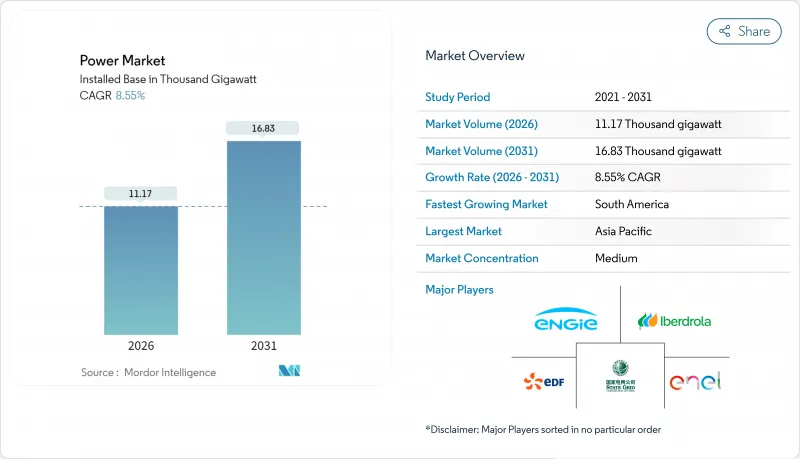
資料中心擴張、工業電氣化以及綠氫能的早期應用,都推動了電力需求的激增,進而推動了電力產能的成長。可再生能源佔新增產能的近一半,這得益於電池儲能成本的快速下降,從而實現了電網數小時的柔軟性。主權財富基金和退休基金每年持續投入1800億美元用於高壓輸電網路的升級改造,加劇了輸電領域的競爭。同時,電網瓶頸和審核延誤可能導致23%的已通過核准清潔能源計劃停滯不前,凸顯了發電目標與基礎設施建設之間的不匹配。
全球電力市場趨勢與洞察
資料中心電力需求爆炸性成長
2024年,資料中心的電力消耗量達到460兆瓦時(TWh),相當於阿根廷的年總用電量,佔全球電力消耗量的2%。超大規模資料中心的平均持續電力消耗量達到100-200兆瓦(MW),迫使電力公司重新協商併網規則,並加速變電站升級。 2024年,隨著科技巨頭放棄傳統的電力供應模式,尋求全天候可再生能源,與企業買家簽訂的清潔能源合約規模達到23.7吉瓦。維吉尼亞的「資料中心集群」已經消耗了該州25%的電力,迫使監管機構重新評估容量市場參與規則[PJM.com]。這些集中負載增加了電壓穩定性風險,並推高了溢價容量合約價格,最終轉嫁到零售電價上。因此,全球電力市場正在圍繞十年前並不常見的區域基本負載激增進行重新平衡。
工業供熱和交通電氣化
到2024年,電弧爐將佔新增鋼鐵產能的73%,而熱泵將在歐洲40%的工業熱源維修中取代天然氣。在交通運輸領域,1,410萬輛電動車新增了85太瓦時(TWh)的淨需求,同時提供了280吉瓦時(GWh)的車網互動(V2G)儲能,有助於緩解晚間用電高峰。北歐電網正是這種融合的典範。電動車充電和工業熱泵循環的同步運作形成了時間捆綁式用電高峰,並透過精細化的定價訊號和基於人工智慧的調度進行平衡。鋁提煉和化學聯合企業已經開始遷往風能資源豐富的地區,以確保獲得價格合理且可靠的可再生能源。這促成了15至20年購電協議的簽署,從而支持了區域電網的擴建。類似的趨勢正在全球蔓延,全球電力市場預測工業電力消耗將持續成長15%至20%,這意味著每年需要擴大價值450億美元的配電網。
電網瓶頸及審核延誤
輸電瓶頸導致127吉瓦已具備建設條件的可再生能源專案在2024年前被迫擱置,造成3,400億美元的投資延誤。美國電網併網積壓容量已飆升至2,600吉瓦,是目前電網容量的五倍,平均核准週期也延長至5.2年。歐洲跨境輸電線路在風電高峰期運轉率高達95%,迫使西班牙和德國等國削減了47太瓦時的發電量。政策制定者已根據歐盟《淨零排放產業法案》將預先規劃計劃的核准週期限制在12個月,但地方政府的反對意見仍然導致四分之一的高壓直流輸電(HVDC)項目延期。如果這些問題無法解決,可能會延緩資金流入,削弱投資者信心,並阻礙全球電力市場的脫碳進程。
細分市場分析
至2025年,可再生能源裝置容量將佔總裝置容量的47.95%,並在2031年之前以13.70%的複合年成長率持續成長。這主要得益於創紀錄的年度新增裝置容量,其中太陽能346吉瓦,風能116吉瓦。離岸風電的複合年成長率將達到23.10%,浮體式基礎結構正在佔據深海域區,並在日本、韓國和加州加速部署。同時,核能發電廠運作和小型模組化反應器(SMR)試點計畫正在為工業供熱合約提供新興但具有戰略意義的低碳能源選擇。燃煤和燃油電廠仍在持續退役或維修,預計到2024年將有47吉瓦的燃煤發電廠改造為氫氣混燒發電,但商業性可行性仍取決於碳價高於每噸80美元。
隨著可再生能源滲透率的提高,規劃重點將轉向柔軟性資產。 2026年至2031年間,全球電網營運商需要累計投資2.8兆美元用於電池儲能、抽水蓄能、需量反應和併網容量。電池併網將緩解白天光伏發電過剩的問題,而跨境高壓直流輸電(HVDC)線路將把多餘的風電輸送到負載中心。隨著這些工具的擴展,全球電力市場將透過多元化的資源組合而非單一能源的主導地位來增強韌性。因此,可再生能源的快速成長將重新定義全球電力系統的資本配置、法規結構和市場定價。
本電力市場報告按能源類型(火力發電、核能、可再生能源)、終端用戶(電力公司、商業/工業、住宅)和地區(北美、歐洲、亞太、南美、中東/非洲)進行細分。市場規模和預測以裝置容量(吉瓦)為單位。
區域分析
到2025年,亞太地區將以44.20%的裝置容量佔有率引領全球電力市場,其中中國(1411吉瓦)和印度(425吉瓦)運作主導地位。中國當年新增可再生能源裝置容量216吉瓦,超過了德國現有的總裝置容量。同時,中國也新增了47吉瓦燃煤發電裝置容量,以應對電網慣性問題。印度正在進行區域電池儲能競標,目標是在2026年之前實現50吉瓦時的儲能容量,這與印度擴大太陽能發電的目標一致。日本和韓國正著力發展離岸風電和先進核能發電,以減少對進口燃料的依賴。日本計畫在2040年實現45吉瓦的離岸風電裝置容量,而韓國正在示範建造一座12吉瓦的浮體式太陽能電站。區域一體化仍然是一項嚴峻的挑戰。在中國西北地區,由於輸電網的限制,可再生能源棄用率超過 8.2%,凸顯了省際間接輸電(HVDC)線路建設的迫切性。
南美洲已成為全球電力市場成長最快的地區,年複合成長率高達15.10%,主要得益於智利的綠色氫能中心以及阿根廷和巴西對併網鋰電池儲能的需求。巴西擁有195吉瓦的裝置容量,並正利用低成本的風能和水力發電來實現採礦業和農業的脫碳。智利阿塔卡馬沙漠的太陽能發電熱潮不僅滿足了採礦需求,也為氫氣出口終端提供了電力,使其平準化電力成本低於30美元/兆瓦時。除了可再生能源,阿根廷的瓦卡穆埃爾塔頁岩氣也為強勁的新增裝置容量提供了支持,穩定了日益波動的發電能力。包括安地斯-太平洋高壓直流輸電線路在內的跨國聯網線路,促進了區域間電力交易,從而最佳化了雨季和旱季的水力發電。
2025年,歐洲將維持全球22.80%的裝置容量,並在2022年天然氣危機後,專注於加強電力系統的柔軟性和能源安全。德國新增了17吉瓦的可再生能源裝置容量,並依賴北歐水力發電和法國核能發電進口進行頻率調節。英國新增了3.2吉瓦的離岸風電,鞏固了其在浮體式基礎技術的主導地位。然而,隨著負電價的增加、儲能經濟效益的提升以及批發電力市場結算週期迅速調整至五分鐘,英國成熟的電網正面臨飽和。北美和中東/非洲的市佔率落後,但被視為極具成長潛力的地區。在IRA稅收優惠政策的支持下,美國將在2024年新增32吉瓦的可再生能源裝置容量。美國已將5.6吉瓦的太陽能光電發電納入2071年淨零排放計畫。這種地域多角化的增強將有助於全球電力市場抵禦特定地區政策和資源衝擊的影響。
其他福利:
- Excel格式的市場預測(ME)表
- 3個月的分析師支持
目錄
第1章 引言
- 研究假設和市場定義
- 調查範圍
第2章調查方法
第3章執行摘要
第4章 市場情勢
- 市場概覽
- 市場促進因素
- 資料中心電力需求激增
- 工業供熱和交通電氣化
- 政府清潔能源補貼政策趨勢(IRA、REPowerEU 等)
- 公用事業規模電池成本迅速下降
- 建置跨境高壓直流輸電超級電網
- 綠色氫電解裝置的擴建將提升基本負載需求。
- 市場限制
- 電網瓶頸及審核延誤
- 關鍵礦產供應鏈波動
- 在飽和電網中增加可再生能源棄用
- 氣候變遷導致水力發電量波動
- 供應鏈分析
- 監管環境
- 技術展望(智慧電網、儲能系統、基於人工智慧的調度)
- 可再生能源結構概述(2024 年)
- 已安裝發電容量預測(吉瓦)
- 發電量預測(太瓦時)
- 初級能源消耗趨勢(百萬噸油當量)
- 波特五力模型
- 供應商的議價能力
- 消費者議價能力
- 新進入者的威脅
- 替代品的威脅
- 競爭對手之間的競爭
第5章 市場規模與成長預測
- 透過發電源
- 火力發電(煤炭、天然氣、石油、柴油)
- 核能
- 可再生能源(太陽能、風能、水能、地熱能、生質能/廢棄物、潮汐能)
- 最終用戶
- 公共產業
- 商業和工業
- 住宅
- 依輸配電電壓等級(僅定性分析)
- 高壓輸電(230千伏特或更高)
- 電網(69-161千伏特)
- 中壓配電(13.2 至 34.5 千伏特)
- 低壓配電(1kV或以下)
- 按地區
- 北美洲
- 美國
- 加拿大
- 墨西哥
- 歐洲
- 英國
- 德國
- 法國
- 西班牙
- 北歐國家
- 俄羅斯
- 其他歐洲
- 亞太地區
- 中國
- 印度
- 日本
- 韓國
- 馬來西亞
- 泰國
- 印尼
- 越南
- 澳洲
- 亞太其他地區
- 南美洲
- 巴西
- 阿根廷
- 哥倫比亞
- 南美洲其他地區
- 中東和非洲
- 阿拉伯聯合大公國
- 沙烏地阿拉伯
- 南非
- 埃及
- 其他中東和非洲地區
- 北美洲
第6章 競爭情勢
- 市場集中度
- 策略性措施(併購、合資、資金籌措、購電協議)
- 市場佔有率分析(主要企業的市場排名和佔有率)
- 公司簡介
- State Grid Corporation of China
- Engie SA
- Enel SpA
- Tokyo Electric Power Co. Holdings
- NTPC Ltd
- Dominion Energy
- China Huaneng Group
- Duke Energy
- E.ON SE
- Siemens Energy
- Hitachi Energy
- Electricite de France(EDF)
- Iberdrola SA
- Korea Electric Power Corp.(KEPCO)
- NextEra Energy
- Southern Company
- Exelon Corporation
- China Three Gorges Corp.
- Orsted A/S
- RWE AG
- General Electric Vernova
- Mitsubishi Electric
第7章 市場機會與未來展望
The Power Market was valued at 10.29 Thousand gigawatt in 2025 and estimated to grow from 11.17 Thousand gigawatt in 2026 to reach 16.83 Thousand gigawatt by 2031, at a CAGR of 8.55% during the forecast period (2026-2031).
Capacity growth stems from spiraling electricity demand created by data-center build-outs, industrial electrification, and early green-hydrogen uptake. Renewables account for nearly half of all new capacity and benefit from steep battery-storage cost declines that unlock multi-hour grid flexibility. Sovereign wealth and pension funds continue to channel USD 180 billion each year into high-voltage grid upgrades, tightening competition in the transmission segment. At the same time, grid bottlenecks and slow permitting threaten to stall 23% of approved clean-energy projects, exposing a mismatch between generation ambitions and infrastructure readiness.
Global Power Market Trends and Insights
Explosive Data-Center Electricity Demand Surge
Data centers consumed 460 TWh in 2024, equaling Argentina's entire annual load and representing 2% of world electricity. Average hyperscale campuses now draw 100-200 MW of continuous power, forcing utilities to renegotiate interconnection rules and fast-track substation upgrades. Corporate buyers contracted 23.7 GW of clean energy in 2024 as tech giants sidestepped traditional utility supply models to secure 24/7 renewables. Virginia's "data-center alley" already absorbs 25% of statewide generation, prompting regulators to revise capacity-market participation rules [PJM.com]. These concentrated loads heighten voltage-stability risk and drive premium capacity-contract pricing that flows through to retail tariffs. The global power market is therefore recalibrating around localized baseload spikes that were uncommon a decade ago.
Electrification of Industrial Heat & Transport
Electric arc furnaces captured 73% of new steel capacity in 2024, and heat pumps displaced natural gas in 40% of European industrial heating retrofits. On the mobility side, 14.1 million EVs added 85 TWh of net demand yet supplied 280 GWh of vehicle-to-grid storage that helped shave evening peaks. Nordic grids illustrate the convergence: synchronized EV charging and industrial heat-pump cycles create time-bundled consumption spikes that are balanced through granular tariff signals and AI-based dispatch. Aluminum smelters and chemical complexes are already relocating to wind-rich zones to capture cheap, firmed renewable power, locking in 15-20-year offtakes that underpin local transmission expansion. As similar patterns echo worldwide, the global power market anticipates sustained 15-20% rises in industrial consumption that call for USD 45 billion of annual distribution hardening.
Grid Bottlenecks & Permitting Delays
Transmission constraints sidelined 127 GW of shovel-ready renewables in 2024, translating into a USD 340 billion investment backlog. U.S. interconnection queues ballooned to 2,600 GW, five times the present grid capacity, with average study cycles extending 5.2 years. European cross-border lines ran at 95% utilization during windy hours, forcing 47 TWh of curtailment, particularly in Spain and Germany. Policymakers reacted by capping review periods to 12 months for pre-zoned projects under the EU Net-Zero Industry Act, yet community opposition still delays one in four HVDC builds. If unaddressed, these chokepoints could undercut the global power market's decarbonization pathway by deferring capital and eroding investor confidence.
Other drivers and restraints analyzed in the detailed report include:
- Government Clean-Energy Subsidy Waves
- Rapid Cost Decline in Utility-Scale Battery Storage
- Critical-Mineral Supply-Chain Volatility
For complete list of drivers and restraints, kindly check the Table Of Contents.
Segment Analysis
Renewables commanded 47.95% of 2025 installed capacity and are scaling at 13.70% CAGR through 2031, underpinned by a record 346 GW of new solar and 116 GW of wind commissioned during the year. Solar photovoltaics, cheaper than marginal gas in most regions, dominate daytime supply and compress peak-price spreads. Wind plays the complementary role during evening hours, though integration challenges rise as variable output surpasses 30% of national mixes in 15 countries. Offshore wind, growing at a 23.10% CAGR, captures deep-water sites through floating foundations, accelerating uptake in Japan, South Korea, and California. Simultaneously, nuclear restarts and small modular reactor pilots add a nascent but strategic avenue for firm, low-carbon generation that can anchor industrial heat contracts. Coal and oil plants continue to retire or retrofit; 47 GW of coal capacity announced hydrogen co-firing conversions in 2024, though commercial viability remains tied to carbon prices above USD 80 per ton.
High renewable penetration tilts planning toward flexibility assets. Grid operators worldwide will require USD 2.8 trillion in cumulative investment for batteries, pumped-hydro, demand response, and expanded interconnectors over 2026-2031. Battery storage integration softens solar midday oversupply, while cross-border HVDC links move surplus wind to load centers. As these levers scale, the global power market embeds resilience through diversified resource stacks rather than single-fuel dominance. The renewables boom, therefore, redefines capital allocation, regulatory frameworks, and merchant-price formation across global electricity systems.
The Power Market Report is Segmented by Power Source (Thermal, Nuclear, and Renewables) and End-User (Utilities, Commercial and Industrial, and Residential), and Geography (North America, Europe, Asia-Pacific, South America, and Middle East and Africa). The Market Sizes and Forecasts are Provided in Terms of Installed Capacity (GW).
Geography Analysis
Asia-Pacific led the global power market with 44.20% capacity share in 2025, anchored by China's 1,411 GW fleet and India's 425 GW. China commissioned 216 GW of new renewables during the year, more than Germany's installed base, yet also added 47 GW of coal to safeguard grid inertia. India, by contrast, balances solar ambition with regional battery tenders that target 50 GWh of storage by 2026. Japan and South Korea lean on offshore wind and advanced nuclear to curb imported-fuel dependence; Japan intends to reach 45 GW of offshore turbines by 2040, while South Korea experiments with 12 GW of floating solar. The region's integration strain remains high, with renewable curtailment surpassing 8.2% in northwest China due to limited transmission, underscoring the urgency of interprovincial HVDC lines.
South America emerged as the fastest-expanding slice of the global power market at 15.10% CAGR, propelled by green-hydrogen hubs in Chile and lithium-driven grid storage demand in Argentina and Brazil. Brazil boasts 195 GW of installed capacity, leveraging low-cost wind and hydro to decarbonize mining and agriculture. Chile's Atacama solar boom supplies both mining loads and hydrogen export terminals, achieving sub-USD 30/MWh levelized costs. Beyond renewables, Argentina's Vaca Muerta shale gas underpins firm capacity additions that stabilize an increasingly variable generation fleet. Cross-border interconnectors, including the Andes-Pacific HVDC, unlock regional trade that optimizes hydropower between wet and dry seasons.
Europe sustained 22.80% of global capacity in 2025, concentrating on flexibility and energy-security upgrades after the 2022 gas crisis. Germany installed 17 GW of renewables while leaning on Nordic hydro and French nuclear imports to balance frequency. The United Kingdom added 3.2 GW of offshore wind, cementing its leadership in floating foundations. Yet mature grids confront rising saturation; negative-price hours proliferate, storage economics improve, and wholesale markets scramble to reconfigure settlement periods to five minutes. North America and the Middle East & Africa lag in share but represent promising growth. The United States installed 32 GW of renewables in 2024, buoyed by IRA tax credits, and the UAE put 5.6 GW of solar into its 2071 net-zero roadmap. Regional diversification, therefore, buffers the global power market against policy or resource shocks in any single geography.
- State Grid Corporation of China
- Engie SA
- Enel SpA
- Tokyo Electric Power Co. Holdings
- NTPC Ltd
- Dominion Energy
- China Huaneng Group
- Duke Energy
- E.ON SE
- Siemens Energy
- Hitachi Energy
- Electricite de France (EDF)
- Iberdrola SA
- Korea Electric Power Corp. (KEPCO)
- NextEra Energy
- Southern Company
- Exelon Corporation
- China Three Gorges Corp.
- Orsted A/S
- RWE AG
- General Electric Vernova
- Mitsubishi Electric
Additional Benefits:
- The market estimate (ME) sheet in Excel format
- 3 months of analyst support
TABLE OF CONTENTS
1 Introduction
- 1.1 Study Assumptions & Market Definition
- 1.2 Scope of the Study
2 Research Methodology
3 Executive Summary
4 Market Landscape
- 4.1 Market Overview
- 4.2 Market Drivers
- 4.2.1 Explosive data-center electricity demand surge
- 4.2.2 Electrification of industrial heat & transport
- 4.2.3 Government clean-energy subsidy waves (IRA, REPowerEU, etc.)
- 4.2.4 Rapid cost decline in utility-scale battery storage
- 4.2.5 Cross-border HVDC super-grid build-outs
- 4.2.6 Green-hydrogen electrolyzer build-outs raising baseload demand
- 4.3 Market Restraints
- 4.3.1 Grid bottlenecks & permitting delays
- 4.3.2 Critical-mineral supply-chain volatility
- 4.3.3 Rising renewable curtailment in saturated grids
- 4.3.4 Climate-induced hydropower variability
- 4.4 Supply-Chain Analysis
- 4.5 Regulatory Landscape
- 4.6 Technological Outlook (Smart Grids, BESS, AI-enabled Dispatch)
- 4.7 Renewable Energy Mix Snapshot (2024)
- 4.8 Installed Power-Generation Capacity Outlook (GW)
- 4.9 Electricity Generation Outlook (TWh)
- 4.10 Primary Energy Consumption Trend (Mtoe)
- 4.11 Porter's Five Forces
- 4.11.1 Bargaining Power of Suppliers
- 4.11.2 Bargaining Power of Consumers
- 4.11.3 Threat of New Entrants
- 4.11.4 Threat of Substitutes
- 4.11.5 Intensity of Competitive Rivalry
5 Market Size & Growth Forecasts
- 5.1 By Power-Generation Source
- 5.1.1 Thermal (Coal, Natural Gas, Oil and Diesel)
- 5.1.2 Nuclear
- 5.1.3 Renewables (Solar, Wind, Hydro, Geothermal, Biomass & Waste, Tidal)
- 5.2 By End-User
- 5.2.1 Utilities
- 5.2.2 Commercial and Industrial
- 5.2.3 Residential
- 5.3 By T&D Voltage Level (Qualitative Analysis only)
- 5.3.1 High-Voltage Transmission (Above 230 kV)
- 5.3.2 Sub-Transmission (69 to 161 kV)
- 5.3.3 Medium-Voltage Distribution (13.2 to 34.5 kV)
- 5.3.4 Low-Voltage Distribution (Up to 1 kV)
- 5.4 By Geography
- 5.4.1 North America
- 5.4.1.1 United States
- 5.4.1.2 Canada
- 5.4.1.3 Mexico
- 5.4.2 Europe
- 5.4.2.1 United Kingdom
- 5.4.2.2 Germany
- 5.4.2.3 France
- 5.4.2.4 Spain
- 5.4.2.5 Nordic Countries
- 5.4.2.6 Russia
- 5.4.2.7 Rest of Europe
- 5.4.3 Asia-Pacific
- 5.4.3.1 China
- 5.4.3.2 India
- 5.4.3.3 Japan
- 5.4.3.4 South Korea
- 5.4.3.5 Malaysia
- 5.4.3.6 Thailand
- 5.4.3.7 Indonesia
- 5.4.3.8 Vietnam
- 5.4.3.9 Australia
- 5.4.3.10 Rest of Asia-Pacific
- 5.4.4 South America
- 5.4.4.1 Brazil
- 5.4.4.2 Argentina
- 5.4.4.3 Colombia
- 5.4.4.4 Rest of South America
- 5.4.5 Middle East and Africa
- 5.4.5.1 United Arab Emirates
- 5.4.5.2 Saudi Arabia
- 5.4.5.3 South Africa
- 5.4.5.4 Egypt
- 5.4.5.5 Rest of Middle East and Africa
- 5.4.1 North America
6 Competitive Landscape
- 6.1 Market Concentration
- 6.2 Strategic Moves (M&A, JVs, Funding, PPAs)
- 6.3 Market Share Analysis (Market Rank/Share for key companies)
- 6.4 Company Profiles (includes Global-level Overview, Market-level Overview, Core Segments, Financials, Strategic Information, Products & Services, Recent Developments)
- 6.4.1 State Grid Corporation of China
- 6.4.2 Engie SA
- 6.4.3 Enel SpA
- 6.4.4 Tokyo Electric Power Co. Holdings
- 6.4.5 NTPC Ltd
- 6.4.6 Dominion Energy
- 6.4.7 China Huaneng Group
- 6.4.8 Duke Energy
- 6.4.9 E.ON SE
- 6.4.10 Siemens Energy
- 6.4.11 Hitachi Energy
- 6.4.12 Electricite de France (EDF)
- 6.4.13 Iberdrola SA
- 6.4.14 Korea Electric Power Corp. (KEPCO)
- 6.4.15 NextEra Energy
- 6.4.16 Southern Company
- 6.4.17 Exelon Corporation
- 6.4.18 China Three Gorges Corp.
- 6.4.19 Orsted A/S
- 6.4.20 RWE AG
- 6.4.21 General Electric Vernova
- 6.4.22 Mitsubishi Electric
7 Market Opportunities & Future Outlook
- 7.1 White-Space & Unmet-Need Assessment

 2026年人工智慧(AI)資料中心熱能儲存全球市場報告2026年全球太陽能人工智慧市場報告2026年全球可再生能源購電合約市場報告
 人工智慧在能源與電力市場的應用:策略性洞察與預測(2026-2031)
 可調可再生能源市場規模、佔有率和趨勢分析報告:按技術、最終用途、地區和細分市場分類,預測至2026-2033年
 西班牙電力:市場佔有率分析、行業趨勢和統計數據、成長預測(2026-2031 年)2026年全球能源電力人工智慧(AI)市場報告
 80 PLUS 白金電源市場按功率範圍、模組化設計、外形規格、散熱方式、價格範圍、最終用戶和配銷通路分類 - 全球預測(2026-2032 年)日本電力:市場佔有率分析、產業趨勢與統計、成長預測(2026-2031)馬來西亞電力市場-佔有率分析、產業趨勢與統計、成長預測(2026-2031)