


 |
市場調查報告書
商品編碼
1910628
汽車軟體:市場佔有率分析、產業趨勢與統計、成長預測(2026-2031)Automotive Software - Market Share Analysis, Industry Trends & Statistics, Growth Forecasts (2026 - 2031) |
||||||

※ 本網頁內容可能與最新版本有所差異。詳細情況請與我們聯繫。
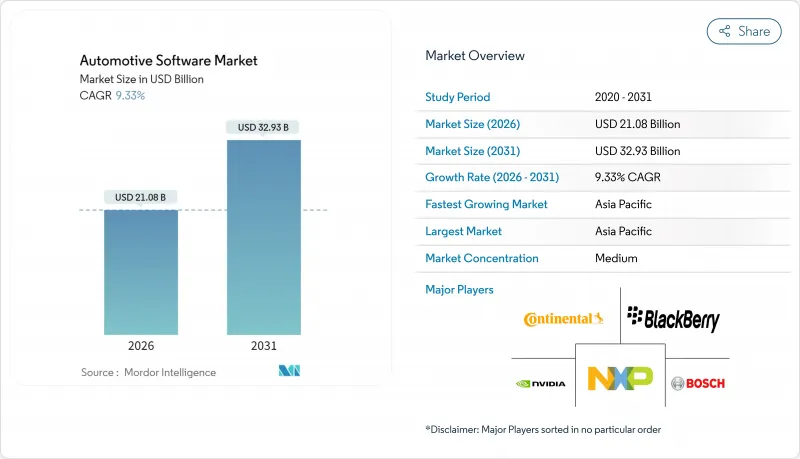
預計到 2025 年,汽車軟體市場規模將達到 192.8 億美元,到 2026 年將達到 210.8 億美元,到 2031 年將達到 329.3 億美元,預測期(2026-2031 年)的複合年成長率為 9.33%。
這種成長反映了汽車產業正從以硬體為中心的模式穩步向軟體定義平台轉變,其中從電池最佳化到自動駕駛等關鍵功能都嵌入在程式碼中,而非機械部件中。分區電子/電氣架構的日益普及,使線束重量減輕了高達30%,從而釋放了運算能力用於開發新功能。全球汽車製造商正在快速部署空中下載(OTA)功能,以符合歐盟WP.29網路安全和軟體更新法規。同時,基於訂閱的「按需功能」服務正開始帶來豐厚的售後收入。半導體供應商、超大規模資料中心業者和一級軟體公司日益成長的興趣加劇了競爭,導致收購活動激增,以確保作業系統、中介軟體和安全堆疊資產的安全。這些趨勢,加上政府對電氣化的獎勵,正在推動資金持續流入電池管理軟體、邊緣雲端連接和人工智慧驅動的程式碼產生工具領域。
全球汽車軟體市場趨勢與洞察
中國汽車製造商推出L2+級自動駕駛功能,推動亞洲ADAS代碼量成長。
比亞迪、小鵬和捷克等品牌正在採用敏捷開發框架,將功能發布週期縮短高達 60%,導致 ADAS 代碼量激增,並加速了西方競爭對手的競爭優勢。感知處理、感測器融合和路徑規劃演算法的快速迭代開發,推動了對冗餘運算的需求,促使主要晶片製造商設計嵌入國產集中式 ECU 中的特定領域加速器。業內相關人員指出,符合規範的 OTA 升級流程對於維持車隊更新至關重要,而安全的 DevOps 是維持市場領先地位的先決條件。
OEM廠商轉向集中式分區電子電氣架構將增加全球中介軟體支出
以特斯拉 Model 3 等車款為例,以四到六個區域控制器取代數十個域 ECU,可顯著簡化佈線,減輕重量並降低功率損耗。然而,分散式佈局將複雜性轉移到了軟體層,例如抽象異質感測器、管理確定性通訊以及實施功能安全分區。由於 OEM 廠商正在快速整合 AUTOSAR Classic 和 Adaptive 協定堆疊、即時 POSIX 核心以及雲端 API,中間件供應商報告稱,整合計劃積壓嚴重。恩智浦以 6.25 億美元收購 TTTech Auto,凸顯了可跨車型系列擴展的認證中間件的價值。
中介軟體標準碎片化阻礙了OEM廠商之間的重複使用。
由於缺乏統一的API,一級供應商不得不將相同的功能移植到多個專有協議堆疊中,這增加了檢驗成本並扼殺了創新。 AUTOSAR和SOAFEE等聯盟提案了協調一致的以服務為導向的框架,但品牌策略的差異,尤其是在堅持使用專有層的歐洲OEM廠商之間,阻礙了融合。因此,中介軟體供應商開發出可配置的適配器,以犧牲效能為代價換取可移植性,這種折衷方案增加了運行時開銷並使安全認證更加複雜。
細分市場分析
應用軟體仍將是最大的收入驅動力,預計到2025年將佔汽車軟體市場48.02%的佔有率,這反映了客戶對高級駕駛輔助系統(ADAS)、資訊娛樂系統和個人化空中下載(OTA)更新的需求。作業系統平台是成長最快的細分市場,隨著原始設備製造商(OEM)採用針對功能安全進行強化的基於Linux的發行版,其複合年成長率(CAGR)將達到9.62%。隨著統一運算加速功能部署,應用層程式碼的市場規模預計將穩定成長。中間件的戰略價值也在不斷提升,它充當POSIX核心和更高級別應用程式之間經過安全認證的橋樑,Aptiv將其稱為區域間流量的「協調器」。
對開放原始碼元件日益成長的依賴正在重塑供應商之間的談判格局。半導體供應商捆綁參考鏡像以加速客戶採用,而軟體整合商則尋求從長期維護、網路安全加固和版本控制中獲利。隨著汽車軟體市場向共用程式碼庫演進,相關人員在合規性、整合工具和即時確定性方面展開競爭。以恩智浦收購中間件為例的產業整合表明,平台覆蓋範圍將決定即將推出的電動車和自動駕駛汽車的合約歸屬。
預計到2025年,ADAS(高級駕駛輔助系統)和安全系統將佔汽車軟體市場收入的33.25%,這主要得益於歐盟通用安全法規強制要求配備智慧速度輔助、車道維持和自動緊急煞車等功能。該細分市場受益於高搭載率和頻繁的功能升級,而ADAS軟體仍是5G數據管道的核心。動力傳動系統和電池管理應用預計將超越其他細分市場,以13.08%的複合年成長率成長,因為汽車製造商競相延長純電動車的續航里程、保護鋰離子電池並協調雙向充電。
資訊娛樂和遠端資訊處理平台將利用 5G頻寬、整合串流媒體合作夥伴以及收集車輛使用數據以進行預測性維護,從而支持持續的收入成長目標。車身控制模組將遷移到中央運算節點,共用晶片將降低物料清單成本,但同時也增加了對強大隔離性的需求。跨領域協作的加強將模糊傳統的邊界,而監管壓力將促使安全邏輯固定在確定性核心中,並將非關鍵軟體遷移到容器化的微服務中。
區域分析
預計2025年,亞洲將佔據汽車軟體市場最大佔有率,達38.62%,年複合成長率(CAGR)為11.48%。這主要得益於中國對軟體定義汽車的快速普及以及政府對自動駕駛導航模組的激勵措施。敏捷的發布週期使中國汽車製造商能夠比傳統製造商快60%整合L2及以上級別的功能,從而重振了中國的中間件和感知堆疊生態系統。韓國透過早期採用5G-V2X技術推動邊緣雲端分析,而日本則透過其人工智慧模型檢驗實驗室專注於功能安全領域的領先地位。區域電池供應鏈正在加速軟體增強型能源管理系統的發展,確保亞洲在汽車軟體市場保持其核心地位。
北美排名第二,這得益於《通貨膨脹與復甦法案》(IRA)的稅額扣抵,該政策推動了對電池管理軟體和家用充電最佳化設備的需求。訂閱式功能的普及使得汽車製造商能夠在車輛售出後很長一段時間內,透過駕駛輔助升級和資訊娛樂應用程式來實現盈利。矽谷的新興企業提供人工智慧工具,可以縮短程式碼發布週期;而底特律的老牌企業則實施DevOps流程,以達到消費性電子產品的開發速度。這些因素共同作用,使得每輛車的軟體負載保持在高位,鞏固了該地區作為汽車軟體市場產生收入模式試驗場的地位。
歐洲憑藉聯合國WP.29框架下嚴格的網路安全和空中下載(OTA)法規,保持強大的市場地位,並積極推廣經認證的軟體更新管理系統。北歐國家(以瑞典主導)預計將以10.85%的複合年成長率成長,這主要得益於電動車的普及和數位服務應對力的提升。然而,開發人員,尤其是具備AUTOSAR認證的開發人員的短缺,正帶來薪資上漲和專案延期的風險。對專業培訓機構的投資標誌著歐洲正朝著培養本土能力的方向進行策略轉型,也體現了歐洲在擴大軟體生產規模的同時,致力於保障軟體品質的決心。
其他福利:
- Excel格式的市場預測(ME)表
- 3個月的分析師支持
目錄
第1章 引言
- 研究假設和市場定義
- 調查範圍
第2章調查方法
第3章執行摘要
第4章 市場情勢
- 市場概覽
- 市場促進因素
- 中國汽車製造商引入L2+級自動駕駛功能,正在推動亞洲ADAS代碼量的成長。
- OEM廠商向集中式、分區式電氣和電子架構的轉型正在推動全球中介軟體支出成長。
- 歐盟WP.29 OTA更新指令:加速歐洲安全軟體堆疊的部署
- 北美地區基於訂閱的「按需功能」模式推動售後軟體收入成長
- 美國IRA電動車獎勵推動電池管理軟體的需求
- 韓國部署5G-V2X網路以支援邊緣雲汽車軟體服務
- 市場限制
- 中介軟體標準碎片化阻礙了OEM廠商之間的重複使用。
- 歐洲AUTOSAR Classic和Adaptive開發人員短缺,導致成本上升。
- R155/R156 網路安全認證考試費用 緩慢的課程進度
- 傳統CAN架構限制了SDV在新興市場的普及
- 價值/供應鏈分析
- 監管趨勢(聯合國歐洲經濟委員會R155/R156號條例、美國OTA法規、歐盟網路彈性法案)
- 技術展望(區域架構、人工智慧工具鏈、空中升級管道)
- 波特五力分析
- 買方的議價能力
- 供應商的議價能力
- 新進入者的威脅
- 替代品的威脅
- 競爭對手之間的競爭
第5章 市場規模及成長預測(價值(美元))
- 軟體層
- 應用軟體
- 中介軟體
- 作業系統
- 韌體/基本輸入/輸出軟體
- 透過使用
- ADAS和安全系統
- 資訊娛樂和車載資訊系統
- 動力傳動系統和電池管理
- 身體控制和舒適度
- 聯網汽車服務
- 按車輛類型
- 搭乘用車
- 輕型商用車
- 大型商用車輛
- 透過推進力
- 內燃機車輛
- 電池式電動車(BEV)
- 混合動力電動車(HEV/PHEV)
- 透過部署
- 車載(嵌入式)
- 雲/邊緣環境
- 按地區
- 北美洲
- 美國
- 加拿大
- 北美其他地區
- 南美洲
- 巴西
- 阿根廷
- 其他南美洲
- 歐洲
- 德國
- 英國
- 法國
- 義大利
- 西班牙
- 其他歐洲地區
- 亞太地區
- 中國
- 日本
- 印度
- 韓國
- 亞太其他地區
- 中東和非洲
- 阿拉伯聯合大公國
- 沙烏地阿拉伯
- 土耳其
- 其他中東和非洲地區
- 北美洲
第6章 競爭情勢
- 市場集中度
- 策略趨勢
- 市佔率分析
- 公司簡介
- Robert Bosch GmbH
- Continental AG
- Elektrobit
- BlackBerry Limited(QNX)
- Google LLC(Alphabet Inc.)
- Microsoft Corporation
- Wind River Systems
- NXP Semiconductors NV
- NVIDIA Corporation
- Aptiv PLC
- TTTech Auto AG
- Vector Informatik GmbH
- Infineon Technologies AG
- Intel Corporation
- LG Electronics Vehicle Solutions
- DENSO Corporation
- Panasonic Automotive Systems
- KPIT Technologies Ltd.
- Intellias Ltd.
- Tata Elxsi Ltd.
- Airbiquity Inc.
- MontaVista Software LLC
- Renesas Electronics Corporation
- HARMAN International
- GlobalLogic Inc.
第7章 市場機會與未來展望
The automotive software market was valued at USD 19.28 billion in 2025 and estimated to grow from USD 21.08 billion in 2026 to reach USD 32.93 billion by 2031, at a CAGR of 9.33% during the forecast period (2026-2031).
Growth reflects the steady shift from hardware-centric vehicles to software-defined platforms where key functions, ranging from battery optimisation to automated driving, reside in code rather than mechanical parts. The rising adoption of zonal electronic/electrical architectures is trimming harness weight by up to 30% and freeing computing power for new features. Global automakers are fast-tracking over-the-air (OTA) update capabilities to comply with EU WP.29 cybersecurity and software-update rules, while subscription-based "functions-on-demand" services are starting to unlock high-margin, post-sale revenue streams. Heightened interest from semiconductor suppliers, hyperscalers, and Tier-1 software firms is intensifying competition, prompting a surge of acquisitions to secure operating-system, middleware, and safety-stack assets. These moves and government incentives for electrification keep capital flowing into battery-management software, edge-cloud connectivity, and AI-driven code-generation tools.
Global Automotive Software Market Trends and Insights
Level-2+ Autonomous Launches by Chinese OEMs Boosting ADAS Code Volume in Asia
Agile development frameworks allow brands such as BYD, Xpeng, and Zeekr to trim feature-release cycles by up to 60%, driving an explosion in ADAS code lines and accelerating competitive catch-up by Western rivals. Rapid iteration on perception, sensor fusion, and path-planning algorithms fuels demand for redundant compute, leading chipmakers to design domain-specific accelerators packaged within Chinese-built centralized ECUs. Industry observers note that compliant OTA pipelines are mandatory to keep those fleets current, making secure DevOps a prerequisite for sustained market leadership.
OEM Shift to Centralized Zonal E/E Architectures Raising Middleware Spend Globally
Replacing dozens of domain ECUs with four to six zone controllers simplifies wiring significantly, as exemplified in models such as Tesla Model 3, cuts weight, and reduces power loss. Yet decentralised layout shifts complexity toward software layers that must abstract heterogeneous sensors, manage deterministic communication, and enforce functional-safety partitions. Middleware vendors report a backlog of integration projects as OEMs race to harmonise AUTOSAR Classic and Adaptive stacks, real-time POSIX kernels, and cloud APIs. NXP's USD 625 million purchase of TTTech Auto highlighted the premium on certified middleware that can scale across vehicle families.
Fragmented Middleware Standards Hindering Cross-OEM Re-use
Lack of unified APIs forces Tier-1s to port identical functions to multiple proprietary stacks, elevating validation expense and slowing innovation. Consortia such as AUTOSAR and SOAFEE have proposed harmonised service-oriented frameworks, yet diverging brand strategies stall convergence, particularly among European OEMs with entrenched bespoke layers. Middleware houses thus build configurable adapters that sacrifice performance for portability, a compromise that adds runtime overhead and complicates safety certification.
Other drivers and restraints analyzed in the detailed report include:
- EU WP.29 OTA-Update Mandate Accelerating Secure Software Stacks in Europe
- Subscription-Based 'Functions-on-Demand' Models Expanding Post-Sale Software Revenues in North America
- Shortage of AUTOSAR Classic and Adaptive Developers in Europe Inflating Costs
For complete list of drivers and restraints, kindly check the Table Of Contents.
Segment Analysis
Application software still delivers the highest revenue at 48.02% of the automotive software market in 2025, mirroring customer appetite for ADAS, infotainment, and personalised over-the-air upgrades. Operating-system platforms are the fastest-growing slice, advancing at 9.62% CAGR as OEMs embrace Linux-based distributions hardened for functional safety. The market size for application-layer code is projected to climb steadily as consolidated compute unlocks faster feature roll-outs. Middleware's strategic value climbs in step, acting as a safety-certified bridge between POSIX kernels and high-level apps; Aptiv calls it the "orchestrator" of zonal traffic.
Growing reliance on open-source components reshapes vendor bargaining power. Silicon suppliers bundle reference images to accelerate customer entry, while software integrators monetise long-term maintenance, cyber-hardening, and variant management. As the automotive software market evolves toward shared code bases, stakeholders differentiate via compliance, integration tooling, and real-time determinism. Consolidation, exemplified by NXP's middleware acquisition, signals that platform breadth will determine contract wins for forthcoming electric and autonomous vehicle launches.
ADAS and safety systems delivered 33.25% revenue of the automotive software market in 2025, thanks to mandatory intelligent-speed assist, lane-keeping, and AEB under the EU General Safety Regulation. The cluster benefits from high attach rates and frequent feature upgrades, keeping ADAS software at the heart of 5 G-enabled data pipelines. Powertrain and battery-management applications are forecasted to outpace all others at 13.08% CAGR as OEMs race to extend BEV range, safeguard lithium-ion cells, and orchestrate bidirectional charging.
Infotainment and telematics platforms absorb 5G bandwidth, integrate streaming partners, and harvest vehicle-usage data for predictive maintenance, fuelling recurring revenue ambitions. Body-control modules migrate to central compute nodes, where shared silicon slashes bill-of-materials cost yet magnifies the need for robust isolation. Increasing cross-domain orchestration blurs historical boundaries, but regulatory pressure keeps safety logic anchored in deterministic cores while non-critical software shifts toward containerised microservices.
The Automotive Software Market Report is Segmented by Software Layer (Application Software, Middleware, and More), Application (ADAS and Safety Systems and More), Vehicle Type (Passenger Cars and More), Propulsion (Internal Combustion Engine Vehicles (ICE) and More), Deployment (On-Board (Embedded) and Off-Board (Cloud / Edge)), and Geography. The Market Forecasts are Provided in Terms of Value (USD).
Geography Analysis
Asia commanded the largest regional share at 38.62% of the automotive software market in 2025, and is projected to grow at an 11.48% CAGR, propelled by China's fast-track deployment of software-defined vehicles and government incentives for autonomous navigation modules. Agile release cycles let Chinese OEMs integrate Level-2+ functions at a pace 60% quicker than traditional counterparts, catalysing domestic middleware and perception-stack ecosystems. South Korea's early roll-out of 5 G-V2X enables edge-cloud analytics, while Japan focuses on functional-safety leadership through AI-model verification labs. Regional battery supply chains accelerate software-enhanced energy-management systems, ensuring that Asia remains the gravitational centre of the automotive software market.
North America sits second, leveraging the Inflation Reduction Act credits to swell demand for battery-management software and home-charging optimisers. Subscription-driven features have proliferated, allowing automakers to monetise driver-assistance upgrades and infotainment apps long after the point of sale. Silicon Valley start-ups inject AI tooling that shortens code-release cycles, and Detroit incumbents adopt DevOps pipelines mirroring consumer-electronics cadence. Together, these factors sustain high per-vehicle software content, cementing the region as a testbed for revenue-generation models in the automotive software market.
Europe maintains a formidable position anchored by stringent cybersecurity and OTA mandates under UN WP.29, driving uptake of certified software-update management systems. The Nordics, spearheaded by Sweden, are pegged for a 10.85% CAGR on the back of EV prevalence and digital-service readiness. Nonetheless, developer shortages, particularly AUTOSAR-certified talent, impose wage inflation and risk schedule slippage. Investment in dedicated training academies reflects a strategic pivot to home-grown capability, underscoring Europe's resolve to safeguard quality while scaling software output.
- Robert Bosch GmbH
- Continental AG
- Elektrobit
- BlackBerry Limited (QNX)
- Google LLC (Alphabet Inc.)
- Microsoft Corporation
- Wind River Systems
- NXP Semiconductors N.V.
- NVIDIA Corporation
- Aptiv PLC
- TTTech Auto AG
- Vector Informatik GmbH
- Infineon Technologies AG
- Intel Corporation
- LG Electronics Vehicle Solutions
- DENSO Corporation
- Panasonic Automotive Systems
- KPIT Technologies Ltd.
- Intellias Ltd.
- Tata Elxsi Ltd.
- Airbiquity Inc.
- MontaVista Software LLC
- Renesas Electronics Corporation
- HARMAN International
- GlobalLogic Inc.
Additional Benefits:
- The market estimate (ME) sheet in Excel format
- 3 months of analyst support
TABLE OF CONTENTS
1 Introduction
- 1.1 Study Assumptions & Market Definition
- 1.2 Scope of the Study
2 Research Methodology
3 Executive Summary
4 Market Landscape
- 4.1 Market Overview
- 4.2 Market Drivers
- 4.2.1 Level-2+ Autonomous Launches by Chinese OEMs Boosting ADAS Code Volume in Asia
- 4.2.2 OEM Shift to Centralized Zonal E/E Architectures Raising Middleware Spend Globally
- 4.2.3 EU WP.29 OTA-Update Mandate Accelerating Secure Software Stacks in Europe
- 4.2.4 Subscription-Based 'Functions-on-Demand' Models Expanding Post-Sale Software Revenues in North America
- 4.2.5 U.S. IRA EV Incentives Driving Battery-Management Software Demand
- 4.2.6 Roll-out of 5G-V2X Networks Enabling Edge-Cloud Automotive Software Services in South Korea
- 4.3 Market Restraints
- 4.3.1 Fragmented Middleware Standards Hindering Cross-OEM Re-use
- 4.3.2 Shortage of AUTOSAR Classic & Adaptive Developers in Europe Inflating Costs
- 4.3.3 R155/R156 Cyber-Homologation Testing Costs Delaying Program Timelines
- 4.3.4 Legacy CAN Architectures in Emerging Markets Limiting SDV Adoption
- 4.4 Value / Supply-Chain Analysis
- 4.5 Regulatory Outlook (UNECE R155/R156, U.S. OTA Rules, EU Cyber Resilience Act)
- 4.6 Technological Outlook (Zonal Architecture, AI Tool-chains, Over-the-Air Pipelines)
- 4.7 Porter's Five Forces Analysis
- 4.7.1 Bargaining Power of Buyers
- 4.7.2 Bargaining Power of Suppliers
- 4.7.3 Threat of New Entrants
- 4.7.4 Threat of Substitutes
- 4.7.5 Competitive Rivalry
5 Market Size and Growth Forecasts (Value (USD))
- 5.1 By Software Layer
- 5.1.1 Application Software
- 5.1.2 Middleware
- 5.1.3 Operating System
- 5.1.4 Firmware / Basic Input-Output Software
- 5.2 By Application
- 5.2.1 ADAS and Safety Systems
- 5.2.2 Infotainment and Telematics
- 5.2.3 Powertrain and Battery-Management
- 5.2.4 Body Control and Comfort
- 5.2.5 Connected Vehicle Services
- 5.3 By Vehicle Type
- 5.3.1 Passenger Cars
- 5.3.2 Light Commercial Vehicles
- 5.3.3 Heavy Commercial Vehicles
- 5.4 By Propulsion
- 5.4.1 Internal Combustion Engine Vehicles (ICE)
- 5.4.2 Battery Electric Vehicles (BEV)
- 5.4.3 Hybrid Electric Vehicles (HEV/PHEV)
- 5.5 By Deployment
- 5.5.1 On-Board (Embedded)
- 5.5.2 Off-Board (Cloud / Edge)
- 5.6 By Geography
- 5.6.1 North America
- 5.6.1.1 United States
- 5.6.1.2 Canada
- 5.6.1.3 Rest of North America
- 5.6.2 South America
- 5.6.2.1 Brazil
- 5.6.2.2 Argentina
- 5.6.2.3 Rest of South America
- 5.6.3 Europe
- 5.6.3.1 Germany
- 5.6.3.2 United Kingdom
- 5.6.3.3 France
- 5.6.3.4 Italy
- 5.6.3.5 Spain
- 5.6.3.6 Rest of Europe
- 5.6.4 Asia-Pacific
- 5.6.4.1 China
- 5.6.4.2 Japan
- 5.6.4.3 India
- 5.6.4.4 South Korea
- 5.6.4.5 Rest of Asia-Pacific
- 5.6.5 Middle East and Africa
- 5.6.5.1 United Arab Emirates
- 5.6.5.2 Saudi Arabia
- 5.6.5.3 Turkey
- 5.6.5.4 Rest of the Middle East and Africa
- 5.6.1 North America
6 Competitive Landscape
- 6.1 Market Concentration
- 6.2 Strategic Moves
- 6.3 Market Share Analysis
- 6.4 Company Profiles (Includes Global Level Overview, Market Level Overview, Core Segments, Financials as Available, Strategic Information, Market Rank/Share for Key Companies, Products and Services, SWOT Analysis, and Recent Developments)
- 6.4.1 Robert Bosch GmbH
- 6.4.2 Continental AG
- 6.4.3 Elektrobit
- 6.4.4 BlackBerry Limited (QNX)
- 6.4.5 Google LLC (Alphabet Inc.)
- 6.4.6 Microsoft Corporation
- 6.4.7 Wind River Systems
- 6.4.8 NXP Semiconductors N.V.
- 6.4.9 NVIDIA Corporation
- 6.4.10 Aptiv PLC
- 6.4.11 TTTech Auto AG
- 6.4.12 Vector Informatik GmbH
- 6.4.13 Infineon Technologies AG
- 6.4.14 Intel Corporation
- 6.4.15 LG Electronics Vehicle Solutions
- 6.4.16 DENSO Corporation
- 6.4.17 Panasonic Automotive Systems
- 6.4.18 KPIT Technologies Ltd.
- 6.4.19 Intellias Ltd.
- 6.4.20 Tata Elxsi Ltd.
- 6.4.21 Airbiquity Inc.
- 6.4.22 MontaVista Software LLC
- 6.4.23 Renesas Electronics Corporation
- 6.4.24 HARMAN International
- 6.4.25 GlobalLogic Inc.
7 Market Opportunities and Future Outlook

 電池管理系統硬體在環測試市場(按最終用途、車輛類型、組件類型、測試模式、應用和BMS類型分類),全球預測,2026-2032年
 汽車保固管理軟體市場規模、佔有率和成長分析(按產品類型、部署模式、組織規模、垂直產業和地區分類)-2026-2033年產業預測
 全球汽車終端認證市場規模、佔有率、趨勢和成長分析報告(2026-2034)汽車軟體市場規模、佔有率、成長及全球產業分析:依類型、應用和地區劃分的洞察與預測(2026-2034)
 汽車軟體市場-全球產業規模、佔有率、趨勢、機會及預測(依車輛類型、應用、軟體層級、地區及競爭格局分類,2021-2031年)高階駕駛輔助系統的硬體在環測試市場,按測試類型、測試階段、車輛類型和應用分類,全球預測(2026-2032年)
 汽車軟體市場機會、成長要素、產業趨勢分析及2026年至2035年預測
 日本汽車軟體市場按產品類型、車輛類型、應用和地區分類,2026-2034年
 汽車軟體市場規模、佔有率和成長分析(按軟體類型、應用、最終用途、部署類型和地區分類)-2026-2033年產業預測
 車載娛樂系統市場預測至2032年:按系統類型、組件、車輛類型、通路和地區分類的全球分析